
International Research Journal of Engineering and Technology (IRJET) e-ISSN: 2395-0056 p-ISSN: 2395-0072

Volume: 12 Issue: 09 | Sep 2025 www.irjet.net

International Research Journal of Engineering and Technology (IRJET) e-ISSN: 2395-0056 p-ISSN: 2395-0072
Volume: 12 Issue: 09 | Sep 2025 www.irjet.net
Ms. Handge Anuja Shantaram[1], Ms. Khangal Payal Babaji[2], Mr. DhingeTanmay Manish[3], Mr. Sali Harsh Nilesh[4], Ms. P. S. Patil[5], Mr. N. R. Thakre[6],
1234Students of department of E&TC Engineering SNJB’s S.H.H.J.B Polytechnic, Chandwad, 5 Lecturer in E&TC Engineering SNJB’s S.H.H.J.B Polytechnic, Chandwad, 6HOD in E&TC Engineering SNJB’s S.H.H.J.B Polytechnic, Chandwad,
Abstract - Agriculture is one of the most essential sectors in and reduce environmental impacts [3]. For instance, smart agricultural drones equippedwith advanced sensors canhelp monitor crop health, optimise pesticide use, and reduce dependenceonimported chemical inputs, which is crucial for maintaining the economic and environmental health of the region. The application of drone-captured attendance has been observed not only on land but also in fish water agriculture[4].
sustaining the global economy, but it faces numerous challenges such as crop diseases, pest attacks, water scarcity, and the need for higher yields with limited resources. To overcometheseproblems,precisionagriculturehasemergedas a modern solution, leveraging advanced technologies like drones, IoT, and AI. This paper presents the design and development of an Agricultural Drone for Smart Crop Monitoring and PrecisionSpraying.Thesystem uses drones equipped with cameras and sensors for real-time monitoring of crop health, soil conditions, and pest infestation. Precision spraying is carried out using automated nozzles, reducing excessive chemical use and ensuring uniform coverage. This approach enhances crop productivity, reduces costs, minimizes environmental impact, andsupportssustainablefarmingpractices.
Key Words: Agricultural Drone[1], Precision Agriculture[2], Smart Crop Monitoring[3], IoT[4], Precision Spraying[5].
Agriculture today not only faces the challenge of feeding a rapidly growing global population but also faces the compounded pressures of climate change, environmental sustainability, and the need for technological integration. In PacificIslandCountries(PICs),wherebetween50%and70% of the population relies on agriculture and fishing for their livelihoods, these challenges are particularly acute [1]. The region’s vulnerability to climate-induced disasters such as rising sea levelsand increasedcycloneactivity,compounded by economic shocks such as the COVID-19 pandemic and global trade disruptions, underscores the urgent need for resilientfoodsystems.
RecentdisruptionshavehighlightedthefragilityofPICs’food systems,heavilyreliantonimportsduetolimitedarableland and the high cost of food imports, which strains alreadylimitedresources.Thepandemicandsubsequentglobalcrises have exacerbated these vulnerabilities, making the stable, reliablefoodsupplyacriticalconcernforthesenations[2]. Tocounterthesethreats,thereisagrowingrecognitionofthe potential of smart agricultural technologies. The integration of Internet of Things (IoT) devices into agriculture offers promising solutions to enhance food security by enabling more precise farming practices that optimise resource use

Thus, this research aims to explore the application of a lowcost, autonomous UAV system tailored to the agricultural context in the Pacific region. It is important to note that the terms “drone”, “UAV”, and “quadrotor” are used interchangeably in this article and refer to the same category of aircraft. Firstly, the areas integrating IoT, object detection, edge computing, autonomous drones, and agricultural technology were studied to gain a comprehensive understanding of the work carried out in these domains. Based on these reviewed works, a gap analysis was performed, and the methodology was developed. The autonomous UAV is designed to perform multiple functions: crop detection through image processing, targeted crop spraying, and autonomous navigation. These functions are intendedtooperateundertheconstraints oflimitedtechnical resources and the need for high adaptability in varied geographicalandclimaticconditions.
Over the last decade, the integration of unmanned aerial vehicles (UAVs), Internet of Things (IOT), and precision agriculturetechnologieshassignificantlytransformedfarming practices. Numerous studies and projects have demonstrated thepotentialofdronesinimprovingagriculturalproductivity, pest management, irrigation, and real-time monitoring. The following literature provides an in- depth review of relevant works:
1. ZhangandKovacs(2012)providedoneoftheearliest comprehensive studies on the role of UAVs in precision agriculture. They emphasized that small UAVs equipped with multispectral cameras can be used for vegetation indexing (NDVI) and disease detection.Theirworkrevealedthatdronescould

Volume: 12 Issue: 09 | Sep 2025 www.irjet.net
International Research Journal of Engineering and Technology (IRJET) e-ISSN: 2395-0056 p-ISSN: 2395-0072
replacesatelliteimagingforreal-timeandaffordable crop surveillance with higher resolution and lower latency.
2. Hunt et al. (2010) explored the use of UAVs equipped with near-infrared (NIR), green, and blue digital cameras to assess crop health. Their study demonstrated that remotely sensed images from drones allowed accurate measurement of canopy reflectanceandcropstressindicators,whichenabled timelyinterventionandimprovedyieldestimation.
3. TripathiandShukla(2020)reviewedrecenttrendsin UAV-based smart agriculture in India. They highlighted how drones integrated with IoT, cloud computing, and GPS could autonomously perform cropscouting,fieldmapping,anddatatransmission. Their analysis also emphasized the affordability of quadcoptersforsmallandmedium-scalefarmersand identified regulatory challenges related to drone operationsinruralareas.
4. Li et al. (2019) developed a prototype for a dronebased precision pesticide spraying system. The system used a variable-rate sprayer controlled by GPScoordinatesandcropdata obtained fromaerial sensors. Their experiments showed that precision spraying could reduce pesticide usage by 25–30% compared to conventional methods, with more targetedapplicationandreducedchemicalrunoff.
5. Jensenetal.(2018)investigatedtheimpactofusing thermalandhyperspectralimagingonUAVsforcrop stressdetectionandirrigationplanning.Theirstudy found that drones could detect water stress and nutrient deficiencies early, allowing for optimized irrigation schedules and fertilizer use, which enhancedwaterconservationandcropquality.
6. Shreyas et al. (2021) proposed a low-cost drone systemintegratedwithimageprocessingalgorithms for early pest detection. Their prototype processed real-time video feeds using OpenCV and Python to classify infected crop regions and trigger autonomous spraying. The study confirmed the feasibility of using machine vision for precision agricultureinresource-constrainedsettings.
7. Sahu et al. (2020) discussed the implementation of IoT-based drones for environmental monitoring in agriculture.Theirmodelusedsoilmoisturesensors, temperature/humidity sensors, and real-time data logging to assist farmers in adjusting crop managementtechniques.Theynotedthatcombining drone-collected imagery with ground sensor data improvedaccuracyindecision-making.
8. FAOandInternationalAtomicEnergyAgency(2020) reported that drones could play a pivotal role in integrated pest management programs by reducing the environmental impact of pesticides and supporting biological control methods. The report also stressed the need for training, infrastructure
The system integrates a UAV platform equipped with multispectralcameras,environmentalsensors,andaprecision spraying mechanism. The flight controller (e.g., Pixhawk or Arduino-based) manages autonomous navigation via GPS waypoint routing. Real-time crop data (RGB/multispectral images and sensor telemetry) is transmitted to a ground stationorcloudforprocessingusingIoTprotocols.
Crop stress and pest infestation are detected through image processing algorithms (e.g., NDVI analysis) and sensor data fusion. Upon detection, the flight controller actuates the spraying subsystem, which includes a micro-pump and solenoid valves for targeted pesticide/fertilizer deployment. Spraying parameters (flow rate, nozzle activation) are dynamically adjusted based on geotagged crop health data, ensuringprecisionandminimalchemicalusage.
PowermanagementisoptimizedviaLi-PobatterieswithESCs controlling brushless motors for stable flight and payload support. Communication modules (Wi- Fi/GSM/LoRa) enable remote monitoring and mission control. The system architecture supports scalability for integration with AIdrivenpredictiveanalyticsinfutureiterations.
Hardwarecomponents:
Frame(HEXA)
Flightcontroller
BLDCMotor
ElectronicsSpeedController(ESP)
GPSModule
Propellers
Wi-FiModule
PowerDistributionBoard
TransmitterandReceiverModule
Lithium–PolymerBattery
BatteryCharger
SoftwareComponents
MissionPlanner
(IRJET) e-ISSN: 2395-0056 p-ISSN: 2395-0072 Volume: 12 Issue: 09 | Sep 2025 www.irjet.net
2.1: Block Diagram
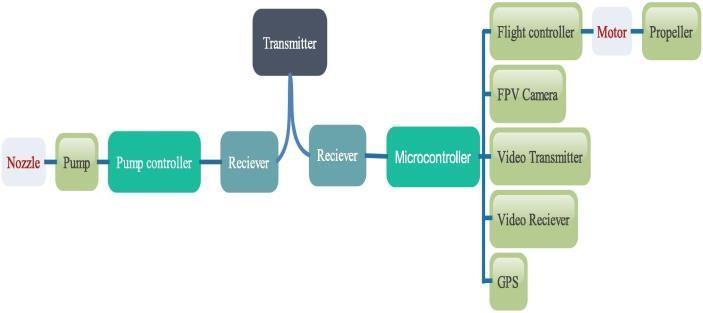
Block Diagram of Agricultural Drone for Smart Crop Monitoring and Precision Spraying
2.2. Flow chart
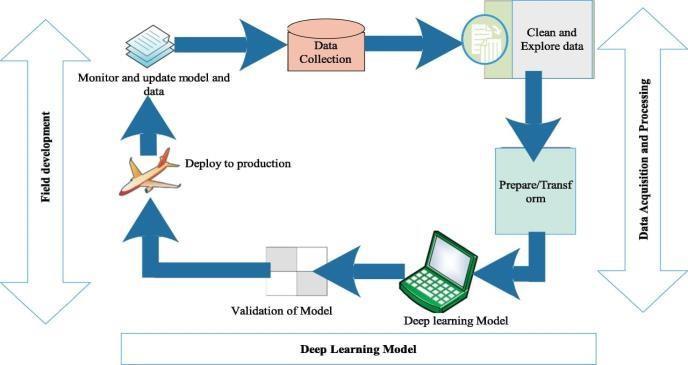
Fig 2: Flow chart of Agricultural Drone for Smart Crop Monitoring and Precision Spraying
Themodelwastrainedandvalidatedwithrefineddataforthe collection of desired information from the crop. The trained systemwasdeployedinthefieldforproblemanalysis.Itwas observed that the segmentation and disease detection capabilitiesofthesystemwasimproved.However,vegetation indices performance has been reduced. The performance of the system can be improved by using other deep learning networksandbetterdatalabelling.
Someimportantoutcomeshavebeenextractedfromresearch done in crop monitoring during the last decade. In recent years, many crop condition-monitoring methods were developed based on remote sensing data. These crop condition monitoring methods can be classified as direct monitoring methods, image classification methods, and IoT basedcropmonitoring.
The direct monitoring methods are based upon crop conditionmonitoringindices(suchasNormalizedDifference VegetationIndex,NDVIand leafarea index,LAI, etc.).These methods are easy to use and needed fewer data. However, duetotheirshort theoretic foundation,theyarehardtouse incomplexareas.
Image classification methods are based upon supervised and unsupervised learning algorithms. These methods visualize the results effectively and are user-friendly. A continuous improvement in machine learning, computer vision, and AI technologies is making it more accurate and user-friendly. This technology needs good programming skills and latest equipment. Moreover, calibration is needed, for the classificationmodel,inthecaseofreal-timeapplications.
IOT-based technology utilizes the different types of sensors for the collection of crop data and these data are analyzed using a simulation model. This technology is efficient in resourceutilization,enhancesdatacollection,needslesstime, and minimizes human efforts. This technology has some drawbackssuchas;complexity,security,andprivacy.
It has been concluded that there is a rapid increase in drone applicationsforprecisionagricultureafter2017.Thisgrowth is mainly due to the reduction in weight and cost of UAVs, along with the increment in payload capability. Drones are being widely used in crop health monitoring and livestock detection,mainlythrough multi-copterandfixed-wing types, while unmanned helicopters are used for pesticide and fertilizer spraying because of their higher payload capacity. Multi-copters are becoming more popular for spot spraying due to their better flight stability. Drone cameras have evolved significantly in terms of weight, size, and resolution, shifting from RGB to multispectral cameras for enhanced feature extraction. Controllers have advanced from basic microcontrollers to AI-enabled boards like Arduino Uno and RaspberryPi.Overall,dronetechnologyismovingfromsemicontrolledsystemstofullyautomatedsolutions,supportedby advancements in embedded systems, data transmission, and dataanalysis.Theintegrationofmachinelearninghasfurther enabledfarmer-friendlysystems.
Despiterapidadvancements,severalchallengesremaininthe adoption of drone technology in agriculture. The key issues include high cost of technology, limited battery life, vision disruption, lack of awareness and literacy about the technology among end-users, and limitations in image processing and data analysis. Addressing these challenges will be crucial for increasing the adoption rate of drones in theagriculturesector.Future research and innovation must focus on reducing costs, improving battery performance, enhancing image analysis techniques, and creating more user-friendly systems to ensure wider application of drone technologyinprecisionfarming.
Prof. P. P. Mone, Chashan Priyanka Shivaji, Jagtap Komal Tanaji, and Nimbalkar Aishwarya Satish (2017) have
Volume: 12 Issue: 09 | Sep 2025 www.irjet.net
International Research Journal of Engineering and Technology (IRJET) e-ISSN: 2395-0056 p-ISSN: 2395-0072
published a paper entitled “Agriculture Drone for Spraying Fertilizer and Pesticides” in IIRTI, Volume 2, Issue 6. In this paper, the authors discussed the implementation of an agricultural drone equipped with an automatic spraying mechanism. They highlighted the serious health hazards associated with pesticide use, citing a World Health Organization (WHO) report that estimates around 3 million cases of pesticide poisoning and up to 220,000 deaths each year, mostly in developing countries. The authors also provided guidelines regarding precautions farmers should follow to reduce harmful effects of pesticides. Furthermore, theyproposedacost-effectivesprayingsystembyusingaPIC microcontroller to control agricultural robots, making the technologymoreaccessibleandsafeforfarmers.
Prof. S. Meivel, Dr. R. Magutrevwaran, N. Gandhiraj, and G. Srinivasan (2016) presented their research paper “Quadcopter UAV Based Fertilizer and Pesticide Spraying System” in the International Academic Research Journal of Engineering Sciences, Volume 1, Issue 1. Their work focused on the design and implementation of a quadcopter UAV for agricultural spraying applications. The authors discussed how the system can deliver pesticides to areas that are otherwise difficult for human access. They integrated multispectral cameras to capture remote sensing images, which helps in identifying crop areas and field boundaries accurately.The payloadcapacityoftheir quadcopter was8g, and QGIS software was employed for analyzing remote sensing images. This research highlighted how UAVs combined with remote sensing and GIS technology can enhanceprecisionsprayinginagriculture.
Prof. K. B. Korlahalli, Mr. Mazhar Ahmed Hangal, Mr. Nitin Jituri, Mr. Prakash Frances Rega, and Mr. Sachin M. Raykar published a paper entitled “An Automatically Controlled DroneBasedAerialPesticideSprayer”underK.L.E.Institute ofTechnology, Hubballi(ProjectReferenceNo.395BE 0564, SNJB’s Hiralal Hastimal Polytechnic, Chandwad). In their work,theauthorsdesignedawirelessdronesprayingsystem using key components such as a Flight Control Board (FCB), GPS,BrushlessDCmotors,ElectronicSpeedControllers(ESC), wireless transceivers, propellers, and a battery. TheFCB was programmed to control multiple sensors including GPS,barometer, accelerometer, and gyroscope. The drone supported both manual and autonomous modes, where manual mode allowed direct human control while autonomous mode enabled automatic operations. Their systemensuredaccuratelifting,movement,andpositioningof the drone during spraying, thus improving efficiency and reducing human exposure to pesticide.