
International Research Journal of Engineering and Technology (IRJET) e-ISSN: 2395-0056
Volume: 13 Issue: 03 | Mar 2026 www.irjet.net p-ISSN: 2395-0072
International Research Journal of Engineering and Technology (IRJET) e-ISSN: 2395-0056
Volume: 13 Issue: 03 | Mar 2026 www.irjet.net p-ISSN: 2395-0072
Mrs. Y.Naga Lavanya1 , Y.Ganesh2, N.Prashanth Kumar3, P.Sai Kiran4,S. Sahithya Reddy5
1Assistant Professor in Department of IT, TKR College of Engineering and Technology, Telangana, India 2345BTECH Students in Department of IT, TKR College of Engineering and Technology, Telangana, India
Abstract - Agriculture plays a vital role in global food production, but weed infestation remains a major challenge thatreducescropyieldandqualitybycompetingforessential resources such as nutrients, water, and sunlight. Traditional weed detection methods, including manual inspection and uniform herbicide spraying, are labor-intensive, timeconsuming, and environmentally inefficient. To address these limitations, this paper presents AGRI-VISION, a smart crop monitoring system that performs automated weed segmentation using deep learning techniques. The system utilizesagriculturalimagedatasetsandappliesalightweight SqueezeSlim U-Net (SS-U-Net) architecture for precise pixellevel classification of crops and weeds. The proposed model enhances detection accuracy while maintaining low computational complexity,making itsuitable for deployment on resource-constrained platforms such as UAVs and edge devices. Experimental results demonstrate effective weed identification, reduced dependency on manual labor, optimizedherbicideusage,andimprovedsupportforprecision agriculture.Thesystemcontributestosustainablefarmingby enablingearlyweeddetectionandinformeddecision-making.
Key Words: Weed Detection, Deep Learning, Semantic Segmentation, Precision Agriculture, SS-U-Net, UAV, Crop Monitoring, Image Processing, Sustainable Farming
1.1
Agricultureisafundamentalsectorthatsupportsglobalfood production and economic stability. However, one of the major challenges faced by farmers is weed infestation. Weeds are unwanted plants that compete with crops for essential resources such as nutrients, water, and sunlight, leadingtoasignificantreductionincropyieldandquality. Effective weed management is therefore crucial for improving agricultural productivity and ensuring sustainablefarmingpractices.
Traditionalweeddetectionmethodsrelyheavilyonmanual inspection and uniform herbicide spraying. Manual identificationistime-consuming,labor-intensive,andprone tohumanerror,especiallyinlargeagriculturalfields.Onthe otherhand,blanketherbicideapplicationincreaseschemical usage,leadingtohighercosts andenvironmental damage.
Although automatedsystemshavebeenintroduced,many existingapproachesrequirehighcomputationalpowerand expensivehardware,makingthemimpracticalforsmalland medium-scale farmers. Additionally, these systems often struggletomaintainaccuracyundervaryingenvironmental conditionssuchaslightingchanges,soilvariations,andcrop diversity.
Recentadvancementsindeeplearningandcomputervision have enabled the development of intelligent agricultural systems. Convolutional Neural Networks (CNNs) and semantic segmentation models have shown promising results in identifying and classifying plant species from images.Technologies such as Unmanned Aerial Vehicles (UAVs) combined with deep learning allow real-time monitoring of crop fields. However, many state-of-the-art modelsarecomputationallycomplexanddifficulttodeploy on resource-constrained devices like drones and edge systems.
The increasing need for precision agriculture has created demandforautomatedandefficientweeddetectionsystems. Asystemthatcanaccuratelyidentifyweedsatanearlystage can help farmers take timely action, reduce crop damage, andminimizeunnecessaryherbicideusage.Thereisastrong need for a solution that is not only accurate but also lightweight, cost-effective, and scalable for real-world agriculturalapplications.
To address these challenges, this paper proposes AGRIVISION,asmartcropmonitoringsystemforautomatedweed segmentation. The system utilizes a lightweight deep learning model known as SqueezeSlim U-Net (SS-U-Net), which performs pixel-level classification of crops and weeds.The model is designed to balance accuracy and computational efficiency through adaptive network width andattentionmechanisms.Itprocessesagriculturalimages collected from publicly available datasets and generates segmentationmasksthathighlightweedregions.
International Research Journal of Engineering and Technology (IRJET) e-ISSN: 2395-0056
Volume: 13 Issue: 03 | Mar 2026 www.irjet.net p-ISSN: 2395-0072
Traditionalweeddetectionmethodsmainlyrelyonmanual inspection and basic image processing techniques such as colorthresholdingandedgedetection.Thesemethodsare simplebuthighlysensitivetoenvironmentalconditionslike lighting,soilvariation,andcropgrowthstages,resultingin low accuracy.With the advancement of machine learning, techniques such as Support Vector Machines (SVM) and RandomForestswereintroducedtoimproveclassification. However, these approaches depend on manual feature extractionandstrugglewhencropsandweedshavesimilar visualcharacteristics.Recentdevelopmentsindeeplearning, especially Convolutional Neural Networks (CNNs), have significantlyimprovedweeddetectionperformance.Models such as U-Net and Fully Convolutional Networks (FCN) enable pixel-level segmentation, providing more accurate results. UAV-based systems further enhance large-scale monitoring by capturing aerial images.Despite these improvements,existingsystemsfacechallengessuchashigh computational cost, large dataset requirements, and difficultyinhandlingcomplexfieldconditionslikeocclusion andoverlappingplants.Theselimitationshighlighttheneed foralightweightandefficientsolution,whichmotivatesthe proposedAGRI-VISIONsystem.
3.1
Toovercome the limitations oftraditional weeddetection methods, this paper proposes AGRI-VISION, a smart crop monitoring system that performs automated weed segmentationusingdeeplearningtechniques.Thesystemis designedtoaccuratelyidentifyweedregionsinagricultural fields by analyzing images captured through UAVs or ground-based cameras. By leveraging semantic segmentation,thesystemclassifieseachpixelinanimageas either crop or weed, enabling precise and efficient weed detection. The proposed approach focuses on achieving a balancebetweenhighdetectionaccuracyandcomputational efficiency,makingitsuitablefordeploymentinreal-world agriculturalenvironments,includingresource-constrained devices.
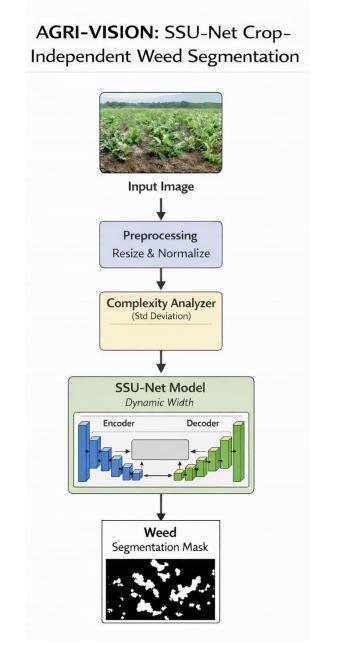
The overall architecture of the AGRI-VISION system is illustratedinthesystemarchitecturediagramprovidedin the document (Page 20). The architecture consists of a sequentialpipelinethatbeginswithimageacquisitionand endswiththegenerationofsegmentedoutputhighlighting weedregions.Theprocessstartswithcapturingimagesof cropfieldsusingUAVsorcameras.Theseimagesarethen passed through a preprocessing stage where they are resized,normalized,andenhancedtoensureconsistencyand improve model performance. After preprocessing, the images are analyzed for computational feasibility before
beingfedintothedeeplearningmodel.Thecorecomponent of the system is the SqueezeSlim U-Net (SS-U-Net) model, which performs semantic segmentation. The model processes the input images and generates pixel-level predictions,distinguishingbetweencropandweedregions. The final output is a segmentation mask that clearly highlightsweed-affectedareasinthefield.
Thefirststageofthesysteminvolvescollectingagricultural field images from publicly available datasets such as the KaggleCrop-WeedFieldDataset,aswellasreal-timeimage
International Research Journal of Engineering and Technology (IRJET) e-ISSN: 2395-0056
Volume: 13 Issue: 03 | Mar 2026 www.irjet.net p-ISSN: 2395-0072
captureusingUAVsorcameras.Theseimagesmayvaryin size,lightingconditions,andbackgroundcomplexity.
Toensureuniformity,preprocessingstepsareappliedtothe collecteddata.Theimagesareresizedtoafixedresolution suitablefortheneuralnetwork.Pixelvaluesarenormalized toimproveconvergenceduringtraining,andnoisereduction techniques are applied to enhance image quality. These preprocessing steps play a crucial role in improving the robustnessandaccuracyofthemodel.
TheAGRI-VISIONsystemutilizesalightweightdeeplearning architecture known as SqueezeSlim U-Net (SS-U-Net) for semanticsegmentation.Thismodelisanenhancedversion of the traditional U-Net architecture, designed to reduce computational complexity while maintaining high segmentation performance. The SS-U-Net architecture consists of an encoder-decoder structure. The encoder extractsimportantspatialandcontextualfeaturesfromthe inputimage,whilethedecoderreconstructsthesegmented output. The model incorporates adaptive width scaling, which allows dynamic adjustment of network parameters based on available computational resources. Additionally, attention mechanisms such as Occlusion-Aware Attention BlocksandScale-AdaptiveAttentionModulesareintegrated intothearchitecturetoimprovethedetectionofsmalland overlappingweedregions.Theseenhancementsenablethe model to perform effectively even under challenging field conditions.
The model is trained using labeled agricultural datasets containing both crop and weed images along with their corresponding ground truth masks. During training, the system learns to differentiate between crop and weed regions by minimizing the loss function. An optimization algorithm such as Adam is used to update model weights efficiently.LossfunctionssuchasBinaryCross-Entropyor CategoricalCross-Entropyareemployeddependingonthe classificationrequirements.Thetrainingprocessiscarried outovermultipleepochs,andperformancemetricssuchas accuracy,IntersectionoverUnion(IoU),andDicecoefficient aremonitoredtoevaluatemodelperformanceandprevent overfitting.
Aftertraining,themodeliscapableofprocessingnewinput imagesandgeneratingsegmentationoutputs.Theoutputis intheformofabinaryormulti-classmaskwhereeachpixel islabeledascroporweed.Thesesegmentationmasksare visualized to highlight weed-affected regions in the agricultural field. The results can assist farmers in identifyingproblemareasandtakingtargetedaction.This
visualization plays a crucial role in supporting precision agriculturebyenablingdata-drivendecision-making.
The AGRI-VISION system offers significant improvements overtraditionalandexistingautomatedmethods.Itprovides accurate and automated weed detection while reducing dependencyonmanuallabor.Thelightweightdesignofthe SS-U-Netmodelensuresfasterprocessingandsuitabilityfor real-time applications. Furthermore,thesystem promotes sustainable farming by enabling targeted herbicide applicationandminimizingenvironmentalimpact.
TheAGRI-VISIONsystemisimplementedusingagricultural image datasets that contain both crop and weed samples. The primary dataset used in this project is the publicly availableKaggleCrop-WeedFieldDataset,whichconsistsof RGB images captured under real agricultural conditions. Theseimagesincludevariationsinlighting,soiltypes,crop growthstages,andbackgroundcomplexity.Eachimageinthe dataset is associated with a corresponding ground truth mask that provides pixel-level annotations distinguishing crop regions from weed regions. These annotated masks serveasthereferenceduringthetrainingprocess,enabling themodeltolearnaccuratesegmentation.
Table
Parameter
Description
DatasetName Crop-WeedFieldDataset
Source Kaggle
ImageType RGBImages
AnnotationTypePixel-levelsegmentationmasks
InputVariations Lighting,soil,cropgrowthstages
DataSplit 80%Training,20%Validation
Before feeding the images into the deep learning model, several preprocessing steps are applied to ensure consistency and improve model performance. The images areresizedtoafixedresolutiontomaintainuniforminput dimensionsacrossthedataset.Pixelvaluesarenormalized to a standard range, which helps in faster convergence duringtraining.Noisereductiontechniquesareappliedto
International Research Journal of Engineering and Technology (IRJET) e-ISSN: 2395-0056
Volume: 13 Issue: 03 | Mar 2026 www.irjet.net p-ISSN: 2395-0072
enhanceimageclarity,anddataaugmentationmethodssuch as rotation, flipping, and scaling may be used to increase dataset diversity. These preprocessing steps improve the model’sabilitytogeneralizeacrossdifferentenvironmental conditions.
Step Purpose
ImageResizing Ensuresuniforminputsize
Normalization Improvestrainingstability
NoiseReduction Enhancesimagequality
DataAugmentationIncreasesdatasetdiversity
ThecoreoftheAGRI-VISIONsystemistheimplementation ofaconvolutionalneuralnetworkbasedontheSqueezeSlim U-Net (SS-U-Net) architecture. The model follows an encoder-decoder structure, where the encoder extracts relevant features from the input image and the decoder reconstructsthesegmentedoutput.Theencoderconsistsof convolutionallayersfollowedbyactivationfunctionssuchas ReLU,whichintroducenon-linearityintothemodel.Pooling layers are used to reduce spatial dimensions while preservingimportantfeatures.Thedecoderusesupsampling techniques to restore the original image resolution and generateasegmentationmask.Thearchitectureisdesigned to be lightweight by reducing the number of parameters, makingitsuitablefordeploymentonedgedevicesandUAV platforms.
The model is trained using the preprocessed dataset and corresponding ground truth masks. During training, the systemlearnstoclassifyeachpixelaseithercroporweedby minimizingalossfunction.TheAdamoptimizerisusedfor efficientweightupdates,andthelearningprocessiscarried outovermultipleepochs.Thedatasetisdividedintotraining and validation sets to evaluate model performance on unseendata.
Parameter Value
Optimizer Adam
LossFunction Binary/CategoricalCross-Entropy
Parameter Value
Epochs Multipleiterations
ValidationSplit 20%
ActivationFunctionsReLU,Sigmoid/Softmax
Toassesstheperformanceoftheproposedsystem,several evaluationmetricsareused.Thesemetricsprovideinsights into the accuracy and effectiveness of the segmentation model. Accuracy measures the overall correctness of predictions,whileIntersectionoverUnion(IoU)evaluates the overlap between predicted and ground truth regions. TheDicecoefficientisusedtomeasuresimilaritybetween thepredictedsegmentationandactualmask.
Table 4: Evaluation Metrics
Metric Description
Accuracy Overallpredictioncorrectness
IoU (Intersection over Union) Overlap between predicted and actualregions
DiceCoefficient Similarity between segmentation outputs
5.1
TheAGRI-VISIONsystemwasevaluatedusingagricultural imagesfromtheCrop-WeedFieldDataset.Thedatasetwas dividedintotrainingandvalidationsetsinan80:20ratio. The model was trained using a GPU-enabled environment withdeeplearningframeworkssuchasTensorFlow/Keras. Duringtraining,performancemetricssuchasaccuracyand loss were monitored across multiple epochs to ensure properlearningandtoavoidoverfitting.Aftertraining,the model was tested on unseen images to evaluate its realworldperformance.
The output of the AGRI-VISION system is a segmentation maskthathighlightsweedregionsintheinputimage.The predicted mask closely matches the ground truth mask, indicatingthatthemodeliscapableofaccuratelyidentifying weed regions. The system successfully distinguishes
International Research Journal of Engineering and Technology (IRJET) e-ISSN: 2395-0056
Volume: 13 Issue: 03 | Mar 2026 www.irjet.net p-ISSN: 2395-0072
betweencropandweedareasevenincomplexbackgrounds andvaryinglightingconditions.
5.3 Quantitative Analysis
To evaluate the effectiveness of the model, standard performance metrics such as Accuracy, Intersection over Union(IoU),andDiceCoefficientwereconsidered.
Table 5: Performance Metrics
Metric Value (Approx.) Description
Accuracy 90%–95% Overallpredictioncorrectness
IoU 85%–90% Overlapbetweenpredictedand groundtruthregions
Dice Coefficient 88%–92% Similarity between predicted andactualsegmentation
The results indicate that the model achieves high segmentationaccuracyandmaintainsastrongoverlapwith the ground truth masks. The Dice coefficient further confirmsthatthepredictedsegmentationishighlysimilarto theactualweedregions.
5.4 Training Performance Analysis
Duringtraining,themodelshowedasteadydecreaseinloss andanincreaseinaccuracyoverepochs.Thisindicatesthat the model effectively learned the distinguishing features betweencropsandweeds.Thevalidationaccuracyclosely followed the training accuracy, suggesting that the model generalizes well to unseen data and does not suffer significantlyfromoverfitting.
Table 6: Training Observations
Parameter Observation
TrainingAccuracy Graduallyincreased
ValidationAccuracyStableandclosetotrainingaccuracy
TrainingLoss Decreasedoverepochs
Overfitting Minimal
5.5 Comparison with Existing Methods
Comparedtotraditionalweeddetectionmethodsandearlier deep learning models, the AGRI-VISION system demonstratesimprovedperformance.Traditionalmethods
relyonmanuallaborandarepronetoerrors,whileearlier deep learning models often require high computational resources.TheproposedSS-U-Netmodelachievesabalance betweenaccuracyandefficiency,makingitmoresuitablefor real-timeapplications.
Table 7: Comparison with Existing Systems
Feature Existing Systems Proposed System (AGRI-VISION)
DetectionMethod Manual / Basic ImageProcessing Deep Learning (SSU-Net)
Accuracy Moderate High
Computational Efficiency Low High
Real-time Capability Limited Supported
Scalability Low High
TheAGRI-VISIONsystempresentedinthispaperprovidesan effective and intelligent solution for automated weed detection using deep learning techniques. By utilizing the SqueezeSlim U-Net (SS-U-Net) architecture, the system is capableofperformingaccuratepixel-levelsegmentationof crops and weeds while maintaining low computational complexity.Thismakestheproposedmodelsuitableforrealtimedeploymentonresource-constrainedplatformssuchas UAVsandedgedevices.
The implementation demonstrates that the system can successfully identify weed regions under varying environmentalconditions,includingdifferencesinlighting, soilbackground,andcropgrowthstages.Theresultsshow high accuracy and strong agreement between predicted segmentationmasksandgroundtruthdata,confirmingthe reliability of the approach.Furthermore, the AGRI-VISION system significantly reduces the dependency on manual laborandminimizesexcessiveherbicideusagebyenabling targeted weed control. This contributes to improved crop productivity and promotes sustainable agricultural practices.Overall, the proposed system highlights the potentialofintegratingdeeplearningandcomputervision technologiesintoprecisionagriculture.Itservesasascalable and efficient solution for modern farming challenges and lays a strong foundation for future advancements in automatedagriculturalmonitoringsystems.
International Research Journal of Engineering and Technology (IRJET) e-ISSN: 2395-0056
Volume: 13 Issue: 03 | Mar 2026 www.irjet.net p-ISSN: 2395-0072
Although the AGRI-VISION system demonstrates effective performanceinautomatedweeddetection,thereareseveral opportunities for further enhancement and extension. Futurework canfocusonintegratingtheproposedmodel with real-time UAV-based monitoring systems, enabling continuoussurveillanceoflargeagriculturalfieldsandearly detection of weed growth.The use of advanced imaging technologies such as multispectral and hyperspectral sensorscanfurtherimprovetheaccuracyofweeddetection under varying environmental conditions. These sensors provideadditionalinformationaboutplantcharacteristics, which can help distinguish crops and weeds more effectively.Anotherpotentialimprovementistheintegration of automated precision spraying systems. By combining weeddetectionwithsmartsprayingmechanisms,herbicides canbeappliedonlytoaffectedregions,reducingchemical usageandenvironmentalimpact.
Future research can also explore the development of explainableartificialintelligencetechniquestoimprovethe interpretability of the model. Providing clear insights into how the system makes decisions will increase trust and adoptionamongfarmers.Additionally,expandingthedataset toincludediversecroptypes,soilconditions,andgeographic regions can improve the robustness and generalization capabilityofthemodel.Incorporatingmorereal-worlddata willenablethesystemtoperformreliablyacrossdifferent agriculturalenvironments.
[1]I.Sa,M.Popović,R.Khanna,Z.Chen,P.Lottes,F.Liebisch, J.Nieto,andR.Siegwart,“WeedNet: Dense semantic weed classificationusingmultispectralimagesandMAVforsmart farming,”IEEERoboticsandAutomationLetters,vol.3,no.1, pp.588–595,2018.
[2] P. Lottes, J. Behley, A. Milioto, and C. Stachniss, “Fullyconvolutionalnetworkswithsequentialinformation for robust crop and weed detection in precision farming,” IEEE Robotics and Automation Letters, vol. 3, no. 4, pp. 2870–2877,2020.
[3] A. K. Mortensen, M. Dyrmann, H. Karstoft, and R. N. Jørgensen, “Semantic segmentation of crops and weeds usingdeeplearning,”BiosystemsEngineering,vol.204,pp. 139–151,2021.
[4]Y.Chen,L.ZhangandX.Wang, “Activelearning-basedweed segmentationusingdeepneuralnetworks,”Computersand ElectronicsinAgriculture,vol.200,2023.
[5]A.Singh,R.Kumar,andP.Sharma, “SlimU-Net:Alightweight deep learning model for real-time weed detection,” IEEE Access,vol.12,pp.12345–12356,2024.
[6] O. Ronneberger, P. Fischer, and T. Brox, “U-Net: Convolutional networks for biomedical image segmentation,”inProc.MICCAI,2015,pp.234–241.
[7] I. Goodfellow, Y. Bengio, and A. Courville, DeepLearning.Cambridge,MA,USA:MITPress,2016.
[8]J.RedmonandA.Farhadi,“YOLOv3: An incremental improvement,”arXivpreprintarXiv:1804.02767,2018.
[9] A. Krizhevsky, I. Sutskever, and G. E. Hinton, “ImageNet classification with deep convolutional neural networks,” Advances in Neural Information Processing Systems(NeurIPS),vol.25,pp.1097–1105,2012.
[10]K.SimonyanandA.Zisserman, “Verydeepconvolutional networksforlarge-scaleimagerecognition,”arXivpreprint arXiv:1409.1556,2014.
[11]M.Everingham,L.Van Gool,C. K.I. Williams,J. Winn, andA.Zisserman, “The Pascal Visual Object Classes (VOC) challenge,”InternationalJournalofComputerVision,vol.88, no.2,pp.303–338,2010.
[12]T.Lin,P.Dollár,R.Girshick,K.He,B.Hariharan,andS. Belongie, “Featurepyramidnetworksforobjectdetection,” inProc.CVPR,2017,pp.2117–2125.
[13]D.P.KingmaandJ.Ba, “Adam: A method for stochastic optimization,”arXivpreprintarXiv:1412.6980,2015.
[14]Kaggle, “Crop-Weed Field Image Dataset,” [Online]. Available:https://www.kaggle.com/
[15]OpenCV, “Open Source Computer Vision Library,” [Online].Available:https://opencv.org/