
International Research Journal of Engineering and Technology (IRJET) e-ISSN: 2395-0056
Volume: 11 Issue: 12 | Dec 2024 www.irjet.net p-ISSN: 2395-0072

International Research Journal of Engineering and Technology (IRJET) e-ISSN: 2395-0056
Volume: 11 Issue: 12 | Dec 2024 www.irjet.net p-ISSN: 2395-0072
Harsha G S1, Abhiram B Jois2, Manjudarshan G N3, Kiran K N4
1Harsha G S, Student, Dept. of ECE, BNM Institute of Technology, Karnataka, India.
2Abhiram B Jois, Student, Dept. of ECE, BNM Institute of Technology, Karnataka, India.
3Manjudarshan G N, Student, Dept. of ECE, BNM Institute of Technology, Karnataka, India.
4Kiran K N, Assistant Professor, Dept. of ECE, BNM Institute of Technology, Karnataka, India.
Abstract - Proper humidity ensures comfort and creates a healthy indoor environment. Traditional humidifiers lack the efficiency and intelligence to change dynamically with fluctuating environmental conditions. This paper presents an affordable smart humidifier system that makes use of advanced technology in managing room humidity. The controlling unit is an Arduino microcontroller that continuously monitors parameters like humidity, temperature, and air quality. It monitors in real time the moisture provided by a humidity sensor and the data is processed by Arduino. When the humidity goes below the threshold value, it triggers a relay module that, in turn, activates the spray module, injecting moisture into the air from an external water container. The proposed work aims to develop an affordable smart humidifier for indoor applications.
Key Words: Arduino UNO, Humidity Sensor DHT11, OLED display, Relay, Spray Module
A smart humidifier is an intelligent device that is responsible for regulating and maintaining the highest possible humidity in a room or space to provide comfort andhealthylivingconditions.Humidityisamongthemost pertinentfactorsinindoor airquality thatrelates directly to health and comfortable living. Indoor heating can drastically reduce the humidity levels in dry climates or during winter months, leading to dry skin, respiratory issues,andoveralldiscomfort.Asmarthumidifierresolves these issues with its automatic adjustment of humidity within a desirable range and is thus considered to be a very important tool in improving indoor air quality. The backbone of the smart humidifier is an Arduino microcontroller.TheArduinoisprogrammedtocommand the different sensors and components that make up the smarthumidifier.
The Arduino microcontroller board is highlighted for its versatility and efficiency in various applications, with particularemphasisonitseaseofuse,open-sourcenature, and ability to seamlessly integrate with sensors and actuators. These features make it ideal for projects
requiringprecisecontrolandautomation[1].TheArduino is highly suitable for developing a smart humidifier, as it effectivelymanagesthe humidity levelsby controlling the humidificationprocessbasedonreal-timesensordata.
The Arduino plays a significant role in prototyping across various domains, emphasizing its widespread use driven by cost-effectiveness, ease of programming, and strong community support. Despite challenges like limited processing power and memory, which may pose constraints for complex projects, the review highlights Arduino's suitability for applications such as a smart humidifier. Its advantages, including rapid prototyping andthe flexibilityto integrate sensors, make it a practical choice for developing efficient and responsive control systems[2].
The Arduino-based microcontrollers along with suitable sensors have been used for monitoring environmental parameters, specifically humidity and temperature. Arduino is highly effective in integrating with sensors to provide accurate and real-time data. The work supports the use of Arduino in developing responsive and efficient systems for observing environmental changes [3]. The integration of Arduino microcontrollers within IoT-based smarthomeapplications,highlightingArduino'scapability toconnectwithvariousIoTdevicesforremotemonitoring and control via the internet is explored. The work underscores the Arduino's potential in creating interconnected smart systems that can be easily monitoredandadjustedthroughtheIoTplatforms[4].
In sensitive applications, a compact weather station is desired, which is cost effective and small size, so as to provide critical information about temperature and humidity. The study highlights the crucial role of precise sensor integration in achieving optimal humidity control system[5].Thecontrolofelectricalequipmentusingrelay modules using Arduino is considered. Arduino can efficiently manage devices by using relays to switch circuitsonandoff[6].
Fuzzy logic-based IoT system has been introduced for controlling temperature and humidity in smart buildings, highlightingtheuseoffuzzylogictomanageuncertainties in environmental conditions, thereby creating a more adaptive and efficient control system [7]. A framework
International Research Journal of Engineering and Technology (IRJET) e-ISSN: 2395-0056
Volume: 11 Issue: 12 | Dec 2024 www.irjet.net p-ISSN: 2395-0072
basedonArduinoaimsatconnectingdevices,sensorsand solarcellstobuildasmarthomeapplication.Theobjective is to lessen the energy consumption by controlling the devicesremotely[8].
Powermodulesarehighlyrelevanttothesmarthumidifier and efficient power management is needed. Non-isolated step-down modules are crucial for providing the stable, lower supply voltages required by the ICs and sensors in the humidifier. Their integration into a compact package saves space and reduces design complexity. Furthermore, the use of these modules streamlines the development process, allowing engineers to concentrate on other aspects of the humidifier while ensuring stable operation and efficiency [9]. It is observed that humidity and temperature monitors are highly needed in industrial applications.Thepaperproposedtheinclusionoffeatures that can identify, record and control the humidity in an industrialsetup[10].
The paper describes the implementation of real time control algorithms using cost effective, simple and powerful platformconsistingofArduinoboardalongwith a Raspberry Pi running the REX control system. The interactionwiththephysicalworldisdoneusingtheinput and outputs of Arduino board [11]. A comprehensive review and survey of articles related to smart home IoT applications, smart home technology, frameworks for design,developmentandoperationofapplicationsisdone [12]. A similar work related to integration of Smart home system with cloud based IoT platform is discussed using the natural language interface [13]. A microcontrollerbased system using an automatic ultrasonic humidifier is developed to primarily identify and eliminate the low humidity problems. A control system is implemented to generate air humidity based on the rooms relative humidityandtemperature[14].
The block diagram of the proposed affordable smart humidifier is illustrated in Figure 1. The system begins with a temperature and humidity sensor placed in a discreet location, where it continuously monitors the environmental conditions, specifically humidity and temperature.ThesensortransmitsthisdatatoanArduino UNO, which acts as the central controller of the system. The Arduino UNO processes the data to determine if the humidity needs to beadjusted.Ifthehumidity fallsbelow a predefined threshold, the Arduino activates a relay module to switch on the spray system. The relay module functionsasacontrolledswitch,managedbytheArduino. When the humidity level drops below the set point, the Arduino turns on the relay, supplying power to the spray module.
Theentiretyofthesmarthumidifiersystemisbuiltaround anArduinoUNO,usedasthecentralcontrollertomanage all the operations. Temperature and humidity were measured using the DHT11 sensor. This sensor continuously supplied real-time data to the Arduino UNO forittomonitortheambientenvironmentalconditions.
The Arduino UNO receives the sensor data and controls the activity of the system: in case of low humidity below the level required, the Arduino UNO turns on the spray moduleconnectedviaarelay.Relayisakindofswitchand operates in a way in which the way Arduino can control the power supply to the spray module. The spray module blows tiny water droplets into the air, increasing the ambient humidity. An OLED display is connected to ArduinoUNOfordisplayingreal-timeupdates.Thiswould showthepresentreadingsoftemperatureandhumidity.
Thesmarthumidifierisdesignedtohaveaseparatepower moduletofeedtherequiredamountofelectricalenergyto the Arduino UNO and other connected components. This in turn will enablethe Arduino to drive thespray module continuously according to the inputs from sensors and also continuously update the current environmental data ontheOLED.
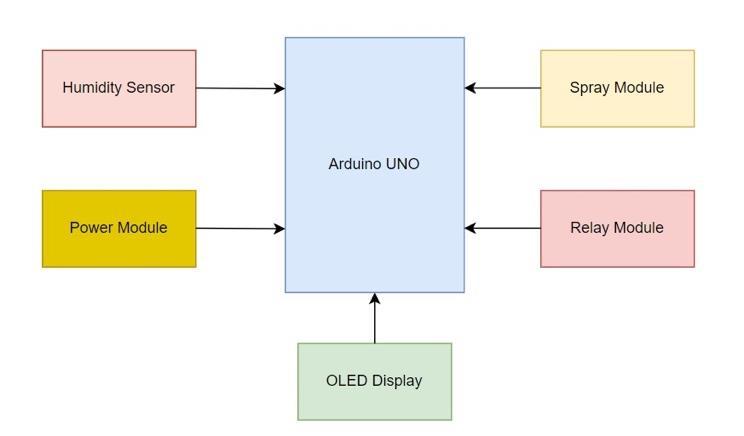
Fig -1:BlockDiagram
The spray module releases water vapor into the room’s atmosphere to increase humidity as required. An OLED displayprovidesreal-timereadoutsofhumiditylevelsand other relevant information for the user. Additionally, a power module supplies the necessary power to the Arduino and other connected components, ensuring the entire system operates smoothly and efficiently. This comprehensive setup allows for automated and precise humidity control, enhancing the overall effectiveness of thesystem.
Volume: 11 Issue: 12 | Dec 2024 www.irjet.net p-ISSN: 2395-0072
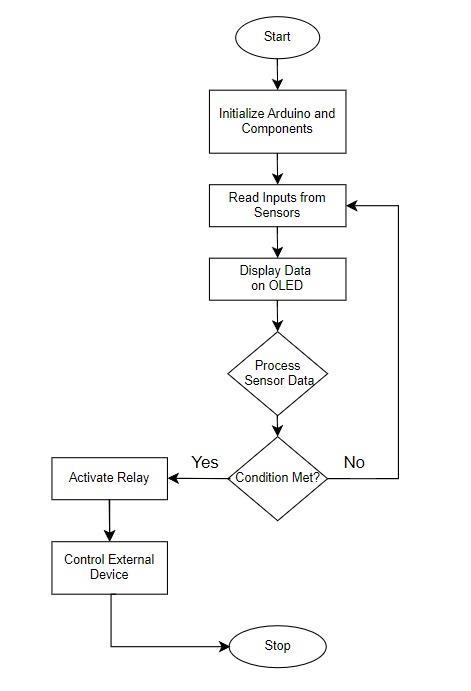
The flowchart for the operating ofthesmart humidifier is showninFigure2.Theflowchartrepresentsaprocessthat initiates its operation with the initialization of Arduino andthesensorsconnectedtoit.Oncethesystemhasbeen initialized, then it goes forward to read inputs from the sensors.Thedatagatheredthroughthesensorsisthen be displayed on an OLED screen for real-time monitoring. Then, advanced processing of sensor data is engaged to see if pre-set conditions are met. The system continues looping from reading the inputs from sensors again for a situationwhenthatconditionisnotmet.
If the desired condition is satisfied, the relay will turn on and further control the external device. In this way, the relay switches on/off the spray control device. Lastly, the process, after controlling the external device, gets to an end, and thus the system halts. This flowchart describes the general control system that uses Arduino; the input taken from sensors undergoes processing to switch the externaldevicesonoroffbasedonpredefinedconditions.
The flowchart for the operating ofthesmarthumidifier is showninFigure2.Theflowchartrepresentsaprocessthat initiates its operation with the initialization of Arduino andthesensorsconnectedtoit.Oncethesystemhasbeen initialized, then it goes forward to read inputs from the sensors.Thedatagatheredthroughthesensorsisthen be displayed on an OLED screen for real-time monitoring. Then, advanced processing of sensor data is engaged to see if pre-set conditions are met. The system continues looping from reading the inputs from sensors again for a situationwhenthatconditionisnotmet.
If the desired condition is satisfied, the relay will turn on and further control the external device. In this way, the relay switches on/off the spray control device. Lastly, the process, after controlling the external device, gets to an end, and thus the system halts. This flowchart describes the general control system that uses Arduino; the input taken from sensors undergoes processing to switch the externaldevicesonoroffbasedonpredefinedconditions.
AsmarthumidifierusingArduinoisasophisticateddevice that helps maintain optimal humidity levels in any closed space by using the Arduino microcontroller to measure and control humidity levels. The device is made up of various components, including a humidity sensor, an output device (such as a humidifier), an Arduino board, andprogrammingcode.
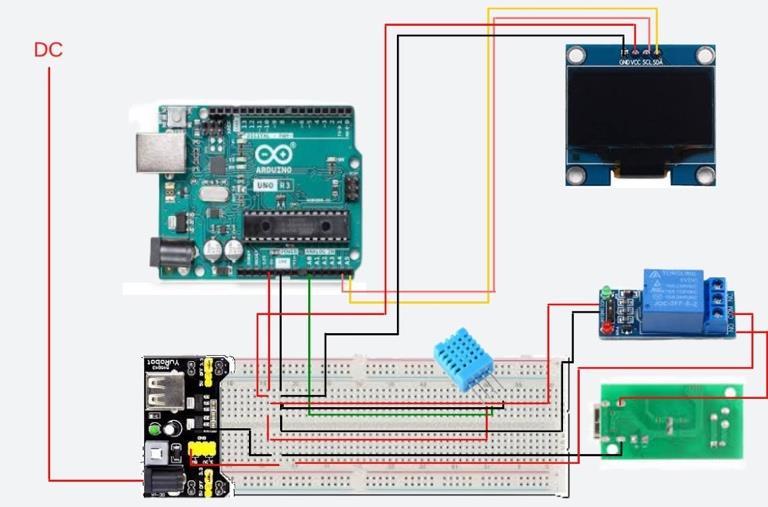
The humidity sensor is a critical component of the smart humidifiersystemasitmeasuresthehumiditylevelinany closed space. It provides information on whether the humidity level is too high, too low, or within the ideal range. Once the humidity level is measured, the information is sent to the Arduino board. It uses the data provided by the humidity sensor to control the output device, which is a humidifier in this case. The board is programmed to adjust the humidifier output based on the current humidity level in the room. For instance, if the humidity level is too low, the Arduino board turns on the humidifier to add moisture to the air, and if the humidity level is too high, it turns off the humidifier to reduce moisturelevels.
The DHT11 sensor, when interfaced with Arduino UNO, is always monitoring temperature and humidity during the operationofthesmarthumidifiersystem.Inthissystem,a targetrelativehumiditywassettobe80%sothatwhenit detected the humidity in the room was below the target
International Research Journal of Engineering and Technology (IRJET) e-ISSN: 2395-0056
Volume: 11 Issue: 12 | Dec 2024 www.irjet.net p-ISSN: 2395-0072
value, the system automatically turned on the spray modulevia thejiashipin.Forexample,whenthehumidity fell to about 70%, the spraymodule wasswitched on, and on for around 3 minutes, increasing the relative humidity uptotherequiredmarkof80%.
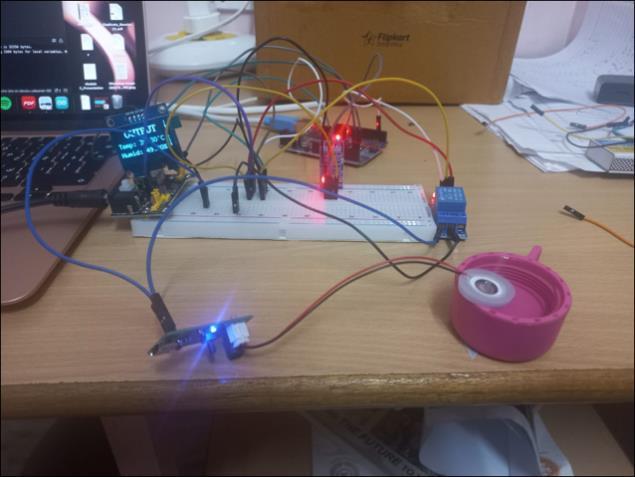
The further actions went as follows: every time the humiditydroppedbelow80%,atabout75%,ArduinoUNO switchedthespraymoduleonagain.Initsturn,everytime thishappened,thesprayworkedforabout2minutesuntil the level of humidity got back to normal. Such a working cycle made sure the system would not be a waste while keeping the target value of humidity and promptly reacts to changes in the environment. Both temperature and humidity were reflected in real time on the OLED screen, thusprovidinganeasilyreadableinterfacetotheusers.
The values are updated continuously,and users can easily monitor the performance of the humidifier with screen display.Arduinocontrolledthespraymoduleaccuratelyto holdtheindoorhumiditylevelinsidethecomfortzonewith the minimum humanintervention. The smart humidifier workseffectivelywithlowpowerconsumption.
A smart humidifier offers a perfect blend of convenience, health benefits, and advanced technology, making it an ideal addition to any application. By maintaining optimal humidity levels, it helps improve air quality, reduce allergens,andprotectyourrespiratoryhealth,especiallyin dry or winter conditions. Its smart features,such as app control, scheduling, and real-time monitoring, add unparalleled ease and efficiency to maintaining your environment. Whether for personal comfort or protecting delicate items like furniture and electronics, a smart humidifier is a valuable investment in enhancing your livingspace.
[1] Ismailov, A.S.; Jo‘Rayev, Z.B, “ Study of arduino microcontroller board,” Sci. Educ. Sci. J. 3, 172–179, 2022.
[2] Hari Kishan Kondaveeti, Nandeesh Kumar Kumaravelu, et al, “A systematic literature review on prototyping with Arduino: Applications, challenges, advantages, and limitations”, Computer Science Review,Volume40,100364,ISSN1574-0137,2021.
[3] T. Lakshmi Narayana, et al, “Advances in real time smart monitoring of environmental parameters using IoTandsensors”,Heliyon,Volume10,Issue7,e28195, ISSN2405-8440,2024.
[4] Bhat, Omkar & Bhat, Sagar & Gokhale, Pradyumna, “Implementation of IoT in Smart Homes”,6.149-154. 10.17148/IJARCCE.2017.61229,2017.
[5] Abdulrazzak,Ibtihaj&Bierk,Hussain&Ahmed,Luma, “Humidity and temperature monitoring,” International Journal of Engineering & Technology. 7. 10.14419/ijet.v7i4.23225,2018.
[6] Tjandi, Yunus & Kasim, Syarifuddin, “Electric Control Equipment Based on Arduino Relay”, Journal of Physics: Conference Series. 1244. 012028. 10.1088/1742-6596/1244/1/012028,2019.
[7] Altalb, Heba & Nazar, Sama & A. Fathi, Toka & AlAdwany, Maan. “A Fuzzy Logic IoT- Based Temperature and Humidity Control System for Smart Building”, IJCDS, Journal. Vol 13, 10.12785 /ijcds/130111,2023.
[8] Al-Rashdan,Mohdh&Alsharari,Mohammad.“Internet Of Things (IoT) Using Arduino Microcontroller for SmartHomeApplications”,2349-204,2023.
[9] D. Cooper, "Power Module Integration: A new approach,"inIEEEPowerElectronicsMagazine,vol.3, no.3,pp.31-36,Sept.2016.
[10] Abu Seman, Mohamad & Abdullah et al., “Monitoring Temperature, Humidity and Controlling System In Industrial FixedRoom StorageBased OnIoT”, Journal of Engineering Science and Technology. 15. 35883600,2020.
[11] Jaroslav Sobota, Roman PiŜl, Pavel Balda, MiloŜ Schlegel,“RaspberryPiandArduinoboardsincontrol education”, IFAC Proceedings Volumes, Volume 46, Issue17,Pages7-12,2013.
International Research Journal of Engineering and Technology (IRJET) e-ISSN: 2395-0056
Volume: 11 Issue: 12 | Dec 2024 www.irjet.net p-ISSN: 2395-0072
[12] Mussab Alaa, A.A. Zaidan, et al., “A review of smart home applications based on Internet of Things”, Journal of Network and Computer Applications, Volume97,Pages48-65,2017.
[13] J. Petnik, J. Vanus, “Design of Smart Home Implementation within IoT with Natural Language Interface”, IFAC-PapersOnLine, Volume 51, Issue 6, Pages174-179,2018.
[14] Sakib,Nazmus&Sohel,Md&Islam,Shahanul&Islam, Minarul. “Smart solution for low humidity problems using automatic ultrasonic humidifier (AUH)”, IOP ConferenceSeries:MaterialsScienceandEngineering. 1078. 012035. 10.1088/1757-899X/1078/1/012035, 2021.