
International Research Journal of Engineering and Technology (IRJET) e-ISSN:2395-0056
Volume: 11 Issue: 12 | Dec 2024 www.irjet.net p-ISSN:2395-0072

International Research Journal of Engineering and Technology (IRJET) e-ISSN:2395-0056
Volume: 11 Issue: 12 | Dec 2024 www.irjet.net p-ISSN:2395-0072
1Rambarki Sai Akshit, 2Konduru Hema Pushpika, 3Rambarki Sai Aashik, 4Dr. Manda Rama Narsinga Rao, 5J. Uday Shankar Rao, 6S. Manjith
1,5,6U.G. Student, Department of Computer Science Engineering, GITAM University, Visakhapatnam, India
2M.S. Student, Department of Data Science, University of Maryland Baltimore County, USA
3M. Tech Graduate, VLSI Design, GITAM University, Visakhapatnam, India
4Professor, Department of Computer Science Engineering, GITAM University, Visakhapatnam, India
Abstract - This research leverages the Fakeddit dataset, a comprehensive multimodal collection of over 1 million news samples with diverse labels for binary and finegrained classifications, to address the pressing challenge of fake news detection on social media. By integrating advanced Natural Language Processing (NLP) models with multimodal data, including textual content, user comments, and images, this study achieves superior performance in detecting misinformation. Using the transformer-based BERT model, the approach effectively captures subtle contextual nuances, attaining 93.8% accuracy. When combined with Support Vector Machines (SVM) in an ensemble, classification accuracy improves to 95.8%.Further incorporatingmultimodalfeatures,such as image captions and metadata, enhances the model’s performance, with a text-image system achieving a peak accuracy of 96.8%. This work highlights the potential of multimodal integration and NLP techniques in developing robust systems to combat disinformationand maintain the integrityofdigitaldiscourse.
Key Words: Fake News Detection, Natural Language Processing, BERT, LSTM, Ensemble Methods, Multimodal Data Integration
The rise of social media platforms has revolutionized how information is shared and consumed, granting unprecedented global reach to individuals and organizations alike. While this democratization of information has empowered people to voice diverse perspectives, it has also exacerbated a critical issue: the proliferation of fake news. Fake news, defined as deliberately false or misleading information, poses significant risks to public opinion, political stability, and even public health. As a result, developing effective methods to identify and curb the spread of misinformation on social media has become a pressing concern.
NaturalLanguageProcessing(NLP),a subsetofartificial intelligence (AI), offers a promising solution to this challenge.NLPenablesmachinestoprocess,analyze,and understand human language, providing the tools to detect subtle linguistic patterns and signals that distinguish authentic content from fabricated material. Researchers in this field are leveraging advanced techniquestobuildrobustsystemscapableofaddressing thecomplexityofmisinformation.
This study undertakes a comprehensive exploration of NLP-based approaches to detect fake news, with a focus on the latest advancements in machine learning and deep learning. By integrating large and diverse datasets, this research aims to not only identify instances of fake news but also unravel the linguistic and contextual factorsbehindtheircreationanddissemination.Amultifacetedmethodologyisemployed,encompassingvarious datasets from social media platforms to train and evaluate a range of NLP models. These models are designed to extract and analyze features such as sentiment,stylisticpatterns,andlinguisticstructures.
Beyond text-based analysis, this research also incorporates multimodal data, including images, captions, and user metadata, to enhance detection accuracy and reliability. By combining these diverse sources of information, the study adopts a holistic approach to the problem of fake news detection. Additionally, ethical considerations such as fairness, transparency,andpotentialbiasesareintegratedintothe research process, ensuring that the detection methods align with democratic values and do not compromise freedomofspeech.
In essence, this investigation aims to contribute to the growing body of knowledge on combating misinformation in the digital age. By utilizing cuttingedge NLP methodologies, diverse datasets, and ethical principles,thisstudyseekstostrengthentheintegrityof digital communication and mitigate the harmful effects of disinformation. The subsequent sections will delve
International Research Journal of Engineering and Technology (IRJET) e-ISSN:2395-0056
Volume: 11 Issue: 12 | Dec 2024 www.irjet.net p-ISSN:2395-0072
into the technical details, findings, and broader implicationsofthisendeavor.
Spam and misinformation detection are critical challenges in the digital age, requiring robust methodologiestoaddressdynamicandevolvingpatterns effectively.Withtherapidgrowthofdigitalplatforms,the volume andvarietyof spam andfake newscontenthave increased significantly, making detection a constantly moving target. Traditional approaches in fake news and spam detection often rely on static datasets and simple classificationmodels,whichstruggletoadapttonewand complex behaviors exhibited by malicious actors. These methods typically involve the use of handcrafted features,suchasn-gramsandTF-IDF,whichfocusonthe textualcontentbutfail tocapturedeepercontextualand semantic nuances. While effective for early detection efforts, these approaches are inherently limited in their scalability,astheycannotdynamicallyadapttoreal-time changes in spam tactics or misinformation strategies. Furthermore, their reliance on predefined feature extraction often makes them vulnerable to adversarial attacks or subtle changes in content patterns. This necessitates the adoption of advanced, adaptive techniques, such as deep learning and multi-modal analysis, to improve the robustness and efficiency of spamandmisinformationdetectionsystems.
This literature review provides a comprehensive overview of pivotal research and advancements in the domain of fake news detection, examining the evolution of techniques, methodologies, and the ethical considerations that have shaped this field. In the initial stages of tackling the spread of misinformation, the primary focus was on manual fact-checking and the development of rule-based algorithms. These early methods relied heavily on predefined patterns, such as specific linguistic or syntactic structures, to identify potentiallyfalseinformation.Whileeffectiveindetecting certain types of falsehoods, such as overly exaggerated claims or stylistic anomalies, these approaches were inherentlylimitedintheirscalability.
Although extensive research on fake news detection has beenperformed[9],[10],[11],[12],[13],[14],[15],[16], [17], [18], [19], [20], [21], [22], [23], the majority of studies focus on analyzing textual data. These works primarily utilize linguistic and structural features extracted from text, leveraging techniques such as Natural Language Processing (NLP) and machine learning models. However, such research often relies on uni-modal features, limiting the scope to detecting fake news in text alone. In real-world scenarios, fake news frequently incorporates multi-modal content, such as text paired with images or videos, which requires more
comprehensive approaches. For example, misleading headlinesmightaccompanymanipulatedvisuals,making text-only methods insufficient. While the cited studies contribute significantly to the field, they underscore the gap in exploring multi-modal methods that integrate textual, visual, and sometimes auditory cues. This highlights the need for futureresearchtoaddressmultimodal fake news detection for improved accuracy in handlingdiversemisinformationformats.
S.Madisettyetal.[2]exploredtheuseofneuralnetworkbased ensemble approaches for detecting spam at the tweet level, highlighting the growing effectiveness of combining deep learning and traditional feature-based methods. Their study utilized multiple convolutional neural networks (CNNs) trained on diverse word embeddings, such as Glove and Word2Vec, alongside feature-based models leveraging content, user activity, and n-gram features. By employing a multilayer neural network as a meta-classifier, the ensemble approach demonstrated superior performance over existing methods, particularly on imbalanced datasets. However, as noted by S. Madisetty et al. [2], while the ensemble framework successfully integrates diverse features and models, its reliance on static datasets limits its adaptability to rapidly evolving spam patterns. This limitation underscores the need for dynamic, real-time detection systems that can adapt to changing behaviors andstrategiesofspammers, drawing parallelstosimilar challengesinreal-timefakenewsdetection.
Recentadvancementsinfakenewsdetectionunderscore the transformative potential of Large Language Models (LLMs) in addressing the limitations of traditional approaches. Rouyu et al. [1] highlighted that conventional models, often dependent on static datasets andauxiliaryfeatureslikemetadataoruserinteractions, are limited in their ability to adapt to rapidly evolving misinformation patterns. These static methods lack the agility required to detect emerging fake news in realtime, particularly in high-velocity digital ecosystems. In contrast, modern LLMs such as GPT-4 and Claude offer significant advantages due to their pre-trained knowledge and capacity for analyzing textual content without relying on external data. However, as noted by Rouyu et al. [1], many of these LLM-based systems still operate within the constraints of static datasets, failing to fully exploit their real-time processing potential. This limitationhighlightstheneedforfurtherexplorationinto LLMs that integrate dynamic data streams, enabling more scalable and effective detection of misinformation asitarises.
The methodology follows a systematic progression, beginning with data acquisition and preprocessing, and
International Research Journal of Engineering and Technology (IRJET) e-ISSN:2395-0056
Volume: 11 Issue: 12 | Dec 2024 www.irjet.net p-ISSN:2395-0072
culminating in model evaluation and validation. Each phase of the process is outlined below, supported by a detailed process flowchart. This framework is designed to ensure precision, efficiency, and robustness in identifying misinformation across various platforms.
3.1.1
The cornerstone of any effective misinformation detectionsystemisadiverseandrepresentativedataset. This methodology emphasizes the collection of news storiesfromawiderangeofsocialmediaplatformssuch as Twitter, Facebook, and Reddit. To ensure a balanced dataset:
Include an equal proportion of genuine and fabricatednewsitems.
Source data from multiple domains (e.g., politics, entertainment, science) to capture varied contexts andthemes.
3.1.2
Raw data collected from various sources is often cluttered with noise, including irrelevant information and inconsistencies, which can significantly hinder the analysis process. To address this, standard text preprocessing techniques are employed to enhance data qualityandensureconsistencyacrossthedataset:
Lowercase Conversion: All text is converted to lowercase, eliminating inconsistencies caused by casesensitivity.For example,"FakeNews" and "fake news" are treated as identical, thereby reducing redundant variations and standardizing the text for furtherprocessing.
Punctuation Removal: Punctuation marks, such as commas, periods, and exclamation points, are stripped from the text to simplify its structure withoutalteringthemeaning.Thisstepensuresthat analysis focuses purely on the semantic and syntacticcontentofthetext.
StopWordElimination:Commonlyusedwordslike "and," "the," and "of," which do not add significant valueto thecontext,areremoved.Thisstepreduces the dimensionality of the dataset and ensures that computational resources are concentrated on meaningfulcontent.
Duplicate and Irrelevant Content Removal: The dataset is scanned for duplicate entries, which are then removed to avoid redundant analysis.
Additionally, non-informative content such as advertisements, irrelevant hyperlinks, and boilerplate text is discarded. This ensures that the final dataset contains only relevant information, improving both efficiency and the reliability of downstreamprocesses.
These cleaning steps are essential for preparing the dataset, enabling the extraction of meaningful insights and enhancing the performance of machine learninganddeeplearningmodels.
Tokenization and lemmatization are fundamental steps in preparing text data for computational analysis, enabling models to better interpret and analyze the content.
Tokenization: This process involves splitting the text into smaller, meaningful units called tokens, such as words, phrases, or subwords. For example, the sentence "Fake news spreads quickly" would be tokenizedinto["Fake","news","spreads","quickly"]. Tokenization simplifies text into manageable components, allowing algorithms to process each token independently or in relation to others. It also helpsinidentifyingword-levelpatternsandfeatures, forming the basis for further analysis. Advanced tokenizationmethods,suchassubwordtokenization used in transformer models, can handle complex wordsorout-of-vocabularytermseffectively.
Lemmatization:Thisstepfurtherrefinesthetokens by reducing them to their base or root form, known as the lemma. For example, the words "running," "ran," and "runner" are reduced to the base form "run." Unlikestemming,whichoftenperformscrude cutting of words, lemmatization considers the word's meaning and part of speech to ensure semantic accuracy. It also reduces the dimensionality of the data, as similar words are grouped under one representation. This not only enhancescomputationalefficiencybutalsoimproves the model's ability to detect patterns and relationshipswithinthetext.
Feature extraction is a pivotal step in transforming raw, preprocessed text into structured data that machine learning models can effectively analyze. Linguistic feature identification leverages Natural Language Processing (NLP) techniques to derive meaningful attributes from text, capturing its semantic, syntactic, andemotionalcharacteristics. This includes analyzing n-
International Research Journal of Engineering and Technology (IRJET) e-ISSN:2395-0056
Volume: 11 Issue: 12 | Dec 2024 www.irjet.net p-ISSN:2395-0072
grams, grammatical patterns, and sentiment indicators:
N-grams: N-grams are contiguous sequences of words or tokens, where "N" specifies the number of items in the sequence. For instance, in the phrase "fakenewsspreadsquickly,"unigramswouldinclude ["fake","news","spreads","quickly"],bigramswould be ["fake news", "news spreads", "spreads quickly"], and so on. N-grams help identify frequently occurring patterns, co-occurrence of terms, and context-specific phrasing, which are often indicative offakeortruthfulcontent.
Grammatical Patterns: Analyzing grammatical structures, such as sentence length, complexity, and parts of speech, provides insights into the writing style of the text. Fake news articles, for example, might exhibit unique stylistic elements, such as exaggerated adjectives or overly simplistic sentence constructions. Identifying these patterns allows models to detect stylistic anomalies that could be indicativeofmisinformation.
SentimentIndicators:Sentimentanalysisevaluates the emotional tone conveyed by the text, categorizing it as positive, negative, or neutral. Fake news often uses emotionally charged language to provokereactionsorinfluencereaders'opinions.By quantifying sentiment, models can identify articles with disproportionate emotional intensity, which mightsignalfabricatedormisleadingcontent.
These extracted linguistic features act as critical inputs formachinelearningmodels,formingthefoundationfor effective classification and predictive analysis. By capturing bothsurface-level patterns(e.g., n-grams)and deeper semantic and syntactic characteristics (e.g., sentiment and grammar), this step ensures that the models are equipped with comprehensive, high-quality dataforrobustperformance.
3.3
Model selection and training are critical steps in the development of an effective fake news detection system. Thesephasesensurethatthechosenmodelsarenotonly capable of analyzing the dataset but are also optimized forhighaccuracy,precision,andgeneralizability.
3.3.1
It involves utilizing traditional machine learning algorithms to create a foundational performance benchmark. Among these, Support Vector Machines (SVM) and Naive Bayes are particularly effective for
initial classification tasks. SVM excels at separating data into distinct categories by identifying the optimal hyperplane,makingitareliablechoicefordistinguishing between real and fake news. Its ability to handle highdimensional data ensures robustness, even with smaller datasets. Naive Bayes, on the other hand, is a probabilistic model that leverages Bayes' theorem to classify text based on feature likelihoods. Its simplicity and efficiency make it well-suited for text classification tasks, especially in identifying patterns where features are conditionally independent. Together, these models provide a strong baseline against which more complex methodscanbeevaluated
To gain deeper insights and capture the complex relationships within textual data, advanced deep learning frameworks are incorporated. These include recurrent neural networks (RNNs) and transformerbasedarchitectureslikeBERT.
Recurrent Neural Networks (RNNs): RNNs are designed to process sequential data, making them ideal for analyzing context in textual content. They can capture dependencies between words in a sequence, but their performance is often enhanced byusingLongShort-TermMemory(LSTM) orGated Recurrent Units (GRU) to address issues like vanishinggradients.
Transformer-Based Models (BERT): BERT (Bidirectional Encoder Representations from Transformers)hasrevolutionizedNLP byleveraging bidirectional context, allowing it to understand the relationships between words in a sentence more effectively than unidirectional models. BERT can be fine-tuned on the specific dataset to optimize its performance,makingithighlyeffectivefortaskslike fakenewsclassification.
Ensemble techniques referto the methods thatcombine the predictions of multiple models to improve overall performance.Themainideabehindensemblelearningis that by aggregating the outputs of several models, the strengths of each individual model can be harnessed, leadingtobettergeneralizationandreducedoverfitting.
Model evaluation and validation are crucial steps in assessing the performance and reliability of machine learning models. These processes help ensure that the model generalizes well to unseen data and is not overfittingtothetrainingset.
International Research Journal of Engineering and Technology (IRJET) e-ISSN:2395-0056
Volume: 11 Issue: 12 | Dec 2024 www.irjet.net p-ISSN:2395-0072
K-fold Cross-Validation: One of the most common techniques used for evaluating a model's generalizability is k-fold cross-validation. This method splits the dataset into k equally sized folds, typically ranging from 5 to 10. The model is then trained on k-1 folds and tested on the remaining fold.Thisprocessisrepeated k times,witheachfold used once as a test set. The average performance acrossallfoldsgivesamorereliableestimateofhow themodelwillperformonunseendata.K-foldcrossvalidation helps mitigate issues like overfitting and ensures that the model's performance is not biased byaparticularsubsetofthedata.
After validation, it is important to assess the model's effectiveness through various performance metrics like accuracy,precision,recall,F1-score.
The results of this study offer valuable insights into the effectiveness of NLP-based methods for detecting fake news across social media platforms. The research utilizedadiversedatasetof10,000newsarticlessourced fromsocialmediaoutletssuchasTwitter,Facebook,and Reddit,withanequal distributionofreal andfakenews. The proposed methodology was implemented, combiningtraditionalmachinelearningalgorithms(SVM andNaiveBayes)withadvancedNLPmodels(BERTand LSTM), ensemble techniques, and multimodal data integration, demonstrating promising performance in identifyingmisinformation.
Table 1: PerformanceMetricsofBaselineModels
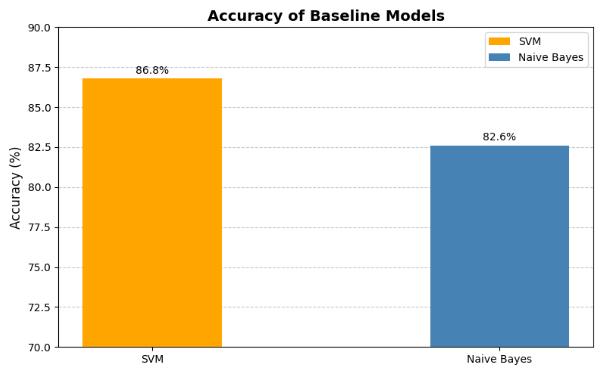
Table 1 presents the performance metrics for the baseline models, Support Vector Machine (SVM) and Naive Bayes, which were implemented to evaluate the initial effectiveness of traditional machine learning techniques in detecting fake news. The SVM model achieved an accuracy of 86.8%, with a precision of 0.84 andrecall of0.83,indicatinga strongabilitytocorrectly identify bothreal andfakenewsarticles.Incomparison, the Naive Bayes model, while effective, demonstrated slightly lower performance, with an accuracy of 82.6%, precision of 0.78, and recall of 0.76. These results highlight the solid performance of SVM as a baseline for fake news detection, though they also emphasize the potential for improvement through the use of more advancedNLPmodelsandensemblemethods.
Table 2: PerformanceMetricsofAdvancedNLPModels
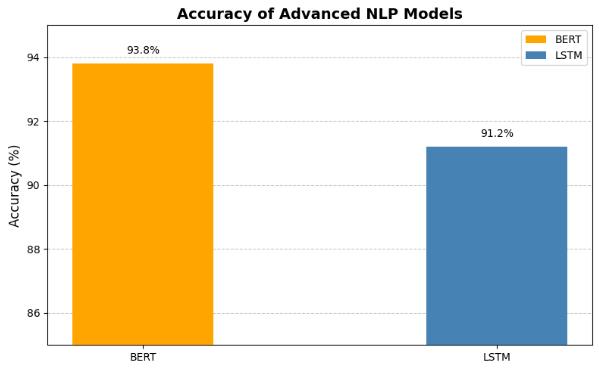
Fig.2: AccuracyPlotforAdvancedNLPModels
The advanced NLP models, BERT and LSTM, were evaluated on accuracy, precision, and recall. From Table 2 it is evident that BERT outperformed LSTM, achieving an accuracy of 93.8%, precision of 0.92, and recall of 0.92, showcasing its strong ability to capture contextual relationshipsintext.LSTM,whilestilleffective,achieved slightly lower results with an accuracy of 91.2%, precisionof0.88,andrecallof0.88,indicatingitsrelative difficultyinhandlinglong-rangedependenciescompared toBERT.
Table 3: EnsembleModelPerformance
International Research Journal of Engineering and Technology (IRJET) e-ISSN:2395-0056
Volume: 11 Issue: 12 | Dec 2024 www.irjet.net p-ISSN:2395-0072
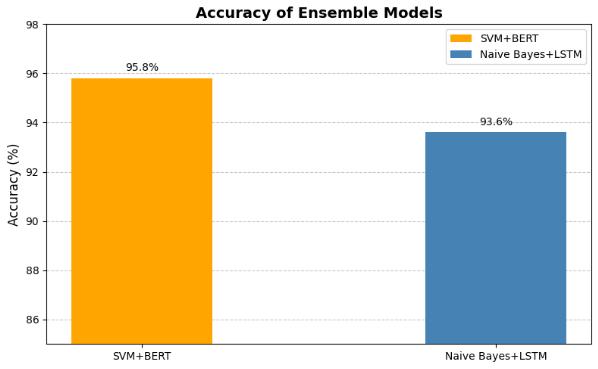
Fig.3: AccuracyPlotforEnsembleModels
Table 3 presents the performance of the ensemble models, the combination of SVM and BERT achieved the highest accuracy of 95.8% This indicates strong performanceinbothcorrectlyidentifyingfakenewsand minimizing false positives. On the other hand, the Naive Bayes and LSTM ensemble achieved an accuracy of 93.6% These findings highlight the effectiveness of combining traditional and advanced models for fake newsdetection.
Table 4: Multi-ModalIntegrationResults
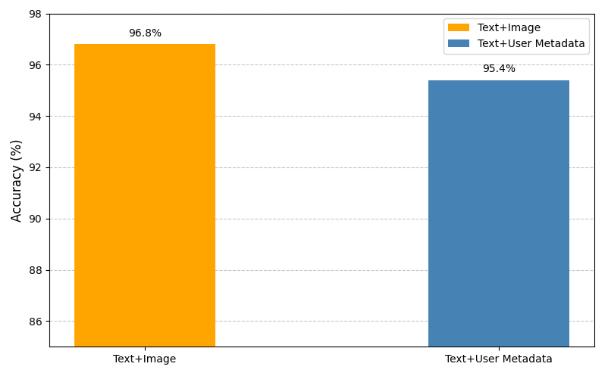
Fig.4: MultiModelIntegrationAccuracyPlot
Table 4 presents the results of the multi-modal integration approach. The model utilizing both text and images achieved the highest accuracy of 96.8%, demonstrating the value of incorporating visual informationalongside textual contentforimprovedfake news detection. The model combining text and user
metadata also showed strong performance, with an accuracy of 95.4%. These results highlight the effectiveness of utilizing multimodal data, including image captions and user metadata, to improve classification accuracy and strengthen the robustness of fakenewsdetection.
Overall, the results underscore the effectiveness of combining sophisticated NLP techniques with multimodal data in enhancing fake news detection on socialmedia.Thesefindingshavesignificantimplications for the development of reliable real-world applications aimed at reducing the spread of misinformation and preservingtheintegrityofonlinediscourse.
This research underscores the effectiveness of employing NLP-based techniques to detect fake news across social media platforms, an area of growing importance in the fight against misinformation. By integratingbothtraditionalmachinelearningalgorithms, such as SVM and Naive Bayes, with advanced NLP models like BERT and LSTM, along with ensemble techniques and multimodal data sources, the study demonstrates substantial improvements in the accuracy and robustness of fake news detection. The incorporation of multimodal data, including image captions and user metadata, significantly enhanced the model's ability to identify misinformation by providing complementary context that text alone could not capture. While BERT and other advanced models exhibited high performance, the ensemble methods ensured a practical balance between classification accuracy and computational efficiency. These results contributevaluable insightsto the field,highlighting the potential of combining diverse data sources for more reliable and effective misinformation detection. Looking ahead, future work could focus on further enhancing model performance by incorporating additional data types, improving real-time processing capabilities, and addressing challenges related to scalability in large, dynamicdatasets.
[1] Xu,R.,Li,G.(2024).AComparativeStudyofOffline Models and Online LLMs in Fake News Detection. arXivpreprintarXiv:2409.03067.
[2] S. Madisetty and M. S. Desarkar, "A Neural Network-Based Ensemble Approach for Spam Detection in Twitter," in IEEE Transactions on Computational Social Systems, vol. 5, no. 4, pp. 973-984, Dec. 2018, doi: 10.1109/TCSS.2018.2878852. keywords: {Twitter; Unsolicited electronic mail; Feature
International Research Journal of Engineering and Technology (IRJET) e-ISSN:2395-0056
Volume: 11 Issue: 12 | Dec 2024 www.irjet.net p-ISSN:2395-0072
extraction; Convolutional neural networks; Social network services; Classification;social media;spamdetection;Twitter},
[3] Y. Wang, F. Ma, Z. Jin, Y. Yuan, G. Xun, K. Jha, L. Su, and J. Gao, “Eann: Event adversarial neural networksformulti-modalfakenewsdetection,”in Proceedings of the 24th acm sigkdd international conference on knowledge discovery & data mining,2018,pp.849–857.
[4] O. Ajao, D. Bhowmik, and S. Zargari, “Fake news identification on twitter with hybrid cnn and rnn models,” in Proceedings of the 9th international conference on social media and society, 2018, pp. 226–230.
[5] Su,Ting&Macdonald,Craig&Ounis,Iadh.(2022). LeveragingUsers'SocialNetworkEmbeddingsfor Fake News Detection on Twitter. 10.48550/arXiv.2211.10672.
[6] W. Yu, J. Ge, Z. Yang, Y. Dong, Y. Zheng and H. Dai, "Multi-domain Fake News Detection for History News Environment Perception," 2022 IEEE 17th Conference on Industrial Electronics and Applications (ICIEA), Chengdu, China, 2022, pp. 428-433, doi: 10.1109/ICIEA54703.2022.10006065. keywords: {Industrial electronics;Social networking (online);Logic gates;History;Fake news;fake news;multi-domain;HNEP},
[7] Xinyi Zhou and Reza Zafarani. 2020. A Survey of Fake News: Fundamental Theories, Detection Methods, and Opportunities. ACM Comput. Surv. 53, 5, Article 109 (September 2021), 40 pages. https://doi.org/10.1145/3395046
[8] P. Narang and U. Sharma, "A Study on Artificial Intelligence Techniques for FakeNews Detection," 2021 International Conference on Technological Advancements and Innovations (ICTAI), Tashkent, Uzbekistan, 2021, pp. 482-487, doi: 10.1109/ICTAI53825.2021.9673252. keywords: {Technological innovation;Systematics;Social networking (online);Explosives;Fake news;Artificial intelligence;Machine Learning;Deep Learning;Neural Network;Fake News;SentimentAnalysis},
[9] S.Afroz,M.Brennan,andR.Greenstadt,‘‘Detecting hoaxes, frauds, and deception in writing style online,’’ in Proc. IEEE Symp. Secur. Privacy, May 2012,pp.461–475.
[10] X. Zhou, J. Wu, and R. Zafarani, ‘‘SAFE: Similarityaware multi-modal fake news detection,’’ in Proc. Advances in Knowledge Discovery and Data Mining. Cham, Switzerland: Springer, 2020, pp. 354–367.
[11] J. Ma, W. Gao, P. Mitra, S. Kwon, B. J. Jansen, K.-F. Wong, and M. Cha, ‘‘Detecting rumors from microblogs with recurrent neural networks,’’ in Proc.Int. JointConf.Artif.Intell.(IJCAI),2016,pp. 3818–3824.
[12] Y. Chen, J. Sui, L. Hu, and W. Gong, ‘‘Attentionresidual network with CNN for rumor detection,’’ in Proc. 28th ACM Int. Conf. Inf. Knowl. Manage., Nov.2019,pp.1121–1130.
[13] J. Ma, W. Gao, and K.-F. Wong, ‘‘Detect rumors on Twitterbypromotinginformationcampaignswith generative adversarial learning,’’ in Proc. World WideWebConf.,May2019,pp.3049–3055.
[14] F. Yu, Q. Liu, S. Wu, L. Wang, and T. Tan, ‘‘A convolutional approach formmisinformation identification,’’ in Proc. 26th Int. Joint Conf. Artif. Intell.,Aug.2017,pp.3901–3907.
[15] V. Vaibhav, R. M. Annasamy, and E. Hovy, ‘‘Do sentence interactions matter? Leveraging sentence level representations for fake news classification,’’2019,arXiv:1910.12203.
[16] L.Wu,Y.Rao,H.Jin,A.Nazir,andL.Sun,‘‘Different absorption from the same sharing: Sifted multitask learning for fake news detection,’’ 2019, arXiv:1909.01720.
[17] M. Cheng, S. Nazarian, and P. Bogdan, ‘‘VRoC: Variational autoencoderaided multi-task rumor classifierbasedontext,’’inProc.WebConf.,2020, pp.2892–2898.
[18] F. Qian, C. Gong, K. Sharma, and Y. Liu, ‘‘Neural user response generator: Fake news detection withcollectiveuserintelligence,’’inProc.27thInt. JointConf.Artif.Intell.,Jul.2018,pp.3834–3840.
[19] Giachanou, P. Rosso, and F. Crestani, ‘‘Leveraging emotional signals for credibility detection,’’ in Proc. 42nd Int. ACM SIGIR Conf. Res. Develop. Inf. Retr.,Jul.2019,pp.877–880.
[20] K. Wu, S. Yang, and K. Q. Zhu, ‘‘False rumors detection on Sina Weibo by propagation structures,’’inProc.IEEE31stInt.Conf.DataEng., Apr.2015,pp.651–662.
International Research Journal of Engineering and Technology (IRJET) e-ISSN:2395-0056
Volume: 11 Issue: 12 | Dec 2024 www.irjet.net p-ISSN:2395-0072
[21] P.Li,X.Sun,H.Yu,Y.Tian,F.Yao,andG.Xu,‘‘Entityoriented multimodal alignment and fusion network for fake news detection,’’ IEEE Trans. Multimedia,vol.24,pp.3455–3468,2022.
[22] P.Qi,J.Cao,X.Li,H.Liu,Q.Sheng,X.Mi,Q.He,Y.Lv, C. Guo, and Y. Yu, ‘‘Improving fake news detection by using an entity-enhanced framework to fuse diverse multimodal clues,’’ in Proc. 29th ACM Int. Conf.Multimedia,Oct.2021,pp.1212–1220.
[23] Song, N. Ning, Y. Zhang, and B. Wu, ‘‘A multimodal fake news detection model based on crossmodal attentionresidualandmultichannelconvolutional neural networks,’’ Inf. Process. Manage., vol. 58, no.1,Jan.2021,Art.no.102437