
International Research Journal of Engineering and Technology (IRJET) e-ISSN: 2395-0056
Volume: 12 Issue: 02 | Feb 2025 www.irjet.net p-ISSN: 2395-0072
International Research Journal of Engineering and Technology (IRJET) e-ISSN: 2395-0056
Volume: 12 Issue: 02 | Feb 2025 www.irjet.net p-ISSN: 2395-0072
Sumalatha M S1 , Manju J2
1 Associate Professor, Department of computer science and engineering, Mahaguru Institute of Technology, Kayamkulam
2Professor, Mahaguru Institute of Technology, Kayamkulam
Abstract - Threat detection in cybersecurity involves identifying and responding to potential cyber threat, such as malware, phishing attacks, and unauthorized access, by analysing network traffic and system behavior. Effective threatdetectionenables organizationstoproactivelymitigate risks, keep sensitive data, and ensure the resilience of their digital infrastructures.Traditionalthreatdetectiontechniques struggle to detect new and evolving threats like zero-day attacks.Theyoftenproducehighfalsepositivesandnegatives, reducing their effectiveness. Additionally, these methods rely on known patterns, making them slow to adapt to emerging cyber threats. This study investigates the potential of deep learning (DL) for cybersecurity by employing the ResNet101 modeltoenhancethreatdetectionusingtheSTINdataset.This study focuses on enhancing the accuracy of threat detection, minimizing false positives, and ensuring rapid responses to emerging cybersecurity risks. The ResNet101 model achieved exceptional performance, with an accuracy of 96.24%, precision of 94.28%, F1 score of 96.47, and recall of 98.67%. These results highlight the model's reliability in identifying and mitigating cybersecurity threats. Additionally, the ResNet101modelprocessestheSTINdatasetinapproximately 55 seconds, demonstrating its suitability for real-time threat detection applications. This study presents a comprehensive analysis of dataset pre-processing techniques, model optimizationstrategies,andperformanceevaluationmethods. The findings contribute the knowledge in AI-driven cybersecurity,offeringvaluableinsightsforbothpractitioners and researchers employing to strengthen digital infrastructure against sophisticated cyber threats
Key Words: Threat Detection, cyber security, ResNet 101, deep learning, intrusion detection
Due to the fast growth of digital infrastructures and networkedsystems,whichexposesenterprisestoaneverincreasing number of sophisticated cyber threats, cybersecurityhasbecomea crucial area inthedigital age. Businesses,governments,andindividualsareatseriousrisk from cyberattacks, which can range from advanced persistentthreats(APTs)tomalwareinfectionsandphishing schemes. Because of the complexity and magnitude of contemporary cyber threats, traditional cybersecurity
techniques like heuristic analysis and signature-based detection have not been able to keep up. This difficulty highlightsthenecessityforcutting-edgeapproachesthatcan improvethecapacitytodetectthreatsandofferpreventative defenses. A subset of AI, DL has emerged as a potent instrumentincybersecurity,withtheabilitytoidentifyand eliminatecyberthreatswithhighprecisionandeffectiveness. DLalgorithmscanevaluateenormousvolumesofdata,spot complexpatterns,andspotabnormalitiesthatcanpointto criminal activity by utilizing complex neural network structures.DLmodelsareextremelyeffectiveinaconstantly changingthreatlandscapebecause,incontrasttoprevious techniques, they can continuously learn and adapt to new attackpatterns[1].
In order to improve the threat detection DL algorithms, presenting a holistic approach to cybersecurity. To attain better performance, DL models must be optimized by adjusting hyperparameters, enhancing feature extraction methods, and incorporating innovative architectures. The suggested method seeks to balance detection accuracy, computingefficiency,andreal-timeresponsecapabilitiesby utilizingoptimizationtechniques.Thestudyalsoexamines thedifficultiesinputtingDL-basedcybersecuritysolutions into practice, such as data availability and quality, adversarial assaults, and the interpretability of model results. For AI-driven security solutions to be dependable andtrustworthy,theseissuesmustberesolved.Inorderto developthoroughandcompletethreatdetectionmodels,the studyalsoexploresthesignificanceofutilizingavarietyof datasourceandthreatintelligencefeeds.Thesummarization ofthisstudyareasfollows:
Aneffectivethreatdetectionframeworkthatmakes use of the pre-trained model and ResNet 101 architecture.
Offers a thorough examination of current DL methods used in cybersecurity, pointing out their advantagesanddisadvantages.
ThesuggestedResNet101andpre-trainedmodel performance are assessed using a standard performancemetrics.
Thefollowingisanarrangementoftheremainingsections: A review of the literature assessing previous research is given in Section 2. The suggested threat detection
International Research Journal of Engineering and Technology (IRJET) e-ISSN: 2395-0056
Volume: 12 Issue: 02 | Feb 2025 www.irjet.net p-ISSN: 2395-0072
methodology is described in Section 3. Section 4 offers results and discussion emphasizing the model's excellent accuracyandperformancemetricsandSection5concludes thestudybysummarizingfindings.
Akgun et al. [2] presented an intrusion detection system (IDS)based on a DL model todetect Distributed Denial of Service(DDoS)attacks.The authors selected theCICDDoS 2019 dataset, which contained 12 classes. To identify the most effective architecture, various models (DNN, CNN, LSTM) with varying layer configurations were compared. Featureeliminationandselectiontechniqueswereappliedto reduce the original 88 features to 40 key attributes. The model achieved a better accuracy for both multi-class classification and binary classification. For real-time analysis,thestudywaslimitedtoevaluatingtheinference times of candidate models to understand their real-time performance.Ashikuetal.[3]proposedaDLarchitecturefor developinganadaptiveandresilientframeworkforanIDSto detectandclassifynetworkattackseffectively.Tovalidate the effectiveness of the model, the authors utilized the UNSW-NB15 dataset, which reflects real-worldnetwork communication patterns and synthetic-generated attack activities.Themodelshowedtheoverallaccuracyof95.4%. Despite promising results, the model’s performance was limitedbyoptimizedfeaturereductiontechniques.
Mughaidetal.[4]proposedacomprehensivesummaryof ML and phishing attacks, highlighting the prevalence of phishing emails as the most effective tactic. A detection model used ML techniques and was trained on three different datasets. The results showed that using a higher number of features yielded more accurate and efficient outcomes. The ML algorithm achieved 88% accuracy on boosted decision trees on the respective datasets. The researchfacedlimitationsindetectionrateduetochallenges inidentifyingthephishingemailscopyinglegitimatemail.Yu et al. [5] introduced a DL-based detection scheme for advancedpersistentthreats(APTs)inIoTenvironmentsand adopted a bidirectional encoder representation from transformers(BERT).TheAPTsequencewas improvedto enhance the model's effectiveness in judging prolonged sequences. The model had a limitation in accuracy when appliedtotheIoTplatform.
Hnamte et al. [6] introduced a DL-based network IDS to securenetworkfromcyberattacks.Thestudypresentedan improvedDCNNBiLSTMmodelforNID,utilizingthehybrid CNN and LSTM networks. The model was trained on realtime network data from Edge IoT and the CICIDS2018 dataset, and the model’s performance was examined by usingmulticlassclassification,andthemodelattainedbetter accuracy.However,themodeltrainedonbalanceddatadid not yield superior performance, and the imbalanced data alsohaditslimitations.Mighanetal.[7]presentedahybrid SVM-SAE model for effective cybersecurity intrusion
detection.Thesystemusedanautoencoder(SAE)network andaSVMmodel. Theefficacyofthemodelwasevaluated usingtheApacheSparkMLtechnique.Theauthorsassessed the SVM-SAE framework by applying dimensionally reductiontothe42-dimensionalISCXdatasetto75%ofits uniquefeatures.Thereduceddatawasthenclassifiedusing SVM. Processing time was reduced by removing the redundant features from the ISCX 2012 dataset. Adding decision treeandSAE improved bothaccuracyandspeed. However,themodelfailedtoachieveoptimalresults.
A DL method for insider threat identification using behaviouralanalysisofcyberattackswaspresentedbyNasir et al. [8]. The technique detected insiders with a better accuracyandlowFPratebyutilisingarichfeaturesetthat includedpracticalunits,userroles,andlogon/logoffevents. Inparticular,LSTM-Autoencoderwasusedtodetectinsider threats.TheCMUCERTv4.2datasetswereusedfortraining and testing, and the model's accuracy was 90.60%. One majorobstaclewastheabsenceofthreatscenariosthatwere accessible to the general public. Al-Abassi et al. [9] introduced a DL approach to address class imbalance in industrial control system (ICS) datasets. The proposed method produced balanced representations of the data, which are then fed into an ensemble DL model for attack detection. The model combined decision trees (DTs) and DNNstoidentifycyberattacks.Evaluatedusing10-foldcrossvalidation on two real-world ICS datasets, the model achieved betterperformanceoverconventional classifiers (RF,DNN,andAdaBoost)andrecentstate-of-the-artmodels. The model performed better than existing techniques but struggled with limited samples. Limitations in identifying attack types and locations, delaying effective downtime prevention.
Maddireddyetal.[10]presentedacomprehensivestudyto enhanceearlythreatdetectiontopreventcyberattacksby utilizingAIforproactivecyberdefence,integratingML,DL, anddataanalytics.Themethodologyinvolvedcollectingand analysingdiversedatasources,applyingMLalgorithmsfor anomaly detection, and utilizing DL models (CNNs and RNNs)forin-depthanalysis.MLalgorithmsshowedbetter accuracy in identifying anomalous activities, empowering security teams to proactively measures and effectively mitigatepotentialcyberthreats.However,thestudyfaced several limitations, including data availability and sample sizeconstraints,aswellastheinherentcomplexitiesofAIdriven cybersecurity analysis. Additionally, biases in data collectionandanalysisprocessesimpactedtherelevanceof thefindings.
Traditionalthreatdetectionmethodsincybersecurityface several significant challenges cyber threats. Traditional signature-basedthreatdetectionmethodsincybernetworks areinherentlyflawed,astheyfailtoidentifyzero-dayattacks andoftenyieldhighfalsepositiveandfalsenegativerates, compromising their effectiveness. Researchers faced limitations in threat detection rates, primarily due to the
International Research Journal of Engineering and Technology (IRJET) e-ISSN: 2395-0056
Volume: 12 Issue: 02 | Feb 2025 www.irjet.net p-ISSN: 2395-0072
difficulty in identifying phishing emails that convincingly replicatethebranding,language,andstructureofauthentic messages[4].Themodel'saccuracywascompromisedinthe IoT platform, due to the complexity and diversity of IoT devices, disparate communication protocols, and the massive volume of generated data, which are resulting in increasedexposuretopotentialsusceptibilitiesandelevated risk of missed detections [5]. The scarcity of publicly availablethreatscenariosposedasignificantchallenge,asit limitedtheabilitytotestandvalidatedetectionmodels.This gap highlighted the need for more realistic and diverse scenario development, facilitating researchers and practitionerstobettersimulateandprepareforthedynamic rangeofcyberthreatsinreal-worldenvironments[8].
The study presents a comprehensive method to threat detection using predictive modeling with a ResNet 101 architecture.Themethodology,illustratedinFig.1,involves asystematicprocessofattributeextractionfromtheSTIN dataset,followedbyextensivedatapre-processingtoensure consistency, quality, and quantity. The trained model is utilizedforthreatdetection,achievingefficientandaccurate results. The computational efficiency of the model is assessed by measuring its execution time on the STIN dataset, providing valuable insights into its performance. The proposed approach provides high-level network security by analysing and examining threat detection, makingitanappreciatedinfluenceincybersecurityfield.
Theuseofapre-trainedResNet101architectureenables themodeltolearncompositedesignsandfeaturesfromthe data,resultinginimproved threatdetectionaccuracy.The systematicapproachpresentedinthisresearchprovidesa robustframeworkforthreatdetection,whichcanbeapplied tovariousnetworksecurityscenarios.
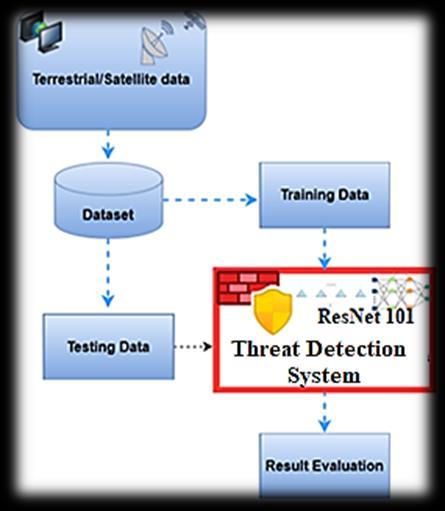
This study evaluates the performance effectiveness of a proposed thread detection framework using the STIN dataset. The STIN security dataset encompasses various types of attacks in both satellite and terrestrial networks, comprising nine terrestrial-type attacks and two satellitetypeattacks.Thedatasetisbuiltusingflow-basedfeatures, whicharedetailedinTable1.
Domain
Terrestrialattacks
Attack
MSSQLDDoS
UDPDDoS
PortmapDDoS
Backdoor
SynDDoS
LDAPDDoS
NetBIOSDDoS
Webattack
Botnet
Satelliteattacks DUPDDoS
SynDDoS
To formulate cybersecurity data for analysis, collect labelleddatasuchassystemlogsandnetworktraffic,which provideinsightsintonetworkactivity(e.g.,datatrafficheat maps). Pre-process the data through standardization or normalization to safeguard features are on the identical scale. Transforming raw network traffic or log data into CNN-friendlyformats,suchastime-seriesrepresentationsor 2Dheatmaps,isrepresentedinEquation1.

where represents the raw data, and represent the dataset'smeanandstandarddeviation,and representsthe normalizeddata.
TheResNet101architectureconsistsof101layers,formed by residual blocks that utilize skip connections to enable efficientinformationtransferbetweenlayersasillustratedin Fig. 2. ResNet core concept involves learning residual mappings,ratherthantheoriginalunreferencedmapping, allowing for effective training of deeper models without degradationissues[11].
International Research Journal of Engineering and Technology (IRJET) e-ISSN: 2395-0056
Volume: 12 Issue: 02 | Feb 2025 www.irjet.net p-ISSN: 2395-0072
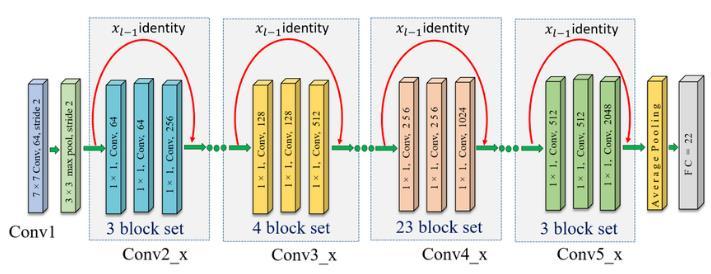
Fig - 2: ArchitectureoftheResNet101model
TheResNet101modelutilizesresidualblockstoextractdeep features from input data, capturing complex patterns essential for risk detection, as represented in Equation 2. TheResNet101modelisshowninFig.2.



where, represents weights of the convolutional layers. By doing so, the network learns the residualfunction whichisasimplermappingtolearn thanthedirectmapping enablingeasieroptimization oftheresidualfunctions.
(2)
where isthefeaturevectorthatresultsfromrunningthe ResNet101 model on the input . Back propagation and gradient descent techniques, usually Adam or SGD (Stochastic Gradient Descent), are used to optimize the model weights during the training phase in order to minimize a loss function. Cross-entropy loss, as shown in Equation3,isutilizedasthelossfunctionforclassification problems. (3)

Where, istheactuallabelofclass, classistheexpected probability, istheentirenumberofclasses(suchasvarious attack kinds). The modified weights are shown in Equation4 (4)
ResNet101outputwillbepassedthroughasoftmaxfunction toassignaprobabilityineachclasswhichisrepresentedin Equation5.

(5)
WhenclassI'soutputscoreisrepresentedby and ,the class'sexpectedprobabilityisdenotedby .Theanticipated threat type is chosen from the class with the highest probability.Equation6providesaformaldefinitionofeach residualblockinResNet101.


(6)
Theresidualblock'soutput iscomputedbyaddingthe block'sinput totheoutputoftheconvolutionallayers

The proposed model was implemented and trained using PythonandKerasonGoogleColab.Theexperimentalsystem ranonWindows10,withTensorFlowasthebackend,12.75 GB RAM, and GPU acceleration. The system utilized an NVIDIA GeForce GTX 1080Ti GPU, providing a significant boost in processing power, and an Intel Core i7-6850K processor.Themodel'sarchitecturewasoptimizedthrough hyperparametertuning,involvingsystematicexplorationof hyperparameter configurations to identify the optimal combination yielding the best classification performance. TheresultsofhyperparametertuningarepresentedinTable 2.Thesystem'sconfiguration enabled efficientprocessing andstorageoflargedatasets,rapidtrainingandtestingof the model, and seamless execution of DL computations. Overall, the system provided a robust and efficient environmentfordevelopingandtestingtheproposedmodel. Tuningthehyperparameterswasessentialtoimprovingthe model'sperformance.
Table – 2: Thesuggestedmodel'sHyperparameters
Hyper parameters Values
LossFunction CategoricalCrossentropy
NumberofEpochs 25
Learningrate
Dropout 0.2
BatchSize 16
Optimizer Adam
ActivationFunction Sigmoid
4. RESULTS AND DISCUSSION
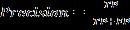
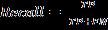
Evaluationmetricswereutilizedtoassesstheperformance oftheclassifier.Thesemetrics,representedbyEquations(7) to(10),provideacomprehensivecomparisonofalgorithmic effectiveness.Theassessmentofthesemetricsisbasedona confusion matrix, which predicts the true positives (TP), truenegatives(TN),falsepositives(FP),andfalsenegatives (FN),foradetailedevaluationofclassifierperformance (7) (8)

Volume: 12 Issue: 02 | Feb 2025 www.irjet.net p-ISSN: 2395-0072

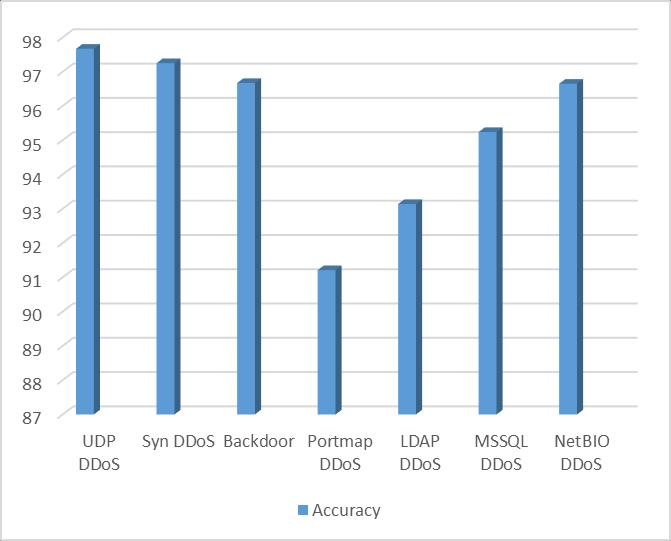
STINdatasetisusedtotestthesuggestedResNet101ability tooffer excellentsecurity forbothsatelliteandterrestrial networks.TheResNet101model'sabilitytodeliverexcellent securityforterrestrial-satellitenetworkswerethoroughly evaluatedusingtheSTINdataset.Thisdatasetservedasa comprehensive benchmark to identify the model's performanceindistinguishingandmodifyingvariouscyber threats. By utilizing the STIN dataset, the study demonstrates the ResNet101 model's efficacy in ensuring the security and integrity of network communications, thereby providing a robust defence against potential cyberattacks.Theresultsshowedpromisingoutcomes.The ResNet101 model's performance was assessed using the STINdataset,andtheresultsdemonstrateditssuperiority overothermodels.Themodelachieved97.67%accuracyin detecting UDP_DoS attacks, showcasing its exceptional capabilityinidentifyingthisspecifictypeofthreat.However, its performance was slightly lower for Syn_DDoS attacks, withanaccuracyof97.25%.
The categorization results, accessible in Table 3, further highlightexceptionalperformanceofthemodel.Whilethe accuracyscoresforthe"PortmapDDoS"and"LDAPDDoS" classeswerelower,at91.21%and93.14%respectively,the overallperformanceofthemodelwasstillsuperiortothatof other ML models. The lower accuracy scores for these specificclassescanberecognizedtothelimitednumberof training samples available. Despite this, the ResNet101 model demonstrated its effectiveness in detecting cyber threats, building it a valuable tool in the field of network security. These results are presented in Fig. 3, which illustrates the classifier's accuracy on the STIN terrestrial dataset.
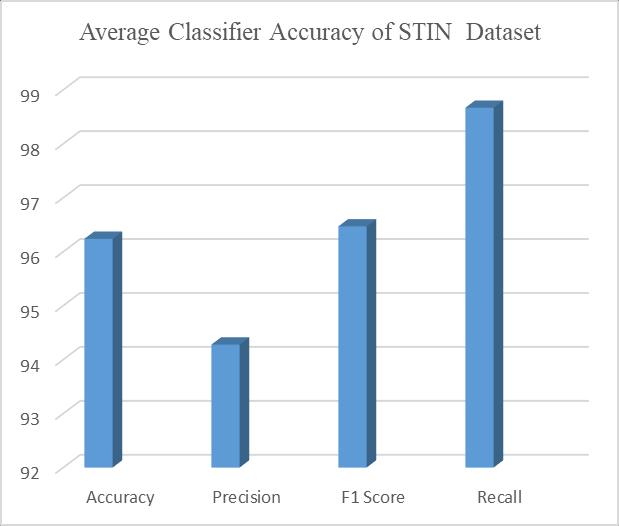
TheperformanceResNet101,wasevaluatedbyarangeof metrics.Table4.presentstheaverageclassifieraccuracyof STIN dataset, shows an overview of performance in the model. Fig. 4 shows a visual depiction of the model's effectiveness by displaying the average classification accuracy. These outcomes show how well the ResNet 101 modeldetectsandcategorisesassaults,resultinginauseful tool in the area of network security. Overall, the systems strong performance across the metrics highlights its potentialforreal-worldapplications.
Table – 4: AverageclassifieraccuracyoftheSTINdataset
International Research Journal of Engineering and Technology (IRJET) e-ISSN: 2395-0056
Volume: 12 Issue: 02 | Feb 2025 www.irjet.net p-ISSN: 2395-0072
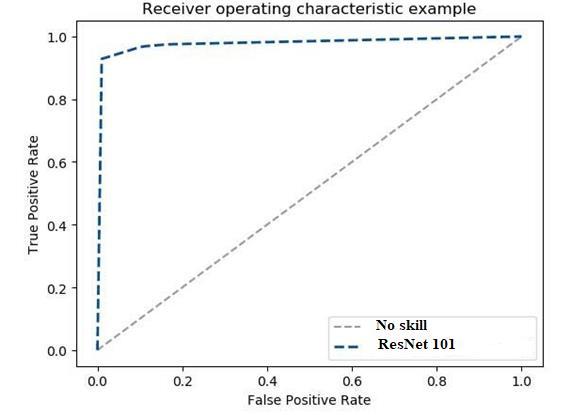
The ResNet 101 model demonstrated outstanding performance on the STIN dataset and achieved the remarkableaccuracy.Thereceiveroperatingcharacteristics (ROC) curve, illustrated in Fig. 5, further highlights the model's superiority. Notably, the model's computational complexitywasassessed,revealinganestimatedexecution time of 55 seconds on the STIN dataset. These findings collectivelyunderscoretheResNet101model'seffectiveness andefficiencyindetectingcyberthreats,makingitavaluable tool for providing the security of satellite and terrestrial networks
The proposed ResNet 101 model can be used as a benchmark for future research. Overall, this research has made a valuable role in field of cyber security and has providedavaluabletool indetectionandclassificationfor cyberthreatsinsatellite-terrestrialnetworks.
5. CONCLUSION
This study concludes by highlighting the significant contribution of the ResNet101 model to advancing cybersecurity through the application of optimal DL methods.Withanaccuracyof96.24%,precisionof94.28%, F1 score of 96.47, and recall of 98.67, the model demonstrates outstanding performance in reliable threat detection. Its effectiveness for real-time applications is furtherunderscoredbyitsprocessingtimeofapproximately 55 seconds, making it a viable solution for addressing modern cybersecurity challenges. The approach demonstrates its outstanding ability to rapidly and accurately detect and address attacks by using the STIN dataset. This study emphasises how important DL approaches are for improving security procedures and adjusting possiblehazardsindynamicallysettings. Future workshouldexploretheintegrationofdiversedatasetsand the development of hybrid strategies that combine traditional security approaches with DL. Additionally, the model’s ability to adapt to evolving cyber threats can be enhanced through the incorporation of adaptive learning techniques.Overall,thestudycontributetotheadvancement of AI-powered cybersecurity solutions and lay a solid
foundation for the effective protection of digital infrastructures.
[1] Li,Y.,&Liu,Q.(2021).Acomprehensivereviewstudyof cyber-attacksandcybersecurity;Emergingtrendsand recentdevelopments.EnergyReports,7,8176-8186.
[2] Akgun,D.,Hizal,S.,&Cavusoglu,U.(2022).AnewDDoS attacks intrusion detection model based on deep learningforcybersecurity.Computers&Security,118, 102748.
[3] Ashiku, L., & Dagli, C. (2021). Network intrusion detection system using deep learning.Procedia ComputerScience,185,239-247.
[4] Mughaid,A.,AlZu’bi,S.,Hnaif,A.,Taamneh,S.,Alnajjar, A.,&Elsoud,E.A.(2022).Anintelligentcybersecurity phishing detection system using deep learning techniques.ClusterComputing,25(6),3819-3828.
[5] Yu,K.,Tan,L.,Mumtaz,S.,Al-Rubaye,S.,Al-Dulaimi,A., Bashir, A. K., & Khan, F. A. (2021). Securing critical infrastructures:deep-learning-basedthreatdetectionin IIoT.IEEECommunicationsMagazine,59(10),76-82.
[6] Hnamte, V., & Hussain, J. (2023). DCNNBiLSTM: An efficienthybriddeeplearning-basedintrusiondetection system.TelematicsandInformaticsReports,10,100053.
[7] Mighan, S. N., & Kahani, M. (2021). A novel scalable intrusion detection system based on deep learning.International Journal of Information Security,20(3),387-403.
[8] Nasir, R., Afzal, M., Latif, R., & Iqbal, W. (2021). Behavioral based insider threat detection using deep learning.IEEEAccess,9,143266-143274.
[9] Maddireddy,B.R.,&Maddireddy,B.R.(2020).Proactive CyberDefense: UtilizingAI forEarly ThreatDetection andRiskAssessment.InternationalJournalofAdvanced EngineeringTechnologiesandInnovations,1(2),64-83.
[10] Singh,P.;Pankaj,A.;Mitra,R.Edge-detect:Edge-centric networkintrusiondetectionusingdeepneuralnetwork. InProceedingsofthe2021IEEE18thAnnualConsumer Communications&NetworkingConference(CCNC),Las Vegas,NV,USA,9–12January2021;pp.1–6.
[11] Demir,A.,Yilmaz,F.,&Kose,O.(2019,October).Early detection of skin cancer using deep learning architectures: resnet-101 and inception-v3. In2019 medical technologies congress (TIPTEKNO)(pp. 1-4). IEEE.