
International Research Journal of Engineering and Technology (IRJET) e-ISSN:2395-0056
Volume: 12 Issue: 04 | Apr 2025 www.irjet.net p-ISSN:2395-0072
International Research Journal of Engineering and Technology (IRJET) e-ISSN:2395-0056
Volume: 12 Issue: 04 | Apr 2025 www.irjet.net p-ISSN:2395-0072
Ms. Femil Rence L1 , Mrs. Grace Berin T2 & Mrs. Anusha K3
12nd year PG student, Ponjesly College of Engineering
2Assistant Professor, Ponjesly College of Engineering
3Assistant Professor, Ponjesly College of Engineering
Abstract Medical image analysis in dental diagnostics encounters significant challenges, particularly in precisely segmenting anatomical components within panoramic X-ray images. This research investigates the use of U-Net-based deep learning architectures for semantic segmentation of dental structures. Six U-Net variations, including Vanilla U-Net, Dense U-Net and Attention U-Net, were examined to evaluate their segmentation performance. The dataset comprised panoramic dental X-ray images, which underwent pre-processing through Contrast Limited Adaptive Histogram Equalization (CLAHE) and resizing to ensure efficient training. Performance metrics such as Dice Coefficient, Intersection over Union (IoU), F1 Score and Accuracy were utilized for model evaluation. Results demonstrated that Vanilla U-Net with two convolutional layers achieved an effective balance between accuracy and computational cost. Future research aims to further enhance segmentation precision through architectural advancements and dataset enrichment.
Key Words: Semantic Segmentation, U-Net, Panoramic Dental X-Ray, Deep Learning, Image Processing, Dice Coefficient, IoU, F1 Score.
Oral health plays a vital role in maintaining overall wellness, and the early detection of dental issues like cavities, gum diseases,andbonelossisessentialforsuccessfultreatment.PanoramicdentalX-rayimagingoffersadetailedoverviewoforal structures, making it a valuable diagnostic resource. However, conventional analysis of these images primarily depends on manual evaluation by dentists and radiologists, which can be time-consuming and susceptible to human error. Additionally, factors like varying image quality, differences in patient anatomy, and overlapping features make precise diagnosis more challenging.Inrecenttimes,ArtificialIntelligence(AI)anddeeplearningmethodshavedemonstratedremarkablepotentialin automatingmedicalimageanalysisandimprovingitsaccuracy[1],[2].TheseAI-basedsystemshavealreadyshownsuccessin cancer identification [3], lung disease prediction [4], and personalized treatments [5], highlighting their capability to transformhealthcare.
In the case of medical imaging, semantic segmentation models have gained substantial attention among deep learning approaches. U-Net stands out as a widely adopted architecture which is focused and designed for biomedical image segmentationtasks.Itfeaturestwomajorthingsaencoderanddecoderframeworkcombinedwithskipconnections,enabling accurate pixel-level classification while retaining spatial information [6]. Over time, various enhanced versions of U-Net, including Dense, Attention, Residual, and Nested, have been introduced to boost segmentation accuracy, improve feature transmission, and increase computational effectiveness [7]. Additionally, lightweight deep learning models have been exploredtoenhanceefficiencywhilemaintaininghighaccuracyinpanoramicdentalX-raysegmentation[8].AI-basedmodels have also been utilized in various medical imaging fields, including transformer-based DL networks for dental segmentation [9]andCNN-basedautomatedanalysisofdentalimplantsinCBCTimages[10].
ThisstudyfocusesonevaluatingandcomparingsixU-NetvariantsforsegmentingpanoramicdentalX-rayimagestoidentify the most effective model for clinical applications. The dataset undergoes pre-processing, annotation, model training, and validation, with segmentation performance evaluated using Dice Coefficient, Intersection over Union (IoU), F1 Score and Accuracy.Previousresearchhasdemonstratedtheeffectivenessofmulti-scalefeedbackfeaturerefinementU-Netformedical imagesegmentation[11]andtheapplicationofattentionmechanismsinU-Netforenhancedsegmentation[12].Additionally, advancements in computer-aided diagnostic (CAD) systems have facilitated the integration of AI-driven segmentation with real-time clinical decision-making tools [13]. By identifying the optimal U-Net variant for dental X-ray segmentation, this
International Research Journal of Engineering and Technology (IRJET) e-ISSN:2395-0056
Volume: 12 Issue: 04 | Apr 2025 www.irjet.net p-ISSN:2395-0072
research aims to advance automated dental diagnostics and contribute to the growing field of AI-powered healthcare solutions.

Image acquisition

Data annotation

Image resize

Clahe implementation
Data pre-processing


Compare & analysis
2.METHODOLOGIES
Data classification


Patchify implementation
Normalization


• Testing & evaluation
• Dice coefficient
• IoU
• F1 Score
• Accuracy

Network architecture for semantic segmentation

Training and validation
ThemethodologyadoptedforsegmentingdentalX-rayimagesisbasedonasystematicpipeline.Initially,panoramicdental X-ray images are acquired. These images are then annotated by assigning ground truth labels for model training. The preprocessing phase involves several enhancement techniques, including image resizing, applying CLAHE, patchify transformation,andnormalizationtoimproveimageclarity.Subsequently,theprocesseddataisutilizedtotrainvariousUNet-baseddeeplearningmodelsforsemanticsegmentation.Themodelsareevaluatedthroughperformancemetricssuchas Dice Coefficient, IoU, F1 Score, and Accuracy, enabling comparative analysis to identify the optimal model for dental diagnostics.
2.1. DATA COLLECTION
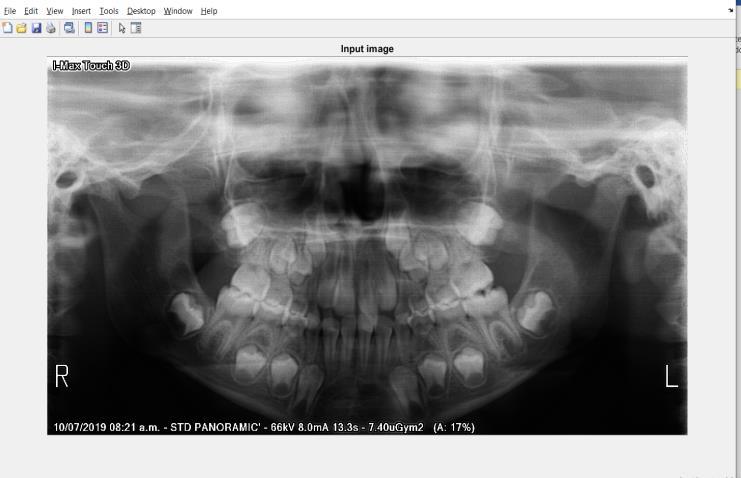
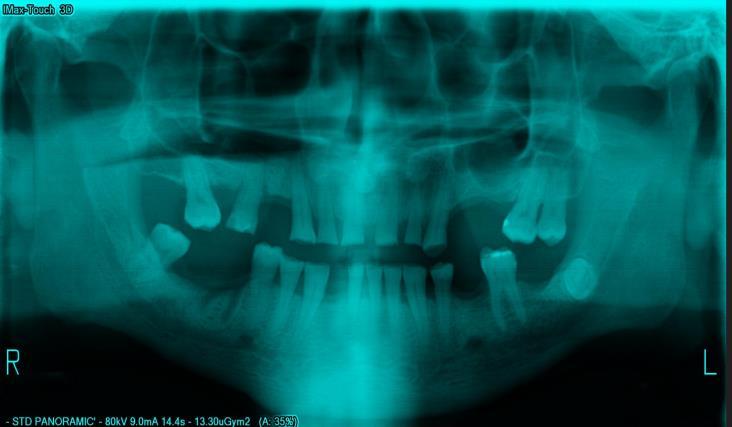
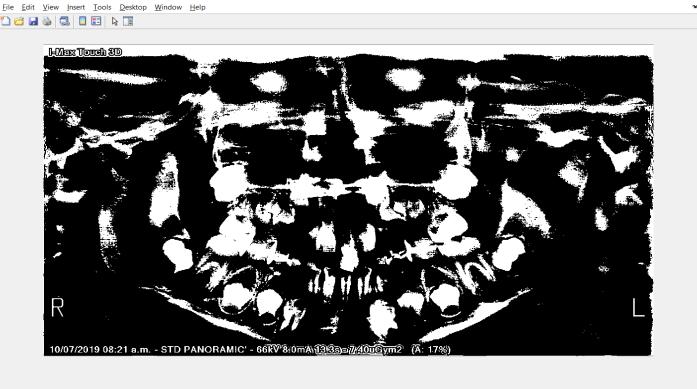
TheinputdatasetcomprisespanoramicX-ray(OPG)imagescollectedfromanopen-sourceKaggledataset.Additionally,raw imageswerecapturedusingaXiaomiRedmiNote9Pro64MPcameratoexpandthedataset.Theimagesrepresentpatients of various age groups and genders, with a focus on middle-aged individuals. Some images exhibit blue and grey tints, highlighting variations in imaging conditions. The dataset ensures diversity by including images of children, men and women,capturingarangeofdentalstructures.Thecollectedimagesserveasinputforthesegmentationmodels,providing real-worldvariabilityessentialforrobustmodelperformance.
International Research Journal of Engineering and Technology (IRJET) e-ISSN:2395-0056
Volume: 12 Issue: 04 | Apr 2025 www.irjet.net p-ISSN:2395-0072
Label Studio was employed to generate annotated training data by marking the dental regions in the X-ray images. The "SemanticSegmentationUsingMask" featurewasusedforlabeling, wherea fixedcolorcode(R=255,G=76 andB=66)was appliedtodistinguishtoothregionsconsistently.Foreachimage,aregionofinterestcalled"Tooth"wasdefined,andmanual masking was performed accordingly. These labeled masks serve as the ground truth for training the U-Net segmentation model.Theannotateddatasetenablesthedeeplearningmodeltoaccuratelyidentifytoothboundaries,ultimatelyenhancing segmentationresults.
2.3. DATA REFINEMENT
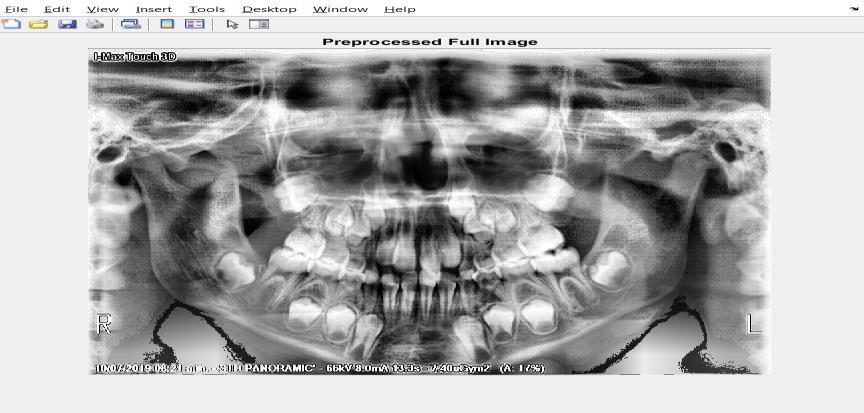
To enhance image quality and standardize input data for the model, multiple pre-processing steps were applied. Image resizing was performed where the original 4000 × 3000-pixel X-ray images were cropped to remove irrelevant areas and resizedto1024×1024pixelstoensurecompatibilitywithU-Netmodels.CLAHEwasemployedwithacliplimitof2.0anda tile grid size of (8,8) to enhance local contrast and amplify fine details in regions with low visibility. This technique effectivelymitigatestheeffectsofunevenilluminationandimprovesthevisibilityofanatomicalstructureswithinthedental X-ray images, facilitating better segmentation performance during model training. Since U-Net performs better with small image patches, the 1024 × 1024 images were divided into 256 × 256 patches using a 4 × 4 grid through Patchify implementation, which enhances model efficiency and allows finer segmentation. Pixel intensity values were normalized usinglinearscaling,convertingvaluesfromtherange0-255to0-1tostandardizeinputacrossthedataset.Thisensuresthat allinputimageshaveuniformpixelintensitydistributions,improvinglearningstability.
International Research Journal of Engineering and Technology (IRJET) e-ISSN:2395-0056
Volume: 12 Issue: 04 | Apr 2025 www.irjet.net p-ISSN:2395-0072
Thedatasetwasdividedintotraining,validation,andtestingsetsintheratioof8:1:1,usingafixedrandomstatevalueof42 to maintain reproducibility. Upon completion of the image enhancement procedures, a total of 6224 image-mask patches werecreated.Outofthese,4978patcheswereassignedfortraining,623patchesforcaseofvalidation,and623patchesfor testing.Thissystematicdatadivisionwillensurebettergeneralizationofmodelandreducesthepossibilityofoverfittingto specificdatacharacteristics.
A U-Net based deep learning framework was employed to perform semantic segmentation on dental panoramic X-ray images. U-Net, a fully convolutional neural network (FCN) with an encoder-decoder architecture, facilitates precise pixelwise classification. The network effectively captures spatial and contextual information while preserving image resolution throughitsskipconnections.Toenhancethemorphologicalseparationofadjacentstructureswithintheimages,apixel-wise weightmapw(x)wasutilized,mathematicallydefinedas: ( ) ( ) ( ( ( ) ( )) )
here w_c(x) represents the base weight map, d₁(x) and d₂(x) are distances to the nearest and second-nearest boundaries, andw₀=10andσ≈5pixelsinthisimplementation.MultipleU-Netvariantswereexplored,includingDenseU-Net,Vanilla U-Net, Attention U-Net and Residual U-Net. These divisions enhance performance by improving feature extraction, localizationandsegmentationaccuracy.
International Research Journal of Engineering and Technology (IRJET) e-ISSN:2395-0056
Volume: 12 Issue: 04 | Apr 2025 www.irjet.net p-ISSN:2395-0072
The training phase utilized the Adam optimizer with a learning rate of 0.0001 to optimize the U-Net model parameters. A batch size of 16 was employed, and the model was trained over 100 epochs using 4978 image-mask pairs for training, while 623pairswerereservedforvalidation.
Tounderstandthesegmentationperformanceofthemodel,severalevaluationmetricswereemployed.TheDiceCoefficient,in particular,wasusedtoquantifythesimilaritybetweenthepredictedsegmentationmasksandthegroundtruthannotations.Itis mathematicallyexpressedas:
whereXdenotesthepredictedandydenotes groundtruthsegmentationmasks.IntersectionoverUnion(IoU)evaluates segmentationqualitybymeasuringtheoverlapratioandisgivenby:
TheF1Scorebalancesprecisionandrecallforaccuratesegmentationresultsandiscomputedusing: ( ) ( ) ( )
Accuracyrepresentstheratioofcorrectlypredictedpixelstothetotalnumberofpixelsinthedatasetandisdefinedas Accuracy=(TP+TN)/(TP+TN+FP+FN)
These metrics collectively assess the efficacy of U-Net-based models in segmented dental structures, ensuring optimal performanceforclinicalapplications.
The U-Net-based model demonstrated exceptional performance in segmenting dental X-ray images, achieving a Dice Coefficient of 0.9904, IoU of 0.9809, F1 Score of 0.9904, and Accuracy of 0.9915. These impressive metrics highlight the model’s ability to accurately identify dental structures with minimal segmentation errors. Enhancing image contrast using techniqueslikeCLAHEimprovedtheclarityoflow-contrastregions,leadingtomoreaccuratesegmentation.Additionally,the use of patch-based segmentation allowed the model to focus on smaller regions, enhancing its ability to extract relevant features.However,slightchallengeswereencounteredincaseswithoverlappingstructuresorvaryingcontrast,occasionally causing misclassifications. Comparisons with other methods revealed that U-Net variants such as Dense and Residual performedbetterwhendealingwithcomplexdentalstructures.
The study further compared six different architectures of it, including two-layer and three-layer versions, on tooth segmentation in panoramic dental X-rays. All models delivered strong performance, with only slight variations in Dice Coefficientscores,suggestingminimal differences insegmentationquality. These resultsoffervaluableinsights forselecting themostsuitablemodelfordentaldiagnosticpurposes.Nonetheless,issueslikecomputationalloadandinferencespeedneed furtheroptimization.Futureimprovementscouldincludetheintegrationoftransformer-basedmodels,attentionmechanisms, and post-processing techniques to enhance accuracy and robustness across varied datasets. The study underscores the potentialofDLapproachesinsupportingAI-assisteddentaldiagnostics.
This study investigated the use of U-Net-based deep learning models for segmenting dental structures in panoramic X-ray images.Theexperimentalresultsconfirmedthehighprecisionandreliabilityofsemanticsegmentationtechniquesindental imageanalysis.Pre-processingstrategiessuchasCLAHE,normalization,andpatch-basedsegmentationplayedacrucialrole
International Research Journal of Engineering and Technology (IRJET) e-ISSN:2395-0056
inenhancingthemodel'sabilitytodetectfinestructuraldetails,resultinginimprovedsegmentationperformance.Although the model achieved impressive metrics including a Dice Coefficient of 0.9904 and an IoU of 0.9809 minor challenges persisted in cases with overlapping structures and inconsistent contrast. The findings provide valuable direction for selectingoptimalmodelstoensureaccurateandefficientdentalsegmentation.
Lookingahead,futureworkwillaimtooptimizemodelperformancebyimprovingprocessingspeedwithoutcompromising accuracy.Enhancingcomputationalefficiency,incorporatinghybridarchitectures,andrefiningpost-processingstepswillbe key areas of focus. These advancements hold promise for boosting segmentation precision across varied datasets. Overall, the results underscore the transformative role of AI-powered image analysis in dentistry, supporting the development of automatedtoolsthatcanassistdentalprofessionalsinmakingmoreinformedclinicaldecisions.
[1] J. S. Ahn, S. Shin, S.-A. Yang, E. K. Park, K. H. Kim, S. I. Cho, C.-Y. Ock, and S. Kim, ‘‘Artificial intelligence in breast cancer diagnosisandpersonalizedmedicine,’’J.BreastCancer,vol.26,no.5,p.405,2024.
[2]E.Dack,A.Christe,M.Fontanellaz,L.Brigato,J.T.Heverhagen,A.A.Peters,A.T.Huber,H.Hoppe,S.Mougiakakou,andL. Ebner,‘‘Artificialintelligenceandinterstitiallungdisease:Diagnosisandprognosis,’’Invest.Radiol.,vol.58,no.8,pp.602–609, Aug.2023.
[3] A. Mansur, A. Vrionis, J. P. Charles, K. Hancel, J. C. Panagides, F. Moloudi, S. Iqbal, and D. Daye, ‘‘The role of artificial intelligence in the detection and implementation of biomarkers for hepatocellular carcinoma: Outlook and opportunities,’’ Cancers,vol.15,no.11,p.2928,May2024.
[4] S. Lin, X. Hao, Y. Liu, D. Yan, J. Liu, and M. Zhong, ‘‘Lightweight deep learning methods for panoramic dental X-ray image segmentation,’’NeuralComput.Appl.,vol.35,no.11,pp.8295–8306,Apr.2023.
[5] S. S. Alharbi, A. A. AlRugaibah, H. F. Alhasson, and R. U. Khan, ‘‘Detection of cavities from dental panoramic X-ray images usingnestedU-Netmodels,’’Appl.Sci.,vol.13,no.23,p.12771,Nov.2023.
[6] B. M. Elgarba, S. Van Aelst, A. Swaity, N. Morgan, S. Shujaat, and R. Jacobs, ‘‘Deep learning-based segmentation of dental implantsoncone-beamcomputedtomographyimages:Avalidationstudy,’’J.Dentistry,vol.137,Oct.2023,Art.no.104639.
[7]O.Ronneberger,P.Fischer,andT.Brox,‘‘U-Net:Convolutionalnetworksforbiomedicalimagesegmentation,’’Med.Image Comput.Comput.-Assist.Intervent.,vol.9351,pp.234–241,2015.
[8]P.Amrollahi,B.Shah,A.Seifi,andL.Tayebi,‘‘Recentadvancementsinregenerativedentistry:Areview,’’Mater.Sci.Eng.,C, vol.69,pp.1383–1390,Dec.2016.
[9]X.Wang,Z.Hu,S.Shi,M.Hou,L.Xu,andX.Zhang,‘‘Adeeplearningmethodforoptimizingsemantic segmentationaccuracy ofremotesensingimagesbasedonimprovedUNet,’’Sci.Rep.,vol.13,no.1,pp.1–13,May2023.
[10]Z.Chen,S.Chen,andF.Hu,‘‘CTA-UNet:CNN-transformerarchitectureUNetfordentalCBCTimagessegmentation,’’Phys. Med.Biol.,vol.68,no.17,Aug.2023,Art.no.175042.
[11] X. Qin, M. Xu, C. Zheng, C. He, and X. Zhang, ‘‘Multi-scale feedback feature refinement U-Net for medical image segmentation,’’inProc.IEEEInt.Conf.MultimediaExpo(ICME),Jul.2021,pp.1–6.
[12]S.Hou,T.Zhou,Y.Liu,P.Dang,H.Lu,andH.Shi,‘‘TeethU-net:AsegmentationmodelofdentalpanoramicX-rayimagesfor contextsemanticsandcontrastenhancement,’’Comput.Biol.Med.,vol.152,Jan.2023,Art.no.106296.
[13] C. Sheng, L. Wang, Z. Huang, T. Wang, Y. Guo, W. Hou, L. Xu, J. Wang, and X. Yan, ‘‘Transformer-based deep learning networkfortoothsegmentationonpanoramicradiographs,’’J.Syst.Sci.Complex.,vol.36,no.1,pp.257–272,Oct.2022.
Volume: 12 Issue: 04 | Apr 2025 www.irjet.net p-ISSN:2395-0072 © 2025, IRJET | Impact Factor value: 8.315 | ISO 9001:2008 Certified Journal | Page1053
International Research Journal of Engineering and Technology (IRJET) e-ISSN:2395-0056
[14] T. J. Jang, K. C. Kim, H. C. Cho, and J. K. Seo, ‘‘A fully automated method for 3D individual tooth identification and segmentationindentalCBCT,’’IEEETrans.PatternAnal.Mach.Intell.,vol.44,no.10,pp.6562–6568,Oct.2022.
[15] R. Azad, E. K. Aghdam, A. Rauland, Y. Jia, A. H. Avval, A. Bozorgpour, S. Karimijafarbigloo, J. P. Cohen, E. Adeli, and D. Merhof,‘‘Medicalimagesegmentationreview:ThesuccessofU-Net,’’2022,arXiv:2211.14830.
[16]M.Z.Alom,M.Hasan,C.Yakopcic,T.M.Taha,andV.K.Asari,‘‘Recurrentresidualconvolutionalneuralnetworkbased on U-Net(R2UNet)formedicalimagesegmentation,’’2018,arXiv:1802.06955.
[17]R.Nicole,‘‘Artificialintelligenceapplicationsindentalimaging,’’Dent.AIRes.,vol.12,pp.123–134,2024.
Volume: 12 Issue: 04 | Apr 2025 www.irjet.net p-ISSN:2395-0072 © 2025, IRJET | Impact Factor value: 8.315 | ISO 9001:2008 Certified Journal | Page1054