
International Research Journal of Engineering and Technology (IRJET) e-ISSN: 2395-0056
Volume: 11 Issue: 12 | Dec 2024 www.irjet.net p-ISSN: 2395-0072

International Research Journal of Engineering and Technology (IRJET) e-ISSN: 2395-0056
Volume: 11 Issue: 12 | Dec 2024 www.irjet.net p-ISSN: 2395-0072
Smt. Seema .S. Jadhav*1,Vilas Kulakarni*2 , Smt.Akshata Kushtagi*3
*1Sr. Gr. Lecturer Department Of Civil Engineering, Government Polytechnic Bilagi, Karnataka, India.
*2 Lecturer Dept. Of Civil Engineering, Government Polytechnic Bilagi, Karnataka, India.
*3Lecturer Department Of Civil Engineering, Government Polytechnic Vijayapur, Karnataka, India ***
Abstract - Till now, the excessive release of Cd2+ ions in water became a foremost concern by way of threatening humanhealthseriously.Therefore,forremovalofheavymetal ions from waste water, adsorbent with high efficacy and lowcost technologies is most needed to alleviate the situation. In this work, robust, synthesized Metal-oxide monoliths (MnO2 andTiO2)bynanocastingprocessandtheirperformanceasan adsorbent for removal of heavy metal ( Cd2+) ions from aqueous water was successfully evaluated. The adsorption data shows better fit at pH 6.5, metal ion concentration of 30mg/l and contact time of 47.5 minutes. The maximum adsorptionefficacyof Cd2+ ions bymonolithswasfoundtobe 94.5% and 90.92 % respectively.
Key Words: Titanium di-oxide (TiO2 ), Manganese dioxide (MnO2 ), Cadmium, adsorption, Monolith, dosage
1.INTRODUCTION
In Asia around 4.4 billion i.e.60% of the world population lives, 1.2 billion in Africa (16%), 738 million i.e. 10% in Europe,theCaribbeanandLatinAmerica(634million)9%, andremaining5%(358million)inNorthernAmerica and39 million Oceania.OneandhalfbillionfromChina&onebillion inIndiaarethe2majornationsoftheglobesignifying19% and 18% of the world’s population. WHO-World Health Organizationin 2015 reported that663million(9%)ofthe globe’sresidents havenoaccesstopuredrinkingwater.48% sub-SaharanAfricaregionpopulationwillhavenoaccessto purewater,20%(134million)peopleofSouthernAsiabeing the 2nd highest. The rural areas population mainly affect withoutaccesstofreshdrinkingwater&sanitation. [1].
The presence of heavy metals like zinc, mercury, nickel, arsenic,chromium,cadmium inwastewater isincreasingday by day due to growth of industry and human activities, e.g., mining,useofbatteries,useofbioreactorsetc.Cadmium(isone such heavy metal which results from such activities.[2] The maximalpermissiblelimitforcd(cadmium)is 0.003mg/L. The above concentration is the threshold limit for the maintenanceofanecologicalequilibriumandpublichealth. Studyconcentratesin removal of Cd from waste water withthe process of adsorption.Removalofcadmiumfrom waste water by using titanium di-oxide and manganese
oxideasnoanoadsoebants haveshownbetterresultsasa verygoodadsorbents.[3]
Nanotechnologyistheuseofnanoscience,whichis the study of nano scale constituents that demonstrate remarkablefunctionality,propertiesandphenomenadueto the effect of small sizes. Nanotechnology depends on the operation, control, and settlement of particles & atoms to shape things, constructions, segments, gadgets, and frameworks at the nano scale. Some of the capable water treatmentmethods/toolspresentedbynanotechnologyare Nano-sorbents(Adsorption),Nano-filtration(Membranesand membraneprocesses),Photocatalysis[4].
Metal Oxide Based Nano materials: Nano sized metaloxide have extraordinary properties, with great removalcapacityandselectivitytoheavymetals.So,they offer promising capable adsorbents for heavy metals. Metaloxidesnanoconstituentscomprisesofnanosized zincoxide,ironoxide,titaniumoxide,manganeseoxide, zirconiumoxideandaluminumoxideetc.[5]
Manganese Oxides Based Nano materials: Nano crystalline manganese oxide with large surface area shows excellentadsorptioncapacity.[6]
TitaniumOxidesBasedNanomaterials:Titaniumoxide, degradestheorganicimpuritiesandhence usedforthe heavymetalremoval.[7].
Advantages
The advantages of using Nanotechnology in wastewater treatmentare:
Costsavingonmaterialsandlesswasteonrawmaterial, i.e.Hugenumberofsampletestingdoneonalowestscale, hencerawmaterialusagewillbemoreeffective.Useof catalysts(Nanoscalechemicalreagents)enhancesrateof chemicalreaction.[8]
Cleaner,mporeeffectiveindustrialpractices.
International Research Journal of Engineering and Technology (IRJET) e-ISSN: 2395-0056
Volume: 11 Issue: 12 | Dec 2024 www.irjet.net p-ISSN: 2395-0072
Enhanced capability to identify and remove contaminationbyrefiningwater,airandsoilquality.
Greataccuracymanufacturingbydecreasingquantityof waste.
Refecilitatingenvironmentaldamages.[9]
Disadvantages
Thedisadvantages/probablehazardsneedtobeconsidered usingnanoparticles:
The main disadvantages of nano particle is analysis method,asnanotechnologyprogresses,newandunique nano materials are steadily established. The materials size&shapeplaysavitalroleindefiningthetoxicity.
Also,dataofthechemicalconfigurationisabasicelement to decide how poisonous the material is, and slight variations of chemical set would certainly result in featurechange.[10]
Highriskevaluationonenvironmentalimpact&lifehas to be forced to be assessed in the least phases of engineering.Thechanceevaluationoughttoembody the contact risk and its probability of exposure, toxicological analysis, transport risk, persistence risk, transformationriskandskilltorecycle.[11]
Largevitalityrequiredforblendingnanoparticlescausing highvitalitydemand.
Lack of skilled workers & engineers affecting further concerns[12].
1.2 Objectives of present study
TostudyadsorptionbyusingmetaloxidemonolithsMnO2 andTiO2 InremovalofCd.
TostudytheinternalstructureofmonolithusingSEM.
To study the adsorbent capacity by varying various factors adsorbent dosage, initial concentration, contact time,pHofthesolution
TostudyadsorptionwithDesignSoftwarebyusingRSM (Response Surface Methodology) by design of Central composite.
Adsorptionisasurfaceattritionwhereintoxinsareadhered tosolidsurface.Aparticle(pollutant)stickingtothesurface is adsorbate, and surface is adsorbent. This phenomena, occurs by physisorption or chemisorption. The significant models are Freundlich, Langmuir, Halsey, and Smith,
Henderson,Elovichfluidfilmdissemination,intramolecule dispersion,andLagergren.[13]
The Langmuir and Freundlich models are most broadly utilized.
Langmuir Model: Adsorption happens uniformly on the dynamicspotsoftheadsorbents,andwhentheeverysingle adsorptivespotareinvolvedbytheadsorbates,nofurther adsorption exercises on these locales. The mathematical representationofLangmuirmodelisexpressedas:
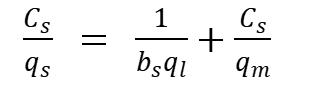
WhereCsrepresentsequilibriumadsorbateconcentration (mg/l), qs represents equilibrium adsorption capacity of adsorbent(mg/g), representsadsorptionequilibrium constant & ql represents saturated solo layer adsorption capacity(mg/g)[11].
FreundlichModel: Itdefinestheheterogeneousadsorption process on surface and at specificactive sites through discreteenergyformedonmultilayeradsorption.Thismodel providesestimationofsorptionefficiencyofadsorbateonan adsorbent.Themathematicalrepresentation of Freundlich Modelisexpressedas:
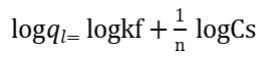
Where Cs = equilibrium concentration of the adsorbate (mg/l),ql=equilibriumadsorptioncapacityoftheadsorbent (mg/g),n=constanti.eadsorptionindex&Kf=Freundlich constant[14].
3.1 Materials used
Synthesized Titanium di oxide and Manganese di oxide monolithswereusedasadsorbentspreparedfromsilica monoliths, with diameter of 0.5cm and length of 0.8cm with99%puritypurchasedfromNANOSHEL.
CadmiumcarbonateCdCO3wasusedasadsorbate.
ThesolutionpHwasadjustedwithSodiumhydroxideand Hydrochloricacidof1N.
Equipments needed for experiment were AAS (Atomic absorption spectroscopy), pH meter, rotary shaker and weighingbalance.
© 2024, IRJET | Impact Factor value: 8.315 | ISO 9001:2008 Certified Journal | Page673
International Research Journal of Engineering and Technology (IRJET) e-ISSN: 2395-0056
Volume: 11 Issue: 12 | Dec 2024 www.irjet.net p-ISSN: 2395-0072
PreparationofAqueouscadmiumsolution:
Synthetic Cadmium sample will be prepared by dissolving 1.533gCadmiumcarbonate(AnalyticalReagent)inonelitreof doubledistilledwater.
3.3 Adsorbents
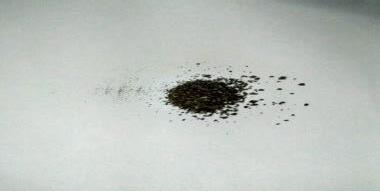
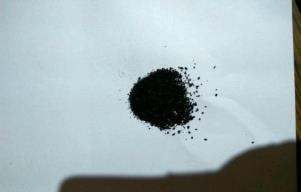
Monoliths of metal oxide with progressively permeable structurescanbesetupbyutilizingnanocastingprocess.Inthis method,poresoftheparentalsilicahavebeenimmersedwith desiredsaltsofmetalionsolution.Thenbyfurtherheating,the metalsaltischangedovertorelatingmetaloxides.Towardthe end,silicapartgetsevacuatedbyeitherKOHorNaOH.Theuse of prepared monoliths of metal oxide is a function of pore diameteralongwithsurfaceproperties.Theporosityofmetal oxide monoliths can be modified by modifying the pore size. IntegrateddifferentporesizecontrolledTiO2 andMnO2 bya nano casting technique utilizing guardian mesoporous silica havebeenutilizedasadsorbents.
3.4 Experimental designs.
Thetables3.1aretheindependentvariableswhosevalues rangebetweenlower andhighervalue.Theexperimentsare conductedin30runs,witheachrunwithvaryingvariables and Response of each run is calculated. The independent variablesforpHvariesfrom 3-10 (i.e 0.5, 3, 6.5, 10,13.5), adsorbent dosage from 10-20 mg( 5,10,15,20,25), initialconcentration10-50mg/l(i.e10,30,50,70)andcontact timefrom15-80minutes(15,47.5,60,80,112.5).Eachrun willbeconductedwiththecombinationofdifferentvariables andresponseiscalculatedforeachrun.
TABLE3.1
FACTORSWITHINDEPENDENTVARIABLESWITHLOWERANDHIGHER RANGE
Factors Ranges lower higher pH 3 10
Dosage (mg) 10 20
Initial Concentration(mg/l) 10 50
ContactTime (minutes) 15 80
4.1 Characterization study
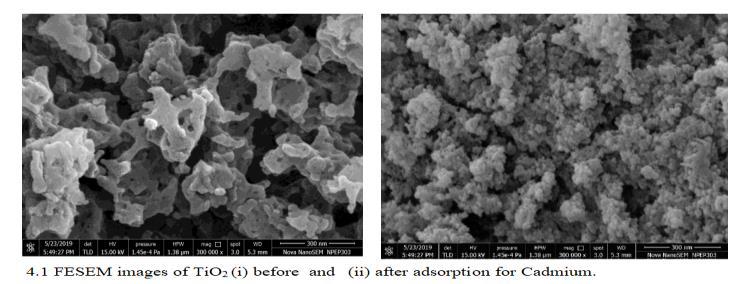
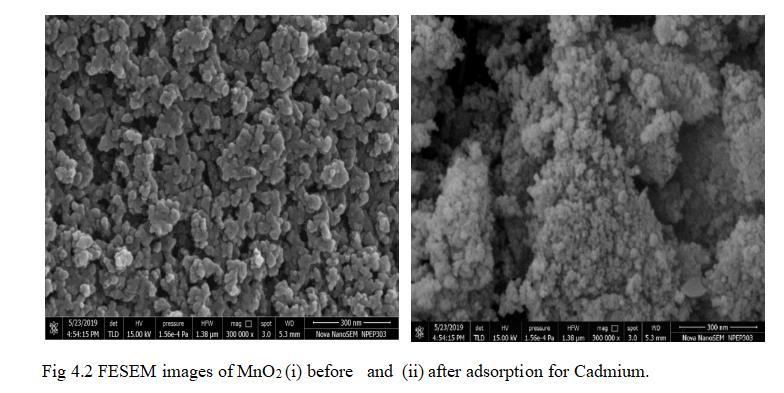
4.2 Adsorption method (Batch process)
Metal-oxide monoliths (MnO2 and TiO2) were used to conductbatchtrialsbyusing Responsesurfaceapproachby designingwithcentrecomposite strategy. The testwere performedforeachsetofrunsfordifferent pH,contacttime, metal concentration and agitation speed of 200 rpm. The independentvariablesforpHvaries from3-10(i.e0.5, 3, 6.5, 10,13.5), adsorbent dosage from 10-20 mg( 5,10,15,20,25), initial concentration 10-50 mg/l(i.e. 10, 30,50,70) and contact time from 15-80 minutes (15, 47.5, 60,80,112.5). AASwasusedtostudythebrokedownCd from a standard arrangement of cadmium carbonate individually. The adsorption is determined by the below formulae.
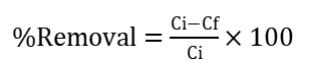
Where,Ci =initial concentration(mg/l).
Cf =Final(equilibrium)concentration(mg/l).
4.3 Adsorption of cadmium using TiO2 monolith
Removal % = -54.19267+8.19432* pH +11.81291*Dosage+0.474595*Concentration +0.655846*ContactTime-0.008071* pH * Dosage +0.011161* pH *Concentration +0.003516*pH*Contact Time-0.000437*Dosage*Concentration-0.008077*Dosage* Contact Time -0.003188*Concentration * Contact Time0.572279* pH² -0.365667* Dosage² -0.005885* Concentration²-0.003273*ContactTime².
International Research Journal of Engineering and Technology (IRJET) e-ISSN: 2395-0056
Volume: 11 Issue: 12 | Dec 2024 www.irjet.net p-ISSN: 2395-0072
The above expression gives the response for each run, consideringeachfactor withdifferentfactorcombination.
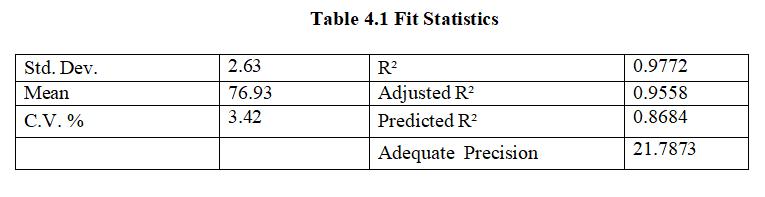
ThePredictedR²of0.8684isclosetoAdjustedR²of0.9558; i.e. difference being 0.2. Adequate Precision value with 21.787isacceptable,hencecanbeusedfordesign.
4.3.1 Effect of pH on removal efficiency of TiO2:
ToexamineadsorptionofCadmiumbymonolithsofmetal oxide,15mgofTiO2wasaddedto30mg/lof100mlCadmium solutionatpH6.5.HClorNaOHwasaddedtoalterthepHof Cadmiumsolution.
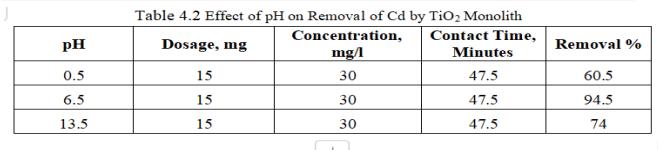
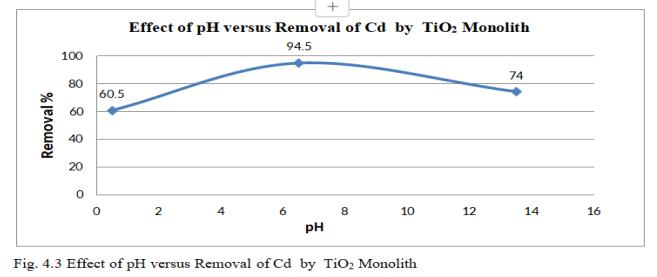
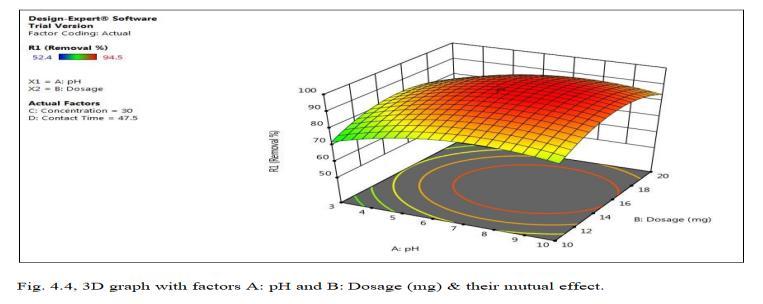
Fig.4.3 illustrates the removal efficiency of Cd by TiO2 monolith of 94.5% at pH of 6.5. Fig.4.4, shows 3D graph showing interaction of parameters at optimum dosage of 15mg,andcontacttimeof47.5minutes.
pHeffectonadsorptionofCd2+showedmaximumremovalat pH6.5anddecreasedsignificantlyasthepHincreases. At lesserpH,theadsorbentsurfaceexhibitspositivechargedue toincreaseinH+ ionsandhencethematerialtobeadsorbed i.e.,Cdionsbeingpositiveexperiencesarepulsiveforceand
8.315
thushinderingtheadsorptionprocessandfurtherH+ along withCadmiumionswillalsocompetefortheadsorption sites present thus opposing the uptake of adsorbate by the adsorbent. On other hand, at higher pH, surface of the adsorbent will be charged negatively thus enhancing the adsorption process of positive charged metal ions. Precipitation of metal ions as its hydroxide occurs with furtherincreaseinpH.
4.3.2 Effect of dosage on adsorption
Dosage effect was studied on surface of TiO2 monolith for Cadmium, adsorption experiments were performed at differentdosagesof(10-20)mg.
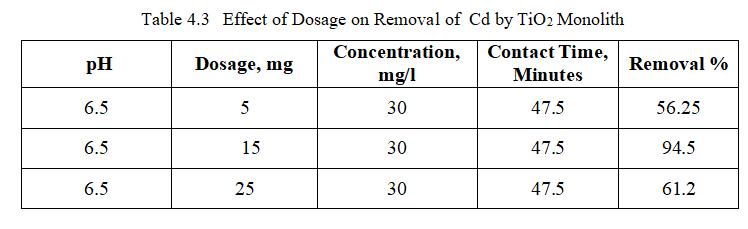
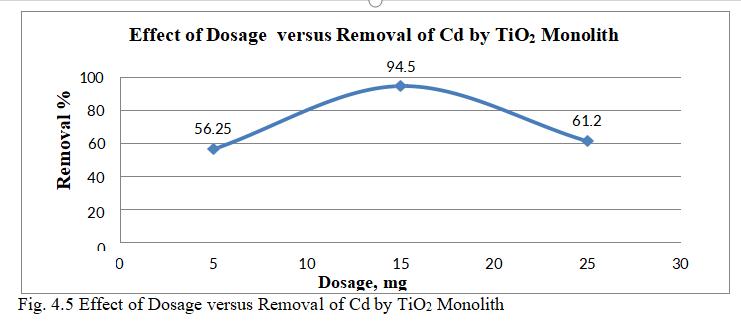
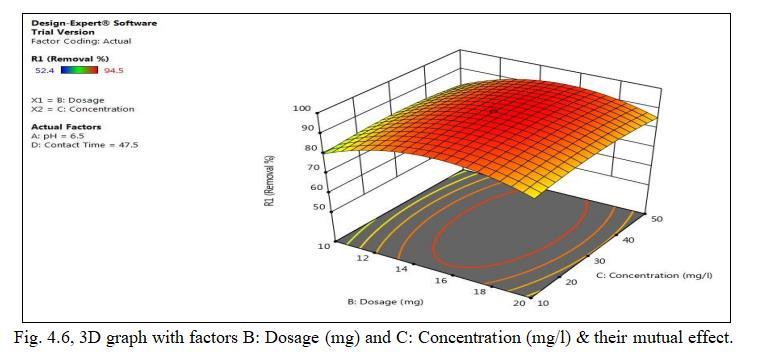
Fig.4.5 illustrates the removal of Cd by TiO2 monolith of 94.5% at adsorbent dosage of 15mg. Fig.4.6, 3D graph showing mutual effect of parameters at 6.5 pH and concentration of 30mg/l.The above figure represents adsorbentdosagehasincreasedfrom15to25mg;removal efficiencygoesondecreasing,thoughthenumberofactive sites present may be more. This may be mainly due to Agglomeration of TiO2 monolith or unsaturation of sites duringtheprocess.
International Research Journal of Engineering and Technology (IRJET) e-ISSN: 2395-0056
Volume: 11 Issue: 12 | Dec 2024 www.irjet.net p-ISSN: 2395-0072
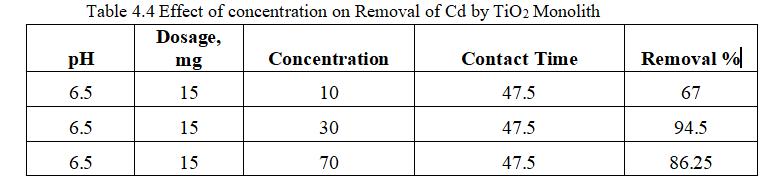
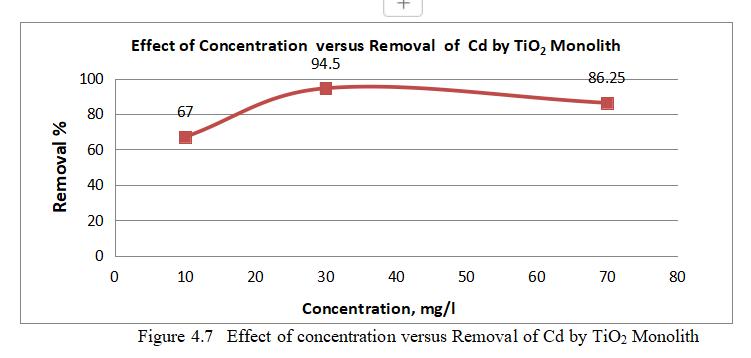
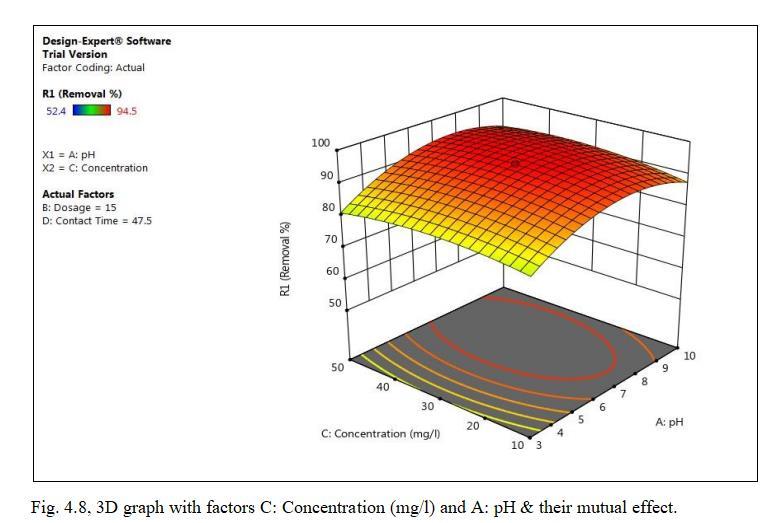
4.3.3
ToexaminetheeffectofconcentrationonthesurfaceofTiO2 forCdadsorptionexperimentswereperformedatdifferent concentration(10-50)ppm.
4.3.4
ToexamineeffectofcontacttimeonsurfaceofTiO2monolith for Cd adsorption experiment was performed for contact time(15-80)minutes.
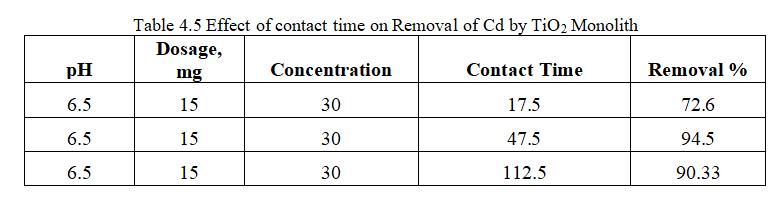
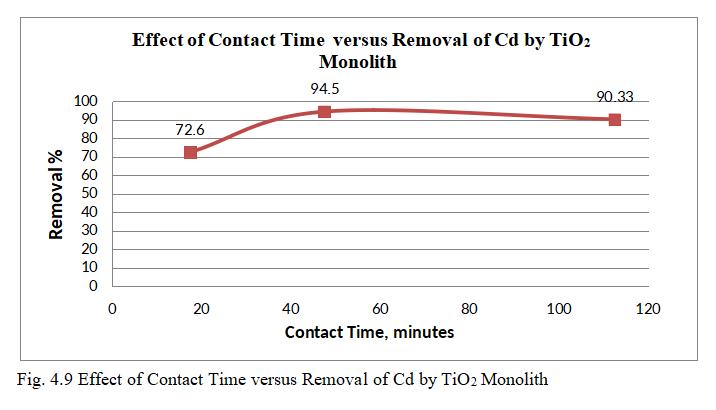
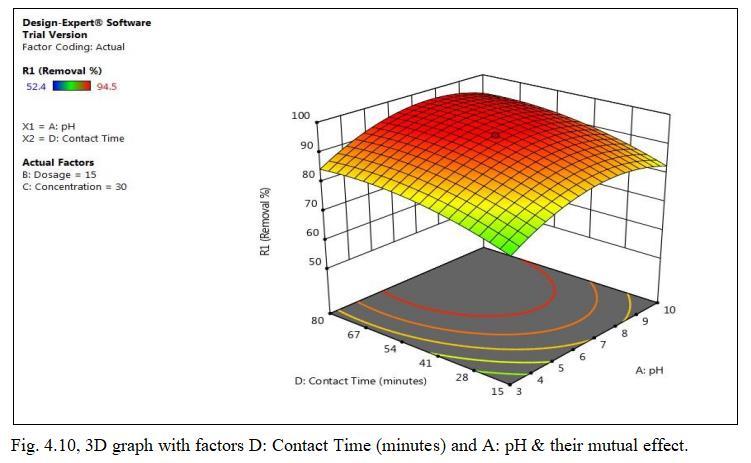
Fig.4.9illustratesremovalCdbyTiO2 monolithof94.5%at contacttimeof47.5minutes.Fig.4.10,3Dgraphsshowing interactionofparametersatoptimumdosageof15mgandpH of6.5.Theabovegraphsrepresentthatoncetheequilibrium is reached i.e saturation of active sites by Cadmium ion occurs within 47.5 minutes; further increased efficiency cannotbeobtainedbyincreasingthecontacttime.Thismay bemainlyduetodesorptiononcethesitesaresaturated.TiO2 monolith has shown removal efficiency of 94.5% with optimumpHof6.5,dosageof15mg,concentration0f30mg/l withcontacttimeof47.5minutes.
4.4 Adsorption of cadmium using MnO2 monolith
Removal % = -47.22855 +4.14756*pH +10.78810 *Dosage +1.24944*Concentration+0.458851*ContactTime +0.056250 * pH * Dosage+0.003366* pH * Concentration+0.018599 *pH * Contact Time-0.042781 *Dosage * Concentration+0.000781 *Dosage * Contact Time+0.001774 *Concentration * Contact Time-0.385213* pH²-0.307404* Dosage²-0.009100* concentration²0.005636*ContactTime².
Theaboveequationexhibits,relationbetweeneachfactors consideredforeach runwhereremovalcanbeobtainedwith influenceofeachfactoroneachrun.
International Research Journal of Engineering and Technology (IRJET) e-ISSN: 2395-0056
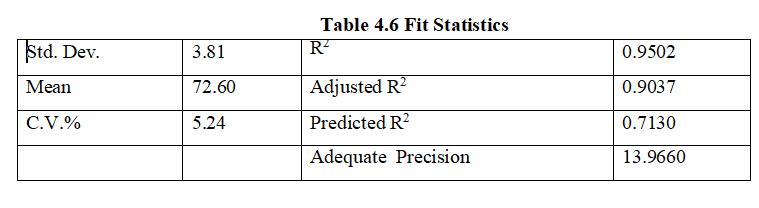
ThePredictedR²value0.7130isinsensibleconcurrencewith theAdjustedR²value0.9037;i.edifferenceislessthan0.2. AdequatePrecision13.966isapproved,thereforecanbeused indesign.
4.4.1 Effect of pH on adsorption:
pH influence on adsorption of Cadmium by monoliths of metaloxide,dosageof15mg(MnO2)wasaddedto30mg/lof 100mlCadmiumsolutionat6.5pH.HClorNaOHwasadded toalterthepHofCadmiumsolution.
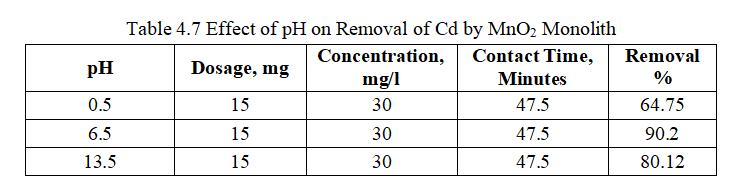
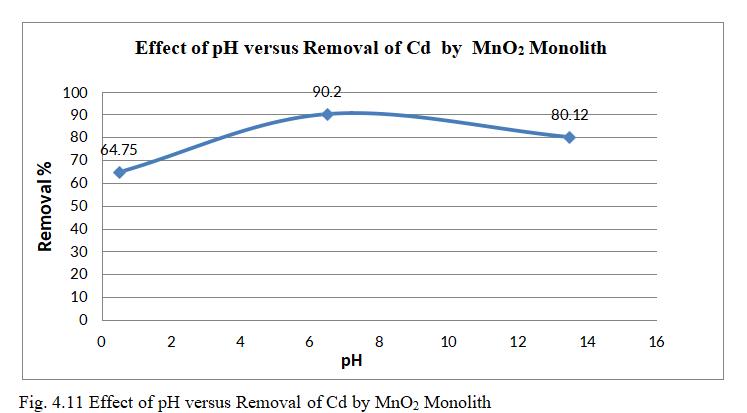
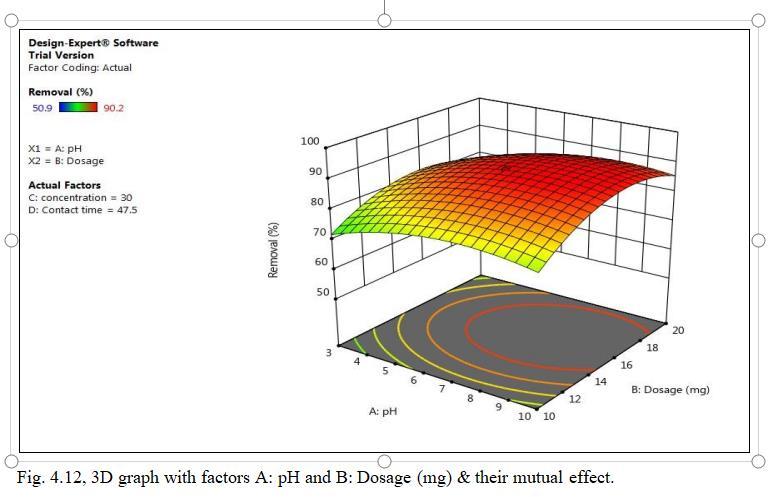
Fig.4.11illustratesremovalofCdbyMnO2 monolithof90.2% atpHof6.5. fig.4.12isa 3Dgraphshowingmutualeffectof parametersatoptimumdosageof15mgandconcentrationof 30mg/l.pHinfluenceonadsorptionofCadmiumionsshowed maximum removal efficiency pH 6.5 and decreased significantlyasthepHincreases.AtacidicconditionCadmium
withpositivechargeandManganesewithnegativecharge, adsorptionoccurs byelectrostaticattraction.AthigherpH thisattractionbecomesweakandhenceefficiencydecreases.
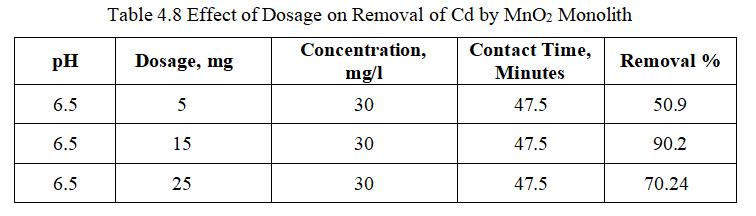
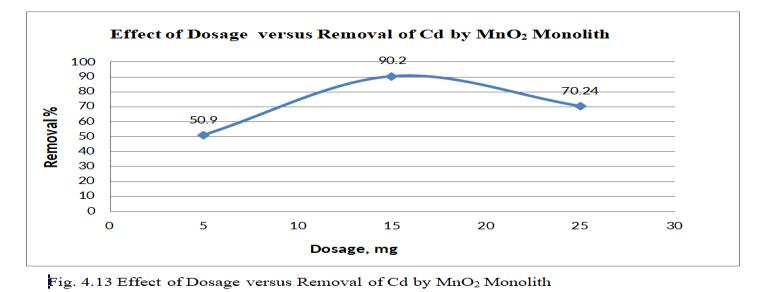
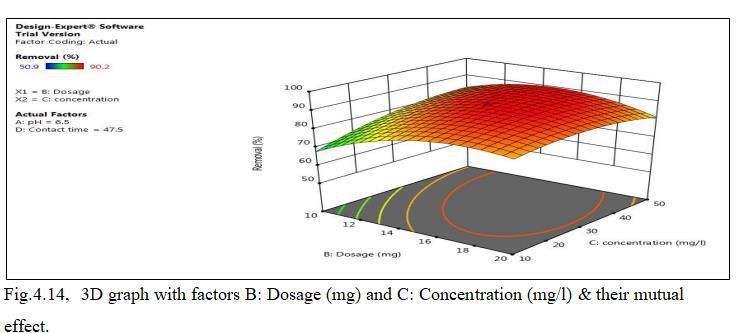
Fig.4.13illustratesremovalofCdbyMnO2 monolithof90.2% at adsorbent dosage of 15mg. Fig.4.14, 3D graph showing interaction of parameters at pH 6.5 and concentration of 30mg/l.The above figure shows that adsorbent dosage is raised from 15 to 25mg; removal efficiency goes on decreasing,thoughthenumberofactivesitespresentmaybe more. This may be mainly due to Agglomeration of TiO2 monolithorunsaturationofsitesduringtheprocess.
4.4.3 Effect of Concentration on adsorption
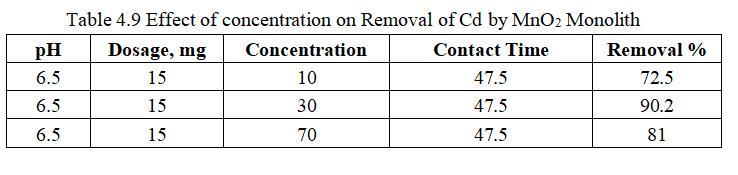
Influenceofconcentrationwasnoticedbyaddingdosageof 15mg,pH6.5withcontacttimeof47.5minutes.
Volume: 11 Issue: 12 | Dec 2024 www.irjet.net p-ISSN: 2395-0072 © 2024, IRJET | Impact Factor value: 8.315 | ISO 9001:2008
International Research Journal of Engineering and Technology (IRJET) e-ISSN: 2395-0056
Volume: 11 Issue: 12 | Dec 2024 www.irjet.net p-ISSN: 2395-0072
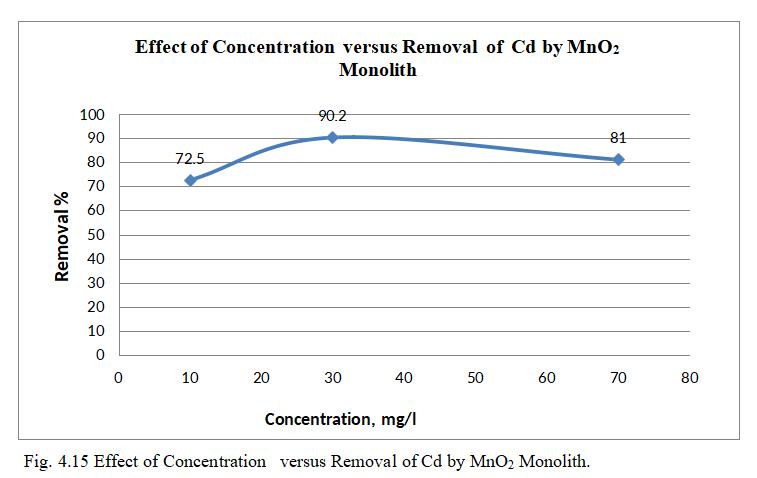
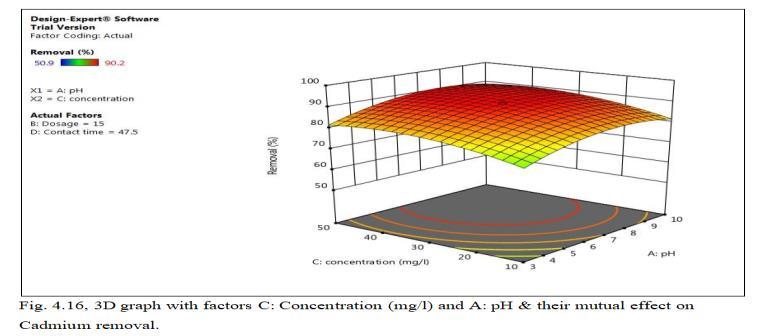
Fig.4.15 illustrates removal of Cd by MnO2 monolith of 90.98% at concentration of 30mg/l. Fig.4.16, 3D graph showingmutualeffectofparametersatoptimumdosageof 15mg,andpHof6.5.Theabovegraphsshowthatadsorption increaseswithincreasedleadionconcentrationupto30mg/l. With increase in Cadmium ion concentration, the removal efficiencydecreasesduetolessactivesitesandsurfacearea.
4.4.4 Effect of Contact Time on adsorption
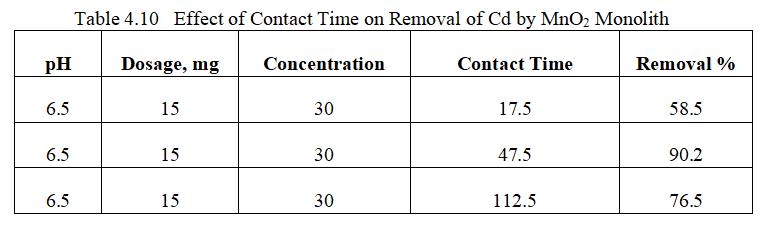
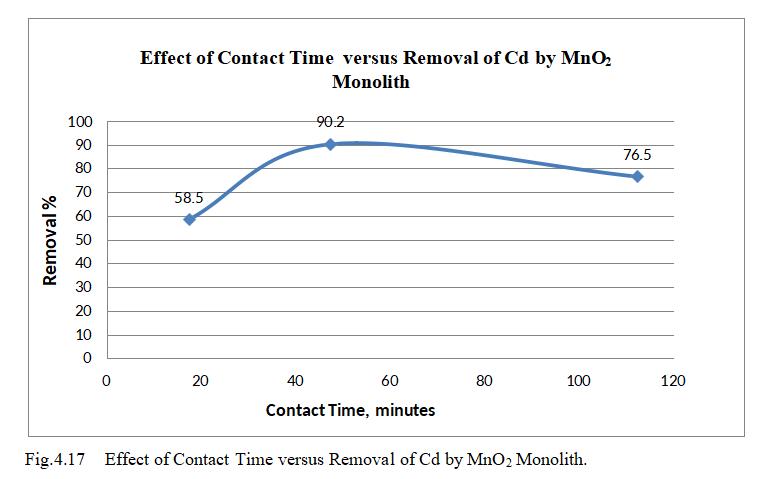
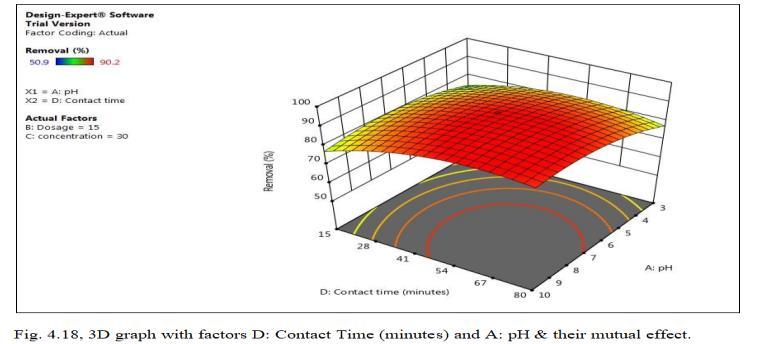
Fig.4.17 illustrates removal efficiency of Cd by MnO2 monolithof90.98%atconcentrationof30mg/l.Fig.4.18, 3D graph showing mutual effect of parameters at optimum dosageof15mgandpHof6.5.Theabovegraphsshowthat adsorption increases with increased Cadmium ion concentration upto 30mg/l. Increase in Cadmium ion concentration, the removal efficiency decreases due to limiting amount of adsorbent dosage.MnO2 monolith has shownremovalefficiencyof90.2%withoptimumpHof6.5, dosageof15mg,concentration0f30mg/lwithcontacttime of47.5minutes.
4.5 Comparisonstudy onremovalofcadmium by using TiO2 and MnO2 monolith
4.5.1 Effect of pH on Removal efficiency of Cd Using TiO2 and MnO2
InfluenceofpHisnoticedbydrawingcomparativegraphof bothmetaloxideatconstanttime,dosageandconcentration.
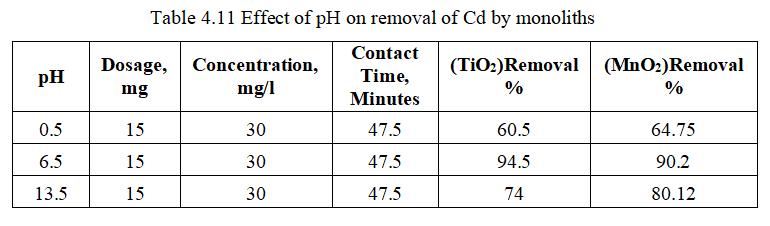
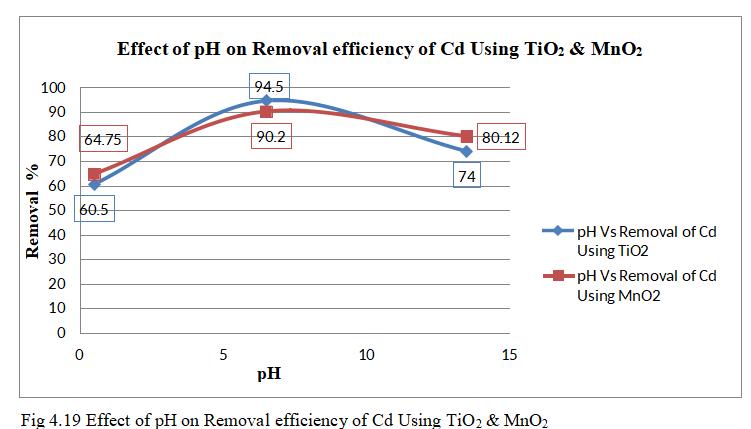
Theabovefig.4.19showsthecomparativegraphofremoval ofCdbyTiO2 andMnO2 monolithswithvaryingpHfrom0.5 to 13.5. TiO2 has highest removal efficiency of 94.5% as comparedwithMnO2 with90.2%atoptimumpHof6.5.
International Research Journal of Engineering and Technology (IRJET) e-ISSN: 2395-0056
Volume: 11 Issue: 12 | Dec 2024 www.irjet.net p-ISSN: 2395-0072
4.5.2 Effect of Dosage on Removal efficiency of Cd
Using TiO2 & MnO2
Dosageeffectforbothmonoliths was noticedbyplottinga comparativegraphatfixedconcentration,time&pH.
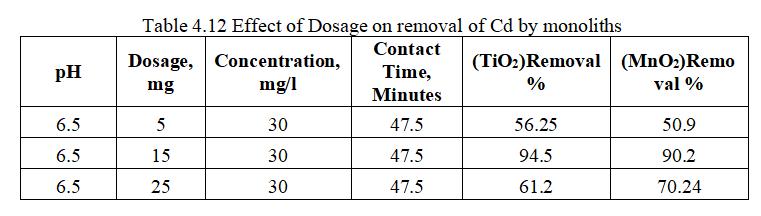
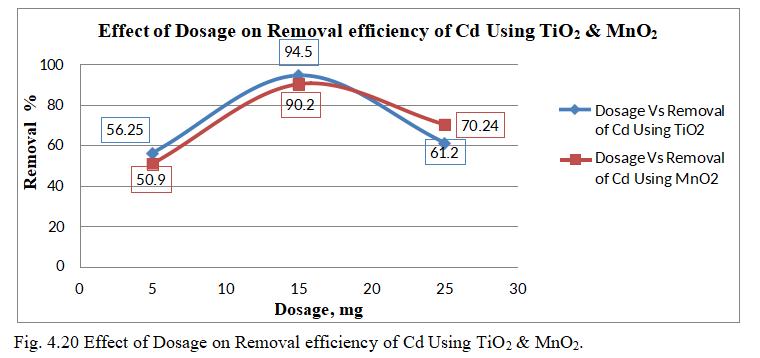
Fig. 4.20 shows a comparative graph on removal of Cd by TiO2 and MnO2 monoliths with varying Dosage from 5 to 25mg. TiO2 has highest removal efficiency of 94.5% as compared with MnO2 with 90.2% at optimum dosage of 15mg.
4.5.3 Effect of Concentration on Removal efficiency of Cd
Using TiO2 & MnO2
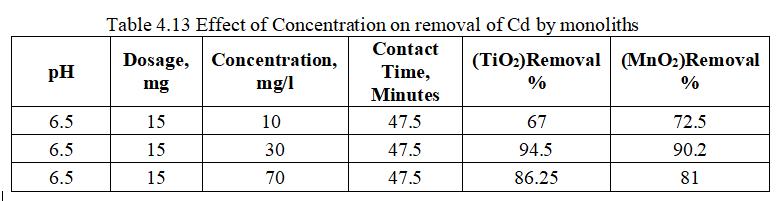
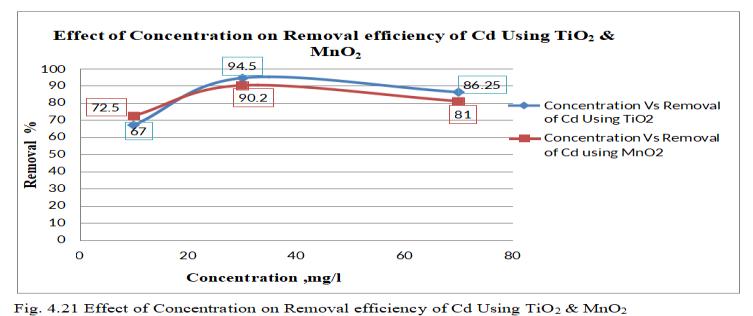
The above fig. 4.21 represents a comparative graph of removalefficiencyofCdbyTiO2 andMnO2 monolithswith varying Concentration of 10 to 70mg/l. TiO2 has highest removalefficiencyof94.5%ascomparedwithMnO2 with 90.2%atoptimumConcentrationof30mg/l.
4.5.4 Effect of Contact Time on Removal efficiency of Cd Using TiO2 & MnO2
Comparativegraphofvaryingcontacttimeisdrawn toobservetheremovalofCdbymonoliths.
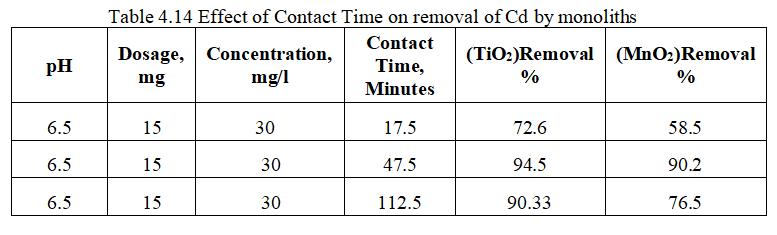
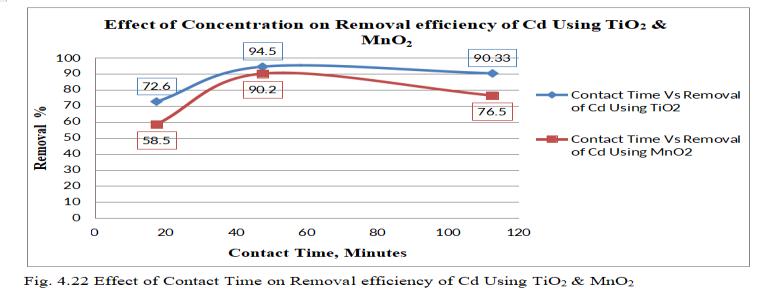
Theabovefig.4.22exhibitsacomparativegraphofremoval of Cd by TiO2 and MnO2 monoliths with varying Contact Timeof17.5to112.5minutes.ItisobservedthatTiO2 has highestremovalefficiencyof94.5%ascomparedwithMnO2 with90.2%atContactTimeof47.5minutes.
Batch experiment conducted with varying pH, dosage, concentration and contact time TiO2 proved to be more efficient in removal of cadmium with 94.5 % than MnO2 monolithwith90.2%.
In this work, TiO2 and MnO2 monolith synthesized monolith were utilized as an adsorbent for adsorption of Cd2+ionsfromaqueoussolution.Foradsorptionprocessof metalions,alltheexperiments wereexecutedindifferent batchesinpreciseenvironmentwithvarying pH,optimum dosage, metal ion concentration, and contact time. Experiments verified that removal of cadmium by using TiO2 andMnO2 monolithasadsorbentsshowedremoval efficiencywith94.5%and90.92%withoptimumdosageof 15mgwithpHof6.5,metalionconcentrationof30mg/land contact time of 47.5 minutes. TiO2 proved to be more effective in the removal of cadmium. Response surface methodology showed effective results in determining the optimumconditionsforcadmiumremovalofcadmiumfrom aqueous solution with monoliths as adsorbents. FESEM imagesbeforeadsorptionshowedinterlinkedporeswhich were createdbyphaseseparation.Afteradsorptionclusters of Cadmium deposit is seen on the surface of monolith formingastrongbondwithmonolith.
International Research Journal of Engineering and Technology (IRJET) e-ISSN: 2395-0056
Volume: 11 Issue: 12 | Dec 2024 www.irjet.net p-ISSN: 2395-0072
The FESEMvalidationofthisresearchworkwas donewith Nova Nano SEM 450 of 300X magnificatation at CIF, SavitribaiPhuleUniversity,Pune.
1. TJAinscough,PAlagappan,DL.Oatley-Radcliffe,AR. Barron,“A hybrid super hydrophilic ceramic membrane and carbon nanotube”, Journal of Water Process Engineering, ElsevierLtd,Vol:19, 2017,PP.220-230.[1].
2. S.O.Lai,K.C.Chong,Z.W. Kerk,B.S.Ooi,W.J.Lau,“ Fabrication of PES/Mno mixed matrix membranes for cadmiumremoval”, MalaysianJournalofAnalyticalSciences, The Malaysian Analytical Sciences Society, ISSN 1394 –2506, Vol21,Issue:02,2017,PP.381–390.[2].
3. XiaomingHuang,TianhuChen1, XuehuaZou,Mulan Zhu ,DongChen andMinPan,“The Adsorption of Cd(II) on Manganese Oxide Investigated by Batch and Modeling Techniques”, International Journal of Environmental ResearchandPublicHealth, MDPI,ISSN:1660-4601,2017, Vol:14,PP.2-11.[3].
4. V.JavanbakhtandS.MohammadGhoreishi,“Application of response surface methodology for optimization of lead removal from an aqueous solution by a novel superparamagnetic nanocomposite”, Adsorption Science & Technology,2017,Vol.35(1–2),PP.241–260.[4].
5. AfshinShokatiPoursani,AbdolrezaNilchi,Amirhessam Hassani,SeyedMahmoodShariat,JafarNouri,“ TheSynthesis of Nano TiO2 and Its Use for Removal of Lead Ions from Aqueous Solution”, JournalofWaterResourceandProtection, ScientificResearchPublishing,2016,Vol:8,PP:438-448.[5].
6. R.Taman , ME,Ossman, MS. Mansour,& HA. Farag , “Metal Oxide Nano- particles as an Adsorbent for Removal of Heavy Metals”,JournalofAdvancedChemical Engineering, ACE,ISSN:2090-4568,Vol.05,Issue 03,2015,PP.1-8.[6].
7. Y.Yasin,M.Mohamad,andFaujanB.H,“TheApplication of Response Surface Methodology forLead Ion Removal from AqueousSolutionUsingIntercalatedTartrate-Mg-AlLayered Double Hydroxides”, International Journal of Chemical Engineering,HindawiPublishingCorporation,2013,Vol.10, PP.1-7.[7].
8. S. Mahdavi , M. Jalali & A. Afkhami, “ Heavy Metals RemovalfromAqueousSolutionsUsingTiO2,MgO,andAl2O3 Nanoparticles”, Chemical Engineering communications, Taylor&FrancisGroup,ISSN:0098-6445,Vol:200,Issue:03, 2013,PP.448-470.[8].
9. G Gangadhar, U Maheshwari, & Suresh Gupta, “Application of Nanomaterials for the Removal of Pollutants
fromEffluentStreams”,Nanoscience&Nanotechnology-Asia, BenthamSciencePublishers,Vol.02, 2012,PP.140-150.[9].
10. Dr. M. M. BrbootI, Dr. A.B. Abid &Dr.M. Najah.AlShuwaikl, “Removal of Heavy Metals Using Chemicals Precipitation”,Eng&Tech.Journal,Vol.29,Issue03,2011, PP.595-612.[10].
11. E.Karen Engates&J.Heather.Shipley, “Adsorption of Pb,Cd,Cu,Zn,andNitotitaniumdioxide nanoparticles:effect of particle size, solid concentration, and exhaustion”, EnvironmentSciencePollutionResearch,Springer,Vol.18, 2011,PP.386–395.[11].
12. N. N. Maximous, F.George. Nakhla & W. K. Wan, “Removal of Heavy Metals from Wastewater by Adsorption andMembraneProcesses:aComparativeStudy”,International JournalofEnvironmentalandEcologicalEngineering,Vol.04, Issue.04,2010,PP.125-130.[12].
13. M. Iaquinta, M. Stoller, C. Merli, “Optimization of a nanofiltration membrane process for tomato industry wastewater effluent treatment”, Desali Kadirvelu , K. Thamaraiselvi, C. Namasivayam, “Removal of heavy metals from industrial wastewaters by adsorption onto activated carbon prepared from an agricultural solid waste”, BioresourceTechnology,Vol:76, 2001,PP.63-65.[14].