
International Research Journal of Engineering and Technology (IRJET) e-ISSN: 2395-0056
Volume: 13 Issue: 04 | Apr 2026 www.irjet.net p-ISSN: 2395-0072

International Research Journal of Engineering and Technology (IRJET) e-ISSN: 2395-0056
Volume: 13 Issue: 04 | Apr 2026 www.irjet.net p-ISSN: 2395-0072
Bonigala Sandhya Rani1, Gopisetti Anusha2, Mallidi Bheemeswara Reddy3, Alapati Madhu Babu4, Sanam Subrahmanyam5, Anil Kumar Gurrapusala6
1,2,3,4Undergraduate Students, Department of Electrical and Electronics Engineering, Bapatla Engineering College, Bapatla, Andhra Pradesh, India
5,6Assistant Professors, Department of Electrical and Electronics Engineering, Bapatla Engineering College, Bapatla, Andhra Pradesh, India ***
Abstract - Signalized intersections often lead to unnecessaryspeedvariations,delayedvehiclemovement,and increased energy consumption during the approach phase. This paper presents an adaptive Green Light Optimal Speed Advisory(GLOSA)frameworkdevelopedinMATLAB/Simulink for a signalized intersection with queue-aware and uncertainty-sensitive operation. The proposed model integratesatrafficsignalcontroller,queueestimationmodule, advisory speed generation logic, driver response model, and vehicle dynamics. To improve the realism of the simulation, queue evolution is updated using the actual simulation time, andtheadvisorylogicaccountsforremainingdistance,vehicle speed, signal phase, remaining signal time, and queue clearance delay. Driver behavior sensitivity is also examined by considering cautious, normal, and aggressive response characteristics, while signal timing uncertainty is incorporated to study advisory behavior under non-ideal timing information. The model is evaluated through queue evolution,advisoryandvehiclespeedbehavior,near-stop-line distanceresponse,driver-responsevariation,andcomparative fuel and CO₂ estimation. The results show that the developed framework provides a structured and realistic basis for evaluating adaptive GLOSA behavior under practical operating conditions. The study highlights the influence of queue dynamics, driver compliance, and signal timing uncertainty on advisory tracking and overall approach performance at signalized intersections.
Key Words: Green Light Optimal Speed Advisory (GLOSA), queue estimation, signalized intersection, driver behavior sensitivity, signal timing uncertainty, MATLAB/Simulink, fuel and CO₂ analysis.
Signalizedintersectionsarecriticalcontrolpointsinurban traffic networks, but they often introduce unnecessary deceleration,stopping,idling,anddelayedvehiclemovement during the approach phase. These effects not only reduce trafficflow efficiencybutalsocontributetoincreasedfuel consumption and exhaust emissions, particularly when vehicles fail to adapt their speed appropriately to the upcomingsignalcondition[4].Inrecentyears,GreenLight Optimal Speed Advisory (GLOSA) has emerged as a
promising approach for improving intersection approach behavior by providing speed guidance that helps vehicles pass through signalized intersections more smoothly. By reducing unnecessary stopping and aggressive speed changes,GLOSA-basedstrategiescansupportmoreefficient, economical,andenvironmentallyconsciousdrivingbehavior [1]–[3].
Green Light Optimal Speed Advisory (GLOSA) has been widelystudiedasanintelligenttransportationstrategyfor improving vehicle movement near traffic signals by recommending an appropriate approach speed. By using signaltiminginformation,aGLOSAsystemcanhelpreduce unnecessary stopping, smooth the vehicle trajectory, and improve energy-efficient driving behavior. However, practical implementation is influenced by several factors suchasqueueformationnearthestopline,imperfectdriver response, and uncertainty in available signal timing information.Therefore,theperformanceofaGLOSAsystem dependsnotonlyonadvisorygenerationitself,butalsoon howrealisticallysurroundingtrafficanddriverbehaviorare representedinthemodel.
Although GLOSA has shown strong potential for improving signalized-intersection approach behavior, realistic implementation requires more than basic speed guidance. In practical conditions, vehicle movement is influenced by queue formation near the stop line, nonuniform driver response, and uncertainty in the available signal timing information.If these factorsareignored,the advisorystrategymayappeareffectiveinsimulationwhile not accurately representing actual approach behavior. Therefore, a more meaningful GLOSA evaluation should account for queue-induced delay, driver-following sensitivity,andnon-idealtimingconditionswithinthesame simulationframework.
Inthiswork,anadaptiveGLOSAframeworkisdeveloped in MATLAB/Simulink for a signalized intersection by integrating queue estimation, queue-aware advisory generation, driver response modeling, and signal timing uncertaintyanalysiswithinasinglesimulationenvironment. The proposed study includes queue evolution based on actualsimulationtime,advisorylogicinfluencedbyqueue clearance delay and signal phase information, driver behaviorsensitivityundercautious,normal,andaggressive
International Research Journal of Engineering and Technology (IRJET) e-ISSN: 2395-0056
Volume: 13 Issue: 04 | Apr 2026 www.irjet.net p-ISSN: 2395-0072
conditions, and uncertainty analysis using modified remaining signal time. The objective of the paper is to provide a structured simulation-based evaluation of adaptive GLOSA behavior under more practical operating conditions and to examine its effect on advisory tracking, approach behavior, and comparative fuel and CO₂ performance.
Green Light Optimal Speed Advisory (GLOSA) has been studied as an intelligent transportation strategy for improvingvehiclemovementatsignalizedintersectionsby recommending an appropriate approach speed based on signaltiminginformation.Existingstudieshaveshownthat GLOSA can reduce unnecessary stopping, smooth vehicle approach trajectories, and improve fuel-efficient driving behaviorundercontrolledconditions.Manysimulation-based studies have focused on advisory speed generation using signal phase and timing information to help vehicles pass throughintersectionsmoreefficiently.Asaresult,GLOSAhas becomeanimportantresearchtopicinthebroaderareaof eco-drivingandintelligenttrafficmanagement[1],[4]–[6].
Recent studies have also recognized that the practical performance of GLOSA depends on more than advisory generationalone.Factorssuchasqueueformationnearthe stopline,variationsindrivercompliance,anduncertaintyin signal timing information can significantly influence the actual response of the vehicle during the approach phase. Therefore, simulation-based GLOSA evaluation becomes more meaningful when these non-ideal conditions are included in the model. In this context, the present work focuses on integrating queue estimation, queue-aware advisorylogic,driverbehaviorsensitivity,andsignaltiming uncertaintywithinasingleMATLAB/Simulinkframeworkfor a more structured and practical assessment of adaptive GLOSAbehavior[5],[6].
The proposed adaptive GLOSA framework is developed in MATLAB/Simulinktorepresentvehicleapproachbehaviorat asignalizedintersectionunderqueue-awareanduncertaintysensitiveconditions.Theoverallmodelconsistsofatraffic signal controller, a queue estimation module, an advisory speed generation block, a driver response model, and a vehicle dynamics section. These components operate in a closed-loopmanner,wherethesignalandqueueinformation are used to generate advisory speed, the driver model respondstothatadvisory,andtheupdatedvehiclemotionis fed back to the advisory block through the remainingdistance calculation. This structure allows the model to representnotonlyadvisorygeneration,butalsothepractical response of the vehicle under changing signal and queue conditions.
The traffic signal controllerprovides the currentsignal phaseandremainingphasetime,whilethequeueestimation logicdeterminesqueuelengthandthecorrespondingqueue clearancedelay.Thesesignalsaresuppliedtotheadaptive GLOSA advisory block, which computes the target and applied advisory speed based on the current approach condition. The driver response model then follows the advisory according to the selected driver behavior parameters,andtheresultingvehiclespeedisusedtoupdate travelled distance and remaining distance to the stop line. The overall signal flow of the proposed framework is presentedthroughthesystemflowchart,whichsummarizes the interaction between signal control, queue estimation, advisorygeneration,driverresponse,vehicledynamics,and performanceevaluation.
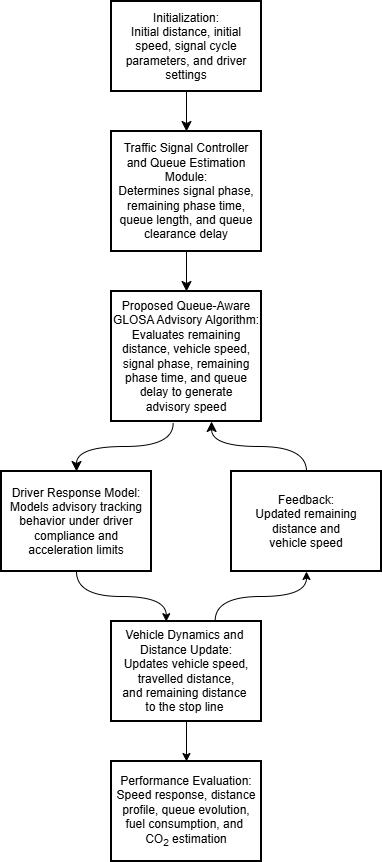
Fig -1:Overallsignalflowandfunctionalstructureofthe proposedadaptiveGLOSAframework.
Figure 1 illustrates the overall signal flow and functional structureoftheproposedadaptiveGLOSAframework.The model begins with initialization of the main simulation conditions,includingvehiclestate,signalcycleparameters, anddriversettings.Thetrafficsignalcontrollerandqueue
Volume: 13 Issue: 04 | Apr 2026 www.irjet.net p-ISSN: 2395-0072
estimation module determine the signal phase, remaining phasetime,queuelength,andqueueclearancedelay,which arethensuppliedtothequeue-awareGLOSAadvisoryblock. Basedontheseinputs,theadvisoryalgorithmgeneratesan appropriate speed recommendation for the approaching vehicle. The driver response model follows the advisory subjecttodrivercomplianceandaccelerationlimits,andthe vehicledynamicsblockupdatesspeed,travelleddistance,and remainingdistancetothestopline.Theseupdatedmotion variables are fed back into the advisory logic, forming a closed-loopsimulationstructure.Thefinaloutputsareused forperformanceevaluationintermsofapproachbehavior, queueevolution,andcomparativefuelandCO₂estimation.
Queueestimationisincludedintheproposedframeworkto representtheinfluenceofvehiclesaccumulatednearthestop line during blocked signal phases. In the model, queue behavior is described using queue length and queue clearancedelaysothattheadvisorylogiccanaccountforthe additionaltimerequiredbeforethestoplinebecomesusable. The queue length is updated using the actual elapsed simulationtimeinsteadofafixedassumedtimestep,which ensuresphysicallyconsistentbehaviorunderbothfixed-step andvariable-stepsimulation.Duringredandyellowphases, the queue grows according to the arrival rate of vehicles, while during the green phase it evolves according to the difference between arrival and discharge rates. The corresponding queue clearance delay is then estimated througha headway-based formulation andsupplied tothe advisoryblockforqueue-awarespeedguidance.
Thequeueevolutionandqueueclearancedelayusedin themodelareexpressedasfollows:
(1)Nqueue(k)=Nqueue(k−1)+ΔN(k) (2a)ΔN(k)=λΔt,duringredoryellow (2b)ΔN(k)=(λ−μ)Δt,duringgreen (3)Tqueue =Nqueue×theadway
Intheaboveformulation,Nqueue(k)representsthequeue length at the current simulation step, while Nqueue(k−1) denotesthequeuelengthfromthepreviousstep.Theterm ΔN(k)givesthechangeinqueuelengthduringtheelapsed simulationinterval.Duringredandyellowphases,thequeue increases according to the vehicle arrival rate λ, whereas duringthegreenphasethequeueevolvesaccordingtothe difference between thearrival rate λ and discharge rateμ. Here,Δtdenotestheactualelapsedsimulationtime,which allows the queue update to remain physically consistent under both fixed-step and variable-step simulation. The queue clearance delay Tqueue is then estimated using the queue length and the discharge headway theadway, representing the expected time required for the queued vehicles to clear before the stop line becomes effectively availablefortheapproachingvehicle.
The adaptive GLOSA advisory algorithm is responsible for generating a speed recommendation for the approaching vehicle based on the current traffic signal condition, remaining phase time, queue clearance delay, remaining distance to the stop line, and current vehicle speed. The objective of the advisory logic is to avoid unnecessary stopping, reduce abrupt speed variation, and guide the vehicletowardasmootherandmoreefficientapproach.In theproposedframework,theadvisoryisnotbasedonlyon the nominal signal phase, but also on whether queued vehiclesaheadareexpectedtodelaytheeffectiveusabilityof the stop line. As a result, the generated speed recommendationbecomessensitivetobothsignaltimingand queueconditions.
Thetargetadvisoryspeedisfundamentallydetermined usingtheratioofremainingdistancetoaneffectivearrival time, scaled by a conservative margin factor. This can be expressedasfollows:
(4)va,target =ηd/Tarrived
whereva,targetisthetargetadvisoryspeed,ηistheadvisory marginfactor,distheremainingdistancetothestopline,and Tarriveistheeffectivearrivaltimeconsideredbytheadvisory logic. In the proposed model, the effective arrival time depends on the current signal phase and queue condition. Duringtheredphase,theadvisoryisinfluencedbythesumof theremainingredtimeandqueueclearancedelay.Duringthe green phase, if the queue is not yet cleared, the vehicle approachisguidedmoreconservativelysothatthestopline is not reached prematurely. During the yellow phase, a conservativepolicyisappliedtoavoidunrealisticorunsafe passageattemptsnearthephasetransition.
Toimprovethepracticalbehavioroftheadvisorynearthe intersection,thefinalmodelalsoincludesstop-linehandling logic.Asmallstandstillgapbeforethestoplineisconsidered inordertoavoidunrealisticexact-zerostoppingbehaviour, andtheadvisoryisconstrainedsothatthevehicledoesnot accelerate aggressively toward the stop line when queue delayisstillpresent.Therefore,theproposedGLOSAadvisory algorithmperformsasaqueue-awareandphase-awarespeed guidancemechanism,ratherthanasimplefree-flowspeed recommendationbasedonlyonsignaltiming.
The driver behavior model is included in the proposed frameworktorepresentthepracticalresponseofthevehicle tothegeneratedadvisoryspeed.Insteadofassumingperfect advisorytracking,themodelconsidersthattheactualvehicle speedfollowstheadvisorywithafiniteresponsedetermined bydrivercomplianceandaccelerationlimits.Thisallowsthe simulationtocapturemorerealisticapproachbehaviorand makes the advisory evaluation meaningful under different
International Research Journal of Engineering and Technology (IRJET) e-ISSN: 2395-0056
Volume: 13 Issue: 04 | Apr 2026 www.irjet.net p-ISSN: 2395-0072
driverconditions.Inthepresentwork,driversensitivityis examinedusingcautious,normal,andaggressiveresponse settings, which differ in compliance gain and allowable accelerationanddecelerationlimits.
The driver response is formulated using the speedtracking error between the advisory speed and the actual vehicle speed. The control effort generated by the driver modelisproportionaltothiserrorandisthenconstrainedby acceleration saturation limits to avoid unrealistic motion. Thiscanbeexpressedasfollows:
(5)ev =vadvisory −vactual
(6)acmd=Kdev
(7)a=sat(acmd,amin,amax)
where ev is the speed-tracking error, Kd is the driver compliancegain,acmdisthecommandedacceleration,andais the final acceleration after applying the acceleration and deceleration limits. The updated acceleration is then integratedinthevehicledynamicssectiontoobtaintheactual vehiclespeed.Throughthisformulation,themodelcaptures theeffectofdriver-followingbehavioronadvisorytracking performance and enables comparative analysis under differentdriver-responseconditions.
The proposed adaptive GLOSA framework is simulated in MATLAB/Simulink for a single-vehicle approach to a signalizedintersection.Thesimulationiscarriedoutusinga fixedsignalcyclewithred,green,andyellowphases,andthe vehicleisinitializedwithapredefineddistancefromthestop line and an initial speed condition. The traffic signal controller,queueestimationlogic,advisoryspeedgeneration block, driver response model, and vehicle dynamics are integratedwithinthesameclosed-loopenvironmentsothat theeffectofsignaltiming,queuedelay,anddriver-following behaviorcanbeevaluatedconsistentlyduringtheapproach phase.
Thesimulationsettingsareselectedtorepresentpractical intersectionapproachconditionswhilemaintainingaclear and interpretable model structure. The advisory logic is bounded by speed limits and influenced by a conservative margin factor, while the queue model uses arrival and discharge rates together with a headway-based queue clearancedelayformulation.Driverresponseisrepresented through compliance gain and acceleration limits, and the model is further evaluated under cautious, normal, and aggressivedriversettingstostudydriverbehaviorsensitivity. In addition, signal timing uncertainty is examined by modifyingtheremainingsignaltimeinordertoobserveits influenceonadvisorygenerationandvehicleresponse.
The overall simulation setup is therefore designed to support the evaluation of queue-aware advisory behavior, driver-following sensitivity, and uncertainty-aware GLOSA performancewithinaunifiedMATLAB/Simulinkframework.
The proposed adaptive GLOSA framework is evaluated in MATLAB/Simulink to examine its behavior under queueaware and uncertainty-sensitive operatingconditions. The analysis focuses on queue dynamics, advisory speed generation, vehicle response during the approach phase, driver behavior sensitivity, and the effect of signal timing uncertainty.Inaddition,comparativefuelconsumptionand CO₂emissionestimatesareusedtostudytheenergy-related implications of the modeled approach behavior. The discussioninthissectionfirstexplainsthecorebehaviorof theimprovedmodelandthenexaminesitssensitivityunder differentdriverandsignalconditions.
Thecorebehavioroftheproposedmodelisfirstexamined usingthequeueevolution,advisoryresponse,vehiclespeed behavior, and distance profile during the approach to the signalized intersection. The queue length and queue clearancedelayplotsverifythatthequeueestimationlogic evolvesconsistentlywithtimeandshowstime-varyingqueue behaviorconsistentwiththeoperationoftheproposedqueue estimationmodel.Theadvisory-relatedplotsshowthatthe generatedspeedguidanceremainsresponsivetobothsignal timingandqueueconditions,whilethedriverresponseand vehicle speed plots indicate that the vehicle follows the advisory with a practical lag rather than instantaneous tracking. The distance remaining profile further shows a conservative near-stop-line approach behavior, indicating thatthequeue-awareadvisorypreventsprematurearrivalat thestopline.
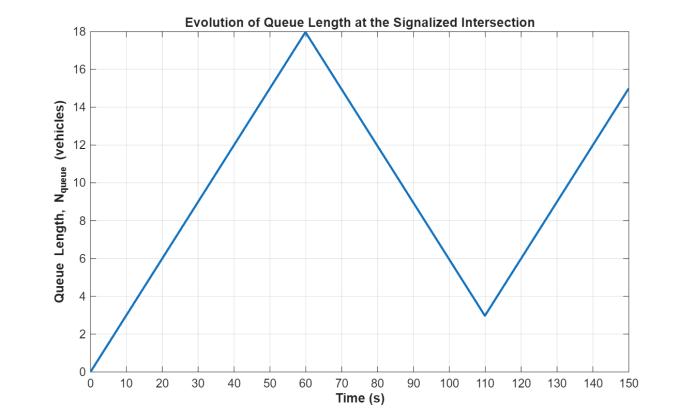
Fig -2: Evolutionofqueuelengthatthesignalized intersection
Figure2showsthevariationofestimatedqueuelengthwith time, indicating the expected buildup of vehicles during blockedphasesanddischargeduringgreenphases.
International Research Journal of Engineering and Technology (IRJET) e-ISSN: 2395-0056
Volume: 13 Issue: 04 | Apr 2026 www.irjet.net p-ISSN: 2395-0072
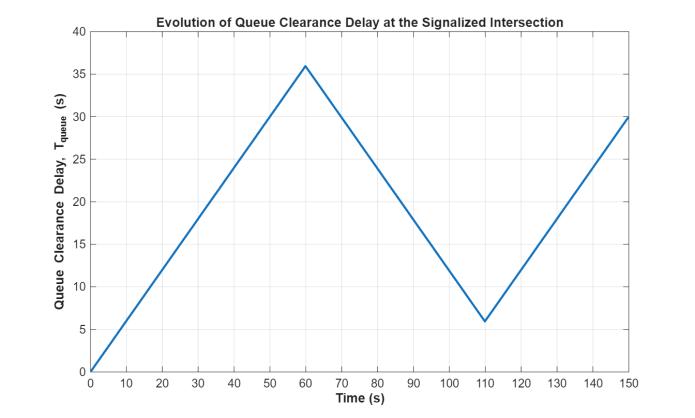
Fig -3: Evolutionofqueueclearancedelayatthesignalized intersection
Figure3presentsthecorrespondingqueueclearancedelay derived from the estimated queue length and discharge headway, representing the additional time before the stop linebecomeseffectivelyusable.
Theadvisory-responsebehavioroftheproposedmodelis further examined using the target advisory speed, applied advisory speed, and actual vehicle speed during the intersection approach. These plots help illustrate how the generatedadvisoryistranslatedintopracticalvehiclemotion throughthedriverresponseandvehicledynamicsblocks.
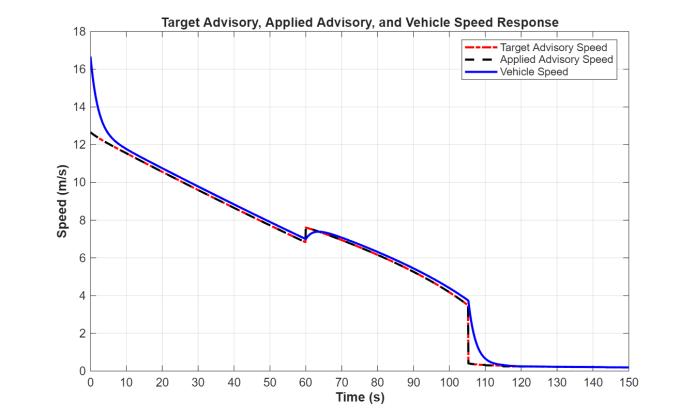
-4: Targetadvisory,appliedadvisory,andvehicle speedresponse
Figure4showstherelationshipbetweenthetargetadvisory speed generated by the control logic, the applied advisory speed,andtheactualvehiclespeedfollowedbythevehicle duringtheapproachphase.
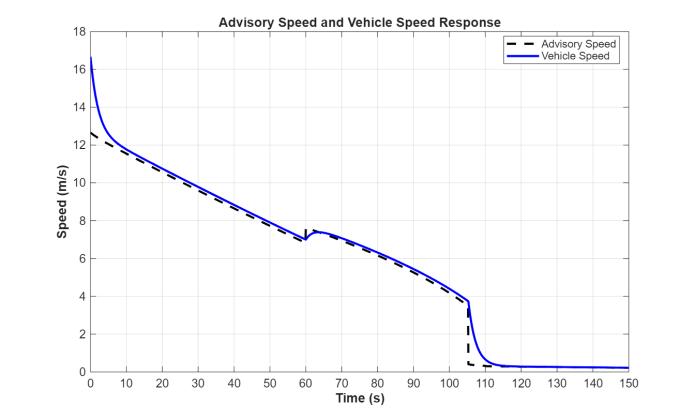
-5: Advisoryspeedandvehiclespeedresponse
Figure 5 presents the advisory-following behavior of the vehicle, highlighting the practical lag between advisory generationandactualspeedresponse
Tofurtherinterprettheapproachbehaviorofthevehicle, the response is also observed with explicit signal phase background and through the remaining-distance profile duringtheapproachtothestopline.Theseplotshelpexplain how the vehicle motion evolves with respect to changing signalconditionsandhowthefinaladvisorylogicinfluences thenear-stop-linebehavior.
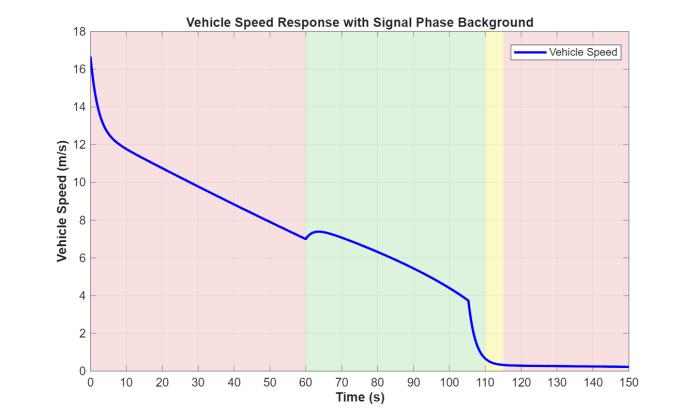
Fig -6: Vehiclespeedresponsewithsignalphase background
Figure6showsthevehiclespeedvariationtogetherwiththe corresponding signal phase background, allowing the approach behavior to be interpreted with respect to red, green,andyellowphases.
Volume: 13 Issue: 04 | Apr 2026 www.irjet.net p-ISSN: 2395-0072
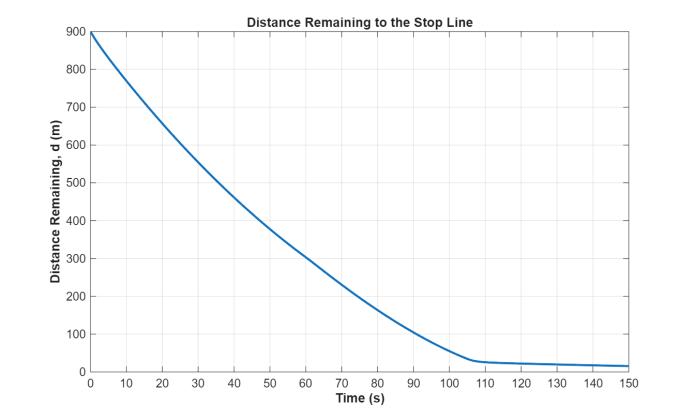
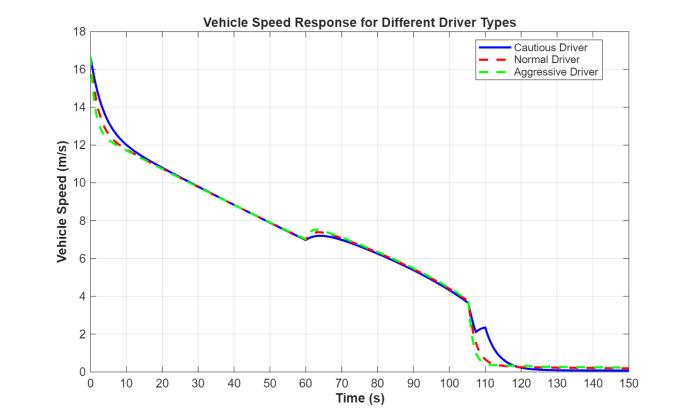
Figure7showsthevariationofremainingdistanceduringthe vehicleapproachandindicatesaconservativenear-stop-line responseunderthefinalqueue-awareadvisorylogic.
Thedistanceprofileshowsthatthevehicleapproaches theintersectionsmoothlywithoutaggressivelytargetingthe stoplineunderqueue-awareconditions.However,thefinal model does not include a dedicated exact stop-position controller near the stop line, and therefore a residual stoppingdistanceremainsinthefinalpartoftheapproach. This behavior is treated as a known simplification of the currentmodelandisinterpretedasconservativenear-stopline handling rather than an exact stop-line capture mechanism.
Driver behavior sensitivity is examined in the proposed frameworkbyconsideringcautious,normal,andaggressive response settings. These cases differ in driver compliance gainandaccelerationlimits,whichinfluencehowcloselythe vehicle follows the advisory speed during the approach phase. The comparison is useful for understanding how advisory-followingbehaviorchangeswhenthedriverismore conservativeormoreresponsive.Inthesimulationresults, the cautious driver responds more gradually, while the aggressivedriverfollowstheadvisorymorequickly,andthe normaldriverprovidesanintermediateresponse.
The vehicle speed comparison under different driver settings is shown through the driver-type response plot, while the advisory and driver-response comparison plot highlights how each driver category tracks the generated advisory speed. These results indicate that the driver response model has a direct influence on the practical realizationoftheadvisorylogic,evenwhenthesamequeueawareGLOSAstrategyisused.Therefore,thedriverbehavior analysis confirms that advisory performance should be evaluated together with driver-following characteristics ratherthanthroughadvisorygenerationalone.
Figure 8 compares the vehicle speed response under cautious,normal,andaggressivedriversettingsduringthe approachphase.
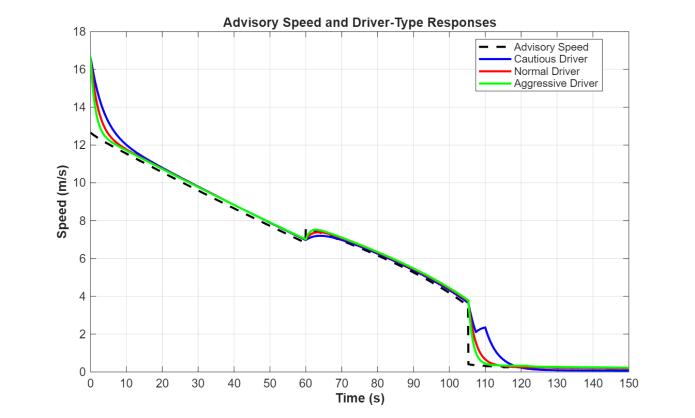
Fig -9: Advisoryspeedanddriver-typeresponses
Figure 9 illustrates how the generated advisory speed is followedunderdifferentdriver-responsecharacteristics.
In addition to advisory-following behavior, the driver sensitivitystudyisalsoexaminedthroughcomparativefuel consumptionandCO₂emissionestimates.Theseresultshelp indicate how different driver-response characteristics influencethemodeledenergyandemissionbehaviorduring theapproachphase.
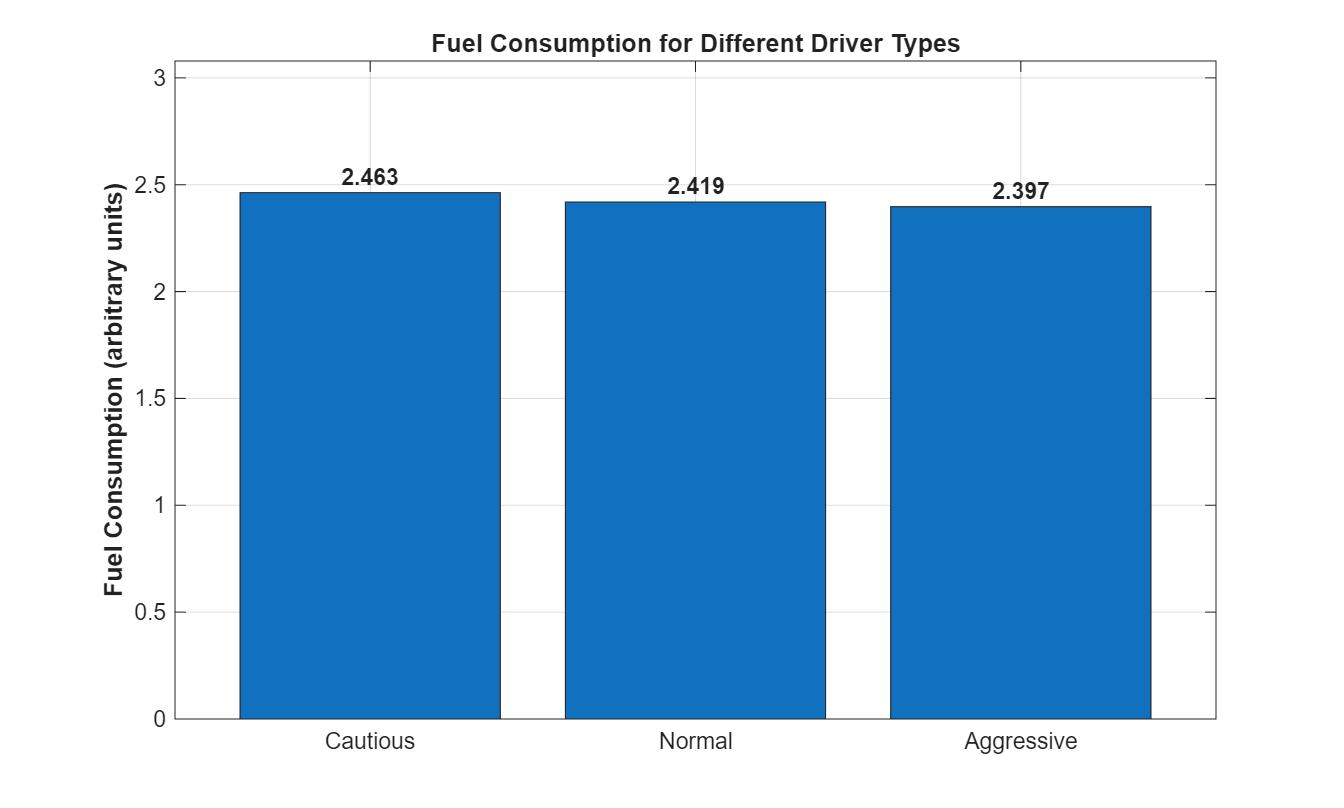
-10: Fuelconsumptionfordifferentdrivertypes
International Research Journal of Engineering and Technology (IRJET) e-ISSN: 2395-0056
Volume: 13 Issue: 04 | Apr 2026 www.irjet.net p-ISSN: 2395-0072
Figure10comparestheestimatedfuelconsumptionunder cautious,normal,andaggressivedriver-responsesettings.
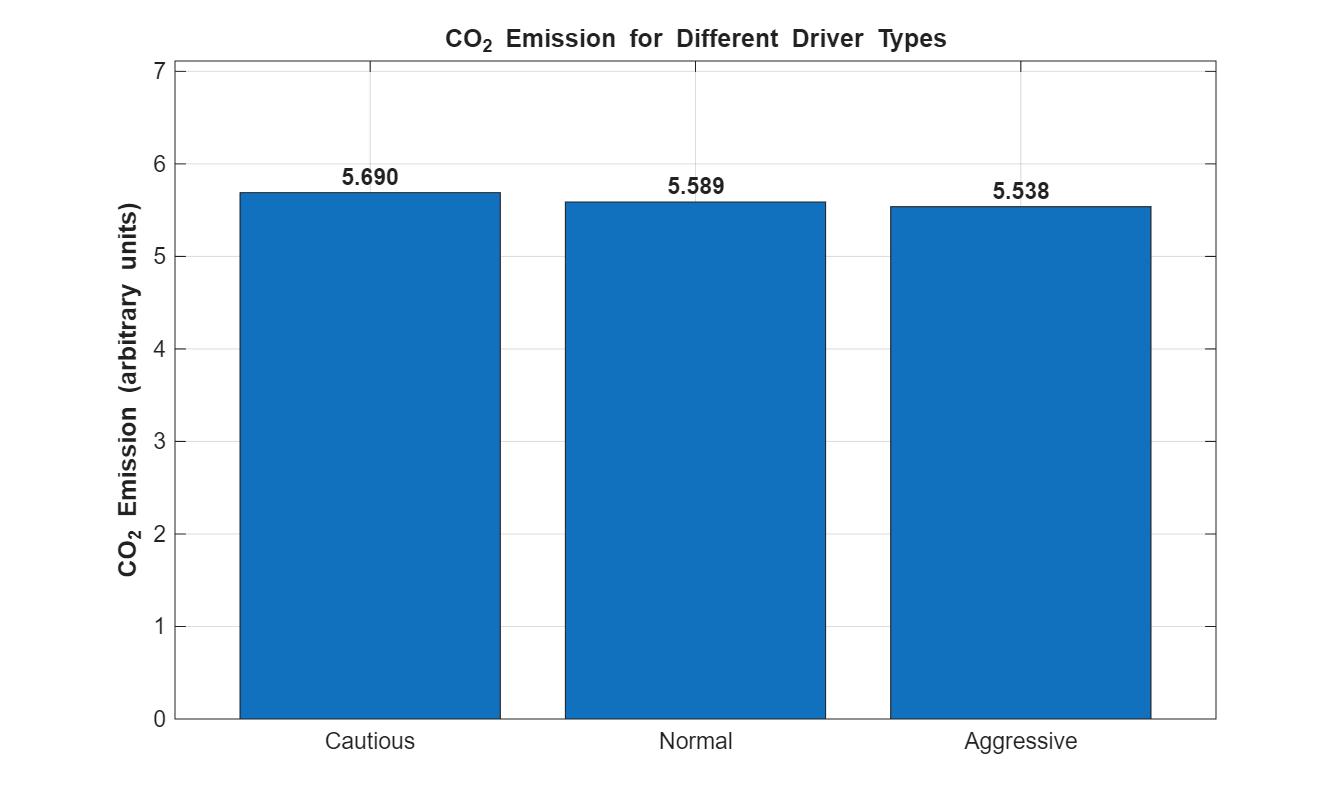
Figure 11 compares the estimated CO₂ emission under cautious,normal,andaggressivedriver-responsesettings.
Table -1: Driverbehaviortrackingresults Driver
The driver behavior results indicate that the tracking performance of the advisory is strongly influenced by the selecteddriverresponsecharacteristics.Thecautiousdriver showsthelargesttrackingerrorduetoslowerresponseand lower acceleration capability, while the aggressive driver exhibitsthelowesttrackingerrorbecauseoffasteradvisoryfollowing behavior. The normal driver provides an intermediate response between these two cases. These observationsconfirmthatadvisoryperformanceshouldbe interpreted together with driver sensitivity, rather than assumingidealoridenticaltrackingbehaviorforalldrivers.
Signal timing uncertainty is considered in the proposed frameworktoexaminehowadvisorybehaviorchangeswhen the remaining phase time is not assumed to be exact. In practicaltrafficconditions,thetiminginformationavailable totheapproachingvehiclemaynotalwaysremainperfectly fixed,andthereforetheadvisorystrategyshouldbestudied undersuchnon-idealtimingconditions.Inthepresentwork, uncertaintyisintroducedbymodifyingtheremainingsignal time using additional timing offsets, and the resulting advisoryandvehicleresponsesarecomparedwiththeexacttimingcase.
The comparative uncertainty analysis shows that increasingtiminguncertaintymakesthegeneratedadvisory moreconservative.Astheuncertaintylevelincreases,both the initial advisory speed and the mean advisory speed during the approach are reduced, while the advisoryfollowing error increases slightly. At the same time, the comparativefuelandCO₂estimatesalsodecreasegradually, indicatingthatamoreconservativespeedguidanceprofile can smooth the vehicle approach and reduce the modeled energy/emissionproxy.Theseobservationsdemonstratethat the final model is capable of representing uncertaintysensitiveGLOSAbehaviorinastructuredmanner.
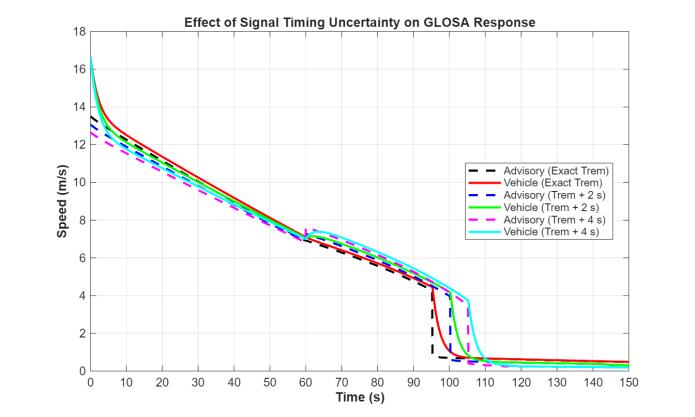
Figure12comparestheadvisoryandvehiclespeedresponses fortheexact-timingcaseandtheuncertainty-modifiedsignal timingcases.
The uncertainty results indicate that increasing the remaining-timeuncertaintycausestheadvisorytobecome progressively more conservative. This is reflected by the reductioninbothinitialandmeanadvisoryspeed,together with a slight increase in tracking error. Therefore, the uncertainty analysis confirms that timing inaccuracies influence both advisory generation and the practical responseofthevehicleduringtheapproachphase.
Theenergy-relatedbehavioroftheproposedframeworkis examined using comparative fuel consumption and CO₂ emission estimates obtained from the simulated vehicle
International Research Journal of Engineering and Technology (IRJET) e-ISSN: 2395-0056
Volume: 13 Issue: 04 | Apr 2026 www.irjet.net
response. In the present study, these values are used as relative performance indicators derivedfrom the modeled speed andacceleration behavior rather than as exact realworldconsumptionmeasurements.Therefore,thefueland CO₂resultsshouldbeinterpretedascomparativesimulationbasedestimatesthathelpdistinguishhowdifferentdriverresponse and uncertainty conditions influence the overall approachbehavior.
Forthedriversensitivityanalysis,thecomparativefuel andCO₂plotsindicatehowcautious,normal,andaggressive driver-response characteristics affect the modeled energy and emission behavior during the approach phase. In addition,the uncertaintystudy also producescomparative fuelandCO₂estimatesfortheexact-timinganduncertaintymodified cases. To summarize these results in a compact manner, the combined comparative values for both driver behavior sensitivity and signal timing uncertainty are presentedinTable-3.
Table -3: ComparativefuelconsumptionandCO₂ emissionresults
The combined fuel and CO₂ results show that the comparative energy/emission behavior changes with both driversensitivityandsignaltiminguncertainty.Inthedriverresponsestudy,theestimatedvaluesvaryonlymoderately acrosscautious,normal,andaggressivesettings,whileinthe uncertainty study the estimates decrease gradually as the advisorybecomesmoreconservative.Theseresultsindicate thatthefinalqueue-awareanduncertainty-sensitiveadvisory frameworknotonlyaffectsadvisorytrackingbehavior,but alsoinfluencesthecomparativeenergyandemissionprofile ofthesimulatedvehicleapproach.
ThepresentmodelisdevelopedasastructuredsimulationbasedframeworkforevaluatingadaptiveGLOSAbehavior under queue-aware and uncertainty-sensitive conditions; however,certainsimplificationsremain.Thestudyconsiders a single-vehicle approach at a signalized intersection and does not include multi-vehicle interaction, lane-changing behavior, or network-level traffic effects. In addition, the final near-stop-line response is represented through simplified queue-aware stopping behavior rather than a
2395-0072
dedicatedexactstop-positioncontroller,whichresultsina residualstoppingdistanceinthefinalapproachstage.The fuel consumption and CO₂ results are also interpreted as comparativesimulation-basedestimatesratherthanexact real-worldmeasurements.Theselimitationsdonotreduce the usefulness of the model for comparative analysis, but theyindicatethedirectionsinwhichtheframeworkcanbe extendedfurther.
The present work developed and evaluated an adaptive GLOSA framework in MATLAB/Simulink for a signalized intersection under queue-aware and uncertainty-sensitive operating conditions. The model integrated traffic signal control,queueestimation,advisoryspeedgeneration,driver response,andvehicledynamicswithinasingleclosed-loop simulation environment. The results showed that queueawareadvisorybehavior,driversensitivity,andsignaltiming uncertaintyallinfluencethepracticalresponseofthevehicle during the approach phase. The driver behavior analysis confirmedthatadvisory-followingperformancechangeswith driver compliance and acceleration capability, while the uncertainty analysis showed that increasing timing uncertainty makes the advisory progressively more conservative. The comparative fuel consumption and CO₂ estimatesalsoindicatedthattheproposedframeworkaffects notonlytrackingbehaviorbutalsothemodeledenergyand emissionprofileofthevehicleapproach.Overall,thestudy providesastructuredsimulation-basedbasisforevaluating adaptive GLOSA behavior under more practical operating conditionsthanapurelysignal-timing-basedadvisorymodel.
[1] T. Wágner, T. Ormándi, T. Tettamanti, and I. Varga, “SPaT/MAP V2X communication between traffic light and vehicles and a realization with digital twin,” Computers and Electrical Engineering, vol. 106, 2023, Art.no.108560.
[2] M.N.Ahangar,Q.Z.Ahmed,F.A.Khan,andM.Hafeez,“A survey of autonomous vehicles: Enabling communicationtechnologiesandchallenges,”Sensors, vol.21,no.3,2021.
[3] E. Zadobrischi and M. Dimian, “Vehicular communications utility in road safety applications: A step toward self-aware intelligent traffic systems,” Symmetry,vol.13,no.3,2021.
[4] M. Papageorgiou, “Overview of road traffic control strategies,”IFACProceedingsVolumes,vol.37,no.19, pp.29–40,2004.
[5] K. Katsaros, R. Kernchen, M. Dianati, and D. Rieck, “Performance study of a green light optimized speed advisory (GLOSA) application using an integrated
International Research Journal of Engineering and Technology (IRJET) e-ISSN: 2395-0056
Volume: 13 Issue: 04 | Apr 2026 www.irjet.net p-ISSN: 2395-0072
cooperative ITS simulation platform,” in 2011 7th International Wireless Communications and Mobile ComputingConference,2011,pp.918–923.
[6] A.Coppola,L.D.Costanzo,L.Pariota,S.Santini,andG.N. Bifulco,“Anintegratedsimulationenvironmenttotest the effectiveness of GLOSA services under different working conditions,” Transportation Research Part C, vol.134,2022,Art.no.103455.
[7] H.ChenandH.A.Rakha,“DevelopingandFieldTestinga GreenLightOptimalSpeedAdvisorySystemforBuses,” Energies,vol.15,no.4,Art.no.1491,2022.
[8] J. Ma, F. Zhou, Z. Huang, C. L. Melson, R. James, and X. Zhang,“Hardware-in-the-LoopTestingofConnectedand AutomatedVehicleApplications:AUseCaseforQueueAwareSignalizedIntersectionApproachandDeparture,” TransportationResearchRecord,vol.2672,no.22,pp. 36–46,2018.
[9] S. Stebbins, M. Hickman, J. Kim, and H. L. Vu, “Characterising Green Light Optimal Speed Advisory Trajectories for Platoon-Based Optimisation,” TransportationResearchPartC:EmergingTechnologies, vol.82,pp.43–62,2017.
[10]P. Typaldos and M. Papageorgiou, “Modified Dynamic Programming Algorithms for GLOSA Systems with Stochastic Signal Switching Times,” Transportation ResearchPartC:EmergingTechnologies,vol.157,Art. no.104364,2023.
[11]L. Simchon and R. Rabinovici, “Real-Time ImplementationofGreenLightOptimalSpeedAdvisory forElectric Vehicles,” Vehicles,vol.2,no.1,pp.35–54, 2020.
[12]M.Xu,D.Zuo,andJ.Li,“AdaptiveFrequencyGreenLight OptimalSpeedAdvisoryBasedonDeepReinforcement Learning,”JournalofTransportationEngineering,PartA: Systems,2024.