
International Research Journal of Engineering and Technology (IRJET) e-ISSN: 2395-0056
Volume: 13 Issue: 03 | Mar 2026 www.irjet.net p-ISSN: 2395-0072
International Research Journal of Engineering and Technology (IRJET) e-ISSN: 2395-0056
Volume: 13 Issue: 03 | Mar 2026 www.irjet.net p-ISSN: 2395-0072
K. Jyothi Raju 1 , K.B.S.K. Venkata Sairam 2 , Dr G.V.R. Prasada Raju 3
1 Research Scholar, University College of Engineering, JNTUK.
2 Project fellow, RUSA, University College of Engineering, JNTUK
3 Sr.Professor in Civil engineering, University college of Engineering, JNTUK.
Abstract - Expansive soils present a major challenge in geotechnical engineering due to their pronounced swelling and shrinking behaviour, resulting from water absorption during monsoon seasons and evaporation in summer. This volume change in soil can produce a large amount of stress, sometimes as high as 720 Kpaonthestructuresconstructedon it, often leading to several structural problems like uplift of foundation, differential settlements, heaving, rutting, and cracking in superstructures. The presence of montmorillonite minerals with an expanding lattice structureinexpansivesoils causes pavement problems like longitudinal and transverse cracking. Among the different geotechnical techniques, soil stabilisation is the most popular technique. There is an increasing trend of research on the use of industrial waste materials for effective soil stabilisation in construction engineering. Vitrified Polish Waste (VPW), a by-productof the manufacturing and construction industry, can be effectively used to improve pavement subgrade conditions at low cost. Similarly, large quantities of waste are generated by the coir industry, creating disposal challenges. The use ofcoir fibre not only enhances soil engineering properties but also offers an eco-friendly waste management solution. The present study examines the combined use of VPW and coir fibre in varying proportions to evaluate their effect on expansive soil behaviour The results show that increasing VPW content decreases the Optimum Moisture Content(OMC),whileadding coir fibre increases OMC. It is observed that from load tests, maximum strength is obtained with the addition of 15% VPW and 1% of Coir fibre
Key Words: Vitrified polish waste VPW, Coir fiber, Expansive soil, Stabilisation
Expansivesoils,commonlyreferredtoasblackcottonsoils duetotheirsuitabilityforcottoncultivation,occupynearly 20% of India’s geographical area. These soils undergo significant volume changes resulting from physical and chemical variations induced by seasonal fluctuations in moisture content. [1]. The use of chemical additives and reinforcementtechniquestoimprovethesuitabilityofVPWstabilised marine clay for pavement construction [2]. The Optimum Moisture Content (OMC) increases with the increaseinthepercentageofcoirfibre,andtheCBRandUCS valuesalsoshowanimprovement.Themaximumincreasein thestrengthpropertieswasfoundat1%coirfibrecontent,
whichistheoptimumpercentage[3].Theincorporationof 10%VitrifiedPolishWaste(VPW)withexpansivesoilleads to a substantial enhancement in the engineering characteristicsofexpansivesoil.VPWhasvastpotentialasa soil stabilising admixture, although further refinement is required to conform to IRC standards [4]. The optimum result was obtained at 0.5% coconut fibre content, where UCSvaluesincreasedfrom186.45kN/m²to240.2kN/m²(3 days)andfrom274.12kN/m²to581.7kN/m²(14days),and soaked CBR values improved by 20.62%. In general, the literatureconfirmsthat30%flyashand0.5%coconutfibre contentisthebeststabilisingcombination[5].
The effectiveness of using coir waste as a stabiliser was examinedinthestudytoenhancethesubgradepropertiesof expansive soil. Although the engineering properties were improvedsignificantly,furtherresearchisrecommendedfor implementation.Processingandusingcoirwastealsohelps in rural employment [6]. The experiment was conducted successfully to assess the geotechnical characteristics of expansivesoilsmodifiedwithRiceHuskAsh(RHA),coconut fibre(CF),andeggshellpowder(EG).TheadditionofRHA, CF,andEGaffectedthetextureoftheclaysoilbyreducing the fine material content. The swelling potential of the expansive soil was reduced with the addition of these admixtures.Inaddition,thecompressibilityofthesoilwas reducedwhenacombinationoflimeandRHAwasadded[7]. The results of various tests conducted on VPW and Fiber additionclearlyshowedimprovementinthecompactionand strength properties of expansive soils. In general, the literaturereviewconfirmsthatVPWis aneconomical and effectivegroundimprovementmaterial[8].Theadditionof VPW, lime, and waste plastic resulted in a substantial improvementinthecompaction,strength,andpenetration properties of expansive soil, along with an effective utilisationofwastematerials[9].Theresultsshowedthatthe additionof1.2%CCF(CoconutCoirFiber)gavethehighest increase in strength, with the UCC strength increasing to 132.59 kPa and the soaked CBR value rising to 18.98%, which is almost four times higher than that of the unreinforcedsoil.[10].Thestudyconcludesthatcoirfibreis abiodegradable,low-cost,andavailablematerialthatcanbe usedforeconomicalsoilstabilisation.Mostimportantly,the additionofcoirfibreincreasestheCaliforniaBearingRatio (CBR)valuebecauseofitsreinforcingaction,whichhelpsthe soilresisthigherloads.Thishelpsinreducingthepavement thickness, making the construction of roads more
International Research Journal of Engineering and Technology (IRJET) e-ISSN: 2395-0056
Volume: 13 Issue: 03 | Mar 2026 www.irjet.net p-ISSN: 2395-0072
economical [11].Thisstudyexaminedthepotential use of coir geotextiles, which are natural and eco-friendly materials, in the construction of rural roads. The results showthatcoirgeotextileshavethepotentialtoimprovethe poorsubgradesoilsandalsosupportthecoirindustry[12]. The research work investigated the influence of lime and coirfibreonthestabilisationofexpansivesoil.Theoptimal mixture of 1% coir fibre and 5% hydrated lime was determined[13].Laboratorytestsrevealedthattheaddition of 2%, 2.5%, and 3% coir pith increased the strength properties of black cotton soil. The increase in the CBR valuesshowsanimprovementinthesurfacehardnessand strengthofthesoil[14].Experimentalworkonclayeysoil (CL)stabilisedwithcoirfibre(0.25%–1%),whichrevealed marked improvement in strength and compaction characteristics, with 0.5% fibre concentration found to be optimum.Ingeneral,theuseof0.5%coirfibreisfoundtobe effectiveandeconomicalforstabilisingclayeysoils[15].The studyindicatesthattheadditionof0.75%xanthangumand 0.5% coconut fibre is the most effective mixture for the stabilisationofsoil.Thisisbecauseitprovidesthehighest compressive strength and bearing capacity, making it the optimalmixturefortheimprovementofsoil[16].
The present investigation aimed to enhance the strength characteristics of expansive soil and to determine the optimumcombinationof VitrifiedPolishWaste(VPW)and Coconutfibres.Coconutfibreswereincorporatedatdosages of 0.25%, 0.50%, 0.75%, 1.0% and 1.25%, while Vitrified Polish waste was added in proportions of 5%, 10%, 15%, and 20% by dry weight of soil. A series of compaction, soakedCaliforniaBearingRatio(CBR),andloadtestswere performed to evaluate the engineering behaviour of the treatedsoil.
The influence of Vitrified polish waste and Coir wasteonexpansivesoilwasinvestigated.
The use of industrial wastes offers an alternative approach to reduce the construction cost of road particularlyinruralareas.
3.1 Black Cotton Soil (ES):
Thesoilsampleusedinthisinvestigationwascollectedfrom Odalarevu, near Amalapuram, Andhra Pradesh, India. The geotechnical characteristics of the expansive soil were determined following the respective Indian Standard (IS) codes. The determined properties are summarised in the tablebelow.
Table -1: PropertiesofBlackcottonsoil
Limit WP(%)
IS:2720(Part5) –1985
IS:2720(Part5) –1985 PlasticityIndex IP(%)
SoilClassification CH(Highly PlasticClay) IS:1498–1970 SpecificGravity G
IS:2720(Part3) –1980
IS:2720(Part 40)–1977
IS:2720(Part8) –1983
IS:2720(Part8) –1983
SoakedCalifornia BearingRatio CBR (%) 1.23 IS:2720(Part 16)–1987
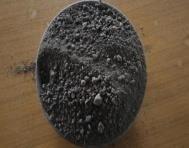
Fig -1:Blackcottonsoil
Theresultsindicatethatthecollectedsoilcanbeclassifiedas highly plastic clay (CH), exhibiting a high degree of swell potential and low bearing capacity, which necessitates stabilisationforengineeringapplications.
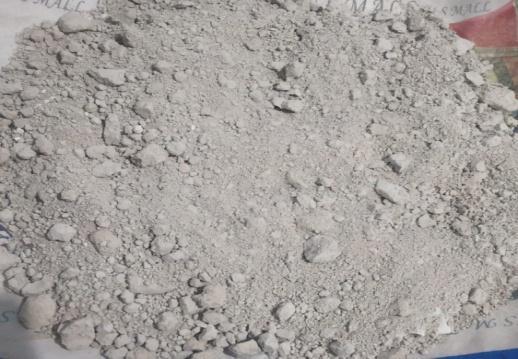
VitrifiedPolishWastesampledforthestudywascollected fromRAKCeramics,Samalkota,EastGodavari,andAndhra Pradesh.
International Research Journal of Engineering and Technology (IRJET) e-ISSN: 2395-0056
Volume: 13 Issue: 03 | Mar 2026 www.irjet.net p-ISSN: 2395-0072
3.3 Coconut Fibre
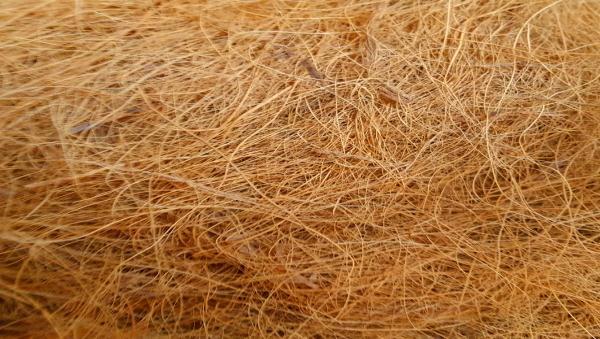
Thecoirfibreusedinthisstudywasextractedfromcoconut husk,ahardstructuralfibre.Thefibroushusksweresoaked inpitsorslow-movingwaterbodiestofacilitateswellingand softeningofthefibres.Subsequently,thelongbristlefibres wereseparatedfromtheshortermattressfibresthrougha processknownaswetmilling.Coirfibreiselastic, capableof beingtwistedwithoutbreaking, andretainsanaturalcurl, making it suitable for various commercial applications, particularlyin mattressmanufacturing Thefibresused in thisstudyhadanaveragediameterof0.5mmandwerecut intolengthsof3–5cm, withproportionsof0.25%,0.50%, 0.75%,1.0%and1.25%bydryweightofsoil.
4 EXPERIMENTAL INVESTIGATIONS
In this study, black cotton soil was blended with varying proportionsofvitrifiedpolishwaste(VPW)bydryweightto evaluateitsinfluenceonthe soil’sgeotechnical properties and to determine the optimum percentage of VPW Subsequently, the expansive soil containing the optimum VPW content was further reinforced with different percentagesofcoirfibre, anditscompactioncharacteristics, soakedCaliforniaBearingRatio(CBR), andcyclicplateload performance were evaluated. All laboratory tests were carried out in accordance with the respective Indian Standard(IS)codestoestablishtheoptimalmixproportions andtoassesstheeffectofVPWandcoirfibreonthestrength improvementofblackcottonsoil.
The compaction characteristics of black cotton soil, both untreatedandtreatedwithvaryingproportionsofvitrified polishwaste(VPW)andcoirfibre, weredeterminedinthe laboratory in accordance with the Modified Proctor CompactionTestasspecifiedinIS:2720(PartVIII)–1983.
CBR test has been conducted on treated and untreated expansive soil as per IS: 2720 part XVI-1987 as shown in Fig.4,withvariousproportionsofVitrifiedPolishWasteand CoconutFibreundersoakedcondition
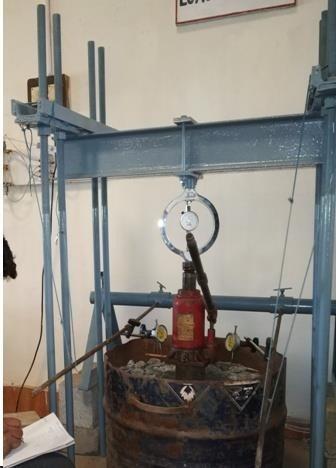
The laboratory cyclic plate load test was performed to evaluatetheultimateload-carryingcapacityandmaximum settlementofthesoilunderappliedloadingconditions.The modelflexiblepavementsystemcompriseda25cmlayerof untreatedortreatedexpansivesoilservingasthesubgrade, overlaidbya5cmgravelcushionasthesub-base,anda5cm WBM-IIIlayerformingthebasecourse.Theloadwasapplied usingacircularsteelplateof10cmdiameter, positionedon thesurfaceofthemodelpavement.Thesteeltesttankwas mountedonthebaseofacompressiontestingmachine, and twodialgaugeswithaleastcountof0.01mmwereusedto recordsettlements.Ahydraulicjackwithacapacityof500 kN was utilised to apply the loading in controlled increments.
Thecyclicloadtestswereconductedonspecimensprepared at their respective optimum moisture content (OMC) conditions, under successive simulated tyre pressures of 500,560,630,700,1000,and1200kPa.Foreachpressure level, six loading–unloading cycles were applied until the deformation readings stabilized, indicating negligible variation between consecutive cycles. All model flexible pavement specimens were tested under Saturated conditionstoassessthesubgradeperformancerealistically.
International Research Journal of Engineering and Technology (IRJET) e-ISSN: 2395-0056
Volume: 13 Issue: 03 | Mar 2026 www.irjet.net p-ISSN: 2395-0072
Inthelaboratory,aseriesoftestswascarriedoutonblack cotton soil stabilised with varying proportions of vitrified polishwasteandcoirfibretodeterminetheoptimummix ratios and to evaluate their influence on the strength characteristicsofthesoil.Theresultsobtainedfromthese testsarepresentedbelow.
TheOptimumMoistureContent(OMC)andMaximumDry Density(MDD)valueswereobservedtovarywithdifferent proportionsofvitrifiedpolishwaste(VPW).TheOMCand MDDwererecordedas26.12%and1.488g/cc,25.37%and 1.501g/cc,24.48%and1.518g/cc,and23.02%and1.511 g/cc for 5%, 10%, 15%, and 20% VPW, respectively, as showninChart1.Themaximumdrydensitywasachievedat 15% VPW content, indicating this as the optimum proportion for stabilisation Further, when coir fibre was added to the soil containing 15% VPW at proportions of 0.5%,0.75%,1.0%,and1.25%,thecorrespondingOMCand MDDvalueswere25.74%and1.502g/cc,26.25%and1.493 g/cc,26.93%and1.520g/cc,and27.37% and1.480g/cc, respectively, as presented in Chart 2. The maximum dry density was obtained at 1.0% coir fibre content, which demonstrated superior performance compared to other combinations. Based on the test results, the optimum proportions of vitrified polish waste and coir fibre were determinedtobe15%and1.0%,respectively.
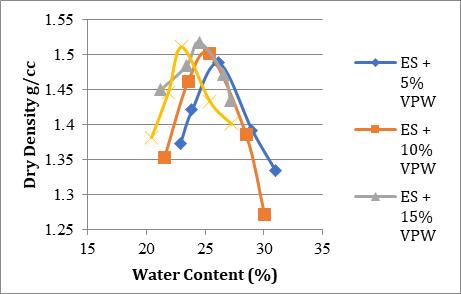
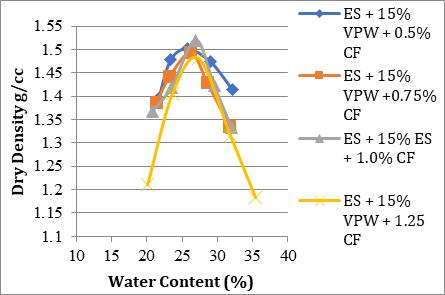
Chart -2: Compactionvaluesof85%blackcottonsoil blendedwith15%VPWand%ofCF.
Soaked CBR tests were performed on black cotton soil blendedwithvaryingproportionsofvitrifiedpolishwaste (VPW)andcoirfibre,andtheresultsarepresentedinChart 3.ThesoakedCBRvaluesforblackcottonsoilmixedwith 10%,15%,and20%VPWwere3.62%,4.36%,and3.84%, respectively, indicating that the maximum CBR value was achievedat15%VPWcontent.
Further, when coir fibre was incorporated into the VPWtreatedexpansivesoilatproportionsof0.5%,0.75%,1.0%, and 1.25%, the corresponding soaked CBR values were 4.62%,5.82%,8.06%,and6.31%,asshowninChart4.Based ontheseresults,theoptimumproportionsofvitrifiedpolish wasteandcoirfibreweredeterminedtobe15%and1.0%, respectively.Theimprovementincompactioncharacteristics contributed to the increase in CBR values, indicating a significantenhancementintheoverallstrengthofthesoil.
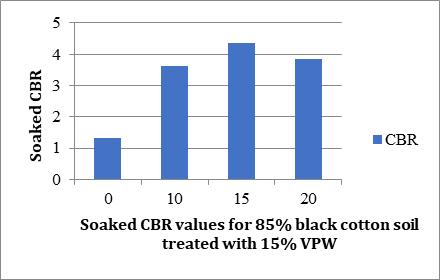
Chart -3: SoakedCBRvaluesfor85%blackcotton soiltreatedwith15%VPW
International Research Journal of Engineering and Technology (IRJET) e-ISSN: 2395-0056
Volume: 13 Issue: 03 | Mar 2026 www.irjet.net p-ISSN: 2395-0072
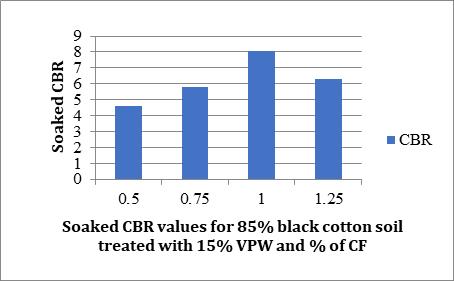
Chart -4: SoakedCBRvaluesfor85%blackcottonsoil treatedwith15%VPWand%ofCoconutFibre
From the laboratory cyclic plate load test results, the untreated black cotton soilsubgrade model of the flexible pavementshowedanultimatebearingpressureof630kPa atadeformationof2.61mm.Incontrast,thesubgrademodel stabilisedwith15%vitrifiedpolishwasteand1%coirfibre exhibitedasubstantiallyhigherultimatebearingpressureof 1200 kPa with a reduced deformation of 2.39 mm, as illustrated in Charts 5 and 6. These results clearly demonstrate a notable improvement in the load-bearing capacity and stiffness of black cotton soil when stabilised with15%vitrifiedpolishwasteand1%coirfibrecompared totheuntreatedsoil.
Chart -5: LaboratoryCyclicplateloadtestresultsof untreatedExpansivesoilatSaturation
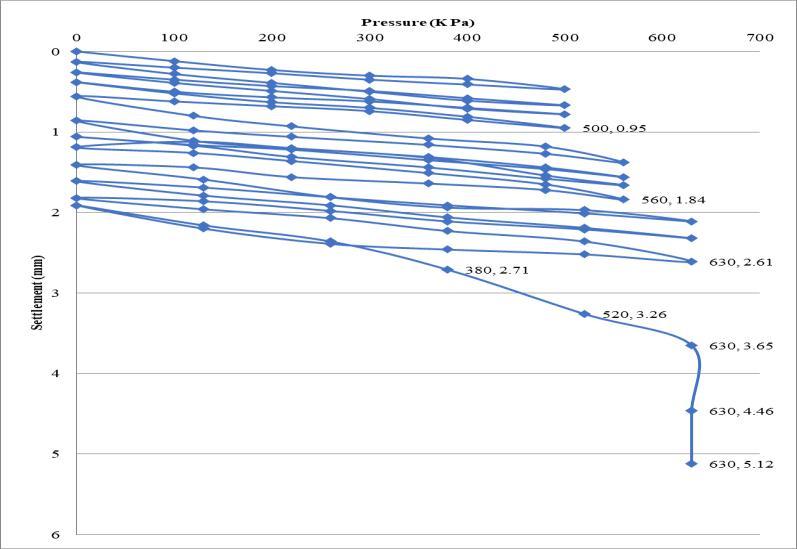
Chart -6: Laboratorycyclicplateloadtestresultoftreated Expansiveclaywithanoptimum15%VPWand1%CFat Saturation
Basedonthefindingsofthe laboratoryinvestigations,the followingconclusionscanbedrawn:
1. The liquid limit of expansive soil decreased by 22.4% with the addition of 15% vitrified polish waste(VPW)andfurtherdecreasedby19.99%with theinclusionof1%coirfibre, indicatingimproved workabilityandreducedplasticity.
2. Theplasticlimitoftheexpansivesoildecreasedby 11.9% upon the addition of 15% VPW, and an additional 9% reduction was observed when 1% coirfibrewasincorporated.
3. Theplasticityindexshowedasubstantialreduction of28.8%with15%VPW, andfurtherdecreasedby 50.2% upon the inclusion of 1% coir fibre, demonstrating a significant improvement in soil stability.
4. Theoptimummoisturecontent(OMC)decreasedby 13.32%with15%VPW, whereasa9%increasewas notedwhen1%coirfibrewasaddedincombination with15%VPW, comparedtountreatedsoil.
5. The maximum dry density (MDD) increased by 3.12%with15%VPW, butdecreasedby2.31%with the combined addition of 1% coir fibre and 15% VPW, relativetotheuntreatedexpansivesoil.
6. The soaked California Bearing Ratio (CBR) value increasedsignificantlyby227.64%with15%VPW, and further improved by 118.11% upon the inclusionof1%coirfibre, reflectingenhancedloadbearingcapacity.
7. Cyclic plate load test results revealed that the ultimate cyclic pressure of the treated expansive clay subgrade increased markedly from 630 kPa (untreated) to 1200 kPa, confirming improved subgradestrength.
8. Settlement values reduced from 2.61 mm to 2.41 mm with the addition of 1% coir fibre and 15% VPW, indicatingenhanceddeformationresistanceof thetreatedsoil.
9. The incorporation of industrial waste materials such as vitrified polish waste (VPW) provides a sustainableandeconomicalapproachforimproving subgrade performance, particularly beneficial for ruralroadconstructionindevelopingregions.
International Research Journal of Engineering and Technology (IRJET) e-ISSN: 2395-0056
Volume: 13 Issue: 03 | Mar 2026 www.irjet.net p-ISSN: 2395-0072
[1] A.C.S.V. Prasad, C.N.V.Satyanarayana Reddy The Potential of Cement Stabilised Gravelly Soils as Construction Material, Proceedings of Indian GeotechnicalConferenceDecember,2011,Kochi.
[2] DKoteswaraRao,2013.ALaboratoryInvestigationon the Affect of Vitrified Polish Waste for Improving the Properties of Marine Clay, nternational Journal of EngineeringandInnovativeTechnology,2(11),pp.3741.
[3] R.RSingh,Er.ShellyMittal.2014.Improvementoflocal subgrade soil for road construction by the use of Coconutcoirfibre,IJRET,Vol.3,Issue:05,pp707-711.
[4] VegullaRaghudeep,M.T.S.Lakshmayya,K.S.B.Prasad. (2015)ImprovementinCBRvalueofBlackCottonSoil bystabilizingitwithVitrifiedpolishWaste,IJIRSET,Vol. 4,Issue8,pp6894-6902.
[5] Sachin D, Mujeeb, Dr. Sowmya N.J. (2016) Effect of CoconutCoirFibresonBlackCottonSoilBlendedwith FlyAsh,IJERT,Volume:5,Issue10,pp.505-508.
[6] S. Muthu Lakshmi, S. Sasikal, V.Padmavathi, S.Priya, V.Saranya. 2018. Utilisation of coconut coir fibre for improving soil subgrade strength characteristics of clayeysand.IRJET,Vol.5,Issue:4
[7] Marimuthu.S,Sundarpandian.M,Mahendran.K.2017.An Experimental Investigation on Soil Stabilisation by Waste Materials, SSRG International Journal of Civil Engineering(ICRTCETM-2017),SpecialIssue,pp748755
[8] PrashanthHugar.(2018).EffectofAlkali-ResistantGlass FibreandVitrifiedPolishWasteonStrengthProperties ofBlackCottonSoil,IJIRSET,Vol.7,Issue5,pp.60486055.
[9] D.Appanna,B.Ganesh.2018.AStudyontheInfluenceof Vitrified Polish Waste (VPW), Lime and Waste plastic inclusions (WPI) in Improving the Expansive clays, IJSART,Volume4,Issue1,pp982-989
[10] S. Muthu Lakshmi, S. Sasikal, V.Padmavathi, S.Priya, V.Saranya. 2018. Utilisation of coconut coir fibre for improving soil subgrade strength characteristics of clayeysand.IRJET,Vol.5,Issue:4.
[11] R.M.HubbaandS.K.Rahman.2021.SoilImprovement Using Coir Fibre: A Case Study. IJARET, Volume.12, Issue.2,pp593-598
[12] Dr Mohammad Zuhair, Prof. A. R. Bijwe, Ms Nikita K. Deshmukh. 2021. Study of the Application of Coir GeotextileUsedinRuralRoadConstruction.IJAEM,Vol. 3,Issue7,pp4276-4284.
[13] S.C.Boobalan,M.SivakamiDevi.2022.Investigational study on the influence of lime and coir fiber in the stabilizationofexpansivesoilElsevierMaterialsToday Proceedings.
[14] Arathi K, Athulya K, Vinaya, Pooja P, Athira V. 2022. Stabilization of black cotton soil using coconut fiber, Sustainability,Agri,FoodandEnvironmentalResearch
[15] Ujal Kumar, Dr. Vikram Pandey, Prasanth Ranjan Malviya. (2022). Stabilization of Soil using Coir Fibre, IRJET,Volume:09,Issue2,pp.50-54.
[16] AminaMeeranO.M,ErfanaM.A,MilanJallel,Parvathy Vijay.(2025).AComparitivestudyonBlackCottonSoil Stabilisation using Xanathan gum, and Coconut Fiber, IRJET,Volume:12,Issue:3,pp.1161-1165.



Jyothi Raju Kalahasthy Research Scholar, pursuing Ph.D, Completed B.Tech (Civil) and M.Tech (Soil Mechanics and Foundation Engineering) from JNTU College of Engineering,Kakinada.
K.B.S.K.Venkata Sairam,Workingas a Project Fellow at RUSA, JNTUK. Completed M.Tech (Soil Mechanics and Foundation Engineering) from JNTU College of Engineering, Kakinada.
Dr. GVR. Prasada Raju working as SeniorProfessorDepartmentofCivil Engineering, J N T University, Kakinada,hasmore than37 yearsof experience in teaching and research, has published more than 150 Technical papers in national and international journals and conferences, and has received the Crop’sofEngineersAwardbytheIEI Journal.