
International Research Journal of Engineering and Technology (IRJET) e-ISSN: 2395-0056
Volume: 12 Issue: 05 | May 2025 www.irjet.net p-ISSN: 2395-0072
International Research Journal of Engineering and Technology (IRJET) e-ISSN: 2395-0056
Volume: 12 Issue: 05 | May 2025 www.irjet.net p-ISSN: 2395-0072
Chorng-Horng Yang1 , Chun-Chieh Ling2
1Assistant Professor, Dept. of Information Management, I-Shou University, Taiwan R.O.C.
2 Graduate Student, Dept. of Information Management, I-Shou University, Taiwan R.O.C.
Abstract - Bluetooth is a low-cost, short-range wireless technology. Since Bluetooth devices may move around in the Scatternet, the access points and gateways are required for the devices to access the Internet. First, this paper investigates the features of the infrastructures that interconnect Bluetooth scatternet and Internet. Though some frameworks of internetworking Bluetooth scatternet and Internet were proposed. The framework for the largescale network is not yet investigated. Thus, a two-level infrastructure that consists of the core network and the access network is proposed in this paper. And several possible structures for the core network are investigated. These structures include single-star, multi-star, tree, master/slave ring (MSR), slave/slave ring (even/odd) (SSRe and SSRo). The future study may include the performance evaluationofthe framework with variousstructures.
Key Words: Bluetooth, Framework, Scatternet, Internet.
Bluetooth is a low-cost, short-range wireless technology, which can be employed for realizing Personal Area Network (PAN). It operates in industrial, scientific and medical (ISM) band at 2.4GHz and adopts Frequency Hopping (FH) to avoid radio interference [1]. For Bluetooth technology, the ISM band is divided into 79 channels, the bandwidth of each channel is 1 MHz The hopping rate of a Bluetooth device is 1600 hops/sec. In addition,itadoptsTimeDivisionDuplex(TDD)technology for data transmission. The length of a time slot for TDD technique is 625 s and the length of a data packet may be1,3,or5timeslot(s)
ThebasictopologyoftheBluetoothnetworkispiconet. When two Bluetooth devices come into each other’s communication range, one Bluetooth device can act as master and the other acts as a slave. Thus, the single-hop network, which is called a piconet, is formed. A piconet contains one master device and up to seven active slave devices. Moreover, two or more piconets use the bridge node to interconnect with each other to form a larger Bluetooth network called Scatternet. The scatternet has different types of topologies [2], such as mesh, tree, ring, etc. The scatternet of mesh topology can be optimized to support less routing and traffic transmission time. For a
tree topology, the data packet can be transmitted quickly throughthescatternet,becausetheaverageroutinglength isshorterthanthoseofothertopologies.Forringtopology, the bottleneck problem, which the root node in a scatternet may suffer from traffic jam, can be alleviated. Besides,mobiledevicesthatmoveinaBluetoothnetwork can be characterized by either low mobility or high mobility. To deal with the device mobility, the efficient handoff procedure is required, so that the devices can connect to the different access points as soon as possible whentheymoveinascatternet.
ForinternetworkingBluetoothscatternetwithInternet, theBluetoothgatewayisemployed.So,thepiconetandthe scatternet can connect to the Internet to access versatile services. When one mobile host enters the area of a scatternet, the device could quickly connect to the access point(AP)inthevicinityandtransmitdata packets tothe Internet.Therefore,howtoestablishascatternetinwhich a Bluetooth device can efficiently connect to the AP and maintain the connection to Internet is becoming a crucial issue. In the literature, a lot of scatternet formation approaches for Bluetooth networks were proposed, but a few works discuss the mobile Bluetooth devices access to Internet via scatternet. In [3], an approach of forming a scatternet as a tree topology and connecting all APs to a central access point (CAP) server for Internet access was proposed. Moreover, to extend the coverage of Bluetooth, the Bluetooth Wireless Gateways (BWGs) [4], which manage the wireless local area network (WLAN) and BluetoothinterfaceinaBlueStararchitecture,isemployed to interconnect Bluetooth networks to WLANs. Besides, BLUEtooth Public ACess (BLUEPAC) [5] makes use of the Mobile IP and Cellar IP for mobile Bluetooth devices to accessInternetservices.
In this paper, a variety of frameworks for internetworking Bluetooth scatternet with Internet were studied. Furthermore, this paper proposes an efficient framework that makes use of less APs and improves service accessibility. The proposed framework consists of two levels. The first level is a core network, which is composed of the Base Station Bridge (BSB), the Base StationLeader(BSL)andtheBaseStationController(BSC). The second level is the access network, which consists of APs. The AP receives data packets from the mobile host andforwardsthemtoBSCthroughBSBandBSL.Moreover,
International Research Journal of Engineering and Technology (IRJET) e-ISSN: 2395-0056
Volume: 12 Issue: 05 | May 2025 www.irjet.net p-ISSN: 2395-0072
the core network with respect to different topologies are explored.
Therestofthepaperisorganizedasfollows.Section2 discusses the related work. Section 3 presents the importantfeatureoftheframework,i.e.,thenumberofthe required access points. Section 4 addresses the proposed two-level infrastructure, and Section 5 concludes the paper.
In this Section, the various scatternet topologies are discussed and, then, the related work on frameworks of internetworking Bluetooth scatternet and Internet are presented. The related work includes the scatternet with infrastructuresupport[3],theBluetoothwirelessgateway [4],andtheBLUEPAC[5].
Bluetooth scatternet can be formed by executing variousformationalgorithms[6,7,8],whichmayconstruct the scatternets with different topologies. The topologies includemesh,tree,ring,etc.
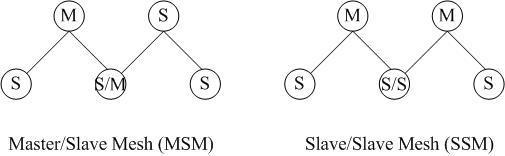
For the scatternet of mesh topology, it can be optimizedtosupportlessroutingandtraffictransmission time. However, the drawback is that it is more complex than other scatternets with different topologies. For the meshtopology,therearetwoalternativesasshowninFig. 1. One is the Master/Slave Mesh (MSM) and the other is theSlave/SlaveMesh(SSM).Obviously,theSSMscatternet makes use of Slave/Slave (SS) bridges to interconnect piconets. On the other hand, the MSM scatternet makes use of either Master/Slave (MS) or Slave/Slave (SS) bridges to interconnect piconets. Thus, MSM scatternet is moreflexiblethanSSMscatternet.
A tree topology consists of a root node, many intermediate nodes and more leaf nodes. Tree hierarchy (TH)topologycanbeusedforconstructingascatternetas shown in Fig. 1. For TH topology, the data packet can be
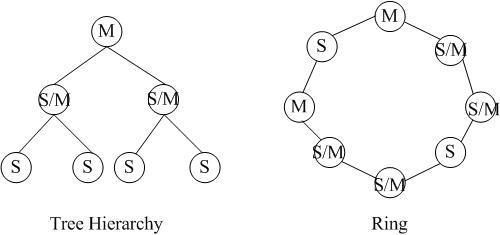
transmitted quickly through the tree-structure scatternet, because the average route length in a tree topology is shorter than those of other topologies. Besides, TH topologycansimplifyroutinginascatternet However,the main disadvantage of tree topology is that the bottleneck for data transmission in the scatternet may occur on the rootnode.
Fortheringtopology(seeFig.1),thecharacteristicsof theringtopologyareoppositetothoseofthetreetopology The ring topology can be used to alleviate bottleneck problems in the TH topology. However, the partition problem and longer average path length are two disadvantagesoftheringtopology.
In the literature, Persson et al. [2] propose several criteria for constructing an optimal scatternet. We also propose some criteria for constructing a framework of internetworkingBluetoothscatternetwithInternet.These criteria include (i) minimized the number of hops, (ii) minimizedaverageroutelength,(iii)minimizedscatternet construction time, and (iv) maximized probability of accesstoInternet.
Madsen et al. proposed formation algorithms [3] for Bluetooth scatternet, which consists of infrastructure and ad hoc parts. The proposed scatternet structure can extend coverage and enable access of a larger number of users. And the formation algorithms can resolve the synchronization problem for creation of a height- and width-balancedtreetopology.
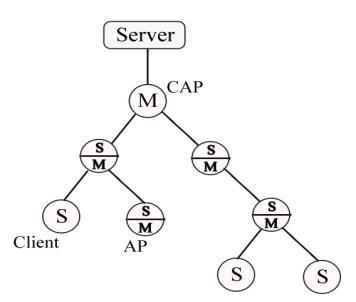
To extend the coverage of network and enable access of large number of clients, access points are interconnectedintoascatternet,whichisformedinatree topologyasshowninFig.2.Thecentralaccesspoint(CAP) isanaccesspointthatdirectlyconnectstothe server.The authors refer to this topology as master-slave separated treetopology.
The CAP acts as a master and APs act as slave/master with respect to CAP/clients as shown in Fig. 2. The client may move around the coverage area of the network and connects to different APs. Moreover, the client can
International Research Journal of Engineering and Technology (IRJET) e-ISSN: 2395-0056
Volume: 12 Issue: 05 | May 2025 www.irjet.net p-ISSN: 2395-0072
communicate with other clients by transmitting packets through APs and CAP, and accessing application service via theserver.Aproblem,whichisinherentfromthetree topology, is the bottleneck at CAP since a large volume of packets are transferred through the root node, i.e., CAP. Besides, the other problem is that the tree may not keep balanced, so that the CAP adopts a level synchronization mechanismtocreateabalancedtree.
Cordeiro etal. proposedanovelBluetootharchitecture, BlueStar [4], which can support Bluetooth devices with uninterrupted access to the Internet. The architecture employsaBluetoothdevicethatisIEEE802.11enabledto be the Bluetooth Wireless Gateway (BWG), which serves as the access point to/from Internet via WLAN. A BluetoothdevicemaytransmitdatapacketstoBWGinthe piconet, the BWG sends the data packet to Internet through local WLAN. Figure 3 illustrates a BlueStar architecture in which two BWGs are employed to realize uninterruptedaccesstotheInternet.
Since a BWG should be equipped with both Bluetooth interface and WLAN interface, the cost of BWG is higher and may dominate the total cost of the system. The maximumnumberofBWGsrequiredinascatternet,which consistsof n piconets,is

In [5], the protocol, which is called Bluetooth Public Access (BLUEPAC) IP, for an extension of IP for mobility issuesinBluetoothscatternet is proposed.By making use of the protocol, access to the Internet in public areas, e.g., airplane,trains,museums,etc.,canbeachieved. BLUEPAC IP is based on IP protocol and additionally adopts Mobile IP and Cellar IP technologies to facilitate IP assignment, routing,andhandoff[9,10,11]
Figure 4 shows the BLUEPAC reference network architecture.ThemainelementoftheBLUEPACLocalArea
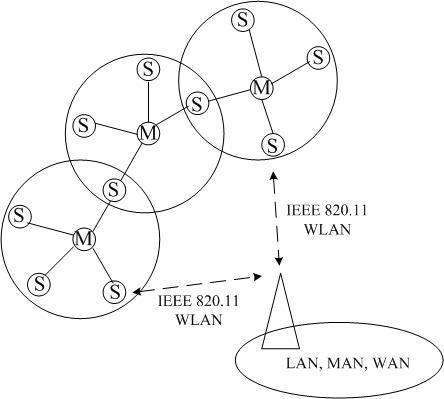
Fig. 3 ThearchitectureofBlueStar
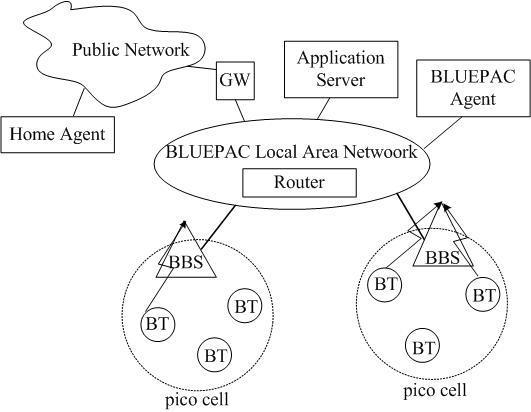
Network is a wired LAN to whichthe BT devicescan gain access. Moreover, a gateway (GW) connects the BLUEPAC LAN to public networks, e.g., Internet, or PSTN. And several BLUEPAC Base Stations (BBSs), which is a LAN accesspoint,aredirectlyattachedtotheBLUEPACLAN.
When a Bluetooth device is within the range of a BLUEPAC Base Station, it will get an allocated IP address from the BLUEPAC Agent. If the BT device owns its IP address, the BLUEPAC Agent will accept the address. The purpose of a BLUEPAC Agent is to be an assignment of IP address and the authentication of the connection devices. The application server provides location-based informationservices.WhenaBTdeviceleavestheoriginal BTpico-cell,theBLUEPACAgentwillbreakoffthepresent connection and establishes a new connection in the other BT pico-cell where a BT device enters. Moreover, some BLUEPAC routers exist between servers and BBSs, and a routing mechanism is designed to achieve routing decisions and accommodate devices in motion, changing positionwithinthenetworkallthetime.
To determine the number of access points in a scatternet tosupporthighconnectivityformobilenodesisatradeoff between total cost of the access points and the connectivity of the mobile nodes. In this Section, some metric that can be used to measure the connectivity of a scatternetwithmobilenodesareaddressed.Thesemetrics include (i) density of access points, (ii) the minimum number of access points required, and (iii) the maximum numberofaccesspointsrequired.
Suppose that there are access points to be regularly arranged on a scatternet and the coverage area of each accesspointisasquareareawith10-meterwidth.Firstly, wedefinethedensityofaccesspointsasfollows.
Definition (Density of Access Points): Let access point be regularly arranged in the area of 2 m . We define thedensityofaccesspoint, D ,asfollows

International
Volume: 12 Issue: 05 | May 2025 www.irjet.net p-ISSN: 2395-0072


Moreover,whenamobilenodeentersasquareareaof , it must be capable of connecting to at least one access point. Therefore, the lower bound of access points requiredis

Definition (Lower Bound of Access Points Required): Thelowerboundofthenumberofaccesspoints, ,ina squareareaof isdefinedasfollows.


Furthermore, if a mobile node can connect to two accesspointsanywhere,thenumberofaccesspointsisthe upper bound of the number of access points. If a mobile node connects to more than two access points anywhere, itmeansthattherearetoo manyredundantaccesspoints in the area. Therefore, the upper bound of the number of accesspointscanbedefinedasfollows.

Definition (Upper Bound of Access Points Required): Theupperboundofthenumberofaccesspointsrequired, ,inasquareareaof isdefinedasfollows. ………………….…(3)

So far, the related works were reviewed and some metric thatcanbeusedtomeasuretheconnectivityofascatternet withmobilenodeswerebrieflydiscussed.Inthefollowing Section, a framework for Bluetooth scatternet that supportsseamlessconnectiontoInternetareproposed.
The proposed framework of internetworking Bluetooth scatternetwithInternet,adoptsatwo-levelinfrastructure. The proposed framework is on the basis of the two-level infrastructure.
4.1
A two-level infrastructure for internetworking Bluetooth scatternet and Internet consists of the core network (the first level) and the access network (the second level) as shown in Fig. 5. A mobile node can connectandtransmitdatapacketstotheBaseStation(BS), and the BS gets and forwards them to the Base Station Leader (BSL) or the Base Station Bridge (BSB). The data packets are finally transmitted to Internet through the Base Station Control (BSC). The core network consists of BSLs and BSCs. On the other hand, the access network consistsoftheBSs.
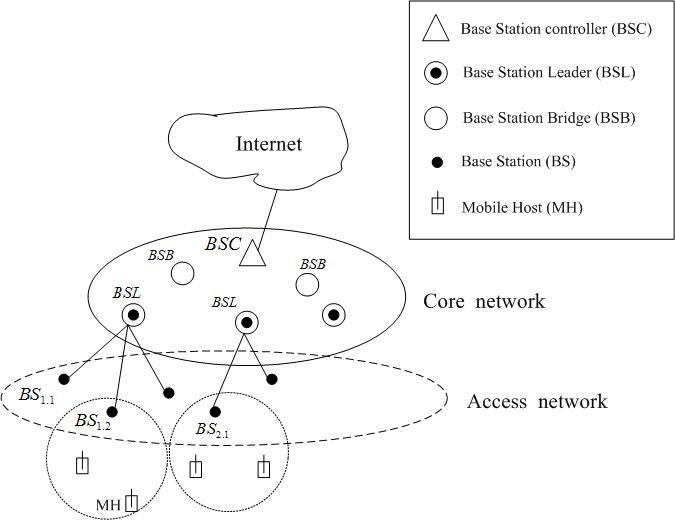
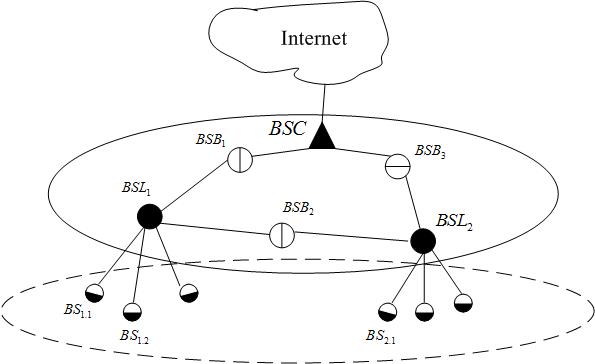
Fig. 5 Two-levelinfrastructure
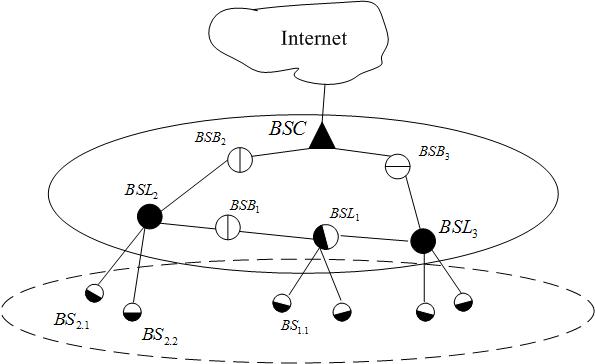
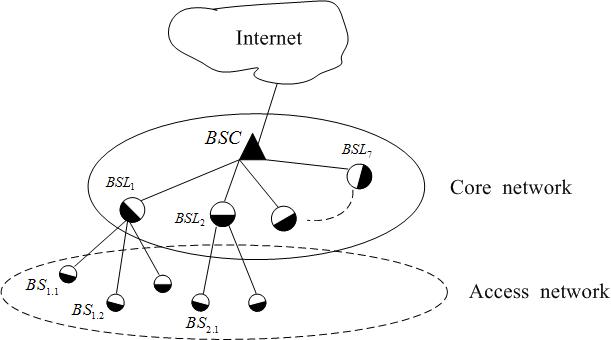
Fig. 11 TheSSRoarchitecture
Fig. 6 Thesingle-stararchitecture
The construction of the proposed framework, which consists of the core network and the access network, is presentedasfollows.
In the access network, each BS can connect to the mobile node which is in the vicinity. Therefore, a BS can connecttosevenmobilenodestoforma piconet.Besides, the BS can connect to its corresponding BSL. The number ofBSsthatcanconnecttotheBSLisdifferentaccordingto thedifferentarchitectureinthecorenetwork.
The BS is responsible for transmitting data packets of the MNs to Internet through the core network. Thus, the topologyofthecorenetworkiscriticaltotheperformance of internetworking Bluetooth scatternet and the Internet. Inthispaper,threetypesoftopologies(i.e.,star,tree,and ring)areconsideredforthecorenetwork.
1) Single Star: Figure 6 shows the single star topology for the core network. The BSC is a gateway for internetworking the Bluetooth scatternet with Internet, andtheBSCconnectstotheBSLsinatreetopology.
Volume: 12 Issue: 05 | May 2025 www.irjet.net p-ISSN: 2395-0072
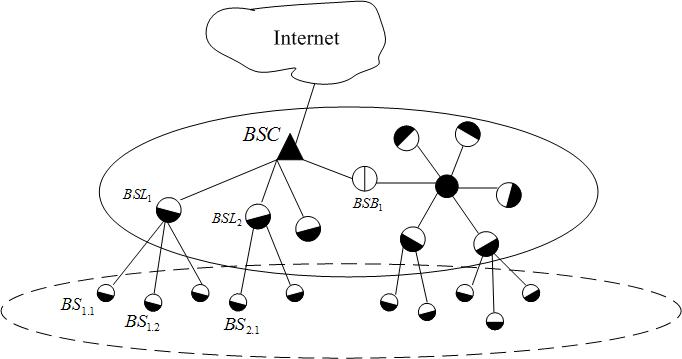
2)MultipleStars:Thearchitectureofmultiple-starcore network is shown in Fig. 7. Unlike the single star, architecture ishorizontally expandedto forma multi-star core network. The BSC directly connects to six BSLs at most and connects to another BSL that acts as the bridge to connect to another star network. However, the master node of a star network could connect only five BSLs because it needs to connect two bridge nodes to extend thecorenetwork.
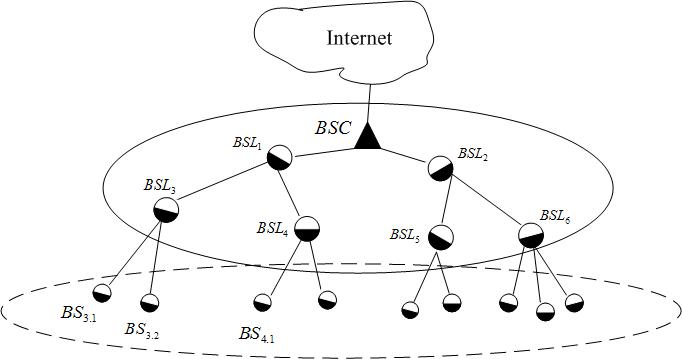
3)Tree: Whenmanymobiledevicesaredispersedina widearea,treearchitecturecaninterconnectlotsofBSsto support these mobile devices connecting to Internet. One of the characteristics of tree architecture is that the average path length is a logarithmic value of the total number of nodes. However, an inherent problem is that therootnodeisabottleneckfortraffic.Inthispaper, only the binary tree is considered. The BSC acts as the master role and the BSLs play the Master/Slave role as shown in Fig.8.
4)Master/Slave Ring (MSR):Forthe ringarchitecture,
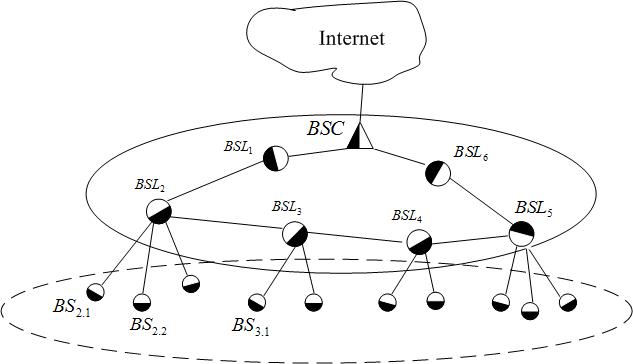
eachBSLcantransmitthedata packettotheBSCthrough two different paths. Because the number of BSLs is not limited, the average path length increases as the number of BSLs gets large. The ring architecture can be classified intotwotypesaccordingto therolesofnodes.IftheBSLs act as Master/Slave role, it is a master/slave ring (MSR). WhenaBSLreceivesadatapacketfromamobilenode,the datapacketwillbetransmittedtothenextBSL.Moreover, each BSL can connect to six BSs at most. Figure 9 illustratestheMSR.
5) Slave/Slave Ring (SSR): On the other hand, the slave/slaveringarchitectureisaringarchitecturethatthe BSL acts as the slave role. The total number of both the BSL and the BSB would affect the slave/slave ring. When thetotalnumberofnodesinthecorenetworkiseven,the BSL nodes must act as the master roles and transmit packets to the BSC through the BSB nodes. So, one BSL node can connects to five BS nodes. We refer to this architecture as the Slave/Slave Ring-even (SSRe) architectureasshowninFig.10.
On the other hand, we refer to the architecture that consists of odd number of nodes in the core network as the Slave/SlaveRing-odd (SSRo)architectureasshown in Fig.11.BecausethenumberofboththeBSLandtheBSBis even,thereisaBSLnodethatwillactastheMaster/Slave nodeinallBSLnodes,soitwouldconnecttosixBSnodes.
International Research Journal of Engineering and Technology (IRJET) e-ISSN: 2395-0056
Volume: 12 Issue: 05 | May 2025 www.irjet.net p-ISSN: 2395-0072
Finally, thecomparison of these architectures is shown in Table1.
Table 1 Comparisonofarchitecture
structure advantage disadvantage
SingleStar Shorter transmissionpath
Shorter transmissiontime
MultiStar
Goodscalability
Limitednumber ofBSL
Poorscalability
Bottleneckat bridge
Tree Nolimiton numberofBSL Longer transmissionpath
Goodscalability
Bottleneckat rootnode
Ring Twoalternative paths Longer transmissionpath
Nolimiton numberofBSL
Poorscalability
MostoftheBluetoothdevicesareportableandmaymove around on the Scatternet. To access the Internet the Bluetooth devices must connect to the access point and gateway. Thus, to develop an efficient infrastructure for internetworking Bluetooth scatternet and Internet is becoming a crucial issue. In this paper, a two-level infrastructure that consists of the core network (the first level) and the access network (the second level) was proposed. In this infrastructure, the access network consists of the MHs and the BSs, and the core network comprises of the BSLsand theBSC(i.e., gateway). Several structures for the core network were investigated. These structuresincludesingle-star,multi-star,binarytree,MSR, SSRe, and SSRo. For the future study, the performance of the infrastructure with different structures of core networkmaybeevaluated.
[1] Bluetooth SIG, Specification of the Bluetooth SystemCorev1.2, 2003(www.bluetooth.com).
[2] K.Persson,D.Manivannan,andM.Singhal,“Bluetooth scatternet formation: criteria, models and classification,” in Proc. IEEE Int. Conf. on Consumer CommunicationsandNetworking,Jan 2004,pp.59-64.
[3] T.Madsen,F.Gudmundsson,S.Sverrisson,H.Schwefel and R. Prasad, “Bluetooth scatternet with infrastructuresupport:formationalgorithms,”in Proc. IEEE Int. Conf. on Consumer Communications and Networking,Jan.2005,pp.13-18.
[4] C.Cordeiro,S.Abhyankar,R.Toshiwal,andD.Agrwal, “A novel architecture and coexistence method to provide global access to/from Bluetooth WPANs by IEEE 802.11 WLANs,” in Proc. IEEE Int. Conf. on Performance, Computing, and Communications, June 2003,pp.23-30.
[5] M. Albrecht, M. Frank, P. Martini, M. Schetelig, A. Vilavaara,andA. Wenzei, “IPservicesoverBluetooth: leading the way to a new mobility,” in Proc. IEEE Int. Conf. on Local Computer Networks (LCN), 1999, pp. 211
[6] P. Johansson, M. Kazantzidis, R. Kapoor, and M. Gerla, “Bluetooth:anenablerforpersonalarea networking,” IEEE Trans. on Networks, vol. 15, no. 5, pp. 28-37, Sept.-Oct.2001.
[7] N Rouhana and E Horlait, “BWIG: Bluetooth web internet gateway,” in Proc. IEEE Int. Symp on Computers and Communications, July 2002, pp679 –684
[8] E. Vergetis, R. Guerin, S. Sarkar, and J. Rank, “Can Bluetooth succeed as a large-scale ad hoc networking technology,” IEEE J. on Sel. Areas in Comm., vol. 23, no. 3,pp.644-656,March2005.
[9] S-H.Chung,Y Hyunsoo,andJ-W Cho,“Afasthandoff scheme for IP over Bluetooth,” in Proc Int. Conf. on ParallelProcessing,Aug.2002, pp 51–55
[10] S Baatz, M Frank, R Gopffarth, D Kassatkine, P Martini, M Schetelig, and A Vilavaara, “Handoff support for mobility with IP over Bluetooth,” in Proc. IEEEInt.Conf. on Local ComputerNetworks,Nov.2000, pp.143–154.
[11] C.-H. Yang, Y.-S. Chen, J.-W. Ruan, and W.-P. Ho, “A mobility model for Bluetooth scatternets in wireless personal area networks,” in Proc.Int Conf.onWireless Networks(WNET’04),June2004,pp.140-143.