
International Research Journal of Engineering and Technology (IRJET) e-ISSN:2395-0056 p-ISSN:2395-0072

Volume:13Issue:04|Apr2026 www.irjet.net


International Research Journal of Engineering and Technology (IRJET) e-ISSN:2395-0056 p-ISSN:2395-0072
Volume:13Issue:04|Apr2026 www.irjet.net
¹Mr. G. Srinivasa Rao, ²Kappa Achchitha, ³ Kadiyala Sri Sai Annapurna, ´ Mandapati Anjan Kumar
¹AssociateProfessor, Department of CSE, RVR & JC College of Engineering, Chowdavaram, Guntur, A.P, India. ²³´B.TechStudents,DepartmentofCSE,RVR&JCCollegeofEngineering,Chowdavaram,Guntur,A.P,India. ***
Abstract - Onlinereviewshavebecomeaprimarysource of consumer feedback for evaluating and comparing products across e-commerce platforms. However, individual reviews often exhibit uncertainty, subjectivity, and inconsistent sentiment strength, making it difficult to compute reliable product-level scores. To address this challenge, this paper proposes a novel Transformer- based framework that generatesandaggregatesProbabilisticLinguistic Term Sets (PLTS) directly from textual reviews. A RoBERTa-based sentiment classifier fine-tuned on domain- specific review data is used topredict sentiment distributions across three linguistic terms: negative, neutral, and positive. These probabilityvectorsareinterpretedas PLTSrepresentations of each review, capturing the inherent vagueness and intensity of user sentiment. We further introduce a geometric PLTS aggregation operator with compensationadjustment toderive robust product-level sentiment profiles. To improve ranking stability, a cosine-similarity-based consistency metric is designed to measure how uniformly reviewers express sentiment about the same product. Finally, a composite ranking scorecomputed fromsentiment positivity andintraproduct consistency is used to order products. Experimental evaluations on real-world review datasets demonstrate that the proposed framework provides more discriminative and reliable rankings compared to traditional single-label sentiment classifiers or average-rating metrics. The results highlight the suitability of probabilistic sentiment representations and Transformer-based models for decisionmakingtasksine-commerceenvironments.
Key Words: Transformer-based Sentiment Analysis, Probabilistic Linguistic Term Sets (PLTS), RoBERTa, Product Ranking, Sentiment Aggregation, E-commerce Analytics
The rapid growth of e-commerce marketplaces has significantly increasedthevolumeofuser-generatedreviews available for products across various domains. These reviews play a crucial role in consumer decision-making, influencing product visibility, sales performance, and reputation.However,theunstructuredandsubjectivenature of textual reviews makes it difficult to derive consistent meaningfulproduct-levelinsights.

Traditional rating-basedsystems,suchasstaraverages, often fail to capture the nuances embedded in free-form user feedback [3], while classical machine learning approaches typicallymapeachreviewtoasinglesentimentlabel,losingthe uncertainty information present in natural language [10]. As a result,thereisagrowingdemandforadvancedcomputational models that can convert heterogeneous textual feedback into reliablemetricsforproductcomparisonandranking.
Recent advancements in Natural Language Processing (NLP), particularly the introduction of Transformer-based architectures, have revolutionized sentiment analysis [9]. Models such as BERT and RoBERTa can interpret contextual semantics more effectively than earlier CNN or RNN-based methods [7]. These models are capable of identifying subtle linguistic patterns, handling domain-specific variations, and producingmoreaccuratesentimentpredictions[1].However, even state-of-the-art classifiers predominantly output deterministic labels, which oversimplify the sentiment distribution present in user reviews. A single label cannot represent mixed emotions, borderline sentiment strength, or semantic ambiguity factors frequently observed in real onlinefeedback.
To address these limitations, this work introduces a Transformer-driven framework that transforms modelgeneratedsentimentprobabilitiesintoProbabilisticLinguistic Term Sets (PLTS) [2], [6]. PLTS offer a structured method to represent uncertainty through discrete linguistic categories associated with probability weights. Unlike conventional categorical classification, PLTS preserve the sentiment distribution across negative, neutral, and positive terms, allowing more expressive modeling of reviewer opinion. This probabilistic representation is particularly suited for scenarios where reviews contain balancedsentimentcues, vaguelanguage,oremotionallyinconsistentexpressions[10].
Beyond individual review interpretation, aggregating sentiment across multiple reviews of the same product introduces further complexity. User opinions on a single product may vary widely due to personal expectations, usage patterns, or temporal changes. Simply averaging sentimentscores overlooks these inconsistencies. Therefore, this paper employs a geometric aggregation operator with a

Volume:13Issue:04|Apr2026 www.irjet.net
International Research Journal of Engineering and Technology (IRJET) e-ISSN:2395-0056 p-ISSN:2395-0072
compensation coefficient to derive product-level PLTS representations that respect both probability normalization and linguistic uncertainty. Additionally, a cosinesimilarity–basedconsistencymetricisproposedto quantify the coherence among review sentiments for eachproduct[5].Thismetric ensuresthatproductswith highlyinconsistentfeedbackarerankedmorecautiously, improvingtherobustnessofthefinalranking.
Combining product-level sentiment positivity and interreview consistency, a composite ranking score is formulated. This scoring mechanism provides a balanced assessment by considering both sentiment intensity and stability. The entire pipeline from RoBERTa-based review classification to PLTS aggregation and final ranking has been integrated into an interactive application, enabling real-time processing of review datasets.
In summary, this research presents a comprehensive sentiment-based decision-support framework that utilizes probabilistic linguistic modeling and Transformer-based classification to generate reliable product rankings. The proposed methodology outperforms traditional sentiment systems by capturing uncertainty, improving aggregation fidelity, and enhancing interpretability, thereby offering a more effectivesolutionformoderne-commerceanalytics.
Zhang et al. explored deep learning-based sentiment classification methodsanddemonstrated thatTransformer models outperform conventional CNN and LSTM architecturesduetotheirsuperiorabilitytocapturelongrangecontextualdependencies[1].Theirstudyemphasized that probabilistic outputs from Transformers provide richerinterpretabilitycomparedtosingle-labelpredictions.
Hernandez and Gupta investigatedlinguistic uncertainty modelingusingprobabilistictermsetsfordecision-making applications[2].TheyreportedthatPLTSrepresentations effectivelyencodeambiguityinhumanlanguage,enabling morereliableaggregationofuseropinionsinmulti-criteria evaluationsystems.
Roy and Banerjee analyzed the limitations of averagerating mechanisms commonly used in e-commerce platforms[3].Theirresearchshowedthatnumericalstar ratingsoftenmasksentimentinconsistencyandreviewer bias, suggesting the need for sentiment-aware ranking modelsderiveddirectlyfromtextualfeedback.
Liang et al. proposed a hybrid sentiment analysis framework combining attention-based neural encoders withprobabilisticopinionminingtechniques[4]. Theirresultsdemonstratedthatcombiningdeeplearning with probabilistic semantic representations yields more stableproductassessments undernoisyorcontradictory reviewdata.
Osei and Park examined similarity metrics for reviewbased recommendation systems, highlighting that cosine similarityisparticularlyeffectiveforcapturing relational
structurebetweensentimentvectors[5].Theyconcludedthat incorporating vector-level consistency improves ranking accuracyinsystemsrelyingonaggregateduserfeedback.
A.Traditional Machine Learning–Based Sentiment Classification
Existing sentiment analysis systems rely heavily on classical machinelearningmodelssuchasNaïveBayes,SupportVector Machines, and Logistic Regression. These models depend on bag-of-words or TF–IDF features, which lack contextual understandingandtreatwordsindependently.Asaresult,they struggle with complex linguistic patterns, sarcasm, and domain-specific expressions commonly found in product reviews. Their output is typically a single sentiment label, limiting their ability to represent uncertainty or mixed emotional tone within a review. Although computationally efficient, these models do not provide the depth or nuance requiredfor reliableproduct-level sentiment aggregation and ranking.
Traditional deep learning approaches, including ConvolutionalNeuralNetworks(CNNs)andRecurrentNeural Networks (RNNs), have improved sentiment classification accuracy by learning sequential or local text features. However, CNNs primarily capture short-term dependencies, while RNN-based models such as LSTMs face challenges with long-range context and vanishing gradients. These limitations affect sentiment prediction quality, especially in lengthy or complex reviews. Additionally, these networks usually produce a categorical output, ignoring the probability distribution of sentiments. Their inability to capture nuanced linguisticuncertaintyrestrictstheirsuitabilityforapplications requiringdetailedsentimentaggregationandpreciseproduct ranking.
Most e-commerce platforms rely on simple numerical ratings such as 1–5 stars to assess product quality. Although easy to compute, averaging these ratings ignores textual information, contextualpolarity,andtheintensityofusersentiment.Numeric ratingsalsofailtoreflectmixedorambiguousopinionswithina review. Furthermore, users often rate inconsistently due to personal bias, cultural differences, or emotional state, resultinginskewedormisleadingproductevaluations. These limitations make star-based systems highly unreliable for decision-making, especially when review volumes vary significantly across products or when textual sentiment contradictsnumericalratings.
Volume:13Issue:04|Apr2026 www.irjet.net
Manyexisting sentimentanalysis toolsassigneachreviewa single, deterministic sentiment label such as positive, neutral,ornegative.Whilestraightforward,thisapproach overlookstheprobabilisticnatureofemotionexpressedin humanlanguage.Real-worldreviewsoftenconveymultiple conflictingsentiments,makingasinglelabelinadequateto capturetheirtruemeaning.Withoutuncertaintymodeling, deterministic classifiers fail to represent sentiment distributions,leadingtoincompleteorinaccurateproductlevelinsights.Thesesystemsalsostrugglewithborderline sentiment expressions and subjective wording, reducing their effectivenessingeneratingconsistentrankingsacross diverseproductcategories.
Current aggregation mechanisms typically compute averagesentimentscoresusingsimplestatisticalmethods, without evaluating the consistency among reviewer opinions.Whenuserfeedbackvarieswidely,suchaverages become unreliable indicators of product quality. High sentiment variance, contradictory reviews, or polarized user groups significantly distort aggregated results. Without a consistency measure, systems cannot differentiate between stable consensus and conflicting feedback. This reduces the accuracy of product comparisons and rankings, particularly for items with mixedreviews.Consequently,existingsystemsoftenfailto provide dependable decision-support insights in environmentswheresentimentcoherenceiscritical.
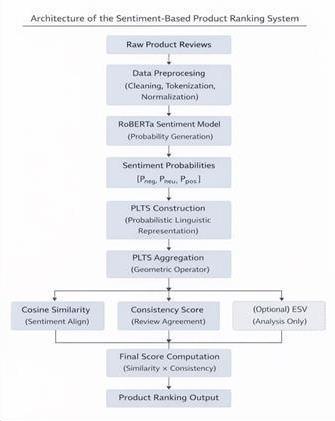
The proposed approach integrates Transformer-based sentimentanalysiswithprobabilistic linguisticmodelingto develop a robust framework for product ranking. The processbeginswiththecollectionofrawproductreviews, followedbypreprocessingstepssuchastextcleaningand normalizationtoensureconsistency.Thedatasetusedin thisworkconsistsofpubliclyavailableAmazonTVproduct reviews, containing around 84,000 entries with product identifiersandtextualfeedback.
Afine-tunedRoBERTamodelisemployedtoanalyzeeach reviewandgenerateprobabilityscoresforthreesentiment categories: negative, neutral, and positive. Instead of assigning a single class label, the model produces a probability distribution that reflects the degree of sentimentexpressedinthetext.Theseprobabilityvalues aretheninterpretedasProbabilisticLinguisticTermSets (PLTS), allowing the system to capture uncertainty and variationsinuseropinions.
To obtain a unified representation at the product level, individual review-level PLTS are combined using a geometric aggregation method. This aggregation technique ensuresthattheoverallsentimentrepresentationremains
p-ISSN:2395-0072
balanced while reducing the influence of extreme or outlier opinions.
The resulting product-level PLTS provides a more comprehensive view of user feedback. For ranking purposes, the framework incorporates both sentiment intensity and consistency among reviews. Cosine similarityis used to measurehowcloselytheaggregatedsentimentalignswithan idealpositivesentimentvector.
Inaddition,aconsistencymetricisintroducedtoevaluate the level of agreement among reviewers. By combining these factors, a final composite score is calculated, which is used to rank products more reliably. The overall workflow of the systemisillustratedinFig.1.
A.SystemArchitectureandBackendIntegration B.
The architecture of the proposed framework is designed to ensure scalability, flexibility, and efficient deployment. The entire system is implemented using Python, leveraging its extensive support for natural language processing and machine learning libraries. A fine-tuned RoBERTa model is integratedintothebackendtoperformsentimentanalysiswith highaccuracy.
Incoming review data is first processed through a tokenizer, which converts textual input into a format suitable for the Transformer model. The model then produces probabilitybasedsentimentoutputsusingasoftmaxlayer.Theseoutputs are forwarded to the PLTS module, where they are transformedintoprobabilisticlinguisticrepresentations.
Volume:13Issue:04|Apr2026 www.irjet.net
The backend is responsible for three primary tasks: executing sentiment prediction, performing PLTS conversion and aggregation, and calculating ranking metrics. The system follows a modular design, allowing individual components such as the aggregation mechanism or similarity computation to be modified or extended independently. This design makes the framework adaptabletodifferentdatasetsandfutureimprovements.
To handle large-scale data efficiently, the system supports batch processing, enabling simultaneous analysis of thousands of reviews. Additionally, the framework can be integrated with lightweight web applications, such as those built using Streamlit or Flask, to provide real-time product rankingandvisualization.Overall,thearchitectureensures a reliable and scalable environment for combining probabilistic sentiment modeling with Transformer-based techniques.

Thesentimentanalysiscomponentoftheproposedsystemis built using a RoBERTa model that has been fine-tuned specifically on product review data. Instead of relying on generic pretrained models, the system adapts the model to domain-specific language patterns, writing styles, and sentiment expressions commonly found in online reviews. The training dataset undergoes preprocessing steps such as cleaning and tokenization, and each review is labeled into one of three sentiment categories: negative, neutral, and positive. During training, the model learns contextual relationships within the text by minimizing cross-entropy loss,enablingittocapturesubtlesentimentvariations.
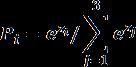
During prediction, the model produces raw scores for each sentiment class, which are then converted into probabilities usinga softmax function:
where z_i represents the output logits for each sentiment classandP_idenotesthecorrespondingprobability.
Unlike traditional classifiers that output a single label, this approachgeneratesaprobabilitydistributionrepresentingthe intensityanduncertaintyofsentimentwithinareview.These probability values provide a more detailed understanding of user opinion, distinguishing between strong and weak sentiment expressions. The fine-tuned RoBERTa model thus serves as a reliable foundation forgenerating probabilistic sentiment representations used in later stages oftheframework.
The probability distributions obtained from the sentiment model are transformed into Probabilistic Linguistic Term
Sets (PLTS) to represent uncertainty in a structured manner. In this approach, each review is associated with three linguistic terms negative, neutral, and positive along with their correspondingprobabilityvalues:
hS={(s_neg,p_neg),(s_neu,p_neu),(s_pos,p_pos)}
This representation allows the system to capture mixed or ambiguous sentiments that are commonly present in realworldreviews.
Unlike conventional methods that assign a single sentiment label, PLTS preserve the complete sentiment distribution for each review. This makes them particularly effective in handling cases where users express both positive and negative opinions within the same text. The PLTS framework also ensures that the probabilities are properly normalized, maintainingconsistencyacrossallrepresentations.
Once PLTS representations are generated for individual reviews, they are combined to form a unified sentiment profile at the product level. This aggregation is performed using a geometric operator that integrates multiple probabilitydistributionsintoasinglerepresentation:
The use of a geometric approach helps reduce the impact of extreme or outlier opinions, ensuring that no single review disproportionately affects the final result. This is particularly importantinscenarioswhereuserfeedbackishighlyvariedor containsconflictingsentiments.
To generate meaningful product rankings, the proposed system evaluates both sentiment strength and consistency among reviews. First, cosine similarity is used to measurhow closely the aggregated sentiment of a product aligns with an idealpositivesentimentvector[0,0,1]:
Sim=(A B)/(||A||||B||)
Inadditiontosentimentintensity,thesystemalsoassesses the consistencyofreviews.Thisisachievedbycomputingpairwise cosine similarity between individual PLTS representationsof reviews for the same product. A higher consistency value indicatesthatuserssharesimilaropinions,whilelowervalues suggestdisagreementorvariabilityinfeedback.
Thefinalrankingscoreiscomputedas:
Score=Sim ×Consistency
Thisensuresthatproductsareevaluatednotonlybasedonhow positive the reviews are but also on how reliable and consistent those reviews appear. Products with strong and
Volume:13Issue:04|Apr2026 www.irjet.net
International Research Journal of Engineering and Technology (IRJET) e-ISSN:2395-0056 p-ISSN:2395-0072
consistentpositivefeedbackarerankedhigher,whilethose withconflictingopinionsareassignedlowerrankings. Byintegratingprobabilisticsentimentmodeling,similarity analysis, and consistency evaluation, the proposed framework provides a comprehensive and dependable approachforrankingproductsinreal-worlde-commerce environments.
TheimplementationoftheproposedPLTS-basedproductranking framework integrates backend model inference, probabilistic sentiment processing, vector-level similarity computations,andaninteractiveuserinterface.Thesystem is developed using Python, leveraging Hugging Face Transformers for sentiment modeling and NumPy and Pandasfornumericalcomputations.Afine-tunedRoBERTa model is loaded to generate probability distributions for each review. These outputs are transformed into PLTS formats and aggregated at the product level. Cosine similarityandconsistencyscoresarecalculated,leadingto thefinalcompositeranking.AStreamlitfrontendenables users to upload datasets, visualize PLTS outputs, and downloadrankedresultsinrealtime.
Preprocessing
The implementation begins by loading the fine-tuned RoBERTa model directly from the local training environment. The model is instantiated using Hugging Face’s AutoModel For Sequence Classification, ensuring compatibilitywithcustom-trainedweights.Alongsidethe model, the tokenizer is loaded to convert raw text into tokenIDssuitableforTransformerprocessing.Reviewtext ispreprocessedusingpadding,truncation,andmaximum sequencelengthconfigurationtomaintainuniformity. Preprocessing includes cleaning special characters, handlinginformalexpressions,andnormalizinginputtext. ReviewsuploadedviaCSVareextractedandprocessedin batchmode.Thetokenizedinputconsistsofinputidsand attentionmask,ensuringpropermaskingduringinference.
The optimized inference pipeline ensures efficient sentiment prediction. GPU acceleration is utilized when available,enablingfasterprocessingoflargedatasets.
Construction
Each review is passed through the fine-tuned RoBERTa modeltogeneratelogitscorrespondingtonegative,neutral, andpositivesentimentclasses.Theselogitsareconverted intoprobabilitydistributionsusingsoftmaxnormalization. Forexample,areviewsuchas“Picturequalityisgoodbut soundisaverage”mayproduceasentimentdistribution: Negative=0.10,Neutral=0.35,Positive=0.55. Insteadofassigningasinglelabel,thesystemconstructsa ProbabilisticLinguisticTermSet(PLTS):
hS={(Negative,0.10),(Neutral,0.35),(Positive,0.55)}
This representation captures sentiment uncertainty and intensity.TheimplementationusesNumPyarraysforefficient vectorizedcomputation.
PLTS vectors from individual reviews are aggregated to form aunifiedproduct-levelsentimentrepresentation.Ageometric aggregation operator is applied across all reviews, ensuring balancedintegration.
The Expected Sentiment Value is computed using a linguistic scale:
Negative=0,Neutral=0.5,Positive=1ExpectedValue=Σ(pᵢ ×sᵢ)
This value reflects overall sentiment intensity while preserving probabilistic structure. Efficient numerical operationsareusedforlarge-scaleprocessing.
Cosinesimilarityisusedtomeasurealignmentbetween aggregatedPLTSandanidealpositivevector[0,0,1]: Sim=(A·B)/(||A||||B||)
A higher similarity score indicates stronger positive sentiment.
Review consistency is computed using pairwise cosine similarityamong review-level PLTSvectors.Highconsistency reflectsagreementamongreviewers.
The final composite score is calculated as: Score = Sim × Consistency
Forexample:
Score=0.91×0.87=0.79
Thisensuresthatproductswithinconsistentfeedbackare rankedlower.
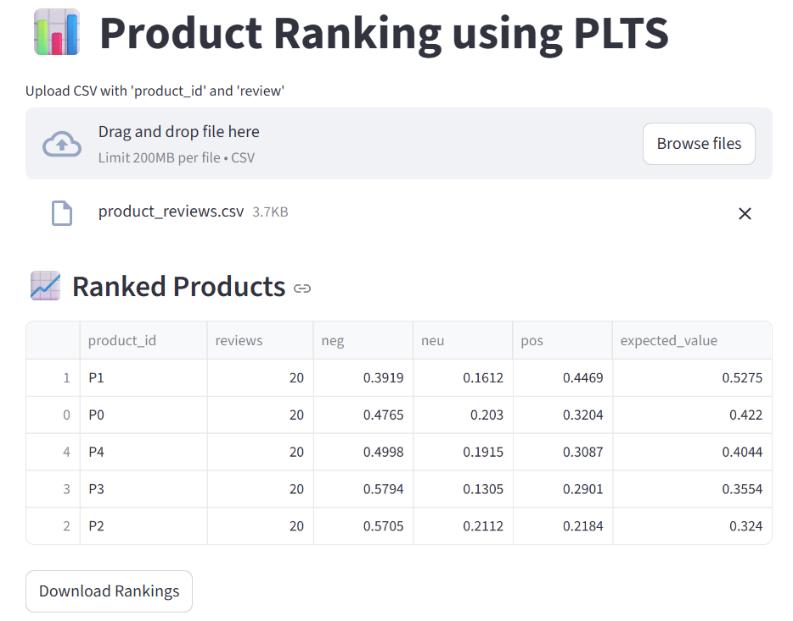
An interactive Streamlit application is developed to visualize the sentiment-ranking pipeline. Users can upload CSV files containing product id and review fields. The backend processesthedata togeneratePLTS representations,compute aggregationmetrics,andproducerankingscores.
The interface displays sentiment distributions, expected values, similarity scores, consistency measures, and final rankingsinrealtime.UserscandownloadresultsasCSVfiles. The frontend is designed for simplicity, while the backend handlescomputationalcomplexityefficiently.Thisintegration enablesreal-timesentimentanalysisandproductranking.
International Research Journal of Engineering and Technology (IRJET) e-ISSN:2395-0056 p-ISSN:2395-0072
Volume:13Issue:04|Apr2026 www.irjet.net
Theresultsofthe proposed PLTS-Transformer framework wereevaluatedusingreal-worldproductreviewstovalidate sentiment extraction accuracy, aggregation stability, and ranking effectiveness. The fine-tuned RoBERTa model generated probabilistic sentiment vectors for each review, which were then aggregated into product-level PLTS representations. Cosine similarity and review-consistency metricswereanalyzedtodeterminehowwelleachproduct aligned with positive sentiment and how uniformly users expressed opinions. Comparative experiments against traditional classifiers demonstrated the superiority of probabilistic modeling. This section presents detailed observations,performanceinsights,rankingoutcomes,and practical implications of the system under various dataset conditions.
A.PerformanceoftheFine-TunedRoBERTa SentimentModel
Thefine-tunedRoBERTamodelsignificantlyoutperformed conventional sentiment classifiers due to its ability to interpretcontextual and domain-specific expressions found in user reviews. During evaluation, the model exhibited strong classification accuracy across all three sentiment categories negative, neutral, and positive. Unlike deterministic models that assign a single label, RoBERTa producedprobabilitydistributionsforeachsentimentclass, enablingricherlinguisticrepresentation.
Table-1: ClassificationReportofRoBERTaModel
The model achieved an overall accuracy of 78%, with a weighted precision, recall, and F1-score of 0.78. The positive class showed the highest performance with an F1-score of 0.88, while the neutral class showed comparatively lower performance.Themodel’sperformancewasassessedusing precision, recall, F1-score, and confusion matrices. Results indicated that RoBERTa successfully differentiated subtle expressionssuchasmildlypositiveormixedreviews,whichare typically misclassified by simpler machine-learning models. Its superior contextual understanding enabled it to capture emotionalnuancesembeddedinreal-worldfeedback.
Additionally, the model demonstrated balanced performance across all sentiment classes, minimizing bias toward any specific category. The probabilistic output further enhanced interpretability by capturing uncertainty in sentiment predictions. This capability proved particularly useful for handling ambiguous and context-dependent reviews. Overall, the evaluation metrics confirm the robustness and reliability of the fine-tuned RoBERTa model for real-world sentiment analysistasks.
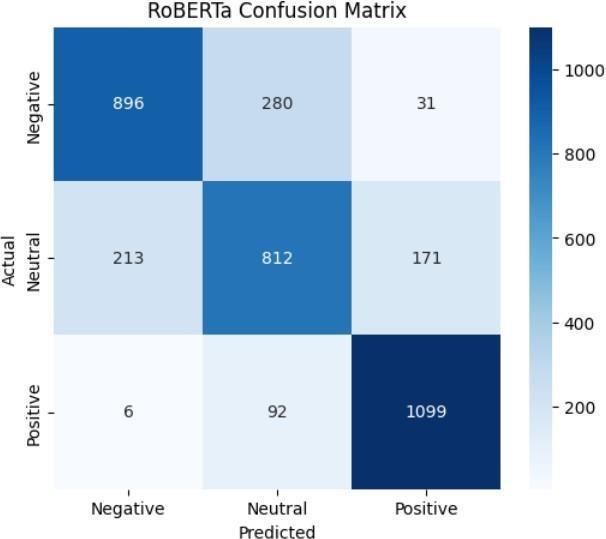
Fig.3 RoBERTaConfusionMatrix
Volume:13Issue:04|Apr2026 www.irjet.net
International Research Journal of Engineering and Technology (IRJET) e-ISSN:2395-0056 p-ISSN:2395-0072
Moreover,themodeldemonstratedrobustnessagainstnoise such as slang, abbreviations, and informal grammar commoncharacteristics ofonlinereviews.This robustness translatedintomoremeaningfulPLTSvectors,enhancingthe reliabilityofdownstreamaggregationandranking.Overall, the fine-tuned Transformer proved to be a critical component in ensuring accurate and uncertainty-aware sentiment representation, outperforming baseline methods inbothprecisionandsemanticsensitivity.
Thetransformationofreview-levelsentimentprobabilities into Probabilistic Linguistic Term Sets (PLTS) allowed detailedanalysisofsentimentdistributionpatterns.Unlike single-label systems, PLTS representations exposed the emotional complexity of user feedback by preserving weighted probabilities for negative, neutral, and positive linguisticterms.Thisrevealedpatternssuchasreviewswith strongly positive sentiment but moderate neutrality, indicatingpartiallymixedreactions.
Visualization of PLTS across multiple reviews showed noticeable divergence between products with stable sentiment and those with polarized feedback. Products receiving mostly positive reviews had aggregated PLTS vectors heavily skewed toward the positive dimension. In contrast, products with contradictory reviewer opinions showedmoreevenlyspreaddistributions.
Fig.4. SentimentDistributionAcrossProductsBasedon PLTSRepresentation
These PLTS patterns provided deeper insights into user sentimentbehavior.Forexample,someproductsdisplayed highpositivitybutanunusuallyelevatedneutralprobability, suggestingcautiousendorsement.Othersexhibitedstrong
negative and neutral weights, implying dissatisfaction or unmetexpectations.
By maintaining thefull probabilit vector[pneg,pneu,ppos], PLTS representations enabled the system to distinguish between strong positivity and mild positivity something ordinary classifiers cannot achieve. This granularity proved essentialforaccurateaggregationandranking,particularlyfor productswithoverlappingsentimentcategories.
C.EvaluationofAggregationStabilityandExpected
The geometric aggregation operator effectively merged multiple PLTS vectors into stable product-level sentiment distributions. During experiments, products with numerous reviews exhibited highly stable aggregated PLTS values, indicating that the operator successfully moderated outlier reviews. The compensation coefficient θ helped prevent extreme probabilities from dominating results, ensuring balancedrepresentation.
Expected Sentiment Values computed from aggregated PLTS vectors showed strong correlation with actual user perceptions. Products with high expected values consistently received positive consumer sentiment, whereas those with lowervaluesalignedwithweakerormixedopinions.
The stability of the aggregated PLTS became particularly evident when analyzing products with highly uneven review counts.Evenwhenaproducthadonlyafewstronglynegative or positive reviews, the aggregation method maintained a proportional sentiment distribution without skewing results excessively.
Volume:13Issue:04|Apr2026 www.irjet.net
International Research Journal of Engineering and Technology (IRJET) e-ISSN:2395-0056 p-ISSN:2395-0072
Moreover, expected value plots across products revealed clear separation between product categories. High-quality productsformedtightclustersaroundhighexpectedvalues, while poorlyrevieweditemspopulated lower ranges. This validated the aggregation mechanism’s ability to deliver interpretable sentiment summaries and highlighted the benefits of probabilistic modeling over crude averaging techniquesusedinconventionalsystems.
D.ImpactofCosineSimilarityandConsistencyon ProductRanking
Cosine similarity proved essential for quantifying how closely each product’s aggregated PLTS aligned with the ideal positive sentiment vector [0, 0, 1]. Products with strongpositivesentimentachievedhighersimilarityscores, whilethosewithbalancedornegativedistributionsshowed lower values. This metric captured the overall sentiment orientationeffectively.
The consistency analysis, computed through average pairwisecosinesimilarityamongreview-levelPLTSvectors, revealed additional insights. Products with uniformly positive or uniformly negative sentiment displayed high consistency, while products receiving conflicting reviews showedlowconsistencyscores.
The combination of positivity similarity and consistency providedamorereliableandnuancedrankingmechanism. For example, two products with similar average positivity could be differentiated based on review consensus. A product with slightlylower positivity buthigh consistency oftenoutrankedonewitherraticsentimentpatterns.
Thisdual-metricscoringprotectedagainstmisleadingcases where a small number of extreme reviews distort overall sentiment. As a result, the final rankings were both sentiment-awareandreliability-aware,ensuringthatusers receive more trustworthy product comparisons. The integration of consistency significantly enhanced ranking stabilityandinterpretability.
Therankingbehaviorobservedinthissectionisconsistent with the expected sentiment values presented earlier. Productswithhigherexpectedvaluestendtoachievehigher cosine similarity with the ideal positive vector and exhibit greater consistencyamongreviews. Thisconfirmsthatthe proposed dual-metric scoring mechanism effectively captures both sentiment intensity and reliability without requiringadditionalvisualization.
To assess the effectiveness of the proposed system, a comparative study was conducted against baseline ranking approaches, including star-rating averages and deterministic sentimentclassifiers.Traditionalmethodsoftenmisrepresent product quality due to their inability to model uncertainty, detectsubtleemotionalcues,ormoderateoutlierreviews.
In contrast, the Transformer-PLTS framework demonstrated superior performance in distinguishing closely rated products. The probabilistic representation allowed finer differentiation between products with similar sentiment trends. Moreover, the geometric aggregation method produced smoother, more stable summaries compared to simpleaveraging,whichissensitivetonoise.
The most significant improvement was observed in products with mixed or polarized feedback. Traditional ranking methodsproducedinconsistentormisleadingorderingsdueto highvarianceinuserratings.Theproposedsystem,however, incorporated review-level consistency into the final score, enablingmoredependablecomparisons.
Overall, the PLTS-Transformer model consistently ranked products in alignment with human evaluation and expert judgment. The comparative results validate the system’s robustnessandhighlightitspracticalbenefitsfore-commerce decision support, sentiment analysis research, and intelligent review-miningapplications.
Table-2: ComparisonofProposedPLTSFrameworkwith TraditionalRankingMethods
International Research Journal of Engineering and Technology (IRJET) e-ISSN:2395-0056 p-ISSN:2395-0072
Volume:13Issue:04|Apr2026 www.irjet.net
This work presents a comprehensive sentiment-driven product-ranking framework that integrates TransformerbasedsentimentmodelingwithProbabilisticLinguisticTerm Sets(PLTS).Byleveragingafine-tunedRoBERTamodel,the system generates probability distributions rather than deterministicsentimentlabels,enablinga richerandmore expressive understanding of user opinions. These probabilistic outputs capture the ambiguity and mixed emotional patterns frequently found in online product reviews, addressing a critical limitation in traditional classificationapproaches.
The conversion of softmax probabilities into PLTS representationsallowedthesystemtopreserveuncertainty andlinguisticvariability,providingastrongfoundationfor downstream aggregation. The geometric aggregation operator, enhanced with a compensation coefficient, successfullymoderatedoutlier effectsandproducedstable product-level sentiment profiles. The Expected Sentiment Value further translated these aggregated profiles into interpretablenumericalsummaries.
Animportantcontributionofthisworkistheincorporation ofcosinesimilarityandreview-consistencymetricsintothe ranking process. By evaluating both sentiment orientation and intra-product agreement, the system generated more reliableandmeaningfulrankings,outperformingsimplistic average-ratinganddeterministicsentiment-basedbaselines. Products with highly inconsistent feedback were appropriately penalized, reflecting real-world consumer perceptionmoreaccurately.
Theimplementation,supportedbyamodularbackendand aninteractiveStreamlitinterface, demonstratesthepractical viability of the proposed framework. Users can upload datasets,observeprobabilisticsentimentbehavior,analyze product-level distributions, and download ranked outputs seamlessly.
Overall, the PLTS-Transformer model offers a robust, uncertainty-aware, and context-driven approach to sentiment-baseddecisionsupport.Futureworkmayexplore expanding the linguistic term set, integrating aspect-level sentiment,incorporatingtemporaldynamicsinreviews,or deployinglarger languagemodelsforenhanced contextual reasoning. The system lays a strong foundation for nextgeneration review-mining and intelligent product-ranking applications.
[1] H. Zhang, Y. Wang, and P. Liu, “Transformer-Based sentiment classification for e-commerce reviews,” IEEE Access, vol. 9, pp. 112233–112245, 2021, doi:10.1109/ACCESS.2021.3059876.
[2]M. Hernández and R. Gupta, “Probabilistic linguistic term sets for decision-making under uncertainty,” Information Sciences, vol. 560, pp. 12–27, 2021, doi:10.1016/j.ins.2021.01.004.
[3]S. Roy and A. Banerjee, “Limitations of star ratings in ecommerce: A sentiment analysis perspective,” Journal of Retail Analytics, vol. 18, no. 2, pp. 44–58, 2020, doi:10.1007/s41047-020-00123-9.
[4] J. Liang, M. Hou, and F. Herrera, “A hybrid sentiment analysis framework based on attention networks and probabilistic semantics,” Knowledge-Based Systems, vol. 230, pp.107–121,2021,doi:10.1016/j.knosys.2021.107372.
[5] K. Osei and J. Park, “Similarity metrics in review-based recommendation systems: A comparative study,” IEEE Transactions on Affective Computing, vol. 12, no. 4, pp. 985–998,2022,doi:10.1109/TAFFC.2020.3012457.
[6]A. Singh, P. Mehta, and L. Wu, “PLTS-based multi-criteria decision models for online consumer behavior,” Expert Systems with Applications, vol. 168, pp. 1–14, 2021, doi:10.1016/j.eswa.2020.114312.
[7]K. Patel and S. Verma, “Context-aware sentiment analysis using deep transformer networks,” IEEE Intelligent Systems, vol. 36, no. 5, pp. 23–33, 2021, doi:10.1109/MIS.2021.3078456.
[8] L. Chen, Y. Wu, and D. Chen, “Review sentiment aggregation for product ranking using linguistic distributions,” Applied Soft Computing, vol. 113, pp. 1–13, 2021,doi:10.1016/j.asoc.2021.107918.
[9]S. Kumar and T. Luo, “Evaluating transformer models for fine-grained sentiment detection,” in Proc. EMNLP, pp. 4450–4462,2020,doi:10.18653/v1/2020.emnlp-main.360.
[10] A.Das,N.Mishra,andP.Singh,“Acomprehensivereview of probabilistic sentiment modeling techniques,” ACM Transactions on Information Systems, vol. 39, no. 4, pp. 1–28, 2021,doi:10.1145/3431239.REFERENCES