
International Research Journal of Engineering and Technology (IRJET) e-ISSN: 2395-0056
Volume: 13 Issue: 03 | Mar 2026 www.irjet.net p-ISSN: 2395-0072

International Research Journal of Engineering and Technology (IRJET) e-ISSN: 2395-0056
Volume: 13 Issue: 03 | Mar 2026 www.irjet.net p-ISSN: 2395-0072
Mrs. Deepa Mahajan, Mast. Kushal Patil, Mast. Soham Kokane, Ms. Shravani Katti,
Mast. Dharmeshkumar Khairnar
Computer Engineering, Pimpri Chinchwad College of Engineering and Research, Pune, India
Abstract Intelligent systems are being used more and more in healthcare delivery to increase effectiveness, accessibility, and continuity of care. Traditional methods confront difficulties such as unstructured patient-doctor interactions, consultation delays, insufficient transparency, and an overreliance on manual triage. With automated risk assessment, symptom assessment, and primary care assistance, large language models (LLMs) present chances to improve patient support. This work provides a healthcare system that combines LLM-driven patient support, safe data storage, andclinical oversight. By automatingroutine triage, streamliningpatient–doctorcommunication,andmaintaining clinician supervision, the system reduces delays, improves reliability, and ensures transparent decision-making. The framework overcomes conventional limitations, providing a scalable,ethicallyaligned,andefficientapproachtointelligent healthcare delivery.
Keywords Home Healthcare, Artificial Intelligence (AI), Large Language Models (LLMs), Patient-CaregiverDoctor Collaboration, Web Development, Database Management, Data Privacy and Security.
The integration of Artificial Intelligence (AI) into healthcare has transformed how patients access medical support and how clinicians deliver care. However, despite advancesintelemedicineandhealthinformatics,patientsand caregivers continue to face difficulties in receiving timely, personalized, and coordinated healthcare at home [1], [3]. Traditional digital health platforms primarily focus on diseaseprediction,givinglessemphasistomedicalservice connectivityandcoordinatedcaredelivery[2],[4].
The emergence of Large Language Models (LLMs) and Generative AI has introduced new possibilities for interactive,context-aware,andhuman-likemedicalguidance [5],[6].Thesemodelscanprocesslargevolumesofhealth dataandprovideadaptivesupporttailoredtospecifichealth conditions [7]. By combining LLM-based conversational intelligencewithcaregivermanagementandremotedoctor access, a Virtual Home Healthcare System can ensure
continuous,intelligent,andpersonalizedassistancewithin homesettings[8].
ThisresearchfocusesondevelopinganLLM-poweredhome healthcare platform that connects patients, doctors, and caregivers through a unified AI-driven system [9]. The platform offers 24/7 home health services, health monitoring, and caregiver coordination to improve accessibility, reduce hospital dependency, and enhance patientsatisfaction[10].
Whileremotecaresystemsandtelehealthapplicationshave gained popularity, several issues continue to hinder their reliabilityand widespreadadoption[1],[3].Mostsystems lackpersonalization,failingtoadapttoeachpatient’sunique medical history, treatment plan, and changing health conditions[2],[4].Communicationamongpatients,doctors, andcaregiversalsoremainsfragmented,causingdelays,data loss, or miscommunication [1], [5]. Moreover, many patients particularlytheelderlyorthoseinruralareas struggle to obtain immediate medical advice or support duringemergencies[3],[9].Inaddition,concernsoverdata privacy and security persist, as existing digital health platforms often lack robust encryption and transparent mechanismsformanagingsensitivemedicalinformation[7]. Thesechallengeshighlighttheurgentneedforanintelligent, interconnected, and secure healthcare system capable of providingreal-time,human-likesupporttopatientswithin theirhomeenvironments[6],[10].
Generative AI has proven effective in domains requiring contextualunderstandingandresponsegeneration[5],[6]. When applied to healthcare, LLMs can interpret medical queries, generate summaries, assist in triage, and guide caregivers through personalized care plans [6], [8]. For instance, models such as GPT, BioGPT, and Hippocrates (2024) demonstrate the capability to analyze patient symptomsanddelivermedicallyrelevantguidance[5],[10]. Integratingsuchmodelsintoavirtualhealthcareplatform
International Research Journal of Engineering and Technology (IRJET) e-ISSN: 2395-0056
Volume: 13 Issue: 03 | Mar 2026 www.irjet.net p-ISSN: 2395-0072
enhances interaction quality, allowing patients to communicate naturally and receive consistent, evidencebasedadvice[4],[9].Moreover,thelearningadaptabilityof LLMsenablescontinuousimprovementasmoreinteractions andfeedbackareintroducedintothesystem[7].
The motivation for this research stems from the need to reducehealthcareworkload,minimizehospitalcongestion, andextendprofessionalcareintohomesusingAI[1],[2].By deployingavirtualassistantpoweredbyLLMs,thesystem provides personalized medical guidance and symptom analysis[5],seamlesscoordinationamongpatients,doctors, and caregivers [3], [9], and a privacy-focused design ensuringpatientdataconfidentialitythroughencryption[7]. Ultimately,thisprojectenvisionsanaccessible,scalable,and AI-driven ecosystem that ensures quality care at home empoweringbothpatientsandhealthcareprofessionals[4], [10].
Summary of “From Challenges to Opportunities: Digital Transformation in Hospital-at-Home Care” (Isakov et al., 2024)
Isakov et al. [2] investigate how digital transformation is reshaping the hospital-at-home (HaH) model, focusing on howtechnologyenablessafe,efficient,andpatient-centered careoutsidetraditionalhospitalsettings.Thestudyanalyzes theshiftfrominstitutionalcaretowarddigitallysupported home-based healthcare, identifying both technical and organizational enablers required for successful implementation[2].
Amajorcontributionofthispaperliesinitsframeworkfor digitalmaturityinhomehealthcare,whichhighlightscritical success factors such as interoperability, secure data exchange,remotemonitoring,andworkflowautomation[2], [4].Theauthorsdiscusstheroleofdigitaltools,IoT-based sensors, and AI-driven analytics in ensuring continuous communicationbetweenpatients,healthcareproviders,and caregivers[1],[2].Importantly,theyemphasizetheneedfor patientengagement,clinicalsafety,andstaffadaptabilityto maximizethebenefitsofdigitaltransformation[3],[4]. Despite its strengths, the paper acknowledges limitations, including inconsistent data standards, fragmented digital infrastructures,andunevendigitalliteracyamonghealthcare professionalsandpatients[2],[3].Theauthorsarguethat truetransformationrequiresnotjusttechnologyadoption, butalsoorganizationalchangeandinteroperabilityacross healthcareecosystems[4].
For the proposed LLM-based Virtual Home Healthcare System,thisstudyprovidesafoundationalunderstandingof
howconnectivity,dataintegration,anddigitalworkflowscan enhance home-based patient care [1], [2]. It supports the idea that AI-powered platforms can serve as a bridge betweenhospitalsandhomes facilitatingcommunication, scheduling,andremoteassistancetodelivercomprehensive, continuouscare[5],[6].
Summary of “A Survey of Large Language Models for Healthcare: From Data, Technology, and Applications to Accountability and Ethics” (He et al., 2025)
Heetal.[4]presentanextensivesurveyonLargeLanguage Models (LLMs) in healthcare, exploring their data foundations, architectures, and diverse applications in medical practice [4], [6]. Thestudy examineshow models like GPT, Med-PaLM, BioGPT, and Hippocrates are transforming healthcare by supporting clinical reasoning, medicaldialogue,summarization,andpatientengagement [5],[6].
The paper highlights how LLMs outperform traditional AI models in understanding medical context, generating human-likeresponses,andassistingclinicianswithdecision support[4],[5].Itcategorizeshealthcareapplicationsinto medicaldocumentation,patienteducation,triagesystems, and diagnosis assistance. Furthermore, He et al. [4] emphasize the importance of ethical governance, accountability, and transparency to ensure responsible AI useinclinicalsettings[7],[10].
Akeystrengthofthissurveyisitsfocusondomain-specific fine-tuning and retrieval-augmented generation (RAG), which improve factual accuracy and reduce hallucination risks [6], [8]. However, challenges remain, including data privacy, bias, and limited interpretability, which restrict large-scaleclinicaldeployment[7].
This paper directly supports the proposed Virtual Home Healthcare System, as it validates the role of LLMs in intelligentpatient–doctor–caregivercommunication[4],[5]. Thesurveydemonstratesthatwell-trainedLLMscanpower reliable,context-awarechatbotscapableofansweringhealth queries,managingpatientrecords,andsupportingremote consultations aligningpreciselywiththeproject’svisionof personalized,AI-drivenhomecare[9],[10].
International Research Journal of Engineering and Technology (IRJET) e-ISSN: 2395-0056
Volume: 13 Issue: 03 | Mar 2026 www.irjet.net p-ISSN: 2395-0072
Sr No. Research Article ProposedWork Methods Described Relevant Findings
[1] A survey of largelanguage models for healthcare: from data, technology,and applicationsto accountability andethics
[2] From challenges to opportunities: digital transformation in hospital-athomecare
[3] Expectation, attitude, and barriers to receiving telehomecare among caregivers of homeboundor bedridden older adults: qualitative study
[4] Stateoftheart andfuture directionsof Healthcare4.0: asystematic literature review
[5] Inpatient-level care at home delivered by virtual wards andhospitalat home: a systematic review and meta-analysis of complex interventions and their components
[6] LargeLanguage Models in Healthcareand Medical Applications:A Review
Comprehensive review of LLM applications in healthcare covering data, technology, and ethics.
Explores digital transformationin hospital-at-home caremodels.
Literature review and comparative analysis of PLMs vs LLMs.
Qualitative study using semistructured interviews with healthcare providers.
Investigates caregiver perceptions of telehomecarefor olderadults.
Qualitative research guidedbythe Technology Acceptance Model.
Highlights benefitsofLLMs in healthcare andemphasizes fairness, accountability, and ethical challenges.
Identifies challenges and opportunities across health information exchange, logistics, and digital interventions.
Caregiversshow positive attitudes but face challenges withtechnology use and communication.
Provides a detailedoverview ofHealthcare4.0 technologies and theirintegration.
Analyzes outcomes of technologyenabledinpatientlevelhomecare.
Systematic Literature Review(SLR) of international studies.
Identifies AI, IoT, and Blockchain as key enablers; highlights research gaps and implementation barriers.
Systematic review and metaanalysis of randomized and nonrandomized studies. Suggests reduced hospital readmission risk without increased mortality.
[8] Securing Generative AI and Large Language Models(LLMs): A Comprehensive Approach
[9] Nurse-delivered telehealth in home-based palliative care: integrative systematic review
[10] Intelligent Clinical Documentation: Harnessing Generative AI for PatientCentric Clinical NoteGeneration
Presents a unifiedstrategy for securing generative AI systems such as LLMs from privacy, integrity, and misuserisks. Combines techniques like federated learning, differential privacy, prompt filtering. Demonstrates that multilayeredsecurity canreducedata leakage and adversarial vulnerabilities by around 40–50%.
Examinesroles of nurses in telehealthenabled home palliativecare.
Integrative systematic reviewusing PRISMAand CFIR 2.0 frameworks.
Proposes the use of generative AI to automate clinical documentation by generating SOAPandBIRP notes. Case study using Natural Language Processing (NLP) and Automatic Speech Recognition (ASR).
Identifies nurses’ leadership in remotecareand outlinesbarriers and facilitators to implementation.
Demonstrates improved accuracy, time efficiency, and quality of documentation.
[7] Differences in home health services and outcomes between traditional Medicare and Medicare Advantage
Reviews how transformerbasedLLMs(GPT4, Med-PaLM, BioGPT,etc.)are revolutionizing healthcare in diagnosis, treatment recommendation, and medical research.
Compares care outcomes between Medicare Advantage and Traditional Medicare.
Conducts a systematic review (2018–2024) analyzing datasets, evaluation benchmarks, ethical frameworks
Crosssectional analysis using weighted regression on patient data.
Concludes that LLMs substantially improveclinical documentation automation, disease prediction, and patient communication
MA patients receive fewer visits and shorter stays but are more oftendischarged to the community.
Heetal.(2025)[1]andIsakovetal.(2024)[2]bothexplore thetransfo/rmationofhealthcarethroughadvanceddigital technologies,yetfromtwodistinctdomainsofinnovation. Heetal.providesacomprehensivesurveyofLargeLanguage Models (LLMs) in healthcare, outlining their potential for medical reasoning, report generation, and conversational assistance. In contrast, Isakov et al. examine the digital transformation of hospital-at-home care, focusing on the infrastructural, operational, and organizational enablers requiredforimplementingremoteclinicalservices.WhileHe etal.emphasizetheintelligencelayerofhealthcaresystems, Isakovetal.concentrateontheinfrastructureandprocess layer, together forming a cohesive vision for intelligent, home-centeredhealthcare.
Heetal.[1]analyzehowLLMssuchasBioGPT,Med-PaLM, andHippocratesarereshapinghealthcaredeliverythrough theirabilitytointerpretmedicalqueries,summarizepatient records, and assist in diagnostic decision-making. Their paperhighlightstheevolutionofdomain-adaptedLLMsand the need for ethical, transparent, and interpretable AI systemsinmedicalenvironments.Ontheotherhand,Isakov etal.[2]discusshowhealthcareorganizationsareadopting digital technologiesto extendinpatient-level care into the home setting. They identify key challenges such as interoperability, data governance, and workflow coordination that must be addressed to realize safe and scalablehospital-at-homemodels.
From a methodological perspective, He et al. [1] adopt a technical and data-centric approach, reviewing architectures,datasets,andperformancemetricsthatdefine
International Research Journal of Engineering and Technology (IRJET) e-ISSN: 2395-0056
Volume: 13 Issue: 03 | Mar 2026 www.irjet.net p-ISSN: 2395-0072
the healthcare AI landscape. In contrast, Isakov et al. [2] employ a qualitativeandsystem-level analysis,using case studies to explore the operational implications of digital transformation in home healthcare. This difference underscoreshowLLMsprovidethecognitiveintelligenceto support decision-making, while digital transformation frameworks establish the physical and organizational ecosystemnecessaryfortheirdeployment.
For the proposed Virtual Home Healthcare System, the synergybetweenbothstudiesisevident.Heetal.[1]validate the integration of LLMs for intelligent dialogue, symptom interpretation,andpersonalizedcare,whereasIsakovetal. [2]demonstratehowdigitalplatformsandinteroperability frameworks can enable real-world application of such intelligencewithinhomesettings.Together,theseinsights reinforce the project’s objective to develop a secure, connected,andAI-drivenhomehealthcareenvironmentthat bridgesmedicalexpertiseandpatientaccessibilitythrough thepoweroflargelanguagemodels.
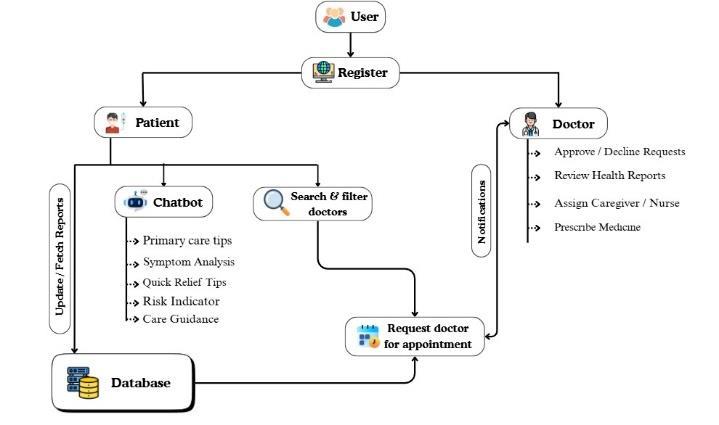
Theproposedsystemisahealthcareframeworkthatkeeps structured patient-doctor interactions along with implementingaLargeLanguageModel(LLM)asapatientcentricassistant[1].Supportedbyacentralizeddatabase,it consistsoftwoprimarymodules:aclinicianinterfacethat handlescommunicationwithpatientsandapatientinterface for consultancy requests [2]. The LLM assistant interacts with patients directly, offering advice on primary care, symptom evaluation, and risk assessment, enabling multimodalcommunication[1],[6].
For advanced consultancy, patients can search and filter physicians based on specialization and availability. Consultationrequestssubmittedbypatientsaresenttothe doctor interface, where doctors are notified and have the optionto accept or rejectthem [5], [7]. Transparency and effective coordination are ensured by automatically informingthepatientabouttheoutcome.Acceptedrequests allowdoctorstoscheduleappointmentswithpatientsand
assigncaregiversifneeded[3],[9].Declinedrequestsenable patients to connect with alternative available doctors, maintaininguninterruptedaccesstocare[2],[5].
Patientscansecurelystoreandretrievetheirpersonalhealth recordswhilemaintainingindividualprofiles,andusethis informationforself-monitoringandcontinuity ofcare[4], [8].
Theproposedhomehealthcarearchitectureachievesthree coreobjectivesthroughtheintegrationofLargeLanguage Models(LLMs):itdeliversinstantAI-drivensupportdirectly to patients [1], [10], facilitates access to reliable medical advicefromdoctors[2],[5],andenablesdoctorstoassign caregivers who provide timely assistance tailored to the patient’sneeds[3],[9].Thiscreatesaconnected,responsive, andpersonalizedcareenvironmentwithinthehome[1],[2], [6].
DespiterapidprogressinAI-assistedanddigitalhealthcare, several key challenges continue to limit the large-scale implementationofintelligenthomehealthcaresystems.The comparativereviewofHeetal.(2025)[1]andIsakovetal. (2024) [2], along with related works [3]–[10], reveals the followingmajorresearchgaps
Lack of Real-Time Interaction: Existing digital health systems primarily focus on disease predictionanddataanalysisbutfailtosupportrealtime medical conversation or guidance (He et al., 2025[1]).
LimitedPersonalizationofCare:Maityetal.(2025) [6] note that current AI tools lack adaptation to individual medical histories, offering generic responses.
WeakDataSecurityandEthicalConcerns:Ponaka (2024)[8]andHeetal.(2025)emphasizeprivacy risks and lack of accountability in generative AI healthcaresystems.
LowEngagementinRemoteCare:Studiessuchas Onseng et al. (2024) [3] and Ma et al. (2025) [9] reveal that patients and caregivers often face barriersintelehomecareadoption.
Difficulty in Appointment Scheduling and Coordination: Many healthcare platforms fail to automate doctor availability and patient booking processesefficiently(Isakovetal.,2024[2]).
International Research Journal of Engineering and Technology (IRJET) e-ISSN: 2395-0056
Volume: 13 Issue: 03 | Mar 2026 www.irjet.net p-ISSN: 2395-0072
IntegrationofClinicalKnowledgeGraphs
Incorporating medical knowledge graphs and verified clinicaldatabaseswillenabletheLLMtogeneratemore context-aware and medically accurate responses, reducing misinformation and improving trust in AIgeneratedguidance.
AI-DrivenContinuousMonitoring
Future research can explore AI-powered anomaly detection and predictive health analytics to alert caregivers and physicians about potential risks before they escalate, ensuring proactive and preventive healthcareathome.
IntegrationwithIoT-EnabledSmartHomeEcosystems Futuredeploymentscanconnectthehealthcareplatform with IoT-based smart home devices such as fall detectors,medicationdispensers,andhealth-monitoring wearables.Bysynchronizingreal-timesensordatawith theLLM’sreasoningcapabilities,thesystemcanprovide context-aware assistance, automate reminders, and initiateemergencyalertswhenanomaliesaredetected.
IntegrationofPredictiveAnalyticsforPreventiveCare
Future research can focus on incorporating predictive analyticswithinthesystemtoforecastpotentialhealth risksbasedonpatienthistory,lifestyle,andcontinuous monitoring data. By identifying early warning signs of diseases such as diabetes, hypertension, or cardiac issues,theplatformcanenablepreventiveinterventions, reduce hospitalization rates and improve long-term patientoutcomes.
TheproposedLLM-basedVirtualHomeHealthcareSystem represents a significant advancement in the digital transformationofhealthcare[1],[2].By integrating Large Language Models with intelligent automation, the system provides personalized, real-time medical assistance that connectspatients,doctors,andcaregiversthroughaunified virtual platform [4], [6]. It enables continuous health monitoring,symptomevaluation,andremoteconsultation, therebyreducinghospitaldependencyandensuringtimely support at home [3], [9]. Through adaptive learning and secure communication, the system enhances patient engagement and builds a foundation for more reliable, accessible,andefficienthealthcaredelivery[7],[10].
Beyond addressing current gaps in coordination and accessibility, this framework demonstrates how AI-driven healthcare ecosystems can evolve into proactive, humancentered companions in patient care [4], [5]. The
combination of conversational intelligence, personalized insights, and predictive analytics establishes a pathway toward intelligent, connected, and inclusive healthcare services[6],[8].Asthesystemcontinuestoevolve,future developments such as multimodal data integration, multilingualsupport,andpredictivehealthalertswillfurther strengthenitsroleinachievingasmart,safe,andsustainable homehealthcareenvironment[9],[10].
[1] K. He, R. Mao, Q. Lin, Y. Ruan, X. Lan, M. Feng, and E. Cambria, “A survey of large language models for healthcare: from data, technology, and applications to accountabilityandethics,”InformationFusion,vol.118, 102963,2025.
[2] T.-M.Isakov,H.Härkönen,I.Atkova,F.Wang,G.Vesty,P. Hyvämäki, and M. Jansson, “From challenges to opportunities:digitaltransformationinhospital-at-home care,”Int.J.Med.Inform.,vol.192,105644,2024.
[3] P. Onseng, W. Jiraporncharoen, S. Moonkayaow, P. Veerasirikul,N.Wiwatkunupakarn,C.Angkurawaranon, and K. Pinyopornpanish, “Expectation, attitude, and barrierstoreceivingtelehomecareamongcaregiversof homeboundorbedriddenolderadults:qualitativestudy,” JMIRAging,vol.7,no.1,e48132,2024.
[4] C.H.dosSantos,A.L.Romano,W.AzzoliniJunior,F.I.G. César,F.Ferraço,andI.Rozo-Rojas,“Stateoftheartand future directions of Healthcare 4.0: a systematic literature review,” IEEE Access, vol. 13, pp. 96469–96494,2025.
[5] C.Shi,J.Dumville,F.Rubinstein,G.Norman,A.Ullah,S. Bashir, P. Bower, and E. R. L. C. Vardy, “Inpatient-level careathomedeliveredbyvirtualwardsandhospitalat home:asystematicreviewandmeta-analysisofcomplex interventionsandtheircomponents,”BMCMedicine,vol. 22,no.145,2024.
[6] S.Maityetal.,“LargeLanguageModelsinHealthcareand MedicalApplications:AReview,”IEEEAccess,vol.13,pp. 5012–5035,2025.
[7] R. A. Prusynski, A. D’Alonzo, M. P. Johnson, T. M. Mroz, andN.E.Leland,“Differencesinhomehealthservicesand outcomes between traditional Medicare and Medicare Advantage,”JAMAHealthForum,vol.5,no.3,e235454, 2024.
[8] [3] N. Ponaka, “Securing Generative AI and Large LanguageModels(LLMs):AComprehensiveApproach,” InternationalJournalofAdvancedResearchinComputer ScienceandSoftwareEngineering(URFJournals),2024.
[9] C.Ma,Y.Fang,H.Zhang,Y.Zheng,Y.Zhang,W.Zhao,G. Yan,Y.Zeng,Y.Zhang,X.Ning,Z.Jia,andN.Guo,“Nursedelivered telehealth in home-based palliative care: integrativesystematicreview,”J.Med.InternetRes.,vol. 27,e73024,2025.