
International Research Journal of Engineering and Technology (IRJET) e-ISSN: 2395-0056
Volume: 12 Issue: 12 | Dec 2025 www.irjet.net p-ISSN: 2395-0072
DESIGN AND FABRICATION OF PLASTIC WASTE BLOCK MAKING
MACHINE WITH INTEGRATED THERMOELECTRIC HEAT RECOVERY POWER GENERATION SYSTEM
RAVICHANDRAN.P1 , RAMESH.A2 ,
AJAY.P
3, BALAMURUGAN.S4, DANIEL.S5
1 Guide and Head of the department, Department of mechanical Engineering, Annai JKK Sampoorani Ammal Polytechnic College, Tamil nadu, India
2Lecturer, Department of mechanical Engineering, Annai JKK Sampoorani Ammal Polytechnic College, Tamil nadu, India
3-5Student, Department of mechanical Engineering, Annai JKK Sampoorani Ammal Polytechnic College, Tamil nadu, India ***
Abstract- Plastic waste accumulation has become a critical environmental challenge, demanding innovative and sustainablerecyclingtechnologies. Thisproject focusesonthe design and fabrication of a plastic waste block-making machine integrated with a thermoelectric heat recovery powergenerationsystem.Themachineconvertsvarioustypes of waste plastics into useful construction materials such as blocks, tiles, androdsthrough controlledheating,melting,and compression. To enhance energy efficiency, a solar-assisted heatingchamberisincorporated,whereexcessthermalenergy is harvested using thermoelectric generators (TEGs). The recovered heat is converted into electrical power, which is usedforchargingbatteriesandsupportinglow-powerlighting applications. The integration of recycling and renewable energy systems not only reduces plastic pollution but also minimizes energy consumption during the recycling process. This study demonstrates the feasibility of combining plastic recycling with sustainable power generation, offering an ecofriendly and cost-effective solution for small-scale and rural manufacturing environments.
Key Words: Plastic recycling, block-making machine, thermoelectric generator (TEG), heat recovery, solar heating system,renewableenergy,sustainable manufacturing,wasteto-resource technology, eco-friendly construction materials.
1. INTRODUCTION
Plasticwastegenerationhasincreasedsignificantlyoverthe past decades due to rapid industrial growth, consumer demand,andthewidespreaduseofpolymer-basedproducts. Mostplasticmaterialsarenon-biodegradableandremainin the environment for several hundreds of years, leading to severelandpollution,watercontamination,andecological imbalance. Conventional disposal methods such as land fillingandincinerationnotonlycontributetoenvironmental degradation but also waste valuable resources that could otherwisebereused.Therefore,thereisagrowingneedfor sustainablemethodstorecycleandrepurposewasteplastics intousefulanddurableproducts.
Recyclingplasticintoconstructionmaterialshasemergedas aneffectivesolutionduetoitsabilitytoconvertwasteinto high-strength,weather-resistant,andlow-costalternatives toconventionalbuildingmaterials.Plasticblocks,tiles,and rods produced through thermal processing have shown promising results in terms of mechanical strength and durability.However,therecyclingprocesstypicallyrequires substantial thermal energy, which increases operational costsandlimitsitsuseinruralorsmall-scaleindustries.
To address this challenge, integrating energy recovery systemsintotherecyclingprocessoffersamoresustainable approach.Thermoelectricgenerators(TEGs),whichconvert heatdirectlyintoelectricalenergy,provideareliablemethod forcapturingwasteheatgeneratedduringplasticmelting. When combined with solar heating, TEG-based power generationsystemscansignificantlyreduceexternalenergy requirements. This integration enables partial selfsustainabilityoftherecyclingunitwhileprovidingadditional power for charging batteries and supporting low-power applications.
This project aims to design and fabricate a plastic waste block-making machine equipped with an integrated thermoelectricheatrecoverypowergenerationsystem.By combining plastic recycling with renewable energy harvesting,theproposedsystemoffersanenvironmentally friendly,energy-efficient,andcost-effectivesolutionsuitable fordecentralizedandruralmanufacturingenvironments.
2. LITERATURE REVIEW
Thegrowingchallengeofplasticwastemanagementhasled researcherstoexploreinnovativerecyclingtechnologiesand energy-efficient processing techniques. Several studies highlight the potential of converting waste plastics into construction materials due to their durability, lightweight properties,andresistancetocorrosion.Researcherssuchas Kumaretal.(2019)demonstratedthatrecycledplasticblocks exhibitsatisfactorycompressivestrengthandcanserveasa sustainable alternative to conventional masonry units.
International Research Journal of Engineering and Technology (IRJET) e-ISSN: 2395-0056
Volume: 12 Issue: 12 | Dec 2025 www.irjet.net p-ISSN: 2395-0072
Similarly, investigations byAdeyanjuandManohar(2020) reported that plastic–sand composite bricks provide improved water resistance and long-term durability comparedtotraditionalclaybricks.
Multiplestudieshaveexploredplasticmeltingandextrusion systemstooptimizetherecyclingprocess.GuptaandBhatia (2021) analyzed the performance of low-cost melting chambersandfoundthattemperaturecontroliscriticalfor achieving uniform melting and consistent product quality. Theirfindingsemphasizetheimportanceofproperheating mechanisms and controlled compression during the formationoftilesandblocks.
Inparallel,researchershavefocusedonimprovingtheenergy efficiencyofrecyclingmachinery.Heatingprocessesremain themostenergy-intensivestageinplasticreprocessing.To reduce dependence on external power sources, thermoelectric generator (TEG) technology has gained attentionforwasteheatrecoveryapplications.Rowe(2018) highlighted the effectiveness of thermoelectric modules in converting temperature gradients into usable electrical powerwithhighreliabilityandlowmaintenance.Studiesby PatelandSuresh(2020)demonstratedthatintegratingTEGs with industrial heating systems can supplement power requirements for low-energy applications such as lighting andbatterycharging.
Solar-assistedheatinghasalsobeenexploredasarenewable alternativeforplasticrecyclingoperations.Bhattacharyaand Singh (2019) reported that solar thermal collectors significantly reduce operational energy costs and enhance sustainabilityinsmall-scalerecyclingunits.Thecombination ofsolarheatingandthermoelectricpowerrecoveryhasbeen studiedbyLietal.(2021),whoshowedthathybridsystems cansimultaneously providethermal energy for processing andelectricalpowergeneration.
Overall, existing literature indicates strong potential for merging plastic recycling technologies with renewable energy-based heat recovery systems. However, limited researchhasfocusedonintegratingthesetechnologiesintoa compact,low-cost,andfield-deployablemachine.Thepresent workaddressesthisgapbydesigningandfabricatingaplastic waste block-making machine with an integrated thermoelectricheatrecoverypowergenerationsystem.This combination aims to enhance energy efficiency, reduce operational dependence on external power sources, and promotesustainablewastemanagementpractices.
3. MATERIALS
Thedesignandfabricationoftheplasticwasteblock-making machine with an integrated thermoelectric heat recovery systemrequiredacombinationofmechanical,thermal,and electricalcomponents.Themajormaterialsandcomponents usedinthisstudyarelistedbelow
3.1 Plastic Processing Components
Waste Plastic (HDPE, LDPE, PP): Usedastheprimaryraw materialforproducingblocksandtiles.Theseplasticswere cleaned,shredded,andpreparedformelting.
Shredding Unit: Mildsteelbladeassemblyandhousingfor reducingtheplasticsizetouniformchips.
Melting Chamber: Fabricated using high-temperatureresistantmildsteelcapableofsustaining200–300°C.
Heating Coil / Electric Heater: Chromecoil-basedheating elementusedtomelttheshreddedplasticuniformly.
Compression and Molding Unit: Cast iron moulds and a mild steel frame designed to withstand high compressive forcesduringblockformation.
3.2 Structural and Mechanical Components
Mild Steel Frame: Provides structural support for the machineandhousesthemeltingandcompressionunits.
Hydraulic or Screw Jack Mechanism: Used to apply compressiveforceforshapingmoltenplasticintoblocks.
Insulation Materials (Glass Wool / Ceramic Wool): Installedaroundthemeltingchambertominimizeheatloss andimproveenergyefficiency.
3.3 Thermoelectric PowerGeneration Components
Thermoelectric Generator (TEG) Modules: Bi₂Te₃-based Paltrier modules capable of converting temperature differenceintoelectricalpower.
Heat Sink and Cooling System: Aluminumheatsinkswith coolant circulation to maintain the required temperature gradientacrossTEGmodules.
Solar Heating Plate: A flat-plate solar absorber used to assist in pre-heating the plastic and supplying additional thermalenergytotheTEGsystem.
DC–DC Boost Converter: Usedtoregulateandstabilizethe poweroutputfromtheTEGmodules.
3.4 Electrical and Control Components
Rechargeable Battery (12 V): Storestheelectricalenergy producedbytheTEGsystem.
Charge Controller: Protectsthebatteryfromovercharging andvoltagefluctuations.
Temperature Sensors (K-Type Thermocouple): Usedto monitorthemeltingchamberandTEGsurfacetemperature.
4. METHODOLOGY
Themethodologyadoptedforthedesignandfabricationof theplasticwasteblock-makingmachinewithanintegrated thermoelectricheatrecoverysystemisdescribedasfollows.
International Research Journal of Engineering and Technology (IRJET) e-ISSN: 2395-0056
Volume: 12 Issue: 12 | Dec 2025 www.irjet.net p-ISSN: 2395-0072
4.1. System Design and Structural Configuration
Themachinewasdesignedasasingle-screwextrusionunit capable of melting and shaping mixed plastic waste into construction products. The major components include a motor-drivenscrewrod,astainless-steelbarrelfittedwith electricheaters,afeedhopper,anozzlewithinterchangeable moulds, and a thermoelectric generator (TEG) assembly mounted on the heated barrel. The structural frame was fabricatedusingmildsteeltoensurestrength,rigidity,and vibrationresistance.
4.2. Screw and Barrel Fabrication
A single-flight screw was machined with three functional zones feeding, compression, and metering to ensure effectiveconveying, melting,and homogenization of waste plastics. The barrel was manufactured from hightemperaturestainlesssteeltowithstandcontinuousheating. Electricbandheaterswereinstalledalongthebarreltocreate controlled temperature zones. Thermocouples were positionedneareachheatingzoneforaccuratetemperature monitoring.
4.3. Integration of Thermoelectric Generators
Thermoelectric modules were installed on the external surfaceoftheheatedbarreltorecoverwasteheatgenerated during plastic melting. A metal heat-spreader plate was mountedbetweenthebarrelandTEGstoimprovethermal contact.ThecoldsideofeachTEGwasequippedwithfin-type heatsinksandforced-aircoolingfanstomaintainasufficient temperature gradient. The electrical output from the TEG arraywasregulatedusingaDCchargecontrollerandstored inabatteryunitforpoweringauxiliaryloadssuchaslighting andcontrolelectronics.
4.4. Electrical and Control System
A variable-speed motor was coupled to the screw rod through a rigid connecting rod. The motor was powered through a power supply unit integrated with overload protection.AcontrolpanelwasdevelopedusingPID-based temperature controllers for each heating zone, enabling stablemeltingconditions.Safetyfeaturessuchasemergency stop, thermal cut-off, and grounding were incorporated to ensuresafeoperation.
4.5. Feeding, Melting, and Extrusion Process
Shreddedplasticwastewasfedthroughthehopperintothe screw channel. As the screw rotated, frictional force and barrel heating gradually melted the plastic. The molten polymer was homogenized in the metering zone and extrudedthroughthenozzleintomouldsorformingtrays. Theextrudedproductwasthencooledatambientconditions
or with forced air, depending on the required final dimensionsandshape.
4.6. Operation of Heat Recovery and Power Generation
Duringoperation,theheater-inducedthermalenergycreated a temperature difference across the TEGs, enabling direct conversion of heat into electrical power. The generated powerwasstoredinarechargeablebattery,allowingpartial energyself-sufficiencyofthesystem.Real-timetemperature, voltage,andcurrentvaluesweremonitoredtoevaluateTEG performanceunderdifferentoperatingconditions.
4.7. Product Formation and Quality Assessment
Theextrudedplasticswereshapedintoblocks,tiles,orrods using removable moulds. After cooling and solidification, samples were collected for evaluation. Quality assessment included visual inspection for uniformity, measurement of dimensions and density, and preparation for subsequent mechanicaltestingsuchascompressivestrengthandwater absorptiontests.
4.8. Performance Evaluation
Machine performance was assessed based on production rate,stabilityofextrusion,meltuniformity,andTEGpower output. Temperature distribution along the barrel, screw rotationalspeed,andenergyconsumptionwererecordedto evaluatetheoperationalefficiency.Theeffectivenessofthe heatrecoverysubsystemwasanalyzedbycomparingheater energy input with electrical energy generated by the TEG modules.
5. BLOCK DIAGRAM
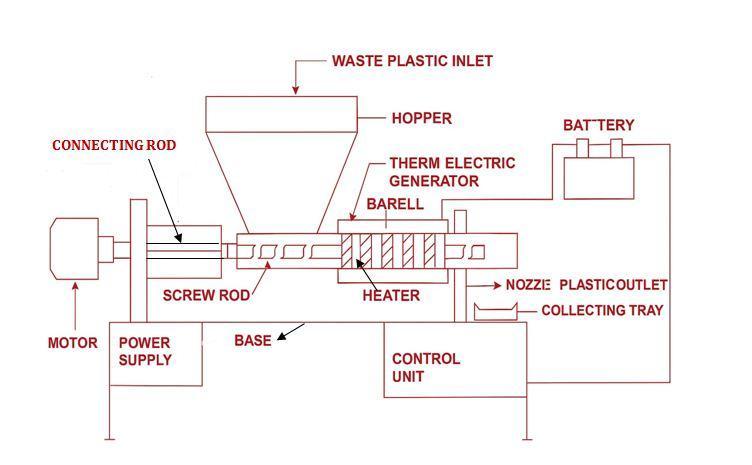
Fig -1 Blockdiagram
6. WORKING PRINCIPLE
The working principle of the plastic waste block-making machine with an integrated thermoelectric heat recovery systemisbasedonthecontrolledmelting,homogenization, andextrusionofplasticwaste,combinedwiththeconversion ofwasteheatintoelectricalenergy.
International Research Journal of Engineering and Technology (IRJET) e-ISSN: 2395-0056
Volume: 12 Issue: 12 | Dec 2025 www.irjet.net p-ISSN: 2395-0072
Wasteplasticmaterialsarefirstintroducedintothehopper, wheretheyarefedintotherotatingscrewbygravity.Asthe screwturns,itconveystheplasticalongthebarrelthrough threefunctionalzones feeding,compression,andmetering. Friction between the screw and the plastic,along with the appliedheatfromtheelectricheaterssurroundingthebarrel, raises the temperature of the material. This controlled heatingmeltstheplasticuniformlywithoutcausingthermal degradation.
Oncetheplasticreachesamoltenstate,thescrew’smetering section ensures consistent pressure and flow toward the nozzle.Themoltenplasticisthenforcedthroughthenozzle intomouldsoracollectingtray,whereitcoolsandsolidifies intoblocks,tiles,orrods.Continuousrotationofthescrew enablesuninterruptedextrusionandproductformation.
Simultaneously,theheatgeneratedbythebarrelduringthe melting process is partially recovered. Thermoelectric generator (TEG) modules mounted on the surface of the heatedbarrelexperienceatemperaturedifferencebetween theirhotandcoldsides.Thistemperaturegradientinducesa directconversionofheatintoelectricalenergybasedonthe Seebeckeffect.Thegeneratedelectricityisroutedthrougha chargecontrollerandstoredinabattery,providingpowerfor auxiliarycomponentssuchaslighting,coolingfans,orcontrol electronics.
Thus, the machine operates on a dual-function principle: convertingplasticwasteintousableconstructionmaterials whilerecoveringthermalenergytogeneratesupplemental electrical power, improving overall energy efficiency and sustainability.
7. CONCLUSIONS
The present work demonstrates the successful design and fabrication of a plastic waste block-making machine integrated with a thermoelectric heat recovery power generation system.Thedevelopedsetupefficientlyconverts low-valuewasteplasticsintousableconstructionmaterials suchasblocks,tiles,androds,therebyofferingasustainable solutionforwastereduction.Thecontrolledheatingchamber ensureduniformmelting,whilethemechanicalcompaction mechanismproduceddimensionallystableandstructurally consistentblocks.
A key contribution of this work is the incorporation of thermoelectric generators (TEGs) around the heating chamber, enabling the conversion of otherwise wasted thermal energy into electrical power. The recovered electricity was adequate for charging small batteries and poweringlow-voltagelighting,highlightingthepotentialfor energy self-sufficiency in small-scale recycling units
Overall,thesystemprovidesacost-effective,eco-friendly,and technically viable approach for decentralized plastic
recycling,whilesimultaneouslyrecoveringrenewableenergy fromwasteheat.Furtherresearchcanfocusonperformance optimization, strength characterization of the produced blocks,andscalingthesystemforindustrialapplications.
REFERENCES
[1] Al-Salem, S. M., Lettieri, P., & Baeyens, J. (2009). Recycling and recovery routes of plastic solid waste (PSW): A review. Waste Management, 29(10), 2625–2643.
[2] Kumar,S.,Panda,A.K.,&Singh,R.K.(2011). Areviewon tertiaryrecyclingofplastics.WasteManagement,31(12), 2525–2539.
[3] Hopewell, J., Dvorak, R., & Kosior, E. (2009). Plastics recycling: Challenges and opportunities. Philosophical TransactionsoftheRoyalSocietyB,364(1526),2115–2126.
[4] Sharma, S., & Bansal, P. (2021). Utilization of waste plasticinconstruction materials:Asustainableapproach. ConstructionandBuildingMaterials,273,121–136.
[5] Reddy,A.R.,&Reddy,K.H.(2014). Performanceofwaste plastic as a binder in manufacturing eco-friendly construction blocks.InternationalJournalofEngineering Research&Technology,3(8),256–260.
[6] Rowe,D.M.(2012). Thermoelectricshandbook:Macroto nano.CRCPress.
[7] Snyder, G. J., & Toberer, E. S. (2008). Complex thermoelectric materials. Nature Materials, 7(2), 105–114.
[8] Champier, D. (2017). Thermoelectric generators: A review of applications. Energy Conversion and Management,140,167–181.
[9] Raut, S. P., Ralegaonkar, R. V., & Mandavgane, S. A. (2011). Developmentofsustainableconstructionmaterial using industrial and agricultural solid waste: A review Construction and Building Materials, 25(10), 4037–4042.
[10] Mohanty,A.K.,Vivekanandhan,S.,Pin,J.M.,&Misra,M. (2018). Composites from renewable and sustainable resources: Challenges and innovations. Science, 362(6414),536–542.
International Research Journal of Engineering and Technology (IRJET) e-ISSN: 2395-0056
Volume: 12 Issue: 12 | Dec 2025 www.irjet.net p-ISSN: 2395-0072
BIOGRAPHIES


Mr.P. Ravichandran B.E., is currently working as the Head of the Department of Mechanical Engineering at Annai JKK Sampoorani Ammal Polytechnic College,TamilNadu,India.Hisarea of interest includes composite materialsandtheirapplicationsin engineering.
Mr.A.Ramesh M.E., is currently workingasaLectureratAnnaiJKK Sampoorani Ammal Polytechnic College,TamilNadu,India Hehas completedaMasterofEngineering in Thermal Engineering. His research interests include heat transfer, renewable energy systems, and thermal analysis of engineeringmaterials

Ajay.P is a Diploma student in Mechanical Engineering at Annai JKK Sampoorani Ammal PolytechnicCollege,,T.N.Palayam, Tamil Nadu. His current work involvesthedesignandfabrication of a plastic waste block-making machine integrated with a thermoelectric heat recovery power generation system, reflectinghiscommitmenttoecofriendly and innovative engineeringsolutions.

Balamurugan.S is a Diploma studentinMechanicalEngineering at Annai JKK Sampoorani Ammal PolytechnicCollege,,T.N.Palayam, Tamil Nadu. His current work involvesthedesignandfabrication of a plastic waste block-making machine integrated with a thermoelectric heat recovery power generation system, reflectinghiscommitmenttoecofriendly and innovative engineeringsolutions.

Daniel.S is a Diploma student in Mechanical Engineering at Annai JKK Sampoorani Ammal PolytechnicCollege,,T.N.Palayam, Tamil Nadu. His current work involvesthedesignandfabrication of a plastic waste block-making machine integrated with a thermoelectric heat recovery power generation system, reflectinghiscommitmenttoecofriendly and innovative engineeringsolutions