
International Research Journal of Engineering and Technology (IRJET) e-ISSN: 2395-0056
Volume: 13 Issue: 01 | Jan 2026 www.irjet.net p-ISSN: 2395-0072
International Research Journal of Engineering and Technology (IRJET) e-ISSN: 2395-0056
Volume: 13 Issue: 01 | Jan 2026 www.irjet.net p-ISSN: 2395-0072
Bhoomika
Wandhekar1, Shivam Das Bairagya2, Vaishnavi Waikar3, Prof. Pravin S. Patil4
123BE IT Student, 4th Year, KJEI’s TCOER, Pune, India 4Assistant Professor, Dept. of Information Technology, KJEI’s TCOER, Maharashtra, India ***
Abstract - Motorcyclists are highly vulnerable to accidents due to limited situational awareness, unpredictable road conditions, and lack of advanced safety systems. Traditional helmets provide onlyphysical protection,offeringnoreal-time assistance. This paper proposes an Augmented Reality (AR) Smart Helmet that integrates GPS navigation, weather updates, blindspot alerts,andarear-viewcameradirectlyinto the rider’s visor. Voice command control enables distractionfree operation, while AI drivencrashdetectionandemergency alert features ensure timely response in critical scenarios. Designed usingauser-centeredapproach,thesystemenhances rider awareness, reduces risks, and promotes responsible riding practices. The system has been developed using Raspberry Pi Zero, sensor fusion, and AR visualization, and tested in simulated riding environments to evaluate its effectiveness.
Key Words: Smart Helmet, Artificial Intelligence (AI), Augmented Reality (AR), Internet of Things (IoT), Accident Detection, GPS Navigation, Rider Safety, Emergency Alert System.
Roadtrafficaccidentsremainoneofthemostseriousglobal publichealthconcerns,withmotorcyclistsamongthemost vulnerable road users. According to the World Health Organization (WHO), over 1.3 million people die in traffic crashesannually,andasignificantportionofthesefatalities involve two-wheeler riders. Limited physical protection, unpredictable traffic, poor visibility, and adverse weather conditionsmakemotorcyclistshighlysusceptibletosevere injuries. Traditional helmets provide essential impact protection but act as passive safety tools. They do not address modern challenges such as real-time hazard awareness, navigation assistance, or emergency response. Riders often depend on smartphones for navigation or communication,whichdistractsthemandincreasesaccident risk. Moreover, existing systems are often fragmented, offeringseparatesolutionsfornavigation,communication, andcrashdetection,whichlimitstheiroveralleffectiveness. RecentadvancementsinArtificialIntelligence(AI),Internet ofThings(IoT),andAugmentedReality(AR)haveenabled the development of intelligent safety helmets. These technologies allow helmets to actively monitor surroundings,predictpotentialhazards,andassistridersin decision-makingwhilemaintaininghands-freeoperation.
TheproposedAI-DrivenProtectionandAugmented Awareness framework bridges the gap between passive protectionandactivesafetybyintegratingAR-basedheadsup display, GPS navigation, blind-spot detection, voice commands,andAI-poweredcrashprediction.Intheeventof anaccident,thesystemcanautomaticallysendanSOSalert with GPS coordinates to emergency contacts, ensuring a promptresponse.Bycombiningproactivehazardalertswith automatedemergencyactions,theSmartHelmetfunctions as an intelligent riding assistant that enhances safety, reducesdistraction,andencouragesresponsibleriding.This research contributes to the advancement of intelligent transportation systems (ITS) by presenting a scalable, technology-integrated solution to improve motorcyclist safety.
Motorcyclists remain highly vulnerable due to limited protectionandsituationalawareness.Conventionalhelmets offer only passive safety and fail to address real-time challenges like poor visibility and sudden lane changes. Smartphoneusefornavigationfurtherincreasesdistraction and accident risk. Therefore, integrating Artificial Intelligence(AI),Internetof Things(IoT),andAugmented Reality (AR) can create an intelligent helmet that actively enhancesridersafety.
The proposed Al-driven AR Smart Helmet aims to:
Enhancesituationalawarenessbydisplayingrealtime data such as navigation routes, weather updates,andobstacleproximityonanARvisor.
Detectpotentialhazardsandaccidentsproactively usingAlandsensorfusion.
Enable hands-free operation through voice commandstominimizedistractions.
Ensure rapid emergency response through automatedSOSalertswithGPScoordinates.
Research on smart helmets has grown rapidly in recent years:
Navigation-focusedhelmetsoverlayGPSroutesbut oftenlacksafetymodules
IoT-based helmets detect crashes and send alerts butarereactiveratherthanpreventive.
International Research Journal of Engineering and Technology (IRJET) e-ISSN: 2395-0056
Volume: 13 Issue: 01 | Jan 2026 www.irjet.net p-ISSN: 2395-0072
Blind-spot monitoring systems improve visibility butdonotintegrateARfeedback
AR-basedprototypesexistbutarelimitedtopartial functionalitywithoutfullAIintegration.
The proposed Al-driven AR Smart Helmet offers several advantages over existing solutions in terms of safety, usability,andtechnologicalintegration.Unlikeconventional helmetsthatfocussolelyonprotectionafteranaccident,this systememphasizesproactiveaccidentprevention,real-time awareness, and seamless communication. The key advantagesinclude:
Enhanced Situational Awareness: Real-time AR overlays provide riders with navigation, obstacle alerts,andweatherupdateswithoutdivertingtheir attentionfromtheroad.
AI-Based Hazard Detection: Sensor fusionusing accelerometer and gyroscope data enables early identification of abnormal riding patterns or collisions.
Hands-Free Control: Voice-commandintegration allows riders to interact with the system safely withoutmanualintervention.
Integrated Safety Mechanisms: The helmet combines preventive and reactive safety features suchasblind-spotmonitoring,crashdetection,and automaticSOSalerts.
Energy Efficiency: The system is designed with optimizedpowerconsumption,ensuringextended operationwithoutfrequentrecharging.
User-Centric Design: Withasimpleandintuitive interface, the helmet minimizes distractions and enhancesusercomfort.
Cost-Effectiveness: Theprototypeoffersmid-range affordabilitywhileincorporatingmultiplehigh-end featuresfoundinpremiumcommercialhelmets.
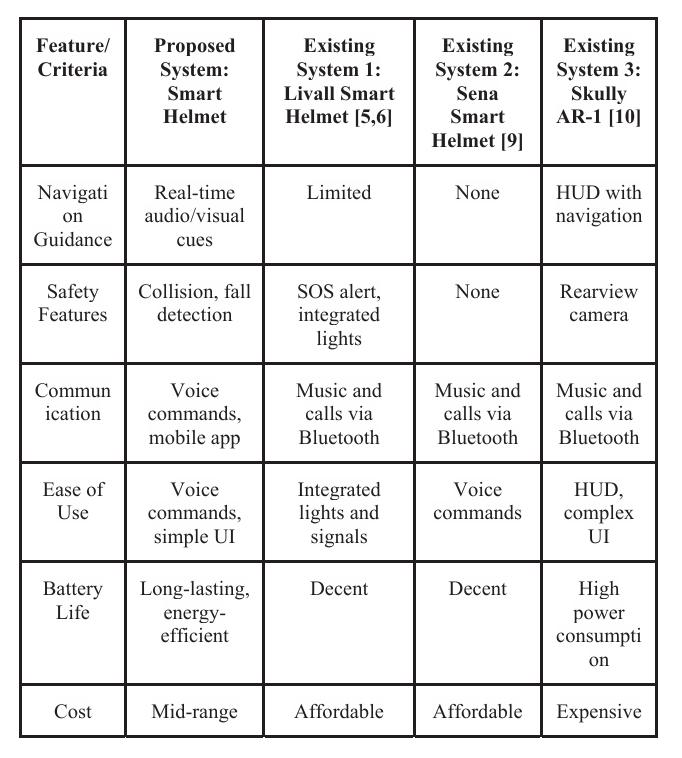
To evaluate the performance and practicality of the proposedsystem,acomparativestudywasconductedwith existing smart helmets available in the market. Table?? Summarizes the key differences based on critical performance criteria such as navigation, safety, communication,usability,batterylife,andcost.
As shown in Table-1, the proposed system outperforms existing helmets by providing a balanced combination of safety, intelligence, and affordability. Unlike commercial models that prioritize entertainment or partial navigation assistance, the proposed design integrates AI-driven accidentdetection,AR-basedvisualization,andIoT-enabled
emergencyresponse,makingitamorecomprehensiveand reliablesafetysolutionforriders.
Table -1: ComparativeStudyofProposedSystemwith ExistingSmartHelmets
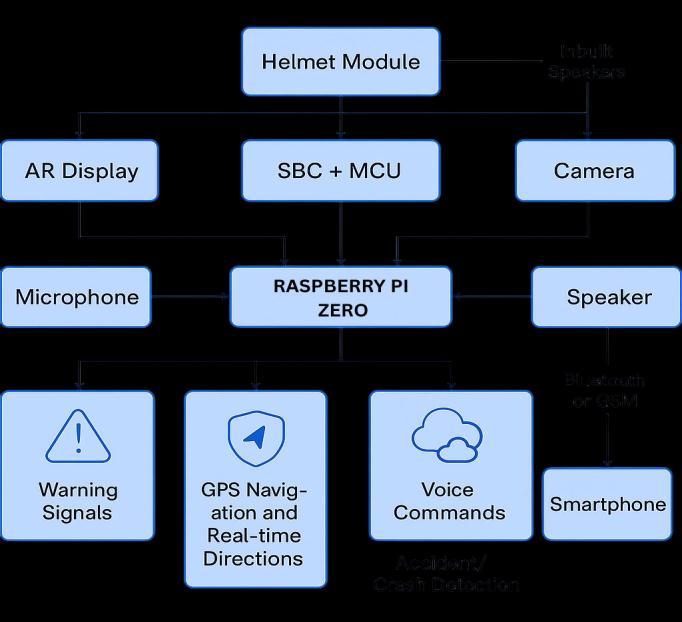
The proposed AR Smart Helmet system is designed as an intelligent, IoT-enabled safety solution that integrates hardware and software components into a compact, wearable platform. The Proposed system architecture, illustratedinFig.1,isbasedonalayereddesignto ensure modularity, real-time processing, and efficient data communication.
At its core, the Raspberry Pi Zero acts as the central processingunit,interfacing withvariousinputandoutput modules through serial and wireless connections. The helmetcontinuouslycollectsandprocessesreal-timedatato providenavigationguidance,safetyalerts,andemergency notifications.
The input subsystem consists of multiple sensors and componentsresponsibleforenvironmentalandmotiondata acquisition.Theseinclude:
GPSModule: Providescontinuouslocationtracking forroutenavigationandemergencygeolocation.
MPU6050AccelerometerandGyroscope: Detects motion, tilt, and sudden impacts to recognize potentialaccidentsorriskymaneuvers.
International Research Journal of Engineering and Technology (IRJET) e-ISSN: 2395-0056
Volume: 13 Issue: 01 | Jan 2026 www.irjet.net p-ISSN: 2395-0072
Pi Camera: Mounted atthe rear to monitor blind spotsandidentifysurroundingvehiclemovement.
Microphone: Enableshands-free control through voicecommands,reducingmanualinteractionwhile riding.
Theoutputsubsystemdeliversreal-timeinformationto theriderthroughvisualandauditorychannels.
AR Visor Display: Projects navigation routes, hazard warnings, and real-time notifications directly onto the rider’s field of view, ensuring minimaldistraction.
Speakers and Audio Alerts: Provide voiceassisted navigation, traffic warnings, and confirmationofsystemcommands.
GSM/Bluetooth Module: Facilitates communication between the helmet and external devices, enabling automated SOS alerts or integrationwithsmartphones.
The control logic within the Raspberry Pi Zero ensures synchronizationbetweentheinputandoutputsubsystems. It processes sensor data through AI algorithms and generates contextual alerts within milliseconds, ensuring proactiveridersafety.
The proposed system follows a systematic, five-stage methodology from hardware integration to emergency response. Each stage focuses on achieving real-time awarenessandsafetyautomationfortherider.
Thehelmetactsastheprimaryhousingunitforall hardware modules. The AR visor, camera, and communication modules are ergonomically positioned to minimize rider discomfort. The Raspberry Pi Zero coordinatesallperipheralmodulesthroughGPIOandserial connections,ensuringefficientpoweranddatamanagement.
SensordataiscontinuouslycollectedfromtheGPS, accelerometer, gyroscope, and camera in real time. The accelerometerandgyroscopetrackmotionvectorsandtilt angles, allowing the detection of sharp turns, falls, or collisions.Simultaneously,therearcamera providesalive videofeedthatisprocessedtodetectblind-spotvehiclesor environmentalobstacles.
CollectedsensordataisanalyzedusingatrainedAI model based on supervised learning. Implemented with TensorFlow Lite, the model classifies rider behavior as normal,hazardous,orcrash.Sensorfusionofaccelerometer and gyroscope data enhances accuracy and reduces false positives. Real-time inference on the Raspberry Pi allows adaptivedetectionundervaryingridingconditions.
Onceprocessingiscomplete,theoutputsubsystem delivers real-time feedback through visual and audio interfaces. The AR visor overlays navigation cues, speed limits,andobstaclewarnings,allowingriderstokeeptheir eyesontheroad.Concurrently,audiopromptssupplement visualcuesforimprovedaccessibilityandsafety.
7.5
When an accident or severe fall is detected, the system automatically triggers the emergency response module.TheGSMunitsendsanSOSmessagecontainingthe GPScoordinates,timestamp,andrideridentificationdetails topredefinedemergencycontacts.Thisautomatedresponse minimizes reaction time and ensures rapid medical assistance.
Thissurveyreviewedtheevolutionandcurrentlandscapeof AIandAR-basedsmarthelmetsystems,highlightingmajor innovations,limitations,and researchgaps.Buildingupon this foundation, a unified AI-driven AR Smart Helmet frameworkwasproposedtoenhancebothpreventiveand reactivesafetyfeatures.Bycombiningmulti-sensorfusion, real-time visualization, and autonomous communication, future iterations of such helmets can substantially reduce rider risk and redefine safety standards for modern transportation.
International Research Journal of Engineering and Technology (IRJET) e-ISSN: 2395-0056
Volume: 13 Issue: 01 | Jan 2026 www.irjet.net p-ISSN: 2395-0072
[1] A. Bhamare, S. Jagtap, O. Bhore, P. Pedhekar, and V. Atharale,“SmartHelmetwithUserNavigationGuidance Support,” 2024 8th International Conference on Computing, Communication, Control and Automation (ICCUBEA),2024.
https://doi.org/10.1109/ICCUBEA61740.2024.1077471 5.
[2] A.George,A.Thomas,A.Abraham,J.Jose,andJ.Joseph, “SAFE RIDE: An Integrated Bike Safety System with CrashDetection,”Proceedingsofthe7thInternational Conference on Intelligent Sustainable Systems (ICISS2025),2025.
https://doi.org/10.1109/ICISS63372.2025.11076269.
[3] M. H. Khan, F. Tasnim, M. R. Uddin, S. Banik, and M. Hasan,“AnAdaptiveFast-ResponseSensorIntegrated SmartHelmetforBlind-SpotProtectionandGuidanceto AvoidUnavoidableOccurrences,”Proceedingsofthe7th InternationalConferenceonInventiveMaterialScience and Applications (ICIMA-2025), 2025. https://doi.org/10.1109/ICIMA64861.2025.11073922.
[4] S. R. Swamy, H. Deepanjali, A. Aryan, A. Kishore, A. Karan,andN.Prasad,“DesignanddevelopmentofAIIoT based smart helmet to ensure safe driving,” 2025 3rd IEEE International Conference on Knowledge Engineering and Communication System (ICKECS2025),2025.
https://doi.org/10.1109/ICKECS65700.2025.11036017.
[5] S.S.Rachel,P.H.,andY.R.,“Accidentdetectionbasedon IoTusingsmarthelmet,”2025InternationalConference on Computing and Communication Technologies (ICCCT),2025. https://doi.org/10.1109/ICCCT63501.2025.11019230
[6] G.Gerentes,A.Leonidis,N.M.Stivaktakis,M.Korozi,and C.Stephanidis,“EnhancingMotorcycleSafetyThrough AugmentedReality:DesignandDevelopmentofaSmart Helmet Prototype,” Human Factors in Design, Engineering,andComputing,vol.159,pp.1089–1099, 2024.https://doi.org/10.54941/ahfe1005675.
[7] K. Saranya, C. Santhosh, D. Ramkumar, M. A. Chockalingam, and S. Naveen, “Collision Prevention TechnologyinIoTIntegratedSmartBikeHelmet,”2025 InternationalConferenceonDataScience,Agents,and Artificial Intelligence (ICDSAAI), 2025. https://doi.org/10.1109/ICDSAAI65575.2025.1101171 4.
[8] P.Gahane,S.Sahare,Y.Lambat,A.R.Raut,andP.Rathi, “Smart Helmet: A New Generation Helmet,” 2022 International Conference on Recent Trends in Microelectronics, Automation, Computing and
Communications Systems (ICMACC), 2022. https://doi.org/10.1109/ICMACC54824.2022.1009334 2.
[9] V.Maheshwari,T.Khandelwal,D.Gulati,andD.Agarwal, “Smart Helmet: A Comprehensive Solution for Rider Safety,” 2025 3rd International Conference on Disruptive Technologies (ICDT), 2025. https://doi.org/10.1109/ICDT63985.2025.10986370.
[10] S.Akter,M.A.Yousuf,K.M.R.Alam,M.Sahidullah,M.M. Islam,andJ.Uddin,“ACost-EffectiveSmartHelmetfor HumanSafetyandRoadAccidentDetectionUsingIoT,” 2024InternationalConferenceonRecentProgressesin Science,EngineeringandTechnology(ICRPSET),2024. https://doi.org/10.1109/ICRPSET64863.2024.1095592 3.
[11] Z.Xiong,J.Zhang,Y.Cai,andJ.Dong,“DesignofASmart Safety Helmet Incorporating Observation, CommunicationandLocalizationFunctions,”202439th Youth Academic Annual Conference of Chinese Association of Automation (YAC), 2024. https://doi.org/10.1109/YAC63405.2024.10598653.
[12] M.Tamilarasi,S.Chitra,N.Barathkumar,S.Bhuvanesh, andC.Dhineshwaran,“SmartHelmetwithTransparent Display,” 2024 4th International Conference on Intelligent Technologies (CONIT), 2024. https://doi.org/10.1109/CONIT61985.2024.10627271.
[13] S. B. Abitha, R. Santhoshi, B. B. Sangameswaran, K. Shivashanker, S. Balakrishnan, and V. Tharun, “Armor Guard: Revolutionizing Motorcycle Safety with Smart Helmet,”2024InternationalConferenceonComputing, Sciences and Communications (ICCSC), 2024. https://doi.org/10.1109/ICCSC62048.2024.10830429.