
International Research Journal of Engineering and Technology (IRJET) e-ISSN:2395-0056
Volume:13Issue:04|Apr2026 www.irjet.net p-ISSN: 2395-0072

International Research Journal of Engineering and Technology (IRJET) e-ISSN:2395-0056
Volume:13Issue:04|Apr2026 www.irjet.net p-ISSN: 2395-0072
Komarina
Dileep Chowdary1 , Ankamreddy Swamy2 , Dharapu Abhishek3 , Pentapalli Uday Kiran 4,Pinninti Ajay 5
1 Assistant professor, Department of Civil Engineering, SanketikaVidya Parishad Engineering College, visakhapatnam, A.P 530041, INDIA
2 B. Tech Student, Department of Civil Engineering, SanketikaVidyaParishad Engineering College, visakhapatnam, A.P 530041, INDIA
3 B. Tech Student, Department of Civil Engineering, SanketikaVidyaParishad Engineering College, visakhapatnam, A.P 530041, INDIA
4B. Tech Student, Department of Civil Engineering, SanketikaVidyaParishad Engineering College, visakhapatnam, A.P 530041, INDIA
5 B. Tech Student, Department of Civil Engineering, SanketikaVidyaParishad Engineering College, visakhapatnam, A.P 530041, INDIA
Abstract - Concrete production has seen various attempts using sewage sludge instead of traditional materials .Instead of coarse gravel, sand, or concrete binder, something else might work.Still,itThoughtestedthoroughly,resultsshowed it just did not hold up when swapped into roles meant for heavier materials because the overall strength fell short Because of how the material weakens and swells when reacting with alkalis. The concrete Fumes rise heavily from factories, yet their role in releasing carbon dioxide stays significant. Machines run endlessly, while smoke pours into skies above industrial zones. Each year, output grows - so does pollution tied to these operations. Tall chimneys belch thick clouds, because energy demand keep climbing across production sites. One big reason Earth gets warmer? About sixty five out of every hundred parts comes from Fumes from CO₂ pour out steadily, while the making of cement pushes roughly 7% into that full pile of planet-warming gase.One way to tackle pollution involves cutting down gas emissions. Shifting away from current methods could help ease harm to nature, so trying new solutions might make a difference here Waste from wastewater treatment now finds purpose in building methods that care for the planet. Here, leftover solids after cleaning water mix into new forms of construction material product of wastewater treatment plants, can be effectively utilized in concrete. The main This work looks at possible substitutes for fine aggregate. The focus here shifts toward materials that might serve a similar purpose Concrete labeled M25, mixed with a water-to-cement measure of 0.45,
went into the batch. Into that mix stepped fine sand as the smaller grains. Some got swapped out, others entirely, using waste from treatment plants mixed in at five percent, then ten, then fifteen. One fifth, along with full measure. Strength when squeezed, plus how concrete handles pressure, At 7, 14, 21, and 28 days after pouring, tests measured how well the material resisted splitting under tension. Outcomes help in understanding the performance of sludge-based concrete at different replacement Working through different layers. This research mainly wants to find a way to manage waste that lasts over time Out here, where wastewater gets cleaned up, tons of leftover sludge pile up fast - yet that mess could turn into something kinder to nature. Instead of treating it like trash, some spots are finding ways to give it new purpose without hurting the planet friendly construction materials.
Key Words :concrete, fine aggregate replacement, sludge fines, sustainable construction, mechanical properties, Compressive strength, workability, durability, waste utilization, environmental impact
Most buildings on Earth use concrete because it holds up well, lasts long, stays strong under pressure. A blend of cement,sand,gravel,pluswatercreatesit -measuredjust right.Oncewet,cementwakesupthroughchemistry.That process glues everything tight. Slowly, what was loose becomesrock-like,firm,unmoving.
International Research Journal of Engineering and Technology (IRJET) e-ISSN:2395-0056
Volume:13Issue:04|Apr2026 www.irjet.net p-ISSN: 2395-0072
Most times you will see concrete where things are being built - like houses,footpaths,overpasses,streets.Its go-to spot isn’t random; it handlesheavysqueezing forces well, lastsageswhenlookedafter,takeswhateverformbuilders need while still wet. What happens later - the real-world behavior-hingesonpickingtherightingredients,blending them just so, then letting it set under smart conditions. Thesedays,buildingstuffreliesonbetterconcretemixeslike super-strong kinds that pack themselves into place without shaking plus greener options that ease environmental harm. Getting strength and long-life right means watching how ingredients mix, nothing more. Precisionkeepseverythingstanding.
Thousands of years have seen people pouring concreteintoshapes.Backthen,Egyptiansmixedmud withstrawjusttoraisewalls.Romanstookadifferent path - lime met volcanic ash along with water made something tougher. Their aqueducts stand crooked but unbroken. Domes built long ago hold up under modernskies.Backthen,in1824,amannamedJoseph Aspdincookedupsomethingnew-mixinglimestone and clay under heat to create what we now call OrdinaryPortlandCement.Thatmomentshiftedhow buildings would be made from that point on. Fast forwardabit,buildersstartedslippingsteelbarsinto the mix, turning regular concrete into a stronger version able to handle stretching forces. Right now, fresh ideas and different ingredients keep nudging concretefurther,changingitpiecebypiece.
A dusty grey substance, Ordinary Portland Cement sticksthingstogetherinbuildings.Whenlimestoneis mixed with clay, fire turns them into lumps called clinker. After cooling, these chunks get crushed. A touchofgypsumjoinsduringgrindingtoslowdrying once mixed with water. The main chemical componentsofcementinclude:
1. Lime(CaO)
2. Silica(SiO₂)
3. Alumina(Al₂O₃)
4. IronOxide(Fe₂O₃)
Hardeninghappensbecauseofthesechemicalsinside. Oncemixedwithwater,itturnsintoastickypastethat holds bits of stone or sand in place. Over days, what was once wet becomes solid through slow changes deepwithin.
Concretegoesthroughtwokeychanges.One,itstops being workable - that’s setting. Strength builds later, whichishardening.Notatoncedoesthishappen;time shapes both.What beginssoftgains firmnessslowly. One kind of setting time happens quickly. Another showsuponlyafterawhile.Eachbehavesdifferently dependingonconditionsarounditStiffeningkicksoff after a while once the cement mix is prepared. That delay marks its initial setting period. Plasticityfades fully-thismarkstheendpoint.Howlongittakes?That duration defines the finish. Days pass while the mix growstougher,slowlybuildingupitspower.Concrete gainsfirmnessastime moves on, each hour adding a bitmoreresistance.
1. Whenwaterisaddedtocement:
2. Certaincompoundsmixedwithwater
3. calciumsilicatehydrateforms
4. Heatisreleased(heatofhydration)
5. Strengthdevelopsgradually
Physical Properties of Cement
Fineness
Howfinethematerialischangedbyhowfastitreacts withwater.Tinybitsbuildstrongerresultsatfirstyet bringhighertemperaturesalong.
Consistency
Water needed for a normal cement mix sits around 26%to33%.Thisfigureshiftsslightlydependingon thetypeused.
SettingTime
International Research Journal of Engineering and Technology (IRJET) e-ISSN:2395-0056
Volume:13Issue:04|Apr2026 www.irjet.net p-ISSN: 2395-0072
Thirtyminutesistheshortestallowedstartperiod;beyond that, completion must happen within ten hours.Thoughit beginsslowly,thefullprocesscannotstretchpasttenhours. Notbeforethirtyminuteswillitbegintoset,yettenhours marksthelongestitcantake.Startingtoosoonwon’twork - ten hours total remain the outer edge. The first change takesatleasthalfanhour,whilethelastshiftwrapsbythe tenthhour.
Once hardened, cement must stay stable - excess swelling breaks structure. Expansion risks crack formation if material shifts post-set. Stability matters most when mixture locks into place. A solid base refuses to grow outward unpredictably. Fixed shape means no unwanted growthfollowshardening.
Whatkeepscementfrombreakingunderpressuredefines its strength. When it holds up well, it tends to last longer too.
Fromsewageandwatertreatmentfacilities,plusindustrial sites,comessludge-aleftoverbyproduct.Thisstuffcreates bigchallengeswhenit'stimetogetridofit.Onewaytoease theburden:mixitintoconcreteinsteadofsomesand.Out goes part of the fine aggregate, in goes the sludge - less waste,samestructure.
Afterdrying,sludgegoesthroughtreatmentthatstripsout water and unwanted materials. Next comes blendingcementjoinsin,alongwithchunksofrock,sand,andliquid. Ratios shift sometimes just a small slice gets swapped, maybefivepercent;othertimesitclimbsuptoeverything. One part fades out while another steps forward, step by step.
Usingsludgehelpsin:
ReducingenvironmentalpollutionSaving naturalsandresources
Improvingsustainabilityinconstruction
Whenmixedinsmallamounts,sludgehelpsthematerial flow more easily while closing gaps among coarse pieces,leadingtotighterpacking.Toomuchofit,though,
tendstoweakenthemixbecausetoo manytinygrains get intheway.
1. Reduces environmental pollution by reusingwastematerial
2. Fewer resources pulled from rivers when natural sandseeslessdemand
3. Low-costandeasilyavailablematerial
4. Improvesworkabilityofconcrete
5. Fillinggapscomesfirst,thentightensthestructure overall. Density grows once empty spaces disappearcompletely
6. Supportseco-friendlyconstruction
7. Helpsinwastemanagement
Fewermaterialspresentmeanslessresistancetosqueezing forces
1. Maycontainharmfulimpurities
2. Increasingwaterdemand
3. Misusecutshowlongitlasts.Whenhandledwrong, wearhappensfaster.Lasts shorter when rules get ignored. Breakdown speeds up without care. Survivaldropsiftreatedpoorly
4. Propertiesvarydependingonsource
5. Mayaffectsettingtime
6. Requirespropertreatmentbeforeuse
Themainobjectivesofthisstudyare:
1. To evaluate the feasibility of using sludge in concrete
2. To determine the optimum replacement percentage
3. Tostudytheworkabilityoffreshconcrete
4. To analyze strength properties of hardenedconcrete
5. To promote sustainable construction practices
Everyday,urbanareasproducetonsofsludge,makingittough to get rid of safely. Because of this, researchers investigated swappingsomesandinconcretewithsludgeinstead.Doingso might lower harm to nature while keeping structures strong.
International Research Journal of Engineering and Technology (IRJET) e-ISSN:2395-0056
Volume:13Issue:04|Apr2026 www.irjet.net p-ISSN: 2395-0072
Theideaisn’t about replacing everything -justpartof the mix.
Fromawastewaterfacility,sludgewasgathered,lefttodry, then passed through a sieve prior to testing. Various amounts - none, half a tenth, one-tenth, three twentieths, onefifth,andfullsubstitution-wereexamined.
Performance was checked using different methods, like slumpandstrengthmeasurementstakenat7,14,21,and28 days.Sludge-basedconcretestoodnexttoregularconcrete inanalysis.
Onegoalstandsout:findingifsludgeworkswellinbuilding tasks without losing toughness over time. Strength must stay solid, even when mixed into structures. Durability mattersjustasmuchasinitialpower.Acloserlookshows promise, yet results depend on how it's applied. Performance shifts are based on material blends nearby. Long-termbehaviorgivescluesaboutreal-worlduse.Some mixes hold up better under stress. Others weaken faster than expected. Testing reveals patterns hidden at first glance. Success links closely to preparation steps taken early.Eachbatchtellsadifferentstoryofstability
Literature Review
Cyr Coutand and Clastres 2016
Looking closely at how sewage sludge behaves physically and chemically when mixed into cement stuff took place. After drying out the sludge, they baked it a bit prior to slipping itintoconcrete batches. When tiny bits of sludge joinedthemix,thingspackedtogetherbetter-especiallyif only a little replaced regular material. Strength might dip though,shouldtoomuchsludgetakeovertherecipe.
Concretemixtestsusedtreatedsewagewasteinsteadof sand.After drying, the material broke downandsifted carefully. Each batch mixed varying amounts into the blend. Water soaked in faster, making pouring a bit harder. Strength stayed acceptable when substitutions stayed under one part in seven. Though flow suffered some,performanceheldupwellatmodestlevels.
Vouk along with colleagues back in 2017
Concrete tested with sewage sludge ash revealed mixed outcomes. Lower amounts swapped in kept structuralpowerintact,alsocuttingmaterialdumpedin landfills. Testing pointed to 10–15% as a workable range before drops in durability began. Strength startedfadingonceratiosclimbedbeyondthatpoint.
Rodríguez et al 2018 Sharma & Verma 2018
Sludge,oncedriedand treated,steppedintothe role of sand - just partly though. A bit less smoothnessshowed up when more sludge joined the mix. Still, squish resistance held strong if only a small amount was added, thanks to tighter grain arrangement. Around 10 to 15 percentseemstobewhereitworksbest.
Cheah and Ramli 2019 Rao and Prasad 2019
Concrete mixed with varying amounts of sludge was examined.Workabilitydropped,yet strengthstayedwithin limits when less sludge replaced cement.Filling gaps inside the material made it denser. As sludgeamount climbed,resistancetowearweakened.
Kumar and Sharma 2020 Ramesh and Kumar 2020
Water soaked into the sludge more, which made it a bit harder to mix by hand. Still, when pressed together, the material helditsshapewellenoughif onlysmall amounts wereused.Uptoonepartintencouldsafelyreplaceregular ingredients.
Singh and Patel 2021 Ramesh and Kumar 2021
Mosttests showedsludgeworkswhen swapped forsome sand. As more sludge mixed in, the blend got stiffer to handle. Yet strength stayed within limits if only a small amountreplacedsand.Whentoomuchsludgetooksand's place,thingsstartedweakening.
Patel and Desai 2022 Zhao et al 2022
Workabilitydippedjustabitassludgeincreased.Still, the material held decent crushing resistance when less was swappedin.Fifteenpercenttopsseemssafetouse.
Reddy and Kumar 2023 Ahmed et al 2023
One thing became clear through their research - particle arrangement got better with sludge, yet mixing grew harder.Goodstrengthappearedonlywhenamountsstayed low; beyond that, it weakened. Higher doses messed up performanceevenifstructureseemedtighter.
Rao and Kumar 2025 Patel et al 2025
Worklatelyhasshownsludgefromwastewaterworksfine whenswappedinataround10to15percent.Gopastthat, though, performance tends to dip. Strength drops off. Longevitytakesahittoo.
International Research Journal of Engineering and Technology (IRJET) e-ISSN:2395-0056
Volume:13Issue:04|Apr2026 www.irjet.net p-ISSN: 2395-0072
1.EvaluatingSludgeUseinConcrete
Themainobjectiveofthisstudyistoexaminewhether sludgecanbeeffective.
Concrete sometimes includes it instead of some sand. Thatprocessmeanslookingathowitfeelsandwhatit’s madeof,while alsoseeinghowitaffectsthingsaroundit concrete acts in certain ways. This work looks at if waste mud can change how, it performs when mixed right, concrete holds up over timewithoutcracking toosoon.
2.DetermineBestReplacementLevel
Another important objective is to identify the suitable percentage of sludge Ffr replacement, try values like 0%, then maybe 5% or even 10%. Sometimes 15% work; at timesitcould be 20% or go all the way to 100%. Finding whatfitsbestistheaimhereconcreteperformsbestwhen it reaches a balance where mixing stays smooth while holding solid structure afterward its quality takes a hit. That’s when picking what works best - and won’t cause harm-becomesclearerreplacementratio.
3.ToAssessHowEasyFreshConcreteIstoUse
Onegoalhereistestinghoweasilynewconcreteblendscan beshaped.Movingthrougheachmixrevealsitsflowunder pressure. What matters most shows up during placement efforts.Everybatchbehavesdifferentlywhenhandledright after mixing. Testing focuses on real handling traits seen early.Attentionstaysonpracticalperformancefromstartto finishsomemixturesholdthickmud.Checkinghoweasily theyflowthroughaslumpcheck,workingtheconcretewell helps it settle right. Good flow means smoother surfaces whendonedevelopmentofstrength
4.Analyzing Strength of Hardened Concrete Concrete's abilitytohandlepressurebecomesclearerthrough testing. One looks at how mixtures behaverevealtheirtruenature understress.Strengthshowsitselfwhensamplesfaceheavy loads. What happens during crushing tells a story about quality.Pressureappliedexposeshiddenweaknesses.Each batch responds differently to force. Results point toward reliableperformancelevels Some samples sat for a week, others two, three, then four weeks.Thatwayweseehowtimechangesthings and how sludge affects strength development compared to conventionalconcrete.
5.PromotingSustainableBuildingMethods
Theoverallobjectiveofthisstudyistoencouragetheuseof wastematerialsin
Buildingthingsdifferentlynowhelpscutdownontakingsand fromnature.Thisshiftalsolowersharmtoecosystemsaround us dirtyairmakesbuildingshardertomaintain,sousing green methods helps. A recent report backs choosing materials that lastwithoutharmingnature.
Inthisstudy,concretewaspreparedbypartiallyreplacing fine aggregate with sewage sludge fines to evaluate its effectonworkabilityandcompressivestrength.M25grade concrete was used, and mixes were prepared with sludge replacementlevelsof0%,5%,10%,15%,20%,and100%. All materials were properly collected, tested, and proportioned before mixing. The concrete was mixed uniformly and cast intostandard cubemoulds of size 150 mm × 150 mm × 150 mm. After 24 hours of casting, the specimensweredemouldedandcuredinwaterfor7,14,21, and 28 days. The workability of fresh concrete was determined using the slump test. Compressive strength testswereconductedusingaCompressionTestingMachine (CTM) at different curing periods. The results obtained were analyzed to study the performance of sludge as a partialreplacementforfineaggregateandtodeterminethe optimum replacement level for achieving desirable strengthanddurability.
Thematerialsusedinthisstudy
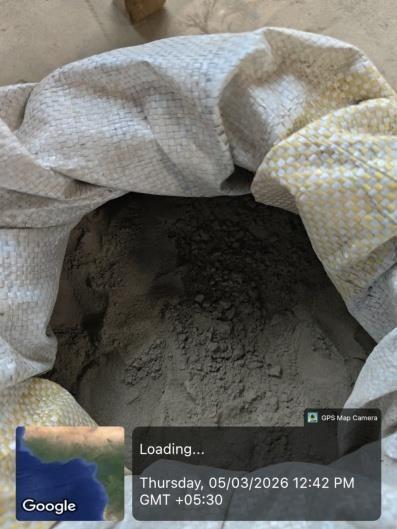
OrdinaryPortlandCement FineAggregateNaturalSandCoarse AggregateCrushedStone SewageSludgeFinesDriedandSievedWater SuitableforMixingandCuring
Standard-grade Ordinary Portland Cement served as the binderhere.Acommonchoice,itheldeverythingtogether reliably. This type stayed consistent across applications. Its role remained central throughout the process. Performancematchedexpectedpatternswithoutsurprise Checking the details the cement came from a nearby source, arrived in proper shape, then kept safe under correct storage conditions. Store it somewhere dry so damp does not get in. What holds concrete together is cement.Stickingcloseduringthemix,theygainpoweras waterworksitswayin.Differenttrials.Testslikehowthick themixis,whenitstartstoharden,whenitfullysets,also its texture - were carried out to ensure the quality of cement
International Research Journal of Engineering and Technology (IRJET) e-ISSN:2395-0056
Volume:13Issue:04|Apr2026 www.irjet.net p-ISSN: 2395-0072
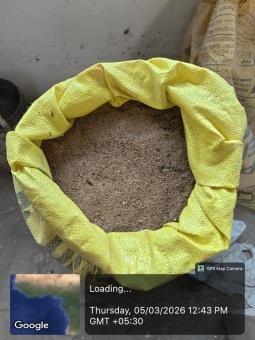
Fromalocalsourceneartheconstructionsite.Thematerial flowed smoothly through sieves during testing. A local sourceprovidedit,clearofcontaminantslikedirt,sand,or plantdebris.Startingoff,asievesortedthesandtoclearout bitsthatdidn’t belong,makingsureonly well-sizedgrains remained. Then again, uneven pieces were left behind so consistency stayed intact through each step. Filling gaps amonglargerstones?Thatiswherefinegravelstepsin.It slipsintoemptyspacesleftbybulkybits,doingitspartin shaping what comes together. Without it, pockets of emptinesswouldweakenthewholemix.Eachgrainplaysa role, linking pieces that otherwise stay apart. Stability growsquietlythroughthesetinyconnections Concrete must hold shape while being easy to place. Its toughnesscomesafterhardeningfully.
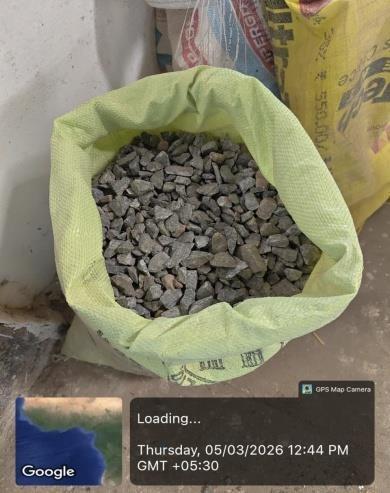
Fine chunks of broken rock, picked by size, went into the mix here. These bits served as the larger particles needed for testing. From a local quarry came the aggregates,washedthoroughlypriortobeingused.The larger particles stood out clearly. Concrete gets its shape mostly from aggregates. These materials give it toughnesswhileholdingeverythingtogether.Strength
comes through their presence, yet stability depends on how they fit. Each bit plays a role even if unseen. Shape mattersjustasmuchasquantity.
Withoutthem,themixwouldcollapseunderpressure.Tiny stones carry weight far beyond their size. Heavy particles lendfirmnessinsidethemix.
Chosen pieces fit by how theysit together -length, outline, bulkguidingeachchoicestrengthcharacteristics.
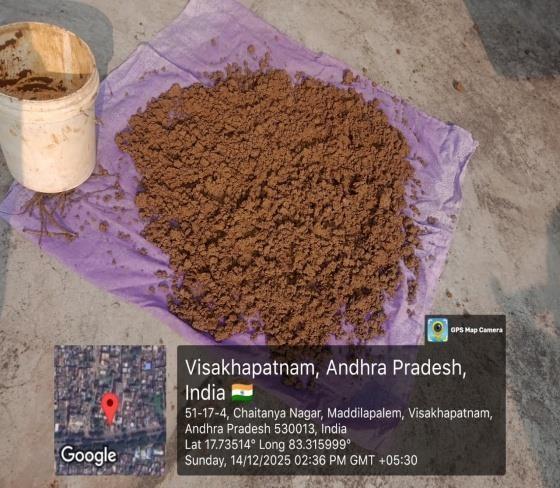
Sewage Sludge Collected from Narava Treatment Plant. Out in the open at STP, Visakhapatnam, the sludge sat dryingslowly.Moistureleftitpiecebypieceundersunand wind.Whatbeganwetturnedfirmover dayswithouthelp frommachines. Naturetook its time reshaping the muck into something lighter, thinner. Each hour shifted its texturejustalittlemoreWatergot taken out first. Once dry, pieces broke apart by hand then sifted through a mesh till only small grains stayed behind tiny bits much like real sand.This cleaned waste took the place of small aggregate in different percentages such as 5%,10%,15%,20%, and 100% to study its effect on the propertiesofconcrete.
International Research Journal of Engineering and Technology (IRJET)
Volume:13Issue:04|Apr2026 www.irjet.net
MIX CALCULATION FOR M25 GRADE CONCRETE
USING FINE AGGREGATE WITH SLUDGE FINES FOR 1 CUBE
• Quantitieswerecalculatedbasedonstandard mix design and converted into weight for laboratorybatching.
1. Dry Volume of Concrete
• DryVolume=1×1.54=1.54m3
2. Mix Ratio
Mixratio:1:1:2
Totalparts:1+1+2=4
3. Volume of Each Material
BinderVolume 1 ×1.54=0.385m3 4
FineAggregateVolume 1 ×1.54=0.385m3 4
CoarseAggregateVolume 2
MIX FOR EACH CUBE
5%MIX
Cement=1.84kg
Sand=1.90kg
Sludge=0.10kg
2395-0072
Coarseaggregate=4.0kg
10%MIX
Sand=1.80kg
Sludge=0.20kg
15%MIX
Sand=1.70kg
Sludge=0.30kg
20%MIX
Sand=1.60kg
Sludge=0.40kg
100%MIX
Sand=0kg
Sludge=2.0kg
MIXING AND BATCHING
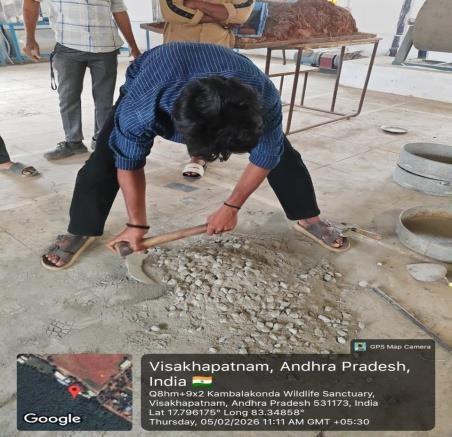
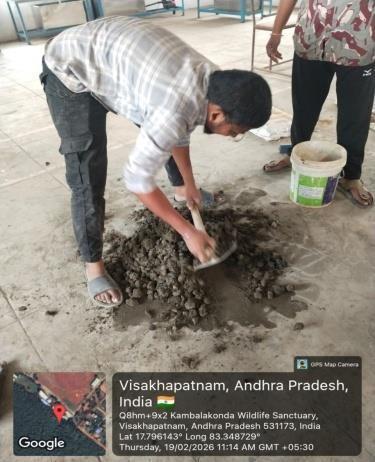
Getting concrete right starts with careful measurement and blending. What comes first is weighing out cement sand, gravel, treated sludge, along with water each amount set by the recipe. Precisionheremakessurethefinalproductholdsup overtime,resistingwearwithoutcrackingeasily.For this work, a standard M25 mix guided the ratios, nothing adjusted on instinct. Weight-based measurements removed guesswork, keeping every batchconsistent.Oncegathered,everythingcombined byhandonaflatsurfacefreeofdirtormoisture.The goal: an even mixture, no pockets of dryness or clumpingvisiblethroughout.
eventually checked how replacing materials with sludgechangedconcretebehavior.
International Research Journal of Engineering and Technology (IRJET) e-ISSN:2395-0056
Volume:13Issue:04|Apr2026 www.irjet.net p-ISSN: 2395-0072
Procedure
Afterweighingeachingredient-cement,sand,gravel,plus sludge - one by one on a scale, everything dries into the mixer first. A steady blend followed, going till the color looked even throughout. Next came the water, poured in slowly as the machine kept turning. The spinning didn’t stop until the goop turned smooth, consistent, ready to pour.Startingwithabasemix,sewagesludgetookpartof the sand's place in varying amounts - none at all, a small bit, up to half, even fully swapped in some cases. Once mixed,thematerialisfilledwithmoldsshapedlikecubes, readyfortestinglateron.
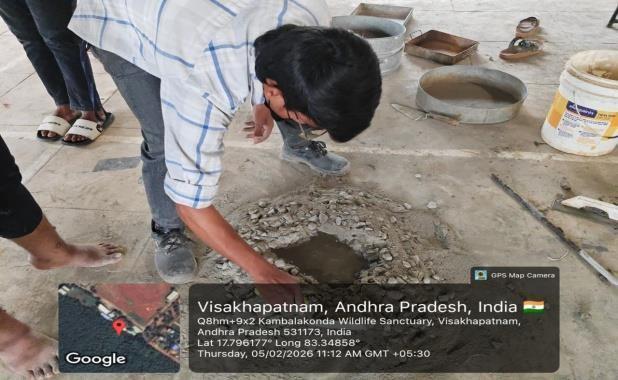
Startingoff,cementblendedwithsand,gravel,andsludge through thorough dry stirring till the shade looked even throughout.Afterthat,liquidtrickledinslowlyasblending carriedonwithoutpause,formingasmooth,ready-to-use mixture.Oncesetup,theblendpouredintomoldsmaking cubes-thesepieces
Atestbeganbyplacingasteelcone-300millimeterstall,200 at the base, narrowing to 100 at the top - onto a flat metal plate. Instead of filling it all at once, workers added fresh concreteinthreeseparates
portions, each one roughly the same size. For every section poured, someone used a straight metal rod, exactly 16 millimeters thick, delivering 25 firm taps to press down the material. Once full, they scraped off excess, so the top sat perfectly even with the rim. Then came the lift: raising the moldslowlyupwardwhileleavingtheconcretebehind.What followedwasquietobservation-thedistanceitsankrevealed how soft or stiff the mix truly was. Starting from the top, subtract the height of the settled concrete from the mould's full height to find the slump. When testing M25 mix, if that numberlands between50and100millimetres,itmeansthe mixflowsjustenoughforeverydaybuildingjobs

1. Once cured, concrete gets tested to check how strong it really is. Strength results show
International Research Journal of Engineering and Technology (IRJET)
Volume:13Issue:04|Apr2026 www.irjet.net p-ISSN: 2395-0072
whetherthematerialcanhandleheavyloadsover time. Performance during these checks reveals howlongthestructuremightlastunderstress.
2. Concrete cubes made with M25 mix and varying amounts of sludge - 5%, 10%, 15%, 20%, up to 100% - were tested after hardening. Following curing, each cube faced a compression machine's force until it cracked. Strength measurement focused on how much pressure the material held just before breaking apart. Results showed what peakloadthesemodifiedmixescouldendure.
3. Abatchof150mmcubesservedassamplesduring thistrial.Oncetheirtimeinthecuringtankended, theycame outto air-dry briefly.Surface moisture anddebrisgotwipedawaybeforemovingforward. Into the compression machine each cube went, readyforevaluation.
4. OntopoftheCTM'sbaseplatesattheconcretecube, positioned with care to spread the force evenly. Gradually, pressure built - no sudden jolt - as weight increased till collapse came. When the breakhappened,thehighestpointofloadreached gotnoteddown.
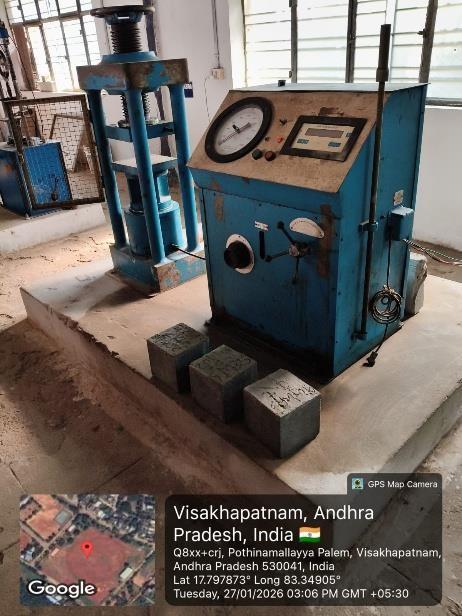
Table1:Slumpcone values






-1 SlumpConeValues Table 2: Compressive Strength Test and Results
International Research Journal of Engineering and Technology (IRJET)
Volume:13Issue:04|Apr2026 www.irjet.net






International Research Journal of Engineering and Technology (IRJET) e-ISSN:2395-0056
Volume:13Issue:04|Apr2026 www.irjet.net

Chart -7 Comparisonofcompressivestrength
Waterabsorptiontestresults
Table 3 :waterabsorptionresults



Chart – 8 waterabsorptionvssludgereplacement
Rate Analysis
RateAnalysisistheprocessofcalculatingthecostofone unitofworkbyconsideringthecostofmaterials,labour, equipment,transportation,overheads,andcontractor’s profit.
Purpose of Rate Analysis
1. Todeterminetheunitcostofconstruction work.
p-ISSN: 2395-0072
2. Toestimatethetotalcostofaproject.
3. Tocheckwhetherthecontractor’squoted rateisreasonable.
4. Topreparedetailedestimatesandbudgets.
Table -4 rate analysis of sludge – based concrete
0 Transportation 500
Table -5 comparison between nominal concrete and sludge concrete
Property Nominal Concrete (0%) Sludge Concrete
Compressive Strength Higherstrength duetoproper bonding Reduced strengthdue toweak bonding
Workability Highandeasy tomix Reduceddue towater absorption
Water
Absorption Low Highdueto poroussludge
Density Higher(denser) Slightlylower Durability Goodlong-term performance Reduceddue toporosity
Cost Higher Lower
Material Naturalsand used Sludge replacessand
Environmental Impact Depletes natural resources Eco-friendly& waste utilization
From tests done on concrete using sludge fines instead of sand, these outcomes emerged: one idea follows another likestepsonapath
International Research Journal of Engineering and Technology (IRJET) e-ISSN:2395-0056
Volume:13Issue:04|Apr2026 www.irjet.net p-ISSN: 2395-0072
1. Concrete moves less freely as more sludge is swappedintothemix.Howitflowsshiftseachtime thesludgelevelclimbs.
2. Concretegotstrongerovertime,nomatterthemix used. Strength rose as days passed under curing conditions.
3. Beyond10percentsubstitution,gainsleveledoffhintingthat tighterclustering ofparticles initially helped lock things together. Concrete's squeeze resistance rose just a bit when waste filled onetenthofthemix,thanks to closercontact between components.
4. Porositygrewhigherwhenmoresludgewasused, which made the material less strong under pressure.Thelinkbetweenparticlesweakenedas substitution levels rose, lowering overall durability.
5. Moresludgeinthemixmeanttheconcretesoaked upmorewater,showingitletfluidsthrougheasier. A rise in replacement level led to greater uptake acrosssamples.
6. Lookingateverything,using10%sludgeinsteadof regularmaterialworksbestwhenmakingconcrete thatholdsupwellandlastslong.
1. One way to go further? Try swapping in stronger concrete, like M30 or M40. Different mixes might revealnewpatternsworthnoting.
2. Usingtougherblendscould shifthow resultsplay out. Instead of sticking with basic formulas, stepping up the grade may add clarity. What happens next depends on material choices made early. Heavier-duty options open doors that standardtypesoftenblock.
3. Checkinghow well sludge concrete holds up over time might involve testing its resistance to wear, waterpassage,orbendingstress.
4. Somelabsruntheseextrachecksjusttoseewhat happens under strain, moisture exposure, or repeated load cycles. Results often revealhidden weaknessesthatstandardmeasuresmissentirely.
5. Looking closer at how sludge changes concrete's innerstructurerequireshigh-endmethods.
6. Tryingoutsludgefinesalongsidematerialslikefly ashmightwork.Silicafumemixedin
could change how things turn out. Each addition playsapartsomehow.
7. One way to go deeper is by checking how sludge finesinconcreteaffectnatureandcost.
8. Another path looks at what happens when waste material becomes part of building mixtures. It might help to see if cleaner outcomes come with cheaperresults.
9. Watching long-term effects could reveal hidden gains or problems. Some answers may show up throughtestingreal-worldapplications.
10. A closer look at production cycles brings more clarity. Results often depend on where and how materials aresourced.Newdatatendstoshiftold assumptionsslowly.
[1] A. M. Neville,PropertiesofConcrete,5thed.,Pearson EducationLimited,London,2011.
[2] M. S. Shetty, Concrete Technology: Theory and Practice,S.ChandandCompanyLtd.,NewDelhi,2005.
[3] Bureau of Indian Standards,IS456:2000–Plain and Reinforced Concrete – Code of Practice, BIS, New Delhi, India.
[4] Bureau of Indian Standards, IS 10262:2019 –Concrete Mix Proportioning – Guidelines, BIS, New Delhi, India.
[5] Bureau of Indian Standards, IS 383:2016 –SpecificationforCoarseandFineAggregatesfromNatural SourcesforConcrete,BIS,NewDelhi,India.
[6] J. H. Tay and K. Y. Show,“Reuseofwastewatersludge in concrete construction,” Journal of Environmental Engineering,vol.123,no. 8,pp.798–803,1997.
[7] C.S.Poon and D. Chan,“Feasibleuseofsewagesludge ash in cement-based materials,” Waste Management, vol. 26,pp.675–680,2006.
[8] X.Chen and D. Lin,“Experimentalstudyonutilization of sewage sludge in concrete,” Construction and Building Materials,vol.23,pp.245–251,2009.
[9] M. Cyr, M. Coutand, and P. Clastres,“Technological and environmental behavior of sewage sludge ash in cement-based materials,” Cement and Concrete Research, vol.37,pp.1278–1289,2007.
[10] D. Vouk, D. Nakic, and I. Stirmer, “Use of sewage sludgeinconcreteindustry,”TehnickiVjesnik,vol.24,no.5, pp.1405–1412,2017.
[11] N. H. Rodriguez, M. J. Coello, and J. M. Ortega, “Reuse of sewage sludge in construction materials,”
International Research Journal of Engineering and Technology (IRJET) e-ISSN:2395-0056
ConstructionandBuildingMaterials,vol.169,pp.178–186, 2018.
[12] S. Verma, “Utilization of waste materials in concrete,” International Journal of Engineering Research, vol.7,no.4,pp.45–50,2018.
[13] C. B. Cheah and M. Ramli, “The implementation of sewage sludge ash in concrete,” Journal of Cleaner Production,vol.227,pp.1079–1090,2019.
[14] P. Rao and K. Prasad,“Sustainableuseofindustrial waste in concrete,” Materials Today: Proceedings, vol. 19, pp.345–350,2019.
[15] S. Kumar and R. Sharma, “Strength properties of sludge-based concrete,” International Journal of Civil Engineering,vol.10,no.3,pp.210–215,2020.
[16] M. Ramesh, “Experimental study on partial replacement of sand with sludge,” International Research Journal of Engineering and Technology, vol. 7, no. 6, pp. 1200–1205,2020.
[17] A. Singh and R. Patel, “Use of waste materials in concrete for sustainability,” Journal of Construction Engineering,vol.5,no.2,pp.88–95,2021.
[18] K. Ramesh and P. Kumar, “Performance ofsewage sludgeinconcrete,”MaterialsScienceForum,vol.1020,pp. 55–60,2021.
Volume:13Issue:04|Apr2026 www.irjet.net p-ISSN: 2395-0072 © 2026, IRJET | Impact Factor value: 8.315 | ISO 9001:2008