
Volume: 12 Issue: 03 | Mar 2025 www.irjet.net p-ISSN:2395-0072
Volume: 12 Issue: 03 | Mar 2025 www.irjet.net p-ISSN:2395-0072
Tanisha Omar1 , Dr. Jayanti Srivastava2
Student of BBA Final Year, Dept. of BBA, Amity University, Lucknow, Uttar Pradesh, India
Asst. Prof., Dept. of BBA, Amity University, Lucknow, Uttar Pradesh, India
Abstract -
The way businesses handle their employees is changing as a result of the adoption of artificial intelligence (AI) in human resource management (HRM). Information systems driven by AI offer sophisticated capabilities for decision-making, employee engagement, performance management, and talent acquisition. This study investigates the integration of AI in HRM, analysing its benefits, challenges and ethical implications. It further evaluates the effectiveness of AI systems in enhancing HR processes and their impact on the future work.
Key Words – Artificialintelligence,humanresources,management,talentacquisition,decision-making.
Human Resource Management (HRM) plays a crucial role in organizational success by managing workforce talent and ensuring alignment with organizational goals. Traditionally, HR processes such as recruitment, employee engagement, performance evaluation and workforce planning have been intensive and time-consuming. However, the approach of ArtificialIntelligence(AI)isreshapingHRMbyintroducingintelligent,data-drivensolutionstoenhancetheseprocesses.
The origin of Artificial Intelligence (AI) has revolutionized the way organizations operate, and Human Resource Management(HRM)isnoexception.TheintegrationofAI-basedinformationsystemsinHRMhastransformedthewayHR functions. This enabling organizations to make data-driven decisions, improve efficiency, and enhance employee experiences.AI-poweredHRsystemscanhandleregulartasks,givehelpfulpredictions,andsuggestpersonalizedoptions. This allows HR professionals to concentrate on more important and strategic work. AI-driven information systems are made to handle large amounts of data, find patterns and provide useful insights. These systems help HR professionals make informed decisions, work more efficiently, and focus on important projects. For instance, AI tools can handle tasks likecheckingresumes,matchingcandidates,andonboardingnewhires,whichmakesthingseasierforHRteams Also,AI technologiessuchasmachinelearningandnaturallanguageprocessingarebeingusedtoevaluateemployeeperformance, trackengagementlevels,andforecastfutureworkforcerequirements
ThestudyofAIinHRMisanewareathatexploreattheadvantagesandchallengesofusingAIinHRtasks.Followingare recruitment, talent management, employee engagement and benefits administration. This research paper aims to investigatethecurrentstateofAIadoptioninHRM TheimpactofAIonHRprocesses arethemainfactorsthatinfluence thesuccessfuluseofAI-basedinformationsystemsinHRM.
BylookingathowAIandHRMworktogether,thisstudyaimstocreatemoreinformedandeffectivewaytomanageHR.It wantstouseAItohelpbusinessessucceedandimprovetheoverallwell-beingoftheemployees.Ultimately,thisresearch aimstoprovideinsightsandrecommendations TheHRprofessionals,organizationsandpolicymakersseekingtoleverage AItocreateamoreefficient,effectiveandemployee-centricfunction.
The study of machine intelligence that mimics human cognitive capacities, including language comprehension, learning, reasoning, problem-solving, planning, pattern recognition and all other human talents, is known as artificial intelligence [1]. Artificial intelligence can be used by HR managers to identify and evaluate applicants based on certain qualities and skills required for a given role. Software technologies that analyse language and emotions, for instance, can assist HR managersinevaluatingacandidate'smotivationandempathy,whichcanbecrucialinchoosingthebestcandidateforthe team [2]. It is crucial for HR managers to become familiar with the ethical concerns surrounding the use of artificial intelligenceinHR[3].
This study aims to provide a comprehensive overview of the role of AI-based information systems in HRM, highlighting their applications, benefits, challenges, and future prospects. By exploring the current state of AI adoption in HRM and International Research Journal of Engineering and Technology (IRJET) e-ISSN:2395-0056
International Research Journal of Engineering and Technology (IRJET) e-ISSN:2395-0056
Volume: 12 Issue: 03 | Mar 2025 www.irjet.net p-ISSN:2395-0072
analysingcasestudiesofsuccessfulimplementations,thispaperseekstocontributetothegrowingbodyofknowledgeon theintersectionofAIandHR.
Thehumanresourcesfunctionshaveevolvedoverthetimeandareconsideredtobedynamic[4].Theacademicliterature shows approaches using AI in the healthcare sector to achieve agility and the study showed the effectiveness of the HR function [5]. The key characteristic of AI is its ability to connect physical objects (or ‘‘things’’) to the Internet, such as vehicles, screens, pacemakers, electric motors, and more [6,7], as discussed by [8]. The Internet of Things (IoT) has practicalimplicationsthatinvolvethetechnicalaspectsofsensing,processing,andcommunication[9,10,11]. Sensorsplay acrucialroleinIoT,astheyareresponsibleforgatheringdataaboutvariousfactors,suchasarea,speed,temperature,and condition of use [12]. This data is then transmitted to AI systems for analysis and decision-making [13,14]. The data collected by sensors is characterised by its detailed nature, continuous flow, natural origin, reliability, and large volume [7,13].
The use of Artificial Intelligence (AI) in Human Resource Management (HRM) is changing the way organizations handle theiremployees.AIisbeingappliedinmanyareasofHRM,suchasfindingandhiringtalent,onboardingnewemployees, managing performance, boosting employee engagement, and analysing workforce data. This technology is making HR processes more efficient and effective. For recruitment, AI-powered tools like applicant tracking systems and automated resumescreeningstreamlinethehiringprocess,whilechatbotsenhancecandidateengagement.
In learning and development, AI facilitates personalized training programs, ensuring employees acquire the skills they need. Performance management is getting a boost from AI-driven tools that offer real-time feedback and performance analytics.
AI provides many benefits, like making processes more efficient, improving decision-making with data insights, and enhancing employee experiences. It helps reduce biases in hiring and promotions and can save organizations money by automatingeverydayHRtasks.However,therearechallenges,includingworriesaboutdataprivacy,potentialbiasesinAI systems,andethicalconcernsaboutmonitoringemployees.Additionally,HRprofessionalsmayfaceresistancetoadopting AIandrequireupskillingtoworkeffectivelyalongsidethesetechnologies.
Despitethesechallenges,thefutureofAIinHRMispromising.EmergingtrendsincludeAI-poweredtoolsforremoteand hybrid work environments, generative AI for talent engagement, and predictive analytics for workforce planning. As AI continues to evolve, it will play an increasingly critical role in creating efficient, equitable, and innovative HR practices OrganizationsmustadoptAIresponsibly,addressingethicalconcernsandensuringtransparencywhileleveragingitsfull potentialtoenhanceHRfunctions.
TheconceptualframeworkofAIinHRmanagementconsistsofseveralinterconnectedcomponentsthatworktogetherto enhancetheefficiencyandeffectivenessofHRfunctions.
2.2.1
The foundation of AI in HR lies in the systematic collection of data from various sources, such as employee records, performance metrics, recruitment platforms, and employee feedback systems. This data is integrated into a centralized database,allowingHRprofessionalstoaccessandanalysecomprehensiveinformationabouttheirworkforce.
2.2.2
AtthecoreofAIinHRareadvanced algorithmsandmachinelearningmodels.Thesetechnologieslookatcombineddata to find patterns, trends, and connections that might not be obvious right away. For instance, predictive analytics can be usedtoforecastemployeeturnoveroridentifyhigh-potentialcandidatesbasedonhistoricalperformancedata.
2.2.3
International Research Journal of Engineering and Technology (IRJET) e-ISSN:2395-0056
Volume: 12 Issue: 03 | Mar 2025 www.irjet.net p-ISSN:2395-0072
2.2.3.1 Recruitment:
AI makes the recruitment process easier by automating tasks like screening resumes, matching candidates to job descriptions,andevendoinginitialinterviewswithchatbots.Thissavestimeandhelpsreducebiasinselectingcandidates.
2.2.3.2 Performance Management:
AI tools can analyse employee performance data to provide insights into individual and team performance. This enables moreobjectiveperformancereviewsandhelpsidentifyareasfordevelopment.
2.2.3.3 Employee Engagement:
AI can assess employee sentiment through surveys and feedback analysis, allowing HR to gauge engagement levels and addressissuesproactively.
2.2.3.4 Training and Development:
AIfacilitatespersonalizedlearningexperiencesbyrecommendingtrainingprogramsbasedonindividualemployeeneeds, skillsgaps,andcareeraspirations.
2.2.4 User Interface:
Auser-friendlyinterfaceiscrucial forHR professionalstointeracteffectivelywithAItools.Dashboardsandvisualization toolspresentdatainsightsinaclearandaccessiblemanner,enablingHRteamstomakeinformeddecisionsquickly.
2.2.5 Ethical Considerations:
As AI becomes more prevalent in HR, addressing ethical concerns is paramount. Issues such as algorithmic bias, data privacy, and transparency must be carefully managed to ensure that AI applications are fair and equitable for all employees.
2.2.6 Continuous Learning and Improvement:
AIsystemsshouldbedesignedtolearncontinuouslyfromnewdataandfeedback.Thisiterativelearningprocess enhances theaccuracyofpredictionsandrecommendations,allowingHRdepartmentstoadapttochangingworkforcedynamics.
2.2.7 Impact Measurement:
Finally, organizations must measure the impact of AI on HR outcomes. This includes evaluating improvements in recruitment efficiency, employee satisfaction, retention rates, and overall organizational performance. By regularly assessingtheeffectivenessofAIinitiatives,HRcanensurecontinuousimprovementandalignmentwithbusinessgoals.
3. APPLICATIONS OF AI IN HUMAN RESOURCE MANAGEMENT
ArtificialIntelligence(AI)isrevolutionizingHumanResourceManagement(HRM)throughitsdiverseapplicationsacross keyfunctions.
3.1 Talent Acquisition and Recruitment
AI-powered tools like applicant tracking systems, automated resume screening, and chatbots simplify the recruitment process and improve candidate engagement. Predictive analytics also helps evaluate a candidate's chances of success, leadingtobetterhiringdecisions.
3.2 Onboarding
AIenablespersonalizedonboardingprograms,virtualassistants,andautomatedcompliancehandling,creatingaseamless andefficientexperiencefornewhires.
International Research Journal of Engineering and Technology (IRJET) e-ISSN:2395-0056
Volume: 12 Issue: 03 | Mar 2025 www.irjet.net p-ISSN:2395-0072
3.3 Employee Engagement and Retention
AI-driven tools that analyse employee feelings can measure morale, while predictive analytics can spot employees who mightleave.OngoingfeedbacksystemspoweredbyAIalsoimprovecommunicationandengagement.
3.4 Learning and Development
AI provides personalized training pathways, adaptive learning platforms, and immersive experiences using virtual and augmentedreality,ensuringemployeesacquiretheskillstheyneedeffectively.
3.5 Performance Management
Real-timefeedback,goaltracking,andidentifyinghigh-potentialemployeesforleadershipdevelopmentaremadepossible throughAI-drivenperformancemanagementtools.
3.6 Payroll and Benefits
AI automates payroll processing, minimizing errors and enhancing efficiency. It also offers personalized benefits recommendationsandensurescompetitivecompensationthroughtrendanalysis.
3.7 Workforce Analytics
AI-powered workforce analytics provides predictive insights for future hiring needs, monitors diversity and inclusion metrics, and tracks key HR indicators such as turnover rates and productivity. By leveraging these applications, AI empowers HR professionals to improve efficiency, enhance decision-making, and create a more engaging and equitable workplaceenvironment.
4. METHODOLOGY
In general, research design may be seen from two perspectives: quantitative research design and qualitative research design. A quantitative research design examines the relationship between variables using numbers and statistics to explainandevaluateitsfindings.Therearethreetypesofquantitativeresearchdesigns:
4.1 Research design:
4.1.1 Descriptive research:
This approach is used to explain the features of a group or circumstance under study. It answers the "what" question (whatarethetraitsofthepopulationorsituation?),butitdoesn'texplainhow,when,orwhythesecharacteristicsoccur.It is common practice to group the attributes into descriptive categories. We will be using this strategy for our study since weneedtogatherdataforourresearchthatincorporatespopulationinformation.
4.1.2 Correlational design research:
Thisaimstodeterminewhethertwovariablesareconnectedorrelatedinsomewaybyutilisingstatisticalanalysiswhile watchingthevariables.
4.1.3 Experimental design research:
Acause-and-effectrelationshipbetweentwoormorevariablescanbeascertainedinthismanner. Toobservetheimpact on the dependent variable, the independent variable is altered. A group may be exposed to a variable, for instance, and thencontrastedwithanothergroupthatwasnot.
4.1.3.1 Qualitative Research:
Usingcasestudies,aqualitativeresearchdesignisemployedtoinvestigatethesignificanceandcomprehensionofintricate socialcontexts,suchasthecharacterofindividuals'experiences.Incontrast,theexploratorynatureofqualitativeresearch designaimstoexploreratherthanforecastresults.
International Research Journal of Engineering and Technology (IRJET) e-ISSN:2395-0056
Volume: 12 Issue: 03 | Mar 2025 www.irjet.net p-ISSN:2395-0072
4.1.3.2
The precise steps or methods used to find, pick, process, and evaluate data on a range of subjects are referred to as research methodology. The methodology part of a research paper gives readers the opportunity to evaluate the study's overall validity and dependability. A variety of qualitative and quantitative research techniques, including surveys, participant observation, experiments, and secondary data, are employed by sociologists. In order to test theories and provide an explanation for data, quantitative approaches concentrate on categorising features, counting them, and developing statistical models. On the other hand, qualitative approaches seek to offer a thorough and comprehensive accountofobservations,encompassingthebackgroundofeventsandsituations.
4.2 Data Collection:
Thisstudycombinedprimaryandsecondarydata.Theprimarydata wasgatheredthroughastandardisedquestionnaire. Thequestionnairewasdistributedto150responders.Afterexaminingthetrustworthinessandplausibilityofthedata,19 fully completed questionnaires were utilised for data analysis. The secondary data was gathered from publications, journalsandPDFs.Primaryandsecondarydatawereanalysedandanalysedtoreachareasonableconclusion.
4.3 Data Analysis Tool:
DataanalysiswasdoneusingSPSSsoftware.Thequestionnaire'sinternalconsistencyandreliabilitywereassessedusing Cronbach'salpha.Multiplelinearregressionanalysiswasthenusedtoexaminethedata.Thepurposeofthisanalysiswas to ascertain whether the impact of artificial intelligence on HRM and HR practices was considerable and how well the researchmodelperformedindoingso.
4.4 Research Model:
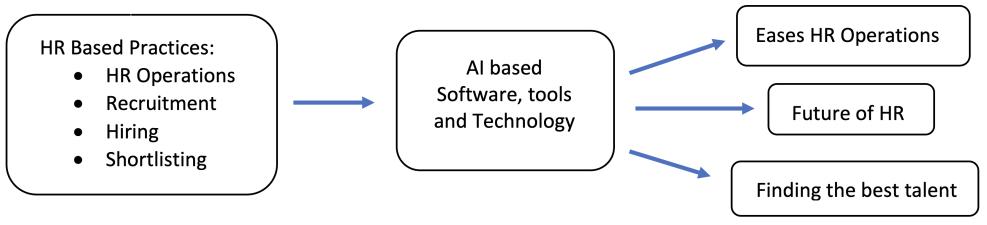
Theresearchmodelusedforthisprojectis showninthefiguregivenbelow.Softwareandtechnologyrelatedtoartificial intelligence are the independent variables in this study model. HRM and HR practices serve as the study's dependent variable.
4.5 Research Hypothesis:
H0 (Null) AIhasnosubstantialimpactonHumanResourceManagement. H1(Alternative) ArtificialintelligencehasabigimpactonHRM.
5. OBJECTIVE OF THE STUDY
Thefollowingarethestudy'sgoals:
1. Thisstudy'sgoalistodeterminehowartificialintelligenceaffectshumanresourcemanagement. 2. TodeterminehowAI-basedsoftwarehelpsrecruitthetopindustryprofessionals.
6.1 Respondent’s characteristics analysis:
Thissectioncontainsananalysisandexplanationofthedatacollectedthroughthequestionnaires.Thequestionnairewas distributed to 150 responders. After validating the data's quality and dependability, 19 replies were received and evaluated. The first segment examines the respondents' ages, occupations, and organisations. Out of 19 respondents, 15 (78.9%), or the majority of the respondents, are between the ages of 20 and 30, followed by 31 to 40 and 51 years and older.Thisisdepictedin Fig-1 givenbelow.
International Research Journal of Engineering and Technology (IRJET) e-ISSN:2395-0056
Volume: 12 Issue: 03 | Mar 2025 www.irjet.net p-ISSN:2395-0072
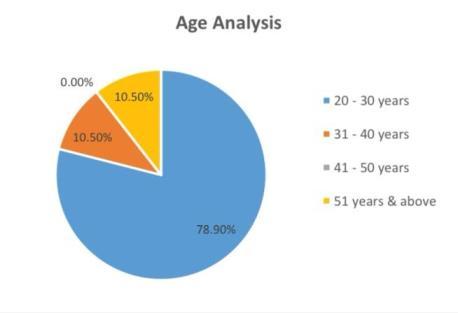
Fig-1: Ageanalysisoftherespondentsoftheorganizations
Itispossibletoanalysetherespondents'occupationsfrom Fig-2 givenbelow.Corporatepersonnelmakeupthemajority of responders (31.6%), followed by other categories (31.6%) and business categories (26.3%). Working professionals makeupthesmallestpercentageofresponders.
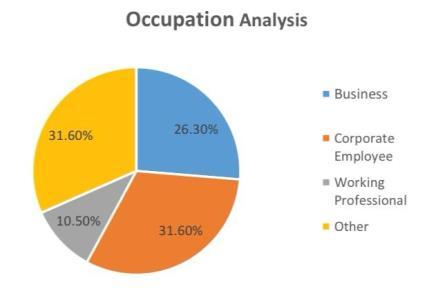
Fig-2: Occupationanalysisoftherespondentsoftheorganizations
Itispossibletoevaluatetherespondents'occupationsfrom Fig-3 below.Themajorityofrespondents(57.8%)donotfall intoanyoftheaforementionedcategoriesandinsteadbelongtoanotherindustry,suchastheeducation,pharmaceutical, journalism, engineering, etc. sectors. The manufacturing sector (15.8%), retail sector (10.5%), automotive sector, and consultingsector(5%each)comenext.
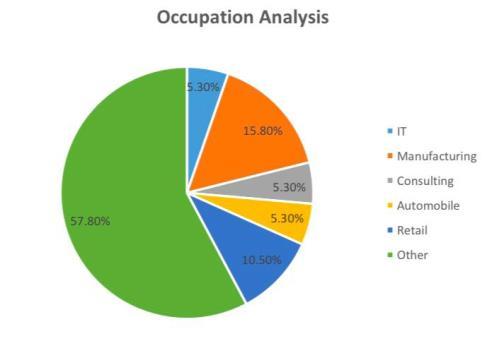
Fig-3: Occupationanalysisoftherespondents(sectorwise)oftheorganizations
6.2 Analysis of the impact of AI on HRM:
After ensuring the questionnaire's reliability and consistency, the influence and significance of Artificial Intelligence on HRM and HR Practices were assessed. Multiple regression analysis was done to determine the impact of the. The independent variables for this study were artificial intelligence technology and AI-based software, while the dependent variable was HRM & HR Practices such as HR Operations. The model's R square value, which is displayed in Table-1, indicates how much of the variability of the dependent variable can be explained by the independent variable and helps determinewhethertheresearchmodelbeingusedfitsthedatawell.Itisevidentfrom Table-1 thattheRsquarevalueis 0.622.Thisindicatesthatartificialintelligenceaccountsfor62.2%ofthevariabilityinhumanresourcemanagement.
International Research Journal of Engineering and
Volume: 12 Issue: 03 | Mar 2025 www.irjet.net
2395-0072
Table-1: ModelSummaryindicateshowmuchofthevariabilityofthedependentvariablecanbeexplainedbythe independentvariableandhelpsdeterminewhethertheresearchmodelbeingusedfitsthedatawell
The results of the ANOVA test, which are displayed in Table-2, provide insight into how well the independent factors in this model predict the dependent variable. Table 2 shows that the sig value is 0.009, which is below the conventional pvalue of 0.05. Thus, it demonstrates that the independent factors selected for this model - software and artificial intelligencetechnologies-helpdeterminethedependentvariable,HRM&HRPractices.
Table-2: ANOVAaTestprovideinsightintohowwelltheindependentfactorsinthismodelpredictthedependentvariable
Table 3 displays the regression test results. This contributes to understanding the significance and impact of artificial intelligenceonhumanresourcemanagementandHRpractices. ItalsodemonstratesthelinkbetweenAIandHRM. Table3 shows that the sig value for all independent variables (familiarity with AI introduction - 0.005) and (agreement of AI software assisting in finding the best talent for the job - 0.011) is less than the standard significance value of 0.05, indicatingthatthesefactors aresignificantandhaveaneffectonHRM. However,theothertwocomponentshaveavalue greaterthan0.05,indicatingthattheirorganisationscurrentlydonotuseAI-basedsoftwareforHRpractices. Table-3 also shows that all of the criteria except the use of in-house or third-party software have positive beta values. This suggests that these variables are favourably associated to HRM and HR Practices. So, based on the results of the investigation, hypothesisH1 canbeaccepted:AIhasafavourableandsignificantimpactonHRM. Thus,theH1 (Alternate)hypothesisis supported, whereas the H0 (Null) hypothesis is denied, implying that Artificial Intelligence has a significant impact on HumanResourceManagement.
Table-3: MultipleRegressionOutputshowsthatthesigvalueforallindependentvariables&alsoshowsthatallofthe criteriaexcepttheuseofin-houseorthird-partysoftwarehavepositivebetavalues
Do you utilise third-party software systems for hiring or do you have your ownHRMsoftware?
DoyouknowabouttheuseofAIinhiring procedures?
Doesyourcompany'shiringsoftwareuse artificial intelligence (AI) or other cutting-edgetechnologies?
How much do you think AI-powered toolsareassistinginidentifyingthemost qualifiedcandidatesforopenpositions?
1. AIhasbeenincludedintoHRMpracticesbythegreatmajorityofcompanies.
2. ThepositiveresponsesfromtherespondentssuggestthattheywillprobablysupporttheuseofAIatvariousHRbasedfunctionlevels.
3. Companies are using third-party and internal technology, such Ezieka and Omnidocs, as AI solutions for human resourcemanagement.
International Research Journal of Engineering and Technology (IRJET) e-ISSN:2395-0056
Volume: 12 Issue: 03 | Mar 2025 www.irjet.net p-ISSN:2395-0072
4. ThevastmajorityoftheorganisationsupportsAIasthefutureofhumanresources.
5. Companieswhohaven'tusedAI-basedsoftwareyetwillliketointhefuture.
The introduction of AI-based HR activities for applicants will surely have a stronger impact on improving the organisation's efficiency. Although AI applications lack human-like emotional and cognitive capacities, they can understand, forecast, and diagnose data, making them a valuable tool for any organisation. However, the underlying problem that is overwhelming the global workforce is how AI is exhibiting its impact in reducing jobs in numerous industries around the world. However, the truth is that improved technology do not replace humans; rather, it is about howhumanscanadapttoandexploittheseinnovationstoincreasewealthandprosperity.Inthegenuinesense,AI-based services will touch a subset of workers, and it is the job of HR leaders and businesses to consider their employees' requirementsandfutureconsequences. And,eventually,basedonourdata,mostorganisationseffectivelyuse AI-related methodologies into recruitment; however, AI will be everywhere in HR in the near future: recruitment, training, onboarding, performance analysis, retention, However, most firms are currently trailing in adopting AI into their HR processesduetointegrationexpenses. Tosummarise,theusageof AIshouldbeviewedasagoodopportunitybecauseit improvespeople'slivesandcreatesabetterfutureprovideditiscorrectlyunderstoodandapplied.
Thisstudygotnospecificfundingfromanypublic,commercial,ornon-profitorganisation.
[1] J.C. Das, “Power system harmonics and passive filter designs”, John Wiley & Sons, March. 2015, DOI:10.1002/9781118887059
[2] B. Ilic, S. Stankovic & S. Al Salaimeh, “Analysis of employee competencies and the role of new technologies”, In ProceedingsoftheFirstInternationalConferenceonLINKIT&EdTech,Vol.1,May.2023,pp.3-4.
[3] T. Kruskovic, B. Ilic, S. Anđelic, “Research and development of human resource management in Serbian organizations”, In Proceedings of Forth Virtual International Conference Path to a Knowledge Society-Managing RisksandInnovation,Dec.2022,pp.183-189.
[4] S.Bibi,T.S.Butt,S.H.Naqvi, “Impactofhumanresourcemanagement practicesonemployeeretentionintelecom sector”,J.Human.Soc.Sci.vol.21,issue8,2016,pp. 26-30.
[5] S.C. Chakraborty, V. Bhatt, T. Chakravorty, “Impact of IoT adoption on agility and flexibility of healthcare organization”, Int. J. Innov. Technol. Explor. Eng. vol. 8, issue 11, Sep. 2019, pp. 2673-2681, DOI:10.35940/ijitee.K2119.0981119
[6] A. Panicker, A. Sharma, U. Khandelwal, “Factorization of AI application in HRM”, Proceedings of International ConferenceonCommunicationandArtificialIntelligence:ICCAI2021,SpringerNature,Singapore, vol.435,2022, pp.637-646,DOI:10.1007/978-981-19-0976-4_53.
[7] E.Fleisch,“WhatistheInternetofThings?:Aneconomicperspective”,vol.1,Jan.2010.
[8] R. Zotta, I. Giannoccaro, P. Pontrandolfo, “The Internet of Things: A survey of topics and trends”, Proceedings of the8thInternationalConferenceonManufacturingResearch,ICMR2010,DurhamUniversityBusinessSchool,UK, 2010,pp.459-466.
[9] R. Priyanka, K. Ravindran, B. Sankaranarayanan, S.M. Ali, “A fuzzy DEMATEL decision modelling framework for identifying key human resources challenges in start-up companies: Implications for sustainable development” , Decis.Anal.J.vol.6,March,2023,100192,DOI:10.1016/j.dajour.2023.100192
[10] M.Chui,M.Loffler,R.Roberts,“TheInternetofThings”,McKinseyQuarterly,vol.2,issue2,Jan.2010,pp.1-9
[11] C. Florkemaier, F. Mattern, “From the Internet of Computers to the Internet of Things, From active data management to event-based systems and more”, Springer, vol 33, issue 2, Sep. 2010, pp. 242–259, DOI:10.1007/978-3-642-17226-7_15
[12] M.Swan,“Sensormania!theinternetofthings,wearablecomputing,objectivemetrics,andthequantifiedself2.0” , J.Sens.ActuatorNetw.vol.1,issue3,Dec.2012,pp.217–253,DOI:10.3390/jsan1030217
[13] E. Borgia, “The Internet of Things vision: Key features, applications and open issues”, Comput. Communication, vol.54,Dec.2014,pp.1-31,https://doi.org/10.1016/j.comcom.2014.09.008
[14] M. Weston, Wearable surveillance–a step too far? Strateg. HR Rev., vol 14, issue 6, (2015) 214–219, https://doi.org/10.1108/SHR-09-2015-0072