
International Research Journal of Engineering and Technology (IRJET) e-ISSN: 2395-0056
Volume: 13 Issue: 05 | May 2026 www.irjet.net p-ISSN: 2395-0072
International Research Journal of Engineering and Technology (IRJET) e-ISSN: 2395-0056
Volume: 13 Issue: 05 | May 2026 www.irjet.net p-ISSN: 2395-0072
Akkilla. C1 , Samrin Aafiya. A1 , Rohan Sajith1, Kanishiya Sri. S1
Kanishiya Sri. S1, Undergraduate Student, Bachelor of Architecture
Professor: Ar. Shivachandran2, Ar. Alan Sekaran2 Faculty of Architecture, Design and Planning, Karpagam Academy of Higher Education, Coimbatore, Tamil Nadu, India
Abstract - Sustainable construction management and building materials are very important for making the built environment better for the economy and society while also having less of an effect on the environment. The review emphasizestheintegrationofinnovativematerials,vernacular knowledge, and modern technological solutions to minimize energy consumption, reduce greenhouse gas emissions, and enhance occupant comfort. Sustainable building approaches and contribute significantly to environmental protection, resourceconservation,andlong-termeconomicresilience.The use of sustainable materials, building construction, energy design,andcostplanningbasedonthelifecyclecanbeseenas a viable solution for environmentally friendly construction. The review concentrates on four principal aspects of sustainable construction: materials, construction methodologies, energy efficiency, and cost-effectiveness. The study that was looked at shows how using sustainable and waste-based materials like waste plastic, crushed marble, recycled aggregates, bamboo, and other low-carbon options can help the environment while still being strong and longlasting.
KEY WORDS: Sustainable Construction, Construction techniques, Energy efficiency
Sustainable construction management is a systematic approachthatintegratessustainabilityintoeverystageofa project from planning and design to construction, operation,anddemolition.Itaimstoreduceenvironmental impactwhileimprovingresourceefficiency,economicvalue, andlong-termperformance.Unliketraditionalconstruction management,itnotonlyfocusesoncost,time,andquality but also emphasizes environmental protection, energy efficiency, waste reduction, and social responsibility. As urbanization increases, the construction industry’s heavy useofnaturalresourcesandenergyhasledtopollutionand environmental degradation. Sustainable construction management addresses these issues by promoting ecofriendly practices that support economic growth while ensuring a better quality of life for present and future generations. Sustainable construction management uses architecturaldesignprinciplestocreateenergy-efficientand environmentallycompatiblebuildings.Itfocusesonpassive strategies like natural ventilation, daylighting, insulation, andclimate-basedorientation,alongwithrenewableenergy
sources such assolar and wind. Features like green roofs, rainwaterharvesting,andefficientbuildingenvelopeshelp reduce environmental impact and maintain ecological balance.
Another vital component to consider in Sustainable ConstructionManagementistheuseofsustainablebuilding materials that are environmentally friendly. When We producetraditionalbuildingmaterials(e.g.,concrete,steel, and brick), they use a lot of energy to produce them and create a lot of carbon dioxide in doing so. Due to this, modern construction projects have begun implementing more sustainable options like bamboo, recycled steel, engineered wood products, recycled aggregate materials, concrete made from fly ash, and other green materials in their projects because they are not only better for the environmentbutwillalsohelptobecomemoreefficientwith resourceswhenpromotingreuseandrecycling,whichleads tolesswastefromconstructionprojects.
Along with material management, Waste Management & ResourceEfficiencyarecriticalcomponentstosustainable construction management because construction & demolition activities produce huge amounts of waste of ConcreteDebris,MetalScrap,Wood,andPackingMaterials. EffectiveWasteManagementstrategies,suchasRecycling, Re-using,&ProperlyDisposingof,cangreatlyreduceboth the amount of environmental pollution & Landfill consumption. Some techniques that help to reduce the amountofwastegeneratedduringconstructionareModular Construction, Prefabrication, and Lean Construction Practices.
Despitethegrowingawarenessofsustainableconstruction practices, several challenges still hide their widespread implementation,particularlyindevelopingcountries.Some oftheproblemsarehighupfrontcosts,notenoughtechnical knowledge, not enough support from policymakers, and resistancetochangefromtraditionalbuildingmethods.But moreandmorepeoplearebecomingconcernedaboutthe environment, and governments are making rules that encouragetheuseofsustainablebuildingmethodsaround theworld.
International Research Journal of Engineering and Technology (IRJET) e-ISSN: 2395-0056
Volume: 13 Issue: 05 | May 2026 www.irjet.net p-ISSN: 2395-0072
A fundamental concept in sustainable construction managementisthetriplebottomline,whichconsistsofthree key pillars: environmental sustainability, economic sustainability, and social sustainability. Sustainable construction management recognizes three distinct elements: environmental, economic, and social sustainability.Environmentalsustainabilityfocusesonhow to minimize the ecological impact of construction by reducingenergyuse,conservingwater,reducinggreenhouse gasemissions,andusingrenewableresources.Theemphasis of economic sustainability is on creating long-term value throughcost-effectiveconstructiontechniques;thisinvolves maximizing energy efficiency, minimizing building maintenancecosts,andmaximizingbuildingperformance. Social sustainability,onthe otherhand, isconcerned with thehealth,safety,andwelfareoftheoccupantsofabuilding aswellasthesurroundingcommunity.
Another significant aspect of sustainable construction managementistheuseofsustainableandenvironmentally friendlybuildingmaterials.Conventionalbuildingmaterials suchascement,steel,andbricksoftenrequirehighenergy consumption during production and generate significant carbonemissions.
Sustainableconstructionmanagementalsoincludesputting in place green building standards, rules, and certification systems,inadditiontothinkingabouttheenvironmentand materials. There are many international frameworks that helppeopledesignandbuildgreenbuildings.Someofthese areLEED(LeadershipinEnergyandEnvironmentalDesign), BREEAM(BuildingResearchEstablishmentEnvironmental Assessment Method), and other national green building ratingsystems.Bylookingathowwellbuildingsperformin areaslikeenergyefficiency,waterconservation,indoorair quality, and material sustainability, these standards encourage developers and contractors to be more environmentallyresponsible.
The construction industry is widely recognized as a major contributortoenvironmentaldegradationduetoexcessive resourceconsumption,highenergydemand,andlarge-scale wastegeneration.Inresponse,researchersandpractitioners have increasingly focused on sustainable construction approaches that integrate eco-friendly materials, efficient constructiontechniques,energy-consciousdesign,andlongterm cost efficiency. The reviewed literature collectively emphasizesthatsustainabilityinconstructionmustaddress material selection, construction processes, operational energy performance, and lifecycle economics in a holistic manner.
Previous studies highlight the importance of using sustainable and alternative building materials to reduce environmental impact. Materials such as bamboo, waste plastic, crushed marble, recycled aggregates, and natural fibershavebeenwidelyexploredduetotheirlowembodied energyandreducedcarbonfootprint.Bamboo,inparticular, is recognized as a rapidly renewable resource with high tensilestrength,flexibility,andseismicresistance,makingit suitableforsustainablehousingandstructuralapplications. Research also emphasizes the reuse of bamboo scrap and constructionwastetosupportcirculareconomyprinciples andminimizelandfilldisposal.Wasteplasticandindustrial by-productshavedemonstratedimproveddurability,crack resistance,andacceptablecompressivestrengthwhenused in construction elements such as paver blocks and road pavements. Overall, sustainable materials contribute significantly to resource conservation and environmental protectionwhilemaintainingstructuralperformance.
“Sustainablebuildingmaterials:Acomprehensivestudyon eco-friendlyalternativesforconstruction”
Thepresentstudyinvestigatesthepotentialuseofpyrolysis lowdensityPlastic(LDPE)asamodifierforasphaltpaving materials.Fivedifferentblendsincludingconventionalmix weresubjectedtobindertestingsuchasrheologicaltests,as wellastosomeothertestsrelatedtothehomogeneityofthe system.Further,itseffectonthemoisturesensitivityandlow temperature performance of stone matrix asphalt (SMA) mixtureswasstudied.
Research results indicate that modified binders showed higher softening point, keeping the values of ductility at minimumrangeofspecificationof(100+cm),andcauseda reductioninpercentagelossofweightduetoheatandair(i.e. increasedurabilityoforiginalasphalt).Theresultsindicated thattheinclusionofLDPEinSMA mixturescansatisfythe performance requirement of high-temperature, low temperatureandmuchrainzone.
This research begins with a comprehensive review of literatureonsustainableconstructionmaterials,examining recent studies and industry publications to identify environmentally friendly options. It focuses on recycled materials(recycledaggregates,recoveredwood),bio-based materials(bamboo,hempcrete),andlow-carbonalternatives (geopolymers, fly ash-based products). Each material is analyzed based on its production, properties,applications, andenvironmentalbenefits.
Sustainable building materials have become essential in addressing environmental issues in the construction industry,particularlyinreducingcarbonemissions,resource consumption, and waste generation. As a result, both researchersandpractitionersareincreasinglyexploringecofriendlyalternativestotraditionalmaterials.
International Research Journal of Engineering and Technology (IRJET) e-ISSN: 2395-0056
Volume: 13 Issue: 05 | May 2026 www.irjet.net p-ISSN: 2395-0072
Recycledmaterials,especiallyaggregatesfromconstruction anddemolitionwaste,helpreduceminingandlandfill use. Recoveredwoodalsosupportssustainabilitybyminimizing reliance on virgin timber. Bio-based materials such as bamboo offer high strength and rapid renewability, while hempcreteprovideseffectivethermalandacousticinsulation.
Low-carbon materials like geopolymers and fly ash-based productspresentviablealternativestoconventionalcement, significantly lowering greenhouse gas emissions while utilizingindustrialbyproducts.
Despite their advantages, challenges remain in terms of performance, cost, regulations, and public acceptance. Ongoing research emphasizes material performance evaluation and environmental impact analysis to support theiradoption.
The ability of the construction industry to adopt global practicesofsustainabilityishinderedbyalackofadequate provision for specialized training for management and constructionstaff.
Kmetz .M et al [23]
The study examines building decarbonization through a lifecycle-basedanalyticalapproach,identifyingoperational andembodiedcarbonaskeycontributorstoemissions.The study highlights strategies such as energy efficiency, renewableenergyintegration,electrification,andtheuseof low-carbon materials. It emphasizes that sustainable constructionmanagementiscriticalinimplementingthese strategiesthrougheffectiveplanning,materialselection,and stakeholder coordination. The research concludes that reducing the carbon footprint of buildings is essential for achievinglong-termenvironmentalsustainabilityandglobal net-zerotargets.
Arvind Singh Gaur et al [22]
Thestudyinvestigatestheuseofconstructionanddemolition waste in the production of concrete paver blocks through experimental analysis of mechanical and durability properties.Thestudydemonstratesthatpartialreplacement of natural aggregates with recycled materials provides adequatestrengthanddurabilitywhilesignificantlyreducing environmental impact and material costs. The findings highlight that effective material selection and waste utilizationarekeycomponentsofsustainableconstruction management, promoting resource efficiency and reducing landfillwaste.
Lakshmi et at [24]
Thejournalinvestigatestheuseofplasticwasteandbottom ashinpaverblockproductionthroughexperimentalanalysis of mechanical and durability properties. The study demonstratesthatthesewastematerialscanpartiallyreplace conventional aggregates while maintaining acceptable strength and durability. The findings highlight that
incorporating recycled materials reduces environmental impact, lowers construction costs, and promotes resource efficiency. The research emphasizes that sustainable construction management relies on effective material selection and waste utilization strategies to achieve environmentalandeconomicsustainability.
Bhukya Govardhan Naik et al [24]
Thestudyonthejournalinvestigatestheuseofwasteglassas a substitute for fine aggregate in paver block production using an experimental and analytical approach. The study employsresponsesurfacemethodologytooptimizematerial proportions and evaluates mechanical and durability properties. The findings indicate that waste glass can effectivelyreplacenaturalsandatoptimallevels,improving resourceefficiencyandreducingenvironmentalimpact.The research highlights that sustainable construction managementreliesoninnovativematerialselection,waste utilization, and data-driven optimization to achieve environmentallyresponsibleconstructionpractices.
Samer Qaidi et al [23]
The study presents a comprehensive review of the use of waste glass as an environmentally friendly aggregate in concrete, analyzing its effects on fresh and mechanical properties. The study finds that partial replacement of naturalaggregateswithwasteglasscanmaintainorimprove concrete performance at optimal levels while significantly reducingenvironmentalimpact.Theresearchhighlightsthat sustainable construction management relies on effective materialselection,wasterecycling,andoptimizedmixdesign to achieve resource efficiency and reduce the carbon footprintofconstructionmaterials.
M. Amran et al [21]
The journal presents a comprehensive review of fly ashbasedeco-efficientconcrete,analyzingitseffectsonfreshand short-termmechanicalproperties.Thestudyhighlightsthat partial replacement of cement with fly ash improves workabilityandreducescarbonemissions,althoughearlyagestrengthmaybeslightlyreduced.Thefindingsemphasize that sustainable construction management depends on efficient material selection, utilization of industrial byproducts, and optimized mix design to achieve environmentally responsible and resource-efficient constructionpractices.
David Pearlmutter et al [20]
The journal review examines the role of nature-based solutionsinpromotingacirculareconomywithinthebuilt urban environment through a comprehensive literature reviewandconceptualframework.Thestudyhighlightsthe integration of green materials, ecological systems, and sustainable site design to enhance resource efficiency and environmental performance. The findings emphasize that sustainable construction management must incorporate circular economy principles and ecosystem-based
International Research Journal of Engineering and Technology (IRJET) e-ISSN: 2395-0056
Volume: 13 Issue: 05 | May 2026 www.irjet.net p-ISSN: 2395-0072
approaches to achieve long-term sustainability, urban resilience,andreducedenvironmentalimpact.
Thepursuitofsustainablebuildingmaterialshasornamental analyses.Manystudieshavebeenundertakentoestimatethe total environmental effect of these materials, allowing for directcomparisonswithtraditionalcounterparts. Finally, the literature illustrates the importance of reemergedasacriticalcomponentoftheconstructionmoving sustainablebuildingmaterialsintheconstructionindustry's attemptstosolveenvironmentalconcernsandbusiness.This extensiveresearchseekstoaddtothecurrentadoptmore environmentallyfriendlymethods.
N. Bheel et al [22]
The study investigates the use of sugarcane bagasse ash, metakaolin, and millet husk ash as ternary cementitious materialsinconcretethroughexperimentalanalysisoffresh, mechanical, and environmental properties. The study demonstratesthatpartialreplacementofcementwiththese materials can maintain structural performance while significantly reducing embodied carbon. The findings highlightthatsustainableconstructionmanagementrelieson the adoption oflow-carbonmaterials, efficient mix design, andwasteutilizationstrategiestoachieveenvironmentally responsibleconstructionpractices.
Anexperimentalstudyonfresh,mechanicalpropertiesand embodied carbon of concrete blended with sugarcane bagasse ash, metakaolin, and millet husk ash as ternary cementitiousmaterial.
Enhancingthecirculareconomywithnature-basedsolutions in the built urban environment: green building materials, systemsandsites.Blue-GreenSystems
A thorough body of knowledge by conducting a detailed evaluation of investigation of eco-friendly alternatives for constructioneco-friendlyalternativesandtheirpotentialto revolutionizematerialshasbecomecriticalintheindustry's desire to the way we design our built environment. This studylowersitsecologicalimprintandmigrates.
W. E. Farrant et al [22]
Theuseofalternativeandwaste-basedmaterialsinconcrete through experimental evaluation of fresh and mechanical properties.Thestudydemonstratesthatpartialreplacement ofconventional materialscanmaintainperformancewhile reducingenvironmentalimpact.Thefindingsemphasizethat sustainable construction management relies on efficient materialselection,reductionofcarbon-intensivematerials, andoptimizedmixdesigntoachieveresource-efficientand environmentallyresponsibleconstructionpractices. Thereisarisinginterestinsustainablebuildingmaterialsin theliterature,withconsiderableresearchconcentratingon material characterization, performance evaluation, and environmentalanalysis.
Influence of sugarcane bagasse ash and silica fume on the mechanicalanddurabilitypropertiesofconcrete.
Construction techniques play a critical role in translating sustainable material choices into effective building performance.Theliteratureemphasizestechniquessuchas waste minimization during construction, recycling of construction debris, prefabrication, and efficient project management practices. Sustainable construction methods integrate traditional knowledge with modern technology, promoting climate-responsive design and locally adapted buildingpractices.Studiesalsohighlighttheimportanceof project management tools,lifecycle assessment, and green certification frameworks to ensure efficient planning, stakeholder coordination, and sustainability compliance. Innovative approaches, including parametric and digital design tools, further optimize material usage and enhance constructionefficiency.
P. U. Okoye, I. A. Odesola, and K. C. Okolie et al [22]
"Evaluating the Importance of Construction Activities for Sustainable Construction Practices in Building Projects in Nigeria,"JournalofSustainableConstructionMaterialsand Technologies
UnsoundconstructionindevelopingnationssuchasNigeria hasbeenidentifiedinresearch.
Feebleregulationsandweakenforcementrenderitdifficult toimplementsustainablepractices,aswellasenforcingthose who don't meet the regulations. Increased awareness and sensitizationofprojectleadersandworkerscanexacerbate such issues, creating a challenge in the use of sustainable practices in the long run. There is a need for long-term studies in order to monitor how effective the practices of sustainability are in the long term, as well as how the involvement of the community influences the use of sustainableconstructionpractices.
We must merge traditional knowledge and practices with contemporary notions of sustainability to synthesize solutionsappropriatetoparticularcircumstances.
Sai Trivedi. S et al [23]
Thejournalpresentsacomprehensivereviewofsustainable approaches for processing and treating construction and demolition waste. The study analyzes various mechanical, chemical, and recycling techniques to improve material recovery and reduce environmental impact. The findings highlight that effective waste management, recycling strategies,andresourceoptimizationarekeycomponentsof sustainable construction management. The research concludesthatintegratingwasteprocessingtechniquesinto construction practices enhances resource efficiency and supports the transition toward a circular construction economy.
W. Ma et al [23]
The journal explores the transition towards a circular economyinconstructionanddemolitionwastemanagement throughacomprehensiveliteraturereviewandframework
International Research Journal of Engineering and Technology (IRJET) e-ISSN: 2395-0056
Volume: 13 Issue: 05 | May 2026 www.irjet.net p-ISSN: 2395-0072
development.Thestudyhighlightsstrategiessuchaswaste reduction,reuse,recycling,anddesignfordeconstructionto improve resource efficiency and minimize environmental impact.Thefindingsemphasizethatsustainableconstruction management requires the integration of circular economy principlesandadvancedconstructiontechniquesacrossthe projectlifecycletoachievelong-termsustainability. Towardsacirculareconomyforconstructionanddemolition waste management in China: critical success factors. SustainableChemistryandPharmacy.Moreover,hempcrete, ahempfiberandlimecombination,hasshownremarkable thermalandacousticqualities,makingitanappealingchoice forsustainablebuildinginsulation.
R. Maderuelo-Sanz et al [22]
The study investigates the use of lightweight construction systemsincorporatingrecycledmaterialstoenhancebuilding performance.Throughexperimental evaluationofacoustic properties, the study demonstrates that such systems can achieve effective sound insulation while reducing material consumption and environmental impact. The findings emphasize that sustainable construction management depends on the adoption of innovative construction techniques,includinglightweightandprefabricatedsystems, to improve efficiency, resource utilization, and overall sustainability.
The incorporation of environmentally friendly building materialsintotheconstructionsectornecessitatesathorough graspoftheirqualitiesandprospectiveuses.Yet,thereare stillissuestoaddressintermsofmaterialperformance,costeffectiveness,regulatorycompliance,andpublicacceptance. Addressingtheseimpedimentsandprovidingevidence-based data to promote the informed selection and integration of eco-friendlyoptionsinconstructionmethodsiscritical. Thermalandacousticalevaluationofbio-compositesmadeof agriculturalwasteforceilingtiles.
Energy efficiency in sustainable construction management refers to the practice of designing, constructing, and operating buildings in a way that minimizes energy consumptionwhilemaintainingcomfortandperformance.It involvestheuseofpassivedesignstrategiessuchasproper buildingorientation,naturalventilation,anddaylightingto reduce dependence on artificial systems. Efficient building envelopes, including insulation and high-performance windows,helpinreducingheatlossorgain.Theintegration ofenergy-efficientsystemslikeLEDlightingandadvanced HVAC, along with renewable energy sources such as solar panels, further enhances efficiency. Additionally, proper planning and management during construction reduce energyuseandwaste.Overall,energyefficiencyhelpslower operationalcosts,reduceenvironmentalimpact,andimprove thesustainabilityofbuildings.
Al Azari et al [24]
The journal identifies 44 driving factors influencing sustainableconstructionadoption.However,whilesignificant research has been conducted on aspects of sustainable construction,mostofthepreviousstudieswerebasedonthe literature review. Also, very little work has attempted to qualifytheCSF'sand morestudieswereachievedtowards environmental factors. There are various metrics that are used to measure project performance and delivery. While some measuring units focus on the completed projects, others measure the procedures, practices, strategies and actions that occurred across the project supply chain. The procedures, practices, strategies and actions are the CFs (16,17,32].
Abdul-Aziz et al 1331, migrant construction workers are frequentlysubjectedtoharshtreatmentbytheiremployers, markedbyexploitativewages,insecureemployment,forced labor,lowsafetystandards,andinadequatelivingconditions. Hedevelopedaprojectmanagementcompetencyframework forIndustrializedBuildingSystem(IBS)constructionusinga mixed-method approach involving literature review and expertvalidation.ThestudypositionsIBSasakeystrategy for sustainable construction management by promoting efficient resource utilization, waste minimization, and improved construction quality. It identifies technical, managerial, and behavioral competencies as essential for integratingsustainabilityprinciplesintoprojectdelivery.The findingshighlightthateffectivemanagementofIBSprocesses enhances environmental performance, optimizes resource efficiency, and supports long-term economic and social sustainability.Theresearchunderscoresthecriticalroleof skilledprofessionalsandstructuredmanagementsystemsin successfullyimplementingsustainableconstructionpractices.
O.Z.ONI et al [24][25]
Onietal.(2025)employedaquantitativeresearchapproach usingastructuredquestionnairesurveyof158construction professionals,analysedthroughfuzzysyntheticevaluation. The study identified environmental, economic, and social dimensions as key pillars of sustainable construction management. Findings revealed that factors such as ecofriendlymaterials,wastemanagement,financialinvestment insafety,andstakeholderengagementsignificantlyinfluence sustainable health and safety practices. The research concludes that integrating safety within sustainability frameworks enhances project performance, reduces risks, andsupportslong-termindustryresilience.
Selamawit Mamo Fufa et al, Cecilie Flyen et al,and AnneCathrine Flyen et al [21]
The journal examines the role of existing and historic buildings in achieving emission reduction targets using a lifecycle-based approach combining literature review and casestudyanalysis.Thestudyfindsthatrefurbishmentand adaptivereusesignificantlyreducegreenhousegasemissions by extending building lifespan and minimizing material consumption.Ithighlightstheimportanceofenergy-efficient
International Research Journal of Engineering and Technology (IRJET) e-ISSN: 2395-0056
Volume: 13 Issue: 05 | May 2026 www.irjet.net p-ISSN: 2395-0072
retrofitting and lifecycle assessment in sustainable constructionmanagement,whilealsoemphasizingthesocioculturalvalueofheritagebuildings.Theresearchconcludes thatintegratingrefurbishmentstrategiesintoconstruction management practices is essential for achieving long-term sustainabilityandcarbonreductiongoals.
The review of literature on sustainable construction management reveals that integrating sustainability principlesacrossmaterials,constructiontechniques,energy efficiency, and lifecycle cost significantly improves environmental, economic, and social outcomes in the constructionindustry.
3.1
The analysis shows that alternative and waste-based materialssuchasbamboo,recycledaggregates,flyash,waste plastic,andglassdemonstratestrongpotentialinreducing environmentalimpactwhilemaintainingstructuralintegrity.
Studies confirm that partial replacement of conventionalmaterials(cement,sand,aggregates) with industrial by-products reduces carbon emissionsandresourcedepletion.
Materials like bamboo and bio-based composites exhibit high strength, renewability, and adaptability,makingthemsuitableforsustainable structuralapplications.
Waste-derivedmaterials(plastic,glass,bottomash) improve durability, crack resistance, and cost efficiencywhenusedoptimally. Overall,theresultsindicatethatmaterialinnovationisakey driver of sustainability, though performance optimization andstandardizationremainnecessary.
The findings highlight that adopting modern construction techniquessignificantlyenhancessustainabilityoutcomes:
Prefabricationandmodularconstructionreduceonsite waste, construction time, and energy consumption.
Recycling and reuse strategies minimize landfill burdenandpromotecirculareconomypractices.
Integrationoftraditionalknowledgewithmodern technology improves climate responsiveness and localadaptability.
However, implementation challenges such as lack of regulations, weak enforcement, and limited technical awareness especially in developing regions limit widespreadadoption.
Energy efficiency emerges as a critical component in sustainableconstructionmanagement:
Passive design strategies such as natural ventilation, daylighting, and building orientation significantlyreduceoperationalenergydemand.
Advancedsystemslikeenergy-efficientHVAC,LED lighting, and renewable energyintegration (solar, wind)enhancebuildingperformance.
Lifecycle studies confirm that operational energy andembodiedcarbonarethemajorcontributorsto environmentalimpact.
Theresultsemphasizethatcombiningdesignstrategieswith technology can substantially lower long-term energy consumptionandemissions.
The review indicates that while sustainable construction may involve higher initial costs, it offers significant longtermeconomicbenefits:
Reduced maintenance, operational, and energy costsimprovelifecyclecostefficiency.
Use of recycled and locally available materials lowersmaterialandtransportationcosts.
Sustainablepracticesenhancebuildinglifespanand assetvalue.
Despitetheseadvantages,financialconstraintsandlackof incentivesremainmajorbarrierstoadoption.
Akeyoutcomeacrossmultiplestudiesistheimportanceof transitioningtowardacircularconstructionmodel:
Emphasis on reuse, recycling, and design for deconstructionimprovesresourceefficiency.
Waste materials are effectively reintegrated into construction cycles, reducing environmental burden.
Nature-based and ecosystem-integrated solutions enhanceurbanresilienceandsustainability.
Thediscussionalsoidentifiesseverallimitations:
Lack of skilled professionals and training in sustainablepractices
Regulatory and policy gaps in enforcing green construction
Publicresistanceandlowawareness
Insufficient long-term performance data for alternativematerials
These gaps indicate the need for stronger policy support, education,andtechnologicaladvancement.
International Research Journal of Engineering and Technology (IRJET) e-ISSN: 2395-0056
Volume: 13 Issue: 05 | May 2026 www.irjet.net p-ISSN: 2395-0072
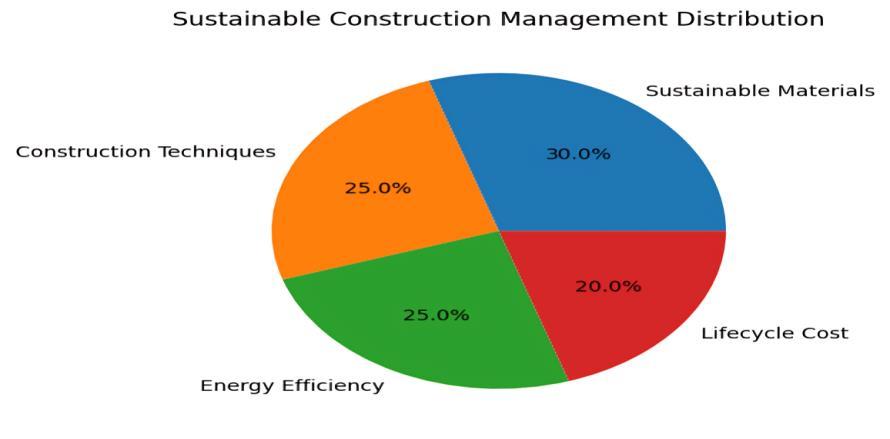
SustainableMaterials–30%
ConstructionTechniques–25%
EnergyEfficiency–25%
LifecycleCost–20%
CONCLUSION
Sustainable construction management is essential for addressingenvironmental,economic,andsocialchallengesin the construction industry by reducing impacts across a project’s lifecycle. The findings highlight that using sustainable materials lowers carbon emissions, conserves resources, and improves waste utilization, while efficient methods like prefabrication and recycling enhance productivityandminimizewaste.Energyefficiencythrough passive design and renewable systems further reduces environmentalimpact.Althoughinitialcostsarehigh,longterm savings in operation and maintenance make it economicallyviable.Adoptingacirculareconomyapproach supports material reuse and sustainability. However, challengessuchashighcosts,lackofexpertise,weakpolicies, andlimitedawarenesshinderitsimplementation,requiring stronger regulations, better training, and technological advancement.
1. Abera, Y. A. et al. (2024). Sustainable building materials: A comprehensive study on eco-friendly alternativesforconstruction
2. Kmetz, M. et al. (2023). Building decarbonization throughlifecycle-basedapproaches
3. Gaur,A.S.etal.(2022).Constructionanddemolition wasteutilizationinconcretepaverblocks
4. Lakshmi et al. (2024). Use of plastic waste and bottomashinpaverblockproduction.
5. Naik,B.G.etal.(2024).Wasteglassasfineaggregate inconstructionmaterials.
6. Qaidi, S. et al. (2023). Waste glass as eco-friendly aggregateinconcrete
7. Amran,M.etal.(2021).Flyash-basedeco-efficient concretereview
8. Pearlmutter,D.etal.(2020).Nature-basedsolutions forcirculareconomyinbuiltenvironment
9. Bheel, N. et al. (2022). Ternary cementitious materialsusingagriculturalwaste
10. Farrant,W.E.etal.(2022).Alternativewaste-based materialsinconcrete
11. Okoye,P.U.,Odesola,I.A.,Okolie,K.C.etal.(2022). Sustainable construction practices in building projects.
12. Trivedi,S.S.etal.(2023).Processingandtreatment ofconstructionanddemolitionwaste.
13. Ma, W. et al. (2023). Circular economy in constructionanddemolitionwastemanagement
14. Maderuelo-Sanz, R. et al. (2022). Lightweight constructionsystemsusingrecycledmaterials
15. Al Azari et al. (2024). Driving factors influencing sustainableconstructionadoption
16. Abdul-Aziz et al. (2023). Labour conditions and sustainabilityinconstructionsector
17. Oni,O.Z.etal.(2025).Sustainableconstructionand health&safetyintegration
18. Fufa, S. M., Flyen, C.,Flyen, A. C. (2021). Lifecyclebasedemissionreductioninbuildings.
19. Blue-GreenSystemsJournal.(2022).Nature-based solutionsinsustainableconstruction
20. Sustainable Chemistry and Pharmacy. (2023). Circulareconomyforconstructionwaste
21. Journal of Sustainable Construction Materials and Technologies. (2022). Sustainable construction practicesevaluation
22. IRJET (International Research Journal of Engineering and Technology). (2026). Review on SustainableConstructionManagement
23. Study on LDPE Modified Asphalt Mixes. (2024). Performanceofplastic-modifiedasphaltmaterials.
24. Study on Recycled Aggregates in Construction. (2023). Environmental benefits of recycled materials
25. Study on Bamboo as Structural Material. (2022). Mechanicalandsustainabilitypropertiesofbamboo
26. StudyonHempcreteApplications.(2023).Thermal andacousticinsulationperformance
27. StudyonGeopolymerConcrete.(2022).Low-carbon alternativestocement
28. StudyonPrefabricationTechniques.(2023).Impact onwastereductionandefficiency
29. StudyonEnergy-EfficientBuildingSystems.(2024). Role of HVAC, LED, and renewable systems in sustainability.