
International Research Journal of Engineering and Technology (IRJET) e-ISSN: 2395-0056
Volume: 13 Issue: 01 | Jan 2026 www.irjet.net p-ISSN: 2395-0072
International Research Journal of Engineering and Technology (IRJET) e-ISSN: 2395-0056
Volume: 13 Issue: 01 | Jan 2026 www.irjet.net p-ISSN: 2395-0072
Jyotsna Gawai1 ,Vaibhav Pawar2,Bhavika Bele3,Shantanu Bodele4,Pratik Kulte5
1Head f Dept , Dept of Electronics and Telecommunication, KDK College of Engineering, Maharashtra, India 2345UG student, Dept of Electronics and Telecommunication, KDK College of Engineering, Maharashtra, India
Abstract - The high rate of progress in electronic technologies and the subsequent shortening of the product lifecycleshasledtoanenormous riseintheelectronicwaste (e-waste), which causes a serious threat to the environment and human health. The proper e-waste management and segregation are thus very important in facilitating sustainable recovery of resources and proper disposal of the toxic elements. This review paper discusses the current ewaste management and segregation technologies comprising manual, semi-automated and fully automated systems with special consideration to how it works, its efficiencies, as well as its limitations. The review finds the major flaws in the existing methods to include high reliance on hand labor, low accuracy of segregation, safety, and poor flexibility to various types of e-waste. This paper will create an intelligent and automated solution to such challenges where a robotic hand-based segregation system is proposed. The proposed system incorporates the use of servo motors, sensors, and Raspberry Pi camera module to facilitate realtime identification and classification of electronic waste. The e-waste is classified into electronic components like printed circuit boards, sensors, processors, glass parts, hazardous metals, and non-metallic products by using advanced and improved deep learning algorithms or YOLOv8 and the use of TensorFlow-based models. The proposed solution is evaluated to increase the accuracy of segregation, operational safety, and decrease human interaction by integrating robotics with computer vision and machine learning. The present review creates a powerful framework in the future studies of intelligent ewaste management systems and emphasizes the potential of AI-based robotics in the attainment of sustainable and effectivee-wastesegregation.
Key Words: e-Waste, Electronic Waste Management, Recycling, Sustainability, Urban Mining, EPR, Circular Economy
The electronics industry has completely altered the modernlife,yetontheotherhandithascreatedoneofthe fastest growing wastes in the world which is called the electronic waste, or e-waste. E-waste is the discarded electrical and electronic equipment that contains a complex set of valuable materials including metals and reusablepartsinadditiontohazardousmaterialsthatare very dangerous to the environment and human health when not handled appropriately. Poor management and
disposalapproachesmayresultinthepollutionofthesoil, water, and air, and efficient management of e-waste has becomeaworldwideconcern.
Different e-waste management and segregation technologies have been created over the years starting with simple manual dismantling, and up to modern advanced technologies. Although manual processes are still common in most parts because of low startup expenses, they are labour-intensive, time conscious, and subject the workers to toxic substances. When processing efficiency has been enhanced due to automated and sensor-based systems, it is most of the time that these systems have a very high cost of implementation, restricted material recognition, and lacked flexibility in handling heterogeneous e-waste streams. These shortcomingsbringaboutthenecessityofsmart,dynamic, andeconomicalalternatives.
In this regard, the combination of robotics, computer visionandmachinelearningisanavenuetobefollowedin ordertodevelope-wastesegregation. Thepresent review paper critically evaluates the current technology to establishtheweaknessesandsuggestanewrobotichandbasede-wastesortingsystem.Thesystemutilizesthedeep learningalgorithmsincludingtheYOLOv8andTensorFlow to get precision in finding and classifying the electronic components with the assistance of Raspberry Pi camera module. The proposed solution will allow e-waste managementtobemoreefficient,safer,andsustainableby facilitatinganaccuratesortingofmaterialssuchasprinted circuit boards, sensors, processors, glass, hazardous metals,andnon-metals.
a) Abdullah et al. (2025) conducted a comprehensive bibliometric analysis on global e-waste management research from 2019–2025 using the Scopus database. The study identified major contributing countries, institutions, and emerging research themes such as metal recovery, policy frameworks, and AI-based solutions. However, the work remains descriptive in natureand does not evaluate the real-world effectiveness of identified technologies or policies. Thus, empirical validation of these trends is still lacking
b) Ruparel et al. (2024) proposed an AI-based smart bin systemusingdeeplearningmodels(VGG16andResNet50) for automatic classification of wet, dry, and electronic
International Research Journal of Engineering and Technology (IRJET) e-ISSN: 2395-0056
Volume: 13 Issue: 01 | Jan 2026 www.irjet.net p-ISSN: 2395-0072
waste. The system demonstrated high classification accuracy and showed potential for reducing human intervention in waste segregation. Nevertheless, the study islimitedtolaboratory-scaleimplementationanddoesnot address long-term deployment challenges or cost feasibilityinrealurbanenvironments
c) Raj (2025) analyzed the challenges and regulatory frameworkofe-wastemanagementinIndiawithafocuson policy implementation and Extended Producer Responsibility (EPR). The paper highlighted gaps in awareness, infrastructure, and enforcement of e-waste rules. However, it does not propose any technological or data-driven solutions, leaving scope for integrating smart systemsintopolicyexecution.
d) Das and Ghosh(2023) presented a detailed review and bibliometric trend analysis of global e-waste recycling practices, emphasizing heavy-metal recovery and circular economy approaches. The study identified China as the dominantcontributorandhighlightedinformalrecyclingas amajorenvironmentalconcern.Despiteitsbroadcoverage, the work lacks region-specific operational models that couldbridgeinformalandformalrecyclingsystems
e)Moretal.(2021)carriedoutanempiricalstudytoassess awareness levels of e-waste management among engineering students in India. The findings revealed low awareness despite increasing concern about environmental impacts, while EPR concepts showed growing acceptance. However, the study focuses only on awareness and does not link behavioral insights with practicalwastemanagementtechnologies
f)Gontakoetal.(2024) examined e-waste managementin urbanTanzaniafromapolicyandgovernanceperspective. Thestudyhighlightedthedominanceofinformalrecycling, weak regulatory frameworks, and limited private sector involvement. While strong policy recommendations were provided, the research does not explore the role of intelligent systems or automation in improving e-waste handlingefficiency
g) Oluwayomi et al. (2025) presented a systematic review on AI-powered sorting systems for improving e-waste recyclingefficiency.Thestudydiscussedmachinelearning, robotics, and computer vision as key tools for enhancing material recovery. Nevertheless, the review does not include experimental validation or case studies demonstratingreal-worlddeploymentchallenges
h) Quintoetal.(2025)reviewedglobal e-wastechallenges with emphasis on sustainable recycling technologies and circular economy integration. The paper highlighted emerging methods such as pyrolysis, bio-metallurgical processes, and AI-assisted recycling. However, it remains
largely conceptual and does not provide implementation frameworkssuitablefordevelopingeconomies.
i)Golpeoetal.(2025)proposedacirculareconomy–based framework for sustainable e-waste management in urban ManilabyintegratingsmarttechnologiessuchasAI-driven sortingandIoTmonitoring.Thestudycomparedreduction, reuse, and recycling practices among households, LGUs, HEIs, and transporters. Although a comprehensive framework was suggested, the work remains largely conceptual and lacks real-time system implementation or performancevalidation.
j)Baldéetal.(2024)presented The Global E-waste Monitor 2024,offeringthemostcomprehensiveglobaldatasetonewaste generation, collection, recycling rates, and policy adoption. The report highlighted that global e-waste generationisincreasing muchfaster than formal recycling capacity. However, the study focuses on macro-level statistics and does not provide localized technological or AI-basedoperationalsolutions
k) Nasiena et al. (2025) developed an automated waste classification system using YOLOv11 deep learning architecture to identify different waste categories with an accuracy of 94%. The model showed strong real-time detection capability and suitability for smart recycling systems.Still,thestudyreportedmisclassificationbetween visuallysimilar materials and did not address deployment challengesinlarge-scalemunicipalenvironments
l)Dasetal.(2024)investigatedtheapplicationofYOLOv11 for efficient waste segmentation in recycling facilities, demonstrating that AI-based automation can reduce manual sorting efforts. The results showed improved classification accuracy compared to traditional methods. However, the research does not integrate policy frameworks or economic feasibility analysis for long-term adoption.
m)Hermosillaetal.(2025)appliedAI-basedtechniquesfor environmental risk and waste-related infrastructure assessment, showing that machine learning can improve monitoring accuracy and reduce human error. Although the study validates AI effectiveness in environmental applications,itdoesnotdirectlyfocusonconsumer-levelewastesegregationorsmartrecyclingbins.
The review of existing e-waste management and segregation technologies highlights meaningful progress, butitalsoexposesseveralunresolvedchallengesthatlimit theirpracticaleffectiveness.Traditionalmanualandsemiautomated methods remain widely used, yet they are inefficient, unsafe, and highly dependent on skilled labor. Even modern automated systems, though capable of bulk
International Research Journal of Engineering and Technology (IRJET) e-ISSN: 2395-0056
Volume: 13 Issue: 01 | Jan 2026 www.irjet.net p-ISSN: 2395-0072
material separation, often fail to achieve accurate component-level segregation due to the complex and heterogeneous nature of electronic waste. As a result, valuable components such as printed circuit boards, processors, and sensors are frequently mixed with nonrecoverable or hazardous materials, reducing recycling efficiencyandincreasingenvironmentalrisk.
Recent research demonstrates growing interest in artificial intelligence and computer vision for e-waste identification. Deep learning models have shown strong performance in controlled environments; however, most studies focus primarily on classification accuracy rather than complete system implementation. There is a noticeablegapbetweenalgorithm-levelresearchandrealworld deployment, particularly in integrating intelligent perception with mechanical handling systems. Many existingsolutionslackadaptabilitytovariationsine-waste size,shape,orientation,andlightingconditions,whichare commoninpracticalrecyclingscenarios.
Furthermore, the majority of advanced segregation systems are costly and infrastructure-heavy, restricting their use to large-scale facilities. Limited attention has been given to developing low-cost, scalable, and modular systems suitable for decentralized recycling units. Affordable platforms such as Raspberry Pi and compact robotic mechanisms remain underutilized despite their potential to bridge this gap. In addition, current systems rarely address long-term adaptability, where models can be updated to recognize newly emerging electronic componentsandhazardousmaterials.
Theselimitationscollectivelyindicateaclearresearchgap in the development of an integrated, intelligent, and costeffective e-waste segregation system. There is a need for solutions that combine real-time computer vision, deep learningalgorithmssuchasYOLOv8andTensorFlow,and robotic manipulation to achieve precise component-level segregation.Addressingthisgapcansignificantlyimprove safety, efficiency, and sustainability in e-waste management, forming the basis for the proposed robotic hand-basedsegregationapproach.
The proposed e-waste segregation system follows a structuredandautomatedworkflowdesignedtominimize human intervention while improving accuracy and safety. Initially,electronicwasteis placedintothesystem,where basic pre-processing ensures proper positioning and readinessforanalysis.Animageacquisition moduleusing a Raspberry PiorESP32camera capturesreal-timevisual dataofthewasteitems.
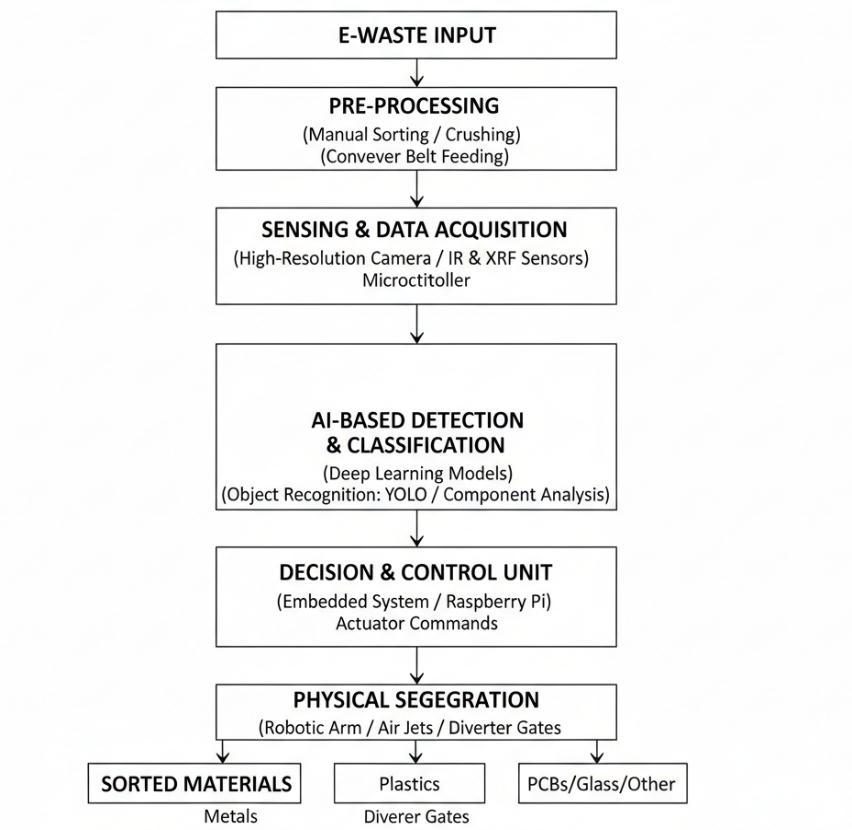
The captured images are processed using deep learning modelsdevelopedwithYOLOv8andTensorFlowtodetect and identify different electronic components. Based on visual features and learned patterns, the system classifies the detected items into predefined categories such as printed circuit boards, sensors, processors, glass components,hazardousmetals,andnon-metallicparts.
Onceclassificationiscompleted,controlsignalsaresentto the robotic control unit. Servo motors drive the robotic hand to pick and place the identified e-waste into the appropriate collection containers. This closed-loop workflow ensures efficient segregation, reduces exposure to hazardous materials, and enables scalable deployment in real-world recycling environments. The proposed methodology effectively integrates computer vision, machine learning, and robotics to address key limitations ofexistinge-wastemanagementsystems.
This review highlights that many existing e-waste management technologies, as reported by previous authors, suffer from critical limitations such as heavy reliance on manual labor, low segregation accuracy, high operational costs, and inadequate handling of hazardous components. Several automated systems are limited to bulkmaterialseparationandlacktheintelligencerequired for precise component-level classification. Additionally, manyAI-basedapproachesremainconfinedtotheoretical or laboratory studies, with minimal focus on real-time
International Research Journal of Engineering and Technology (IRJET) e-ISSN: 2395-0056
Volume: 13 Issue: 01 | Jan 2026 www.irjet.net p-ISSN: 2395-0072
deployment, mechanical integration, and cost-effective implementationforindustrialuse.
The proposed project addresses these challenges by integrating deep learning–based visual detection with a robotic hand–assisted segregation mechanism. By employing YOLOv8 and TensorFlow for real-time componentidentificationandcombiningthemwithservodriven actuation, the system overcomes issues of misclassification, worker safety, and operational inefficiency observed in earlier technologies. The use of affordable hardware platforms further enhances scalabilityandadaptability,makingthesystemsuitablefor bothcentralizedanddecentralizedrecyclingfacilities.
Overall, this approach presents a practical and intelligent solution for modern e-waste segregation. Its ability to accurately separate hazardous and non-hazardous components with minimal human intervention makes it highly relevant for industrial-scale deployment. The proposed system contributes toward safer recycling practices, improved resource recovery, and sustainable global e-waste management, aligning with the growing need for environmentally responsible technological solutions.
[1] Abdullah, M., et al., “E-Waste Management: A Bibliometric Analysis from 2019 to 2025,” Recycling, vol.10,no.1,pp.1–20,2025.
[2] Ruparel, P., et al., “Smart Waste Management System Using AI-Based Deep Learning Models,” International Research Journal of Advanced Engineering and Science, vol.10,no.1,pp.448–453,2025.
[3] Raj,A.,“E-WasteManagementinIndia:Challengesand Policy Framework,” World Journal of Environmental Engineering,vol.9,no.1,pp.1–7,2025.
[4] Das, A., and Ghosh, S., “Global Trends in E-Waste Recycling: A Bibliometric Review,” Recycling, vol. 10, no.2,pp.72–89,2023.
[5] Mor,R.S.,etal.,“AssessmentofAwarenessonE-Waste Management among Engineering Students in India,” International Journal of Natural Resources and Development,vol.11,no.2,pp.55–63,2021.
[6] Gontako, K., et al., “E-Waste Management Practices and Policy Challenges in Urban Tanzania,” Journal of Environmental Sustainability, vol. 7, no. 3, pp. 101–115,2024.
[7] Quinto, J. R., et al., “Current Recycling Innovations to UtilizeE-WasteforSustainableDevelopment,” Journal ofCleanerProduction,vol.340,pp.130–145,2021.
[8] Mor, R. S., et al., “Extended Producer Responsibility and Sustainable E-Waste Management,” International Journal of Research and Analytical Reviews, vol. 8, no. 3,pp.112–120,2021.
[9] Prajwal, S., Hosmani, S., Chigoni, R. B., and Kumar, S., “Automatic Waste Sorting System,” Journal of Emerging Technologies and Innovative Research (JETIR),vol.12,no.1,pp.e282–e288,2025.
[10] Baldé, C. P., et al., The Global E-Waste Monitor 2024, United Nations University (UNU), Bonn, Germany, 2024.
[11] Golpeo,J.M.,Andres,G.L.,Faronal,I.N.,andCasuat,C. D., “Sustainable E-Waste Management Through a Circular Economy Framework: Integrating Smart Technologies for Resource Recovery in Urban Environments,” E3S Web of Conferences, vol. 643, pp. 01005,2025.
[12] Nasiena, D., Adiya, M. H., Farkhan, M., Rahmadhani, U. S., and Samah, A. A., “Automated Waste Classification Using YOLOv11: A Deep Learning Approach for SustainableRecycling,” Journal of Applied Business and Technology,vol.6,no.1,pp.68–74,2025.
[13] Das, A., Sayma, J., Barman, A. N., and Hasan, K. A., “Application of YOLOv11 for Efficient Waste SegmentationinRecyclingFacilities,” Situations,vol.7, pp.1–9,2024.
[14] Hermosilla, G., et al., “AI-Based Environmental Risk Assessment for Waste Infrastructure Monitoring,” IEEEAccess,vol.13,pp.14453–14470,2025.