
International Research Journal of Engineering and Technology (IRJET) e-ISSN: 2395-0056
Volume: 12 Issue: 01 | Jan 2025 www.irjet.net p-ISSN: 2395-0072
International Research Journal of Engineering and Technology (IRJET) e-ISSN: 2395-0056
Volume: 12 Issue: 01 | Jan 2025 www.irjet.net p-ISSN: 2395-0072
Miss. Ratika R. Jangamwar1 , Prof. Anurag Gahalod2
1Student, Dept. of Environmental Science & Engineering, G.H. Raisoni University Amravati, India
2Professor, Dept. of Environmental Science & Engineering, G.H. Raisoni University Amravati, India
Abstract - Thequalityofdrinkingwaterisacriticalfactor for public health and environmental sustainability. This research focuses on the comprehensive assessment of drinking water quality using various physical, chemical, and biological parameters. Physical tests, including color, temperature, and pH, provide fundamental insights into the water's appearance and acidity/alkalinity, serving as preliminary indicators of quality. Chemical tests, such as TotalDissolvedSolids(TDS),ElectricalConductivity(EC),and Chemical Oxygen Demand (COD), evaluate the presence of dissolved ions, the water's conductivity, and the concentration of organic and inorganic pollutants. Additionally, biological tests, specifically Biochemical Oxygen Demand (BOD), measure the oxygen required for microbial degradation of organic matter, indicating the biological contamination level. By integrating these parameters, this study aims to give test procedure, description, significance andmeasurementforthedrinkingwaterqualityassessment.
Key Words: Drinking water distribution system, Chlorination, Biochemical Oxygen Demand, Chemical Oxygen Demand, Total Dissolved Solids, Intermittent water supply.
In many countries, poorly located latrines and septictanksareasignificantsourceofwatercontamination, particularlyaffecting wells. Local industriesalsocontribute to water pollution, especially when chemicals are handled ordisposedofimproperly.Nutrientrun-offorleachinginto slow-moving or stagnant surface waters can lead to excessivegrowthofcyanobacteria(blue-greenalgae).Many species of cyanobacteria produce nuisance chemicals that affect water taste, odor, and treatment processes. More concerning is their ability to produce toxins, which pose serious health risks, especially when water treatment is minimalorinadequate.
Improper water treatment can also introduce contaminants. For instance, residues of chemicals used during treatment may persist, causing sediment accumulation in water pipes. Contamination can occur during water distribution due to materials like iron, which can corrode and release iron oxides, or from external
pollutants entering the system. Additionally, diffusion through plastic pipes is possible, such as when spilled oil seepsintosurroundingsoil,leadingtotasteandodorissues. Plumbing materials in consumer premises, like lead or copper, can also leach into the water, while improper connections may result in back-flow contamination. These contaminantscanbechemicalormicrobiologicalinnature.
Public water supply treatment systems employ multiple barriers in a "treatment train" designed to meet specific supply needs and address the vulnerability of the source. Common processes include coagulation, flocculation, filtration, and oxidation. Chlorine is the most widely used oxidative disinfectant, offering an effective barrier against pathogens while leaving a measurable residual that indicates proper disinfection and acts as a preservativeinthedistributionsystem.
The role of public water suppliers in identifying and monitoring drinking water contaminants in selected developedcountries waspresentedasa potential guideline fordevelopingcountries.Thispaperreviewemphasisedthe need for a comprehensive understanding of water quality and its impacts on human health to ensure access to clean drinkingwaterworldwide[1].
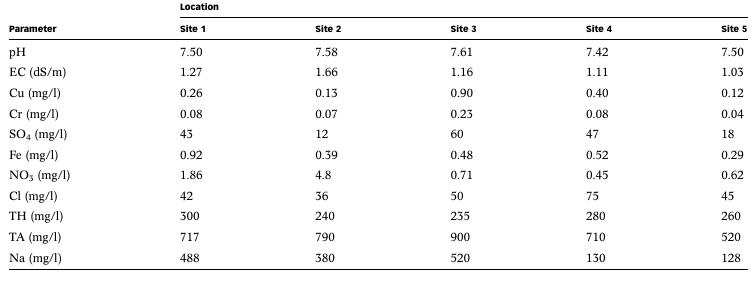
The parameters of pH, Electrical Conductivity (EC), Copper (Cu), Chromium (Cr), Sulphate (SO4), Iron (Fe), Nitrate (NO3), Chloride (Cl), Total Hardness (TH), Total Alkalinity (TA), and Sodium (Na) were analyzed to estimate the groundwater quality. The water quality index (WQI) has been applied to categorize the water quality, whichis quite usefultoinferthequalityofwaterforthepeopleandpolicy makersintheconcernedarea[2].
International Research Journal of Engineering and Technology (IRJET) e-ISSN: 2395-0056
Volume: 12 Issue: 01 | Jan 2025 www.irjet.net p-ISSN: 2395-0072
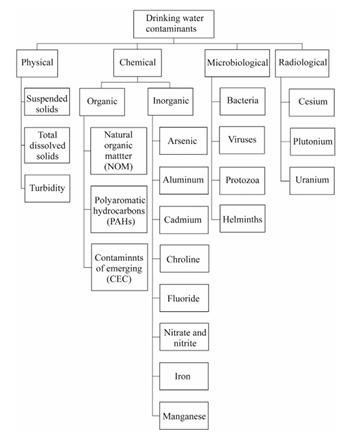
Fig 1-Majorcontaminantsindrinkingwater.[1]
Assessment of water quality was carried out on 114 samples. Questionnaires were used to determine the community’s practices of water transportation from source to the point-of-use and storage activities. Many of the households reported constant water supply interruptions and the majority (92.2%) do not treat their water before use.WhileE.coliandtotalcoliformwerenotdetectedinthe water samples at source (dam), most of the samples from the street taps and at the point of use (household storage containers)werefoundtobecontaminatedwithhighlevels ofE.coliandtotalcoliform.[3]
Table 1-Physico-chemicalpropertiesofwatersamples.[2]
The quality of water samples was also assessed by measuring the color, odor, temperature, pH, electrical conductivity (EC), biological oxygen demand (BOD), dissolved oxygen (DO), total dissolved solids/ salts (TDS)
and hardness. For the estimation of the emerging contaminants (Endosulphan (ES) and Hexachlorohexane (HCH)) in the water samples, an extraction procedure was carried out by dispersive liquid-liquid extraction method followed by analysis using gas chromatography-mass spectrometry (GC-MS). The levels of ES and HCH obtained were compared with the drinking water standards of the BureauofIndianStandards(IS:10500).
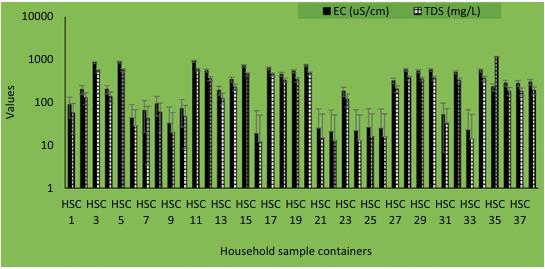
Fig 2-ECandTDSlevelsforhouseholdstoragecontainer samples[3]
The levels of HCH and ES in all the water samples tested werefoundtobebelowthedetectionlimit.[4]
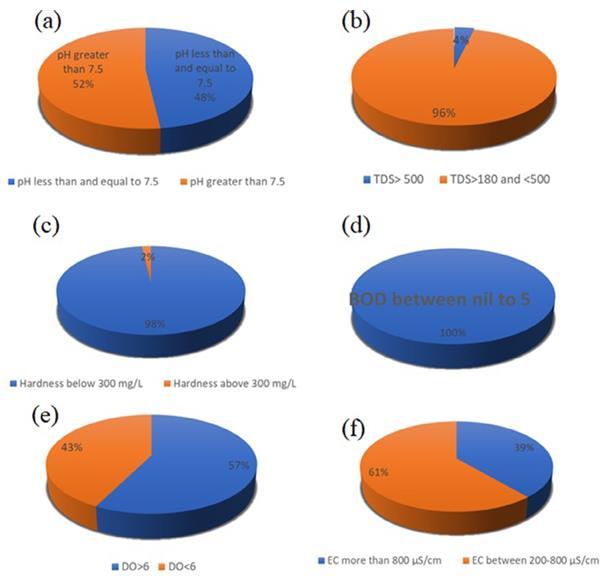
Fig 3- Percentageofthesampleshavingdifferent(a)pH(b) TDS(c)Hardness(d)BOD(e)DOand(f)ECvalues.[4]
To assess the quality of drinking water following basic test are necessary to check the quality of water and the effectiveness of the treatment procedure. This paper presents the brief description the tests procedure for
© 2025, IRJET | Impact Factor value: 8.315 | ISO 9001:2008 Certified Journal | Page630
International Research Journal of Engineering and Technology (IRJET) e-ISSN: 2395-0056
Volume: 12 Issue: 01 | Jan 2025 www.irjet.net p-ISSN: 2395-0072
Physical test (Color, Temperature, pH) chemical tests (TDS, ElectricalConductivity(EC),COD))biologicaltests(BOD).
3.1.1 Description: Pure water iscolorless,butcolorin drinking water can occur due to dissolved organic matter,metals,orindustrialcontaminants.
3.1.2 Significance: While color itself is not necessarily harmful, noticeable coloration can indicate contamination and affect the aesthetic quality of water. It may also be indicative of the presence of organicmaterialsoriron,whichcanaffecttasteand odor.
3.1.3 Measurement: Color is typically measured in true colorunits(TCU) throughspectrophotometric methods.
3.2.1 Description: pH measures the hydrogen ion concentration in water and reflects its acidity or alkalinity.ThepHscalerangesfrom0to14,with7 beingneutral.
3.2.2 Significance: For drinking water, a pH range of 6.5–8.5isgenerallyacceptable.AlowerpHcanlead to corrosion of pipes, releasing metals like lead or copper intothe water, while a higher pHcan cause scale buildup. Both conditions can have health implicationsandaffectthetasteandappearanceof water.
3.2.3 Measurement: pHismeasuredusingapHmeter orpHindicator.
ThepHofwaterisdeterminedtounderstanditsacidity oralkalinity,whichisimportantforassessingwaterquality. pH is measured on a scale of 0 to 14, with 7 being neutral, valuesbelow7beingacidic,andabove7beingalkaline.
Herearethe proceduresto determine the pH of water usingdifferentmethods:
3.2.A Method 1 Using a pH Meter (Recommended for Accuracy)
MaterialsRequired
pHmeter
Distilledwater(forrinsing)
Buffersolutions(pH4,7,and10)forcalibration
Samplewater
StepbystepProcedure:
i.Calibration of the pH Meter
o TurnonthepHmeterandallowittostabilize.
o Calibratethemeterusingstandardbuffersolutions. First, immerse the electrode in a pH 7 buffer solutionandadjustthemetertoreadexactly7.0.
o Rinse the electrode with distilled water, then immerse it in a pH 4 or pH 10 buffer solution, depending on the expected pHrangeof your water sample,andadjustthemeteraccordingly.
o Repeat the process to ensure accurate calibration acrossthepHscale.
ii. Measuring pH of the Water Sample
o Rinse the electrode with distilled water and then immerseitinthewatersample.
o Stir gently and wait for the reading to stabilize. RecordthepHvaluedisplayedonthemeter.
iii. Cleaning Up
o Rinse the electrode with distilled water after each measurementtopreventcontamination.
3.2.B Method 2: Using pH Paper (Less Accurate but Simple)
MaterialsRequired
pHpaperorpHteststrips
Distilledwater(forrinsing)
Samplewater
Step-by-StepProcedure
i. Testing the Sample
o Dip a strip of pH paper into the water sample and immediatelyremoveit.
o ComparethecoloronthepHpaper withthecolorchart provided with the pH paper kit to determine the approximatepH.
3.2.C Method 3: Using a Colorimetric pH Indicator (for Field Testing)
MaterialsRequired
ColorimetricpHindicatorsolution
Cleartesttubeorsmallcontainer
Distilledwater(forrinsing)
Samplewater
Step-by-StepProcedure
i. Testing the Sample
o Add a few drops of the pH indicatorsolution to a small amount of the water sample in a clear test tube.
International Research Journal of Engineering and Technology (IRJET) e-ISSN: 2395-0056
Volume: 12 Issue: 01 | Jan 2025 www.irjet.net p-ISSN: 2395-0072
o Comparetheresultingcolorwithaprovidedcolor charttoestimatethepHofthesample.
3.1.1 Description: The temperature of water is a measure ofitsthermalenergyandisanimportantphysicalproperty that influences its chemical and biological characteristics. Water temperaturecan impact solubility, chemical reaction rates,andthehealthofaquaticecosystems.Innaturalwater bodies, temperature is typically affected by seasonal climate, geographic location, and water depth, while in industrial or urban water sources, temperature may be influencedbythermaldischargesfromindustrialprocesses.
1. Thermometers: Water temperature can be measured using a thermometer, typically with a waterproof casing, for direct and immediate readings. Common types include digital thermometers, mercury thermometers, and alcohol-basedthermometers.
2. Temperature Probes: In more advanced monitoring setups, temperature probes are used. These probes provide continuous temperature readingsandcanbelinkedtodataloggersforrealtime monitoring in water treatment facilities, naturalwaterbodies,orlaboratoryenvironments.
3. Infrared Thermometers: For surface temperature measurements, infrared thermometers can be used, though they are less accurate for bulk water temperature readings. They are particularly useful in industrial applicationsorwheredirectcontactisdifficult.
i. Description: BOD measures the amount of oxygen required by bacteria to decompose organic matter inwater.
ii. Significance: High BOD levels indicate organic pollutionandcanleadtooxygendepletion,making the water unsuitable for aquatic life. In drinking water, low BOD is preferable as it suggests less organiccontamination.
iii. Measurement: BOD is measured by determining the oxygen levels before and after a set incubation period (typically five days) at a controlled temperature.
BOD bottles (usually 300 mL capacity, glassstoppered)
Dissolved Oxygen (DO) meter or Winkler titration setup
Incubatorsetto20°C
Water sample (preferably collected in a way that minimizesoxygenexposure)
Phosphate buffer, magnesium sulfate, calcium chloride, and ferric chloride solutions for dilution water
Distilledwater(fordilution)
Step-by-StepProcedure
1. Sample Preparation
Sample Collection: Collect the water sample in a clean container, keeping it airtight to avoid oxygen exposure.
Dilution (if necessary): If the sample has a high organic load, dilute it with distilled water containing the appropriate buffer and nutrient solutions to ensure optimal microbial activity without depleting all oxygen. Commonly used dilution factors are 1:5, 1:10, or 1:100, depending onanticipatedBODlevels.
2 Initial DO Measurement (Day 0)
Fill a BOD bottle with the prepared sample, ensuring no air bubbles are trapped, as this can affectresults.
Measure and record the initial DO concentration usingaDOmeterorbyWinklertitration.
Foraccuracy,takeduplicatemeasurements.
3. Incubation
PlacetheBODbottleinanincubatorsetat20°C.
Incubate the sample for 5 days in the dark to prevent photosynthesis (which would produce oxygenandinterferewiththeresults)
Ifneeded,seal the bottle capwithtape or parafilm topreventoxygenfromdiffusingintothesample.
4. Final DO Measurement (Day 5)
After 5 days, remove the bottle from the incubator andmeasuretheDOconcentrationagain.
International Research Journal of Engineering and Technology (IRJET) e-ISSN: 2395-0056
Volume: 12 Issue: 01 | Jan 2025 www.irjet.net p-ISSN: 2395-0072
RecordthisvalueasthefinalDO. BOD(mg/L)=(DOinitial –DOfinal)XDilutionFactor
i. Description: COD represents the amount of oxygen needed to chemically oxidize organic and inorganic compounds in water. It is a critical parameter for assessing water pollution, as higher COD levels often indicate a high concentration of oxidizable pollutants, which can be organic matter orcertaininorganicchemicals.
ii. Significance: COD is essential for understanding theorganicpollutionloadinwater,asitreflectsthe presence of contaminants that could impact water quality and the ecosystem. In drinking water sources,lowCODvaluesareideal,ashighCODmay correlate with harmful substances that compromisewaterqualityandtreatmentefficacy.
iii. Measurement:CODismeasuredinmilligramsper liter (mg/L) using chemical titration or photometric methods. A common procedure involves adding potassium dichromate as a strong oxidizing agent to the sample in an acidic solution, followed by a reaction in a heating block. The amountofoxygenconsumedinthisreactionisthen calculatedtodeterminetheCODlevel.
The Chemical Oxygen Demand (COD) is a measure of the amountofoxygenrequiredtooxidizeorganicandinorganic matter in a water sample. The following steps summarize themethodfordeterminingCOD:
1. Preparation:
o Collectawatersample.
o Useaknownvolumeofthesample(e.g.,10 mL).
2. Digestion:
o Add a strong oxidizing agent, such as potassium dichromate(K₂Cr₂O₇),inanacidicmedium(using sulfuricacid).
o Add a catalyst, like silver sulfate, to aid the oxidationofcertaincompounds.
o Heatthe mixture in a reflux apparatus fora fixed duration(usually2hours).
3. Titration:
o Afterdigestion,coolthemixtureanddiluteit.
o Addanindicator(e.g.,ferroin).
o Titratetheremainingpotassiumdichromatewith ferrous ammonium sulfate (FAS) until a color changeisobserved
4. Calculation:
o Use the volume of FAS consumed to determine theamountofdichromatereduced.
o CalculateCODin mg/L O₂ usingtheformula:
i. Description: TDS refers to the concentration of dissolved substances in water, including minerals, salts,andorganiccompounds.Itreflectsthesumof all ions present, giving a sense of the mineral and chemicalcompositionofthewater.
ii. Significance:TDS impacts taste, water hardness, andpotentialcorrosiveness.Indrinkingwater,high TDS levels may contribute to a salty or metallic taste and can lead to scaling in plumbing and appliances. TDS also affects water's suitability for industrial, agricultural, and personal uses, as very highlevelscanbeundesirableorevenunsafe.
iii. Measurement: TDS is commonly measured in mg/Lorpartspermillion(ppm)usingaTDSmeter, which indirectly measures the electrical conductivity of the water and then calculates an approximate TDS value. Alternatively, gravimetric methods can be used in laboratory settings, which involve evaporating the water and weighing the remainingresiduetocalculateTDS.
3.6.A Method 1: Using a TDS Meter (Quick and Accurate)
MaterialsRequired
TDS meter (or conductivity meter with TDS conversionfeature)
Distilledwater(forrinsing)
Samplewater
Step-by-StepProcedure
1. CalibrationofTDSMeter
o Calibrate the TDS meter with a standard TDS solution as per the manufacturer's instructions.
2. MeasuringTDSintheSample
o Rinse the electrode with distilled water andshakeoffanyexcess.
o Insert the TDS meter into the water sample, ensuring the sensor is fully submerged.
International Research Journal of Engineering and Technology (IRJET) e-ISSN: 2395-0056
Volume: 12 Issue: 01 | Jan 2025 www.irjet.net p-ISSN: 2395-0072
o Allow the reading to stabilize, then record the TDS value displayed on the meter, typicallygiveninmg/L(orppm).
3. CleaningUp
o Rinse the electrode with distilled water aftereachuse.
i. Description: Electrical conductivity is a measure of water’s ability to conduct electric current, which is directly related to the concentration of dissolved ions.
ii. Significance: High conductivity in drinking water can indicate the presence of dissolved salts, which mayaffecttasteandcanbeharmfultoindividualson low-sodiumdiets.Conductivityisalsoanindicatorof overall water quality, as higher conductivity may signifycontamination.
iii. Measurement: Conductivity is measured in microsiemens per centimeter (µS/cm) using a conductivitymeter.
The assessment of drinking water quality through various physical,chemical,andbiologicalparametersisessentialfor ensuring its safety and suitability for consumption. This studyreviewedkeytestssuchasphysicalparameters(color, temperature, pH), chemical tests (TDS, electrical conductivity, COD), and biological tests (BOD), providing a comprehensive understanding of their test procedures, significance, measurement techniques, and applications. Each parameter offers valuable insights into different aspects of water quality, helping to identify potential contaminants and assess the overall health risk. By employing a combination of these tests, water quality can be effectively monitored, ensuring that drinking water meets the required safety standards. The continued use of these assessment methods, along with advancements in water treatment technologies, will play a crucial role in maintaining safe drinking water and protecting public health.
[1] Ahsan Shah, Arun Arjunan, Ahmad Baroutaji , Julia Zakharova- A review of physicochemical and biological contaminants in drinking water and their impacts on human health Water Science and Engineering 2023, 16(4):333E344
[2] Sudesh Bhaskar Ghoderao, Sarita Gajbhiye Meshram and Chandrashekhar Meshram -Development and evaluation of a water quality index for groundwater qualityassessmentin parts ofJabalpurDistrict,Madhya Pradesh, India. Water Supply Vol 22 No 6, 6002 doi: 10.2166/ws.2022.174
[3] N. Luvhimbi , T.G.Tshitangano , J.T. Mabunda , F. C. Olaniyi & J. N. Edokpay- Water quality assessment and evaluation of human health risk of drinking water from source to point of use at Thulamela municipality, Limpopo Province scientific Reports | (2022) 12:6059 | https://doi.org/10.1038/s41598-022-10092-4
[4] Devika Vashisht, Amit Kumar, Surinder Kumar Mehtaa, Alex Ibhadon- Analysis of emerging contaminants: A case study of the underground and drinking water samplesinChandigarh,IndiaEnvironmentalAdvances1 (2020) 100002