
International Research Journal of Engineering and Technology (IRJET) e-ISSN: 2395-0056
Volume: 13 Issue: 01 | Jan 2026 www.irjet.net p-ISSN: 2395-0072
International Research Journal of Engineering and Technology (IRJET) e-ISSN: 2395-0056
Volume: 13 Issue: 01 | Jan 2026 www.irjet.net p-ISSN: 2395-0072
Ashwini Anil Farkade1, Dr. Kiran B. Sangve2
Assistant Professor, Department of Zoology, M.B. Patel College of Arts, Commerce and Science, Deori, Maharashtra, India
Professor& Head, Department of Zoology, Brijlal Biyani Science College, Amravati, Maharashtra, India
Abstract - Phytoremediation is a developing clean up technology that employs plants to break down, remove, stabilize, or isolate pollutants in contaminated soil and water. It has gained attention as an innovative and cost-effective alternative to conventional hazardous waste treatment methods. Phytoremediation uses plants to clean contaminated soil and water and is being promoted by the EPA as a cost-effective, innovative approach to hazardous waste site remediation. It has recently gained recognition as an innovative and economical alternative to traditional cleanup techniques used at hazardous waste sites. The U.S. Environmental Protection Agency (EPA) aims to safeguard human health and the environment while supporting the development and use of innovative technologies like phytoremediation to improve site cleanup efforts. Plants possess natural characteristics that make them well suited for cleaning contaminated soils. Their root systems provide a large surface area that allows efficient absorption and accumulation of water and nutrients needed for growth. Plants also have advanced metabolic and uptake mechanisms, along with transport systems capable of selectively absorbing various ions from the soil.
Key words – Soil contamination, heavy metals, trace elements, phytoextraction, hyperaccumulator, toxicity, lead, cadmium, mercury, biomass, etc
Soil contaminationisa majorenvironmental issueresultingfromthespreadofindustrial andurban wastesproducedby anthropogenicactivities.Bothregulatedandunregulatedwastedisposal,accidentalspills,industrialprocesses,miningand smeltingofmetalores,andtheapplicationofsewagesludgetofarmlandallowcontaminantstospreadtopreviouslyclean areasthroughdustorleaching,therebypollutingtheecosystem.Soilpollutioniscausedbyawidevarietyofinorganicand organic substances, including heavy metals, flammable and decomposable materials, hazardous wastes, explosives, and petroleumproducts.Amonginorganicpollutants,heavymetalsarethemostsignificantcontributors.Soilmicroorganisms are capable of breaking down organic pollutants, whereas metals must be immobilized or physically removed from the soil. (Adriano D. C., 1986) Although many metals are necessary for biological functions, they become toxic at elevated concentrations by inducing oxidative stress through the formation of free radicals. Metals can also exert toxicity by displacing essential elements in pigments or enzymes, thereby interfering with their normal function. As a result, metal contaminationmakeslandunsuitableforplantgrowthandleadstoalossofbiodiversity.(Alloway,B.J.,1990).Theuseof phytoremediation is key to achieving sustainable development. Plant based methods provide a low-cost method of land remediationandarethebeststrategyforfutureuse(Misraet.,al.2019).
Overtime,plantshavedevelopeddiversegeneticadaptationsthatenablethemtotoleratepotentiallytoxicconcentrations ofmetalsandotherpollutants.Whilemostmetal-tolerantplantslimittheuptakeofharmfulmetals,certainspeciesknown as hyperaccumulators can absorb and withstand high levels of toxic metals and other ions, sometimes reaching several percent of their dry weight. In addition, plant roots release various substances that modify the soil environment by supplying nutrients and energy to microorganisms or by forming stable metal complexes. The root zone supports increasedmicrobialactivity,whichcanfurtheraidinthebreakdownofcontaminantsinsoil.(HenryJ.R.,2000)
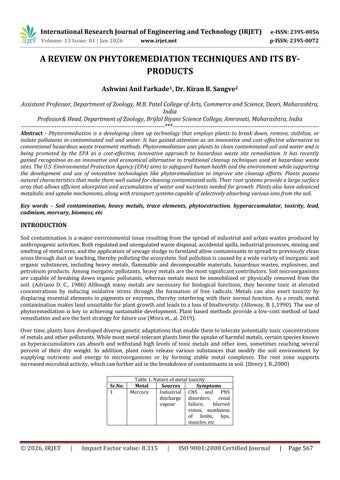
Table1 Natureofmetaltoxicity
Sr.No. Metal Sources Symptoms 1 Mercury Industrial discharge vapour CNS and PNS disorders, renal failure, blurred vision, numbness of limbs, lips, muscles,etc
Volume: 13 Issue: 01 | Jan 2026 www.irjet.net
The term phytoremediation encompasses a range of plant-based technologies that utilize higher plants to remediate contaminated ecosystems, including rhizofiltration, phyto extraction, phyto volatilization, phytodegradation and phytostabilization.
Phyto extraction, also known as phyto accumulation, involves the uptake of contaminants from soil or water and their subsequent translocation to the aerial parts of plants, including shoots, stems, and leaves (Ghori et al., 2016; Iqbal et al., 2015). This technique relies on the efficient absorption of contaminants by plant roots and their accumulation in harvestable aboveground tissues (Brennan & Shelley, 1999). Effective translocation requires specific conditions, such as the presence of contaminants particularly metals in soluble forms that facilitate uptake. Once absorbed, these metals arechelatedwithintheplantandtransportedtoaerialtissuesforaccumulation(Guptaetal.,2016).
Phyto stabilization involves the immobilization of heavy metals in soil and water through their adsorption and accumulation within the plant rhizosphere or root zone (Pinto et al., 2015). This technique reduces the bioavailability of contaminantsbypromotingtheirprecipitationandstabilizationusingvariousorganicandinorganicamendments,suchas biosolids,compostedmanure,flyash,NPKfertilizers,limestone,dolomite,andred mud(Radziemskaetal.,2017).Unlike phyto extraction, phyto stabilization limits contaminant mobility, thereby preventing their accumulation in plant tissues and reducing leaching into deeper soil layers or groundwater. However, this approach primarily isolates contaminants within the soil–root interface and does not provide a permanent solution for the complete removal of pollutants from contaminatedenvironments(Vangronsveldetal.,2009).
Rhizo filtration isdefinedastheuseofterrestrialoraquaticplantstoabsorb,concentrate,andprecipitatecontaminants frompollutedaqueous environments,particularlythosewithlowcontaminantconcentrations,withintheir root systems. Thistechniqueiseffectiveforthepartialtreatmentofindustrialeffluents,agriculturalrunoff,andacidminedrainage,and is commonly applied for the removal of metals such as lead, cadmium, copper, nickel, zinc, and chromium, which are predominantlyretainedinplantroots.(Chaudharyet.al.,1998)Rhizofiltrationisconceptuallysimilartophyto extraction; however, it employs plants grown in constructed wetlands or hydroponic systems for contaminant remediation (Horne, 2000). In such systems, artificial growth media, such as vermiculite–sand mixtures, are used to support plant development. The plants function as hydraulic barriers, facilitating the removal of contaminants from groundwater and surfacewaterbypromotingupwardwaterflow,duringwhichpollutantsareabsorbedintoroottissuesandsubsequently
International Research Journal of Engineering and Technology (IRJET) e-ISSN: 2395-0056
Volume: 13 Issue: 01 | Jan 2026 www.irjet.net p-ISSN: 2395-0072
concentrated and precipitated (Roy et al., 2015). Plant species with extensive fibrous root systems and abundant root hairs, providing a high surface area, are particularly effective for rhizo filtration (Tomé et al., 2008). This technique is widely applied for the treatment of groundwater and wastewater contaminated with heavy metals and radionuclides, includingradium(Ra),uranium(U),andcesium(Cs)(Toméetal.,2008;Mikheevetal.,2017;Yangetal.,2015)
Table 2. Phytoremediation includes the following processes and mechanismsofcontaminantremoval
Sr no Process Mechanism Contaminant
1 Rhizofiltration Rhizosphere accumulation Organics/Inorganics
2 Phytostabilisation Complexation Inorganics
3 Phytoextraction Hyperaccumulation Inorganics
4 Phytovolatilization Volatilisation byleaves Organics/Inorganics
5 Phytotransformation Degradation inplant Organics
Phytovolatilization,alsoreferredtoasanevapotranspiration-basedmechanism,isprimarilyutilizedfortheremediation of contaminants such as mercury (Hg), selenium (Se), and certain organic solvents (Karami & Sumsuddin, 2010). In this process,contaminantsaretakenupfromthesoilandsubsequentlyvolatilizedeitherdirectlyfromaerialplantparts,such asstemsandleaves,orindirectlyfromtherootzone.Withintheplant,thesecontaminantsaretransformedintolesstoxic volatile forms and are then released into the atmosphere through stomatal transpiration, thereby reducing their overall toxicityandenvironmentalimpact(Limmer&Burken,2016;Rascio&Navari-Izzo,2011).
Phytodegradation, also known as phytotransformation, refers to the breakdown of pollutants through metabolic processes mediated by plants. In this process, contaminants are absorbed by specific plant species and subsequently degraded by enzymes such as dehydrogenases, oxygenises, and reductases, along with the involvement of inorganic nutrients(Vishnoi&Srivastava,2008;Zayed&Terry,2003).Phyto degradationoccurswithinplantrootand shootscells via enzymatic metabolic pathways that enhance degradation rates, resulting in the transformation of contaminants into smaller, less toxic compounds. Consequently, this mechanism reduces pollutant toxicity and supports plant growth in contaminatedenvironments(Raoetal.,2014).
Phytoremediationincludesseveraldistinctmechanisms,whichareoutlinedbelow.Definingthesemechanismsisessential forunderstandingthe range of processes mediated byvegetation,the fate and transport of contaminants, thelocationat which remediation occurs, and the management strategies required to achieve effective remediation outcomes. Different phytoremediationprocessesmaybeapplicabletospecifictypesofcontaminantsorcontaminatedmediaandoftenrequire theselectionofappropriateplantspeciessuitedtotheparticularremediationobjective.
Table4.Examplesofhyperaccumulatorsandrecommendedphytoremediationmethods
Sr. No. Plant species
1 Alyssum murale, Thalaspi spp., Berkheya codil Ni Phytoextraction Bani et., al, Skuza et., al (2010,2018,2022)
2 Brassica oleracea Tl Phytoextraction Al-Najar et., al, 2005, Kidd et., al,2009
3 Arabidopsis halleri Cd,Zn,Ni Phytoextraction Skuza et., al 2022, Corso et., al 2021,Huanget.,al2011
4 Azollapinnata, Thalaspi caerulescenace Cd,Zn,Ni Cu Phytoextraction Rhizofiltration Rai et., al 2008, Talebi et., al, 2009, Kumar et., al,2020, Padmavathiamma et.,al,2007
5 Brassica juncea, Pb,Cd,Cu, Rhizofiltration Skuza et., al 2022 Yadav et., al
International Research Journal of Engineering and Technology (IRJET) e-ISSN: 2395-0056
Volume: 13 Issue: 01 | Jan 2026 www.irjet.net p-ISSN: 2395-0072
Minuartia verna Ni,Zn,Cr 2022
6 Betula occidentalis, Agrostis tenuis Pb
7 Eleocharis acicularis, Pteris rittate
Cu,Cd,Zn, As,Pb
8 Euphorbia sp., Ipomea alpine Cu,As,Cd, Pb,Zn
9 Thlaspica erulescens Cd Zn
10 Tagetes minuta As,Pb
Rhizofiltration Koptsiket.,al2014
Phytoextraction
Phytostabilization
Phytoextraction Rhizofiltration
Ernst, W.H.O. 2005, Nurfitri 2017
Skuza et., al 2022, Conesa et., al 2006,SilvaGonzagaet.,al2006
Skuza et., al 2022 Yadav et., al 2022
Phytoextraction Miranda Pazcel et.,al, 2018, Salazaret.,al2014
Phytoremediation derives from the Greek term phyton (plant) and the Latin verb remediare (Raskin et., el 1994). This approachreliesontheabilityofcertain plantspeciestoestablishandsurviveincontaminatedenvironments,wherethey interactwithbiological,chemical,andphysicalprocessestofacilitatetheremovalorstabilizationofxenobioticcompounds within the ecosystem. (Meagher, Susarla et., al 2005,2002) To date, approximately 400 ecotypes of metal-accumulating plants have been identified and are collectively referred to as hyperaccumulators. These plants possess the unique capacitytoconcentratespecific metalsin theirtissues atlevelsfar exceeding those foundin most plantspecies,often by several orders of magnitude. A plant is classified as a hyperaccumulator when, under natural growing conditions, the metalconcentrationintheabove-groundtissues(expressedonadryweightbasis)exceedsestablishedthresholdvalues: greaterthan100µgg⁻¹forcadmium(Cd),thallium(Tl),andselenium(Se);morethan300µgg⁻¹forcobalt(Co),copper (Cu), and chromium (Cr); over 1000 µg g⁻¹ for nickel (Ni), arsenic (As), lead (Pb), or rare earth elements (REEs); above 3000 µg g⁻¹ for zinc (Zn); and exceeding 10,000 µg g⁻¹ for manganese (Mn). (Babau, Reeves, et., al. 2027,2020)
Table.3Thresholdconcentrationsforclassificationof metalhyperaccumulatorplants
Sr. No. Metal/Element Group Threshold concentration in shoot tissue (µg g⁻¹ dryweight)
The use of biofuel crops in phytoremediation has been reported by Amin et al. (2022). Among the plant species evaluated Abelmoschus esculentus, Avena sativa, Guizotia abyssinica,and Glycine max A. sativa exhibitedthehighestzinc uptake, tolerance, and biomass production, indicating its suitability for combined phytoremediation and biofuel applications. The conversion of phytoremediation-derived plant biomass into renewable energy presents a significant global opportunity, particularly given that bioenergy currently contributes approximately 14% of global energy demand. Energy crops selected for phytoremediation should be fast-growing, produce high biomass, possess deep root systems, and yield economically valuable products. (Kumar Yadav et.,al 2018). Table 5 summarizes energy crops used in phytoremediationforbiofuelproduction.
International Research Journal of Engineering and Technology (IRJET) e-ISSN: 2395-0056
Volume: 13 Issue: 01 | Jan 2026 www.irjet.net p-ISSN: 2395-0072
Table 5. List of energy crops used in phytoremediationwithconsiderationofbioenergy
Sr.No. Bioenergy Crop Soil Pollutants Sustainable Bioenergy Production
1 Jatropha curcas Heavy metals Biodiesel (seedoil)
2 Populus spp. Organics, heavy metals Bioethanol (biomass)
3 Salixspp. Organics, heavy metals Bioethanol (biomass)
4 Arundo donax Organics, heavy metals Bioenergy, bioethanol (biomass)
5 Miscanhtus Organics, heavy metals Bioethanol (biomass)
6 Ricinus communis Organics, heavy metals Biodiesel (biomass and seedoil)
7 Zeamays Heavy metals Bioenergy (biomass)
8 Halianthus annuus Heavy metals Bioenergy, bioethanol (biomass and seedoil)
9 Brassica spp. Heavy metals Biofuel, biodiesel (seedoil)
10 Canabis sativa Heavy metals Bioenergy (biomass)
As with any remediation strategy, phytoremediation offers numerous advantages but also presents several inherent limitations. The principal benefits of phytoremediation include a significant reduction in both organic and inorganic contaminants, as well as a decrease in the volume of waste requiring landfill disposal. The presence of vegetation contributestothepreservationand,inmanycases,enhancementofsoilstructureandquality,asrootexudatesstimulate microbial communities in the rhizosphere, increase humic substance content, and improve overall soil fertility. Additionally,vegetativecoverhelpsmitigatewinderosion,whilethetechnique eliminatestheneedforcostlyspecialized equipmentorhighlytrainedpersonnel.Phytoremediationcanbeimplemented in situ,therebyminimizingsoildisturbance and reducing the risk of contaminant dispersion. Compared with conventional remediation technologies, it is generally more cost-effective and easier to implement and maintain, given that plants are inexpensive, readily available, and renewable. Furthermore, phytoremediation is environmentally sustainable, socially acceptable, and typically associated withlowernoiseemissions,asvegetation particularlytrees canactasanaturalbarriertoindustrialnoise.
Despitetheseadvantages,theapplicationofphytoremediationisconstrainedbyseveralfactors.Itseffectivenessislimited byrootdepth,aswellasbythesolubilityandbioavailabilityofcontaminants.Theremediationprocessisoftenprolonged, potentiallyrequiringseveral yearsto decadestoachievedesired outcomes.Consequently, phytoremediationis primarily suitable for sites with low to moderate levels of contamination. In cases involving phytoextraction, the harvested plant biomass must be managed as hazardous waste, necessitating appropriate treatment or disposal. The success of phytoremediation is also influenced by climatic conditions and seasonal variability, as plant damage caused by pests, diseases, or extreme weather events can reduce remediation efficiency. Careful selection of plant species is essential to prevent the introduction of invasive or ecologically unsuitable species that could disrupt local biodiversity. Additional concerns include the potential mobilization of metals into other environmental compartments, such as water or air, and their subsequent entry into the food chain. Finally, agricultural and cultivation practices introduced during phytoremediationmayalterthemobilityanddistributionoftraceelementswithinthesoil.
International Research Journal of Engineering and Technology (IRJET) e-ISSN: 2395-0056
Volume: 13 Issue: 01 | Jan 2026 www.irjet.net p-ISSN: 2395-0072
Phytoextractionisaplant-basedremediationapproachthatreliesontherepeatedcultivationandharvestingofvegetation on metal-contaminated soils to progressively reduce contaminant concentrations to levels that comply with regulatory standards.Theregulatoryacceptanceandpracticalfeasibilityofthistechniquelargelydependontheabilitytoestablisha reliable mass balance between the observed decrease in soil metal concentrations and the amount of metal removed through plant uptake and biomass production. Conceptually, metal removal can be quantified by measuring metal concentrations in harvested plant tissues and multiplying these values by the corresponding biomass yield, followed by comparisonwiththe reductioninsoil metal inventories.However, despiteitsapparent simplicity, accuratelyclosingthis massbalanceunderfieldconditionsremainschallengingduetospatial heterogeneityofsoilcontamination,variabilityin plant growth, metal bioavailability, and losses associated with leaching or erosion. A significant limitation to the largescaleimplementationofphytoextractionisthemanagementanddisposalofmetal-contaminatedbiomassgeneratedafter each harvesting cycle. Continuous cropping and removal of plants result in the accumulation of substantial quantities of hazardousbiomass,which,ifimproperlymanaged,mayposesecondaryenvironmentalandhealthrisks.Consequently,the safe handling, treatment, and disposal of this biomass represent critical logistical and economic constraints for the commercialviabilityofphytoextractiontechnologies.Plantbiomassconstitutesstoredsolarenergyintheformoforganic matterandiscommonlyclassifiedasacombustiblerenewableresource.Chemically,biomassiscomposedpredominantly of carbon, hydrogen, and oxygen and is therefore characterized as an oxygenated hydrocarbon. On an empirical basis, woody biomasscanbeapproximated bythechemical formula CH1.44O0.66, whichisfrequentlyusedinthermochemical and energy-related assessments. This intrinsic energy content of biomass presents opportunities for coupling phyto extraction with biomass valorization strategies, provided that appropriate measures are implemented to manage the associatedmetalcontaminants.
Biomassisprimarilycomposedoflignin,hemicellulose,cellulose,mineralmatter,andash,withhighmoistureandvolatile matter content, low bulk density, and variable calorific value depending on species. In phyto extraction, Brassica juncea canproduceapproximately6tonnes/haofdrybiomass,accumulating10,000–15,000mg/kgoflead.
Post-harvest management of metal-contaminated biomass remains a critical challenge for large-scale phyto extraction. Composting and compaction have been proposed as potential treatment methods. While composting can reduce the overallvolumeofharvestedbiomass,leachingtestshavedemonstratedthatsolubleorganiccompoundsformedduringthe composting process may enhance the solubility and mobility of metals such as lead. Consequently, metal-contaminated compost still requires appropriate handling and disposal prior to release into the environment. Similarly, compaction of harvestedbiomassreducesitsbulk,therebyloweringtransportationcoststohazardouswastedisposalfacilities,butalso necessitates careful collection and treatment of leachate to prevent environmental contamination. Although compaction sharesseveraladvantageswithcomposting,thereremainslimitedresearchonitsefficacyformetal-richbiomassresidues.
Thermochemical conversion processes, including combustion, gasification, and pyrolysis, represent promising strategies fortheintegratedutilizationofphytoextractionbiomass.Combiningphytoextractionwithenergyrecoverycouldenhance the economic viability of remediation operations. Combustion of contaminated biomass under controlled conditions reducesitsvolumeto2–5%oftheoriginalmass,whiletheresultingashmayserveasapotentialsourceofmetalrecovery, aligning with the principles of phytomining. Gasification further transforms biomass into a combustible producer gas through a series of complex reactions involving drying, pyrolysis, gasification, and partial oxidation. This process allows for the recovery of thermal and electrical energy while retaining metals in the residual ash, which can be collected and potentiallyrecycled.Co-firingofmetal-ladenplantbiomasswithcoalhasbeenreportedtoreducemassbyover90%and partition lead into the ash, suggesting opportunities for metal recovery, though cost and feasibility assessments remain limited.
Pyrolysis, conducted under anaerobic conditions, decomposes biomass into pyrolytic oil and char, while retaining heavy metalswithinthesolidresidue.Studiesonsynthetichyperaccumulatorbiomassindicatethatmetalscanbeconcentrated by 3–6 times in the char relative to the feedstock, highlighting its potential for subsequent metal recovery in smelting operations. Low-temperature pyrolysis experiments with wood treated with chromium, copper, and arsenate have demonstrated that metals predominantly remain in the residue, minimizing emissions. The influence of metal ions on pyrolysiskineticsandproductdistributionhasbeenextensivelystudied,thoughdataspecifictophytoextractionbiomass remainlimited.
Overall, thermochemical treatment of contaminated plant biomass offers an environmentally sound alternative to open burning or uncontrolled disposal, enabling volume reduction, energy recovery, and potential metal reclamation. Future
International Research Journal of Engineering and Technology (IRJET) e-ISSN: 2395-0056
Volume: 13 Issue: 01 | Jan 2026 www.irjet.net p-ISSN: 2395-0072
research should focus on the optimization of combustion, gasification, and pyrolysis systems specifically for phyto extractionresidues,aswellasthedevelopmentofefficientmethodsformetalrecoveryfromresidualashorchar.
Phytoremediation has become a rapidly expanding field of environmental research, with a notable increase in field-scale applications worldwide over the past decade. This approach has been successfully applied to the remediation of sites contaminated with organic pollutants, inorganic compounds, and radionuclides. Owing to its sustainability and costeffectiveness,phytoremediationisincreasinglyregardedasaviablealternativetoconventionalremediationtechnologies, particularlyindevelopingcountriessuchasIndia,wherelow-costandenvironmentallycompatiblesolutionsareurgently needed. Despite this growing global interest, most phytoremediation studies and practical implementations have been conductedindevelopedcountries.Consequently,thereremainsalimitedunderstandingofplantspeciessuitableforlocal climatic and soil conditions in India. At present, the commercial application of phytoremediation for soils contaminated withheavymetalsororganiccompoundsinIndiais stillatanearlystageofdevelopment.Addressingthisknowledgegap isessentialforthebroaderadoptionofphytoremediationintheregion.Inadditiontoplantselection,themanagementand disposal of contaminated biomass represent critical challenges for the large-scale implementation of phytoremediation. Although several biomass treatment and disposal methods have been proposed, comprehensive data assessing their effectivenessandenvironmentalsafetyremainlimited.Techniquessuchascompostingandcompactionmaybeemployed as preliminary steps to reduce biomass volume; however, leachate generated during compaction must be carefully collectedandtreatedtopreventsecondarycontamination.Amongcurrentlyavailableoptions,incinerationappearsto bea more time-efficient and environmentally sound approach compared with direct burning or ashing, making it a preferred methodforthefinaltreatmentofcontaminatedplantmaterial.
1. AdrianoD.C.,(1986):Traceelementsintheterrestrialenvironment.–SpringerVerlag,NewYork;.pp,533.
2. Alkorta, I.; Hernández-Allica, J.; Becerril, J.M.; Amezaga, I.; Albizu, I.; Garbisu, C. Recent Findings on the Phytoremediation of Soils Contaminated with Environmentally Toxic Heavy Metals and Metalloids Such as Zinc, Cadmium,Lead,andArsenic.Rev.Environ.Sci.Bio/Technol.2004,3,71–90.[CrossRef]
3. Alloway,B.J.(1990):–InHeavyMetalsinSoils(edAllowayB.J.),Blackie,Glasgow.
4. Al-Najar,H.;Schulz,R.;Römheld,V.PlantAvailabilityofThalliumintheRhizosphereofHyperaccumulatorPlants: AKeyFactorforAssessmentofPhytoextraction.PlantSoil2003,249,97–105.[CrossRef]
5. Amin, H.; Ahmed Arain, B.; Jahangir, T.M.; Abbasi, A.R.; Abbasi, M.S.; Amin, F. Comparative Zinc Tolerance and PhytoremediationPotentialofFourBiofuelPlantSpecies.Int.J.Phytoremediation2022,3,1–15.[CrossRef]
6. Babau, A.M.C.; Micle, V.; Damian, G.E.; Sur, I.M. Preliminary Investigations Regarding the Potential of Robinia pseudoacaciaL.(Leguminosae)inthePhytoremediationofSterileDumps.J.Environ.Prot.Ecol.2020,21,46–55.
7. Babau,A.M.C.; Micle, V.; Damian, G.E.; Sur, I.M. Sustainable Ecological Restoration of Sterile Dumps Using Robinia Pseudoacacia.Sustainability2021,13,14021.[CrossRef]
8. BakerA.J.M, WalkerP.L.,(1990):in HeavyMetal Tolerancein Plants:Evolutionary Aspects.(edShawAJ). – Boca Raton:CRCPress.;pp155–177
9. Baker, A.J.M.; Brooks, R.R. Terrestrial Higher Plants Which Hyper- Accumulate Metallic Elements A Review of TheirDistribution,EcologyandPhytochemistry.Biorecovery1989,1,81–126
10. Bani, A.; Pavlova, D.; Benizri, E.; Shallari, S.; Miho, L.; Meco, M.; Shahu, E.; Reeves, R.; Echevarria, G. Relationship between the Ni Hyperaccumulator Alyssum Murale and the Parasitic Plant Orobanche Nowackiana from SerpentinesinAlbania.Ecol.Res.2018,33,549–559.[CrossRef]
11. Bani,A.;Pavlova,D.;Echevarria,G.;Mullaj,A.;Reeves,R.D.;Morel,J.L.;Sulçe,S.Nickel Hyperaccumulationbythe SpeciesofAlyssumandThlaspi(Brassicaceae) fromtheUltramaficSoilsoftheBalkans.Bot.Serbica2010,34,3–14.
12. Blaylock,M.J.,Huang,J.W.,(2000):Phytoextractionofmetals.In:Raskin,I.,Ensley,B.D.(Eds.),Phytoremediationof ToxicMetals:UsingPlantstoCleanuptheEnvironment.–JohnWileyandSons,NewYork;pp.53–70.
13. Blaylock,M.J.,Salt,D.E.,Dushenkov,S.,Zakharova,O.,Gussman,C.(1997):EnhancedaccumulationofPbinIndian mustardbysoil-appliedchelatingagents.–EnvironSciTechnol.31;860-865[77]
14. Brennan,M.A.; Shelley,M.L.Amodeloftheuptake,translocation,andaccumulationoflead(Pb)bymaizeforthe purposeofphytoextraction.Ecol.Eng.1999,12,271–297.
15. Bruce E. Pivetz Phytoremediation of Contaminated Soil and Ground Water at Hazardous Waste Sites. Ground waterissue EPA/540/S-01/500February2001
16. Cameselle,C.;Gouveia,S.PhytoremediationofMixedContaminatedSoilEnhancedwithElectricCurrent.J.Hazard. Mater.2019,361,95–102.[CrossRef]
International Research Journal of Engineering and Technology (IRJET) e-ISSN: 2395-0056
17. Chaudhry,T.M.,Hayes,W.J.,Khan,A.G.andKhoo,C.S.(1998):Phytoremediation-focusingonaccumulatorplants thatremediatemetalcontaminatedsoils.–AustralianJournalofEcotoxicology.4;37-51.
18. Conesa, H.M.; Faz, Á.; Arnaldos, R. Heavy Metal Accumulation and Tolerance in Plants from Mine Tailings of the SemiaridCartagena–LaUniónMiningDistrict(SESpain).Sci.TotalEnviron.2006,366,1–11.[CrossRef]
19. Corso,M.;An,X.;Jones,C.Y.; Gonzalez-Doblas, V.; Schvartzman, M.S.; Malkowski, E.; Willats, W.G.T.; Hanikenne, M.; Verbruggen,N.AdaptationofArabidopsishalleritoExtremeMetalPollutionthroughLimitedMetalAccumulation InvolvesChangesinCellWallCompositionandMetalHomeostasis.NewPhytol.2021,230,669–682.[CrossRef]
20. Ernst, W.H.O. Phytoextraction of Mine Wastes Options and Impossibilities. Geochemistry 2005, 65, 29–42. [CrossRef]
21. Ghori,Z.,Iftikhar,H.,Bhatti,M.F.,Sharma,I.,Kazi,A.G.,&Ahmad,P.(2016).Phytoextraction:theuseofplantsto removeheavymetalsfromsoil.InPlantmetalinteraction(pp.385-409).Elsevier.
22. Ghosh & Singh.: A review on phytoremediation of heavy metals and utilization of its byproducts APPLIED ECOLOGYANDENVIRONMENTALRESEARCH3(1):1-18.http://www.ecology.kee.hu
23. Gupta, N., Ram, H., & Kumar, B. (2016). Mechanism of Zinc absorption in plants: uptake, transport, translocation andaccumulation.ReviewsinEnvironmentalScienceandBio/Technology,15,89-109.
24. Hader,D.-P.;Banaszak,A.T.;Villafañe,V.E.;Narvarte,M.A.;González,R.A.;Helbling,E.W.AnthropogenicPollution of Aquatic Ecosystems: Emerging Problems with Global Implications. Sci. Total Environ. 2020, 713, 136586. [CrossRef]
25. Helsen L, Bulck E.V.D., Broeck K.V.D., Vandecasteele C. (1997): Low temperature pyrolysis of CCA-treated wood waste: chemical determination and statistical analysis of metal input and output; mass balances. – Waste Management.17(1);79-86.[85]
26. HenryJ.R.(2000):InAnOverviewofPhytoremediationofLeadandMercury.–NNEMSReport.Washington,D.C.; pp,3-9.
27. Horne,A.J.(2000).Phytoremediationbyconstructedwetlands.NormanTerry.
28. Huang,H.; Yu, N.; Wang, L.; Gupta, D.K.; He, Z.; Wang, K.; Zhu, Z.; Yan, X.; Li, T.; Yang, X. The Phytoremediation PotentialofBioenergyCropRicinusCommunisforDDTsandCadmiumCo-ContaminatedSoil.Bioresour.Technol. 2011,102,11034–11038.[CrossRef]
29. Iqbal,M.,Ahmad,A.,Ansari,M.K.A.,Qureshi,M.I.,Aref,I.M.,Khan,P.R.,...&Hakeem,K.R.(2015).Improvingthe phytoextractioncapacityofplantstoscavengemetal(loid)-contaminatedsites.EnvironmentalReviews,23(1),4465.
30. Iyer,P.V.R.,Rao,T.R.,Grover,P.D.(2002):BiomassThermochemicalcharacterization.Thirdedition;pp.38.[76]
31. Jacob, J.M.; Karthik, C.; Saratale, R.G.; Kumar, S.S.; Prabakar, D.; Kadirvelu, K.; Pugazhendhi, A. Biological Approaches to Tackle Heavy Metal Pollution: A Survey of Literature. J. Environ. Manag. 2018, 217, 56–70. [CrossRef][PubMed]
32. Karami, A., & Shamsuddin, Z. H. (2010). Phytoremediation of heavy metals with several efficiency enhancer methods.AfricanJournalofBiotechnology,9(25),3689-3698.
33. Kidd, P.; Barceló, J.; Bernal, M.P.; Navari-Izzo, F.; Poschenrieder, C.; Shilev, S.; Clemente, R.; Monterroso, C. Trace ElementBehaviourattheRoot–SoilInterface:ImplicationsinPhytoremediation.Environ.Exp.Bot.2009,67,243–259.[CrossRef]
34. Koptsik,G.N.ProblemsandProspectsConcerningthePhytoremediationofHeavyMetalPollutedSoils:AReview. EurasianSoilSc.2014,47,923–939.[CrossRef]
35. Kumar Yadav, K.; Gupta, N.; Kumar, A.; Reece, L.M.; Singh, N.; Rezania, S.; Ahmad Khan, S. Mechanistic Understanding and Holistic Approach of Phytoremediation: A Review on Application and Future Prospects. Ecol. Eng.2018,120,274–298.[CrossRef]
36. Kumar, V.; Kumar, P.; Singh, J.; Kumar, P. Potential of Water Fern (Azolla pinnata R.Br.) in Phytoremediation of Integrated Industrial Effluent of SIIDCUL, Haridwar, India: Removal of Physicochemical and Heavy Metal Pollutants.Int.J.Phytoremediation2020,22,392–403.[CrossRef]
37. Laureysens, I.; Blust, R.; De Temmerman, L.; Lemmens, C.; Ceulemans, R. Clonal Variation in Heavy Metal AccumulationandBiomassProductionina PoplarCoppiceCulture:I.Seasonal VariationinLeaf, WoodandBark Concentrations.Environ.Pollut.2004,131,485–494.[CrossRef][PubMed].
38. Limmer, M., &Burken, J. (2016). Phytovolatilization of organic contaminants. Environmental Science & Technology,50(13),6632-6643.
39. McCutcheon, S.C.; Rock, S.A. Phytoremediation: State of the Science Conference and Other Developments. Int. J. Phytoremediation2001,3,1–11.[CrossRef]
40. Meagher,R.B.;Heaton,A.C.P.StrategiesfortheEngineeredPhytoremediationofToxicElementPollution:Mercury andArsenic.J.Ind.Microbiol.Biotechnol.2005,32,502–513.[CrossRef][PubMed]
Volume: 13 Issue: 01 | Jan 2026 www.irjet.net p-ISSN: 2395-0072 © 2026, IRJET | Impact Factor value: 8.315 | ISO 9001:2008 Certified Journal | Page574
International Research Journal of Engineering and Technology (IRJET) e-ISSN: 2395-0056
Volume: 13 Issue: 01 | Jan 2026 www.irjet.net p-ISSN: 2395-0072
41. Miranda Pazcel, E.M.; Wannaz, E.D.; Pignata, M.L.; Salazar, M.J. Tagetes minuta L. Variability in Terms of Lead PhytoextractionfromPollutedSoils:IsHistoricalExposureaDeterminingFactor?Environ.Process.2018,5,243–259.[CrossRef]
42. Misra, S.; Misra, K.G. Phytoremediation: An Alternative Tool Towards Clean and Green Environment. In Sustainable Green Technologies for Environmental Management; Shah, S., Venkatramanan, V., Prasad, R., Eds.; Springer:Singapore,2019;pp.87–109,ISBN9789811327711.
43. Nurfitri, A.G.; Masayuki, S.; Koichiro, S. Phytoremediation of Heavy Metal-Polluted Mine Drainage by Eleocharis Acicularis.Environ.Sci.IndianJ.2017,13,11.
44. Ow, D.W. (1996): Heavy metal tolerance genes-prospective tools for bioremediation. – Res. Conserv. Recycling. 18;135–149.
45. Padmavathiamma, P.K.; Li, L.Y. Phytoremediation Technology: Hyper-Accumulation Metals in Plants. Water Air SoilPollut.2007,184,105–126.[CrossRef]
46. PanW-P.,RichardsG.N.(1990):Volatileproductsofoxidativepyrolysisofwood:influenceofmetalions. –Journal ofAnalyticalandAppliedPyrolysis.17;261–73.
47. Petruzzelli,G.;Grifoni,M.;Barbafieri,M.;Rosellini,I.;Pedron,F.Sorption:ReleaseProcessesinSoil TheBasisof Phytoreme diation Efficiency. In Phytoremediation; Ansari, A.A., Gill, S.S., Gill, R., Lanza, G.R., Newman, L., Eds.; SpringerInternationalPublishing:Cham,Switzerland,2018;pp.91–112,ISBN978-3-319-99650-9.
48. Pinto, A. P., De Varennes, A., Fonseca, R., & Teixeira, D. M. (2015). Phytoremediation of soils contaminated with heavy metals: techniques and strategies. Phytoremediation: Management of Environmental Contaminants, Volume1,133-155.
49. Radziemska,M.,Vaverková,M.D.,Baryła,A.,2017.Phytostabilization-managementstrategyforstabilizingtracein contaminated http://dx.doi.org/10.3390/ijerph14090958. soils. Int. J. Environ. Res. Public Health 14, http://dx.doi.org/10.3390/ijerph14090958.
50. Rai,P.K.TechnicalNote:PhytoremediationofHgandCdfromIndustrialEffluentsUsinganAquaticFreeFloating MacrophyteAzollaPinnata.Int.J.Phytoremediation2008,10,430–439.[CrossRef]
51. Rao, M. A., Scelza, R., Acevedo, F., Diez, M. C., & Gianfreda, L. (2014). Enzymes as useful tools for environmental purposes.Chemosphere,107,145-162.
52. Rascio N, Navari-Izzo F (2011). Heavy metal hyper-accumulating plants: how and why do they do it? and what makesthemsointeresting?PlantScience180(2):169-181.
53. Raskin,I.;Kumar,P.N.;Dushenkov,S.;Salt,D.E.BioconcentrationofHeavyMetalsbyPlants.Curr.Opin.Biotechnol. 1994,5,285–290.[CrossRef]
54. Reeves, R.D.; Baker, A.J.M.; Jaffré, T.; Erskine, P.D.; Echevarria, G.; Ent, A. A Global Database for Plants That HyperaccumulateMetalandMetalloidTraceElements.NewPhytol.2017,218,407–411.[CrossRef][PubMed]
55. Roy,M.,Giri,A.K.,Dutta,S.,&Mukherjee,P.(2015).Integratedphytobialremediationforsustainablemanagement ofarsenicinsoilandwater.Environmentinternational,75,180-198.
56. Salazar, M.J.; Pignata, M.L. Lead Accumulation in Plants Grown in Polluted Soils. Screening of Native Species for Phytoremediation.J.Geochem.Explor.2014,137,29–36.[CrossRef]
57. Shrinkhal, R. Coupling Phytoremediation Appositeness with Bioenergy Plants: A Sociolegal Perspective. In PhytoremediationPotentialofBioenergyPlants;Bauddh,K.,Singh,B.,Korstad,J., Eds.;Springer:Singapore,2017; pp.457–472,ISBN978-981-10-3083-3.
58. Silva Gonzaga, M.I.; Santos, J.A.G.; Ma, L.Q. Arsenic Chemistry in the Rhizosphere of Pteris vittata L. and NephrolepisexaltataL.Environ.Pollut.2006,143,254–260.[CrossRef]
59. Singh, S. P., Ghosh, M. (2004): Phytoextraction study of lead induced soil: a comparative study. – Bioresource Technology(Communicated)
60. Skuza,L.;Szu´cko-Kociuba,I.;Filip,E.;Bo˙zek,I.NaturalMolecularMechanisms ofPlantHyperaccumulationand HypertolerancetowardsHeavyMetals.Int.J.Mol.Sci.2022,23,9335.[CrossRef][PubMed]
61. Susarla, S.; Medina, V.F.; McCutcheon, S.C. Phytoremediation: An Ecological Solution to Organic Chemical Contamination.Ecol.Eng.2002,18,647–658.[CrossRef]
62. Talebi,M.;Tabatabaei,B.E.S.;Akbarzadeh,H.HyperaccumulationofCu,Zn,Ni,andCdinAzollaSpeciesInducing ExpressionofMethallothioneinandPhytochelatinSynthaseGenes.Chemosphere2019,230,488–497.[CrossRef]
63. Tomé,F.V.,Rodríguez,P.B.,&Lozano,J.C.(2008).Eliminationofnaturaluraniumand226Rafromcontaminated watersbyrhizofiltrationusingHelianthusannuusL.Scienceofthetotalenvironment,393(2-3),351-357.
64. UnitedStatesProtectionAgencyReports(2000):IntroductiontoPhytoremediation.–EPA600/R-99/107.
65. VanderEnt,A.;Baker,A.J.M.; Reeves,R.D.;Pollard,A.J.;Schat,H.Hyperaccumulators ofMetal andMetalloidTrace Elements:FactsandFiction.PlantSoil2013,362,319–334.[CrossRef]
66. Vangronsveld, J., Herzig, R., Weyens, N., Boulet, J., Adriaensen, K., Ruttens, A., Thewys, T., Vassilev, A., Meers, E., Nehnevajova, E., Van der Lelie, D., Mench, M., 2009. Phytoremediation of contaminated soils and groundwater: lessonsfromthefield.Environ.Sci.Pollut.Res.16,765–794.
2026, IRJET | Impact Factor value: 8.315 | ISO 9001:2008 Certified
International Research Journal of Engineering and Technology (IRJET) e-ISSN: 2395-0056
Volume: 13 Issue: 01 | Jan 2026 www.irjet.net p-ISSN: 2395-0072
67. VinodKumarChaudharyAnOverviewOnPhytoremediationVolume6,Issue2June2018(80-86)
68. Vishnoi, S.R., Srivastava, P.N., 2008. Phytoremediation-green for environmental clean. In: The 12th World Lake Conference,pp.1016–1021.
69. Yadav, R.; Singh, S.; Kumar, A.; Singh, A.N. Phytoremediation: A Wonderful Cost-Effective Tool. In Cost Effective TechnologiesforSolidWasteandWastewaterTreatment;Elsevier:Amsterdam,TheNetherlands,2022;pp.179–208.
70. Yan, A.; Wang, Y.; Tan, S.N.; Mohd Yusof, M.L.; Ghosh, S.; Chen, Z. Phytoremediation: A Promising Approach for RevegetationofHeavyMetal-PollutedLand.Front.PlantSci.2020,11,359.[CrossRef][PubMed]
71. ZayedAM,TerryN(2003).Chromiumintheenvironment:factorsaffectingbiological remediation.PlantandSoil 249:139-15
2026, IRJET | Impact Factor value: 8.315 | ISO 9001:2008