
International Research Journal of Engineering and Technology (IRJET) e-ISSN:2395-0056
Volume: 12 Issue: 08 | Aug 2025 www.irjet.net p-ISSN:2395-0072
International Research Journal of Engineering and Technology (IRJET) e-ISSN:2395-0056
Volume: 12 Issue: 08 | Aug 2025 www.irjet.net p-ISSN:2395-0072
Richa Sukhdev Ambapkar1 , Dr. A. S. Yadav2
1Department of Computer Science and Engineering, D.Y. Patil College of Engineering & Technology,Kolhapur, Maharashtra, 416006, India
2 Associate Professor, Department of Computer Science and Engineering, D.Y. Patil College of Engineering & Technology,Kolhapur, Maharashtra, 416006, India
Abstract - Combiningvisibleandinfrared(IR)imageshas emerged as an integral technique in image enhancement, allowing for improved perception, identification, and decision- making in a range of industrial and real-world situations. By combining spatial detail from visible light with thermal information from infrared imaging, fused outputs offer significantly improved clarity and utility, particularly in low-light or obscured environments. This review presents a comprehensive study of recent deep learningmodelsdevelopedforvisibleandIRimagefusion.It explores a variety of approaches including convolutional neural networks (CNNs), encoder-decoder architectures, and attention mechanisms. The paper also discusses key applicationareassuchassurveillance,autonomousvehicles, medical diagnostics, and environmental monitoring. In addition, major challenges such as heterogeneous data alignment, high computational cost, and the scarcity of labeled datasets are examined. In an attempt to facilitate the creation of more resilient and intelligent image fusion systems,futureresearchdirectionsarefinallynoted.
Key Words: Image Fusion, Deep learning, Convolutional Neural Networks (CNN), Image enhancement, feature extraction,Visible Images, Infrared Images
An important field of study in computer vision and image processing is picture fusion, specifically the combination ofvisibleandinfrared(IR)images.Visibleimagescapture high-resolution spatial details and color textures under optimal lighting conditions, whereas infrared images record thermal radiation, allowing visibility even in darkness, smoke, or fog. Combining these complementary modalities through fusion techniques results in enhanced images with greater detail, contrast, and semantic richness.
Thedemandforrobustimagefusiontechniquesisgrowing across several critical domains. In surveillance and security, fused images can improve the detection of intruders and suspicious activities in low-light or nighttimeconditions.Inautonomousdriving,fusingvisibleand
IR inputs enables better recognition of pedestrians and obstacles under varying environmental conditions. Medical imaging benefits from the fusion of thermal and visible data to detect conditions such as inflammation or tumors with higher accuracy. Additionally, environmental monitoring applications such as wildfire detection or crop health assessment can be improved through the integrationofspatialandthermalinformation.
Traditionally, image fusion methods relied on manual feature extraction or statistical models, which often struggled with robustness, adaptability, and computational efficiency. The advent of deep learning has introduced a paradigm shift, offering data-driven models that learn rich feature representations automatically and can adapt across multiple fusion scenarios. Convolutional Neural Networks (CNNs), encoder-decoder models, residual learning, and attention mechanisms have been increasingly applied to enhance merged pictures' efficacy andquality.
Recent developments in deep learning models for visible andinfraredimagefusionarethoroughlyexaminedinthis article. It explores a range of techniques, compares their strengths and limitations, and identifies challenges and opportunitiesforfutureresearch.Theobjectiveistoguide researchers and practitioners in selecting and designing effective image fusion solutions for real-world applications.
The proposed methodology begins with collecting dualmodality image inputs visible and IR images from relevant datasets. These inputs undergo preprocessing and normalization steps including data cleaning, formatting, and scaling to ensure consistency across modalities.Thecorefeatureextractionisperformedusing adual-branchconvolutionalneuralnetwork(CNN),where eachbranchindependentlyprocessesoneimagetype.The extractedfeaturesarethenfusedusinganattention-based fusion layer to preserve and emphasize significant image details. The fused features are passed through a classification layer and tested using standard model
International Research Journal of Engineering and Technology (IRJET) e-ISSN:2395-0056
Volume: 12 Issue: 08 | Aug 2025 www.irjet.net
training practices. The system’s performance is evaluated usingmetricssuchasprecision,recall,F1-score,accuracy, and ROC-AUC curve, providing a comprehensive assessmentofitseffectivenessinimageenhancementand classificationtasks.
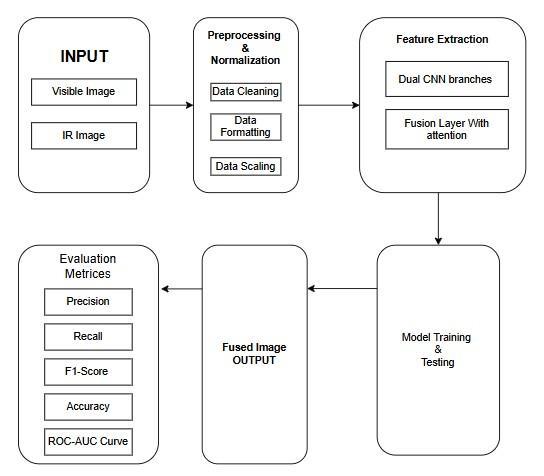
The proposed methodology divides into following modulesas-
This module focuses on acquiring dual-modality image datasets, including both visible spectrum images and infrared (IR) images, from publicly available sources. Suitable datasets are collected from platforms such as FLIR Thermal Dataset, KAIST Multispectral Pedestrian Dataset, and other benchmark repositories for multimodal image fusion and classification. These datasets typically include day and night-time images, urban and natural scenes, and varying environmental conditions to ensure diversity. The visible images capture color and texture, while the IR images provide thermal information, enabling robust analysis. This dual-source approach allows the system to fuse complementary information for better accuracy in downstream tasks such as object detection,surveillance,andsceneunderstanding.
The preprocessing module standardizes the input data to improve compatibility and performance during training. Raw visible and IR images often come with varying resolutions, color spaces, and noise levels. Therefore, preprocessing includes resizing the images to a common resolution, converting them into a consistent format (e.g.,
p-ISSN:2395-0072
grayscaleorRGBasneeded),andapplyingnoisereduction techniques. The data is then normalized to scale pixel valueswithinafixedrange,improvingmodelconvergence. Furthermore,imagealignmentandregistrationtechniques may be used to ensure spatial correspondence between visible and IR images. This preprocessing ensures clean, uniform,andwell-structuredinputthatfacilitatesefficient featureextractionandfusioninsubsequentstages.
This module is responsible for extracting meaningful features from both visible and infrared (IR) images to aid in image fusion and classification. The system employs dual CNN branches, where one convolutional neural networkprocessesvisibleimagesandtheotherprocesses IR images. Each branch learns modality-specific features suchasedges,textures,and temperaturegradients. These features are then passed through a fusion layer with an attention mechanism, which intelligently combines relevant information from both sources. The attention mechanism ensures that the most informative features from each modality are emphasized, leading to better fused representations. This dual-stream approach enhances the ability to capture complementary characteristics of the two modalities, making the fused image more informative for downstream tasks like object recognition,surveillance,orthermalanalysis.
In this module, the extracted and fused features are used to train a deep learning model for classification or detectiontasks.Thefusedoutputfromtheattention-based layer is flattened and passed through fully connected layers, where the model learns high-level semantic patterns. During training, the model is optimized using loss functions such as categorical cross-entropy or binary cross-entropy, depending on the application. Training is performed using backpropagation and gradient-based optimizerslikeAdam.Avalidationsetisusedtofine-tune hyperparameters and avoid overfitting. Once trained, the model is tested on unseen data to evaluate its generalizationability.Thismodulealsosupportsinference on real-time data, allowing for live deployment in intelligent imaging systems. The output is a fused image with associated labels or decisions that demonstrate improvedperformanceduetothesynergybetweenvisible andIRmodalities.
The result of the fusion process is a single image or decision output that retains important features from both the visible and IR sources. This output is used either for visualization or as an input to downstream tasks (e.g., objectdetection,classification).
International Research Journal of Engineering and Technology (IRJET) e-ISSN:2395-0056
Volume: 12 Issue: 08 | Aug 2025 www.irjet.net p-ISSN:2395-0072
Thismoduleisdedicatedtoevaluatingtheperformanceof the fused image classification model using standard quantitativemetrics.Oncethemodelistrainedandtested, its output is assessed using precision, recall, F1-score, accuracy,andtheROC-AUCcurve.
● Precision measures how many of the predicted positive results are actually correct, ensuring the modelavoidsfalsepositives.
● Recall evaluates how well the model identifies all relevantinstances,minimizingfalsenegatives.
● F1-Score provides a balanced measure between precision and recall, especially useful for imbalanceddatasets.
● Accuracy gives an overall percentage of correctly classifiedinstances.
● The ROC-AUC Curve plots the true positive rate against the false positive rate, helping visualize the model’sdiscriminativeabilityacross different thresholds.
Deep learning has revolutionized by making automatic feature extraction possible in the field of image fusion, adaptive fusion strategies, and end-to-end learning architectures. Numerous methods have been proposed to enhance the fusion of visible and infrared (IR) images using Convolutional Neural Networks (CNNs), encoderdecoder models, attention mechanisms, and generative adversarial networks. This section summarizes and compareskeycontributionsfromtherecentliterature.
● Liu et al. suggested an algorithm for extracting multilayer features from input photos that is based on Convolutional Sparse Representation (CSR). While effective in combining key elements from both modalities, the model's robustness to diverse input conditions remains limited.
● Liu et al. later introduced a CNN-based fusion approach using image patches and decision graphs.Althoughthetechniqueimprovedfeaturelevel integration, it lacked generalizability across multiplefusiontasks.
● Li et al. provided a framework supporting deep learning leveraging VGG-19 to split source image information into low-frequency and texture components. Multilayer fusion helped extract deep features, though the method suffered from
highcomputationalcostandrelianceonmanually engineeredfeatures.
● Prabhakar et al. recommended an encoderfusion-decoder based on CNN architecture that did not require parameter adjustment for input changes. By optimizing loss functions, the model achieved reliable fusion, though generalizability across different input types was not fully explored.
● Ma et al.provided a method for eliminating total variation that maintained the gradients in visible images and the pixel intensity in infrared images. While this approach maintained essential information, it was prone to visual artifacts in complex scenes.
● Li et al. used a ResNet-based framework combined with Zero-Phase Component Analysis (ZCA) and L1-normalization to extract deep features and reconstruct fused images. Although effective in retaining detail, the model lacked flexibilityforvariedfusiontasks.
● Xu et al. presented an unsupervised, densely connected CNN trained across multiple fusion tasksusing Elastic Weight Consolidation (EWC) toretainknowledgeacrossdomains.Thismethod showed promise for adaptive multi-task fusion but required further optimization for real-time andhigh-resolutionapplications.
● Zhang et al. presented an end-to-end CNN with distinct modules for feature extraction, combination, and reconstruction. The model demonstrated good fusion accuracy but lacked analysis of robustness under multimodal input variability.
● Chen et al. designed a Multilayer Fusion CNN (MLF-CNN) for pedestrian detection in low-light conditions using multispectral inputs. A multiscale region proposal network enabled the fusion of IR and visible features, although scalability for real-time deployment remained a concern.
● Hou et al. introduced a method that utilized a mixed loss function to adaptively merge IR and visibleinputswhilesuppressingnoise.Themodel demonstrated strong preservation of texture and salient features but needed validation on larger datasets.
● Zhang et al. conducteda comprehensive survey ofvisible-infraredfusion(VIF)methods, datasets,
International Research Journal of Engineering and Technology (IRJET) e-ISSN:2395-0056
Volume: 12 Issue: 08 | Aug 2025 www.irjet.net p-ISSN:2395-0072
andevaluationtechniques.Whilethisworkserves as a valuable reference, it did not propose new fusionmodels.
● Meher et al. introduced a region-based fusion technique, called Adaptive Transition Region Extraction (ATRE), which selectively extracts bright thermal features and preserves visual clarity from visible images. The method proved effective for military and surveillance tasks.
● Sulthana et al. presentedanadversarialnetworkbasedmethodthatenhancessourceimagesbefore fusion. This GAN-based model operated without the need for supervised training data and delivered strong fusion quality by improving contrast and texture offering a new benchmark inimagefusionperformance.
Deeplearning-basedvisibleandinfrared(IR)imagefusion is getting more popular, which demonstrates its potential to transform imaging applications in complex environments. While the current literature presents a wide rangeof architectures andfusionstrategies, a closer examination reveals several gaps that still need to be addressed for more robust, efficient, and general-purpose solutions.
Many research efforts are tailored to specific use cases such as surveillance, pedestrian detection, or medical diagnostics resulting in models that are highly taskspecific. While this can yield strong performance in a particular domain, it limits the broader applicability of these models. There's a noticeable lack of unified frameworks that can adapt across different domains and datadistributions.
A major limitation across the studies reviewed is the absence of standard, large-scale, and diverse datasets thatincludepairedvisibleandIRimages.Manymodelsare evaluated on privately curated or small-scale datasets, hindering reproducibility and comparative analysis. The research community needs to invest in the creation and open dissemination of benchmark datasets that reflect variedreal-worldconditions night/day,fog,rain,moving objects,etc.
4.3
Current evaluation approaches rely heavily on visual inspection or a limited set of quantitative metrics. Few
studies perform thorough evaluations across both lowlevel (image quality) and high-level (task performance) metrics. Additionally, human perceptiondriven evaluations, such as user studies, are rarely conducted even in critical domains like healthcare or defense.
Severalmodelsdemonstrategoodperformanceonspecific datasets but fail to generalize when applied to different scenes, objects, or lighting conditions. This suggests potential overfitting, particularly in architectures trained withlimitedorhighlycurateddata.Futuremodelsshould betrainedandvalidatedusing cross-dataset evaluations toensurerobustness.
4.5
While some models show theoretical promise, real-time performance remains underexplored. Many methods involve deep encoder-decoder structures, attention mechanisms,oradversarialtraining allofwhichincrease inferencetimeandcomputational load.There isa need to balance model complexity with speed and develop lightweight architectures optimized for edge deployment.
As deep models become more opaque, explainability is largely ignored in fusion research. For high-stakes domains like healthcare, military, and autonomous driving, black-box models can reduce trust and hinder deployment. Techniques such as feature importance visualization, attention maps, and saliency detection need tobeintegratedintofuturefusionpipelines.
4.7
Recentadvancesin transformers, diffusion models, and self-supervised learning haveyettobefullyexploitedfor image fusion. Most existing work still relies on CNNs. Exploring these newer paradigms could lead to breakthroughs in model accuracy, adaptability, and interpretability.
Withnewtechniquesandapplicationsappearingannually, the area of visible and infrared (IR) image fusion utilizing deep learning is developing quickly. However, in order to attain wider acceptance and usefulness, future studies need to tackle current constraints and investigate novel avenues.Thissectionlistspromisingdirectionsforfurther researchanddevelopment.
International Research Journal of Engineering and Technology (IRJET) e-ISSN:2395-0056
Volume: 12 Issue: 08 | Aug 2025 www.irjet.net p-ISSN:2395-0072
The enormous computational complexity of current models is one of their main limitations. The development oflightweightarchitecturesthatcanbeinstantlydeployed on resource-constrained devices like edge AI platforms, embedded systems, and drones should be the main focus of future research. To cut down on model size and inference time, methods including knowledge distillation, quantization,andmodelpruningcouldbeinvestigated.
5.2 Adoption of Transformer and Diffusion Architectures
While CNNs dominate current fusion architectures, transformers widely successful in image classification and natural language processing have demonstrated promise in simulating contextual linkages and long-range dependencies. Similarly, diffusion models have recently emergedaspowerfultoolsforimagegenerationandcould be adapted for fusion tasks to produce higher-quality outputswithbettercontroloverthegenerationprocess.
5.3 Self-Supervised and Unsupervised Learning
Lack of labeled training data is a recurring challenge in this field. To overcome this, future research should explore self-supervised learning frameworks that can learn from unlabeled or weakly labeled data. Unsupervisedlearningtechniquescanalsobeimprovedto handle domain shifts, ensuring models perform consistentlyacrossvariedenvironmentalconditions.
5.4 Multi-Modal and Multi-Sensor Fusion
InadditiontovisibleandIRdata,othermodalitiessuchas depth, LiDAR, or hyperspectral images can be integrated for richer perception. Future models should investigate multi-modal fusion pipelines, allowing systems to adaptively choose relevant information from diverse sensorinputs.
5.5 Explainable and Trustworthy AI
As deep learning models are increasingly deployed in critical applications like defense and healthcare, explainability and trust become essential. Future research must incorporate interpretability tools such as attention visualization, decision reasoning modules, and confidence scoring. This will help stakeholders better understand and trust the fusion decisions made by AI systems.
5.6 Standardization of Datasets and Benchmarks
Thecommunitywouldgreatlybenefitfromthecreationof open-source, standardized datasets with paired visible and IR images across varied environments. Moreover,
unified benchmarking protocols shouldbeestablishedto compare models based on accuracy, speed, robustness, andvisualquality.
5.7 Application-Specific Optimizations
There is potential to build domain-optimized fusion models, fine-tuned for specific applications like smart surveillance, autonomous driving, medical diagnostics, or remote sensing. This includes optimizing for task-specific objectives such as detection accuracy, thermal signature clarity,oranomalylocalization.
6. Conclusion
Using deep learning approaches to fuse visible and infrared (IR) images has shown itself to be a potent tool forimprovingsceneunderstanding,situationalawareness, and image quality in a variety of demanding contexts. By leveraging the complementary strengths of visible and thermal imaging, fused outputs enable more accurate perception and decision-making in critical applications such as surveillance, autonomous driving, medical diagnostics,andenvironmentalmonitoring.
Numerousnewresearchinitiativeshavebeenreviewedin this study, emphasizing the transition from conventional techniquestocomplexdeep learningsystems.Techniques such as convolutional neural networks (CNNs), encoderdecoder models, attention mechanisms, and generative adversarial networks (GANs) have significantly improved thequalityandadaptabilityoffusionresults.Nonetheless, issues like lack of interpretability, processing demands, modelgeneralization,anddatascarcitycontinuetoexist.
Through a detailed analysis, we have identified key research gaps, including the need for standardized datasets,betterevaluationmetrics,lightweightmodelsfor real-time processing, and the integration of newer learning paradigms such as transformers and selfsupervised learning. Additionally, there is a pressing demand for explainable and trustworthy fusion systems thatcanbeconfidentlyusedinhigh-stakesdomains.
As the field continues to grow, addressing these gaps will be essential for the development of robust, scalable, and intelligent image fusion solutions. Deep learning offers a promising foundation but its success will depend on cross-disciplinary collaboration, ethical deployment, and continuous innovation in both model design and applicationstrategy.
1. S. Kalamkar and A. G. Mary, “Multimodal image fusion: A systematic review,” Decision Analytics Journal, vol. 9, p. 100327, Dec. 2023, doi: 10.1016/j.dajour.2023.100327.
International Research Journal of Engineering and Technology (IRJET) e-ISSN:2395-0056
Volume: 12 Issue: 08 | Aug 2025 www.irjet.net p-ISSN:2395-0072
2. C. Brunner, T. Peynot, T. Vidal-Calleja, and J. Underwood, “Selective Combination of Visual and Thermal Imaging for Resilient Localization in Adverse Conditions: Day and Night, Smoke and Fire,” Journal of Field Robotics, vol. 30, no. 4, pp. 641–666, Jul. 2013, doi: 10.1002/rob.21464.
3. J.Ma,Y.Ma,andC.Li,“Infraredandvisibleimage fusion methods and applications: A survey,” Information Fusion, vol. 45, pp. 153–178, Jan. 2019, doi: 10.1016/j.inffus.2018.02.004.
4. J. Qi, D. E. Abera, M. N. Fanose, L. Wang, and J. Cheng, “A deep learning and image enhancement based pipeline for infrared and visible image fusion,” Neurocomputing,vol.578,p.127353,Apr. 2024, doi: 10.1016/j.neucom.2024.127353.
5. T.L.Narayanaetal.,“Advancesinrealtimesmart monitoring of environmental parameters using IoTandsensors,” Heliyon,vol.10,no.7,p.e28195, Apr. 2024, doi: 10.1016/j.heliyon.2024.e28195.
6. Y. Liu, X. Chen, R. K. Ward, and J. Wang, “Image Fusion with Convolutional Sparse Representation,” IEEE Signal Processing Letters, vol. 23, no. 12, pp. 1882–1886, Dec. 2016, doi: 10.1109/LSP.2016.2618776.
7. Y.Liu,X.Chen,H.Peng,and Z.Wang,“Multi-focus image fusion with a deep convolutional neural network,” Information Fusion, vol. 36, pp. 191–207, Jul. 2017, doi: 10.1016/j.inffus.2016.12.001.
8. H. Li, X. J. Wu, and J. Kittler, “Infrared and Visible ImageFusionusingaDeepLearningFramework,” Proc. International Conference on Pattern Recognition (ICPR), 2018, pp. 2705–2710, doi: 10.1109/ICPR.2018.8546006.
9. K. R. Prabhakar, V. S. Srikar, and R. V. Babu, “DeepFuse: A Deep Unsupervised Approach for Exposure Fusion with Extreme Exposure Image Pairs,” Proc. IEEE International Conference on ComputerVision(ICCV),2017,pp.4724–4732,doi: 10.1109/ICCV.2017.505.
10. Y.Ma,J.Chen,C.Chen,F.Fan,andJ.Ma,“Infrared and visible image fusion using total variation model,” Neurocomputing,vol.202,pp.12–19,Aug. 2016, doi: 10.1016/j.neucom.2016.03.009.
11. H. Li, X. J. Wu, and T. S. Durrani, “Infrared and visible image fusion with ResNet and zero-phase component analysis,” Infrared Physics & Technology, vol. 102, p. 103039, Nov. 2019, doi: 10.1016/j.infrared.2019.103039.
12. H.Xu,J.Ma,Z.Le,J.Jiang,andX.Guo,“FusionDN:A Unified Densely Connected Network for Image Fusion,” Proc. AAAI Conference on Artificial Intelligence, vol. 34, no. 07, pp. 12484–12491, 2020, doi: 10.1609/aaai.v34i07.6936.
13. Y. Zhang et al., “IFCNN: A general image fusion framework based on convolutional neural network,” Information Fusion,vol.54,pp.99–118, Feb. 2020, doi: 10.1016/j.inffus.2019.07.011.
14. Y. Chen, H. Xie, and H. Shin, “Multi-layer fusion techniques using a CNN for multispectral pedestrian detection,” IET Computer Vision, vol. 12, no. 8, pp. 1179–1187, Dec. 2018, doi: 10.1049/iet-cvi.2018.5315.
15. R. Hou et al., “VIF-Net: An Unsupervised Framework for Infrared and Visible Image Fusion,” IEEE Transactions on Computational Imaging, vol. 6, pp. 640–651, Jan. 2020, doi: 10.1109/TCI.2020.2965304.
16. X. Zhang and Y. Demiris, “Visible and Infrared Image Fusion Using Deep Learning,” IEEE Transactions on Pattern Analysis and Machine Intelligence, vol. 45, no. 8, pp. 10535–10554, Aug. 2023, doi: 10.1109/TPAMI.2023.3261282.
17. B.Meher etal.,“Visibleand infrared imagefusion using an efficient adaptive transition region extraction technique,” Engineering Science and Technology, an International Journal, vol. 29, p. 101037, May 2022, doi: 10.1016/j.jestch.2021.06.017.
18. N. T. N. Sulthana and S. Joseph, “Infrared and visible image: Enhancement and fusion using adversarialnetwork,” AIP Conference Proceedings, vol. 3037, no. 1, Apr. 2024, doi: 10.1063/5.0196355.