
12 Issue: 11 | Nov 2025 www.irjet.net
12 Issue: 11 | Nov 2025 www.irjet.net
Prof. M. M. Thakur1 , VEDANG M. GIRI2, TUSHAR M. CHANDEWAR3, SAHIL B. PAWAR4, RAGHAV A. TIWARI5 .
1Assistant Professor AI & DS Department K. D. K. COLLEGE OF ENGINEERING, Nagpur
2,3,4,5 K. D. K. COLLEGE OF ENGINEERING, Nagpur
ABSTRACT - The demand for effective photovoltaic panels is emphasized by the expanding use of solar energy. For large solar farms, manual cleaning is too labour-intensive, and dust and pollution on panels can reduce energy efficiency by 30%. Many existing automated solutions are either too expensive or lack smart control systems. This review paper looks at an IoT-enabled smart solar panel cleaning system. It combines robotics, Raspberry Pi-based control, and adaptive scheduling for efficient maintenance. The framework automates cleaning using sensors and actuators, ensures real-time monitoring through IoT, and schedules cleaning based on conditions to save energy and water. A thorough literature review covers previous approaches, including mechanical brushes, water-based spraying, and electrostatic cleaning systems. However, intelligent decision-making for scheduling and resource optimization is not incorporated into the majority of these approaches.Comparingthesuggesteddesigntomanualand semi-automatic methods, experimental analysis reveals encouraging results, including increased power output, enhancedpanelefficiency,andreducedoperatingcosts. All things considered, this study enhances smart solar maintenance by fusing automation, IoT, and renewable energy technologies into an economical and environmentallyfriendlycleaningsolution.
Keywords: IoT, photovoltaic (PV) system, cleaning robot, Raspberry Pi, solar panel efficiency, and automation for renewable energy.
Renewableenergyfromthesunhasemergedasoneofthe most reliable and sustainable alternatives to fossil fuels. Photovoltaic (PV) panels convert sunlight directly into electricity, providing an eco-friendly and cost-effective energy solution.The efficiencyofPVsystemsiscritical,as higher efficiency reduces operational costs and ensures optimalutilizationofavailablesolarradiation.Maintaining high-performance standards is therefore essential for large-scalesolarfarmsandsustainableenergygeneration.
One major challenge affecting PV panel efficiency is the accumulation of dust, dirt, bird droppings, and other environmental debris. Such contamination can reduce energy conversion efficiency by 20–30%, depending on location and environmental conditions. Traditional cleaning methods, like manual hand washing, are laborintensive, time-consuming, water-intensive, and often insufficient for large solar farms. Additionally, manual cleaning increases operational costs and risks damaging thedelicatesurfaceofsolarpanels.
To overcome these limitations, automated and intelligent cleaning systems have gained attention. Autonomous cleaning robots equipped with sensors and actuators can detect and remove dirt efficiently while minimizing water consumption and labor requirements. Unlike manual cleaning, these systems ensure consistent panel maintenance, prevent energyloss,and extend the lifespan of PV panels. Energy lost due to dust cannot be compensatedbyadvancedenergyoptimizationtechniques such as Maximum Power Point Tracking (MPPT), highlightingtheneedforregularandeffectivecleaning.
Integrating Internet of Things (IoT) technology with robotic cleaning systems provides additional advantages. IoT-enabled robots can be monitored and controlled remotely,schedulecleaningintelligently,andproviderealtime feedback on panel conditions. Using Raspberry Pi as the control unit, this study presents a Smart Solar Panel CleaningRobot (SPCR)capableofautonomous navigation, dirt detection, and precise cleaning operations. The system’s intelligent scheduling optimizes water and energy usage, reduces human intervention, and improves overallsystemefficiencyandcost-effectiveness.
In conclusion, adopting smart robotic cleaning solutions like SPCR can significantly enhance the performanceandsustainabilityofsolarenergysystems.By reducing labor dependency, minimizing water usage, and maintaining optimal panel cleanliness, these systems support efficient renewable energy production and contribute to environmental sustainability. The SPCR represents a step forward in combining robotics, IoT, and
Volume: 12 Issue: 11 | Nov 2025 www.irjet.net
energy management to maximize solar energy generation whilepromotingsustainablepractices.
In the past few years, there has been an increase of studies on solar power sterilization systems, via different methods being recommended that boost performance and reduce costs associated with upkeep. Robotic, sensor-based, and Internet of Things-based designshavebeenthetopicofnumerousstudies.
[1]Kumar and Murthy (2020) demonstrated an Internet of Things-controlled cleaning robot that can blow air, spray, and wipe. They discovered that predictive maintenance, madeaccessiblebyIoTconnectivity,increasedproduction and reduced the requirement for manual support. [2]The sustainability benefits of automatic cleaning were also emphasized by Khairul and Rahman (2021), who noted thatthesesystemsaremoresustainableduetotheirlesser useofwaterandreducedvulnerabilitytocontamination.
Sensor-based automation has also attracted significant interest. [3]Bedge et al. (2022) created an Arduino-based robotthatadjustsitscleaningcyclesbasedondustdensity and temperature data gathered from ultrasonic and
Study
Kumar & Murthy (2020) IoT-enabled roboticcleaning
Khairul & Rahman (2021) Environmental impactstudy
Bedge et al (2022) Arduino-based robot
Gochhait et al. (2022) Comparativestudy
Kumar, R. (2022) Bluetoothcontrolledrobot
Singarap et al (2023)
Zhao et al. (2023)
IoT-based timed cleaning
Air blowing, liquid spraying, wiping mechanisms
Emphasis on water conservation, reduced contamination
Sensor-driven dust and temperature monitoring
Manual vs. automated cleaningefficiency
Roller brush and water spray mechanism
p-ISSN: 2395-0072
infrared sensors. Their findings indicated a considerable drop in energy losses due to dust build-up. In another study, [4]Gochhait et al.(2022)found that robotic cleaning improved efficiency by 1.6 to 2.2 percent compared to manual cleaning. This method also ensured better worker safetyandreducedoperationalcostsforlargesolarfarms.
Cost-effective and modular designs have also been looked at. [5]Kumar (2022) presented a Bluetooth-operated robot with a roller brush and water-spraying system, achieving improved efficiency at a relatively low cost. [6]Singarap et al.(2023)expandedonthisideabyaddingIoTwithmobile app control, reporting up to 32 percent improvement in power generation after cleaning. This finding highlights thebenefitsofsmartautomationandremoteaccess.
Apartfromroboticsystems,material-basedsolutionshave beeninvestigated.Inordertolessendustadhesion, [7]Zhao et al. (2023) investigated hydrophobic surfaces and selfcleaningcoatings.Thesecoatingsfurtherreducelong-term expenses and maintenance requirements when paired withroboticsystems.
Increased energy efficiency;reducedlabor
Qualitative sustainability benefits
Reduced efficiency loss fromdust
16–22% increase in energygeneration
Improved PV panel efficiency
Mobile app-controlled water-and-wiper system ~32% increase in power output
Limited testing under diverse weather conditions; lacks adaptive schedulingandscalability.
No quantitative efficiency analysis; ignores IoT integration and costbenefitstudy.
No AI-based predictive cleaning; lacks large-scale trials and energy optimization.
Does not address optimal cleaning frequencyorimpactonpanelsurface durability.
Limited control range (Bluetooth only); water usage and maintenance costsnotstudied
Relies heavily on water; not suitable for arid regions; lacks machine learningscheduling.
Durability of coatings under realworldsoilingandweatherconditions untested International Research Journal of Engineering and Technology (IRJET) e-ISSN: 2395-0056
Material sciencebasedapproach
Self-cleaning hydrophobiccoatings
Reduced maintenance costs;improvedefficiency
International Research Journal of Engineering and Technology (IRJET) e-ISSN: 2395-0056
Volume: 12 Issue: 11 | Nov 2025 www.irjet.net
New research on methods for cleaning solar panels point to a few important patterns and unanswered issues that demand more attention. Most automated cleaning systems have effectively lowered labor requirementsandincreasedpanelefficiency;theseinclude sensor-based Arduino robots (Bedge) and IoT-enabled robots (Kumar & Murthy, 2020). Water-saving methods (Khairul & Rahman, 2021) and materialbased solutions including self-cleaning hydrophobic coatings (Zhao et al., 2023) have also been used to tackle environmental sustainability. There are still some significantproblemsthathavetobesolved.Manysystems donothaveadaptiveschedulingorpredictivemaintenance, whichcouldhelptomaximizecleaningcyclesbasedonthe environment.Certainmethods suchBluetooth-controlled robots (Kumar, 2022) or timed IoT systems (Singarap et al., 2023) have either a limited control range or an overdependence on water, so limiting advantages in dryregion or large-scale applications, hence reducing their value Moreover,mostlyunknownarerobustnessinactual settings, interaction with AI-based optimization, and thoroughfieldtesting.
Using IoT, robots, and smart scheduling together can significantly improve the overall efficiency, sustainability, and cost-effectiveness of solar panel maintenance, accordingtothisresearch.Theexaminedstudiesprovidea good foundation, but it is possible to create a smart, flexible, resource-efficient cleaning system that goes beyond current constraints and ensures long-term dependability.
The work began with identifying the challenges associated with solar panel maintenance. Dust accumulation was found to be a critical issue leading to efficiency reduction. Manual cleaning methods were timeconsuming,labor-intensive,andnotsuitableforlarge-scale solar farms. A literature review highlighted existing solutions and revealed major research gaps, particularly theabsenceofIoT-enabledsmartautomationandadaptive scheduling.
After problemanalysis,a systemarchitecturewas designed combining both hardware and software components. The Arduino microcontroller was chosen as the main control unit, supported by a Raspberry Pi for
advanced processing and IoT integration. The design emphasized modularity so that different cleaning mechanisms brushes, water pump, and motors could workincoordinationundercentralizedcontrol.
The hardware setup included DC motors for movement, a brushmotor for physical dustremoval,anda waterpump connected to a tank and nozzle for wet cleaning. Limit switches were integrated to ensure safety and controlled motor movements, while a multi-mode switch enabled both manual and automatic modes of operation. A Bluetoothsensorestablishedwirelessconnectivity,andan LCD display provided real-time system feedback to the user.
The Arduino was programmed to control motor drivers, pump operations, andinput/output handling. The Raspberry Pi was used for IoT-based functionalities, such asdatalogging,smartscheduling,andcommunicationwith the mobile application. A mobile app was developed to provideuserswithremoteaccess,allowingthemtoinitiate cleaning,monitorstatus,andswitchbetweenmodes.
Once hardware and software integration was complete, the prototype was tested on solar panels under various conditions. Performance parameters such as dust removal efficiency, water consumption, power requirement,andcleaningtimewererecorded.Theresults werecomparedagainstmanualcleaning,showingthatthe robot improved panel efficiency, reduced dependency on humanlabor,andconservedresources.
The methodology successfully demonstrated an IoT-based autonomous cleaning system capable of smart scheduling, efficient dust removal, and sustainable operation.Thesystemprovedtobecost-effective,reliable, andscalableforfuturelarge-scaleimplementation.
Theproposedsystemisdesignedasan IoT-based smart solar panel cleaning robot that integrates both hardware and software components for efficient and automatedoperation.
International Research Journal of Engineering and Technology (IRJET) e-ISSN: 2395-0056
Volume: 12 Issue: 11 | Nov 2025 www.irjet.net p-ISSN: 2395-0072
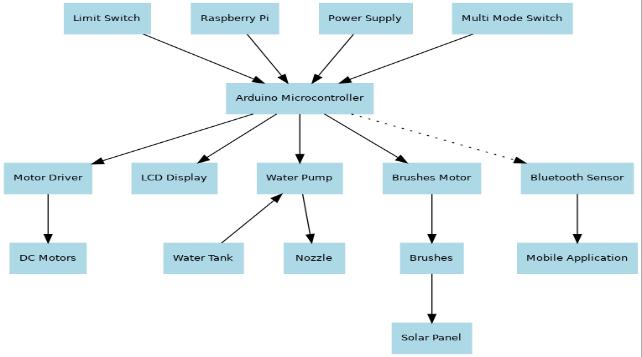
The hardware unit is built around an Arduino microcontroller interfacedwith Raspberry Pi(optional), which functions as the central control unit. Key componentsinclude:
Sensors and Switches: Limit switches for safety and a multi-mode switch for selecting manual or automaticoperation.
Actuators: DC motors (via motor driver) for movement, a brush motor for surface cleaning, andawaterpumpconnectedtoastoragetankand nozzleforspraying.
Communication & Control: Bluetooth sensor for wireless connectivity, supported by an IoTenabledmobileapplication.
Display & Power: An LCD display provides realtime system status, while a regulated power supplyensurescontinuousoperation.
The software part integrates Arduino with an IoTenabled application throughBluetoothandRaspberryPi. Theapplicationallows:
Remote Monitoring & Control of the cleaning process.
Smart Scheduling forautomaticcleaningcycles.
In automatic mode, sensors and scheduling
System Feedback viaLCDdisplayforoperational status. algorithmstriggercleaningwhendustlevelsreach athreshold.
In manual mode, the user can control the cleaning process remotely using the IoT application.
Increased PV efficiency through regular and
The brush motor removes dust, while the water pump sprays water through the nozzle to clear sticky dirt. Limit switches ensure safe movement ofthecleaningunit. effectivecleaning.
Reduced water and energy usage compared to conventionalmethods.
Lowermanualeffortduetoautomation.
Feasibility for integration into large-scale solar farms.
International Research Journal of Engineering and Technology (IRJET) e-ISSN: 2395-0056
Volume: 12 Issue: 11 | Nov 2025 www.irjet.net p-ISSN: 2395-0072
Automated solar panel cleaning systems are needed to keepphotovoltaic(PV)systemsworkingwellandreliably. New studies on robotic cleaning methods driven by IoT show a notable drop in energy losses connected to dust and garbage. These tools free up manual labor and lower running costs as well. The proposed IoT-based cleaning robot may improve panel efficiency, lower costs, and facilitate ecologically friendly operation by means of sensors, Raspberry Pi, and astute scheduling. These systemsarepredictedtobringabouthigherenergyoutput, lower use of labor and water, longer-lasting solar panels, and less need for labor and water. Good scheduling and remote monitoring also help to ensure optimum cleaning cycles based on the present conditions of the surroundings.
Upcoming research might emphasize
-DevelopingAI-basedschedulingsystemstooptimizethe efficiencyofcleaningcycles.
- Using these techniques on solar farms helps to evaluate how well they work in real-world settings and how well theyscale.
- Their interaction with self-cleaning coatings and hydrophobic surfaces reduces maintenance requirements.
- Investigating energy-efficient cleaning methods and water-savingstrategiesfordryregions.
- Employ cloud-based analyticsand IoT to regularlytrack and predict maintenance requirements in order to increaselong-termefficiency.
Maintaining the validity and efficacy of photovoltaic (PV) systems demands automatic solar cells cleaning devices. Based on recent research, IoT-powered robotic systems for cleaning may significantly decrease energy waste from dust and garbage. These techniques minimize human labor and help to reduce operational expenses. The proposed IoT-based cleaning robot combining Raspberry Pi, sensors, andcleverschedulinghasthepotentialtoimprove panel efficiency, lower costs and allow for sustainableoperation.
Thesesystemsshouldmakemoreenergy,useless water and labor, and make solar panels last longer. Furthermore, clever scheduling and remote monitoring let perfect cleaning cycles dependonthecurrentstateofthesurroundings.
Moreresearchmightcenteron:
Making AI-driven scheduling systems to make cleaningcyclesworkbetter.
The performance and maximum size of these technologiesunderactualconditionsaretestedon solarfarms.
Combine them with self-cleaning coatings and water-repellentsurfacestoreducemaintenance.
Looking into water and sustainable cleaning technologiesfordesertregions.
Using analytics via the cloud and the Internet of Things for ongoing tracking and anticipatory repairincreaseslong-termefficiency.
[1] S.S. Kumar and K. Murthy, "Solar Electric PV Panel Inspection Robot," IEEE, 2020 the International Conference on Recent Trends on Electronics, Information, Communication&Technology(RTEICT),November2020.
[2] Khairul M. and Rahman A., " The Environmental Impact for automated Solar Panel Cleaning Systems," International Journal of Renewable Energy Research, vol. 11,no.3,2021,pp.1205to1214.
[3] An Arduino-Powered Automatic Solar Panel Cleaning Automation, a Research Journal of Modernisation in IRJMETS2022:Science,Engineering,andTechnology.
[4] Gochhait, R. Asodiya, T. Hasarmani, V. Patin, and O. Maslova, "The Advantages of Automated Maintenance Systems in sunlight Generation," IEEE, 4th International Symposium on Electricity, Control, and Automation Engineering(ICECIE),November2022.
[5] "Solar Panel Cleaning Robot with Bluetooth Control," by R. Kumar, International Journal of Innovative Science andResearchTechnology,vol.7,no.7,2022,pp.223–230.
[6] S. Singarapu, K. Swaraja, and M. Kirola, "Smart IoT Based Solar Panel Cleaning System," E3S Web of Conferences,vol.430,p.01147,2023.
[7] L. Zhao and colleagues, "Self-Cleaning Coatings and HydrophobicSurfacesforSolarPanels,"RenewableEnergy Journal,vol.210,2023,pp.547–558.
[8] "Automatic Solar Panel Cleaning System," International Journal of Advances in Scientific Research andEngineering,vol.4,no.7,pp.26–31,2018;B.Manju,A. Bari,andC.M.Pavan.
International Research Journal of Engineering and Technology (IRJET) e-ISSN: 2395-0056
Volume: 12 Issue: 11 | Nov 2025 www.irjet.net
[9] N. Ronnaronglit and N. Maneerat, "A Cleaning Robot for Solar Panels," IEEE, 5th International Conference on Engineering, Applied Sciences and Technology (ICEAST), 2019.
[10]Effectsofdust,soiling,aging,andweatherconditions on the performance of PV systems: Case study in M. Memichel, C. Bouzian, A. Benzahial, and A. Moussi, Feb. 2020Algerie,Global EnergyInterconnectionDevelopment andCooperationOrganization.
[11] Design and Development of an Autonomous RaspberryPiCleaningRobotforPhotovoltaicInternational Journal of Innovative Science and Research Technology, Vol. 7, Issue 6 Panels 2022. (Highlights independent cleaning and Raspberry Pi-based control; misses AI-based adaptivescheduling.)
[12]RobotforCleaningSolarPanels,Vol.10,Issue3,2024, International Journal of Scientific Research & Engineering Trends.(Highlightsmodularroboticdesign;omitsremote IoTmonitoringandpredictivecleaning.)
[13] International Journal of Creative Research in Technology, Vol. 8, Issue 3, 2022. Camera Sensor Solar Panel Cleaning Robot: Combines dust vision sensors. research; limited large-scale testing and alteration of meteorologicalcircumstances.)
[14] Dergipark, Vol. 5, Issue 1, 2021. Rubber Belt Transmission Autonomous Solar Panel Cleaning Robot. (Mechanical design ensures mobility; lacks smart schedulingandwaterefficiencyanalysis.)
[15] International Journal of Engineering Applied Science and Technology, Vol. 5, Issue 2, 2021; IoT enabled solar panel cleaning robot. (IoT-enabled remote control; does not).Includeadaptableenergyefficiencyorcleaningbased onmachinelearning.
[16] International Journal of Scientific Research in Computer Science, Engineering and Information Technology, Vol. 6,Issue 2, 2020.(Waterless Solar Energy Equipped IoT Based Vacuum Uncommon and not flexible intiming,acleanercleaningapproach.)