
International Research Journal of Engineering and Technology (IRJET) e-ISSN: 2395-0056
Volume: 13 Issue: 03 | Mar 2026 www.irjet.net p-ISSN: 2395-0072
A REVIEW OF TIME-DEPENDENT CRACK ARREST MECHANISMS IN STEEL–BASALT HYBRID FIBER REINFORCED HIGH-STRENGTH CEMENTITIOUS COMPOSITES UNDER PROGRESSIVE FLEXURAL LOADING
Surydeep Maurya1 , Mr. Ushendra Kumar2
1Master of Technology, Civil Engineering, Lucknow Institute of Technology, Lucknow, India
2Head of Department, Department of Civil Engineering, Lucknow Institute of Technology, Lucknow, India
Abstract - High-strengthcementitiouscomposites(HSCCs) areincreasinglyemployedinadvancedstructuralsystemsdue to their superior compressive capacity and durability; however, their intrinsic brittleness makes them vulnerable to crack initiation and unstable propagation under flexural loading. Hybrid fiber reinforcement has emerged as an effective strategy to enhance fracture resistance and postcracking ductility. In particular, the combination of steel and basalt fibers offers complementary mechanical characteristics hightensilestrengthandstiffnessfromsteel fibers, and chemical stability and fine crack control from basalt fibers. This review critically examines the timedependent crack arrest mechanisms in steel–basalt hybrid fiber reinforced high-strength cementitious composites subjected to progressive flexural loading. The paper synthesizescurrentliteratureoncrackinitiation,fiber–matrix interfacialbehavior,bridgingaction,pull-outresistance,stress redistribution,andcracktipshieldingeffects.Specialemphasis is placed on the interaction between creep, microstructural evolution,anddelayedcrackpropagationundersustainedand incrementalflexuralloads.Thesynergisticroleofhybridfibers in modifying fracture energy, enhancing residual flexural strength, and controlling crack width over time is systematically analyzed. Existing analytical and numerical modelingapproachesforsimulatingtime-dependentfracture behavior are also reviewed, highlighting their limitations in capturing multi-scale hybrid fiber interactions. The study identifies critical research gaps, including the need for standardizedtestingprotocolsandunifiedconstitutivemodels for long-term flexural performance prediction. The findings provideacomprehensiveframeworkforunderstandingcrack arrestmechanismsin hybrid fibersystemsandofferguidance for material optimization and structural design applications.
Key Words: Steel fibers; Basalt fibers; Hybrid fiber reinforced concrete; Time-dependent behavior; Crack arrest mechanisms; Progressive flexural loading
1. INTRODUCTION
The development of high-performance construction materials has become central to modern civil engineering practice,particularlyininfrastructuresubjectedtocomplex and sustained loading conditions. High-strength cementitious composites (HSCCs) exhibit superior compressive strength and durability; however, their
inherently brittle fracture behavior poses significant challenges under flexural loading. Crack initiation and unstablepropagationoftengovernstructuralfailurerather than compressive crushing. To mitigate such brittleness, fiber reinforcement strategies have been widely investigated.Amongthese,hybridfibersystemscombining metallic and mineral fibers have demonstrated promising synergistic effects in enhancing toughness, energy absorption,andcrackresistance(BenturandMindess,2007; Banthia and Gupta, 2004). This review focuses on timedependentcrackarrestmechanismsinsteel–basalthybrid fiber reinforced HSCCs subjected to progressive flexural loading.
1.1 Background
1.1.1
Importance of Advanced Cementitious Composites in Modern Civil Engineering
Rapid urbanization and the demand for resilient infrastructure have accelerated the adoption of advanced cementitious materials with enhanced mechanical and durability performance. High-strength and ultra-highperformance composites are now extensively used in bridges,high-risebuildings,marinestructures,andprecast elementsduetotheirimprovedload-bearingcapacityand reduced cross-sectional requirements (Neville, 2011). However, increasing matrix strength typically results in reduced strain capacity and fracture energy, thereby increasing susceptibility to brittle cracking. Consequently, research has shifted toward modifying fracture behavior ratherthansolelyimprovingcompressivestrength.
1.1.2 Role of Hybrid Fibers in Enhancing Structural Performance
Fiber reinforcement enhances post-cracking behavior through crack bridging, pull-out resistance, and stress redistribution mechanisms. While steel fibers contribute significantlytoflexuralstrengthandtoughnessduetotheir high modulus and tensile capacity, micro-scale fibers are effective in controlling crack initiation and microcrack coalescence. Hybridization using fibers of different geometries and mechanical properties promotes multiscale crack control and improved energy dissipation (Banthia and Gupta, 2004). This synergistic interaction
International Research Journal of Engineering and Technology (IRJET) e-ISSN: 2395-0056
Volume: 13 Issue: 03 | Mar 2026 www.irjet.net p-ISSN: 2395-0072
delays crack localization and enhances residual strength underflexuralloading.
1.1.3 Relevance of Steel–Basalt Hybrid Fiber Systems
Basalt fibers have gained attention because of their high tensilestrength,corrosionresistance,andthermalstability comparedtoconventionalsyntheticfibers(Simetal.,2005). When combined with steel fibers, basalt fibers primarily control microcrack formation, while steel fibers provide macrocrackbridgingandductility.Emergingstudiessuggest thatthishybridconfigurationimprovesfracturetoughness and long-term durability, particularly under sustained or progressiveloadingregimeswheretime-dependenteffects becomesignificant.
1.2 Scope and Objectives of the Review
1.2.1
Focus on Crack Arrest Mechanisms
This review concentrates on fundamental crack arrest mechanismsoperatinginsteel–basalthybridfiberreinforced HSCCs. Emphasis is placed on microstructural crack initiation,fiber–matrixinterfacialbonding,bridgingstress development, pull-out behavior, crack tip shielding, and energydissipationprocesses.Theobjectiveistosynthesize existingtheoreticalandexperimentalfindingstoclarifyhow hybridfibersmodifyfracturemechanicsparameterssuchas fractureenergy,criticalstressintensityfactor,andresidual flexuralstrength(Naaman,2003).
1.2.2 Time-Dependency under Progressive Flexural Loading
Unlike monotonic short-term loading, progressive or sustainedflexuralloadingintroducescreep,relaxation,and microstructuralevolutioneffectsthatinfluencecrackgrowth kinetics.Time-dependentdeformationaltersfiberbridging stresses and interfacial bond characteristics, thereby affectingcrackarrestefficiency.Thisreviewevaluateshow long-term loading conditions modify crack propagation pathways and residual load-carrying capacity, integrating fracturemechanicsandrheologicalperspectives(Bazantand Planas,1998).
1.2.3
Review Scope versus Experimental Research
Itisimportanttoclarifythatthismanuscriptisastructured literaturereviewratherthananexperimentalinvestigation. The paper critically evaluates and synthesizes published experimental,analytical,andnumerical studiestoidentify trends, inconsistencies, and research gaps. No new experimentaldataarepresented.Thegoalistoestablisha coherent framework for understanding time-dependent crackarrestbehaviorinhybridfibersystemsandtooutline future research priorities for material optimization and structuraldesign.
2. FUNDAMENTALSOFHYBRIDFIBERREINFORCED CEMENTITIOUS COMPOSITES
Hybrid fiber reinforced cementitious composites (HFRCs) represent an advanced class of quasi-brittle materials engineered to improve fracture resistance, ductility, and long-term durability. By incorporating fibers with distinct mechanical and physical properties into a high-strength cementitious matrix, these composites exhibit enhanced crack control at multiple scales. Understanding their fundamental material characteristics is essential for analyzing time-dependent crack arrest behavior under progressiveflexuralloading.
2.1 Cementitious Composites: Definitions and Classifications
Cementitious composites are heterogeneous materials composedofcement,aggregates,water,andsupplementary cementitiousmaterials,optionallyreinforcedwithfibersto improve mechanical performance. Their classification is generally based on compressive strength, microstructural density,andreinforcementstrategy.
2.1.1 High-Strength versus Normal Concrete
Normal strength concrete (NSC) typically exhibits compressivestrengthbelow40–50MPaanddemonstrates relativelyhigherstraincapacitybeforefracture.Incontrast, high-strength concrete (HSC), often exceeding 60 MPa, is characterized by a dense microstructure and reduced porosity, achieved through low water–cement ratios and mineral admixtures such as silica fume (Neville, 2011). AlthoughHSCprovidessuperiorcompressivecapacityand durability,ittendstoexhibitbrittlepost-peakbehaviordue tolimitedmicrocrackredistributioncapability.Thefracture energydoesnotincreaseproportionallywithcompressive strength,makingcrackpropagationmoreunstableinhighstrengthmatrices(BazantandPlanas,1998).Consequently, fiberincorporationbecomesessentialformitigatingbrittle failure.
2.1.2 Fiber Reinforced Cementitious Composites
Fiber reinforced cementitious composites (FRCCs) are developedbydispersingdiscretefibersrandomlywithinthe matrixtoenhancetensileandflexuralperformance.Fibers act as crack-bridging elements that transfer stress across crackfaces,therebyimprovingenergyabsorptionandpostcrackingductility.Dependingonfibertype,volumefraction, and aspect ratio, FRCCs can exhibit strain-hardening or strain-softening responses (Naaman, 2003). The primary mechanisms include fiber pull-out, debonding, and crack deflection, which collectively improve toughness and residualstrength.
International Research Journal of Engineering and Technology (IRJET) e-ISSN: 2395-0056
Volume: 13 Issue: 03 | Mar 2026 www.irjet.net p-ISSN: 2395-0072
2.2 Steel Fibers
Steelfibersareamongthemostwidelyusedreinforcements instructuralconcreteduetotheirhightensilestrengthand elasticmodulus.
2.2.1
Geometry and Mechanical Properties
Steel fibers are manufactured in various geometries, includinghooked-end,crimped,straight,andtwistedforms. Theiraspectratio(length-to-diameterratio)typicallyranges from40to100,significantlyinfluencingpull-outresistance andbondperformance.Steelfibersexhibittensilestrengths between 1000–2500 MPa and a modulus of elasticity comparable to reinforcing steel (~200 GPa), enabling efficient stress transfer across macrocracks (Bentur and Mindess,2007).Surfacedeformationenhancesmechanical anchorage,therebyincreasinginterfacialbondstrengthand pull-outenergy.
2.2.2 Contribution to Toughness and Ductility
The primary contribution of steel fibers lies in improving flexural toughness and post-peak load-carrying capacity Underflexuralloading,steelfibersbridgemacrocracksand delay crack widening through progressive pull-out rather than sudden rupture. This mechanism increases fracture energyandenhancesresidualstrength,particularlyinhighstrengthmatricespronetobrittlefailure.Theabilityofsteel fiberstoredistributestressesreducescracklocalizationand improves structural ductility under service and ultimate loadingconditions(ACICommittee544,2002).
2.3 Basalt Fibers
Basaltfibersaremineral-basedfibersproducedbymelting naturally occurring basalt rock and extruding it into fine filaments.
2.3.1
Chemical Composition and Properties
Basalt fibers primarily consist of silica (SiO₂), alumina (Al₂O₃),ironoxides,andcalcium–magnesiumoxides.They exhibittensilestrengthsintherangeof3000–4800MPaand amodulusofelasticitybetween80–95GPa,positioningthem betweenglassandcarbonfibersinmechanicalperformance (Sim et al., 2005). Basalt fibers demonstrate excellent chemicalstability,alkaliresistance,andthermaldurability, whichareadvantageousincementitiousenvironments.
2.3.2 Advantages over Traditional Synthetic Fibers
Compared to polypropylene or glass fibers, basalt fibers offersuperiortensilestrength,improvedthermalresistance, and better compatibility with cement matrices. They are non-corrosive and exhibit higher resistance to chemical degradation in alkaline pore solutions. Additionally, their relatively small diameter enables effective control of
microcracksduringearly-ageshrinkageandinitialloading stages.Thismicro-scalecrackcontrolenhancesdurabilityby reducingpermeabilityandlimitingcrackcoalescence(Fiore etal.,2015).
2.4 Hybridization of Steel and Basalt Fibers
Hybridfibersystemscombinefibersofdifferentmechanical characteristicstooptimizemulti-scalecrackresistance.
2.4.1 Synergistic Effects
Hybridizationleveragesthehighstiffnessandmacrocrack bridgingcapacityofsteelfiberswiththemicrocrackcontrol and durability benefits of basalt fibers. Basalt fibers primarily delay crack initiation and restrict microcrack growth, while steel fibers arrest macrocrack propagation and enhance post-cracking strength. This complementary interaction improves fracture toughness and energy dissipation capacity more effectively than mono-fiber systems(BanthiaandGupta,2004).Theresultisenhanced crack distribution, reduced crack width, and improved residualflexuralperformance.
3. MECHANISMS OF CRACK FORMATION AND PROPAGATION IN CEMENTITIOUS MATERIALS
Cementitious materials are inherently heterogeneous and quasi-brittle, and their fracture behavior is governed by microstructural defects,stressconcentrations,andenergy dissipationmechanisms.Crackformationandpropagationin these materials involve complex interactions between aggregates,cementpaste,interfacialtransitionzones(ITZ), andanyembeddedfibers.Understandingthesemechanisms isfundamental for evaluatingcrack arrestperformance in hybridfiberreinforcedhigh-strengthcomposites.
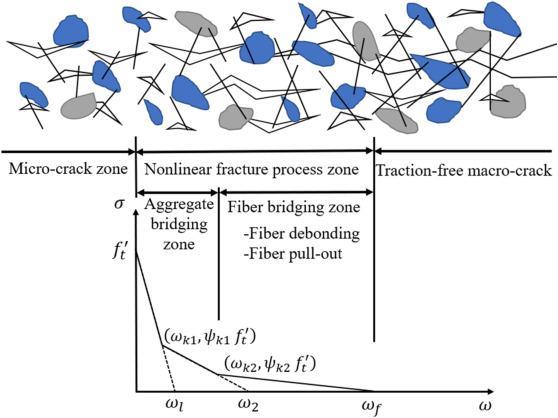
Figure-1: Fiber Bridging Mechanism
International Research Journal of Engineering and Technology (IRJET) e-ISSN: 2395-0056
Volume: 13 Issue: 03 | Mar 2026 www.irjet.net p-ISSN: 2395-0072
3.1 MicrostructuralDefectsandInitiationofCracks
Crackinitiationincementitiousmaterialstypicallyoriginates atmicroscopicflawswherelocaltensilestressesexceedthe tensilestrengthofthematrix.Theseflawsmayexistpriorto loadingordevelopduringhydrationandcuring.
3.1.1 Matrix Heterogeneity
Concreteisamultiphasecompositeconsistingofaggregates embeddedinahydratedcementmatrix,withtheinterfacial transition zone forming a mechanically weaker region around aggregates. Variations in stiffness and strength betweenthesephasescreatelocalizedstressconcentrations under applied loads. The ITZ, characterized by higher porosityandmicro cracking,oftenactsasthepreferential siteforcracknucleation(Scriveneretal.,2004).Microcracks initiate within this zone and gradually coalesce under increasing tensile stresses, leading to visible macrocrack formation.Thestochasticdistributionofflawsandaggregate geometry significantly influences crack trajectory and fractureenergy(BazantandPlanas,1998).
3.1.2 Shrinkage and Curing Effects
Early-agecrackingmayoccurduetoautogenousanddrying shrinkage, especially in low water–cement ratio highstrength concretes. Chemical shrinkage during hydration and moisture gradients during curing generate internal tensilestresses,whichmayexceedtheearlytensilecapacity ofthematrix(Neville,2011).Impropercuringexacerbates these stresses, promoting microcrack development even before external loading is applied. These pre-existing microcracksreduceeffectivestiffnessandserveasinitiation sites for subsequent crack propagation under flexural or tensileloading.
3.2 Modes of Crack Propagation
Crackpropagationincementitiousmaterialsdependsonthe type of loading and the stress state within the structural element.Fracturemechanicsprinciplesclassifycrackgrowth accordingtodominantstressmodes.
3.2.1 Flexural Cracking
Under flexural loading, tensile stresses develop at the extreme tension fiber of a beam or slab. Once the tensile strength of the matrix is exceeded, cracks initiate perpendicular to the principal tensile stress direction. Flexural cracks typically propagate vertically from the tensionzonetowardtheneutralaxis.Asloadingincreases, crackwideningandlocalizationoccur,eventuallyleadingto unstable fracture if not restrained by reinforcement or fibers.Theload–deflectionresponseisgovernedbyfracture energyandpost-peaksofteningbehavior(Hillerborgetal., 1976).
3.2.2 Direct Tensile Cracking
In uniaxial tension, cracks form when the applied stress surpasses the tensile capacity of the matrix. Crack propagation is generally rapid due to limited stress redistributioncapabilityinplainconcrete.Thestress–strain curve exhibits a sharp post-peak drop, reflecting brittle fracture. In fiber-reinforced systems, bridging stresses developacrosscrackfaces,modifyingpropagationkinetics andenhancingductility(Naaman,2003).
3.2.3 Shear Cracking
Shear cracks develop under combined shear and bending stressesandaretypicallyinclinedrelativetothelongitudinal axis of the member. These cracks result from principal tensile stresses exceeding the tensile strength of the material. Shear cracking is often more complex due to aggregateinterlock,dowelaction,andfrictionalresistance mechanisms.Inhigh-strengthmatrices,reducedaggregate interlockmayaccelerateshearcrackpropagation(Mindess etal.,2003).
3.3 Influence of High-Strength Matrix on Cracking Behavior
Themechanicalcharacteristicsofhigh-strengthcementitious matrices significantly influence crack initiation and propagationmechanisms.
3.3.1 Brittleness and Reduced Fracture Energy
Although high-strength concrete exhibits improved compressive performance and reduced porosity, it often demonstrates increased brittleness due to its dense microstructure and reduced microcrack redistribution capacity. The fracture process zone becomes narrower, limitingenergydissipationpriortofailure.Ascompressive strength increases, tensile strain capacity and fracture energy do not increase proportionally, leading to sudden crack localization (Shah et al., 1995). Furthermore, the stronger bond between aggregates and matrix in highstrengthsystemsmayshiftcrackpropagationfromtheITZ intotheaggregateitself,resultinginmoreabruptfracture behavior. Consequently, high-strength matrices require external toughening mechanisms such as fiber reinforcement to enhance crack arrest capability and ensure stable crack growth under progressive flexural loading.
4.TIME-DEPENDENTBEHAVIOROFCEMENTITIOUS COMPOSITES
Time-dependentphenomenasignificantlyinfluencethelongtermmechanical performanceofcementitious composites subjectedtosustainedorprogressiveloading.Unlikepurely elasticmaterials,cement-basedsystemsexhibitrheological behaviorduetotheviscoelasticnatureofhydratedcement
International Research Journal of Engineering and Technology (IRJET) e-ISSN: 2395-0056
Volume: 13 Issue: 03 | Mar 2026 www.irjet.net p-ISSN: 2395-0072
pasteandongoingmicrostructuralevolution.Underflexural loading,time-dependenteffectsalterstressredistribution, crack growth kinetics, and fiber–matrix interaction mechanisms.Therefore,understandingcreep,environmental exposure, and long-term degradation is essential for evaluating crack arrest performance in hybrid fiber reinforcedhigh-strengthcomposites.
4.1 Creep and Relaxation Phenomena
Creep and stress relaxation are fundamental rheological characteristics of cementitious materials that influence deformationandstresstransferovertime.
4.1.1
Definitions and Mechanical Implications
Creep refers to the gradual increase in strain under sustained stress, whereas relaxation denotes the gradual reduction in stress under constant strain conditions. In cementitious composites, creep arises primarily from viscousflowwithinthecalciumsilicatehydrate(C–S–H)gel andmicrostructuralrearrangementsatthenano-andmicroscales(BazantandBaweja,2000).Undersustainedflexural loading, tensile creep in the tension zone can accelerate crack opening and reduce stiffness. This time-dependent deformationmodifiesthestressdistributionbetweenmatrix and fibers, potentially reducing fiber bridging stress if interfacial slip occurs. High-strength matrices typically exhibit lower creep strain than normal-strength concrete; however,thereducedfractureprocesszonemayintensify crack localization under long-term loading (Aïtcin, 2000). Consequently,creepdirectlyaffectscrackarrestmechanisms by altering crack tip stress intensity and fiber pull-out resistanceovertime.
4.2 Environmental Influences
Environmental exposure plays a critical role in the timedependent performance of cementitious composites by influencing moisture transport, thermal expansion, and chemicalstability.
4.2.1
Temperature Effects
Elevatedtemperaturesacceleratehydration reactionsand moisture evaporation, potentially increasing shrinkageinduced stresses and micro crack formation. Thermal gradients generate differential expansion between aggregatesandmatrix,producinginternalstressesthatmay initiate or propagate cracks (Mehta and Monteiro, 2014). Long-term exposure to fluctuating temperatures can also affect the mechanical properties of fibers and interfacial bondstrength,therebymodifyingcrackbridgingefficiency.
4.2.2
Humidity and Moisture Diffusion
Relativehumiditystronglyinfluencescreepandshrinkage behavior. Drying conditions promote moisture diffusion
from capillary pores, resulting in drying shrinkage and microcracking.Conversely,saturatedconditionsmayreduce shrinkage but increase susceptibility to chemical degradation mechanisms. Moisture movement within the pore network contributes to time-dependent deformation through capillary tension and disjoining pressure effects (Neville,2011).Infiberreinforcedsystems,repeatedwet–dry cycles can alter fiber–matrix adhesion, affecting longtermcrackcontrolcapacity.
4.3 Time-Dependent Degradation Mechanisms
Beyondrheological deformation,cementitiouscomposites experience progressive microstructural degradation that influencescrackgrowthandarrestbehavior.
4.3.1 Micro-Crack Coalescence
Under sustained or cyclic flexural loading, distributed microcracksgraduallycoalesceintodominantmacrocracks. This process is governed by subcritical crack growth mechanisms, where crack propagation occurs even when stress intensity remains below the instantaneous fracture toughness threshold (Shah et al., 1995). Time-dependent crack extensionreduceseffectivestiffnessandaccelerates damageaccumulation.Inhigh-strengthmatriceswithlimited energy dissipation capacity, microcrack coalescence may occurmoreabruptlyoncecriticalconditionsarereached.
4.3.2 Aging Effects in the Fiber–Matrix Interface
The fiber–matrix interfacial transition zone evolves over time due to continued hydration, shrinkage, and environmentalexposure.Chemicalinteractionsinalkaline pore solutions may influence bond characteristics, particularly for mineral fibers. Long-term exposure can modifyinterfacialfrictionalresistance,affectingfiberpulloutbehaviorandbridgingstressdevelopment(Benturand Mindess, 2007). In hybrid systems, differential aging between steel and basalt fibers may alter the balance betweenmicro-andmacrocrackcontrolmechanisms.Such changesdirectlyimpacttheefficiencyofcrackarrestunder progressiveflexuralloadingconditions.
5. CRACK ARREST MECHANISMS IN FIBER REINFORCED COMPOSITES
Crackarrestinfiberreinforcedcementitiouscompositesis governedbyacombinationofmicro-mechanicalandfracture mechanics-basedmechanismsthatoperateacrossmultiple length scales. In high-strength matrices, where intrinsic brittleness reduces the size of the fracture process zone, fiberreinforcementplaysadecisiveroleinstabilizingcrack growth. Hybrid fiber systems, particularly steel–basalt combinations, enhance resistance to crack initiation, propagation, and localization through complementary mechanical interactions. This section synthesizes the
International Research Journal of Engineering and Technology (IRJET) e-ISSN: 2395-0056
Volume: 13 Issue: 03 | Mar 2026 www.irjet.net p-ISSN: 2395-0072
principal mechanisms responsible for crack arrest under progressiveflexuralloading.
5.1 Fiber Bridging Effect
5.1.1
Mechanism and Significance
Fiber bridging is the primary mechanism through which discrete fibers resist crack opening. When a crack forms, fibersintersectingthecrackplanetransfertensilestresses across crack faces, thereby reducing the effective stress intensity at the crack tip. This bridging stress counteracts crackopeningdisplacementandincreasesthecomposite’s fractureenergy.Thedevelopmentofabridgingstress–crack opening relationship (σ–w curve) governs post-cracking behavior and determines whether crack propagation remainsstableorunstable(Hillerborgetal.,1976).Inhighstrengthcementitiouscomposites,fiberbridgingtransforms brittle fracture into a more ductile response by enabling gradualstressredistributionratherthansuddenfailure.
5.1.2
Role of Fiber Volume Fraction
The efficiencyofcrack bridgingdependsstronglyonfiber volume fraction, orientation, and aspect ratio. Increased fibercontentenhancestheprobabilityoffibersintersecting potential crack planes, thereby increasing bridging stress andresidualstrength.However,excessivefiberdosagemay impair workability and induce fiber clustering, reducing mechanicalefficiency.Optimalfibervolumefractionscreate abalancebetweenmechanicalperformanceanddispersion quality,enablingdistributedcrackingandimprovedenergy absorption(Naaman,2003).
5.2 Pull-Out Resistance and Energy Dissipation
5.2.1
Influence of Fiber Type and Surface Treatment
Pull-outresistancegovernstheenergydissipationcapacity offiberreinforcedcomposites.Whencrackopeningoccurs, fiberseitherruptureorundergoprogressivedebondingand pull-out. Controlled pull-out is generally preferred, as it dissipatessignificantenergythroughfrictionalslidingand mechanicalanchorage.Steelfiberswithhookedordeformed endsexhibitenhancedmechanicalinterlock,increasingpulloutloadandtoughness(ACICommittee544,2002).Basalt fibers,owingtotheirsmallerdiameterandrelativelysmooth surface, primarily contribute through frictional resistance and chemical bonding. Surface treatments or coatings can furthermodifyinterfacialbondstrength,influencingcrack arrest efficiency. The balance between bond strength and slip capacity determines whether the composite exhibits strain-hardeningorsofteningbehavior.
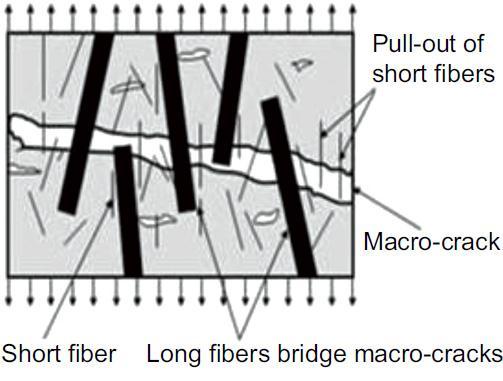
Figure-2: Pull-Out and Macro-Crack Interaction
5.3 Stress Redistribution and Crack Tip Shielding
5.3.1
Contribution of Hybrid Fibers
Stressredistributionreferstotheabilityoffiberstotransfer tensilestressesawayfromhighlystressedregions,thereby reducingcracktipstressintensity.Thisphenomenon,often termedcracktipshielding,lowerstheeffectivedrivingforce for crack propagation. In hybrid systems, basalt fibers controlearly-stagemicrocracks,whilesteelfibersengageat larger crack widths to provide macro-level bridging. The multi-scale reinforcement enhances the size and effectiveness of the fracture process zone, resulting in improvedcrackstability(BenturandMindess,2007).Such synergisticactionreducescracklocalizationunderflexural loadingandincreasesresidualload-bearingcapacity.
5.4 Microcrack Deflection and Crack Path Tortuosity
5.4.1 Interaction between Matrix, Steel, and Basalt Fibers
Crackdeflectionoccurswhenpropagatingcracksencounter inclusions such as aggregates or fibers, causing deviation fromastraightpath.Increasedcrackpathtortuosityraises the fracture surface area and energy required for propagation.Inhybridcomposites,basaltfibersdispersedat the micro-scale disrupt crack continuity at early stages, while steel fibers impose mechanical constraints at larger scales.Thisinteractionproducesdistributedmicrocracking rather than a single dominant crack. The heterogeneous microstructureenhancesaggregateinterlockandfrictional resistance,increasingoverallfractureenergy(Mindessetal., 2003). Consequently, crack propagation becomes more gradualandcontrolled.
International Research Journal of Engineering and Technology (IRJET) e-ISSN: 2395-0056
Volume: 13 Issue: 03 | Mar 2026 www.irjet.net p-ISSN: 2395-0072
5.5 Time-Dependent Aspects of Crack Arrest
5.5.1
Delayed Crack Propagation
Under sustained or progressive flexural loading, crack growth may occur through subcritical propagation mechanismsevenwheninstantaneousstresslevelsremain belowpeakcapacity.Fiberbridgingdelayscrackextension by reducing crack opening rates and distributing stresses over time. The gradual mobilization of fiber pull-out resistance provides resistance against delayed crack instability. Time-dependent fracture models indicate that fiberreinforcementincreasesthecriticalenergyreleaserate required for sustained crack growth (Bazant and Planas, 1998).
5.5.2
Creep Retardation by Fiber Reinforcement
Fiberreinforcementalsoinfluencestensilecreepbehavior within the cracked zone. Fibers restrain crack widening under sustained loading, thereby limiting creep-induced strainaccumulation.Steelfibers,duetotheirhighstiffness, areparticularlyeffectiveinreducinglong-termdeflectionin flexural members, while basalt fibers enhance microcrack stabilityduringearlystagesofsustainedloading.
6. PROGRESSIVE FLEXURAL LOADING: BEHAVIOR AND RESPONSE
Progressiveflexuralloadingisacriticalassessmentmethod for evaluating fracture performance and crack arrest mechanismsincementitiouscomposites.Unlikemonotonic short-termtests,progressiveloading whetherincremental static or cyclic allows detailed observation of crack initiation, propagation stability, stiffness degradation, and residual load-carrying capacity. In high-strength cementitious composites reinforced with hybrid fibers, flexural response provides insight into multi-scale crack controlandtime-dependentperformance.
6.1 Flexural Loading Protocols in Literature
Experimental methodologies adopted in the literature significantly influence the interpretation of fracture behavior.Flexuralperformanceistypicallyassessedusing three-pointorfour-pointbendingtestsunderdisplacementcontrolledloading.
6.1.1 Static-Incremental Loading
In static-incremental loading, the load or displacement is graduallyincreasedinsteps,allowingmeasurementofcrack mouthopeningdisplacement(CMOD),mid-spandeflection, andloadredistributionaftereachincrement.Thisapproach facilitates observation of crack stabilization and fiber bridgingdevelopment.Thefictitiouscrackmodelproposed byHillerborgandcolleaguesformsthetheoreticalbasisfor interpretingsofteningbehaviorinsuchtests(Hillerborget
al.,1976).Incrementalprotocolsareparticularlyusefulfor identifying transition points from elastic response to crackingandfromstabletounstablecrackgrowth.
6.1.2
Cyclic Loading
Cyclic flexural loading introduces repeated load–unload sequencestosimulateserviceconditionssuchastrafficor wind-induced vibrations. Under cyclic regimes, stiffness degradation and progressive crack widening can be monitored.Fatigue-inducedmicrocrackaccumulationoften precedes macrocrack formation, especially in brittle highstrengthmatrices.Repeatedloadingalsoaffectsfiber–matrix bondintegrity,influencingpull-outresistanceandresidual strength (Mindess et al., 2003). Cyclic protocols therefore provide insight into durability and crack arrest efficiency underrealisticloadingscenarios.
6.2 Flexural Toughness and Post-Peak Behavior
The flexural response of fiber reinforced composites is characterizednotonlybypeak loadbutalsobypost-peak loadretentionandenergyabsorptioncapacity.
6.2.1
Evaluation Parameters
CrackMouthOpeningDisplacement(CMOD)iswidelyused to quantify crack propagation under controlled fracture tests. The load–CMOD curve enables determination of fracture energy, defined as the area under the curve normalized by ligament area. Residual flexural strength, often measured at specified CMOD levels or deflection values, indicates the effectiveness of fiber bridging after matrixcracking.Standardizedguidelinessuchasthosefrom RILEMprovideproceduresforevaluatingtoughnessindices andresidualperformance(RILEMTC162-TDF,2003).These parameters are particularly relevant for high-strength matrices where post-peak brittleness is otherwise pronounced.
6.2.2 Post-Peak Softening and Hardening Behavior
Plainhigh-strengthconcretetypicallyexhibitsabruptpostpeaksofteningduetorapidcracklocalization.Incontrast, fiber reinforcement modifies this response, potentially leadingtostrain-hardeningorgradualsofteningdepending onfiberdosageandbondcharacteristics.Theshapeofthe descending branch in the load–deflection curve reflects crack stability and energy dissipation capacity. Enhanced post-peak ductility indicates improved crack arrest efficiency and greater resistance to catastrophic failure (Shahetal.,1995).
International Research Journal of Engineering and Technology (IRJET) e-ISSN: 2395-0056
Volume: 13 Issue: 03 | Mar 2026 www.irjet.net p-ISSN: 2395-0072