
International Research Journal of Engineering and Technology (IRJET) e-ISSN: 2395-0056
Volume: 13 Issue: 02 | Feb 2026 www.irjet.net p-ISSN: 2395-0072
International Research Journal of Engineering and Technology (IRJET) e-ISSN: 2395-0056
Volume: 13 Issue: 02 | Feb 2026 www.irjet.net p-ISSN: 2395-0072
Manish Kumar Pandey1 , Mrs. Arifa Khan2
1Master of Technology, Computer Science and Engineering, Lucknow Institute of Technology, Lucknow, India 2Assistant Professor, Department of Computer Science and Engineering, Lucknow Institute of Technology, Lucknow, India
Abstract - The rapid proliferation of misinformation in online social networks has emerged as a critical societal challenge,influencingpublicopinion,electoralprocesses,and public health responses. Accurate forecasting of temporal misinformation spread is therefore essential for early intervention and mitigation strategies. Recent advances in graph-structureddeeplearninghaveprovidedpowerfultools formodelingthecomplexinterplaybetweennetworktopology andtemporaldynamicsinherentininformationdiffusion.This review systematically synthesizes existing research on temporal misinformation spread forecasting using graphbased deep learning models. We present a structured taxonomy covering static graph neural networks with temporal features, dynamic graph neural networks, hybrid GNN–sequence architectures, and spatio-temporal graph models. The review critically examines methodological designs, benchmark datasets, evaluation protocols, and reported performance trends. Furthermore, we analyze key challenges, including scalability to large-scale networks, handling temporal irregularity, data imbalance, robustness againstadversarialmanipulation,andmodelinterpretability.
By consolidating fragmented research across diffusion modeling and graph representation learning, this review highlights emerging directions such as multimodal fusion, cross-platformforecasting,andexplainablegraphintelligence. Thepaperaimstoprovideresearchersandpractitionerswith a comprehensive understanding of current capabilities, limitations, and future opportunities in temporal misinformationspreadforecasting.
Key Words: Temporal Misinformation Forecasting; Graph Neural Networks; Dynamic Social Networks; Information Diffusion Modeling; Spatio-Temporal Deep Learning; Online Social Media Analytics
1.1 Background on Misinformation in Online Social Networks
Online social networks (OSNs) such as Twitter, Facebook, andWeibohavefundamentallytransformedthemechanisms ofinformation productionanddissemination. Whilethese platforms enable rapid communication and democratized content creation, they also facilitate the large-scale
propagation of misinformation defined as false or misleading information shared irrespective of intent to deceive.Empiricalstudiesdemonstratethatmisinformation spreadsfasterandreachesbroaderaudiencesthanfactual information due to novelty effects, emotional appeal, and algorithmic amplification (Vosoughi, Roy and Aral, 2018). ThestructuralcharacteristicsofOSNs,includingscale-free connectivity and community clustering, further accelerate cascade formation and viral diffusion processes (Barabási andAlbert,1999).Consequently,misinformationdiffusion has become a critical interdisciplinary research problem spanning computer science, sociology, and information systems.
1.1.1
Thesocietalconsequencesofmisinformationaresubstantial and multidimensional. In political contexts, coordinated misinformation campaigns have been linked to electoral manipulationandpolarization(AllcottandGentzkow,2017). DuringpublichealthcrisessuchastheCOVID-19pandemic, misinformationunderminedtrustinscientificguidanceand vaccination programs, exacerbating global health risks (Cinelli et al., 2020). The rapid online amplification of rumors and conspiracy theories has also been associated withsocialunrestandeconomicinstability.Theseimpacts underscore the need not only for detection but also for proactive forecasting mechanisms capable of anticipating diffusiontrajectoriesbeforemisinformationreachescritical mass.
Traditionalmisinformationresearchhasfocusedprimarily on classification and detection after dissemination has occurred. However, early-stage forecasting offers a preventiveparadigmbypredictingcascadegrowth,diffusion speed, and eventual reach. Forecasting enables platform moderators and policymakers to allocate intervention resources efficiently and implement timely countermeasures. From a computational perspective, misinformation spread forecasting is inherently a spatiotemporalpredictionproblem,wherefuturecascadestates must be inferred from evolving network interactions and historical propagation patterns (Cheng et al., 2014).
International Research Journal of Engineering and Technology (IRJET) e-ISSN: 2395-0056
Volume: 13 Issue: 02 | Feb 2026 www.irjet.net p-ISSN: 2395-0072
Therefore, robust predictive modeling is essential for mitigatingdownstreamsocietalharm.
Forecasting misinformation diffusion presents significant methodological and computational challenges due to the dynamic, heterogeneous, and large-scale nature of social networks.
1.2.1
InformationcascadesinOSNsexhibit non-lineartemporal characteristics, including burstiness, rapid early growth, decayphases,andperiodicresurgence.Thesepatternsoften violatestationarityassumptionsunderlyingclassicaltimeseries models. Moreover, diffusion processes may be influenced by exogenous eventssuchasbreaking news or offline incidents, introducing abrupt shifts in propagation rates. Modeling such irregular temporal dependencies requires architectures capable of capturing long-range dependenciesandtime-varyingintensities,beyondsimple autoregressiveframeworks.
1.2.2
Thestructuralconfigurationofsocialnetworkssignificantly shapesdiffusionoutcomes.Centralitymeasures,community structures,andhubnodesinfluenceexposureprobabilities andcascadeamplification.Empiricalevidencefromnetwork science indicates that heterogeneous degree distributions andsmall-worldpropertiesenhanceviralspread(Newman, 2010). Therefore, forecasting models must integrate topological information rather than relying solely on aggregatetemporalfeatures.Ignoring graphstructurecan lead to oversimplified predictions that fail to account for structuralcontagioneffects.
1.2.3 User Behavior Heterogeneity
User-level variability further complicates forecasting. Individuals differ in susceptibility, influence, credibility perception,andactivitypatterns.Behavioralheterogeneity affectsboththelikelihoodofresharingmisinformationand thetemporalspacingofinteractions.Cognitivebiasessuch as confirmation bias and echo chamber dynamics amplify selectiveexposure,reinforcingpolarizedcommunities(Del Vicarioetal.,2016).Consequently,predictivemodelsmust account for node-level heterogeneity and evolving user interactionswithinthenetwork.
Thelimitationsoftraditionaldiffusionandstatisticalmodels have led to increasing adoption of graph-structured deep learningapproachesformisinformationforecasting.
Social networks are inherently relational data structures best represented as graphs, where nodes correspond to
usersorcontentitemsandedgesrepresentinteractionssuch as follows, mentions, or reposts. Graph Neural Networks (GNNs)extenddeeplearningtonon-Euclideandomainsby enabling localized message passing and neighborhood aggregation (Kipf and Welling, 2017). These architectures capturehigher-orderdependenciesandstructuralpatterns that are difficult to model using conventional machine learningtechniques.Furthermore,temporalgraphmodels allow dynamic edge evolution and time-aware representation learning, which are crucial for modeling evolvingmisinformationcascades(Rossietal.,2020).
Early diffusion modeling relied on epidemiological frameworks such as the Susceptible–Infected (SI) and Independent Cascade models, which assume simplified probabilistic transmission mechanisms. While analytically tractable,theseapproachesstruggletoaccommodatehighdimensionalfeaturesandnon-linearpropagationdynamics. The emergence of deep learning, particularly recurrent neuralnetworksandattentionmechanisms,enabledmore expressive modeling of sequential and contextual information. The integration of graph representation learningwithtemporalarchitectureshasfurtherenhanced predictive performance, marking a paradigm shift toward end-to-end spatio-temporal modeling of misinformation spread.
Thisreviewaimstosystematicallysynthesizeresearchon temporal misinformation spread forecasting using graphstructured deep learning models. First, it provides a comprehensive examination of temporal forecasting methodologies applied to information diffusion in online socialnetworks.Second,itproposesastructuredtaxonomy of graph-based deep learning approaches, including static graphmodelswithtemporalencoding,dynamicgraphneural networks,hybridGNN–sequencearchitectures,andspatiotemporal frameworks. Third, it critically analyzes benchmark datasets, evaluation practices, scalability considerations, and robustness issues. Finally, the review identifiesopenresearchchallengesandemergingdirections toguidefutureinvestigationsinpredictivemisinformation analytics.
2.1
The study of misinformation diffusion builds upon interdisciplinary foundations from network science, communication theory, and computational social science. Understanding conceptual distinctions and propagation mechanisms is essential before examining predictive modelingapproaches.
International Research Journal of Engineering and Technology (IRJET) e-ISSN: 2395-0056
Volume: 13 Issue: 02 | Feb 2026 www.irjet.net p-ISSN: 2395-0072
2.1.1 Definitions: Misinformation, Disinformation, Rumors, and Fake News
Misinformation generally refers to false or inaccurate information shared without necessarily intending harm, whereasdisinformationinvolvesdeliberatedisseminationof falsehoodstodeceiveaudiences(WardleandDerakhshan, 2017). Rumors are unverified pieces of information that circulateinuncertaincontextsandmaylaterbevalidatedor debunked. Fake news is a narrower construct typically describing fabricated news articles designed to mimic journalistic formats while promoting false claims for ideological or financial gain (Lazer et al., 2018). These distinctionsareanalyticallyimportantbecausepropagation dynamicsmayvarydependingonintent,credibilitysignals, andcontextualframing.Forinstance,politicallymotivated disinformation campaigns often involve coordinated behavior, while rumors may spread organically due to ambiguityandemotionaltriggers.
2.1.2
Misinformationdiffusioninonlinesocialnetworksisshaped by structural, cognitive, and algorithmic mechanisms. Structurally,scale-freeandsmall-worldpropertiesfacilitate rapid cascade growth through highly connected hubs. Cognitively, novelty and emotional valence significantly increaseresharingprobabilities,contributingtodeeperand fastercascades(Vosoughi,RoyandAral,2018).Algorithmic curation systems further amplify engaging or polarizing content, unintentionally reinforcing misinformation visibility. Additionally, homophily and echo chambers promoteselectiveexposure,increasingwithin-community diffusion while limiting cross-community correction (Del Vicario etal.,2016).Theseinteracting mechanisms create complex, non-linear propagation patterns that challenge predictivemodeling.
2.1.3
Empiricalresearchreliesheavilyonlarge-scalesocialmedia datasets.Twitterdatasetsarewidelyusedduetoaccessible APIsandretweetcascadestructures,enablingfine-grained temporal analysis. Weibo datasets provide comparable large-scalerumorpropagationtraceswithinChinesesocial media ecosystems. Reddit-based corpora offer threaded discussionstructuresthatcaptureconversationaldiffusion. CuratedbenchmarkssuchasFakeNewsNetintegratesocial context, user profiles, and content features to support multimodalanalysis(Shuetal.,2020).Despitetheirutility, thesedatasetsoftensufferfromannotationinconsistencies, classimbalance,andlimitedcross-platformgeneralizability.
Temporal modeling is central to forecasting because misinformation cascades evolve continuously rather than statically.
Informationdiffusionexhibitsburstybehaviorcharacterized byrapidspikesinactivityfollowedbydecayphases.Human communication patterns are inherently heavy-tailed and non-Poissonian, leading to irregular inter-event times (Barabási, 2005). Diurnal and weekly cycles further influenceengagementlevels,reflectingcollectivebehavioral rhythms.Externalshocks suchasbreakingnewsevents can reactivate dormant cascades, producing secondary peaks.Thesepropertiesimplythatdiffusionprocessesare non-stationaryandrequiretime-awaremodelingcapableof capturinglong-rangedependenciesandvariableintensities.
Static forecasting approaches assume fixed network topologyandaggregatetemporalfeatures,oftenpredicting finalcascadesizebasedonearlydiffusionstatistics.While computationally efficient, such models overlook evolving interactionsandstructuralchanges.Dynamicforecasting,in contrast, incorporates time-varying edges and sequential dependencies, enabling step-wise prediction of cascade growth. Dynamic methods better reflect real-world scenarioswhereuserengagementandnetworkconnectivity shiftovertime.Thetransitionfromstaticregression-based predictiontodynamicsequencemodelinghassignificantly improvedtemporalforecastingfidelityincomplexnetworks.
Graph-based representations provide a principled framework for modeling relational dependencies in misinformationspread.
Ingraphformulations,nodestypicallyrepresentusers,posts, or content items, while edges encode interactions such as follows, mentions, replies, or reposts. Edge weights may capture interaction frequency, trust levels, or temporal recency. Directed graphs are often used to reflect asymmetric influence relationships. Incorporating node attributes such as user credibility scores or textual embeddings enhances representational richness. This structured representation enables modeling of relational inductivebiasesabsentinEuclideanfeaturespaces.
Real-world social networks evolve continuously as new edgesformandinteractionsunfold.Temporalgraphsextend staticrepresentationsbyassociatingtimestampswithedges or nodes, producing time-indexed adjacency structures. Dynamicnetworkmodelingallowsrepresentationlearning frameworks to update embeddings incrementally as new events occur. Such representations are particularly importantformisinformationforecasting,whereearly-stage
International Research Journal of Engineering and Technology (IRJET) e-ISSN: 2395-0056
Volume: 13 Issue: 02 | Feb 2026 www.irjet.net p-ISSN: 2395-0072
diffusionsignalsmustbeintegratedwithongoingstructural evolution.
2.3.3
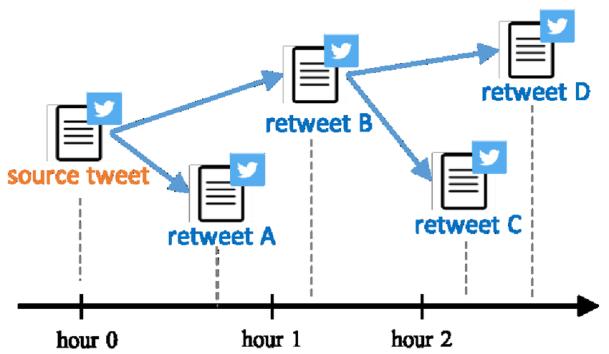
Aninformationcascadecanberepresentedasapropagation tree or directed acyclic graph tracing the sequence of reshares from an initial source. Cascade-based modeling focusesonstructuralgrowthpatterns,depth,breadth,and temporal intervals between events. Tree-structured encodings have been widely used to capture hierarchical diffusion paths, enabling structured learning over propagation trajectories. These representations form the backboneforgraph-basedtemporalpredictionmodels.
Deep learning architectures have substantially advanced sequential modeling capabilities, enabling more accurate temporalforecastingincomplexnetworks.
2.4.1
RNN, LSTM, and GRU
Recurrent Neural Networks (RNNs) model sequential dependencies by maintaining hidden states across time steps. However, standard RNNs suffer from vanishing gradient issues when modeling long-term dependencies. Long Short-Term Memory (LSTM) networks and Gated Recurrent Units (GRUs) address this limitation through gating mechanisms that regulate information flow (Hochreiter and Schmidhuber, 1997). These architectures havebeenwidelyappliedtocascadegrowthpredictionby encoding temporal event sequences and inter-event intervals.
2.4.2 Sequence-to-Sequence
Sequence-to-sequence (Seq2Seq) frameworks extend recurrentmodelingtomapinputsequencestofutureoutput trajectories. Originally developed for machine translation, Seq2Seq models have been adapted for time-series forecasting, enabling multi-step prediction of cascade evolution. Encoder–decoder structures capture historical propagation features, while decoders generate predicted diffusion states for defined forecasting horizons. Such
modelssupportflexibletemporalgranularityandmulti-step predictiontasks.
2.4.3
Attentionmechanismsallowmodelstoselectivelyfocuson relevanttimestepsornodeswhengeneratingpredictions, improving interpretability and performance. Transformer architectures eliminate recurrent structures and rely entirelyonself-attentiontomodellong-rangedependencies efficiently (Vaswani et al., 2017). In diffusion forecasting, attention-based models capture complex interactions between temporal signals and structural embeddings, offering scalability advantages for large-scale networks. Theirparallelizablearchitecturealsoreducestrainingtime comparedtosequentialrecurrentmodels.
Themethodologicallandscapeoftemporalmisinformation spreadforecastingcanbesystematicallyorganizedbasedon how models integrate graph structure and temporal dynamics. Broadly, existing approaches fall into four categories:(i)staticgraphmodelsaugmentedwithtemporal features, (ii) dynamic graph neural networks, (iii) hybrid architectures combining graph learning with temporal sequencemodels,and(iv)fullyintegratedspatio-temporal graph frameworks. This taxonomy reflects increasing modeling sophistication in capturing evolving diffusion processes.
Early graph-based deep learning approaches for misinformationforecastingtypicallyrelyonstaticnetwork representationswhileincorporatingtemporalattributesas auxiliaryfeatures.
3.1.1
GraphConvolutionalNetworks(GCNs)extendspectralgraph theory to deep learning by aggregating information from local neighborhoods in a fixed adjacency matrix (Kipf and Welling, 2017). In misinformation diffusion tasks, static GCNs are often applied to user interaction graphs or propagation trees, where node embeddings encode structural influence. Temporal information such as time since publication, early cascade growth rate, or posting frequency is appended as node-level or global features. Thesehybridrepresentationsallowmodelstoapproximate spatio-temporal dependencies while maintaining computational simplicity. Empirical studies demonstrate that integrating early diffusion statistics with graph embeddingsimprovescascadesizepredictioncomparedto purelytemporalregressionbaselines(Chengetal.,2014).
3.1.2
Despitetheireffectiveness,staticgraphmodelsassumefixed networkconnectivity,whichisunrealisticindynamicsocial platforms.Edgeformationandinteractionintensityevolve
International Research Journal of Engineering and Technology (IRJET) e-ISSN: 2395-0056
Volume: 13 Issue: 02 | Feb 2026 www.irjet.net p-ISSN: 2395-0072
continuously,especiallyduringviralmisinformationevents. Static adjacency matrices cannot capture temporal edge appearance, deletion, or varying interaction strength. Consequently, such models may misrepresent exposure pathwaysandfailtoadapttostructuralshiftsduringcascade evolution.Additionally,staticmodelsoftenrelyonsnapshotbased training, limiting their capacity for real-time forecasting.
To address structural evolution, dynamic graph neural networks(DGNNs)incorporatetime-awarerepresentations thatupdateasnewinteractionsoccur.
3.2.1 Temporal Graph Attention Networks (TGAT) and EvolveGCN
Temporal Graph Attention Networks (TGAT) introduce functionaltimeencodingtomodelcontinuous-timedynamic graphs, enabling attention-based aggregation over temporallyindexedneighbors(Xuetal.,2020).Thisdesign captures both structural proximity and temporal recency. Similarly, EvolveGCN updates GCN parameters through recurrentmechanisms,allowingmodelweightsthemselves toevolvealongsidenetworkstructure(Parejaetal.,2020). Thesearchitectureseliminatetheneedforstaticsnapshots bylearningrepresentationsdirectlyfromeventstreams.In misinformation forecasting, such models better capture shiftinginteractionpatternsandinfluencedynamicsduring cascadegrowth.
3.2.2 Edge Evolution
AcorecomponentofdynamicGNNsisexplicitmodelingof edge evolution. Event-based frameworks represent interactions as time-stamped edges, allowing continuous embeddingupdatesthroughmessagepassingmechanisms. This approach aligns with temporal point process theory, where future interactions depend on historical events. By learning temporal decay functions or attention weights, DGNNsquantifythediminishingorreinforcinginfluenceof pastexposures.Suchmodelingisparticularlyimportantfor misinformationspread,whererapidburstsofengagement cansignificantlyalterfuturepropagationtrajectories.
Hybridarchitecturesintegrategraphrepresentationlearning with sequential models to jointly capture structural and temporaldependencies.
3.3.1
Inthesearchitectures,graphneuralnetworksfirstcompute node or cascade embeddings based on structural information. The resulting embeddings are then fed into recurrentunitssuchasLSTMsorGRUstomodeltemporal evolution. This two-stage design leverages spatial aggregationforrelationalcontextandrecurrentgatingfor
sequential dynamics. Such frameworks have been widely applied in cascade prediction tasks, where early-stage structuralembeddingsinformfuturegrowthestimation.The recurrent component enables modeling of non-linear temporal dependencies and variable forecasting horizons (HochreiterandSchmidhuber,1997).
3.3.2
Recent approaches replace recurrent modules with attention-based architectures. Transformers employ selfattention to capture long-range dependencies without sequential processing constraints (Vaswani et al., 2017). When combined with graph embeddings, attention mechanisms selectively emphasize influential nodes or critical time steps during prediction. This improves scalability and parallelization, particularly for large misinformation cascades. Attention weights also provide partial interpretability by highlighting influential propagationpaths.
Hybrid models typically follow one of three architectural paradigms: (i) graph-first, sequence-second pipelines; (ii) jointly trained spatio-temporal layers; or (iii) attentiondrivenfusionmodulesintegratingstructuralandtemporal signalssimultaneously.Thechoicedependsondatasetscale, temporalgranularity,andcomputationalconstraints.While hybrid approaches offer improved flexibility, they may introduce increased parameter complexity and training instability,particularlyinlongcascadesequences.
Spatio-temporalgraphmodelsunifyspatial(structural)and temporalmodelingwithinasingleintegratedarchitecture.
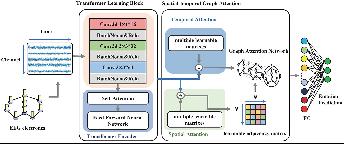
Spatio-temporalGraphNeuralNetworks(ST-GNNs)extend graph convolution operations across both node neighborhoodsandtimesteps.Insteadofseparatingspatial andtemporalmodules,thesemodelsapplyconvolutionor attention mechanisms along the temporal dimension simultaneously with spatial aggregation. Originally developedfortrafficforecastingandsensornetworks,STGNN frameworks have been adapted for social network diffusion modeling (Yu, Yin and Zhu, 2018). This joint modelingcapturescorrelationsbetweenneighboringnodes acrossconsecutivetimeintervals.
International Research Journal of Engineering and Technology (IRJET) e-ISSN: 2395-0056
Volume: 13 Issue: 02 | Feb 2026 www.irjet.net p-ISSN: 2395-0072
3.4.2
Inmisinformationspreadforecasting,ST-GNNarchitectures model cascade growth as a sequence of evolving graph states. Temporal convolutions capture short-term burst patterns, while graph convolutions encode structural dependenciesamongusers.Comparedtohybridpipelines, fully integrated spatio-temporal models reduce modular fragmentationandallowend-to-endoptimization.However, they often require high computational resources and carefullydesignedtimediscretizationstrategies.
Thissectionprovidesastructuredandcriticalsynthesisof existing studies on temporal misinformation spread forecasting using graph-structured deep learning. The discussion is organized according to the taxonomy establishedinSection3,enablingsystematiccomparisonof modelingparadigms,datasets,andempiricalfindings.
Static graph-based approaches represent early efforts to incorporate relational structure into diffusion forecasting tasks.
4.1.1
Initialpredictivestudiesfocusedoncascadesizeestimation usingearly-stagediffusionfeaturescombinedwithnetwork topologydescriptors.Chengetal.(2014)demonstratedthat early structural growth patterns strongly correlate with eventual cascade magnitude. Subsequent work employed GraphConvolutionalNetworkstoencodepropagationtrees anduserinteractiongraphsforrumordetectionandearly predictiontasks(Montietal.,2019).Thesemodelstypically operateonfixedsnapshotsofthenetwork,leveragingnode embeddingsderivedfromadjacencymatrices.
4.1.2 Data Sources and Evaluation
MoststaticgraphmodelsrelyonTwitterandWeibodatasets containinglabeledrumororfakenewscascades.Evaluation protocols frequently include accuracy and F1-score for classification-oriented forecasting, as well as regression metrics such as RMSE for cascade size prediction. Public benchmarks such as FakeNewsNet provide multimodal
signals, enabling integration of textual and social context features(Shuetal.,2020).However,manystudiesevaluate on platform-specific datasets, limiting cross-domain generalization.
4.1.3
Empirical evidence suggests that incorporating structural features improves early-stage forecasting compared to purely temporal baselines. Graph embeddings capture influence concentration and community clustering effects thatcorrelatewithviralgrowth.Nevertheless,staticmodels struggle to represent evolving interactions, resulting in degradedperformanceforlong-horizonpredictions.
4.2 Dynamic GNNs for Temporal Forecasting
Dynamic Graph Neural Networks (DGNNs) address structuralevolutionbymodelingtime-stampedinteractions directly.
4.2.1 Techniques for Dynamic Edge Modeling
Dynamic models often treat interactions as event streams ratherthandiscretesnapshots.TemporalGraphNetworks employ memory modules that update node embeddings incrementallyuponeachnewinteraction(Rossietal.,2020). Continuous-time attention mechanisms allow models to weighneighborsbasedonrecencyandinteractionfrequency (Xu et al., 2020). Other frameworks evolve convolutional parameters through recurrent structures, enabling adaptabilitytostructuralshifts(Parejaetal.,2020).These techniques enhance representational fidelity in rapidly changingmisinformationcascades.
4.2.2
DynamicGNNshavedemonstratedimprovedperformancein early rumor growth prediction on Weibo and Twitter datasets. Studies applying time-aware graph attention mechanisms report superior forecasting accuracy in capturing burst phases and decay trends. By explicitly modelinginteractionsequences,DGNNsoutperformstatic counterparts in scenarios where exposure pathways shift significantlyovertime.However,increasedcomputational overheadremainsaconcerninlarge-scalenetworks.
Hybrid architectures combine graph-based structural encodingwithsequentialdeeplearningmodelstocapture temporalevolution.
4.3.1
A common design pattern involves generating structural embeddings via GCNs and feeding them into recurrent networksfortime-seriesforecasting.Forexample,recurrent rumordetectionframeworksincorporateGRUmodulesto process time-ordered propagation features, achieving improved early prediction performance (Ma et al., 2016).
International Research Journal of Engineering and Technology (IRJET) e-ISSN: 2395-0056
Volume: 13 Issue: 02 | Feb 2026 www.irjet.net p-ISSN: 2395-0072
Sucharchitecturesdecouplespatialandtemporallearning, enablingmodularoptimization.
4.3.2 RNN versus Transformer-Based Approaches
RecurrentnetworkssuchasLSTMandGRUareeffectivefor modeling short- to medium-term dependencies but may struggle with very long cascades due to sequential processingconstraints.Transformer-basedmodelsaddress this limitation through self-attention mechanisms that remindlong-rangerelationshipsandenableparalleltraining (Vaswanietal.,2017).Inmisinformationforecastingtasks, attention-enhanced architectures demonstrate improved stabilityandscalability.Nevertheless,transformerstypically requirelargerdatasetsandhighercomputationalresources foreffectivetraining.
Spatio-temporal Graph Neural Networks (ST-GNNs) integratestructuralandtemporalmodelingwithinunified architectures.
4.4.1 Joint Spatial and Temporal Modeling
ST-GNNframeworksapplygraphconvolutionsacrossnode neighborhoodswhilesimultaneouslyincorporatingtemporal convolutions or attention across time steps. Originally introduced for traffic and sensor forecasting (Yu, Yin and Zhu, 2018), these models have been adapted to capture misinformation cascade evolution. By jointly optimizing spatial and temporal dependencies, ST-GNNs reduce informationlossassociatedwithmodularhybridpipelines.
4.4.2
Empiricalevaluationsindicatethatspatio-temporalmodels outperformseparatedgraph-then-sequenceapproachesin multi-stepforecastingtasks.Theirintegrateddesignbetter captures correlations between neighboring users across consecutivetimeintervals.However,thesemodelsdemand substantial computational resources and often require discretization of continuous time into fixed intervals, potentiallyaffectingtemporalprecision.
4.5 Cross-Method
A comparative assessment across modeling paradigms highlightstrade-offsinpredictiveperformance,scalability, andinterpretability.
4.5.1
Staticgraphmodelsarecomputationallyefficientandeasier to train but lack adaptability to structural evolution. Dynamic GNNs offer higher representational fidelity yet introduceincreasedmemoryandcomputationaldemands. Hybridarchitecturesbalanceflexibilityandperformancebut maysufferfromarchitecturalcomplexity.Fullyintegrated spatio-temporalmodelsprovideend-to-endoptimizationat thecostofscalabilitychallenges.
Static GCN-based approaches generally scale with the numberofedgesinaconsideredsnapshot.Dynamicmodels incur additional overhead from time encoding and incrementalembeddingupdates.Transformer-basedhybrids introduce quadratic complexity with respect to sequence length due to self-attention operations. Consequently, practical deployment requires careful trade-offs between accuracyandefficiency.
Large-scale online social networks pose significant scalability constraints due to millions of nodes and highfrequency interactions. Sampling strategies, mini-batch training, and neighborhood truncation are frequently adopted to manage memory usage. Distributed training frameworksandgraphpartitioningtechniquesareemerging toaddressindustrial-scalemisinformationmonitoring.
Robust evaluation of temporal misinformation spread forecasting models depends critically on dataset quality, temporal annotation strategies, and appropriate performancemetrics.Variationsinbenchmarkconstruction and evaluation design significantly influence reported outcomes, making standardized assessment practices essentialformeaningfulcomparison.
Benchmark datasets form the empirical foundation for model development and validation in misinformation forecastingresearch.
5.1.1 Twitter, Weibo, FakeNewsNet, and PolitiFact Datasets
Twitter-baseddatasetsarewidelyusedduetotheplatform’s retweetstructure,whichnaturallyformspropagationtrees suitable for cascade modeling. These datasets typically includetimestamps,userinteractions,andlabeledrumoror fake news instances. Weibo datasets provide analogous large-scale rumor propagation data within Chinese social media ecosystems, enabling cross-cultural comparative analysis.
FakeNewsNetintegratesnewscontent,userprofiles,social engagement data, and fact-checking annotations from sources such as PolitiFact and GossipCop, offering a multimodal benchmark for misinformation detection and forecasting (Shu et al., 2020). PolitiFact datasets, derived from professional fact-checking organizations, supply verified labels for political misinformation and are often linkedwithcorrespondingsocialmediapropagationtraces. While these datasets are valuable, their construction methodologiesdiffersubstantially,leadingtoinconsistencies in network scale, class distribution, and annotation granularity.
International Research Journal of Engineering and Technology (IRJET) e-ISSN: 2395-0056
Volume: 13 Issue: 02 | Feb 2026 www.irjet.net p-ISSN: 2395-0072
5.1.2
Temporalannotationplaysacrucialroleinforecastingtasks. Most datasets record timestamps at the level of posts, retweets, or replies, enabling reconstruction of cascade evolution sequences. Some studies discretize continuous time into fixed intervals (e.g., hourly or daily bins) to facilitatetemporalmodeling,whereasothersadopteventdriven continuous-time representations. The choice of annotationstrategydirectlyaffectsforecastinggranularity andmodeldesign.Event-basedannotationpreservesfinegrained temporal dependencies, while interval-based aggregationsimplifiescomputationbutmayobscureburst dynamics. Consequently, evaluation results must be interpretedinlightofthesetemporaldesigndecisions.
5.2
Performanceevaluationinmisinformationforecastingvaries dependingonwhetherthetaskisframedasclassification, regression,ormulti-steptime-seriesprediction.
5.2.1
For classification-oriented forecasting (e.g., predicting whetheracascadewillexceedapredefinedsizethreshold), commonly reported metrics include Accuracy, Precision, Recall, and F1-score. F1-score is particularly important in imbalanced datasets where positive misinformation instances are underrepresented. For regression-based forecasting tasks, such as predicting final cascade size or growth rate, Root Mean Square Error (RMSE) and Mean AbsolutePercentageError(MAPE)arefrequentlyemployed. RMSEpenalizeslargedeviationsmorestrongly,whileMAPE provides scale-invariant interpretability in percentage terms.Selectionofappropriatemetricsshouldalignwiththe forecastingobjectiveandthedistributionalcharacteristicsof cascadesizes.
5.2.2
Beyondpredictiveaccuracy,somestudiesevaluatehowwell modelscapturestructuraldiffusionproperties.Metricssuch ascascadedepth,structuralvirality,andreproductionratio provideinsightintopredictedpropagationpatterns(Goelet al.,2016).Structuralvirality,forexample,quantifieswhether diffusion resembles a broadcast pattern or a multigenerational branching process. Incorporating structural metrics enables more nuanced assessment of whether predictedcascadesreflectrealisticnetworkbehavior.
5.2.3
Forecasting horizon specification significantly influences model evaluation. Short-term forecasting may involve predictingcascadegrowthwithinthenextfewhours,while long-termforecastingtargetsfinalcascadesize.Somestudies adoptrollingpredictionwindows,updatingforecastsasnew interactions occur. Others define early prediction tasks, whereonlyinitialdiffusionstages(e.g.,first10%ofcascade events)areobservable.Differencesinforecastinghorizons
complicatecross-studycomparisonandhighlighttheneed forstandardizedbenchmarkingprotocols.
Despite progress in benchmark development, several methodologicalchallengespersist.
5.3.1
Misinformation datasets often exhibit severe class imbalance, where true news cascades significantly outnumberfalseonesorviceversa.Thisimbalancecanbias modelstowardmajorityclassesandinflateaccuracymetrics withoutreflectingrealpredictivecapability.Techniquessuch asresampling,cost-sensitivelearning,andmetricselection (e.g., macro-averaged F1) are commonly employed to mitigate this issue. However, inconsistent handling of imbalanceacrossstudiesreducescomparabilityofreported results.
Establishing reliable ground truth labels remains a fundamentalchallenge.Fact-checkingorganizationsprovide authoritative labels, but verification processes are timeconsumingandoftenlimitedtohigh-profilecases(Lazeret al., 2018). Additionally, misinformation may evolve over timeasnewevidenceemerges,complicatingstaticlabeling. Insomedatasets,rumorveracityisinferredindirectlyfrom userreportsorplatformmoderationdecisions,whichmay introduceannotationnoise.Suchuncertaintiesdirectlyaffect trainingstabilityandevaluationvalidity.
5.3.3
Temporal fragmentation arises when datasets capture incompletecascadehistoriesduetoAPIlimitations,deleted content, or restricted data access. Missing early-stage interactions can distort diffusion patterns and bias forecasting models. Furthermore, cross-platform misinformation propagation where content migrates between networks is rarely captured comprehensively. Theselimitationsconstrainecologicalvalidityandhighlight theimportanceoftransparentreportingofdatacollection procedures.
Despite significant progress in graph-structured deep learning for temporal misinformation spread forecasting, several technical and methodological challenges remain unresolved.Theseissuesaffectmodelscalability,temporal reliability, interpretability, robustness, and real-world applicability.
Forecasting misinformation spread in real-world online social networks requires handling graphs with millions of nodesandhigh-frequencyinteractions.
International Research Journal of Engineering and Technology (IRJET) e-ISSN: 2395-0056
Volume: 13 Issue: 02 | Feb 2026 www.irjet.net p-ISSN: 2395-0072
6.1.1
Graph Neural Networks (GNNs) typically rely on neighborhood aggregation mechanisms whose computational complexity grows with node degree and graphsize.Inlarge-scalesocialplatforms,full-batchtraining becomesinfeasibleduetomemorylimitationsandmessagepassing overhead. Sampling-based techniques such as neighborhood sampling mitigate this challenge but may introducerepresentationbias(Hamilton,YingandLeskovec, 2017). Additionally, dynamic graph models incur extra computationalcostsformaintainingtemporalembeddings and updating representations with each event. These constraintshinderdeploymentinreal-timemisinformation monitoring systems where latency and throughput are critical.
Temporal irregularities present fundamental modeling challengesindiffusionforecasting.
6.2.1
Socialinteractionsoccurasynchronously,resultinginnonuniformtimeintervalsbetweenevents.Traditionaldiscretetime models assume regular sampling, which may distort real-world dynamics. Continuous-time dynamic graph frameworksaddressthisbyencodingtimestampsdirectly intoembeddingfunctions(Xuetal.,2020). However,such modelsrequirecarefuldesigntopreventoverfittingtohighfrequency bursts while preserving meaningful long-range dependencies. Balancing temporal precision with computationalefficiencyremainsanopenresearchproblem.
6.2.2
Misinformation diffusion processes are inherently nonstationary. External shocks, policy interventions, trending topics, and algorithmic changes can alter propagation dynamics abruptly. Models trained on historical cascades may fail to generalize when underlying diffusion mechanismsshift.Non-stationaritychallengesassumptions of stable data distributions commonly required in supervisedlearning.Adaptivelearningstrategiesandonline updatingmechanismsarethereforenecessarytomaintain forecastingreliabilityovertime.
6.3
As forecasting models become more complex, interpretability becomes critical for accountability and policydeployment.
6.3.1
Graph neural networks aggregate multi-hop relational signals, making prediction pathways difficult to interpret. Post-hoc explanation methods such as GNNExplainer attempttoidentifyinfluentialsubgraphsandnodefeatures contributing to predictions (Ying et al., 2019). However,
explanation fidelity in dynamic diffusion settings remains limited.Inmisinformationforecasting,stakeholdersrequire interpretable justifications to understand why certain cascadesarepredictedtobecomeviral.Withouttransparent reasoning,modeloutputsmaylackcredibilityinregulatory orplatformmoderationcontexts.
6.3.2
Forecastingmisinformationspreadraisesethicalconcerns related to censorship, free speech, and algorithmic bias. Predictive systems may disproportionately target specific communitiesiftrainingdatareflectexistingsocietalbiases. Furthermore, automated early-warning systems could inadvertentlysuppresslegitimatediscourseiffalsepositives occur. Responsible deployment requires fairness-aware evaluationandtransparentreportingofmodellimitations.
The reliability of forecasting models is closely tied to the qualityofmisinformationdatasets.
6.4.1
Ground truth labels in misinformation datasets often originate from fact-checking organizations or manual annotationprocesses.However,labelingcanbesubjective, delayed, or incomplete. Weak supervision may introduce noisy labels that degrade model performance and distort evaluation results (Northcutt, Jiang and Chuang, 2021). Moreover,misinformationnarrativesmayevolve,rendering staticlabelsoutdated.Addressinglabelnoisethroughrobust learningtechniquesremainsanactiveareaofresearch.
6.4.2
Data collection limitations frequently result in incomplete cascadehistories.APIratelimits,deletedposts,andprivacy restrictions create gaps in interaction sequences. Missing early-stageeventscansignificantlybiastemporalmodeling, asearlydiffusionsignalsareoftenmostpredictiveoffuture growth. Imputation strategies and uncertainty-aware modelingapproachesareneededtomitigatetheimpactof temporalincompleteness.
Misinformationecosystemsinvolveadversarialactorswho activelymanipulatepropagationdynamics.
6.5.1
Coordinated bot networks and malicious users may artificially amplify misinformation through synchronized reposting or strategic timing. Such adversarial behaviors distort organic diffusion patterns and can mislead forecastingmodels.Graph-baseddeeplearningmodelsare particularlyvulnerabletoadversarialperturbationsinnode features or edge structures (Zügner, Akbarnejad and Günnemann,2018).Robusttrainingmethodsandanomaly
International Research Journal of Engineering and Technology (IRJET) e-ISSN: 2395-0056
Volume: 13 Issue: 02 | Feb 2026 www.irjet.net p-ISSN: 2395-0072
detection mechanisms are therefore critical for secure deployment.
Ensuringrobustnessrequiresdesigningmodelsresilientto structuralnoiseandadversarialattacks.Techniquessuchas adversarial training, graph regularization, and anomalyaware embedding updates have shown promise in improving stability. However, balancing robustness with computationalefficiencyremainschallenging,especiallyin real-time monitoring scenarios. Future research must address the co-evolution of forecasting systems and adversarialmisinformationstrategies.
Thisreviewsystematicallyexaminedtheevolvinglandscape of temporal misinformation spread forecasting in online socialnetworksthroughthelensofgraph-structureddeep learning. By organizing existing studies into static graph models, dynamic graph neural networks, hybrid graph–sequencearchitectures,andfullyintegratedspatio-temporal frameworks, the paper highlighted the methodological progression from snapshot-based structural encoding to continuous-time adaptive modeling. The synthesis demonstratesthatincorporatingrelationalinductivebiases through graph representations substantially improves forecasting fidelity compared to purely temporal or statistical baselines. Dynamic and attention-based architecturesfurtherenhancetheabilitytocapturebursty, non-stationary diffusion patterns characteristic of misinformationcascades.
However,thereviewalsounderscorespersistentchallenges, including scalability to large-scale networks, temporal heterogeneity, data noise, adversarial manipulation, and limited interpretability. Benchmark inconsistencies and variations in evaluation protocols hinder rigorous crossstudycomparison.Emergingdirectionssuchasmultimodal fusion,explainablegraphintelligence,onlineadaptation,and robustness-aware training present promising avenues for advancing predictive misinformation analytics. Overall, graph-structured deep learning offers a powerful yet still maturingparadigmforproactivemisinformationmitigation, requiringcontinuedinterdisciplinarycollaborationtobridge methodological innovation with responsible real-world deployment.
7.1.Limitations of the Review
This review is limited by its reliance on publicly available benchmark studies and peer-reviewed publications, potentially overlooking proprietary or industrial systems deployed by social media platforms. Variations in dataset constructionandevaluationmetricsacrossstudiesrestrict direct quantitative comparison. Additionally, the rapidly evolving nature of graph learning and misinformation research means that newly proposed models may not be
comprehensively covered. The review emphasizes methodological synthesis rather than empirical metaanalysis, and therefore does not provide standardized performancebenchmarkingacrossmodels.
1. Allcott,H.andGentzkow,M.(2017)‘Socialmediaand fake news in the 2016 election’, Journal of Economic Perspectives,31(2),pp.211–236.
2. Barabási,A.-L.(2005)‘Theoriginofburstsandheavy tailsinhumandynamics’,Nature,435,pp.207–211.
3. Barabási, A.-L. and Albert, R. (1999) ‘Emergence of scalinginrandom networks’,Science,286(5439),pp. 509–512.
4. Cheng, J., Adamic, L., Dow, P.A., Kleinberg, J.M. and Leskovec, J. (2014) ‘Can cascades be predicted?’, Proceedings of the 23rd International Conference on WorldWideWeb,pp.925–936.
5. Cinelli, M., Quattrociocchi, W., Galeazzi, A., Valensise, C.M., Brugnoli, E., Schmidt, A.L., Zola, P., Zollo, F. and Scala,A.(2020)‘TheCOVID-19socialmediainfodemic’, ScientificReports,10,16598.
6. DelVicario,M.,Bessi,A.,Zollo,F.,Petroni,F.,Scala,A., Caldarelli, G., Stanley, H.E. and Quattrociocchi, W. (2016) ‘The spreading of misinformation online’, Proceedings of the National Academy of Sciences, 113(3),pp.554–559.
7. Goel,S.,Anderson,A.,Hofman,J.andWatts,D.J.(2016) ‘Thestructuralviralityofonlinediffusion’,Management Science,62(1),pp.180–196.
8. Hamilton, W.L., Ying, Z. and Leskovec, J. (2017) ‘Inductive representation learning on large graphs’, Advances in Neural Information Processing Systems, 30.
9. Hochreiter,S.andSchmidhuber,J.(1997)‘Longshortterm memory’, Neural Computation, 9(8), pp. 1735–1780.
10. Kipf, T.N. and Welling, M. (2017) ‘Semi-supervised classification with graph convolutional networks’, InternationalConferenceonLearningRepresentations (ICLR).
11. Lazer, D.M.J., Baum, M.A., Benkler, Y., Berinsky, A.J., Greenhill, K.M., Menczer, F., Metzger, M.J., Nyhan, B., Pennycook, G., Rothschild, D., Schudson, M., Sloman, S.A., Sunstein, C.R., Thorson, E.A., Watts, D.J. and Zittrain,J.L.(2018)‘Thescienceoffakenews’,Science, 359(6380),pp.1094–1096.
International Research Journal of Engineering and Technology (IRJET) e-ISSN: 2395-0056
Volume: 13 Issue: 02 | Feb 2026 www.irjet.net p-ISSN: 2395-0072
12. Ma,J.,Gao,W.,Mitra,P.,Kwon,S.,Jansen,B.J.,Wong,K.F. and Cha, M. (2016) ‘Detecting rumors from microblogs with recurrent neural networks’, Proceedingsofthe25thInternationalJointConference onArtificialIntelligence(IJCAI),pp.3818–3824.
13. Monti, F., Frasca, F., Eynard, D., Mannion, D. and Bronstein,M.M.(2019)‘Fakenewsdetectiononsocial media using geometric deep learning’, IEEE Transactions on Signal Processing, 67(5), pp. 1250–1260.
14. Newman,M.(2010)Networks:AnIntroduction.Oxford: OxfordUniversityPress.
15. Northcutt, C.G., Jiang, L. and Chuang, I.L. (2021) ‘Confidentlearning:Estimatinguncertaintyindataset labels’, Journal of Artificial Intelligence Research, 70, pp.1373–1411.
16. Pareja,A.,Domeniconi,G.,Chen,J.,Ma,T.,Suzumura,T., Kanezashi, H., Kaler, T., Leiserson, C.E. and Chen, J. (2020) ‘EvolveGCN: Evolving graph convolutional networksfordynamicgraphs’,ProceedingsoftheAAAI ConferenceonArtificialIntelligence,34(04),pp.5363–5370.
17. Rossi,E.,Chamberlain,B.,Frasca,F.,Eynard,D.,Monti, F. and Bronstein, M.M. (2020) ‘Temporal graph networksfordeeplearningondynamicgraphs’,ICML WorkshoponGraphRepresentationLearning.
18. Shu,K.,Mahudeswaran,D.,Wang,S.,Lee,D.andLiu,H. (2020) ‘FakeNewsNet: A data repository with news content, social context, and dynamic information for studyingfakenews’,BigData,8(3),pp.171–188.
19. Vaswani,A.,Shazeer,N.,Parmar,N.,Uszkoreit,J.,Jones, L., Gomez, A.N., Kaiser, Ł. and Polosukhin, I. (2017) ‘Attention is all you need’, Advances in Neural InformationProcessingSystems,30.
20. Vosoughi,S.,Roy,D.andAral,S.(2018)‘Thespreadof true and false news online’, Science, 359(6380), pp. 1146–1151.
21. Wardle, C. and Derakhshan, H. (2017) Information disorder: Toward an interdisciplinary framework for researchandpolicymaking.CouncilofEuropeReport.
22. Xu,D.,Ruan,C.,Korpeoglu,E.,Kumar,S.andAchan,K. (2020)‘Inductiverepresentationlearningontemporal graphs’, International Conference on Learning Representations(ICLR).
23. Ying,R.,Bourgeois,D.,You,J.,Zitnik,M.andLeskovec,J. (2019) ‘GNNExplainer: Generating explanations for graph neural networks’, Advances in Neural InformationProcessingSystems,32.
24. Yu,B.,Yin,H.andZhu,Z.(2018)‘Spatio-temporalgraph convolutionalnetworks:Adeeplearningframeworkfor traffic forecasting’, Proceedings of the 27th InternationalJointConferenceonArtificialIntelligence, pp.3634–3640.
25. Zügner,D.,Akbarnejad,A.andGünnemann,S.(2018) ‘Adversarialattacksonneuralnetworksforgraphdata’, Proceedings of the 24th ACM SIGKDD International ConferenceonKnowledgeDiscovery&DataMining,pp. 2847–2856.
26. Almutairi,M.,Aktas,M.Y.,Wali,N.,Mitra,S.andZhou,D. (2024) Enhancing temporal link prediction with HierTKG: A hierarchical temporal knowledge graph framework,arXivpreprint.
27. Plepi, J., Sakketou, F., Geiss, H.-J. and Flek, L. (2022) ‘Temporalgraphanalysisofmisinformationspreaders insocialmedia’,ProceedingsofTextGraphs-16:Graphbased Methods for Natural Language Processing, pp. 89–104.
28. Tong, Q., Xu, X., Zhang, J. and Xu, H. (2025) ‘Public opinion propagation prediction model based on dynamic time-weighted Rényi entropy and graph neuralnetwork’,Entropy,27(5),516.
29. Sharma,S.andLi,Y.(2025)Fakenewsdetectionusing temporal snapshots in graph neural networks, 2025 Workshop on Computing, Networking and Communications(CNC).
30. Temporally evolving graph neural network for fake news detection (2021) Information Processing & Management.
31. ‘Dynamic graph neural network for fake news detection’(2022)Neurocomputing.
32. ‘Bidirectional temporal-delay graph convolutional networkfordetectingfakenews’(2024)Engineering ApplicationsofArtificialIntelligence.
33. Li, H., Jiang, L. and Li, J. (2024) Continuous-time dynamic graph networks integrated with knowledge propagation for social media rumor detection, Mathematics,12(22),3453.
34. Li, H., Huang, G., Li, C., Li, J. and Wang, Y. (2023) Adaptive spatial–temporal and knowledge fusing for social media rumor detection, Electronics, 12(16), 3457.
35. Guille,A.,Hacid,H.andFavre,C.(2013)Predictingthe temporal dynamics of information diffusion in social networks,arXivpreprint.
International Research Journal of Engineering and Technology (IRJET) e-ISSN: 2395-0056
Volume: 13 Issue: 02 | Feb 2026 www.irjet.net p-ISSN: 2395-0072
36. Yuan, C., Li, J., Zhou, W. et al. (2020) DyHGCN: A dynamicheterogeneousgraphconvolutionalnetwork forinformationdiffusionprediction,arXivpreprint.
37. Ullah,A.U.,Abbasi,R.A.,Khattak,A.S.andSaid,A.(2023) Identifyingmisinformationspreaders:Agraph-based semi-supervisedlearningapproach,arXivpreprint.
38. Chen, Z., Wei, J., Liang, S., Cai, T. et al. (2021) ‘Informationcascadespredictionwithgraphattention’, FrontiersinPhysics.
39. Asurveyonrumordetectionandpreventioninsocial mediausingdeeplearning(2025)AnnalsofEmerging Technologies in Computing overview of GNN methodsinrumordetection.
40. Predicting information diffusion via deep temporal convolutionalnetworks(2022)InformationSciences.
41. Ethan,V.andDennis,T.(2025)Temporalgraphneural networksforearlydetectionofcoordinatedfakenews campaignsacrosssocialmediaplatforms,ResearchGate preprint.
42. IC-Mamba: Early prediction of misinformation engagement(2025)Lin,T.etal.,arXivpreprint state space forecasting (engagement, not only binary detection).
43. CausalMamba:Interpretabletemporalrumorcausality modeling(2025)Zhan,X.andCheng,X.,arXivpreprint causaldynamicmodelswithGNN-likearchitectures.