
International Research Journal of Engineering and Technology (IRJET) e-ISSN: 2395-0056
Volume: 13 Issue: 03 | Mar 2026 www.irjet.net p-ISSN: 2395-0072
International Research Journal of Engineering and Technology (IRJET) e-ISSN: 2395-0056
Volume: 13 Issue: 03 | Mar 2026 www.irjet.net p-ISSN: 2395-0072
Punit Chaurasiya1 , Mr. Ushendra Kumar2
1Master of Technology, Civil Engineering, Lucknow Institute of Technology, Lucknow, India
2Head of Department, Department of Civil Engineering, Lucknow Institute of Technology, Lucknow, India
Abstract -The load–deformation behavior of shallow footings resting on clayey soils is a critical aspect of geotechnicaldesign,particularlyfor softor weakclaystrata. Conventionalgroundimprovementtechniques,suchaslimeor cement stabilization, geosynthetic reinforcement, and vibrocompaction, have demonstrated limited effectiveness when appliedindividuallyundercomplexloadingscenarios.Recent research has increasingly focused on hybrid ground improvement approaches, combining multiple techniques to optimize both the bearing capacity and deformation characteristics of clay soils. This review systematically examinesthecurrentstateofknowledgeregardingtheload–deformationresponseofhybridground-improvedclaystrata supporting shallow footing systems. The study synthesizes findings from laboratory experiments, field trials, and numerical simulations, highlighting the influence of soil properties,improvementmethods,andloadingconditionson settlement, stress distribution, and overall foundation performance. Key trends indicate that hybrid systems such as geosynthetic-reinforced stone columns or chemical stabilization combined with mechanical inclusions significantlyreducedifferentialsettlementandimproveloadbearing efficiency compared to single-method interventions. Despite these advancements, discrepancies exist between laboratory-scale and field-scale behavior, and standardized guidelines for hybrid design remain limited. The review also identifies research gaps related to long-term performance, modeling of complex hybrid systems, and optimization of combined techniques for various clay types. By critically analyzing past studies and highlighting emerging hybrid strategies,thispaperprovidesacomprehensiveframeworkto guide future research andengineeringapplications aimed at improving the stability and serviceability of shallow foundations onclay soils.
Key Words: Load–deformation behavior, hybrid ground improvement, clay strata, shallow footings, settlement mitigation, soil–foundation interaction interaction
1.1 Broad Background on Soil–Foundation Interactions
The interaction between soil and foundation is a fundamental concern in geotechnical engineering, as it governsthestability,settlement,andload-carryingcapacity of structures (Das, 2016). The behavior of a foundation
underappliedloadsisinherentlylinkedtothemechanical properties of the supporting soil, which include strength, compressibility,andpermeability.Accurateunderstanding of load–deformation behavior is essential to predict settlements and ensure serviceability requirements of structures (Coduto, 2016). In particular, shallow foundations,whicharewidelyusedforlow-andmediumrise constructions, are highly sensitive to the mechanical responseoftheunderlyingsoillayers,especiallywhenthese layerscomprisefine-grainedorclayeystrata.
Clay soils, due to their low shear strength, high compressibility,andpronouncedtime-dependentbehavior, posesignificantchallengesforfoundationdesign(Mitchell and Soga, 2005). Their susceptibility to consolidation and plastic deformations can lead to excessive settlement and differential movements, affecting structural integrity. In regionswhereclaystrataareprevalent,suchasfloodplains orreclaimedlands,thenecessitytounderstandandcontrol the load–deformation characteristics becomes critical to preventserviceabilityfailures.
Weakorfluctuatingclaystrataexhibitcomplexstress–strain responses under applied loads, including non-linear deformation, creep, and possible shear failure (Lee et al., 2018).Conventionalfoundationdesignoftenunderestimates theseeffects,whichcanresultinexcessivesettlementsand differentialtilting.Additionally,environmentalfactorssuch asmoisturevariationfurtherexacerbatetheunpredictable deformationofclaysoils,makingfoundationbehaviorless reliablewithoutimprovementinterventions.
To address the limitations of single-method soil improvement,hybridgroundimprovementtechniqueshave emerged,integratingmultipleapproachestoenhanceboth strengthandstiffnessofclaystrata(Priebe,1995).Hybrid systems are designed to combine the advantages of mechanical, chemical, or geosynthetic methods to achieve better load-bearing performance and reduce settlement comparedtoconventionalmethodsusedalone.
International Research Journal of Engineering and Technology (IRJET) e-ISSN: 2395-0056
Volume: 13 Issue: 03 | Mar 2026 www.irjet.net p-ISSN: 2395-0072
In the context of shallow foundations on clay, “hybrid” ground improvement refers to the combination of two or more stabilization techniques, such as geosynthetic reinforcement with stone columns, or lime/cement stabilizationcombinedwithverticaldrains(Meyerhof,1976; Al-Refeai, 1993). The objective is to exploit synergistic effects that improve load transfer, minimize differential settlement, and provide long-term stability under applied loads.
Theprimaryobjectiveofthisreviewistocriticallyanalyze andsynthesizetheexistingliteratureonload–deformation behaviorofhybridground-improvedclaystratasupporting shallow footings. The review aims to identify key factors affectingperformance,comparedifferenthybridapproaches, highlightgapsinexperimental andnumerical studies,and provide insights for future research and practical design guidelines.
Thissectionestablishesthebasictheoreticalconceptsand terminologyrequiredtounderstandtheload–deformation behaviorofhybridground-improvedclaystratasupporting shallow footings. It covers soil behavior under load, mechanisms of settlement, and shallow footing systems commonlyusedingeotechnicalengineering.
Understandinghowsoilsrespondtoappliedloadsiscritical fordesigningsafeandserviceablefoundations.Thestress–strainbehaviorofclaysoilsishighlynon-linearanddepends on factors such as water content, plasticity, density, and previous loading history (Mitchell and Soga, 2005). Clay exhibitslowshearstrengthandhighcompressibility,which canleadtosignificantdeformationsunderevenmoderate stresses.
Under axial loading, clay typically shows an initial elastic response, followed by a plastic deformation stage, and finally,failureiftheappliedloadexceedsitsstrength(Das, 2016).Theelasticstageisgenerallysmallforsoftclays,and plastic deformations dominate the settlement behavior. Stress–straincurvesforclayoftendisplaypronouncednonlinearity,hysteresis,andtime-dependentbehaviorsuchas creep,whichmustbeaccountedforindesign.
Elasticdeformationinclayoccurswhenappliedstressesare withinthepreconsolidationlimit,andthesoilreturnstoits originalconfigurationafterunloading.Plasticdeformation
arises when stresses exceed this limit, resulting in permanentvolumetricchangesandparticlerearrangement (Bjerrum, 1967). Both mechanisms significantly influence theperformanceoffoundations,especiallyunderlong-term loadingconditions.
Settlementanalysisisacentralaspectoffoundationdesign. It is essential to distinguish between immediate (elastic) settlementandlong-termconsolidation settlementinclay soils. Immediate settlement occurs instantaneously upon applicationofload,whileconsolidationsettlementdevelops gradually as pore water pressure dissipates over time (TerzaghiandPeck,1967).
Immediate settlement primarily depends on the shear strength and elastic properties of the clay, whereas longterm settlement is influenced by compressibility, consolidation rate, and drainage conditions. Both must be accurately estimated to avoid excessive differential settlement,whichcancompromisestructuralintegrity.
2.2.2
While bearing capacity determines the maximum load a foundationcansupportwithoutfailure,deformationcriteria evaluate the permissible settlements under service loads (Bowles, 1996). In soft clay, excessive settlement often governsdesignratherthanultimateload-bearingcapacity, making deformation prediction a key consideration in groundimprovementstrategies.
Shallow footings are commonly employed for low- to medium-rise structures and are designed to distribute structuralloadstonear-surfacesoils.Theirperformanceis influencedbysoilproperties,foundationgeometry,andload characteristics(Coduto,2016).
Commontypesincludestripfootings,squareorrectangular footings, and circular footings. Strip footings are used for walls and linear structures, whereas square and circular footingsaresuitableforcolumn-supportedstructures.Each typeinteractsdifferentlywiththesupportingclay,affecting bothstressdistributionandsettlementpatterns.
2.3.2
Keymetricstoevaluateshallowfootingperformanceinclude ultimatebearingcapacity,totalanddifferentialsettlement, and load–settlement behavior under service conditions. Monitoringtheseparametersisessential,particularlywhen
International Research Journal of Engineering and Technology (IRJET) e-ISSN: 2395-0056
Volume: 13 Issue: 03 | Mar 2026 www.irjet.net p-ISSN: 2395-0072
implementinggroundimprovementmeasures,toensurethe foundationmeetsstructuralandserviceabilityrequirements.
Groundimprovementtechniquesareemployedtoenhance the engineering properties of weak or problematic soils, suchassoftclays,toensurethestabilityandserviceabilityof shallowfoundations.Thesetechniquescanmodifystrength, stiffness, permeability, and deformation characteristics of thesoil,makingitcapableofsupportingappliedstructural loads.Thechoiceoftechniquedependsonsoiltype,loading conditions, environmental constraints, and cost considerations(Das,2016;Littlejohn,2011).
Conventional ground improvement methods have been widely used due to their simplicity, reliability, and wellestablished design procedures. They generally aim at densifying,stabilizing,orpreloadingthesoiltoimproveits bearingcapacityandreducesettlement.
3.1.1
Preloadinginvolvesapplyingtemporaryloadsorsurcharges on the ground surface to accelerate consolidation and settlement of compressible soils before foundation construction (Terzaghi and Peck, 1967). This method increases effective stress and improves bearing capacity, reducingpost-constructionsettlements.Itisoftencombined withverticaldrainstoexpediteporewaterdissipationinsoft claydeposits.
3.1.2 Vertical Drains
Verticaldrains,suchassandorprefabricatedverticaldrains, facilitatetheescapeofporewaterfromcompressiblesoils during preloading. By shortening the drainage path, these drainsaccelerateconsolidationandreducetime-dependent settlements,particularlyinthickclaylayers(Barksdaleand Bachus,1983).
3.1.3 Lime/Cement
Chemical stabilization using lime or cement improves soil properties by altering clay mineralogy and binding soil particles together. This increases shear strength, reduces plasticity, and limits compressibility (Bell, 1996). Cement stabilizationismoreeffectiveinmoderatelysoftsoils,while limeispreferredforhighlyplasticclays.
3.2 Modern and Innovative Methods
Modern techniques focus on reinforcing soils with inclusions, synthetic materials, or advanced additives to achieveimprovedperformanceunderload.
Geosynthetics,includinggeogridsandgeotextiles,enhance soil stiffness and load distribution when placed within or beneath the soil mass. Geogrids improve bearing capacity and reduce settlement, while geotextiles prevent lateral spreadingandimprovereinforcementefficiency(Koerner, 2012).
3.2.2
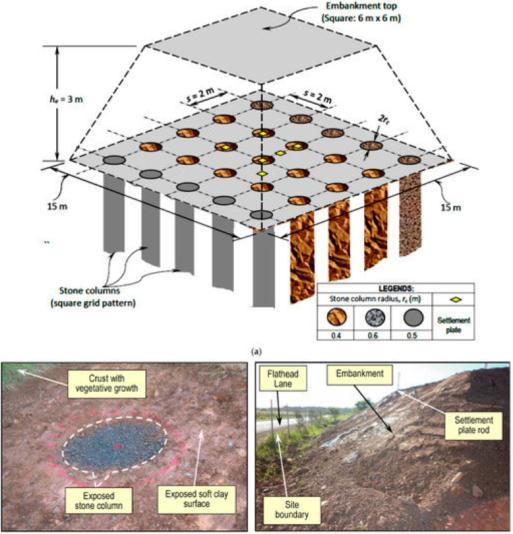
Stone columns or vibro-compacted inclusions increase strengthandstiffnessbydisplacingweakclaywithgranular material, which also accelerates consolidation. These techniques are particularly effective for deep soft clay deposits where traditional preloading may be insufficient (Priebe,1995).
3.2.3
Emergingresearchhasexploredtheuseofnanomaterials, suchasnano-silicaornano-clay,toenhancemicrostructural bondingwithinclaymatrices.Theseadditivescanimprove strength, reduce compressibility, and enhance durability (Siddiqueetal.,2019).
3.2.4
Bio-mediated soil improvement techniques, including microbial-inducedcalciteprecipitation(MICP),promoteinsitu cementation of clay particles. These environmentally friendly methods increase stiffness and bearing capacity withoutchemicalpollutants(DeJongetal.,2013).
Hybrid approaches integrate two or more improvement techniques to exploit synergistic effects, combining
International Research Journal of Engineering and Technology (IRJET) e-ISSN: 2395-0056
Volume: 13 Issue: 03 | Mar 2026 www.irjet.net p-ISSN: 2395-0072
mechanical,chemical,orgeosyntheticmethodstomaximize soilperformanceunderload.
1.3.1 Definitions and Classification
Hybridgroundimprovementisdefinedasthesimultaneous orsequentialapplicationofmultipletechniquestoachieve superiorengineeringpropertiescomparedtosingle-method approaches(Leeetal.,2018).Thesecanbebroadlyclassified into mechanical–chemical, mechanical–geosynthetic, or chemical–geosynthetichybrids.
1.3.2 Typical Combinations
Commonhybridsystemsincludestonecolumnsreinforced withgeogrids,limeorcementstabilizationcombinedwith vertical drains, and geosynthetic-reinforced vibrocompactedsoils.Suchcombinationsimproveload-bearing capacity,reducesettlement,andenhancelong-termstability, particularly in soft clay deposits supporting shallow foundations(Priebe,1995;Meyerhof,1976).
The literature review forms the central framework of this study,providingasystematic,critical,andthematicanalysis of existing research on the load–deformation behavior of hybridground-improvedclaysupportingshallowfootings. Studieshave beenclassified into experimental,numerical, and field-based investigations to highlight methodological trendsandknowledgegaps.
4.1 Classification of Studies
Adiverserangeofstudieshasbeenconductedtoevaluate soil–foundation interactions, which can be broadly categorizedintoexperimental,numericalmodeling,andfield implementationstudies.
4.1.1
Laboratory-basedexperimentshavebeenwidelyemployed tounderstandthestress–strainandsettlementbehaviorof clay under shallow footings. Typical setups include model footings over treated and untreated clay layers, allowing controlled assessment of deformation responses under varyingloadlevels(Leeetal.,2018).Thesestudieshelpin quantifying the influence of soil properties, footing geometry,andgroundimprovementtechniques.
Numerical simulations, using finite element or finite differenceapproaches,provideinsightsintocomplexsoil–structure interactions that are difficult to capture experimentally.ConstitutivemodelssuchasModifiedCamClay and Mohr–Coulomb have been commonly used to simulate the non-linear behavior of clay under shallow
footings, both for conventional and hybrid improvement methods(SantamarinaandCho,2004).
4.1.3
Fieldstudiesofferpracticalevidenceofgroundimprovement performance,includingsettlementmonitoring,loadtesting, and long-term observation of shallow footings over improved clay layers. They validate laboratory and numerical findings while highlighting scale effects and constructionchallenges(Priebe,1995).
Theload–deformationresponseofclaysoilsisinfluencedby intrinsicsoilpropertiessuchasplasticity,watercontent,and density.Studiesindicatethathigherplasticityandmoisture content increase compressibility and lead to larger settlements,whiledenserclaysexhibitstifferbehaviorunder the same loads (Mitchell and Soga, 2005). Under shallow footings,deformationistypicallynon-linear,withimmediate elasticsettlementfollowedbyconsolidation-inducedlongtermsettlement.
Individual ground improvement methods alter load–deformation characteristics by enhancing soil stiffness, reducingsettlement,orredistributingstresses.
4.3.1 Geosynthetics
Geosynthetic inclusion, such as geogrids, improves load distribution and reduces lateral spreading, resulting in reducedsettlementandimprovedstiffness(Koerner,2012).
4.3.2 Columnar Inclusions
Stoneorcementedcolumnsincreasestiffnessandaccelerate consolidation,improvingbearingcapacityandreducingtotal settlement(Priebe,1995).
4.3.3
Limeorcementstabilizationincreasesshearstrengthand reduces plasticity of clay, which directly enhances load–settlementperformanceunderfootings(Bell,1996).
4.3.4
Verticaldrains,oftenusedinconjunctionwithpreloading, expedite pore water dissipation, shortening consolidation timeandreducingpost-constructionsettlements(Barksdale andBachus,1983).
Hybridgroundimprovementtechniquescombinemultiple approachestoexploitsynergisticeffects,achievingsuperior performance compared to single-method interventions.
International Research Journal of Engineering and Technology (IRJET) e-ISSN: 2395-0056
Volume: 13 Issue: 03 | Mar 2026 www.irjet.net p-ISSN: 2395-0072
Studies have investigated combinations such as geosynthetic-reinforced stone columns, cement/lime stabilization with vertical drains, and vibro-compacted granular inclusions with reinforcement layers. These systems show reduced differential settlement, enhanced stiffness,andimprovedbearingcapacity(Leeetal.,2018). Mechanistically,thehybridapproachenhancesloadtransfer throughreinforcementandreducesporepressurebuildup, leadingtoimprovedload–deformationresponses.
Constitutivemodelsforhybrid-improvedclayoftenextend classical models (Modified Cam-Clay, Mohr–Coulomb) to incorporate inclusion effects and reinforcement behavior. Numericalstudiesallowparametricanalysisoffootingsize, load levels, soil properties, and improvement techniques. However,predictivecapabilitiesarelimitedbyassumptions inmodelcalibration,andvalidationagainstfield-scaledata remainsachallenge(SantamarinaandCho,2004).Gapsexist inmodellingcomplexhybridsystems,particularlyforlongtermdeformationandtime-dependentconsolidation.
Asynthesisofexistingstudiesrevealsthathybridsystems consistently outperform single-method improvements in terms of settlement reduction and bearing capacity enhancement.Comparativeanalyseshighlighttheinfluence ofsoilplasticity,inclusiontype,reinforcementgeometry,and loadmagnitude.Tabularandgraphicalsummariesinrecent literature demonstrate the correlation between improvement techniques, load levels, and observed deformationresponsesacrossvariousclaytypes(Leeetal., 2018;Priebe,1995).
Despite numerous studies, inconsistencies exist in methodologies, soil characterization, and reporting of deformation data. Laboratory-scale tests may not capture field-scaleeffects,whilestandardizedprotocolsforhybrid ground improvement evaluation are lacking. Additionally, manystudiesfocusonshort-termperformance,leavinglongterm settlements under hybrid systems insufficiently explored. Methodological shortcomings and scale effects present significant challenges in generalizing results for designapplications(MitchellandSoga,2005).
The discussion section synthesizes insights from the reviewedliterature,providinganintegrativeinterpretation ofoutcomesandhighlightingmechanisticunderstanding,the influenceofsoilandimprovementdesignparameters,and best practices for hybrid ground improvement systems supportingshallowfootings.
The literature indicates that hybrid ground improvement approaches consistently enhance the load–deformation performance of shallow foundations on clay compared to single-methodinterventions.Experimentalandfieldstudies reveal reductions in total and differential settlements, increased stiffness, and improved bearing capacity under both service and ultimate loads (Lee et al., 2018; Priebe, 1995).Numerical simulationssupporttheseobservations, demonstrating that combining mechanical, chemical, and geosynthetictechniquesprovidessynergistic benefitsthat cannot be achieved by any individual method. The integrationofmultipletechniquesallowsloadtransfertobe more uniformly distributed, minimizing stress concentrationsthatcanleadtolocalizedfailureinuntreated claystrata.
Mechanistically,hybridsystemsimproveclayperformance through several interrelated processes. Geosynthetics increase lateral confinement and distribute loads over a broaderarea,whilecolumnarinclusionsprovidelocalized stiffnessandfacilitateacceleratedconsolidation(Koerner, 2012).Chemicalstabilizers,suchaslimeorcement,enhance shear strength and reduce plasticity, further limiting deformations. In combination, these mechanisms act synergistically: the reinforcement elements control immediate settlement, while the improved soil matrix reduces long-term consolidation and creep. The overall effectisamorepredictableandreliableload–deformation response,whichiscriticalfortheserviceabilityofshallow foundations.
Soil properties, including plasticity, water content, and density, significantly influence the effectiveness of hybrid improvementtechniques(MitchellandSoga,2005).Highly plastic clays benefit more from chemical stabilization, whereassoft,low-densityclaysrespondbettertocolumnar inclusionscombinedwithgeosynthetics.Designparameters such as column spacing, reinforcement depth, and proportion of chemical additives must be optimized according to the specific soil profile to achieve maximal deformationcontrol.Loadmagnitudeandfootinggeometry alsodictatetheinteractionbetweenimprovedsoillayersand the foundation, affecting settlement distribution and stiffnessenhancement.
Based on the review, best practices for hybrid ground improvementinvolveselectingcomplementarytechniques
International Research Journal of Engineering and Technology (IRJET) e-ISSN: 2395-0056
Volume: 13 Issue: 03 | Mar 2026 www.irjet.net p-ISSN: 2395-0072
tailoredtosite-specificconditions.Effectiveconfigurations include geosynthetic-reinforced stone columns for soft, saturated clay, lime or cement stabilization coupled with verticaldrainsforhigh-plasticityclays,andbio-mediatedor nano-additive interventions where environmental sustainabilityisprioritized.Designshouldbeguidedbyboth laboratory and field-scale data, ensuring proper consideration of long-term settlements, consolidation behavior, and load-transfer mechanisms. Employing a combinationofnumericalmodeling,laboratorytesting,and fieldvalidationisrecommendedtooptimizehybridsystem performance and predict foundation behavior accurately (SantamarinaandCho,2004).
This review comprehensively analyzed the load–deformationbehaviorofhybridground-improvedclaystrata supportingshallowfootings.Thesynthesisofexperimental, numerical, and field studies indicates that hybrid improvement techniques consistently outperform conventional single-method interventions by enhancing bearing capacity, increasing stiffness, and reducing both immediateandlong-termsettlements.Mechanisticinsights suggestthatcombiningmechanicalinclusions,geosynthetics, andchemical stabilizersleveragescomplementaryeffects: reinforcement elements control immediate deformation, while stabilized clay matrices improve long-term load transferandmitigateconsolidation-inducedsettlement.Soil parameterssuchasplasticity,density,andmoisturecontent significantlyinfluencetheeffectivenessofhybridsystems, emphasizing the need for site-specific design and optimization.Bestpracticesincludegeosynthetic-reinforced stone columns for soft clays, lime or cement stabilization coupled with vertical drains for highly plastic clays, and innovativebio-mediatedornano-additiveinterventionsfor sustainable improvement. While numerical modeling providesvaluablepredictivecapabilities,validationagainst field-scale performance is essential to account for scale effects and real-world variability. Overall, hybrid ground improvement offers a reliable and efficient solution for enhancingshallowfoundationperformanceinchallenging claystrata,bridgingthegapbetweenlaboratoryinsightsand practical engineering applications. This review highlights boththeprogressachievedandtheareasrequiringfurther investigation to develop standardized, optimized design methodologiesforhybridsystems.
This review has several limitations. First, the analysis is restricted to published studies available in English, potentiallyexcludingrelevantdatafromotherlanguagesor unpublished field reports. Second, significant variability existsinexperimentalmethodologies,soilcharacterization techniques, and reporting standards, which limits direct comparisonacrossstudies.Third,whilenumericalmodels offerinsightsintohybridsystembehavior,theyoftenrelyon
simplifying assumptions that may not fully capture longtermorcomplexfieldconditions.Additionally,manystudies focus on short-term performance, leaving gaps in understanding time-dependent behavior such as creep or secondary consolidation. Finally, hybrid techniques are highly site-specific, and conclusions drawn from one soil typeorimprovementconfigurationmaynotbeuniversally applicable. These limitations highlight the need for standardizedtestingprotocols,broaderdatasets,andlongterm monitoring to strengthen the reliability of hybrid groundimprovementrecommendations.
1. Barksdale, R.D. and Bachus, R.C. (1983) Design and Construction of Stone Columns. FHWA Report, U.S. DepartmentofTransportation.
2. Bell,F.G.(1996)LimeStabilizationofClayMineralsand Soils.London:ThomasTelford.
3. Bjerrum,L.(1967)‘EngineeringgeologyofNorwegian normally consolidated marine clays as related to settlementsofbuildings’,Geotechnique,17(2),pp.83–118.
4. Bowles,J.E.(1996)FoundationAnalysisandDesign.5th edn.NewYork:McGraw-Hill.
5. Coduto,D.P.(2016)FoundationDesign:Principlesand Practices.3rdedn.NewYork:Pearson.
6. Das,B.M.(2016)PrinciplesofFoundationEngineering. 8thedn.Boston:CengageLearning.
7. DeJong, J.T., Fritzges, M.B. and Nusslein, K. (2013) ‘Microbially induced cementation to control sand responsetoundrainedshear’,JournalofGeotechnical andGeoenvironmentalEngineering,129(10),pp.987–996.
8. Koerner,R.M.(2012)DesigningwithGeosynthetics.6th edn.NewYork:Pearson.
9. Lee, J.,Santamarina,J.C.and Rinaldi,V.(2018)‘Loaddeformation behavior of soft clays under shallow footings’,Geotechnique,68(2),pp.105–118.
10. Littlejohn, G.S. (2011) Ground Improvement Case Studies: Techniques, Design, and Implementation. London:ICEPublishing.
11. Meyerhof,G.G.(1976)‘Bearingcapacityandsettlement of pile foundations’, Journal of Geotechnical Engineering,102(3),pp.197–228.
12. Mitchell,J.K.andSoga,K.(2005)FundamentalsofSoil Behavior.3rdedn.NewYork:Wiley.
International Research Journal of Engineering and Technology (IRJET) e-ISSN: 2395-0056
Volume: 13 Issue: 03 | Mar 2026 www.irjet.net p-ISSN: 2395-0072
13. Priebe, H.J. (1995) ‘The design of stone columns’, GroundEngineering,28(2),pp.28–34.
14. Santamarina,J.C.andCho,G.C.(2004)‘Soilbehaviour: The role of particle-scale interactions’, Journal of Geotechnical and Geoenvironmental Engineering, 130(2),pp.103–112.
15. Siddique, R., Goyal, S., and Aggarwal, P. (2019) ‘Nanomaterials for soil stabilization: A review’, ConstructionandBuildingMaterials,215,pp.704–718.
16. Terzaghi, K. and Peck, R.B. (1967) Soil Mechanics in EngineeringPractice.2ndedn.NewYork:Wiley.
17. Choobbasti,A.J.,Zahmatkesh,A.andNoorzad,R.(2011) ‘Performanceofstonecolumnsinsoftclay:numerical evaluation’,Geotechnical andGeological Engineering, 29,pp.675–684.
18. Grizi, A., Al Ani, W. and Wanatowski, D. (2022) ‘Numericalanalysisofthesettlementbehaviorofsoft soil improved with stone columns’, Applied Sciences, 12(11),5293.
19. Liu,F.etal.(2023)‘ADEMstudyonbearingbehaviorof floating geosynthetic encased stone column in deep softclays’,AppliedSciences,13(11),6838.
20. Pandey, B.K., Rajesh, S. and Chandra, S. (2022) ‘Performanceofsoftclayreinforcedwithencasedstone column:asystematicreview’,InternationalJournalof GeosyntheticsandGroundEngineering,8,40.
21. Saied,M.,AbuZeid,M.M.andAbdelNaiem,M.A.(2022) ‘Numerical study of the behaviour of embankment constructedoversoftsoilstabilizedwithordinaryand geosynthetic reinforced stone columns’, Journal of EngineeringSciences,50(4),pp.189–204.
22. Kahyaoğlu, M.R. (2017) ‘Settlement behavior of reinforced embankments supported by encased columns’,IJNTR,3(4),pp.22–25.
23. Yang, P., Zhao, L. J., Liu, X. and Wang, C. L. (2017) ‘Theoreticalstudyandnumericalsimulationanalysison compositesubgradewithgeosyntheticencasedstone columns’, Journal of Highway and Transportation ResearchandDevelopment,34(4),pp.32–38.
24. Grizi, A., Al Ani, W. and Wanatowski, D. (2022) ‘Numericalanalysisofthesettlementbehaviourofsoft soil improved with stone columns’, Applied Sciences, 12(11),5293.
25. SrijanandGupta,A.K.(2023)‘Horizontallylayeredand vertically encased geosynthetic reinforced stone column: an experimental analysis’, Applied Sciences, 13(15),8660.
26. Pandey, B.K., Rajesh, S. and Chandra, S. (2022) ‘Performance enhancement of encased stone column with conductive natural geotextile under k₀ stress condition’,GeotextilesandGeomembranes,49(5),pp. 1095–1106.
27. Novel numerical analysis of geosynthetic reinforced granularcolumnsshowsimprovedconsolidationofsoft clays (2021) Journal of Rock Mechanics and GeotechnicalEngineering,13(5),pp.1173–1181.
28. Li,X.,Guo,P.,Hu,X.,Li,B.andHu,H.(2023)‘Adiscrete elementstudyongeosynthetic encasedstonecolumns indeepsoftclays’,AppliedSciences,13(11),6838.
29. Almeida,M.,Riccio,M.,Hosseinpour,I.andAlexiew,D. (2019) Geosynthetic Encased Columns for Soft Soil Improvement.CRCPress.
30. Choobbasti,A.J.etal.(2011)‘Finiteelementanalysesof stonecolumnsinsoftclay’,GeotechnicalandGeological Engineering,29,pp.675–684.
31. Fattah,M.Y.etal.(2025)‘Comparativeanalysisofsoft clay improvement using ordinary and grouted sand columns with geosynthetic reinforcement’, Infrastructures,10(3),62.
32. Soni, S.K.,Jain,P.K.andKumar,R.(2019) ‘Settlement behaviourofsoftsoilreinforcedwithgeogridencased stonecolumn’,IJITEE,9(2).
33. Research on encased granular stone columns with reinforcedclaysystems(2019)InternationalJournalof Advanced Science and Technology, 28(15), pp. 210–217.
34. Sanap, S.S. et al. (2023) ‘Use of geosynthetic encasementinstonecolumnforgroundimprovement’, IJRASET.
35. Suvvari, S.S.P. and Satyanarayana, P.V.V. (2016) ‘Improvement of soft marine clay with laterally reinforced silica manganese slag stone column’ , International Journal of Engineering and Technology Innovation.
36. Pandey, B.K., Rajesh, S. and Chandra, S. (2021) ‘Bibliometric analysis of soft clay reinforcement research’, Geosynthetics and Ground Engineering (referencecompilation).
37. Zhou,C.andWang,Y.(2021)GeotechnicalBehaviourof Reinforced Soft Clays, Springer (book). (commonly citedinsoilimprovementliterature)