
International Research Journal of Engineering and Technology (IRJET) e-ISSN: 2395-0056
Volume: 13 Issue: 03 | Mar 2026 www.irjet.net p-ISSN: 2395-0072
A REVIEW OF INVESTIGATION OF MECHANICAL PERFORMANCE AND CRACK PROPAGATION BEHAVIOR IN FIBER-ENHANCED CONCRETE SYSTEMS
Ramanuj1 , Mr. Ushendra Kumar2
1Master of Technology, Civil Engineering, Lucknow Institute of Technology, Lucknow, India
2Head of Department, Department of Civil Engineering, Lucknow Institute of Technology, Lucknow, India
Abstract -Fiber-enhancedconcrete(FEC)hasemergedasa pivotal solution to improve the mechanical performance and durability of conventional concrete. The incorporation of fibers intocementitiousmatricessignificantlyenhancestensile and flexural strength, toughness, and crack resistance, addressing inherent brittleness in traditional concrete. This review systematically examines existing literature on the mechanical performance and crack propagation behavior of fiber-reinforced concrete systems. Various fiber types, including steel, synthetic, glass, and natural fibers, as well as hybrid fiber combinations, are critically evaluated for their influence on compressive, tensile, andflexural properties. The review highlights the key mechanisms governing crack initiation,propagation, andbridging, emphasizingthe role of fiber geometry, dosage, orientation, and matrix–fiber interaction. Experimental methods such as digital image correlation, scanning electron microscopy, acoustic emission techniques, and fracture mechanics-based evaluations are analyzedtoprovide insight intomicro-andmacro-scalecrack behavior. The synthesis of literature reveals that hybrid fiber systems often exhibit superior toughness and crack control compared to single fiber systems, though performance is highly dependent on proper fiber dispersion and matrix compatibility. Modeling approaches, including finite element and cohesive zone methods, are also discussed as tools for predicting fracture behavior and guiding structural design. Despiteextensiveresearch,inconsistencies intestingmethods, limitedlong-term durability studies,andlack ofstandardized evaluation protocols remain major challenges. This review identifies gaps in current knowledge and proposes directions for future research, including multi-scale modeling, sustainability considerations, and advanced smart fiber systems. The insights providedare intendedto guide material selection,structuraldesign,andpracticalapplicationoffiberenhanced concrete in infrastructure development.
Key Words: Fiber-reinforced concrete; Mechanical performance; Crack propagation; Fracture mechanics; Toughness; Hybrid fibers; Durability; Concrete matrix
1. INTRODUCTION
1.1 Background and Industrial Significance
Concrete is the most widely used construction material worldwide,formingthebackboneofinfrastructuresuchas
bridges, buildings, pavements, and dams due to its high compressivestrength,cost-effectiveness,andadaptabilityto different structural forms (Mishra et al., 2025). Its widespread industrial use stems from a long history of performance under compressive loads and ease of production using locally available materials. However, conventional concrete exhibits inherent deficiencies that limititsservicelifeandstructuralreliability.Specifically,it has very low tensile and flexural strength and is prone to brittle failure once cracks form, as it possesses limited tensilestraincapacityandweakresistancetocrackinitiation andpropagation(Anasetal.,2022;Ediletal.,2024).These limitations can lead to the development of micro-cracks under service loads, which grow and coalesce, eventually compromising structural integrity and leading to costly maintenance and potential safety issues. Furthermore, cracking accelerates durability deterioration through increasedpermeabilitytoharmfulagentssuchaschlorides and sulfates, exacerbating reinforcement corrosion and reducingservicelife.
Conventional concrete’s poor performance under tensile stressesposeschallengesindynamicloadingenvironments, such as seismic zones or heavy traffic pavements, where crackgrowthcanacceleratestructuraldegradation.Thishas motivatedbothacademicresearchandpracticalinnovation toward materials that can mitigate such deficiencies and improveinfrastructureresilience(Mishraetal.,2025;Anas etal.,2022).
1.2 Motivation for Using Fiber Reinforcement
The limitations of traditional concrete particularly its brittlenessandsusceptibilitytocracking havedriventhe development of fiber-enhanced materials. Fiber reinforcementinvolvestheincorporationofdispersedshort fibers into the cementitious matrix to act as micro-reinforcement,improvingpost-crackingbehaviorand overall structural performance (Anas et al., 2022). The addition of fibers increases tensile capacity and energy absorption, enabling concrete to withstand higher crack opening stresses and delaying crack propagation beyond initial failurepoints(Mishra etal.,2025). Thisisachieved through mechanisms such as crack bridging and stress redistribution:fibersintersectmicro-cracks,restraincrack growth, and enhance toughness by transferring stresses
International Research Journal of Engineering and Technology (IRJET) e-ISSN: 2395-0056
Volume: 13 Issue: 03 | Mar 2026 www.irjet.net p-ISSN: 2395-0072
across cracked planes, leading to improved ductility and resistancetofracture(Ediletal.,2024).
Fibersalsocontributetoenhanceddurabilitybycontrolling crackspacingandwidth,reducingpathwaysforaggressive agents and thereby mitigating long-term degradation of concrete structures (Anas et al., 2022; Edil et al., 2024). These mechanical and durability benefits have broad implicationsforinfrastructureperformanceandservicelife, motivatingextensiveresearchonfiber-reinforcedconcrete (FRC)inbothlaboratoryandfieldapplications.
1.3 Objectives and Scope of Review
This review aims to synthesize existing research on the mechanicalperformanceandcrackpropagationbehaviorof fiber-enhancedconcretesystems,focusingonhowdifferent fibertypes,contents,andtestingmethodsaffectstructural performance and fracture resistance. Unlike experimental studiesthatinvestigateindividualconcretemixes,thispaper systematically compares findings across a range of fiber materials including steel, synthetic, natural, and hybrid fibers toidentifycommon patterns,performancetrends, and underlying mechanisms governing mechanical enhancementandcrackcontrol.
Thescopeencompassesvariousperformancemetricssuch as compressive strength, tensile and flexural behavior, toughnessindices,andfracturepropertiesunderdifferent loadingconditions.Testingmethodsandfractureevaluation techniquesreportedintheliteraturearealsoexaminedto highlightmethodologicaldifferencesandtheirinfluenceon reported outcomes. Finally, the review delineates boundariesbyspecifyingthatitfocusesonfiber-reinforced concrete systems reported in peer-reviewed studies and doesnotincludealternativereinforcementsystemssuchas traditional rebar or advanced nanocomposites beyond common fibers. This structured review provides a comprehensive understanding of the state of the art in fiber-enhanced concrete and identifies gaps for future research.
2. MATERIALS AND FIBER TYPES
2.1 Concrete Matrix and Key Properties
Theconcretematrixservesasthecontinuousphaseinwhich fibers are embedded, significantly influencing the mechanical behavior and durability of fiber-enhanced concretesystems.Itisprimarilycomposedofcement,water, fine aggregates, and coarse aggregates, with optional supplementarycementitiousmaterialssuchasflyash,silica fume,orslagtoenhanceperformance(Neville,2012).Key properties of the concrete matrix, including compressive strength,workability,andshrinkagecharacteristics,playa critical role in determining the efficiency of fiber reinforcement. A well-designed matrix ensures adequate bonding with fibers and allows stress transfer across the
fiber–matrix interface, which is essential for controlling crackpropagationandimprovingtoughness.Water–cement ratio,aggregategrading,andadmixtureusealsoinfluence fiber dispersion and overall mechanical performance, makingmatrixoptimizationacrucialstepinfiber-reinforced concrete(FRC)design.
2.2 Classification of Fibers
Fibersusedinconcretecanbebroadlyclassifiedbasedon their material composition, mechanical properties, and functional roles. Selection depends on the intended performance improvement, such as crack resistance, toughness,orimpactabsorption.
2.2.1 Steel Fibers
Steelfibersarethemostwidelystudiedmetallicfibersand areknownfortheirhightensilestrengthandstiffness.They effectively control both micro- and macro-cracks and enhanceflexuralstrength,toughness,andimpactresistance of concrete (Banthia and Gupta, 2006). Their geometry, including length, diameter, and aspect ratio, along with properdosage,criticallyaffectsperformance,particularlyin structuralandindustrialflooringapplications.
2.2.2
Synthetic Fibers (e.g., Polypropylene, Nylon)
Synthetic fibers such as polypropylene and nylon are lightweight,corrosion-resistant,andchemicallyinert.These fibers primarily reduce plastic shrinkage cracking and improve post-cracking ductility without significantly increasing the density of concrete (Bentur and Mindess, 2007).Their effectivenessdepends on fiber length,aspect ratio, and distribution, with higher dosages generally improvingcrackcontrolbutpotentiallyaffectingworkability.
2.2.3 Glass Fibers
Glass fibers, including alkali-resistant (AR) glass, provide enhancedtensilepropertiesanddimensionalstability.They are particularly useful in controlling surface cracks and improvingtensileandflexuralperformanceinarchitectural or precast applications (Badr and Youssef, 2014). Proper matrixcompositioniscriticaltopreventfiberdegradationin thealkalineenvironmentofcementpaste.
2.2.4 Natural Fibers (e.g., Sisal, Bamboo)
Naturalfibers,derivedfromplantssuchassisal,bamboo,or coir,offersustainablealternativesforreinforcementdueto theirbiodegradabilityandlowcost.Whiletheirmechanical propertiesarelowerthansyntheticorsteelfibers,theycan improvecrackresistanceandtoughnessinlow-tomediumstrength concrete, especially in rural or eco-friendly construction(SoroushianandLee,2013).Pretreatmentand properdispersionareimportanttoenhancedurabilityand fiber–matrixbonding.
International Research Journal of Engineering and Technology (IRJET) e-ISSN: 2395-0056
Volume: 13 Issue: 03 | Mar 2026 www.irjet.net p-ISSN: 2395-0072
2.2.5 Hybrid Fiber Systems
Hybridfibersystemscombinetwoormoretypesoffibers (e.g., steel + polypropylene) to exploit synergistic effects. These systems often provide superior crack control, toughness,andpost-crackingenergyabsorptioncompared to single-fiber systems, balancing stiffness, ductility, and cost-effectiveness (Bentur and Mindess, 2007). Hybridization allows designers to tailor concrete performance to specific structural or environmental demands.
2.3 Fiber Properties Relevant to Performance
Fiber performance in concrete depends on mechanical, geometric, and dosage characteristics. Mechanically, high tensile strength and modulus of elasticity improve stress transfer across cracks and enhance toughness (Neville, 2012).Geometricfactorssuchasfiberlength,diameter,and aspectratioinfluencecrack-bridgingefficiency,dispersion, and pull-out resistance. Proper dosage and uniform dispersion are essential to avoid fiber clumping, ensure effectivecrackcontrol,andmaintainworkability.Optimizing theseparametersensuresthatfiberreinforcementmeetsthe desiredstructuralanddurabilityobjectives.
3. REVIEW OF MECHANICAL PERFORMANCE
Fiberreinforcementsignificantlyinfluencesthemechanical performance of concrete, improving its ability to resist cracking, enhance post-cracking behavior, and increase structural resilience. Numerous studies have investigated howdifferentfibertypes,dosages,andcombinationsaffect compressive, tensile, and flexural properties, as well as toughnessand impact resistance.Thissection synthesizes key findings from recent literature and identifies critical trends.
3.1 Compressive Strength Behavior
Theincorporationoffibersintoconcretegenerallyresultsin modestimprovementsincompressivestrength,thoughthe effect is highly dependent on fiber type, geometry, and dosage. Steel fibers, due to their high stiffness and tensile strength, typically contribute to a 5–15% increase in compressivestrength,particularlyatdosagesrangingfrom 0.5%to2%byvolume(BanthiaandGupta,2006).Synthetic fibers such as polypropylene or nylon generally have minimalimpactoncompressivestrengthbutimprovepostcracking integrity by bridging micro-cracks (Bentur and Mindess, 2007). Comparative studies indicate that hybrid fiber systems, combining steel with synthetic fibers, can provide synergistic effects, simultaneously enhancing compressivecapacityandenergyabsorption(Mishraetal., 2025). Overall, while fiber reinforcement does not drastically change the peak compressive strength, it improvespost-peakbehaviorandstructuralreliabilityunder compression.
3.2 Tensile and Flexural Strength
Fibershaveapronouncedinfluenceontensileandflexural strength, where conventional concrete is weakest. Steel fibers improve both direct tensile strength and flexural capacity, increasing toughness and delaying crack propagation(BanthiaandGupta,2006).Syntheticandglass fiberscontributemoretocontrollingcrackwidthandpostcrackingductilitythanpeakstrength.Flexuraltoughnessis commonly assessed according to RILEM and ASTM standards (ASTM C1609, 2020), which evaluate energy absorption under load-deflection curves. Comparative studies reveal that hybrid fiber systems often outperform single-fiber mixes in flexural toughness, providing higher post-crackingload-carryingcapacityanddeflectionatfailure (Ediletal.,2024).
3.3 Impact Resistance and Post-Cracking Behavior
Fiber-reinforced concrete exhibits enhanced resistance to impactanddynamicloadsduetothecrack-bridgingeffect. Steelfiberssignificantlyincreaseenergyabsorption,while syntheticfibershelpcontrolmicro-crackpropagationduring repeatedloadingcycles(BenturandMindess,2007).Postcrackingbehaviorisquantifiedbymeasuringloadretention afterinitialcrackformation.Hybridsystemstypicallyshow superiorenergydissipationunderimpactcomparedtosingle fiber types, providing better durability in high-traffic pavementsandindustrialflooringapplications.
3.4 Toughness and Ductility
Toughnessreferstothetotalenergyamaterialcanabsorb beforefailure,whileductilityindicatesitsabilitytoundergo deformation without collapse. Fibers enhance both by bridging cracks and distributing stress across the matrix. Standardmetrics,suchasthetoughnessindexandresidual strengthfactor,arewidelyreportedinliterature(Mishraet al.,2025).Steelfiberscontributethemosttotoughnessdue tohigh modulus,while syntheticfibers primarily enhance ductilityandpost-crackload-carryingcapacity.Hybridfiber systemsoftenachieveabalancedcombinationoftoughness and ductility, improving both peak load and post-peak energyabsorption.
3.5 Influential Parameters
Several parameters critically affect the mechanical performance of fiber-reinforced concrete. Water–cement ratio influences matrix strength and fiber bonding; lower ratios improve compressive strength but may reduce workability(Neville,2012).Fiberalignmentandorientation affect stress transfer efficiency, with randomly oriented fibers providing isotropic benefits while aligned fibers optimizeperformanceinspecificdirections.Matrixadditives andchemicaladmixturescanimprovefiberdispersionand bonding,therebymaximizingperformance(Soroushianand Lee,2013).
International Research Journal of Engineering and Technology (IRJET) e-ISSN: 2395-0056
Volume: 13 Issue: 03 | Mar 2026 www.irjet.net p-ISSN: 2395-0072
3.6 Summary of Mechanical Performance Findings
Thecollectiveevidenceindicatesthatsteelfibersprovidethe greatestimprovementsincompressive,tensile,andflexural properties, while synthetic and natural fibers are more effective in controlling crack propagation and enhancing ductility. Hybrid fiber systems combine the advantages of different fiber types, yielding superior post-cracking behavior and energy absorption. Table 1 (suggested) can summarize key quantitative results from recent studies, comparing fiber type, dosage, mechanical property enhancement,andtoughnessmetrics.
4. REVIEW OF CRACK PROPAGATION BEHAVIOR
The propagation of cracks in concrete significantly influences structural performance and durability. Fiber reinforcementmodifiescrackdevelopment,delaysfracture, and improves post-cracking behavior. This section synthesizes existing studies on crack initiation, growth mechanisms, experimental evaluation techniques, fiber efficiency, and modeling approaches in fiber-enhanced concrete.
4.1 Fundamentals of Fracture in Concrete
Fractureinconcretebeginswithmicro-crackformationdue to applied stresses, shrinkage, or environmental effects. Crackinitiationoccursatpointsofstressconcentration,such asaggregateinterfacesorvoids,whereascrackpropagation representsthegrowthandcoalescenceofthesemicro-cracks into macro-cracks that compromise structural integrity (Bazant and Planas, 1997). Understanding the transition frominitiationto propagationiscrucial for evaluatingthe benefits of fiber reinforcement. Microstructural heterogeneities, loading rate, and matrix properties influencefracturepatternsandthecriticalstressintensity requiredforcrackgrowth.
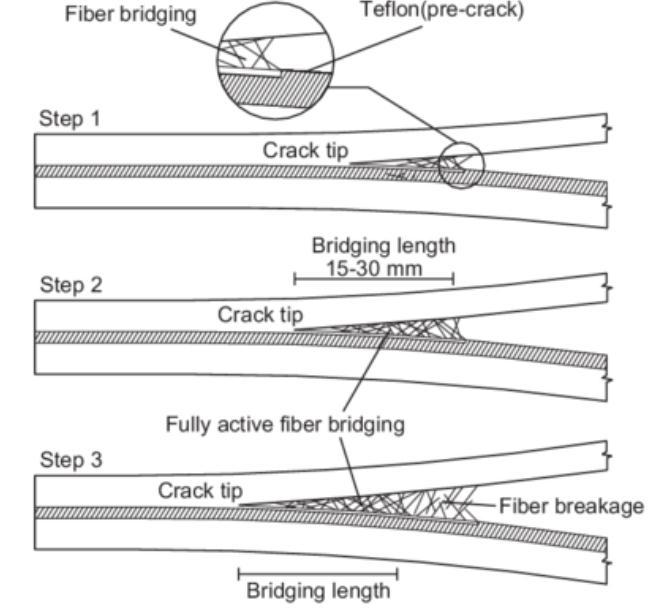
Figure-1:
4.2 Effects of Fibers on Crack Propagation
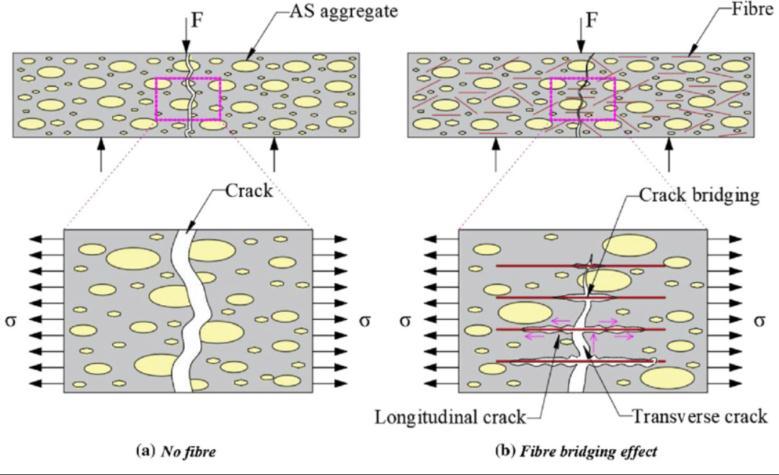
Fibersimprovecrackresistancethroughmechanismssuch as bridging, pull-out, and pinning. Crack bridging occurs whenfibersspanthefacesofdevelopingcracks,transferring stressandslowingcrackopening.Pinningeffectsarisewhen fibersintersectacrackpath,redirectingorarrestingcrack growth. Steel fibers, with high tensile strength, effectively bridge larger cracks, while synthetic fibers are more effective in controlling micro-cracks and reducing crack widths (Bentur and Mindess, 2007). Hybrid fibers exploit synergistic mechanisms, combining macro-bridging and micro-crack control to enhance both toughness and durability.
4.3 Experimental Evaluation Methods
Severalexperimentaltechniquesareemployedtoquantify crackpropagationinfiber-reinforcedconcrete.DigitalImage Correlation(DIC)providesfull-fieldstrainanddisplacement measurements, enabling precise visualization of crack development under load. Scanning Electron Microscopy (SEM) offers microstructural insights into fiber–matrix interaction and pull-out behavior. Acoustic emission monitors crack initiation and growth in real-time by detectingstresswavesgeneratedbymicro-cracking.
4.4 Fiber Efficiency and CrackControlEffectiveness
Theefficiencyoffibersincontrollingcracksdependsontype, size,aspectratio,andorientation.Single-fibersystemsoffer moderate improvements in crack resistance, while hybrid systems combining steel and synthetic fibers demonstratesuperior performance,effectivelycontrolling bothmicro-andmacro-cracks.Fiberdistributionuniformity and orientation significantly influence crack bridging efficiency; aligned fibers enhance directional toughness, whereas random dispersion provides isotropic crack resistance(SoroushianandLee,2013).
International Research Journal of Engineering and Technology (IRJET) e-ISSN: 2395-0056
Volume: 13 Issue: 03 | Mar 2026 www.irjet.net p-ISSN: 2395-0072
4.5 Modelling Approaches in Literature
Computationalmodelingcomplementsexperimentalstudies bysimulatingcrackpropagationundervaryingconditions. Finite Element Modeling (FEM) allows stress and strain analysiswithinfiber-reinforcedconcrete,predictingcrack pathsandstressredistribution.CohesiveZoneModels(CZM) representfractureprocessesatthefiber–matrixinterface, capturing crack initiation, growth, and bridging effects. These approaches aid in understanding complex fracture mechanics and optimizing fiber design for specific performance objectives (Bazant and Planas, 1997; Bentur andMindess,2007).
4.6 Summary Table of Crack Propagation Studies
Literature consistently indicates that fiber reinforcement reduces crack widths, delays propagation, and enhances post-cracking load-carrying capacity. Steel fibers excel in bridginglargecracks,syntheticfiberscontrolmicro-cracks, and hybrid systems combine these benefits. Table 2 (suggested)cansummarizekeystudies,includingfibertype, dosage, evaluation method, fracture parameters, and observed performance improvements, providing a clear comparative overview for future research and practical applications.
5. MECHANISTIC INSIGHTS AND MATERIAL BEHAVIOR
Understandingthemechanisticbehavioroffiber-enhanced concrete is essential for linking observed macroscopic performance with underlying microstructural processes. Fibersinfluencecrackpropagation,energyabsorption,and failuremodesbyinteractingwiththecementitiousmatrixat multiplescales.Thissectiondiscussesthemicro-mechanics offiber–matrixinteraction,fractureenergyconsiderations, andtheresultingeffectsonfailurebehavior.
5.1 Micro-Mechanics of Fiber–Matrix Interaction
The performance of fiber-reinforced concrete is largely governed by the interaction between fibers and the surrounding cement matrix. Effective bonding at the interfaceenablesstresstransferacrosscracks,contributing to enhanced tensile and flexural performance. Pull-out mechanismsarecentraltothisprocess:whenacrackopens, fibers resist separation through adhesion, mechanical interlock,andfrictionalongtheirembeddedlength(Bentur andMindess,2007).Steelfiberstypicallyexhibithighpullout resistance due to their surface deformations, while synthetic fibers rely on friction and surface roughness. Natural fibers, depending on treatment and surface modification, can achieve moderate bonding. Uniform dispersion and optimal orientation of fibers enhance bridgingefficiency,ensuringthatstressredistributionoccurs across multiple micro-cracks, delaying macro-crack
formation and improving post-cracking load-bearing capacity.
5.2 Fracture Energy and Toughness Indices
Fractureenergyquantifiestheenergyrequiredtopropagate acrackthroughtheconcretematrix,servingasakeymetric for material toughness. Fiber reinforcement increases fracture energy by allowing the material to absorb higher loads after initial cracking, resulting in improved ductility and energy dissipation (Bazant and Planas, 1997). Toughness indices, such as residual strength factors and energy absorption capacity, are widely used to compare performance across different fiber systems. Hybrid fibers often provide superior fracture energy due to combined mechanisms of micro-crack control and macro-crack bridging, thereby enhancing both peak strength and postpeakbehavior.
5.3 Influence on Failure Modes
Fiber addition fundamentally alters the failure mode of concrete from brittle to quasi-ductile behavior. In unreinforcedconcrete,cracksrapidlypropagateoncetensile strengthisexceeded,resultinginsuddenandcatastrophic failure. With fibers, crack growth is restrained, allowing gradualstressredistributionanddelayedcollapse(Neville, 2012). Steel fibers are particularly effective in producing quasi-ductile behavior under flexural and tensile loading, while synthetic fibers primarily improve post-cracking ductilityandcontrolcrackwidths.Hybridsystemsleverage both effects, resulting in more controlled failure, higher toughness,andimprovedenergyabsorptioncapacity,which iscriticalforstructuralsafetyandlongevity.
6. COMPARATIVE ANALYSIS
Comparativeanalysisprovidesa holistic understanding of how different fiber types influence concrete performance, considering both mechanical properties and practical considerations. By evaluating variations in strength, toughness,andcost-effectiveness,engineersandresearchers canmakeinformeddecisionsonfiberselectionforspecific applications.
6.1 Comparative Performance of Different Fiber Types
Different fibers impart distinct mechanical benefits to concrete, dictated by their material properties, geometry, and interaction with the cement matrix. Steel fibers consistently demonstrate the highest improvements in tensileandflexuralstrength,post-crackingtoughness,and impactresistanceduetotheirhighmodulusofelasticityand superiorbondingwiththematrix(BanthiaandGupta,2006). Synthetic fibers, such as polypropylene or nylon, excel at controlling micro-cracks and mitigating shrinkage-related cracking,althoughtheycontributeminimallytocompressive
International Research Journal of Engineering and Technology (IRJET) e-ISSN: 2395-0056
Volume: 13 Issue: 03 | Mar 2026 www.irjet.net p-ISSN: 2395-0072
strength(BenturandMindess, 2007).Glassfibersprovide enhanced tensile performance but require careful matrix designtoavoiddegradationinthealkalineenvironmentof concrete(BadrandYoussef,2014).Naturalfibers,suchas sisal or bamboo, offer moderate mechanical enhancement and sustainability benefits but generally display lower toughness and durability compared to steel or synthetic fibers (Soroushian and Lee, 2013). Hybrid fiber systems, which combine fibers with complementary properties, typically achieve a balancebetween macro-crack bridging and micro-crack control, producing superior overall performance in flexural toughness, ductility, and energy absorption.
6.2 Strength vs Toughness Trade-Offs
Whilefibersimprovebothstrengthandtoughness,trade-offs exist depending on fiber type and dosage. Steel fibers enhance peak load capacity and post-cracking toughness simultaneously, but high dosages may reduce workability andrequirehigherwater-reducingadmixtures(Mishraetal., 2025).Syntheticfibersimprovetoughnessandductilitybut havelimitedeffectoncompressivestrength.Hybridsystems mitigate this trade-off by combining high-strength fibers withductilefibers,optimizingbothpeakperformanceand energy absorption. Thus, selecting the appropriate fiber system requires balancing desired structural strength against post-crack toughness requirements, especially in applicationssubjectedtodynamicorimpactloading.
6.3 Cost-Benefit Considerations in Application
Practical implementation of fiber-reinforced concrete requiresevaluationofmaterialcosts,workability,andlongtermperformancebenefits.Steelfibersaremoreexpensive than synthetic or natural fibers, yet their superior mechanicalperformancemayjustifycostsinstructuraland industrialapplications(BanthiaandGupta,2006).Synthetic fibersarerelativelyeconomicalandprovideshrinkageand micro-crackcontrolatlowerdosages,makingthemsuitable for pavements and overlays. Natural fibers, while costeffective and sustainable, may require pre-treatment and haveshorterservicelife,limitingtheirapplicationinhighperformance structures. Hybrid systems, though costlier, offer optimal performance for critical structural elements where both toughness and ductility are paramount. Costbenefit analysis thus helps engineers determine the most suitablefibertypeforagivenapplication,consideringboth economicandstructuralefficiency.
7. PRACTICAL APPLICATIONS AND CASE STUDIES
Fiber-reinforced concrete (FRC) has found increasing adoption in practical construction applications due to its enhanced mechanical performance, crack control, and durability. This section highlights industrial usage, field performanceobservations,andimplementationchallenges associatedwithfiber-reinforcedconcrete.
7.1 Industrial Usage Examples
FRC is widely employed in pavements, overlays, and structural elements where improved toughness and crack resistance are critical. In pavements, steel and synthetic fibersareusedtoreduceshrinkagecracking,improvefatigue resistance, and increase load-bearing capacity under repetitive traffic loading (Banthia and Gupta, 2006). Industrial floors and slabs benefit from high-energy absorption and post-cracking strength provided by fiber reinforcement,allowingforthinnerslabswithcomparable durability.Structuralelements,suchasbeams,columns,and tunnel linings, utilize hybrid fibers to combine tensile strength, ductility, and crack control, ensuring safer performanceinseismicanddynamicloadconditions(Mishra etal.,2025).Additionally,glassfibersareoftenincorporated in architectural concrete panels to enhance flexural performance and prevent surface cracking without compromisingaestheticquality(BadrandYoussef,2014).
7.2 Field Performance Observations
Field studies demonstrate that fiber-reinforced concrete significantlyextendsservicelifebycontrollingcrackwidths and delaying fracture under real-world conditions. Pavements reinforced with steel or polypropylene fibers exhibitfewertransverseandlongitudinalcracksovertime compared to conventional concrete (Bentur and Mindess, 2007). Observations from industrial flooring projects indicatethatpost-crackload-bearingcapacityallowsfloors to sustain heavy machinery and repetitive impact loading withoutcatastrophicfailure.Hybridfibersystemsinbridge decks and tunnel linings show improved durability and reducedmaintenancefrequencyduetoenhancedductility and toughness. Despite differences in environmental conditions, fiber-reinforced concrete consistently exhibits superior performance in controlling crack propagation, reducing permeability, and mitigating reinforcement corrosion.
7.3 Implementation Challenges and Limitations
Despite its benefits, practical implementation of fiberreinforced concrete presents challenges. Uniform fiber dispersionisessentialtoachievethedesiredperformance, as clumping or misalignment can reduce toughness and create stress concentrations (Soroushian and Lee, 2013). High fiber dosages may negatively affect workability, requiring chemical admixtures and modified mixing procedures. Cost remains a significant consideration, particularlyforhybridfibersystemsandhigh-strengthsteel fibers,whichcanincreasematerialexpenses.Additionally, limitedstandardizationintestingmethodsandperformance metricscancreateuncertaintiesindesignspecificationsand quality control. Long-term durability under harsh environmental conditions, particularly for natural fibers, alsorequirescarefulevaluation.Addressingthesechallenges through optimized mix design, proper construction
International Research Journal of Engineering and Technology (IRJET) e-ISSN: 2395-0056
Volume: 13 Issue: 03 | Mar 2026 www.irjet.net p-ISSN: 2395-0072
practices,andadherencetoemergingstandardsisessential foreffectiveapplication.
8.CONCLUSION
Fiber-reinforced concrete (FRC) has emerged as a transformativeadvancementincivilengineeringmaterials, offeringenhancedmechanicalperformance,durability,and crack resistance compared to conventional concrete. This reviewsystematicallyanalyzedthe effectsofvarious fiber types includingsteel,synthetic,glass,natural,andhybrid systems on compressive, tensile, and flexural behavior, toughness,andimpactresistance.Steel fibersconsistently improve tensile strength, flexural capacity, and energy absorption, whereas synthetic fibers primarily control micro-cracks and post-cracking ductility. Hybrid fiber systems combine these benefits, providing a balanced improvementinbothpeakstrengthandfracturetoughness. Micro-mechanicalinteractions,includingfiberbridging,pullout,andstressredistribution,wereshowntobecentralto controlling crack propagation and delaying catastrophic failure. Experimental techniques, such as digital image correlation, acoustic emission, and fracture mechanics parameters(K_IC,CMOD),enablepreciseevaluationoffiber effectivenessandmaterialbehavior.Practicalapplicationsin pavements, overlays, industrial flooring, and structural elementsconfirmtheenhanceddurabilityandservicelifeof FRC under real-world conditions. Overall, the literature demonstratesthatfiberadditionsignificantlyimprovesboth thestructuralreliabilityandpost-crackingperformanceof concrete,withhybridsystemsofferingoptimalsolutionsfor criticalapplications.Theseinsightsarevaluableformaterial selection, design optimization, and the development of durable,high-performanceconcretestructures.
9. LIMITATIONS OF REVIEW
While this review provides a comprehensive synthesis of fiber-reinforcedconcreteresearch,severallimitationsexist. First, variations in experimental methodologies, testing standards,andreportingmetricsacrossstudiesmakedirect comparisons challenging. Second, the review primarily focusesonshort-termmechanicalperformance;long-term durability under diverse environmental conditions, particularly for natural and hybrid fibers, remains less explored. Third, economic considerations, life-cycle assessment, and sustainability aspects are not uniformly addressed in the literature, limiting generalizability for practicalapplications.Finally,emergingfibertechnologies andnano-scalereinforcementapproacheswerenotincluded duetolimitedpeer-revieweddata.Despitetheselimitations, thereviewidentifiesconsistenttrendsinfiberperformance andprovidesa foundation forfuture researchtooptimize fibertypes,dosages,andhybridsystemsforstructuraland durabilityenhancements.
REFERENCES
1) ASTMC1609(2020)StandardTestMethodforFlexural Performance of Fiber-Reinforced Concrete, ASTM International,WestConshohocken,PA.
2) Badr,M.andYoussef,F.(2014)‘Glassfiberreinforced concrete: Durability and mechanical performance’, ConstructionandBuildingMaterials,67,pp.314–322.
3) Banthia,N.andGupta,R.(2006)‘Performanceofsteel fiberreinforcedconcretesubjectedtoimpactloading’, CementandConcreteComposites,28(9),pp.891–900.
4) Bazant, Z.P. and Planas, J. (1997) Fracture and Size Effect in Concrete and Other Quasibrittle Materials, BocaRaton:CRCPress.
5) Bentur, A. and Mindess, S. (2007) Fibre Reinforced CementitiousComposites,2ndedn.,London:Taylor& Francis
6) Edil, T.B. et al. (2024) Discover Civil Engineering, Springer.
7) Mishra,R.K.,Jamshaid,H.,Muller,M.,Urban,J.andPenc, M. (2025) ‘Comprehensive Review on Mechanical Performance of Concrete Reinforced with Fibers and WasteMaterials’,Materials,18(23),p.5419.
8) Neville, A.M. (2012) Properties of Concrete, 5th edn., London:Pearson.
9) Soroushian, P. and Lee, Y. (2013) ‘Natural fibers in concrete: Mechanical and durability properties’, MaterialsandStructures,46(6),pp.1035–1048.
10) Zhang,P.,Liu,Y.,Wang,C.,Xie,W.andLi,Q.(2023)‘A reviewonfracturepropertiesofsteelfiberreinforced concrete’,JournalofBuildingEngineering,54,108867.
11) Carmona,J.R.,Cortés Buitrago,R.,Rey Rey,J.andRuiz, G. (2022) ‘Planar crack approach to evaluate the flexuralstrengthoffiber reinforcedconcretesections’ , Materials,15(17),5821.
12) Wang, X. et al. (2026) ‘Fracture behavior of fiber reinforcedconcreteassessedusingahigh speed camera ’,Buildings,16(2),413.
13) Mechanical properties and durability of steel fiber reinforced concrete: A review (2024) Journal of BuildingEngineering,82,108025.
14) Anas,M.,Khan,M.,Bilal,H.,Jadoon,S.andKhan,M.N. (2022) ‘Fiber reinforced concrete: A review’, EngineeringProceedings,22(1),p.3.
International Research Journal of Engineering and Technology (IRJET) e-ISSN: 2395-0056
Volume: 13 Issue: 03 | Mar 2026 www.irjet.net p-ISSN: 2395-0072
15) Li, X. et al. (2024) ‘Mechanical and fracture characteristics of hybrid fibre reinforced concrete’, Structures,47,107053.
16) Tong, J. (2022) ‘Review of fracture properties and researchmethodsoffiberrecycledconcrete’,Academic JournalofScienceandTechnology.
17) ExploringFractureEnergyinEngineeredCementitious Composites: A Comprehensive Review (2025) International Journal of Concrete Structures and Materials.
18) Ojha, P.N. (2022) ‘Fracture behavior of plain and fiber reinforced high strength concrete’, Journal of ResearchinEngineeringandScience.
19) Hu, X. et al. (2026) ‘Flexural fracture behavior and mechanical properties of SAP PVA fiber reinforced concrete’,PMC.
20) Li, J. et al. (2021) ‘Tensile behavior of hybrid fiber reinforced ultra high performance concrete’ , FrontiersinMaterials,8,769579.
21) Engineered Cementitious Composites – A review (2023)ConcreteandCementComposites.
22) Li,V.C.(2003)‘Onengineeredcementitiouscomposites (ECC): A review of the material and its applications’, JournalofAdvancedConcreteTechnology,1(3),215–230.
23) Jenq, Y.S.and Shah,S.P.(1986)‘Crack propagation in fiber reinforced concrete’, Journal of Structural Engineering,112(1),pp.19–34.
24) Carmona,J.R.etal.(2022)‘Fracturemechanicsmodels infiberreinforcedconcretedesign’,Materials,15(17), 5821.
25) Ramadoss,R.andNagamani,G.(2023)‘Experimental investigations on HPFRC mechanical performance’, JournalofMaterials&EngineeringStructures,10(10), pp.581–599.
26) Mutnbak,M.etal.(2025)‘Effectsofspecimengeometry and size on fracture behavior of high strength fiber reinforced concrete’, Scientific Reports, 15, 15286.
27) L Li et al. (2024) ‘Experimental study on flexural toughness of fiber reinforced concrete’, Journal of BuildingEngineering.
28) Mechanical andpost crackingcharacteristics offiber reinforcedconcretecontainingcopper coatedsteeland PVAfibers(2022)AppliedSciences.
29) Advancing Hybrid Fiber Reinforced Concrete: Performance,crackresistancemechanism,andfuture innovations(2023)Buildings.
30) Review on failure modes and cracking behaviors of polypropylene fibers reinforced concrete (2023) Buildings,12(11),1951.
31) Fracture models and effect of fibers on fracture properties(2020)Materials.
32) Najjar,M.S.andBennitz,A.(2020)‘Fractureproperties of engineered cementitious composites under cyclic loading’, International Journal of Concrete Structures andMaterials.
33) Siddique,R.andKaur,M.(2023)‘Effectofhybridfibers on concrete strength and fracture characteristics’, ConstructionandBuildingMaterials.
34) Chen, B. and Meyer, C. (2023) ‘Glass fiber reinforced concrete slabs: mechanical and fracture evaluation’, JournalofCompositeMaterials.