
International Research Journal of Engineering and Technology (IRJET) e-ISSN: 2395-0056
Volume: 12 Issue: 12 | Dec 2025 www.irjet.net p-ISSN: 2395-0072
International Research Journal of Engineering and Technology (IRJET) e-ISSN: 2395-0056
Volume: 12 Issue: 12 | Dec 2025 www.irjet.net p-ISSN: 2395-0072
Pradeep Kumar Yadav1
Mr. Ushendra Kumar2
,
1Master of Technology, Civil Engineering, Lucknow Institute of Technology, Lucknow, U.P, India
2Head of Department, Department of Civil Engineering, Lucknow Institute of Technology, Lucknow, India ***
Abstract - This review will examine how the curing environment influences both the development of the strength properties in addition to the microstructural evolution of geo polymer concrete, specifically focusing on curing conditions such as temperature, time, and moisturecontrol.Performance of geo polymer systems is highly dependent upon the curing environment which dictates the rate at which reactions occur as well as gelation. Studies have demonstrated that curing of geo polymer systems at higher temperatures (compared to ambient) leads to increased compressive strength during the early ages of a structure and resultsindensermicrostructures. Additionally, studies have shown that optimal curing under ambient conditions or moisture controlled curing may beable to produce comparable long-term strengths with greater practicality when utilizing geo polymer materials for construction projects. This reviewalsoprovidesanoverviewof how curing conditions affect porosity; the interfacial transition zone between aggregate particles and cement paste; shrinkage of the geo polymer system; andthedurability of geo polymer systems to various types of environmental stressors including chemical, thermal, and mechanical. In addition, this review identifies areas of future research that relate to implementing curing strategies in the field; evaluating the long-term durability of geo polymer systems; and developing scalable curing techniques for geo polymer systems.
Key Words: Geo polymer concrete, curing conditions, strength development, microstructure, temperature curing, moisture control, durability
1.1
Theincreasingconcernabouttheenvironmentandtheeverincreasing carbon footprint associated with the use of traditional Portland cement, have led to an increase in researchonalternativebindersystemsthatwillcontribute to reducing greenhouse gas emissions and supporting sustainable building methods. The manufacturing process fortraditionalcementrequiresalotofenergyandproduces asignificantamountofCO2intotheatmosphere;therefore, there has been a growing interest in using industrial byproductmaterialswhichrequirelessenergytomanufacture. Inlightoftheabove,geopolymerconcretehasshowngreat promise as it can be made from waste alumina silicate materials,whilealsoshowingcomparable performance in
termsofmechanicalanddurabilitypropertiescomparedto othertypesofconcrete.
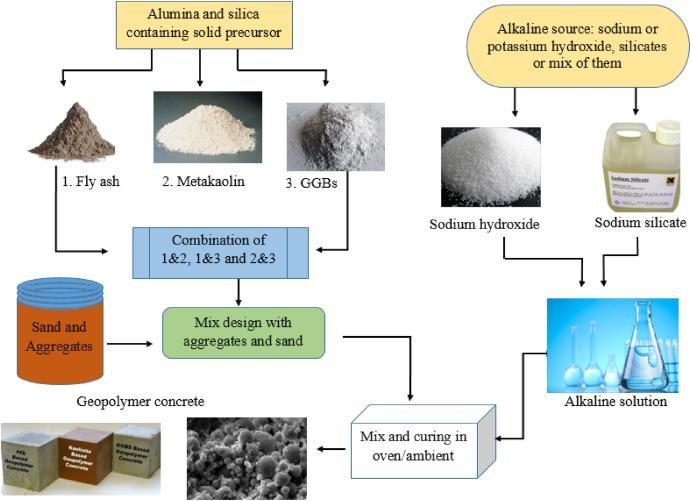
Thedevelopmentofgeopolymerconcreteoccursfromthe chemicalreactionbetweenmaterialsrichinaluminasilicates (flyash;groundgranulatedblastfurnaceslag;metakaolin) with an alkaline activating liquid. In the chemical development,dissolutionoftheseprecursormaterialsoccur followed by polymerization and development of a 3-D inorganicframeworkpredominantlycomprisedofN-A-S-H or C-A-S-H type gel networks. Geo polymer binder developmenthasbeendemonstratedtobedifferentthanthe hydration development of traditional cements in that geo polymer binder development can be affected by the availabilityofreactivespecies,temperature,alkalinitylevels, and moisture conditions. Provided that proper curing conditions exist, this unique chemistry allows for the developmentofgeopolymerbindersexhibitinghighearly strength properties, enhanced chemical durability, and superiorthermalstabilityproperties.
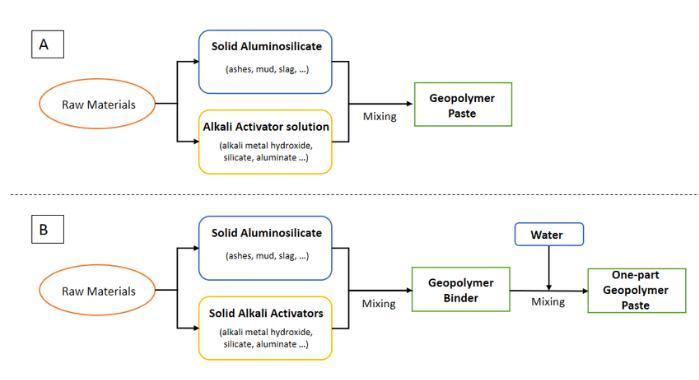
Figure-1: Processing flow chart of (A) traditional geo polymer; and (B) one-part geo polymer.
Thecuringprocessistheprimaryfactorwhichdetermines howmuchthegeopolymerizationreactionoccursandhow efficiently; therefore, curing is an extremely important parameterindeterminingtherateofstrengthdevelopment ingeopolymerconcrete.Inorderforthereactiontoproceed
International Research Journal of Engineering and Technology (IRJET) e-ISSN: 2395-0056
Volume: 12 Issue: 12 | Dec 2025 www.irjet.net p-ISSN: 2395-0072
as desired, sufficient thermal energy must be provided, moisturelevelsmust beadequatelycontrolled, andample time should be allowed for the geo polymer gel phase to formandthendevelopdensity.Increasedtemperatureswill enhancethedissolutionofthereactantsandalsoencourage quicker gelation; conversely, proper humidity control will aid in preventing excessive moisture loss prior to curing, thereby reducing the potential for poor bonding and increasedporosity.Assuch,varyingthecuringtemperature, duration, or moisture content, can have significant effects uponthedegreeofmicrostructuraldevelopment,whichin turn may lead to significant differences in both the compressive strengths and long term performance of geo polymerconcretes.
2.1 Overview of Research Trends in Geo polymer Concrete
Overthepasttwentyyearstherehasbeenanexplosionin researchongeopolymerconcreteprimarilyduetotheneed forsustainablebuildingmaterialsandthedesiretorecycle industrial waste. Researchers have investigated a wide varietyofprecursormaterials(flyash,slag,metakaolin,etc.) thatarerichinalumina-silicatesandreactdifferentlybased on their chemical composition and particle size. A large portionoftheresearchinthisfieldhasfocusedonalkaline activators(sodiumhydroxide,sodiumsilicate,andvarious alkalisolutionblends)astheydeterminetherateatwhich reactions occur and the ultimate properties of the geo polymer binder. As the field of geo polymer concrete has evolved,investigatorshavemovedawayfrominvestigating thegeneralphysicalpropertiesofthebinderandintomore specific aspects of performance (compressive strength development, durability, optimal mixture designs, curing techniques). These investigations demonstrate a larger movementtounderstandhowprocessingparametersaffect theengineeringperformanceofgeopolymerconcrete.
2.2HistoricalDevelopmentofCuringTechniquesin Geo polymers
Theearlyresearchingeopolymerswascarriedoutunder conditionsofhigh-heatcuring,whichwasusedextensively to achieve low-calcium fly ash-based systems with higher temperature to enable dissolution and polymerization. It wasalsodemonstratedthat thereisa positivecorrelation betweenheatcuringtemperatures(bothmoderateandhigh) andtherateofearlystrengthgain,suchthatithasbecome analmostdefaultmethodofcuringduetothespeedofearly strengthdevelopment.However,subsequentlimitationsof heat curing (high energy consumption, poor practicability forsitebasedconstructionetc.)promptedamovetowards ambient curing techniques. Consequently, as researchers becameinterestedinoptimizingtheirwork,theystartedto investigatehowchangesinmixdesign,blendingprecursors, increasing the concentration of the activating agent etc.
would lead to improved early strength development at ambient temperatures. The recent focus of curing optimizationtechniqueshasbeentodevelopoptimalcuring methods through manipulation of curing profile, altering humidity, employing combined curing methods and developingoptimizedcuringproceduresthatwillimprove thepropertiesofgeopolymerswithoutrequiringadditional externalheating.
Asubstantialamountofliteraturehasstudiedtheeffectsof curingtemperature(temperatureduringcuring)onstrength development; this body of work demonstrates that curing temperatureisamajorfactoraffectingthedevelopmentof strengthforgeopolymermaterials.Themajorityofstudies haveshownthatcuringatlowtemperaturesimpedetherate of dissolution of aluminum silicate particles; thus, lowtemperaturecuringresultsindelayedincreasesinstrength for geo polymer samples. Conversely, curing at moderate temperaturesacceleratesthegelationprocessandprovides geo polymer samples with significant increases in early strength.Inaddition,highercuringtemperaturespromote rapidpolymerizationandprovidebenefitssuchasimproved mechanicalproperties.However,highcuringtemperatures mayalsoresultinmicro-cracksorunevendryingconditions, both of which are detrimental to long-term geo polymer performance.Overall,thetemperature-dependenttrendsin reactionkineticspresentedbythesestudiesemphasizethe importanceofdetermininganoptimumcuringtemperature foreachcombinationofprecursorsandactivatorsused in the production of geo polymer materials. The response of different geo polymer systems to their environment (thermal)varies.
The duration of curing (the amount of time the binder is exposedtoheat)hasalsobeenwell-studied.Theresearch indicates that the duration of the heating process directly affectsthecompletenessofthechemicalreactionsthatoccur during the curing process, and ultimately the level of mechanical property development exhibited by the cured binder.Ashortcuringdurationwillgenerallyresultinhigher early-agestrengththanalongercuringduration.However,it ispossiblethatsomeofthereactantsintheprecursorbinder systemremainunreactedasaresultoftheshortcuringtime. Thiscanleadtoreducedlong-termstrengthandlessdense matrixmicrostructurescomparedtoafullyreactedbinder. Conversely,anextendedcuringperiodwillallowfornearly completeconversionofthereactantswithintheprecursor binderintoastable,homogeneouspolymermatrix.Although mostresearchsupportsthisposition,therehavebeensome studiesindicatingthatafteraspecificoptimalcuringtime, additionalcuringtimeresultsinonlyincrementalincreases in strength. Thus, curing time will need to be optimized based on the type of reactive precursor being used, the
International Research Journal of Engineering and Technology (IRJET) e-ISSN: 2395-0056
Volume: 12 Issue: 12 | Dec 2025 www.irjet.net p-ISSN: 2395-0072
concentrationofthealkalineactivator,andthetemperature atwhichthecuringprocessisconducted.
Research has demonstrated that curing temperature (and thusmoisture/humidity)hasasubstantialeffectonboththe strength and structure of geo polymer products. Sealed versus unsealed curing conditions have been compared; researchindicatesthatuncontrolledevaporationduringthe initialreactionsmayleadtopartialorincompleteformation of the geo polymer gel and increased porosity within the product. Controlling the curing environment via sealed curingorothermethods,therebyretaininginternalmoisture andprovidingaconsistentsourceofmoistureforcontinued gelformation,canprovideimprovedmechanicalproperties. Curing in a controlled environment using a humidity chamberprovidestheabilitytocontrolnotonlythedensity ofthegeopolymermatrix,butalsotominimizethenumber ofdefectsformedasaresultofdrying.Thisresearchclearly illustratesthesignificanceofmaintainingadequatemoisture levelsduringthegeopolymerreactionprocess,particularly formixeshavinglowamountsofavailablefreewaterorhigh percentages of fine precursor materials requiring considerable internal moisture to proceed through their respectivechemicalreactions.
In addition to traditional heat and curing by ambient temperature, there are several other, advanced curing techniques presented in literature. One of the most commonly discussed alternatives is the curing by solar radiation (solar curing) which was tested as an environmentallyfriendlymethodofcuringinareaswithhigh levelsofsolarirradiation.Thisresearchdemonstratedthat, underspecificcircumstances,solarradiationmaybeusedas a supplementary source of heat to support the curing process.Microwavecuringwasresearchedforitspotential to rapidly and uniformly heat geo polymeric materials; however, controlling microwave curing to prevent overheating at local points is required. In addition to microwave curing, steam curing and hot air curing were researchedinordertoincreasestrengthofthegeopolymer by increasing the amount of thermal energy available for curing. The research of hybrid curing techniques that use combinations of various thermal and/or moisture curing techniqueshasshowngreatpromiseasameanstoachieve consistent results with minimal energy consumption. The development of these alternative curing techniques is indicative of the on-going efforts to improve and develop curingtechniquesthataresuitableforbothvaryingclimates andbuildingenvironments.
Theuseofambient-cured(roomtemperature)versusheatcured geo polymer systems has been one of the most disputedaspectsofgeopolymerresearch.Whileheatcuring tends to yield greater initial strengths (particularly when usinglow-calciumprecursorssuchasflyash)primarilyby accelerating polymerization processes with increased temperatures;ambientcuringcanoffernumerousbenefits includinggreatereaseofapplication,lowercosts,andbetter field applications. Researchers have reported several methods that can be used to enhance the performance of ambientcuredsystems.Someofthemethodsincludefiner grindsoftheprecursors(inordertocreatealargersurface area), addition of calcium rich materials (such as blast furnaceslag)andmodificationoftheactivatorcomposition. Although researchers have made significant progress in developingimprovedambientcuringsystems,thereremains considerablevariabilityintheresultsobtainedfromambient curing systems across various studies. The variability in resultshasprimarilyoccurredduetothedifferencesinthe characteristics of the precursors and the environmental conditions under which the curing process occurs. This variability clearly indicates a need for a further understandingofthemechanismscontrollingthebehaviorof ambientcuringsystems.
3.1 Chemistry of Geo polymerization
Geopolymersareformedwhenaluminasilicatesreactwith analkalineactivatortocreateathree-dimensionalinorganic polymer matrix through multiple poly condensation reactions.Thefirststepinthegeopolymersynthesisprocess is the dissolution of alumina and silica from the alumino silicatesourcematerialintosolutionwithhydroxide(OH-) ions. Once dissolved, the two primary gel-forming species undergopolycondensationtoproducevariousformsofgel, such as N-A-S-H in low-Ca systems or C-A-S-H in Ca-rich systems. Geo polymerization differs significantly from Portland cement hydration; while Portland cement hydration results in the formation of calcium-silicatehydrates (C-S-H) through a hydration reaction, geo polymerization is a direct chemical transformation that occurs due to the effects of alkalinity, temperature and moisturecontentofthesystem.Itisthisgel-formingreaction thatprovidesgeopolymerstheirhighmechanicalstrength, thermalstabilityanddurableperformancecharacteristics.
Differentaluminosilicatematerialscanbeusedassources for synthesis of geo polymer concrete; the three most commonly utilized are fly ash, ground granulated blast furnace slag (GGBS), and meta kaolin. The contribution of each material is varied based on chemical compositions,
International Research Journal of Engineering and Technology (IRJET) e-ISSN: 2395-0056
Volume: 12 Issue: 12 | Dec 2025 www.irjet.net p-ISSN: 2395-0072
particlesizedistributions,andthedegreeofamorphosity present in the material. Fly ash-based mixtures generally needhightemperaturecuringtoproducehigh-strengthgeo polymers,whileGGBS-basedmixturesoftenshowimproved earlyagereactivityatroomtemperatureastheyhavehigher calcium contents than fly ash. Ultimately, the choice of sourcematerialimpactsboththerateoftheoverallreaction andthetypesofgelthatareformedaswellastheproperties ofthefullycuredgeopolymerbinder.
Alkalineactivatorswhichnormallyincludealkalihydroxides (NaOH),alkalinemetal hydroxides(KOH),and/oralkaline silicates(Na2SiO3)oracombinationthereofarekeyforthe preparationofgeopolymerconcretesincetheyfacilitatethe dissolutionofprecursorsandtheformationofthegelphase. In addition, the molarity of hydroxide solution; silicate modulus;andactivatortobinderratiocontroltherateand degreeofpolymerization.Althoughhighermolaritiesofthe activatortypicallyincreasethedissolutionrateitmayalso produce some detrimental effects such as high heat evolutionandefflorescence.Thereforethecorrectactivator systemshouldbedevelopedbasedonthecharacteristicsof theparticularprecursortoensurethattheconcretehasgood workability, develops adequate strength over time, and is durable.
Duringthegeopolymerizationprocess(whichiscomprised of a series of interdependent processes) the initial stages involve the dissolution of amorphous alumino silicates; diffusion of the dissolved ions; nucleation; and ultimately polymerization of gel structures. The early stages of geo polymerization are significantly influenced by both temperatureandmoistureconditionsasthesetwovariables will affect the rate at which dissolution occurs and the mobilityoftheionsbeingdissolvedandconsequentlyaffect thedensityanduniformityofthegelthatisbeingdeveloped asitforms.Eventually,aspolymerizationproceedsthegel structure that develops becomes increasingly dense as it beginstooccupythevoidspresentwithinthestructure.This developmentofthegelstructureresultsinahighlyordered microstructure with reduced porosity and increased stiffness. Therefore, the microstructural development is directly related to the curing conditions, therefore the thermalandmoistureconditionspresentduringthecuring process are critical for achieving desired mechanical propertiesandlongtermdurability.
Theuseofheatcuringisacommonmethodinthecreationof geo polymer concrete using many different types of
precursors,particularlythosewithlowerlevelsofcalciumin flyash.Heatcuringallowsthenewlycreatedgeo polymer concretetobecuredatelevatedtemperatures(moderateto high)withinanovenorsteamcuringchambertopromote theeffectivecuringofthegeopolymer.Throughtheuseof elevated temperatures, the rate of gelation of the geo polymer increases through the increased dissolution of alumino silicate particles, thus increasing the early age strength of the geo polymer. Additionally, through the applicationofheatcuring,thedevelopmentofadenserand more continuous gel network is enhanced. Although the process of heat curing has proven to be successful in the laboratory environment, there are still some challenges associatedwiththistypeofcuringsuchasthehighamount ofenergyrequiredandlimitationsinitspracticalityforuse inlargerscaleconstructionprojects.
Duetoitspotentialforuseinthefieldwithlessequipment, and less energy consumption; Ambient Curing has gained increasedinterestasanalternativetoheatcuring.Ambient curing allows geo polymer concrete to be cured at room temperature,eliminatingtheneedforsupplementalheat
Moisture-controlledcuringaimstoregulatetheavailability ofwaterduringthegeopolymerizationprocess,preventing premature drying and ensuring that sufficient moisture remains for continued gel formation. This method often involves sealed curing, the use of plastic wrapping, or controlled humidity chambers that maintain a stable moisture environment around the specimen. Moisture retention has been shown to improve the density and uniformity of the geo polymer matrix by allowing uninterrupted polymerization reactions and reducing the risk of shrinkage-induced micro cracking. Studies
International Research Journal of Engineering and Technology (IRJET) e-ISSN: 2395-0056
Volume: 12 Issue: 12 | Dec 2025 www.irjet.net p-ISSN: 2395-0072
consistently demonstrate that moisture-controlled curing enhancesbothstrengthanddurability,especiallyinsystems withlowwater-to-solidratiosorfineprecursorsthatrelyon internal moisture for reaction progression. This curing approach plays a crucial role where environmental conditions fluctuate or where extended curing time is needed.
5.1 Peak Strength Development under Various Temperature Regimes
Geo polymer concrete curing temperatures are crucial for the amount and rate of time it takes for geo polymer concrete to develop its strength. Increased curing temperature results in a faster breakdown of alumino silicate precursor materials which increases the rate of reactionofformingthebindinggelofgeopolymerconcrete. Consequently, geo polymer concrete cured at higher temperaturesthanambienttemperaturestypicallyexhibit significantly greater strength immediately after casting (early age) than those cured under ambient conditions. Experimentalstudieshavedemonstratedthatincreasingthe curingtemperaturewithinareasonabletemperaturerange produces an increase in compressive strength through a more complete geo polymerization process. Additionally, excessive curing temperatures may produce micro-cracks within the geo polymer matrix through thermal stresses, evaporation of pore water, or producing less stable gel phases. While curing at elevated temperatures generally improvespropertiesofthegeopolymermatrix,theremust be a balance to achieve the maximum strength at the optimumcuringtemperaturetoavoidundesirableeffects.
5.2OptimalTemperatureRangesforDifferentGeo
The appropriate temperature for curing geo polymer concretedependsuponanumberofparametersincluding thetypeofprecursor(i.e.,low-calciumvs.calcium-rich),the specificformulationofthealkalineactivatorandtheratioof all of the components in the mixture. Low-calcium precursors,e.g.,ClassFflyash,generallyarerequiredtobe curedat relativelyelevated temperaturesin order tofully react; optimum curing conditions for these types of precursorshavebeenreportedtoexistinthetemperature rangeof60°Cto90°C.However,becauseoftheirinherently greaterreactivitythanlow-calciumprecursors,calcium-rich precursors (e.g., slag, fly ash–slag blends) will typically developsufficientstrengthatrelativelylowertemperatures. To determine the "optimum" curing temperature for a particular geo polymer concrete mixture requires consideration of both the chemical properties of the individual constituents of the mixture, as well as several otherpracticalconsiderations,includingthedesiredcuring duration, energy consumption and/or field applications. There is consistent evidence in research indicating that
curingtemperatureswithinacertain"window,"definedby thespecificgeopolymerconcretemixturebeingevaluated, enhance reaction kinetics while maintaining structural integrity, thus temperature is considered one of the most significant variables affecting the performance of geo polymerconcrete.
6.1MoistureAvailabilityandItsImpactonPorosity
The amount of moisture available during curing has a substantial impact on the internal pore-structure formed within the curing environment of geo polymer concrete. Maintaining adequate levels of moisture will allow for continued progress in the geo polymerization reaction processsothatitcancontinuetoformuniformanddense networks of gels. Typically when samples are placed into sealed or high-humidity environments during curing the retained moisture allows for the dissolution of aluminosilicate particles which allows for a higher degree of poly condensation.Thehigherdegreesofpolycondensationtend to result in a matrix with less total porosity and greater structural integrity. Conversely, if samples are exposed to low-humidityconditionsduringcuring(orevenunsealed), then there will be an excessive loss of moisture and this couldleadtothe occurrenceoflimited reactionprocesses andalsothecreationoflargecapillarypores.Thesetypesof environments could negatively affect both the early age properties of geo polymer concrete and its long term performance. As such, controlling the level of humidity is importantfordeterminingthequalityanddurabilityofthe finalmicrostructureofgeopolymerconcrete.
Thedegreeofshrinkageingeopolymerconcreteisprimarily influencedbytheamountofmoisturemigratingintoandout of the developing gel throughout its initial development stages. Shrinkage can occur due to rapid loss of moisture resulting in tensile stress within the matrix causing it to shrink,andfurthercausemicro-crackingtoform.Theeffect ofshrinkageongeopolymerconcretecanbesubstantially diminished through the maintenance of a high humidity environmentwhichwillreducetherateofevaporationand minimizethepotentialfordifferentialshrinkage;thisresults in a less variable material with respect to dimensional stability. Research has demonstrated that establishing an optimal moisture level for curing can both minimize shrinkage and diminish the likelihood of cracks that may resultinreducedlongtermdurability.Therefore,effective managementofhumiditycanactasa meansofprotecting againstshrinkage-relateddamage.
International Research Journal of Engineering and Technology (IRJET) e-ISSN: 2395-0056
Volume: 12 Issue: 12 | Dec 2025 www.irjet.net p-ISSN: 2395-0072
7.1
The curing process of geo polymer concrete is typically controlled by multiple, interacting factors, including temperature,curingtime(duration)andmoisturecontent (curing environment). As such, these curing factors frequently act in conjunction with each other to create combined influences on reaction progression and final strengthdevelopment.Forexample,theenhancedreaction rates associated with elevated curing temperatures are significantly dependent on sufficient available moisture. Likewise, extended curing periods can provide additional benefitsdependinguponwhethercontinuedpolymerization willoccurwithinanenvironmentallyfavorablecondition.A thorough understanding of these multi-factorial relationships will enable accurate prediction of future performanceandselectionofcuringprocedurestoproduce desired mechanical and microstructural properties. This multi-faceted behavior also underscores the need for a comprehensiveorintegratedapproachtoevaluateallcuring factorssimultaneously.
ResponseSurfaceAnalysis(RSA)isbecominganincreasingly importantmethodtostudytheinteractionbetweencuring parameters, as RSA allows researchers to evaluate nonlinear relations and optimal curing conditions for Geo polymer formation. The use of Response Surface Models, through systematic variation of Temperature, Time and Moisture Levels allow researchers to determine areas in whichCuringParameterswillinteracttoproducemaximum Strengthand/orminimumPorosity.TheuseofRSAwillgive a more complete understanding of how Curing Variables affect one another and what are the Threshold Limits at which Performance begins to decrease. Optimization techniques using RSA are particularly beneficial for the developmentofFieldApplicableCuringStrategies,whichcan optimizeEfficiencyandPracticalitywhileachievingOptimal Performance.
Therelationshipbetweenchemicaldurabilityingeopolymer concreteandcuringcanbeexplainedbytheeffectsonthe density and connectivity of the gel phase which will influencehowwellageopolymerconcreteresistschemical attacks. Systems with a good curing history (especially systems cured at elevated temperatures or in a sealed
environment)tendtohavehigher-densitymicrostructures thatprovideeffectiveprotectionfromsulfateattack,chloride ionpenetration,andacidicattack.Ontheotherhand,poorly curedsystemstendtoproduceporenetworksthatarehighly susceptibletodamagecausedbyionspenetratingthrough them. The formation of continuous stable alumino silicate gels during a successful curing process has a significant impactonthedurabilityofgeopolymerconcrete,showing thatcuringdoesnotonlyaffectearlystrengthbutalsothe long term chemical resistance of a geo polymer concrete system.
Curing has an important influence on the formation of thermallyresistantgelstructuresingeopolymerconcrete, whichcanhelppreservethethermalstabilitybenefitsofgeo polymer concrete over OPC (ordinary Portland cement) basedsystems.Theeffectivecuringofgeopolymerconcrete providesthermallystablegelstructuresthatwillcontinueto provide load bearing properties at high temperature. Typically,samplesthathavebeencuredwithheataremore resistanttothermaldegradationthansamplesthathavenot received adequate heat curing due to their higher density andimprovedinterfacialbonddevelopment,bothofwhich arelesslikelytofailfromcracksormassloss.Ontheother hand, poorly cured materials will typically exhibit defects thatareexacerbatedbythermalstresses;thus,curingaffects notonlytheamountofheatresistantphasethatformsinthe geopolymerconcrete,butitalsodetermineshowmuchof the original material properties remain post-thermal exposure.
Strength development, Microstructure refinement, Longtermdurabilityareallimpactedbycuringconditionsinthe productionofgeo polymerconcrete.EachofTemperature (duration),Duration,andMoistureavailabilitycontributeto thegeopolymerizationreactiontoformdifferentgelphases, Porositydistributions,andMatrixQuality.Hightemperature curing enhances reaction rate and creates High Strength Densities at Early Age, Ambient curing when properly optimized is an Energy Efficient Alternative to Field Applications. Moisture controlled curing is a significant factor in Maintaining Reaction Continuity and Reducing Shrinkage Induced Defects. The interactions between the three curing factors emphasize the Need for Design Considerations that account for the Interactions between Curing Parameters and Both Early and Long Term Performance. Overall, the Study indicates that Developing CuringProtocolsbasedonPrecursorReactivity,MixDesigns, andApplicationwillImproveMechanicalBehavior,Stability ofMicrostructure,andEnvironmentalSustainabilityofGeo polymers. Overall this study reinforces that Curing is an Essential Design Variable to Advance Geo polymer TechnologyintoWiderUseinCivilEngineeringPractice.
International Research Journal of Engineering and Technology (IRJET) e-ISSN: 2395-0056
Volume: 12 Issue: 12 | Dec 2025 www.irjet.net p-ISSN: 2395-0072
Though a substantial amount of research has been conductedoncuringofgeopolymer,therearestillanumber of constraints limiting the ability to generalize the results from those studies. The majority of the studies have used controlled laboratory conditions which fail to reflect the complexity and variability of actual site construction conditions; therefore, translating an optimum laboratory curing regime to a practical application is challenging. Additionally, the variation in precursor materials, specificallytheheterogeneityofindustrialby-productsuch asflyash,introducesadditionaluncertaintyasdifferencesin chemicalcompositionandfinenesssignificantlyaffectcuring sensitivity and reaction rate. Most studies provide informationonearlyagestrengthandmicro-structurewith verylittlelong-termdataondurabilityperformanceunder various environmental conditions. While advanced curing techniquesshowpromise,theyaretypicallyevaluatedona smallscaleand,thus,leaveopenquestionsconcerningtheir costeffectivenessandscalability.Lastly,thecollectiveeffect of curing variables are not fully understood and many modelsoversimplifythecomplexkineticsinvolvedinthegeo polymerizationprocess.Theselimitationsdemonstratethe need for further systematic, field oriented, and long term investigation to establish universally applicable curing practices.
[1]J.Davidovits,“Geopolymerchemistryandapplications,” GeopolymerInstitute,Saint-Quentin,France,2015.
[2] P. Duxson, J. L. Provis, G. C. Lukey, and J. S. J. van Deventer,“Theroleofinorganicpolymertechnologyinthe developmentof‘greenconcrete’,”Cem.Concr.Res.,vol.37, no.12,pp.1590–1597,2007.
[3] J. L. Provis and S. A. Bernal, “Geopolymers and related alkali-activated materials,” Annu. Rev. Mater. Res., vol. 44, pp.299–327,2014.
[4] D. Hardjito and B. V. Rangan, “Development and properties of low-calcium fly ash-based geopolymer concrete,”CurtinUniv.Tech.Res.Rep.,2005.
[5] A. Palomo, M. W. Grutzeck, and M. T. Blanco, “Alkaliactivated fly ashes: A cement for the future,” Cem. Concr. Res.,vol.29,pp.1323–1329,1999.
[6] F. Puertas, S. Martinez-Ramirez, S. Alonso, and T. Vazquez,“Alkali-activatedflyash/slagcements,”Cem.Concr. Res.,vol.30,no.10,pp.1625–1632,2000.
[7] Y. Xie and Z. Xia, “Effect of curing temperature on geopolymerization of metakaolin-based binders,” Constr. Build.Mater.,vol.189,pp.787–795,2018.
[8]Z.Pan,Y.Xie,J.L.Provis,andQ.Feng,“Curingeffectson thepropertiesofmetakaolin-basedgeopolymer,”Appl.Clay Sci.,vol.99,pp.61–72,2014.
[9]K.J.Krakowiaketal.,“Expansionandshrinkagebehavior ofalkali-activatedmaterials,”Cem.Concr.Res.,vol.91,pp. 52–59,2017.
[10]J.Temuujin,R.Williams,andA.vanRiessen,“Effectof mechanical activation of fly ash on properties of geopolymer,”J.Mater.Process.Technol.,vol.209,pp.5276–5280,2009.
[11] K. Komnitsas and D. Zaharaki, “Geopolymerisation: A reviewandprospectsforthemineralsindustry,”Min.Eng., vol.20,no.14,pp.1261–1277,2007.
[12]S.Guo,H.Shi,Z.Yang,andY.Shi,“Microstructureand durabilityofflyash–slaggeopolymerscuredunderdifferent conditions,” Constr. Build. Mater., vol. 226, pp. 579–590, 2019.
[13]A.Fernández-JiménezandA.Palomo,“Factorsaffecting strengthofalkali-activatedflyashmortars,”Mater.Constr., vol.51,pp.99–106,2001.
[14] S. A. Bernal et al., “Bonding mechanisms in alkaliactivatedslagconcretes,”Mater.Struct.,vol.46,pp.923–939, 2013.
[15] B. Singh and G. Ishwarya, “Durability performance of geopolymers:Areview,”Constr.Build.Mater.,vol.191,pp. 125–140,2018.
[16]K.SureshandP.Kumar,“Influenceofcuringmethodson thestrengthofgeopolymerconcrete,”Int.J.Civ.Eng.Tech., vol.8,pp.210–217,2017.
[17]M.Nathand P. K.Sarker,“Effect ofGGBFS on setting, workability and early strength properties of fly ash geopolymer,” Constr. Build. Mater., vol. 66, pp. 163–171, 2014.
[18] S. Kazmi et al., “Response surface methodology for optimizing geopolymer curing conditions,” J. Clean. Prod., vol.198,pp.665–675,2018.
[19]L.Reig,M.A.Tashima,andM.V.Borrachero,“Strengthenhancedalkaliactivatedmaterialsusingalternativecuring,” Mater.Lett.,vol.136,pp.347–350,2014.
[20] M. Chi, “Effects of moisture on fly ash-based geopolymer,” Constr. Build. Mater., vol. 73, pp. 226–233, 2014.
[21] A. Albidah et al., “Influence of humidity-controlled curing on geopolymer properties,” J. Build. Eng., vol. 44, 2021.
International Research Journal of Engineering and Technology (IRJET) e-ISSN: 2395-0056
Volume: 12 Issue: 12 | Dec 2025 www.irjet.net p-ISSN: 2395-0072
[22] S. Deb, N. Siddique, and A. Mukherjee, “Thermal resistanceofgeopolymercomposites,”FireMater.,vol.43, pp.710–720,2019.
[23] P. Rovnaník, “Effect of curing temperature on geopolymerhardening,”Constr.Build.Mater.,vol.24,no.7, pp.1176–1183,2010.
[24] C. Shi, A. Fernández-Jiménez, and A. Palomo, AlkaliActivated Cements and Concretes. London, U.K.: Taylor & Francis,2011.
[25] G. Habert and A. Roussel, “Study of two geopolymer concretes activated by different solutions and cured at ambienttemperature,”EnergyBuild.,vol.43,pp.2419–2426, 2011.
[26] P. D. Silva, K. Sagoe-Crentsil, and V. Sirivivatnanon, “Kineticmodelingofgeopolymerization,”J.Mater.Sci.,vol. 42,pp.3007–3016,2007.
[27]A.R.Rahmanetal.,“Microstructuralanalysisofalkaliactivated binders under varying curing,” Constr. Build. Mater.,vol.229,2019.
[28] M. Nematollahi, J. Sanjayan, and F. U. A. Shaikh, “Ambient-curedgeopolymermaterialsforconstruction,”J. Mater.Civ.Eng.,vol.27,no.4,2015.