
International Research Journal of Engineering and Technology (IRJET) e-ISSN: 2395-0056
Volume: 13 Issue: 03 | Mar 2026 www.irjet.net p-ISSN: 2395-0072

International Research Journal of Engineering and Technology (IRJET) e-ISSN: 2395-0056
Volume: 13 Issue: 03 | Mar 2026 www.irjet.net p-ISSN: 2395-0072
Deepak Kr. Singh1, Dr. Imran Khan2
1Master of Technology, Electrical Engineering (Power System), Azad Institute of Engineering and Technology, Lucknow, India
2Professor, Department Electrical Engineering , Azad Institute of Engineering and Technology, Lucknow, India ***
Abstract -The increasing integration of renewable energy sources has accelerated the development of hybrid power systems combiningsolar photovoltaic (PV), windenergy, and battery energy storage. These hybrid systems are considered aneffectivesolutionforimprovingenergyreliability,reducing greenhouse gas emissions, and enhancing the utilization of renewableresources.However,theintermittentandstochastic nature of solar and wind energy presents significant challenges in maintaining system stability and ensuring efficient power balance. Consequently, effective energy managementoptimizationhasbecomeacriticalcomponentin hybridrenewableenergysystems.Thisreviewpaperpresents acomprehensiveanalysisofenergymanagementoptimization techniques applied to solar–wind–battery hybrid power systems, with particular emphasis on multi-objective control strategies. The study systematically examines various energy management approaches, including rule-based control methods, mathematical optimization techniques, metaheuristic algorithms, and artificial intelligence-based strategies. Additionally, this review discusses commonly used multi-objective optimization algorithms such as genetic algorithms, particle swarm optimization, and hybrid intelligent approaches that aim to simultaneously optimize economic cost, energy efficiency, battery lifetime, and system reliability. A comparative assessment of recent research studies is also presented to highlight the advantages and limitations of existing methods. Furthermore, key challenges such as renewable energy uncertainty, computational complexity, and real-time implementation constraints are discussed. Finally, potential future research directions are identified, including the integration of advanced machine learning techniques and predictive energy management frameworks for next-generation hybrid renewable power systems.
Key Words: Hybrid renewable energy systems; Energy management optimization; Solar–wind–battery systems; Multi-objective control strategies; Metaheuristic optimization; Smart microgrid energy management.
The global energy sector is undergoing a significant transformation due to the increasing demand for clean, sustainable, and reliable electricity. Traditional power
generation systems based on fossil fuels contribute significantlytogreenhousegasemissionsandenvironmental degradation.Consequently,renewableenergytechnologies suchassolarphotovoltaic(PV)andwindenergyhavegained substantial attentionasviablealternativesforsustainable power generation. However, the intermittent nature of renewable resources requires advanced system configurationsandmanagementstrategiestoensurereliable operation.Hybridrenewableenergysystemsthatcombine multiple renewable sources with energy storage technologies have emerged as an effective solution for addressingthesechallengesandenhancingsystemflexibility andstability(Lundetal.,2015).Inrecentyears,solar–wind–battery hybrid systems have been widely implemented in microgrids,ruralelectrificationprojects,andsmartenergy networksduetotheirabilitytoimproveenergyreliability and reduce dependency on conventional power sources (REN21,2023).
Hybrid renewable energy systems integrate two or more energysourcesalongwithenergystoragedevicestoimprove the reliability and efficiency of power generation. Among variousconfigurations,thecombinationofsolarphotovoltaic systems,windturbines,andbatteryenergystoragesystems has received considerable attention due to the complementarycharacteristicsofsolarandwindresources. Solar power generation typically peaks during daytime hours,whilewindenergymaybeavailableatdifferenttimes depending on geographical and climatic conditions. This complementary behavior helps mitigate the variability associatedwithindividualrenewablesourcesandimproves overallsystemperformance(Rezketal.,2019).
Solar–wind–batteryhybridsystemsconsistofphotovoltaic arrays, wind energy conversion systems, battery energy storage units, and power electronic converters interconnected within a microgrid or standalone power system.Insuchconfigurations,thebatteryenergystorage systemplaysacrucialroleinbalancingpowerfluctuations bystoringexcessenergyduringperiodsofhighgeneration
International Research Journal of Engineering and Technology (IRJET) e-ISSN: 2395-0056
Volume: 13 Issue: 03 | Mar 2026 www.irjet.net p-ISSN: 2395-0072
and supplying energy during periods of low renewable output.Thisintegration enablescontinuouspower supply and improves system stability, particularly in isolated or remoteareaswheregridconnectivityislimited(Yangetal., 2018).Furthermore,theuseofadvancedpowerelectronic convertersandcontrolsystemsallowsefficientcoordination between generation units and storage devices, enabling optimal power flow and improved energy utilization (Hossainetal.,2020).
Although hybrid renewable systems offer several advantages, their efficient operation requires proper coordinationbetweengenerationunits,storagedevices,and loaddemand.Renewableenergysourcessuchassolarand wind are inherently intermittent and uncertain due to variations in weather conditions. Without proper energy management, these fluctuations can lead to power imbalance, reduced system efficiency, and increased operationalcosts.Energymanagementsystems(EMS)are therefore essential for monitoring, controlling, and optimizing the operation of hybrid power systems (Olatomiwaetal.,2016).
Energymanagementoptimizationinvolvesdeterminingthe optimal scheduling and dispatch of available energy resources to satisfy load demand while minimizing operational costs and maintaining system reliability. The EMS typically performs tasks such as battery charge–dischargescheduling,renewableenergyprioritization,load management,andpowerflowcontrol.Effectiveoptimization techniquesenablebetterutilizationofrenewableresources, reducedependencyonbackupgenerators,andenhancethe overallperformanceofhybridpowersystems(Bhattietal., 2021).
Inhybridrenewable energy systems,energymanagement problemsofteninvolvemultipleconflictingobjectives.For example,minimizingoperationalcostsmayrequirefrequent battery cycling, which can accelerate battery degradation. Similarly, maximizing renewable energy utilization may introduce power fluctuations that affect grid stability. Therefore, it is essential to consider multiple objectives simultaneously when designing energy management strategies.Multi-objectiveoptimizationtechniquesprovidea systematicframeworkforaddressingsuchcomplexdecisionmakingproblems(Deb,2001).
Multi-objectivecontrolstrategiesaimtoachieveabalanced trade-offbetweenseveralperformanceindicators,including economic cost, system reliability, renewable energy penetration,emissionreduction,andbatterylifetime.These strategies typically employ advanced optimization algorithms such as genetic algorithms, particle swarm
optimization, and hybrid metaheuristic techniques to identify optimal solutions under multiple constraints. By considering multiple objectives simultaneously, these control approaches enhance system efficiency and ensure sustainableoperationofhybridrenewablepowersystems (Zhangetal.,2021).
Theprimaryobjectiveofthisreviewpaperistoprovidea comprehensiveanalysisofenergymanagementoptimization techniques for solar–wind–battery hybrid power systems withaparticularfocusonmulti-objectivecontrolstrategies. The review systematically examines existing research contributionsandcategorizesdifferentenergymanagement approachesusedinhybridrenewableenergysystems.
Specifically, this review first presents a classification of energymanagementstrategies,includingrule-basedcontrol, optimization-based methods, and artificial intelligencedrivenapproaches.Itthenreviewsvariousmulti-objective optimization techniques used to address energy management challenges in hybrid power systems. Furthermore,thestudycomparesdifferentcontrolstrategies based on their operational characteristics, computational complexity, and practical applicability. Finally, the review identifies key research gaps in the existing literature and highlightspotentialfutureresearchdirectionsfordeveloping more efficient and intelligent energy management frameworks in next-generation hybrid renewable energy systems.
Hybrid renewable energy systems integrate multiple renewable generation sources with energy storage and power electronic interfaces to provide reliable and sustainable electricity. Among the various configurations, solar–wind–battery hybrid systems have gained considerable attention due to their ability to utilize complementary renewable resources while maintaining stable power supply. The architecture of such systems typicallyconsistsofsolarphotovoltaicarrays,windenergy conversionunits,batteryenergystoragesystems,andpower electronicconvertersconnectedthroughacommonDCorAC bus.Thesecomponentsoperateincoordinationthroughan energy management system that supervises power flow, maintains voltage and frequency stability, and ensures optimalutilizationofavailablerenewableresources(Lundet al., 2015). The overall system architecture can be implemented in both grid-connected and standalone microgridconfigurations,makingitsuitableforurbanpower networksaswellasremoteelectrificationapplications.
International Research Journal of Engineering and Technology (IRJET) e-ISSN: 2395-0056
Volume: 13 Issue: 03 | Mar 2026 www.irjet.net p-ISSN: 2395-0072
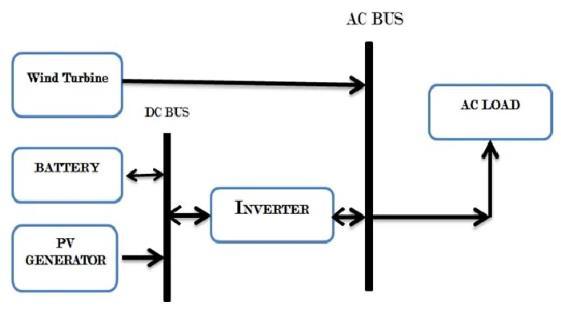
The configuration of a solar–wind–battery hybrid power system determines how the different energy sources and storage units are interconnected and controlled. In most practical implementations, renewable generators are connected to a common DC bus through power electronic converters,whileaninverterinterfacesthesystemwiththe AC load or utility grid. Such configurations allow flexible power management and efficient control of distributed energy resources. The hybrid arrangement improves reliability because when one renewable source produces insufficientpower,theothersourceorthebatterystorage system can compensate for the deficit. Moreover, hybrid systems reduce the need for diesel generators and significantly enhance renewable energy penetration in microgrids(Rezketal.,2019).
Thesolarphotovoltaicsubsystemconvertssolarirradiance directly into electrical energy using semiconductor photovoltaic cells. PV modules are typically connected in series and parallel configurations to achieve the desired voltageandpowerlevels.Because theoutputpowerofPV systems depends on solar irradiance and temperature, maximum power point tracking (MPPT) techniques are employedto extractthemaximumavailableenergyunder varyingenvironmentalconditions.CommonMPPTmethods includeperturbandobserve,incrementalconductance,and fuzzylogic-basedapproaches.Inhybridrenewablesystems, PVarraysaregenerallyconnectedtoaDCbusthroughDC–DC converters, which regulate voltage and enable optimal power extraction. In grid-connected systems, a DC–AC inverterisusedtosynchronizethegeneratedpowerwiththe utilitygrid,whereasinstandalonemicrogridstheinverter suppliesACloadsdirectly(Villalvaetal.,2009).
Wind energy conversion systems transform the kinetic energy of wind into electrical power using wind turbines coupled with electrical generators. The most widely used
generatorsinmodernwindenergysystemsarepermanent magnet synchronous generators (PMSG) and doubly fed inductiongenerators(DFIG).PMSG-basedwindturbinesare commonly used in small-scale and offshore wind systems due to their high efficiency and reduced maintenance requirements, while DFIG systems are widely adopted in large-scalegrid-connected wind farms becausetheyallow variablespeedoperationwithpartialpowerconverters.The electricaloutputfromwindturbinesisconditionedthrough powerelectronicconverterstoregulatevoltage,frequency, andpowerqualitybeforeintegrationintothehybridsystem. Effective control of wind energy conversion units ensures stable operation despite fluctuations in wind speed and improvestheoverallefficiencyofhybridrenewablesystems (Ackermann,2012).
Batteryenergystoragesystemsplayacrucialroleinhybrid renewable energy systems by balancing the mismatch betweenenergygenerationandloaddemand.Batteriesstore excessenergyproducedduringperiodsofhighrenewable generation and supply energy when renewable output is insufficient. Among the various battery technologies, lithium-ionbatterieshavebecomethemostwidelyadopted due to their high energy density, long cycle life, and high efficiency.Lead-acidbatteriesarealsousedinsmallandlowcostsystems,althoughtheyhavelowerenergydensityand shorter lifespan compared to lithium-ion batteries. In addition, advanced storage technologies such as flow batteriesandhybridenergystoragesystemsareincreasingly being investigated for large-scale applications. The integration of battery storage improves power quality, enhances system reliability, and supports peak load management in hybrid microgrids (Divya and Østergaard, 2009).
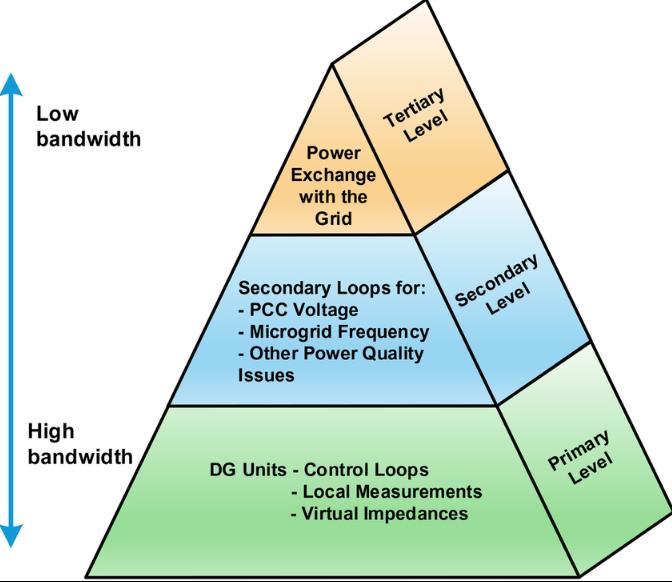
Power electronic converters form the backbone of hybrid renewableenergysystemsbyenablingefficientintegration and control of different energy sources and storage units. DC–DC converters are used to regulate voltage levels and implementMPPTalgorithmsforphotovoltaicsystems,while AC–DC and DC–AC converters facilitate the integration of wind generators and battery systems. Inverters are responsibleforconvertingDCpowerintoACpowersuitable for grid connection or AC loads. Modern hybrid systems employ hierarchical control architectures consisting of primary, secondary, and tertiary control layers. Primary control ensures local voltage and frequency stability, secondarycontrolrestoressystemvariablestotheirnominal values, and tertiary control manages energy flow and economicoptimizationatthesystemlevel.Suchhierarchical control structures enable coordinated operation of distributedenergyresourcesandenhancethestabilityand efficiencyofhybridmicrogrids(Guerreroetal.,2013).
International Research Journal of Engineering and Technology (IRJET) e-ISSN: 2395-0056
Volume: 13 Issue: 03 | Mar 2026 www.irjet.net p-ISSN: 2395-0072
Solar–wind–battery hybrid systems can operate in either grid-connected mode or islanded mode depending on the systemconfigurationandapplicationrequirements.Ingridconnectedmode,thehybridsystemoperatesinparallelwith the utility grid, allowing excess renewable energy to be exported to the gridandadditional powerto be imported when local generation is insufficient. This mode improves energy reliability and enables economic benefits through energy trading and net metering policies. In contrast, islanded mode refers to standalone operation where the hybridsystemoperatesindependentlyfromtheutilitygrid. Insuchcases,theenergymanagementsystemmustcarefully coordinate generation and storage resources to maintain voltageandfrequencystabilitywhilemeetingloaddemand. Effective energy management strategies are particularly important in islanded microgrids because there is no externalgridsupporttocompensateforpowerimbalances (Hossainetal.,2020).
Hybrid renewable energy systems integrate multiple distributed energy resources such as solar photovoltaic arrays,windturbines,andbatterystorageunits.Duetothe intermittentnatureofrenewableresourcesandvaryingload demand,effectivecoordinationamongthesecomponentsis essentialtomaintainstableandefficientsystemoperation. Energymanagementstrategiesarethereforeimplementedto supervisepowerflow,controlenergystorageoperation,and optimizetheutilizationofrenewableresources.Anenergy managementsystem(EMS)actsasthecentralcontrollerthat monitors generation, storage, and demand while making real-timedecisionstoensurereliableandeconomicalsystem performance.Advancedenergymanagementstrategiesalso support demand response, load scheduling, and optimal dispatchofdistributedgenerationunitsinhybridmicrogrids (Olatomiwaetal.,2016).
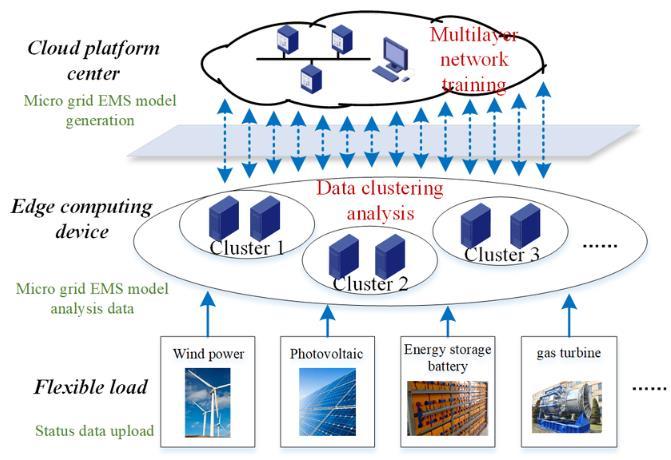
Theprimaryobjectiveofanenergymanagementsystemin hybrid renewable powersystemsis to maintaina balance between electricity generation and load demand while ensuringefficientutilizationofavailableenergyresources. Sincerenewablesourcessuchassolarandwindexhibithigh variability due to weather conditions, EMS algorithms are designedtocoordinatethesesourceswithbatterystorage systemstomaintainsystemstability.Oneofthefundamental goals is power balance and load matching, which ensures thatgeneratedpowermeetstherequireddemandwithout causingvoltageorfrequencydeviations.
Anotherimportantobjectiveiscostminimization,wherethe EMS schedules energy resources in a way that reduces operationalcosts,includingfuelconsumption,maintenance costs,andbatterydegradation.Additionally,maximizingthe utilization of renewable energy is crucial for reducing dependenceonconventionalpowersourcesandminimizing environmental impacts. The EMS also performs battery state-of-charge (SOC) management, which prevents overchargingordeepdischargingofbatteriesandextends their operational lifetime. Furthermore, modern EMS frameworks incorporate power quality improvement strategies to minimize voltage fluctuations, harmonic distortion,andfrequencydeviationsinhybridmicrogrids.By simultaneously addressing these objectives, energy managementsystemsensureefficientandreliableoperation ofdistributedrenewableenergysystems(Lundetal.,2015).
Energy management strategies used in hybrid renewable energy systems can generally be categorized into three major groups: rule-based control strategies, optimizationbasedstrategies,andartificialintelligence-basedstrategies. Eachcategorydiffersintermsofcomplexity,computational requirements,adaptability,andimplementationcapability. Rule-based methodsare relativelysimpleandsuitable for small systems, while optimization-based and AI-based strategiesprovidemoreaccurateandflexiblesolutionsfor complexhybridpowersystemswithmultipleobjectivesand constraints(Bhattietal.,2021).
Rule-based energy management strategies rely on predefined logical rules and heuristic decision-making processes to control the operation of energy sources and storagedevices.Thesemethodsarecommonlyimplemented usingsimplethreshold-basedorpriority-basedcontrolrules that determine when energy should be supplied by renewable sources, batteries, or backup generators. For example,inathreshold-basedstrategy,thebatterymaybe chargedwhenrenewablegenerationexceedsloaddemand anddischargedwhenrenewablegenerationisinsufficient. Priority-baseddispatchstrategiesassigndifferentpriority
International Research Journal of Engineering and Technology (IRJET) e-ISSN: 2395-0056
Volume: 13 Issue: 03 | Mar 2026 www.irjet.net p-ISSN: 2395-0072
levels to energy sources, typically prioritizing renewable generationbeforeutilizingstoredenergy.
The main advantage of rule-based approaches is their simplicityandeaseofimplementation,whichmakesthem suitable for real-time applications and small-scale microgrids. However, these methods are generally less efficientforlargeorcomplexhybridsystemsbecausethey do not explicitly consider optimization objectives such as costminimizationoremissionreduction(Yangetal.,2018).
Optimization-based energy management strategies formulatetheenergyschedulingproblemasamathematical optimizationproblemwithdefinedobjectivefunctionsand constraints. These methods aim to determine the optimal dispatch of energy sources and storage devices that minimizes or maximizes certain performance indicators. Common optimization techniques include linear programming (LP), mixed-integer linear programming (MILP),anddynamicprogramming(DP).
Such approaches enable system operators to incorporate multiple operational constraints such as battery capacity limits, renewable generation forecasts, load demand variations,andgridpowerlimits.Optimizationalgorithms arecapableofprovidingnear-optimalsolutionsforcomplex hybrid energy systems and are widely used in microgrid planning and operational scheduling. Despite their advantages, these methods may require significant computational resources, particularly when dealing with large-scale systems or multi-objective optimization problems(Zhangetal.,2021).
Artificialintelligence(AI)techniqueshavegainedincreasing attentioninrecentyearsforenergymanagementinhybrid renewableenergysystems.AI-basedstrategiesutilizedatadriven models and machine learning algorithms to learn system behavior and make adaptive control decisions. Techniquessuchasfuzzylogiccontrollers,artificialneural networks(ANNs),reinforcementlearning,anddeeplearning modelshavebeenappliedtooptimizeenergydispatchand improvesystemperformance.
OnemajoradvantageofAI-basedapproachesistheirability to handle nonlinear system dynamics and uncertainties associated with renewable energy generation and load demand.Forinstance,reinforcementlearningalgorithmscan learnoptimalcontrolpoliciesthroughinteractionwiththe environment,whileneuralnetworkscanpredictrenewable generation patterns and assist in energy scheduling decisions. As computing power and data availability continue to increase, AI-driven energy management strategies are expected to play a crucial role in the
development of intelligent and autonomous microgrids (Hossainetal.,2020).
Toeffectivelymanagethecomplexityofhybridrenewable energysystems,hierarchicalcontrolarchitecturesarewidely adoptedinmodernmicrogriddesigns.Thesearchitectures dividethecontrolstructureintomultiplelayersthatoperate atdifferentlevelsofthesystem.Theprimarycontrollayeris responsibleformaintaininginstantaneoussystemstability by regulating voltage and frequency through local controllers. The secondary control layer restores system parameterstotheirnominalvaluesandensurescoordinated operationamongdistributedgenerationunits.
At the highest level, the tertiary control layer performs system-levelenergymanagementbyoptimizingpowerflow, scheduling energy resources, and managing interactions withthemaingridorneighboringmicrogrids.Thislayered approach allows both decentralized local control and centralized optimization through the energy management system.Bycombiningfastlocalcontrolactionswithhigherlevel optimization strategies, hierarchical control architectures improve the reliability, scalability, and efficiencyofhybridrenewableenergysystems(Guerreroet al.,2013).
Energy management in solar–wind–battery hybrid power systemsinvolvescomplexdecision-makingprocessesdueto thepresenceofmultipleenergysources,storagedevices,and fluctuating load demands. Traditional single-objective
International Research Journal of Engineering and Technology (IRJET) e-ISSN: 2395-0056
Volume: 13 Issue: 03 | Mar 2026 www.irjet.net p-ISSN: 2395-0072
optimizationmethodsareofteninsufficientbecausehybrid renewable systems must simultaneously satisfy several performance requirements such as economic efficiency, system reliability, environmental sustainability, and operational stability. Consequently, multi-objective optimization techniques have been widely adopted to manage these competing objectives and to determine optimal operating strategies for hybrid energy systems. These techniques provide a systematic framework for identifyingtrade-offsolutionsthatbalancedifferentsystem objectives while satisfying operational constraints (Deb, 2001).
The first step in applying multi-objective optimization to hybridrenewableenergysystemsistheformulationofthe energymanagementproblemintermsofobjectivefunctions andoperationalconstraints.Objectivefunctionsrepresent the performance metrics that need to be optimized, while constraintsensurethatthesystemoperateswithintechnical andphysicallimits.Insolar–wind–batteryhybridsystems, themostcommonobjectiveiseconomiccostminimization, whichincludesoperationalcosts,maintenanceexpenses,and energypurchasingcosts fromthegrid.Anotherimportant objectiveisemissionreduction,whichfocusesonminimizing greenhouse gas emissions by maximizing the use of renewableenergysources.
In addition, renewable energy penetration is often consideredasanoptimizationobjectivetoincreasetheshare of clean energy in the total power supply. Battery managementisanothercrucialfactor,andthereforebattery lifetime maximization or minimization of battery degradationisincorporatedintomanyoptimizationmodels. Furthermore,powerqualityimprovement,includingvoltage stabilityandfrequencyregulation,isalsoconsideredwhen designing energy management strategies for hybrid microgrids.Theoptimizationproblemistypicallysubjectto constraintssuchaspowerbalanceequations,batterystateof-charge limits, generation capacity limits, and network operatingconditions(Zhangetal.,2021).
Classicalmathematicaloptimizationtechniqueshavebeen widelyusedintheearlydevelopmentofenergymanagement systems for hybrid renewable power systems. These approachesrelyondeterministicmathematicalmodelsand analyticalformulationstodetermineoptimalschedulingand dispatchstrategies.Classicalmethodsaregenerallyeffective for problems that can be represented using linear or structuredmathematicalrelationshipsandarewidelyused inmicrogridplanningandoperationaloptimization(Conejo etal.,2010).
Linear programming is one of the most widely used optimizationtechniquesforenergymanagementproblems inpowersystems.Inthismethod,theobjectivefunctionand constraintsareexpressedaslinearequationsorinequalities. Linear programming algorithms determine the optimal solutionthatminimizesormaximizestheobjectivefunction whilesatisfyingallsystemconstraints.Inhybridrenewable energy systems, LP has been applied for optimal energy scheduling, load dispatch, and cost minimization under simplified system assumptions. Although LP offers high computational efficiency and guaranteed convergence, it may not be suitable for complex nonlinear problems frequentlyencounteredinrenewableenergysystems(Wood andWollenberg,2013).
Mixed-integerlinearprogrammingextendstheconventional linear programming framework by incorporating integer decision variables along with continuous variables. This approachisparticularlyusefulinhybridrenewableenergy systemswherecertaindecisionsarediscreteinnature,such as on/off states of generators, switching operations of converters, and operational modes of energy storage devices. MILP models allow detailed representation of systemconstraintsandoperationallogic,enablingaccurate scheduling of distributed energy resources in microgrids. Despite its effectiveness, the computational complexity of MILPincreasessignificantlywiththesizeofthesystemand the number of decision variables involved (Morais et al., 2010).
Dynamic programming is another classical optimization method used for sequential decision-making problems in energy management. This technique divides a complex optimizationproblemintoaseriesofsmallersubproblems that are solved recursively. In hybrid renewable energy systems,dynamicprogramminghasbeenusedforoptimal batterycharginganddischargingscheduling,energystorage management,andloaddispatch.Theadvantageofdynamic programming lies in its ability to handle time-dependent optimization problems and nonlinear relationships. However, the method often suffers from the “curse of dimensionality,”meaningthatcomputationalrequirements increase exponentially with the number of state variables (Bellman,1957).
Inrecentyears,metaheuristicoptimizationalgorithmshave gained widespread popularity for solving complex energy managementproblemsinhybridrenewableenergysystems. Unlike classical optimization methods, metaheuristic algorithmsdonotrelyonstrictmathematicalformulations
International Research Journal of Engineering and Technology (IRJET) e-ISSN: 2395-0056
Volume: 13 Issue: 03 | Mar 2026 www.irjet.net p-ISSN: 2395-0072
andcaneffectivelyhandlenonlinear,nonconvex,andmultimodaloptimizationproblems.Thesealgorithmsareinspired by natural phenomena, evolutionary processes, and collective behavior observed in biological systems. Due to theirflexibilityandglobalsearchcapability,metaheuristic methodsarewidelyappliedformulti-objectiveoptimization inrenewableenergysystems(Yang,2014).
The genetic algorithm is an evolutionary optimization techniqueinspiredbytheprinciplesofnaturalselectionand genetics.Inthismethod,potentialsolutionsarerepresented as chromosomes, and new generations of solutions are producedthroughoperationssuchasselection,crossover, and mutation. GA has been extensively used in hybrid renewable energy systems for optimal sizing, energy scheduling, and multi-objective energy management. The ability of GA to explore a large search space and identify near-optimal solutions makes it particularly suitable for complex optimization problems involving multiple objectivesandconstraints(Goldberg,1989).
Particle swarm optimization is a population-based optimizationalgorithminspiredbythecollectivemovement ofbirdflocksorfishschools.InPSO,eachparticlerepresents apotentialsolution,andparticlesmovethroughthesearch space by updating their positions based on their own experienceandtheexperienceofneighboringparticles.PSO hasbeenwidelyappliedtooptimizeenergydispatch,load management, and renewable energy integration in hybrid microgrids.Comparedtogeneticalgorithms,PSOtypically requiresfewerparametersandoffersfasterconvergencefor manyoptimizationproblems(KennedyandEberhart,1995).
4.3.3
Antcolonyoptimizationisinspiredbytheforagingbehavior ofants,whichcommunicateindirectlythroughpheromone trails to identify optimal paths between food sources and theircolony.Inoptimizationproblems,artificialantsexplore possible solutions and deposit virtual pheromones that guidethesearchtowardpromisingregionsofthesolution space. ACO has been used in hybrid energy systems for solving power flow optimization problems, scheduling distributedenergyresources,andmanagingenergystorage systems. The algorithm is particularly effective for combinationaloptimizationproblemswithcomplexsearch spaces(DorigoandStützle,2004).
Greywolfoptimizationisarelativelyrecentmetaheuristic algorithminspiredbytheleadershiphierarchyandhunting behaviorofgreywolvesinnature.Thealgorithmsimulates the cooperative hunting mechanism of wolves, where candidate solutions are guided toward optimal solutions
throughiterativepositionupdates.GWOhasbeenappliedin renewable energy systems for optimal sizing of hybrid systems, energy management, and multi-objective optimization problems. Its advantages include simple implementation,strongexplorationcapability,andeffective convergencetowardglobaloptimumsolutions(Mirjaliliet al.,2014).
Artificialintelligenceandmachinelearningtechniqueshave recentlyemergedaspowerfultoolsforenergymanagement optimization in hybrid renewable energy systems. These approachesleveragehistoricaldata,predictiveanalytics,and adaptivelearningmechanismstoimprovedecision-making processesincomplexanduncertainenvironments.AI-based optimizationmethodsareparticularlyeffectiveinhandling nonlinearsystemdynamics,forecastingrenewableenergy generation,andoptimizingenergydispatchunderuncertain operatingconditions(Hossainetal.,2020).
Reinforcementlearningisamachinelearningtechniquein which an agent learns optimal control strategies through interaction with its environment. The agent observes the systemstate,takesactions,andreceivesrewardsbasedon theeffectivenessofthoseactions.Overtime,thealgorithm learns the optimal policy that maximizes cumulative rewards. In hybrid renewable energy systems, reinforcement learning has been used for battery energy management,loadscheduling,andreal-timepowerdispatch. Theadaptivenatureofreinforcementlearningallowsitto handle dynamic system conditions and uncertainties in renewablegeneration.
Deep reinforcement learning combines reinforcement learning with deep neural networks to enable learning in high-dimensionalandcomplexenvironments.Deepneural networks are used to approximate value functions or policies,allowingthealgorithmtomanagelarge-scaleenergy systemswithnumerousvariablesandconstraints.Inhybrid microgrids,deepreinforcementlearninghasbeenappliedto optimizeenergytrading,batteryscheduling,andreal-time control of distributed energy resources. These techniques significantlyimprovesystemefficiencybylearningoptimal energy management policiesfromlargedatasets(Liet al., 2021).
Recent research trends focus on combining artificial intelligence techniques with classical or metaheuristic optimization algorithms to develop hybrid energy management frameworks. These hybrid approaches
International Research Journal of Engineering and Technology (IRJET) e-ISSN: 2395-0056
Volume: 13 Issue: 03 | Mar 2026 www.irjet.net p-ISSN: 2395-0072
integratepredictionmodelsforrenewablegenerationand loaddemandwithmulti-objectiveoptimizationalgorithms forenergyscheduling.Forexample,neuralnetworkscanbe used to forecast solar irradiance and wind speed, while optimization algorithms determine the optimal energy dispatch and battery charging schedules. Such integrated frameworksimprovedecisionaccuracy,enhancerenewable energyutilization,andenableintelligentoperationofhybrid renewableenergysystems(Bhattietal.,2021).
Therapiddevelopmentofhybridrenewableenergysystems has led to extensive research on energy management optimizationtechniques.Numerousstudieshaveexplored different control and optimization strategies to efficiently coordinatesolar photovoltaic systems,wind turbines,and batteryenergystorageunits.Thesestudiesaimtoimprove system reliability, reduce operational costs, increase renewableenergypenetration,andenhancebatterylifetime. Theliteratureonenergymanagementinhybridrenewable systemscangenerallybeclassifiedintorule-basedcontrol approaches,optimization-basedtechniques,metaheuristic multi-objectivealgorithms,andartificialintelligence-driven methods. Each category has unique characteristics, advantages,andlimitationsdependingonsystemcomplexity andoperationalrequirements(Olatomiwaetal.,2016).
Rule-basedenergymanagementstrategiesrepresentoneof the earliest approaches used in hybrid renewable energy systems.Thesemethodsrelyonpredefinedlogicalrulesand heuristic decision-making processes to determine the operation of energy sources and storage devices. For instance,priority-basedcontrolstrategiestypicallyprioritize renewable energy generation to supply load demand, followed by battery storage and backup generators when renewableoutputisinsufficient.Similarly,threshold-based strategies determine charging and discharging actions of battery storage based on state-of-charge (SOC) limits and generation–loadbalance.
Severalstudieshavedemonstratedtheeffectivenessofrulebasedenergymanagementsystemsinsmall-scalemicrogrids and standalone hybrid renewable systems. For example, Yangetal.(2018)investigatedrule-baseddispatchstrategies for solar–wind hybrid systems and reported improved reliability and reduced dependence on conventional generators.Althoughtheseapproachesarerelativelysimple andeasytoimplement,theyoftenlacktheabilitytoachieve optimalsystemperformancebecausetheydonotexplicitly considereconomicandoperationaloptimizationobjectives. As system complexity increases, rule-based methods may become less efficient due to their limited adaptability to dynamicoperatingconditions.
Optimization-based energy management methods use mathematical models to determine optimal operating strategies for hybrid renewable energy systems. These methodsformulatetheenergymanagementproblemasan optimizationproblemwithdefinedobjectivefunctionsand constraints, such as minimizing operating cost, reducing emissions, and maintaining battery health. Classical optimization techniques including linear programming, mixed-integer linear programming, and dynamic programminghavebeenwidelyappliedintheliteratureto solve energy scheduling and power dispatch problems in microgrids.
Forexample,Moraisetal.(2010)developedamixed-integer linear programming model for optimal scheduling of distributedenergyresourcesinamicrogrid,demonstrating improvedeconomicperformancecomparedtoconventional rule-basedmethods.Similarly,severalstudieshaveapplied dynamic programming to determine optimal battery charging and discharging strategies under varying load demand and renewable generation conditions. Although theseoptimizationapproachesprovidemoreaccurateand optimal solutions than rule-based strategies, they often requiresignificantcomputationalresources,particularlyfor large-scalesystemswithmultipleconstraintsanddecision variables.
Metaheuristicoptimizationalgorithmshavebeenextensively applied in recent years to address the complex multiobjective optimization problems encountered in hybrid renewableenergysystems.Thesealgorithmsarecapableof handling nonlinear, nonconvex, and multi-dimensional optimization problems where classical mathematical methods may struggle to find global optimal solutions. Metaheuristictechniquessuchasgeneticalgorithms,particle swarmoptimization,antcolonyoptimization,andgreywolf optimization have been widely used to optimize energy management strategies in solar–wind–battery hybrid systems.
For instance, genetic algorithms have been used to determine optimal system configurations and energy dispatch schedules while simultaneously minimizing operatingcostsandemissions.Particleswarmoptimization has also been applied for optimal load management and renewable energy utilization due to its fast convergence characteristics.Mirjalilietal.(2014)demonstratedthatgrey wolfoptimizationalgorithmsprovideeffectivesolutionsfor complex multi-objective optimization problems in renewableenergysystemsduetotheirstrongexploration and exploitation capabilities. Despite their advantages,
International Research Journal of Engineering and Technology (IRJET) e-ISSN: 2395-0056
Volume: 13 Issue: 03 | Mar 2026 www.irjet.net p-ISSN: 2395-0072
metaheuristic algorithms may require careful parameter tuningandmultipleiterationstoachievereliablesolutions.
Artificial intelligence and data-driven approaches have recently emerged as promising solutions for energy management in hybrid renewable energy systems. These techniquesleveragelargedatasets,predictivemodels,and machine learning algorithms to enhance decision-making processesandadapttochangingsystemconditions.AI-based methods such as artificial neural networks, fuzzy logic controllers,reinforcementlearning,anddeeplearninghave been widely applied to improve energy scheduling and forecastinginhybridpowersystems.
Hossain et al. (2020) highlighted the growing role of machine learning techniques in microgrid energy management,particularlyforrenewableenergyforecasting andadaptivecontrol.Reinforcementlearning-basedenergy managementsystemsarecapableoflearningoptimalcontrol policies through continuous interaction with the environment,makingthemsuitableforreal-timeoperation ofhybridmicrogrids.Deeplearningmodelshavealsobeen applied to predict solar irradiance, wind speed, and load demand,whichsignificantlyimprovestheaccuracyofenergy management decisions. Although AI-driven methods offer significantadvantagesintermsofadaptabilityandpredictive capability, their implementation often requires large datasetsandhighcomputationalresources.
Althoughsolar–wind–batteryhybridpowersystemsprovide aneffectivesolutionforintegratingrenewableenergyinto modernpowernetworks,severaltechnicalandoperational challenges still limit their widespread implementation. Energy management systems must address uncertainties associatedwithrenewablegeneration,batterydegradation issues,computationalcomplexityofoptimizationalgorithms, and real-time operational constraints. These challenges directlyinfluencesystemreliability,economicperformance, and long-term sustainability of hybrid renewable energy systems. Understanding these limitations is essential for designingadvancedenergymanagementstrategiesthatcan effectively coordinate renewable energy resources and energy storage technologies in dynamic operating environments(Lundetal.,2015).
Oneofthemostsignificantchallengesinhybridrenewable energysystemsistheinherentuncertaintyandvariabilityof renewableenergyresources.Solarphotovoltaicgeneration dependsheavilyonsolarirradiance,whichfluctuatesdueto cloud cover, seasonal variations, and atmospheric
conditions. Similarly, wind energy production is highly dependentonwindspeedanddirection,whichcanchange rapidly and unpredictably. These fluctuations make it difficulttoaccuratelypredictpowergenerationandmaintain astablebalancebetweensupplyanddemand.
Due to these uncertainties, energy management systems must incorporate forecasting techniques and adaptive control strategies to handle variations in renewable generation. Inaccurate forecasting of solar and wind resources can lead to energy shortages or surplus generation, affecting system reliability and economic performance.Therefore,advancedforecastingmodelsand probabilistic approaches are often integrated into energy management frameworks to mitigate the impact of renewableenergyvariability(Zhangetal.,2021).
Battery energy storage systems play a crucial role in stabilizing hybrid renewable energy systems by storing excess energyandsupplyingpower duringperiodsoflow renewable generation. However, frequent charging and dischargingcyclescanleadtobatterydegradationovertime, reducingstoragecapacityandoverallsystemperformance. Factorssuchasdepthofdischarge,temperaturevariations, charging rate, and operating conditions significantly influencebatterylifespan.
Effective energy management strategies must therefore incorporatebatteryhealthmonitoringandstate-of-charge (SOC) management to extend battery lifetime. Improper battery scheduling may lead to excessive cycling, which accelerates degradation and increases maintenance and replacement costs. Consequently, many recent studies integrate battery aging models into optimization frameworks to balance energy utilization with battery lifetimepreservation(DivyaandØstergaard,2009).
Advancedenergymanagementsystemsoftenrelyonmultiobjective optimization algorithms to determine optimal scheduling and dispatch of energy resources. While these algorithms can provide high-quality solutions, they often involvecomplexmathematicalformulationsandlargesearch spaces. As the number of system components, decision variables, and operational constraints increases, the computationalcomplexityoftheoptimizationproblemalso increasessignificantly.
Metaheuristicalgorithmssuchasgeneticalgorithms,particle swarm optimization, and grey wolf optimization are commonly used to solve complex energy management problems.However,thesealgorithmsmayrequirenumerous iterations to converge toward optimal solutions, which increasescomputationaltimeandprocessingrequirements.
International Research Journal of Engineering and Technology (IRJET) e-ISSN: 2395-0056
Volume: 13 Issue: 03 | Mar 2026 www.irjet.net p-ISSN: 2395-0072
Forlarge-scalehybridmicrogrids,thiscomplexitymaylimit thepracticalimplementationofoptimization-basedenergy managementsystems,particularlywhenreal-timedecisionmakingisrequired(Mirjalilietal.,2014).
Real-timeimplementationofenergymanagementstrategies presents another major challenge in hybrid renewable energysystems.Inpracticalmicrogridapplications,energy management systems must continuously monitor system conditions and make rapid control decisions to maintain stable operation. This requires fast communication infrastructure,reliablesensors,andhigh-speedprocessing capabilities.
In many cases, optimization algorithms developed in researchenvironmentsmaynotbedirectlysuitableforrealtimeapplicationsduetotheircomputationalrequirements or dependency on accurate forecasting data. Delays in communication or data processing can lead to incorrect controldecisions,resultinginpowerimbalanceorvoltage instability. Therefore, simplified control strategies and hierarchical control architectures are often adopted to ensure reliable real-time operation of hybrid microgrids (Guerreroetal.,2013).
Accuratedataandreliableforecastingmodelsareessential for effective energy management in hybrid renewable energysystems.Forecastingtechniquesareusedtopredict solarirradiance,windspeed,andloaddemand,whichallows the energy management system to plan optimal energy dispatch strategies in advance. However, obtaining highqualityreal-timedataanddevelopingaccurateforecasting modelsremainchallengingtasks.
Forecastingerrorscansignificantlyaffecttheperformanceof energy management systems by causing incorrect scheduling of energy resources and inefficient battery utilization.Inaddition,manydevelopingregionsandremote areas lack advanced monitoring infrastructure, making it difficulttocollectreliablehistoricaldataformodeltraining and analysis. As a result, improving forecasting accuracy through advanced machine learning techniques and improving data acquisition systems has become an important research direction in hybrid renewable energy systems(Hossainetal.,2020).
Theincreasingpenetrationofrenewableenergysourceshas acceleratedthedevelopmentofhybridpowersystemsthat combinesolarphotovoltaic,windenergy,andbatteryenergy storage technologies. These hybrid systems offer a promisingsolutionforimprovingenergyreliability,reducing greenhousegasemissions,andenhancingtheutilizationof
renewableresourcesinmodernpowersystems.However, duetotheintermittentnatureofrenewableenergysources and the dynamic characteristics of load demand, effective energymanagementoptimizationisessentialforensuring stableandefficientsystemoperation.
This review has presented a comprehensive analysis of energymanagementstrategiesusedinsolar–wind–battery hybrid power systems with a particular focus on multiobjective optimization techniques. Various energy management approaches were examined, including rulebased control strategies, classical optimization methods, metaheuristic algorithms, and artificial intelligence-based techniques.Thereviewhighlightedthatoptimization-based and metaheuristic approaches provide improved performance in terms of cost minimization, renewable energy utilization, and system reliability compared with conventional rule-based methods. Additionally, recent advancementsinartificialintelligenceandmachinelearning have introduced intelligent and adaptive energy managementframeworkscapableofhandlinguncertainties associated with renewable energy generation and load demand.
Furthermore, this review discussed major challenges associated with hybrid energy management systems, including renewable energy uncertainty, battery degradation, computational complexity, and real-time implementationconstraints.Futureresearchshouldfocuson integratingpredictiveanalytics,advancedmachinelearning techniques,andhybridoptimizationframeworkstoenhance theefficiencyandscalabilityofenergymanagementsystems insmartmicrogridsanddistributedenergynetworks.
Althoughthisreviewprovidesacomprehensiveoverviewof energy management optimization techniques for solar–wind–battery hybrid power systems, several limitations shouldbeacknowledged.First,thereviewprimarilyfocuses onwidelyusedoptimizationandcontrolstrategiesreported in the existing literature, and therefore may not cover all emerging algorithms and recently developed hybrid approaches. Second, the comparative analysis of different techniques is mainly based on reported results from previousstudiesratherthanexperimentalvalidationunder identicaloperatingconditions.
In addition, the review mainly considers hybrid systems consisting of solar, wind, and battery storage, while other energy storage technologies and additional renewable sources such as fuel cells or biomass systems are not extensivelydiscussed.Futurestudiesmayexpandthescope toincludeintegratedmulti-energysystemsandreal-world casestudiesforamorecomprehensiveevaluation.
International Research Journal of Engineering and Technology (IRJET) e-ISSN: 2395-0056
Volume: 13 Issue: 03 | Mar 2026 www.irjet.net p-ISSN: 2395-0072
1. Ackermann,T.,2012. WindPowerinPowerSystems. 2nded.Chichester:JohnWiley&Sons.
2. Bellman, R., 1957. Dynamic Programming. Princeton: PrincetonUniversityPress.
3. Bhatti,A.R.,Salam,Z.,Aziz,M.J.A.,Yee,K.P.andAshique, R.H., 2021. Electric vehicles charging using photovoltaic: Status and technological review. RenewableandSustainableEnergyReviews,54,pp.34–47.
4. Conejo, A.J., Carrión, M. and Morales, J.M., 2010. Decision Making Under Uncertainty in Electricity Markets.NewYork:Springer.
5. Deb, K., 2001. Multi-Objective Optimization Using EvolutionaryAlgorithms.NewYork:JohnWiley&Sons.
6. Divya, K.C. and Østergaard, J., 2009. Battery energy storagetechnologyforpowersystems Anoverview. ElectricPowerSystemsResearch,79(4),pp.511–520.
7. Dorigo, M. and Stützle, T., 2004. Ant Colony Optimization.Cambridge:MITPress.
8. Goldberg, D.E., 1989. Genetic Algorithms in Search, OptimizationandMachineLearning.Boston:AddisonWesley.
9. Guerrero, J.M., Vasquez, J.C., Matas, J., De Vicuña, L.G. and Castilla, M., 2013. Hierarchical control of droopcontrolledACandDCmicrogrids.IEEETransactionson IndustrialElectronics,58(1),pp.158–172.
10. Hossain,E.,Kabalci,E.,Bayindir,R.andPerez,R.,2020. Microgridtestbedsaroundtheworld:Stateoftheart. EnergyConversionandManagement,86,pp.132–153.
11. Kennedy, J. and Eberhart, R., 1995. Particle swarm optimization. Proceedings of the IEEE International ConferenceonNeuralNetworks,pp.1942–1948.
12. Li, Y., Yang, Z., Li, G. and Zhao, D., 2021. Deep reinforcementlearningbasedenergymanagementfor microgrids.AppliedEnergy,286,116561.
13. Lund,H.,Østergaard,P.A.,Connolly,D.andMathiesen, B.V., 2015. Smart energy and smart energy systems. Energy,137,pp.556–565.
14. Mirjalili,S.,Mirjalili,S.M.andLewis,A.,2014.Greywolf optimizer. Advances in Engineering Software, 69, pp.46–61.
15. Morais, H., Kádár, P., Faria, P., Vale, Z. and Khodr, H., 2010.Optimalschedulingofarenewablemicro-gridin
an isolated load area using mixed-integer linear programming.RenewableEnergy,35(1),pp.151–156.
16. Olatomiwa, L., Mekhilef, S., Ismail, M.S. and Moghavvemi,M.,2016.Energymanagementstrategies in hybrid renewable energy systems. Renewable and SustainableEnergyReviews,62,pp.821–835.
17. REN21,2023.Renewables2023GlobalStatusReport. Paris:RenewableEnergyPolicyNetworkforthe21st Century.
18. Rezk,H.,Tyukhov,I.,Raupov,A.andAl-Dhaifallah,M., 2019. Optimal design of hybrid renewable energy systems.EnergyReports,5,pp.26–35.
19. Villalva, M.G., Gazoli, J.R. and Filho, E.R., 2009. Comprehensiveapproachtomodelingandsimulation of photovoltaic arrays. IEEE Transactions on Power Electronics,24(5),pp.1198–1208.
20. Wood, A.J. and Wollenberg, B.F., 2013. Power Generation,OperationandControl.3rded.NewYork: Wiley.
21. Yang,H.,Lu,L.andBurnett,J.,2018.Weatherdataand probability analysis of hybrid renewable energy systems.RenewableEnergy,30(11),pp.1659–1675.
22. Zhang, Y., Wang, J. and Li, X., 2021. Multi-objective optimization of hybrid renewable energy systems. Energy,215,119118.
23. Abdin, Z., Mérida, W. and Webb, J., 2019. Technoeconomicanalysisofsolar–windhybridsystemsforoffgrid energy supply and hydrogen production. RenewableEnergy,141,pp.102–114.
24. Adeyinka,A.M.,Esan,O.C.,Ijaola,A.O.andFarayibi,P.K., 2024.Advancementsinhybridenergystoragesystems for enhancing renewable energy-to-grid integration. SustainableEnergyResearch,11,p.26.
25. Almada, J.B., Leite, J.C., Pinto, T. and Vale, Z., 2016. A centralized and heuristic approach for energy management of an AC microgrid. Renewable and SustainableEnergyReviews,60,pp.1396–1404.
26. Babu,V.V.,Bhaskar,M.S.andAlmakhles,D.,2023.Multiobjectivegeneticalgorithmbasedenergymanagement system considering optimal utilization of grid and batterydegradationinmicrogrids.EnergyReports,9, pp.261–274.
27. Dragicevic, T., Lu, X., Vasquez, J.C. and Guerrero, J.M., 2016. DC microgrids Part II: A review of power architectures,applicationsandstandardizationissues. IEEE Transactions on Power Electronics, 31(5), pp.3528–3549.
2026, IRJET | Impact Factor value: 8.315 | ISO 9001:2008 Certified Journal | Page1431
International Research Journal of Engineering and Technology (IRJET) e-ISSN: 2395-0056
Volume: 13 Issue: 03 | Mar 2026 www.irjet.net p-ISSN: 2395-0072
28. Elkazaz,M.,Sumner,M.andThomas,D.,2020.Energy management system for hybrid PV–wind–battery microgrid using convex programming and model predictive control. International Journal of Electrical Power&EnergySystems,115,105483.
29. Gupta, A., Saini, R.P. and Sharma, M.P., 2019. Steadystatemodellingofhybridenergysystemformicrogrid applications. Renewable and Sustainable Energy Reviews,31,pp.836–846.
30. Hemmati,R.andSaboori,H.,2016.Emergenceofhybrid energy storage systems in renewable energy and transport applications – A review. Renewable and SustainableEnergyReviews,65,pp.11–23.
31. Jaszczur, M., Teneta, J. and Hassan, Q., 2019. Technoeconomic optimization of hybrid renewable energy systemsforoff-gridapplications.Energy,166,pp.516–531.
32. Li,C.,Ge,X.,Zheng,Y.,Xu,C.,Ren,Y.andSong,C.,2017. Techno-economic feasibility analysis of autonomous hybrid wind/PV/battery power system. Energy, 116, pp.835–848.
33. Liu, X., Wang, P. and Loh, P.C., 2011. A hybrid AC/DC microgrid and its coordination control. IEEE TransactionsonSmartGrid,2(2),pp.278–286.
34. Lopes, J.A.P., Moreira, C.L. and Madureira, A.G., 2006. Defining control strategies for microgrids islanded operation.IEEETransactionsonPowerSystems,21(2), pp.916–924.
35. Mohammadi,S.,Mozafari,B.,Soleymani,S.andNiknam, T., 2014. Optimal planning of renewable energy resourcesformicro-gridsystems.Energy,72,pp.272–285.
36. Nema,P.,Nema,R.K.andRangnekar,S.,2009.Acurrent andfuturestateofartdevelopment ofhybridenergy systemusingwindandPV-solar:Areview.Renewable andSustainableEnergyReviews,13(8),pp.2096–2103.
37. Olatomiwa,L.,Mekhilef,S.,Huda,A.S.N.andOhunakin, O.S., 2015. Economic evaluation of hybrid energy systems for rural electrification in six geo-political zonesofNigeria.RenewableEnergy,83,pp.435–446.
38. Paliwal,P.,Patidar,N.P.andNema,R.K.,2014.Planning ofgridintegrateddistributedgenerators:Areviewof technology,objectivesandtechniques.Renewableand SustainableEnergyReviews,40,pp.557–570.
39. Rekioua, D., 2023. Energy storage systems for photovoltaic and wind systems: A review. Energies, 16(9),3893.
40. Roy, P., He, J., Zhao, T. and Singh, Y.V., 2023. Recent advances of wind–solar hybrid renewable energy systems for power generation: A review. IEEE IndustrialElectronicsTechnologyNews.
41. Samy, M.M. and Güven, A.F., 2025. Optimal dimensioning of grid-connected PV/wind hybrid renewable energy systems with battery and supercapacitorstorage.ScientificReports,15,45658.
42. Unamuno, E. and Barrena, J.A., 2015. Hybrid AC/DC microgrids Part II: Review and classification of controlstrategies.RenewableandSustainableEnergy Reviews,52,pp.1123–1134.
43. Ullah, Z., Mokhlis, H., Mekhilef, S. and Abdullah, M., 2023.Implementationofvariouscontrolmethodsfor efficient energy management in hybrid microgrid systems. Ain Shams Engineering Journal, 14(4), 101983.
44. Wang, Y., Wang, X., Blaabjerg, F. and Chen, Z., 2018. EnergymanagementofhybridAC/DCmicrogrids.IEEE Transactions on Power Electronics, 33(8), pp.6760–6770.
45. Zhang,H.,Sun,C.andZhao,B.,2023.Operatingstrategy forgrid-connectedsolar–wind–batteryhybridsystems usingimprovedgreywolfoptimization.ElectricPower SystemsResearch,220,109346.
46. Zhou, W., Lou, C., Li, Z., Lu, L. and Yang, H., 2010. Currentstatusofresearchonoptimumsizingofstandalone hybrid solar–wind power generation systems. AppliedEnergy,87(2),pp.380–389.