
International Research Journal of Engineering and Technology (IRJET) e-ISSN: 2395-0056
Volume: 13 Issue: 02 | Feb 2026 www.irjet.net p-ISSN: 2395-0072
International Research Journal of Engineering and Technology (IRJET) e-ISSN: 2395-0056
Volume: 13 Issue: 02 | Feb 2026 www.irjet.net p-ISSN: 2395-0072
Sapna Singh1, Mrs. Arifa Khan2
1Master of Technology, Computer Science and Engineering, Lucknow Institute of Technology, Lucknow, India 2Assistant Professor, Department of Computer Science and Engineering, Lucknow Institute of Technology, Lucknow, India ***
Abstract - Artificial Intelligence (AI) systems are increasingly deployed in high-consequence decision domains suchashealthcare,autonomoustransportation,finance,and defense, where erroneous or opaque decisions can result in severe societal, ethical, and economic impacts. In such environments, establishing calibrated human trust and ensuringmodelexplainabilityarecriticalrequirements.While substantial progress has been made in Explainable AI (XAI) and computational trust modeling independently, the integration of dynamic trust mechanisms with adaptive explainabilityremainsfragmentedacrosstheliterature.This review systematically analyzes existing approaches to trustaware explainability, focusing on models that dynamically adjust explanations based on contextual risk, user expertise, andsystemperformance.Wecategorizecurrentresearchinto intrinsic and post-hoc explainability methods, static and dynamic trust estimation frameworks, and integrated trust–explainability architectures. Furthermore, we evaluate domain-specificimplementationsandcomparativeevaluation metrics used to assess explanation quality and trust calibration.Thereviewidentifieskeyresearchgaps,including the absence of standardized benchmarks, limited real-time adaptability, and insufficient human-centered validation. Finally, we outline future research directions aimed at developing unified, context-sensitive, and regulatorycompliant trust-aware explainable AI systems for safetycritical applications.
Key Words: Explainable Artificial Intelligence (XAI), Dynamic Trust Modelin, Trust-Aware Systems, HighConsequence Decision Domains, Human–AI Interaction, AI Accountability
Artificial Intelligence (AI) systems are increasingly embedded in socio-technical infrastructures where their decisionsdirectlyinfluencehumansafety,legalstanding,and economic stability. In high-impact environments, performance accuracy alone is insufficient; systems must alsoprovideintelligiblereasoningandmaintaincalibrated trustrelationshipswithusers.TheemergenceofExplainable
Artificial Intelligence (XAI) and computational trust modeling reflects the recognition that transparency, accountability, and reliability are foundational for
responsibleAIdeployment(Gunning,2017;Doshi-Velezand Kim, 2017). This section contextualizes the review by examining the operational landscape of AI in critical domains, the theoretical need for dynamic trust-aware explainability,andthemethodologicalapproachadoptedfor literaturesynthesis.
1.1.1
AItechnologiesarenowwidelydeployedinhealthcarefor diagnosticsupportandtreatmentplanning,inautonomous vehicles for perception and navigation, in defense for surveillanceandthreatassessment,andinfinanceforcredit scoring and fraud detection. In healthcare, deep learning modelshaveachievedexpert-levelperformanceinmedical imagingtasks,yettheiropacityraisesconcernsaboutclinical accountability(Estevaetal.,2017).Similarly,autonomous drivingsystemsrelyoncomplexperceptionpipelineswhere failurecanresultincatastrophicconsequences,highlighting thenecessityforinterpretabledecisionpathways(Bonnefon, ShariffandRahwan,2016).Infinance,algorithmicdecisionmaking affects credit eligibility and risk profiling, often raisingfairnessandtransparencyissues(BarocasandSelbst, 2016). Across these sectors, AI systems operate under regulatoryscrutinyandethicalconstraints,reinforcingthe demandforexplainableandtrustworthymodels.
Trust in AI systems is a multidimensional construct involving reliability, predictability, and perceived competence.Withoutappropriateexplanations,users may either over-trustautomated systems(automation bias)or under-trust them (algorithm aversion), both of which degrade decision quality (Lee and See, 2004; Dietvorst, SimmonsandMassey,2015).Explainabilitymechanismsaim to render model reasoning comprehensible, thereby supportingtrustcalibrationratherthanblindreliance.The DARPAXAIinitiativeformalizedthisneedbyemphasizing that AI systems must provide human-understandable justifications to support operational decision-making (Gunning,2017).Consequently,trustandexplainabilityare interdependentconstructsinhigh-consequencedomains.
International Research Journal of Engineering and Technology (IRJET) e-ISSN: 2395-0056
Volume: 13 Issue: 02 | Feb 2026 www.irjet.net p-ISSN: 2395-0072
1.2.1
Traditional trust models often assume static reliability estimates; however, AI systems deployed in dynamic environments experience distribution shifts, adversarial inputs,andcontextualvariability.Trustmusttherefore be adaptive, updating based on performance feedback, environmental uncertainty, and user interaction history. Bayesianandprobabilistictrustmodelshavebeenproposed todynamicallyquantifysystemreliabilityunderuncertainty (Yu, Singh and Sycara, 2004). In safety-critical domains, context-sensitivetrustestimationisessentialforreal-time risk mitigation and human oversight. Despite progress in adaptive AI, integration between trust dynamics and explanationgenerationremainslimited.
Many explainability techniques such as post-hoc feature attribution methods provide local explanations without accounting for user expertise, situational risk, or evolving model behavior (Ribeiro, Singh and Guestrin, 2016; LundbergandLee,2017).Thesestaticexplanationsmaybe technically accurate yet cognitively misaligned with endusers.Moreover,explanationfidelitydoesnotautomatically translateintousertrust,especiallywhenexplanationsfailto adapttocontextualrequirements.Thislimitationmotivates the exploration of dynamic, trust-aware explainability frameworks that tailor explanatory depth and format accordingtooperationalcontext.
1.3.1
High-consequencedecisiondomainsrefertoenvironments in which AI-driven outcomes can result in significant physicalharm,legalliability,ethicalviolations,orlarge-scale economic loss. Examples include clinical diagnostics, autonomous navigation, military operations, and financial riskassessment.Thesedomainsarecharacterizedbyhigh uncertainty,strictregulatoryoversight,andthenecessityfor human accountability. The European Union’s regulatory framework for trustworthy AI emphasizes transparency, robustness,andhumanoversightasessentialrequirements insuchcontexts(EuropeanCommission,2019).Therefore, anyexplainabilitymodeldesignedforthesedomainsmust satisfy both technical robustness and socio-legal accountability.
1.3.2
Dynamic trust-aware explainability models aim to align system transparency with evolving risk levels and user needs. Unlike static frameworks, these models adjust explanatorygranularitybasedoncontextualsignalssuchas anomalydetection,modelconfidence,oruserfeedback.This
adaptability supports calibrated trust, reduces cognitive overload, and enhances collaborative human–AI decisionmaking. By synthesizing research across XAI and trust modeling, this review seeks to identify conceptual gaps, methodologicaltrends,andintegrationstrategiesnecessary for next-generation AI systems operating in safety-critical environments.
1.4.1
Theliteratureforthisreviewwassystematicallycollected from major academic databases, including IEEE Xplore, Scopus, and Web of Science. These repositories were selected due to their comprehensive indexing of peerreviewedjournalsandconferenceproceedingsinartificial intelligence, human–computer interaction, and computationaltrust.
1.4.2
Included studies met the following criteria: (i) focus on explainableAI,trustmodeling,orintegratedframeworks;(ii) applicationinsafety-criticalorhigh-riskdomains;and(iii) publication in peer-reviewed venues. Excluded works comprisednon-peer-reviewedarticles,purelyopinion-based commentaries, and studies lacking methodological transparency. Preference was given to highly cited foundationalworksandrecentcontributions(2015–2024) tocaptureboththeoreticalfoundationsandcontemporary advancements.
1.4.3
Thereviewprimarilycoverspublicationsfrom2010onward, reflecting the rapid growth of deep learning and XAI research.Searchkeywordsincluded“ExplainableAI,”“trust modeling,” “dynamic trust,” “human-AI trust calibration,” “safety-critical AI,” and “trust-aware systems.” Boolean operators were used to refine search queries and ensure comprehensivecoverageofinterdisciplinaryliterature.
The conceptual foundation of dynamic trust-aware explainabilityliesattheintersectionofExplainableArtificial Intelligence(XAI),computationaltrustmodeling,andrisksensitive system design. Understanding these theoretical pillars is essential for critically analyzing integrated frameworksintendedforhigh-consequencedomains.This section synthesizes foundational constructs, formal definitions,andevaluationparadigmsthatunderpincurrent research.
Explainable Artificial Intelligence refers to methods and techniquesthatmakethedecision-makingprocessesofAI
International Research Journal of Engineering and Technology (IRJET) e-ISSN: 2395-0056
Volume: 13 Issue: 02 | Feb 2026 www.irjet.net p-ISSN: 2395-0072
systems understandable to humans. The field emerged in responsetotheopacityofcomplexmachinelearningmodels, particularly deep neural networks, whose internal representationsareoftennon-intuitive.XAIseekstobridge thisinterpretabilitygapbyprovidinghuman-interpretable reasoning,featurerelevanceinsights,anddecisionrationales (Gunning,2017).Conceptually,explainabilityoverlapswith interpretability, transparency, and accountability, though thesetermsarenotstrictlysynonymous(Doshi-Velezand Kim,2017).
complicates cross-study comparison and underscores the needfordomain-sensitiveevaluationframeworks.
TrustinAIsystemsisasocio-technicalconstructinvolving psychological,computational,andrelationaldimensions.It determines the extent to which users rely on automated outputsunderuncertainty.Inhuman–automationresearch, trustisoftendefinedastheattitudethatanagentwillhelp achieve goals in situations characterized by vulnerability (Lee and See, 2004). In AI contexts, trust becomes particularly critical when system outputs influence highstakesdecisions.
2.1.1
XAImethodsaregenerallycategorizedintointrinsic(antehoc)andpost-hocapproaches.Intrinsicexplainabilityrefers tomodelsthatareinherentlyinterpretablebydesign,such asdecisiontrees,rule-basedclassifiers,andlinearmodels. These models prioritize structural transparency but may sacrificepredictiveperformanceincomplextasks.Post-hoc explainability,bycontrast,isappliedaftermodeltrainingto interpret otherwise opaque systems. Techniques such as LIME and SHAP generate local feature attributions to approximate decision behavior without modifying the original model architecture (Ribeiro, Singh and Guestrin, 2016;LundbergandLee,2017).Whilepost-hocapproaches are flexible and widely applicable, concerns remain regardingfidelityandstabilityofgeneratedexplanations.
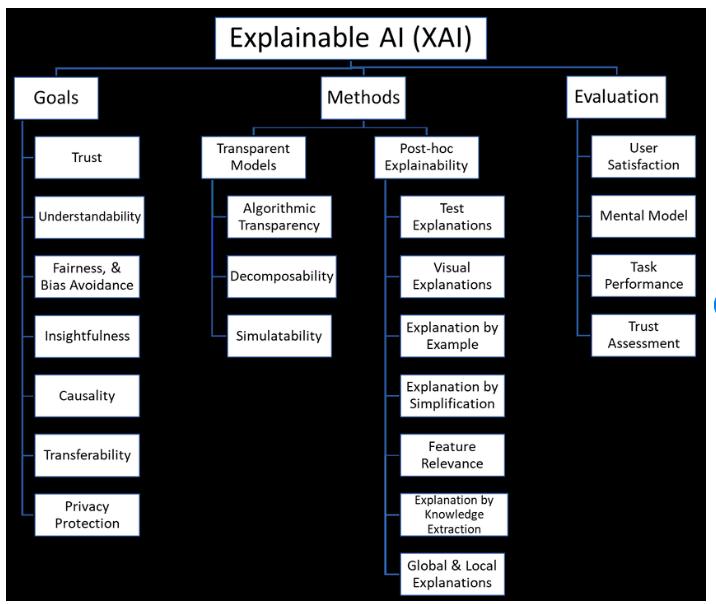
Evaluating explainability remains an open research challenge.Metricsarecommonlydividedintofidelity(how accurately explanations reflect the underlying model), interpretability(humancomprehensibility),andusefulness (impactondecisionquality).Quantitativeevaluationoften measures faithfulness or consistency under perturbation, whereas human-centered evaluation assesses trust, understanding, and cognitive workload (Doshi-Velez and Kim, 2017). The absence of standardized benchmarks
Cognitive trust refers to the human psychological state of reliancebasedonperceivedcompetence,predictability,and integrity of the system. It is shaped by user experience, explanationclarity,andprioroutcomes.Computationaltrust, incontrast,ismathematicallymodeledwithinthesystemto quantifyreliabilityusingprobabilisticreasoning,reputation mechanisms, or performance histories. Bayesian trust models, for example, dynamically update reliability estimatesasnewevidencebecomesavailable(Yu,Singhand Sycara, 2004). The distinction between cognitive and computationaltrusthighlightstheneedtoalignsystem-level trust metrics with human perception to avoid trust miscalibration.
Trustcalibrationreferstoaligninguserreliancewithactual systemcapability.Over-trustcanresultinautomationbias, whereasunder-trustleadstodisuseoralgorithmaversion (Dietvorst,SimmonsandMassey,2015).Effectivecalibration requires transparent feedback mechanisms, uncertainty quantification, and context-aware explanations. Adaptive explanation strategies that adjust depth or modality according to user expertise have been proposed as mechanisms for improving calibrated reliance in complex environments.
High-consequence decision domains are environments where AI errors may result in severe physical, ethical, financial, or societal harm. These domains exhibit high uncertainty,strictaccountabilityrequirements,andlimited tolerance for failure. Examples include medical diagnosis, aviation control, military operations, and financial risk modeling.
Suchdomainsarecharacterizedbyprobabilisticuncertainty, incomplete information, and potentially irreversible
International Research Journal of Engineering and Technology (IRJET) e-ISSN: 2395-0056
Volume: 13 Issue: 02 | Feb 2026 www.irjet.net p-ISSN: 2395-0072
outcomes. Ethical considerations such as fairness, transparency, and responsibility become central design constraints.Algorithmicbiasoropaquedecision-makingin healthcare or finance can exacerbate social inequities (BarocasandSelbst,2016).Consequently,AIsystemsmust not only achieve technical robustness but also provide ethicallyinterpretablereasoningprocesses.
2.3.2 Regulatory Requirements and Explain ability Standards
Regulatoryframeworksincreasinglymandatetransparency and human oversight for high-risk AI applications. The European Commission’s guidelines for trustworthy AI emphasize requirements including transparency, accountability, and technical robustness (European Commission, 2019). Emerging standards advocate documentation practices, auditability, and explain ability mechanismsthatenabletraceabilityofautomateddecisions. Compliancepressuresthereforeactasadrivingforcebehind the development of dynamic trust-aware explain ability models capable of satisfying both operational and legal expectations.
This section critically synthesizes existing scholarship on explainability models, trust mechanisms, and their integration into trust-aware explainable AI frameworks. Ratherthantreatingexplainabilityandtrustasindependent constructs, recent research increasingly views them as interdependent components of reliable AI systems, particularlyinhigh-consequencedomains.
Explainability models aim to make AI decision processes interpretabletostakeholderswithvaryinglevelsoftechnical expertise. The literature broadly distinguishes between intrinsicallyinterpretablemodelsandpost-hocexplanation techniquesdesignedforcomplexblack-boxsystems.
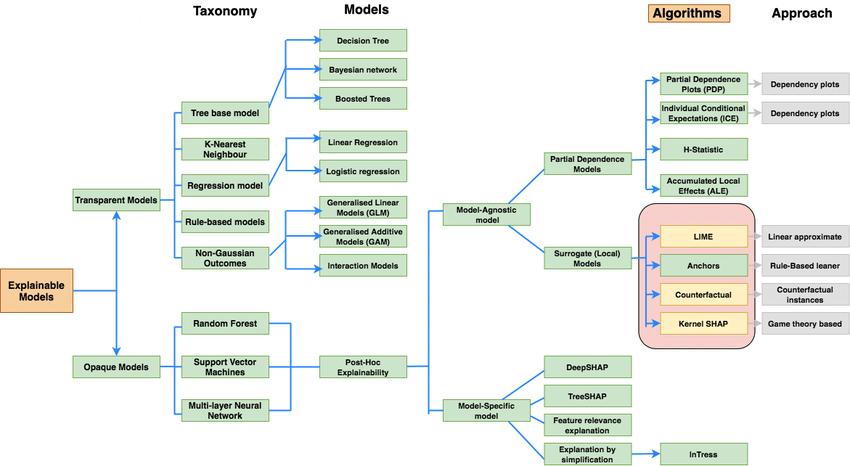
Figure-2: Explainable AI Taxonomy
Intrinsicexplainabilityreferstomodelsthataretransparent byconstruction.Decisiontrees,rule-basedclassifiers,sparse linear models, and generalized additive models are frequently cited as inherently interpretable due to their explicitstructurallogic.Forinstance,decisiontreesprovide hierarchical rule paths that can be directly inspected and validated by domain experts (Breiman et al., 1984). Similarly,rule-basedsystemsarticulatehuman-readableIF–THENlogic,facilitatingtraceabilityinregulatedsectors.
However, intrinsic models often face scalability and expressivenesslimitationsinhigh-dimensional,non-linear environments. As data complexity increases such as in medical imaging or real-time perception tasks simpler interpretablemodelsmayunderperformcomparedtodeep neural architectures. This performance–interpretability trade-offremainsacentraltensioninXAIresearch(Rudin, 2019).
Post-hoc explain ability methods are applied after model training to interpret complex black-box systems. Local surrogateapproaches,suchasLIME,approximatedecision boundaries around specific instances to generate feature importance explanations (Ribeiro, Singh and Guestrin, 2016).SHAPemployscooperativegametheorytocompute Shapley values, attributing contributions of individual featurestopredictions(LundbergandLee,2017).
Attention-basedexplanationsindeeplearningfurtheraimto highlight salient input regions influencing outputs, particularly in natural language processing and computer vision.Complementaryvisualizationtools saliencymaps, partial dependence plots, and interactive dashboards enhance user interpretability by presenting explanations graphically.Nevertheless,post-hocmethodsraiseconcerns regarding explanation fidelity and robustness under perturbations.
Intrinsicapproachesprovidehighstructuraltransparency andregulatoryalignmentbutmaylackpredictivepowerin complexdomains.Post-hoctechniquesofferflexibilityand compatibility with high-performance models but may introduce approximation errors or misleading rationalizations.Empiricalcomparisonssuggestthatwhile post-hocexplanationsimproveuserunderstanding,theydo not automatically guarantee calibrated trust (Jacovi and Goldberg, 2020). Consequently, the literature indicates a needforhybridstrategiesthatbalanceinterpretabilitywith accuracyandcontextualreliability.
International Research Journal of Engineering and Technology (IRJET) e-ISSN: 2395-0056
Volume: 13 Issue: 02 | Feb 2026 www.irjet.net p-ISSN: 2395-0072
Trust mechanisms determine how system reliability is quantified, communicated, and adapted over time. The literature distinguishes between static trust metrics and adaptive,dynamictrustmodelingapproaches.
3.2.1
Static trust models typically rely on predefined rules, performance statistics, or confidence scores to estimate systemreliability.Confidencecalibrationtechniques,suchas probability scaling and reliability diagrams, provide a numerical representation of prediction certainty. These approaches are common in classification systems where predictionconfidenceisusedasaproxyfortrustworthiness.
However,statictrustmetricsassumeenvironmentalstability andconsistentdatadistributions.Insafety-criticalcontexts, such assumptions rarely hold due to concept drift and adversarial conditions. As a result, static models may misrepresentactualreliabilityunderchangingoperational scenarios(Guoetal.,2017).
3.2.2
Dynamictrustmodelsupdatereliabilityestimatesbasedon contextual feedback, environmental shifts, and user interaction history. Bayesian trust modeling frameworks adjustposteriortrustprobabilitiesasnewevidencebecomes available,allowingsystemstoaccountforuncertaintyand performancedegradation(Yu,SinghandSycara,2004).
Reinforcement learning-based trust adaptation and performance monitoring mechanisms have also been proposedtoaddressmodeldriftinreal-timeenvironments. Such adaptive approaches are particularly relevant in autonomous systems and mission-critical infrastructures, where rapid recalibration is necessary to maintain safe human–AIcollaboration.
Emergingresearchintegratestrustestimationwithexplain ability mechanisms to create context-aware AI systems capableofsupportingcalibratedhumanreliance.
3.3.1 Integrated Frameworks for Trust and Explain ability
Integrated frameworks combine model explanations with dynamic trust metrics to modulate the depth, format, or frequency of explanations. For example, adaptive explanationsystemstailoroutputsbasedonestimateduser expertiseandtaskrisklevel.Somearchitecturesincorporate uncertainty quantification alongside feature attribution, enabling users to assess both reasoning and reliability simultaneously(SokolandFlach,2020).
In healthcare diagnostics, explain ability tools are used to justify model predictions in radiology and pathology, improving clinician oversight while supporting accountability(Estevaetal.,2017).Inautonomousdriving, explanationsystemsclarifyperceptionoutputsanddecision policiestoenhancedrivertrustandsituationalawareness.
Evaluation of trust-aware explain ability models extends beyond predictive accuracy. Human judgment alignment measures assess whether explanations improve user understanding and decision quality. Objective trust quantification involves metrics such as calibration error, reliability curves, and dynamic performance tracking. Despite growing interest, standardized benchmarks integrating both trust calibration and explanation fidelity remainlimited,complicatingcross-domainvalidationefforts.
A comparative synthesis of the literature reveals both conceptual convergence and persistent research gaps in integratingtrustmodelingwithexplainabilitytechniques.
Existing models can be compared across dimensions including explanation type (intrinsic vs post-hoc), trust representation(staticvsdynamic),applicationdomain,and evaluation methodology. Studies differ significantly in whethertrustistreatedasahumanperceptionvariableora computational parameter embedded within the system architecture. Few frameworks comprehensively integrate bothdimensionsinreal-timeoperationalsettings.
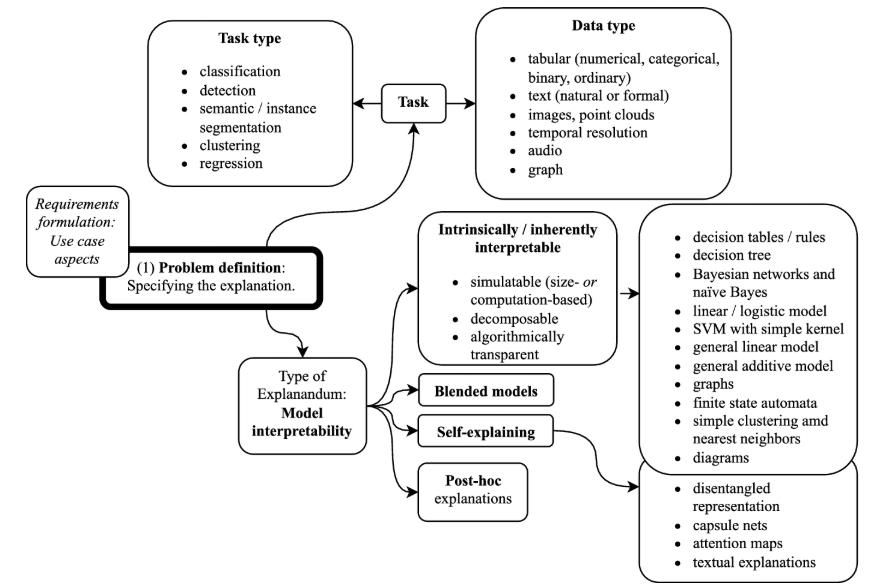
Figure-3: Comprehensive XAI Concept Map
International Research Journal of Engineering and Technology (IRJET) e-ISSN: 2395-0056
Volume: 13 Issue: 02 | Feb 2026 www.irjet.net p-ISSN: 2395-0072
Strengths of current approaches include improved transparency, enhanced uncertainty communication, and better human engagement. However, notable weaknesses persist: limited adaptability under distribution shifts, insufficient modeling of user-specific trust profiles, and inadequate empirical validation in high-risk real-world deployments. Furthermore, many systems focus on explanationgenerationwithoutempiricallymeasuringlongtermtrustcalibrationeffects.
Recenttrendsemphasizeinteractiveexplanationinterfaces, incorporation of human feedback loops, and regulatorydriven transparency requirements. The increasing prominenceofAIgovernanceframeworkshasaccelerated research on auditable and accountable AI systems. Trustawareexplainabilityisprogressivelyviewednotonlyasa usabilityenhancementbutalsoasacompliancemechanism aligning AI deployment with emerging legal and ethical standards.
Despite substantial progress in explainable AI and computationaltrustmodeling,severalunresolvedchallenges limit the effective deployment of dynamic trust-aware explainabilitymodelsinhigh-consequencedomains.These challengesspantechnicalscalability,epistemicevaluation, ethical compliance, and human–machine interaction complexities. Addressing them is essential for advancing robust,context-sensitiveAIsystems.
Oneoftheforemostchallengesconcernsscalabilityinlargescale,high-dimensionalsystems.Manypost-hocexplanation techniquesrequirerepeatedmodelevaluationsorsurrogate approximations, which can introduce computational overhead incompatible with real-time decision environments. For example, model-agnostic explanation methodsmaynotmeetlatencyconstraintsinautonomous navigation or critical care monitoring systems where millisecondsmatter(AdadiandBerrada,2018).
Furthermore, dynamic trust modeling necessitates continuousmonitoringofsystemperformance,uncertainty estimation, and context-aware recalibration. Integrating these processes into resource-constrained edge or embedded systems amplifies architectural complexity. Ensuring low-latency explanation generation without sacrificing fidelity remains an open systems engineering problem.
The performance–interpretability trade-off continues to pose theoretical and practical tensions. Highly expressive deeplearningarchitecturesoftenoutperforminterpretable models in complex tasks such as image recognition or anomaly detection. However, their opacity complicates accountabilityandhumanoversight(Rudin,2019).
Attempts to embed interpretability directly within neural networks such as attention mechanisms or inherently interpretable neural modules have shown promise but maystilllackrigorousguaranteesoftransparency.Achieving both predictive optimality and robust interpretability without resorting to approximate post-hoc explanations remains a central research objective in safety-critical AI design.
A significant methodological challenge lies in quantifying trust and explanation effectiveness in a standardized manner. Trust is inherently psychological and contextdependent,makingitdifficulttooperationalizeasastable metric. While calibration error and uncertainty measures capturestatisticalreliability,theydonotfullyrepresentuser perceptionorbehavioralreliance(LeeandSee,2004).
Similarly,explanationqualitylacksuniversal benchmarks. Fidelity, stability, completeness, and human comprehensibilityareoftenevaluatedseparately,leadingto fragmented assessment frameworks. The absence of domain-specificevaluationstandardsforintegratedtrust–explainabilitysystemsimpedesreproducibilityandcrossstudycomparability.
Ethical and legal constraints significantly shape the deployment of AI systems in high-consequence settings. Regulatoryframeworksincreasinglymandatetransparency, fairness,andaccountabilityinautomateddecision-making. Forinstance,EuropeanAIgovernanceguidelinesemphasize explain ability and human oversight as prerequisites for high-risksystems(EuropeanCommission,2019).
However,explainabilityalonedoesnotguaranteefairnessor absenceofbias.Algorithmicdecisionsmayembedstructural inequities that persist despite transparent reasoning (BarocasandSelbst,2016).Additionally,disclosingdetailed explanations may conflict with intellectual property protection or security considerations. Balancing transparency with privacy, safety, and proprietary constraints presents a multidimensional governance challenge.
International Research Journal of Engineering and Technology (IRJET) e-ISSN: 2395-0056
Volume: 13 Issue: 02 | Feb 2026 www.irjet.net p-ISSN: 2395-0072
Effectivetrust-awareexplainabilitymustaccountforhuman cognitive limitations. Overly complex or frequent explanationscanincreasecognitiveload,impairsituational awareness, and reduce decision efficiency. Research in human–automation interaction indicates that optimal transparency is context-dependent; excessive detail may overwhelm users, whereas insufficient explanation undermines trust calibration (Parasuraman, Sheridan and Wickens,2000).
Dynamicexplanationsystemsmustthereforeadapttouser expertise, stress levels, and task criticality. Designing interfacesthatsupportcollaborativehuman–AIteaming without inducing automation complacency or overload requires interdisciplinary integration of cognitive science, human–computer interaction, and AI system design principles.
This review has critically examined the evolution of explainable artificial intelligence and computational trust modeling,withparticularemphasisontheirintegrationinto dynamic trust-aware explainability frameworks for highconsequencedecisiondomains.Theanalysisdemonstrates thatwhilesignificantadvancementshavebeenachievedin post-hoc explanation techniques, intrinsic interpretability methods,andprobabilistictrustmodeling,theirintegration remains fragmented and context-insensitive. Existing systems frequently address explainability and trust as parallel objectives rather than interdependent design requirements. In safety-critical environments such as healthcare,autonomoussystems,finance,anddefense,static explanation mechanisms and fixed trust metrics are insufficient to ensure calibrated human reliance under uncertainty and distributional shifts. The literature highlightstheimportanceofadaptiveexplanationstrategies, uncertaintyquantification,anduser-centeredevaluationfor enhancingaccountabilityandcollaborativedecision-making. However, standardized benchmarks for jointly evaluating trust calibration and explanation fidelity are still lacking. Futureprogressrequiresinterdisciplinaryapproachesthat integratehumanfactorsengineering,regulatorycompliance, and real-time system optimization. Ultimately, dynamic trust-awareexplainabilitymodelsrepresentafoundational step toward responsible, transparent, and resilient AI systemscapableofoperatingreliablyinenvironmentswhere decisionscarrysignificantethical,societal,andoperational consequences.
Thisreviewissubjecttoseverallimitations.First,although major academic databases were consulted, the synthesis primarily emphasizes peer-reviewed literature in English, potentially excluding relevant contributions from non-
indexed or regional publications. Second, the rapidly evolvingnatureofexplainableAIandtrustmodelingmeans that newly emerging frameworks may not be fully represented. Third, empirical comparisons across studies wereconstrainedbyheterogeneousevaluationmetricsand domain-specific methodologies, limiting the ability to conductquantitativecross-studyanalysis.Additionally,the reviewfocusespredominantlyontechnicalandconceptual frameworksratherthanconductingexperimentalvalidation or meta-analytic statistical synthesis. Finally, regulatory discussionsarecontextualizedprimarilywithinwidelycited global guidelines and may not comprehensively reflect jurisdiction-specificlegalnuances.
1. Adadi, A. and Berrada, M. (2018) ‘Peeking inside the black-box:Asurveyonexplainableartificialintelligence (XAI)’,IEEEAccess,6,pp.52138–52160.
2. Barocas,S.andSelbst,A.D.(2016)‘Bigdata’sdisparate impact’,CaliforniaLawReview,104(3),pp.671–732.
3. Bonnefon, J.F., Shariff, A. and Rahwan, I. (2016) ‘The social dilemma of autonomous vehicles’, Science, 352(6293),pp.1573–1576.
4. Breiman,L.,Friedman,J.H.,Olshen,R.A.andStone,C.J. (1984) Classification and Regression Trees. Belmont, CA:Wadsworth.
5. Dietvorst, B.J., Simmons, J.P. and Massey, C. (2015) ‘Algorithm aversion: People erroneously avoid algorithms after seeing them err’, Journal of Experimental Psychology: General, 144(1), pp. 114–126.
6. Doshi-Velez,F.andKim,B.(2017)‘Towardsarigorous science of interpretable machine learning’, arXiv preprintarXiv:1702.08608.
7. Esteva,A.,Kuprel,B.,Novoa,R.A.,Ko,J.,Swetter,S.M., Blau, H.M. and Thrun, S. (2017) ‘Dermatologist-level classificationofskincancerwithdeepneuralnetworks’, Nature,542(7639),pp.115–118.
8. European Commission (2019) Ethics Guidelines for TrustworthyAI.Brussels:EuropeanCommissionHighLevelExpertGrouponArtificialIntelligence.
9. Guo,C.,Pleiss,G.,Sun,Y.andWeinberger,K.Q.(2017) ‘On calibration of modern neural networks’, in Proceedings of the 34th International Conference on MachineLearning(ICML),pp.1321–1330.
10. Gunning,D.(2017)‘ExplainableArtificialIntelligence (XAI)’, Defense Advanced Research Projects Agency (DARPA).Availableat:
International Research Journal of Engineering and Technology (IRJET) e-ISSN: 2395-0056
Volume: 13 Issue: 02 | Feb 2026 www.irjet.net p-ISSN: 2395-0072
https://www.darpa.mil/program/explainableartificial-intelligence.
11. Jacovi,A.andGoldberg, Y.(2020)‘Towardsfaithfully interpretableNLPsystems:Howshouldwedefineand evaluate faithfulness?’, in Proceedings of the 58th Annual Meetingof the AssociationforComputational Linguistics(ACL),pp.4198–4205.
12. Lee, J.D. and See, K.A. (2004) ‘Trust in automation: Designing for appropriate reliance’, Human Factors, 46(1),pp.50–80.
13. Lundberg,S.M.andLee,S.-I.(2017)‘Aunifiedapproach to interpreting model predictions’, in Advances in NeuralInformationProcessingSystems(NeurIPS),30, pp.4765–4774.
14. Parasuraman, R., Sheridan, T.B. and Wickens, C.D. (2000) ‘A model for types and levels of human interaction with automation’, IEEE Transactions on Systems,Man,andCybernetics–PartA,30(3),pp.286–297.
15. Ribeiro, M.T., Singh, S. and Guestrin, C. (2016) ‘“Why shouldItrustyou?”Explainingthepredictionsofany classifier’, in Proceedings of the 22nd ACM SIGKDD InternationalConferenceonKnowledgeDiscoveryand DataMining(KDD),pp.1135–1144.
16. Rudin, C. (2019) ‘Stop explaining black box machine learning models for high stakes decisions and use interpretable models instead’, Nature Machine Intelligence,1(5),pp.206–215.
17. Sokol,K.andFlach,P.(2020)‘Oneexplanationdoesnot fit all: The promise of interactive explanations for machine learning transparency’, KI – Künstliche Intelligenz,34,pp.235–250.
18. Yu, B., Singh, M.P. and Sycara, K. (2004) ‘Developing trust in large-scale peer-to-peer systems’, in Proceedings of the IEEE First Symposium on MultiAgentSecurityandSurvivability,pp.1–10.
19. Amershi, S., Weld, D., Vorvoreanu, M., Fourney, A., Nushi, B., Collisson, P., Suh, J., Iqbal, S., Bennett, P.N., Inkpen,K.andTeevan,J.(2019)‘Guidelinesforhuman–AIinteraction’,Proceedingsofthe2019CHIConference onHumanFactorsinComputingSystems,pp.1–13.
20. Arrieta,A.B.,Díaz-Rodríguez,N.,DelSer,J.,Bennetot,A., Tabik,S.,Barbado,A.,García,S.,Gil-Lopez,S.,Molina,D., Benjamins, R. and Herrera, F. (2020) ‘Explainable Artificial Intelligence (XAI): Concepts, taxonomies, opportunities and challenges toward responsible AI’, InformationFusion,58,pp.82–115.
21. Bansal, G., Nushi, B., Kamar, E., Horvitz, E., Weld, D.S. andLasecki,W.S.(2019)‘Beyondaccuracy:Theroleof mental models in human–AI team performance’, Proceedings of AAAI Conference on Artificial Intelligence,33(01),pp.9669–9676.
22. Bhatt, U., Andrus, M., Weller, A. and Xiang, A. (2020) ‘Machine learning explainability for external stakeholders’, Proceedings of FAT Conference*, pp. 344–353.
23. Carvalho, D.V., Pereira, E.M. and Cardoso, J.S. (2019) ‘Machine learning interpretability: A survey on methodsandmetrics’,Electronics,8(8),832.
24. Chen,J.Y.C.,Barnes,M.J.andHarper-Sciarini,M.(2011) ‘Supervisory control of multiple robots: Humanperformance issues and user-interface design’, IEEE TransactionsonSystems,Man,andCybernetics,41(2), pp.435–454.
25. Endsley,M.R.(2017)‘Fromheretoautonomy:Lessons learned from human–automation research’, Human Factors,59(1),pp.5–27.
26. Gilpin,L.H.,Bau,D.,Yuan,B.Z.,Bajwa,A.,Specter,M.and Kagal,L.(2018)‘Explainingexplanations:Anoverview of interpretability of machine learning’, IEEE 5th InternationalConferenceonDataScienceandAdvanced Analytics,pp.80–89.
27. Hancock,P.A.,Billings,D.R.,Schaefer,K.E.,Chen,J.Y.C., De Visser, E.J. and Parasuraman, R. (2011) ‘A metaanalysis of factors affecting trust in human–robot interaction’,HumanFactors,53(5),pp.517–527.
28. Holzinger, A., Carrington, A. and Müller, H. (2020) ‘Measuring the quality of explanations: The system causability scale’, KI – Künstliche Intelligenz, 34, pp. 193–198.
29. Kaur, H., Nori, H., Jenkins, S., Caruana, R., Wallach, H. and Wortman Vaughan, J. (2020) ‘Interpreting interpretability:Understandingdatascientists’useof interpretabilitytools’,ProceedingsofCHIConference onHumanFactorsinComputingSystems,pp.1–14.
30. Lipton, Z.C. (2018) ‘The mythos of model interpretability’,Queue,16(3),pp.31–57.
31. Miller,T.(2019)‘Explanationinartificialintelligence: Insightsfromthesocialsciences’,ArtificialIntelligence, 267,pp.1–38.
32. Ovadia, Y., Fertig, E., Ren, J., Nado, Z., Sculley, D., Nowozin,S.,Dillon,J.,Lakshminarayanan,B.andSnoek, J. (2019) ‘Can you trust your model’s uncertainty? Evaluatingpredictiveuncertaintyunderdatasetshift’,
2026, IRJET | Impact Factor value: 8.315 |
International Research Journal of Engineering and Technology (IRJET) e-ISSN: 2395-0056
Advances in Neural Information Processing Systems, 32.
33. Wachter, S., Mittelstadt, B. and Russell, C. (2017) ‘Counterfactualexplanationswithoutopeningtheblack box: Automated decisions and the GDPR’, Harvard JournalofLaw&Technology,31(2),pp.841–887.
34. Zhang, Y. and Dafoe, A. (2019) ‘Artificial intelligence: American attitudes and trends’, Center for the GovernanceofAIWorkingPaper,UniversityofOxford.
Volume: 13 Issue: 02 | Feb 2026 www.irjet.net p-ISSN: 2395-0072 © 2026, IRJET | Impact Factor value: 8.315 | ISO 9001:2008
| Page600