
International Research Journal of Engineering and Technology (IRJET) e-ISSN: 2395-0056
Volume: 13 Issue: 05 | May 2026 www.irjet.net p-ISSN: 2395-0072
International Research Journal of Engineering and Technology (IRJET) e-ISSN: 2395-0056
Volume: 13 Issue: 05 | May 2026 www.irjet.net p-ISSN: 2395-0072
Mukesh Vishwakarma1, Mr. Anurag Yadav2
1Master of Technology, Mechanical Engineering, Sagar Institute of Technology and Management, Barabanki, India
2Assistant Professor, Department Mechanical Engineering, Sagar Institute of Technology and Management, Barabanki, India ***
Abstract - Mechanicalfastenerassembliesarecriticalloadtransferring elements in power transmission systems such as gearboxes, drive shafts, couplings, and wind turbine hubs. Theirstructuralintegritydirectlyinfluencessystemreliability, operational safety, and lifecycle cost. Among various failure mechanisms, fatigue remains the dominant cause of premature failure due to cyclic loading, vibration, thermal fluctuations, and preload variations. Consequently, rigorous design validation and accurate fatigue performance assessment are essential to ensure long-term durability of theseassemblies.Thisreviewsynthesizesexistingresearchon analytical, experimental, and numerical approaches used for design validation and fatigue evaluation of mechanical fastener assemblies in power transmission applications. Classical design methodologies based on stiffness models and standardized codes are examined alongside advanced finite elementmodelingtechniquesincorporatingcontactmechanics and preload simulation. Experimental validation strategies, including static load testing, cyclic fatigue testing, and nondestructive evaluation methods, are critically assessed. Furthermore, fatigue life prediction frameworks such as stress-life (S–N), strain-life (ε–N), and fracture mechanicsbased models are comparatively analyzed with respect to their applicability, accuracy, and limitations. The review identifies key challenges in multiphysics modeling, standardization of fatigue testing protocols, and uncertainty quantification. Emerging trends, including probabilistic modeling and digital monitoring approaches, are also discussed. The findings provide a consolidated reference frameworktosupportrobustdesignvalidationandimproved fatiguereliabilityoffastenerassembliesinpowertransmission systems.
Key Words: Mechanical Fasteners; Power Transmission; Design Validation; Fatigue Performance; Bolted Joints; Fatigue Life Prediction.
1.1
Mechanical fasteners are indispensable components in structural assemblies and rotating machinery, providing detachableyetreliableconnectionscapableoftransmitting complexloadcombinations.Incontrasttopermanentjoining
techniques such as welding, threaded fasteners enable maintenance, inspection, and component replacement withoutstructuraldamage.Theirmechanicalperformanceis governedbypreloadgeneration,jointstiffnessinteraction, andstressconcentrationeffectsatthreadrootsandbearing interfaces. Classical joint mechanics demonstrates that appropriatepreloadensurescompressiveclampingforces that mitigate cyclic tensile stresses in the bolt, thereby improving durability and structural integrity (Bickford, 2008). In heavy-duty machinery and high-speed rotating systems, the reliability of these joints directly influences operationalsafetyandlifecyclecost.
In power transmission systems, fastener assemblies are exposedtotorsionalloads,bendingmoments,axialthrust, andvibratoryexcitationarisingfromgearmeshingandshaft rotation.Applicationssuchasgearboxcasings,windturbine hubconnections,shaftcouplings,andflangejointsrequire precise torque control and fatigue-resistant design to prevent catastrophic failures. The increasing adoption of high-strength materials and lightweight structural configurations has intensified stress sensitivity in bolted interfaces,necessitatingadvancedanalyticalandnumerical validationapproaches(BudynasandNisbett,2015).
Despite established design standards, failures of fastener assemblies remain prevalent in power transmission environments.Fatigueiswidelyrecognizedasthedominant failure mechanism in cyclically loaded threaded joints, typicallyinitiatingatthefirstengagedthreadwherestress concentration is maximum. Variable amplitude loading, preloadrelaxation,andsurfaceimperfectionssignificantly reducefatiguelifeunderserviceconditions(Stephensetal., 2001).
Additionally, self-loosening under transverse vibration presents a persistent reliability challenge. Experimental investigations have shown that cyclic shear displacement canprogressivelyreduceclampingforce,ultimatelyleading to joint separation even when initial tightening torque is adequate (Junker, 1969). The combined effects of fatigue damage and preload loss highlight limitations in conventionaldesignapproachesthatrelyprimarilyonstatic
International Research Journal of Engineering and Technology (IRJET) e-ISSN: 2395-0056
Volume: 13 Issue: 05 | May 2026 www.irjet.net p-ISSN: 2395-0072
safety factors. Consequently, there is a pressing need for robustvalidationmethodologiesthatintegrateexperimental verification,advancedsimulation,andreliabilityassessment frameworks.
The primary aim of this review is to critically examine existingdesignvalidationstrategiesformechanicalfastener assembliesemployedinpowertransmissionsystems.This includes analytical stiffness-based models, standardized code-based procedures, and high-fidelity finite element simulations incorporating contact mechanics and preload effects.Emphasisisplacedonhowtheseapproachesensure structuralintegrityunderrealisticoperationalloading.
A second objective is to comparatively evaluate fatigue performance assessment methods used in the literature. Stress–life(S–N),strain–life(ε–N),andfracturemechanicsbasedcrackpropagationmodelsareanalyzedwithrespect to their assumptions, predictive accuracy, and industrial applicability.Particularattentionisgiventocyclicmultiaxial loading and environmental influences relevant to rotating machineryapplications(Norton,2011).
Thescopeofthereviewisconfinedtofastenerassemblies usedinpowertransmissioncontexts,includinggearboxes, windturbinehubs,shaftcouplings,andflangeconnections. Permanentjointsandnon-structuralfasteningsystemsare excluded to maintain thematic coherence and technical depth.
Thissectioncriticallysynthesizespriorresearchondesign methodologies, validation techniques, and fatigue assessmentapproachesformechanicalfastenerassemblies used in power transmission systems. Rather than cataloguing studies, emphasis is placed on conceptual evolution,methodologicalstrengths,andidentifiedresearch gaps.
2.1.1
Early research on bolted joint behavior was grounded in analytical formulations based on elasticity theory and simplified stiffness models. Joint stiffness theory conceptualizestheboltandclampedmembersasspringsin series, enabling estimation of load distribution under external tensile forces. This approach established the foundationforpredictingthefractionofappliedloadcarried by the bolt versus the joint members, directly influencing fatigue performance (Bickford, 2008). Torque–tension relationships were also extensively studied to correlate appliedtighteningtorquewithachievedpreload,accounting for friction at thread and bearing interfaces. Analytical expressions, although approximate, became central to
industrial practice due to their simplicity and ease of implementation.Safetyfactor-baseddesigndominatedearly methodologies, with allowable stress limits derived from static strength considerations rather than fatigue-specific criteria(BudynasandNisbett,2015).
With increasing industrial demand for standardization, internationalcodessuchasISO,DIN,andASMEformalized boltpropertyclasses,tighteningprocedures,andallowable stresscriteria.Thesestandardsprovidedstructureddesign frameworks incorporating proof load limits, preload recommendations, and thread geometry tolerances. Codebased design enhanced consistency across industries, particularly in heavy machinery and power transmission assemblies. However, these standards often rely on conservativeassumptionsandempiricalcalibrationrather than high-fidelity stress analysis. Industrial tightening specifications further evolved to include torque-angle methodsandyield-controlledtighteningtoimprovepreload accuracyandrepeatability.
Despitetheirpracticalutility,classicalanalyticalandcodebased approaches exhibit limitations. Simplified assumptions such as uniform stress distribution, linear elasticity, and constant friction coefficients do not adequately represent real joint behavior under cyclic multiaxial loading. Furthermore, early design frameworks largelyemphasizedstaticstrengthandproofloadcapacity while offering limited guidance on fatigue crack initiation andpropagationmechanisms.Subsequentfatigueresearch demonstrated that thread root stress concentration and preload variability significantly influence service life, highlightingdeficienciesinpurelystaticdesignparadigms (Stephensetal.,2001).
Experimental validation has historically served as the benchmark for verifying analytical and numerical predictions.Staticstrengthvalidationtestsassessproofload capacity,jointseparationthresholds,andultimatefracture behavior.Cyclicfatiguebenchtesting,oftenconductedusing servo-hydraulic systems, evaluates durability under controlled stress amplitudes and load ratios. Additionally, preload relaxation studies investigate clamping force reductionduetoembedment,creep,andvibrationaleffects. Suchexperimentsprovideempiricaldatasetsnecessaryfor model calibration and safety assessment in rotating machineryapplications(Norton,2011).
International Research Journal of Engineering and Technology (IRJET) e-ISSN: 2395-0056
Volume: 13 Issue: 05 | May 2026 www.irjet.net p-ISSN: 2395-0072
Advancements in computational mechanics have enabled detailed Finite Element Analysis (FEA) of threaded joints. Numerical models now incorporate three-dimensional threadgeometry,nonlinearcontactmechanics,andfrictional behavior to predict localized stress distribution. Contact simulations allow evaluation of load transfer at the first engaged thread, where stress concentration is typically highest.Recentresearchalsointegratesthermo-mechanical coupling to account for temperature-induced preload variationsingearboxesandturbineassemblies.WhileFEA offers high spatial resolution, model accuracy depends heavily on boundary condition selection and material constitutivemodels.
To bridge discrepancies between simulations and experiments,hybridvalidationapproacheshave emerged. TheseinvolvecorrelatingFEApredictionswithstraingauge measurements,digitalimagecorrelation(DIC),orloadcell datatorefinemodelparameters.Modelupdatingtechniques improve predictive capability by iteratively adjusting materialproperties,frictioncoefficients,orcontactstiffness. Such correlation-based strategies enhance reliability of numerical validation frameworks and are increasingly adoptedincriticalpowertransmissionapplications.
Despitemethodologicalprogress,literatureidentifiesseveral unresolved challenges. There is no universally accepted validation metric for threaded joint fatigue performance, leading to inconsistent comparison across studies. Additionally,manynumericalmodelsneglectmultiphysics interactionssuchascorrosion,temperaturegradients,and vibratorydynamicssimultaneously.Thelackofintegrated validation protocols limits predictive confidence in realserviceenvironments,especiallyundervariableamplitude loadingconditions.
2.3.1
Stress–life (S–N) approaches dominate high-cycle fatigue analysis of mechanical fasteners. These methods relate stress amplitude to number of cycles to failure and are particularly applicable when deformation remains predominantlyelastic.Meanstresscorrectionmodels,such asGoodmanandGerberrelations,arecommonlyappliedto accountforpreload-inducedmeanstresseffects.Although computationally efficient, S–N methods do not explicitly modelcrackgrowthmechanismsandmayunderestimatelife undercomplexloadingspectra(Stephensetal.,2001).
Strain–lifemethodologiesextendfatigueanalysisintolowcycleregimeswherelocalizedplasticdeformationoccursat thread roots. By incorporating cyclic stress–strain relationships and Coffin–Manson parameters, ε–N models provideimprovedpredictionofcrackinitiationunderhigh stress amplitudes. These approaches are particularly relevantintransientoverloadconditionsoryield-controlled tightening scenarios. However, they require detailed material characterization and are computationally more demandingthanS–Nmethods.
Fracture mechanics models focus on crack initiation and propagation behavior using stress intensity factors and Paris’lawformulations.Thesemodelsprovidemechanistic insight into fatigue failure progression once a crack is nucleated. In threaded fasteners, accurate estimation of stress intensity at the thread root is critical. Fracture mechanics approaches are well suited for life extension assessment and damage tolerance analysis, especially in safety-criticalpowertransmissionsystems.
Recognizing significant scatter in fatigue data, recent research adopts probabilistic frameworks to quantify uncertaintyinlifeprediction.Statisticalmodelsincorporate variabilityinmaterialproperties,preloadlevels,andsurface finish. Reliability-based design methodologies employ probabilistic S–N curves and Monte Carlo simulations to estimate failure probability over service life. Such approaches provide more realistic risk assessment comparedtodeterministicsafetyfactors.
Comparative studies highlight a trade-off between model complexityandindustrialapplicability.S–Nmethodsremain widely used due to simplicity and standardized data availability.Strain–lifeandfracturemechanicsapproaches offerhigheraccuracyinlocalizedstressanalysisbutrequire extensive input parameters and computational effort. Probabilistic models enhance reliability assessment yet demand comprehensive statistical datasets. The literature consistently suggests that hybrid frameworks combining deterministicfatigueanalysiswithreliabilityconsiderations provide optimal balance for power transmission applications.
International Research Journal of Engineering and Technology (IRJET) e-ISSN: 2395-0056
Volume: 13 Issue: 05 | May 2026 www.irjet.net p-ISSN: 2395-0072
(Literature Perspective)
2.4.1
High-strengthalloysteelsareextensivelystudiedfortheir superiortensilestrengthandimproved fatigueresistance. However, increasing strength often reduces ductility and mayheightensusceptibilitytobrittlefractureorhydrogen embrittlement.Properheattreatmentandmicrostructural control are therefore essential to achieve balanced mechanicalperformance(BudynasandNisbett,2015).
Surface engineering techniques such as shot peening introduce compressive residual stresses that delay crack initiationatthreadroots.Protectivecoatings,includingzinc or phosphate layers, enhance corrosion resistance and influence frictional characteristics during tightening. Literatureindicatesthatoptimizedsurfacetreatmentscan significantlyextendfatiguelifeincyclicallyloadedjoints.
2.4.3
Residual stresses arising from manufacturing processes, tightening, or surface treatment alter local stress distribution in fasteners. Compressive residual stress improvesfatigueresistance,whereastensileresidualstress accelerates crack nucleation. Advanced measurement techniques, including X-ray diffraction, have been used to quantifythesestressesandcorrelatethemwithdurability performance.
Corrosion–fatigue interaction is a critical degradation mechanism in outdoor or marine power transmission systems.Thesynergisticeffectofcyclicstressandcorrosive environments reduces fatigue strength below values observed in air. Studies emphasize the importance of material selection, coatings, and environmental control strategies to mitigate combined corrosion and fatigue damage(RevieandUhlig,2008).
Understanding the mechanical behavior of fastener assemblies in power transmission systems requires a rigorous theoretical framework grounded in elasticity, contact mechanics, and fatigue theory. The load-bearing performance of threaded joints is governed by stiffness interaction, localized stress fields, and preload stability under operational loading. This section synthesizes the principal theoretical constructs that underpin modern analyticalandnumericalmodelsofboltedjointbehavior.
Jointstiffnesstheoryformsthebackboneofanalyticalbolt design.Inapreloadedboltedjoint,theboltandtheclamped membersareidealizedaselasticspringsarrangedinseries. Whenanexternaltensileloadisapplied,onlyafractionof thatloadistransferredtothebolt,dependingontherelative stiffness of the bolt and joint members. The load fraction carried by the bolt is commonly expressed as a stiffness ratio,whichdirectlyinfluencesfatiguelifesinceincreased bolt load amplitude elevates stress cycling severity (Bickford,2008).
Thetheoreticalframeworkassumeslinearelasticbehavior anduniformstressdistributionacrosstheclampedinterface. Whiletheseassumptionssimplifycalculations,theyprovide practical engineering estimates for preload selection and safety factor determination. Extensions of stiffness theory incorporatejointseparationcriteria,embeddingeffects,and gasketedinterfaces,particularlyrelevantinflangejointsof powertransmissionsystems.Advancedformulationsfurther integratecompliancematricesderivedfromelasticitytheory toimprovepredictionaccuracyinnon-uniformgeometries (BudynasandNisbett,2015).
Contactmechanicsgovernstheinteractionbetweenmating threads and bearing surfaces in fastener assemblies. The localized contact pressure distribution along engaged threadsishighlynon-uniform,withthefirstengagedthread typicallysustainingthehighestload.Hertziancontacttheory provides a foundational basis for estimating stress distributionatcurvedinterfaces;however,threadedjoints requiremorecomplexnonlinearcontactformulationsdueto frictionalslidingandgeometricdiscontinuities.
Finiteelementimplementationsofcontactmechanicshave demonstrated that friction coefficient, thread pitch, and manufacturing tolerances significantly affect load sharing amongthreads.Plasticdeformationmayoccurlocallyathigh preloadlevels,alteringstressredistributionpatterns.These phenomena are particularly important in high-strength bolted joints used in gearboxes and turbine hubs, where repeated torque fluctuations can modify contact pressure fields over time. Theoretical and computational developments in nonlinear contact modeling have thus becomecentraltoaccuratefatiguelifeprediction(Norton, 2011).
Threaded fasteners inherently contain geometric discontinuities that act as stress raisers. The thread root, characterized by a small radius and sharp curvature transition, produces high theoretical stress concentration factors (Kt). Classical elasticity solutions quantify Kt for notched components, but effective fatigue performance
International Research Journal of Engineering and Technology (IRJET) e-ISSN: 2395-0056
Volume: 13 Issue: 05 | May 2026 www.irjet.net p-ISSN: 2395-0072
depends on notch sensitivity, which accounts for material microstructureandcyclicplasticityeffects.
Fatigueanalysisdemonstratesthatcrackinitiationinbolts typicallyoccursatthefirstengagedthreadduetocombined axial and bending stresses. The effective fatigue stress concentrationfactor(Kf)incorporatesmaterial-dependent notch sensitivity parameters, enabling more realistic life estimation under cyclic loading (Stephens et al., 2001). Microstructural considerations, including grain size and surfacefinish,furtherinfluencecracknucleationbehavior. TheoreticalframeworkslinkingKtandKfthereforeprovide essential insight into the fatigue vulnerability of threaded assembliesinrotatingmachinery.
Preloadstabilityiscriticaltomaintainingjointintegrityin power transmission systems. Theoretical models identify several mechanisms contributing to preload reduction, includingembedmentrelaxation,creep,thermalexpansion mismatch,andvibrationalself-loosening.Embedmentoccurs when surface asperities plastically deform under compressive stress, leading to a gradual reduction in clampingforceaftertightening.
Thermal effects introduce differential expansion between bolt and clamped components, modifying tensile stress in the fastener. In high-temperature gear assemblies, these effectscaneitherincreaseordecreasepreloaddependingon material coefficients of thermal expansion. Vibrational loosening, driven by transverse cyclic displacement, has been experimentally validated as a significant cause of preloaddecay,particularlyundershear-dominatedloading conditions. Analytical and empirical models of preload relaxationhighlighttheneedtoincorporatetime-dependent anddynamiceffectsintovalidationstrategies(Junker,1969).
Collectively, theoretical understanding of stiffness interaction, contact behavior, stress concentration, and preload stability forms the foundation for reliable fatigue performance assessment and design validation of mechanical fastener assemblies in power transmission applications.
Design validation of mechanical fastener assemblies in power transmission systems requires application-specific frameworksthatintegrateanalyticalverification,numerical simulation,experimentaltesting,andreliabilityassessment. Unlikegenericboltedjoints,fastenersinrotatingmachinery are exposed to multiaxial stresses, vibration, thermal gradients, and variable amplitude loading. Consequently, validationprotocolsmustreflectservice-specificboundary conditionsandfailuremodes.
Gearboxhousingsandbearingcapsrelyonboltedjointsto maintain alignment of gears and shafts under dynamic torque transmission. Validation frameworks for gearbox assemblies typically emphasize joint stiffness adequacy, preload retention, and resistancetofatigue-induced crack initiation.Finiteelementanalysisiscommonlyemployedto evaluate stress distribution around bolt holes and thread rootsundercombinedtorsionalandbendingloads.
Experimental validation often includes static proof load testing,cyclicdurabilitytestingunderrepresentativetorque spectra, and vibration endurance assessment. Since gear meshing induces periodic excitation, frequency-domain analysisisintegratedintovalidationprocedurestoprevent resonance-induced preload loss. The importance of joint rigidityinmaintaininggeartoothalignmenthasbeenwidely discussed in machine design literature, highlighting the interdependence between structural stiffness and transmissionefficiency(BudynasandNisbett,2015).
Windturbinehubandflangejointsrepresentoneofthemost critical fastenerapplications inmodern renewable energy systems.These jointsaresubjected tofluctuating bending moments, axial thrust from aerodynamic loading, and environmentalexposure.Validationframeworkstherefore incorporatefatiguelifepredictionundervariableamplitude loadingderivedfromwindspectra.
High-strengthboltsusedinturbineflangesrequireprecise preloadcontroltopreventseparationundercyclicbending. Numerical simulations typically model full 3D thread geometry to capture stress concentration effects, while experimentalprogramsincludelong-durationfatiguetesting andpreloadmonitoring.Theinfluenceofoffshorecorrosion further necessitates material and coating validation to mitigate corrosion–fatigue interaction (Stephens et al., 2001).Giventhecatastrophicconsequencesofflangefailure, validation procedures are often governed by stringent industry standards and safety factors exceeding those in conventionalmechanicalsystems.
Shaft couplings transmit torque between rotating shafts whileaccommodatingminormisalignments.Boltedflange couplingsexperiencecyclicshearstressessuperimposedon tensile preload stresses. Validation frameworks for such assemblies emphasize shear capacity, frictional slip resistance,andfatiguestrengthundertorsionalreversal.
Analytical models are initially employed to estimate bolt shear and bearing stresses, followed by detailed finite elementsimulationsincorporatingcontactfrictionandbolt
International Research Journal of Engineering and Technology (IRJET) e-ISSN: 2395-0056
Volume: 13 Issue: 05 | May 2026 www.irjet.net p-ISSN: 2395-0072
pretension. Experimental validation frequently includes torsional fatigue testing and slip threshold determination. Misalignment-induced bending moments introduce additional stress components, necessitating multiaxial fatigueassessment.Theoreticaltreatmentsofrotatingshaft systems underline the importance of accurate preload to maintainfrictionalloadtransferandpreventfrettingdamage attheinterface(Norton,2011).
Recent advances in digital engineering have introduced digitaltwinframeworksforreal-timevalidationoffastener assemblies in power transmission systems. A digital twin integratesnumericalmodelswithoperationalsensordatato continuouslyevaluatestructuralhealthandpreloadstatus. Embedded strain gauges, load-sensing washers, and ultrasonicboltelongationmeasurementtechniquesenable in-situmonitoringofclampingforce.
Sensor-basedmonitoringenhancesvalidationbycapturing actualserviceloadingconditionsratherthanrelyingsolely onlaboratorysimulations.Data-drivenfatiguelifeprediction models can be updated using measured stress histories, thereby improving reliability assessment. Furthermore, digital twin platforms facilitate predictive maintenance strategies, reducing unplanned downtime in gearbox and turbine systems. The integration of structural health monitoringwithmechanicaldesignprinciplesrepresentsa significant advancement beyond traditional deterministic validationmethods(Bickford,2008).
Fatigueassessmentinpowertransmissionsystemsrequires methodologiescapableofaddressingcomplexstressstates, fluctuating load histories, and environmental influences. Fastener assemblies in gearboxes, turbine hubs, and shaft couplingsrarelyexperiencesimpleuniaxialloading;instead, they operate under combined axial, shear, torsional, and bending stresses. This section synthesizes major fatigue assessment strategies reported in the literature, emphasizingtheirapplicabilitytorotatingmachinery.
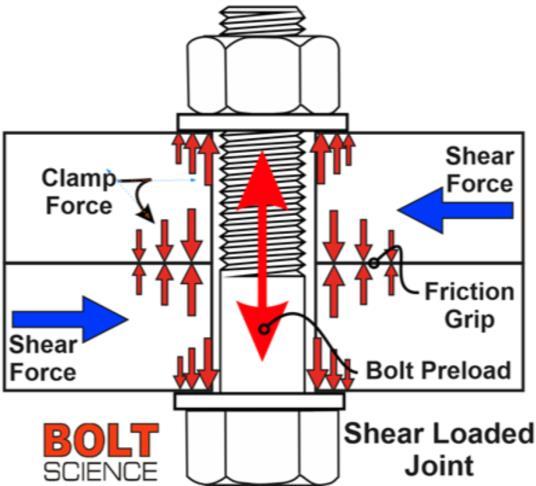
Fastenersinrotatingmachineryarefrequentlysubjectedto multiaxial stress states due to combined preload, torque transmission, bending from misalignment, and dynamic excitation. Traditional uniaxial S–N approaches are insufficientforsuchconditionsbecausetheydonotcapture shear–normal stress interaction at the thread root. Multiaxialfatiguecriteria,suchascriticalplanemethodsand equivalent stress approaches, have been developed to evaluatecrackinitiationundercombinedloading.
Critical plane models assess fatigue damage on material planes experiencing maximum shear or normal stress amplitude, enabling improved prediction of crack orientation and initiation life. Equivalent stress methods, including von Mises or Dang Van criteria, provide scalar measuresofdamagebutmayoversimplifyphasedifferences betweenstresscomponents.Researchinfatiguemechanics demonstrates that accurate multiaxial assessment significantlyimproveslifepredictioninrotatingcomponents wheretorsionandbendingcoexist(Stephensetal.,2001).
Power transmission systems operate under non-constant loading conditions. Wind turbines experience stochastic wind spectra, while gearboxes in industrial machinery encounter fluctuating torque demand. Variable amplitude loadingacceleratesfatiguedamagethroughloadinteraction effectsthatarenotcapturedbyconstant-amplitudetesting.
Cumulative damage models, most notably Miner’s linear damagerule,arewidelyusedtoestimatefatiguelifeunder variablestresshistories.However,studieshaveshownthat linearsummationdoesnotaccountforloadsequenceeffects, where high-amplitude cycles may induce crack growth accelerationdisproportionatetotheirfrequency.Advanced nonlinear damage models and rainflow cycle counting
International Research Journal of Engineering and Technology (IRJET) e-ISSN: 2395-0056
Volume: 13 Issue: 05 | May 2026 www.irjet.net p-ISSN: 2395-0072
techniquesarethereforeemployedtoextractrepresentative stress cycles from operational data. These approaches improve prediction fidelity in real-service conditions (Norton,2011).
Thermal–mechanical coupling plays a significant role in fatigue performance of fasteners in high-speed gearboxes and turbine assemblies. Temperature variations alter material properties, modify preload through differential thermalexpansion,andinfluencestressdistributioninthe joint. Repeated thermal cycling can introduce additional fatigue damage due to expansion–contraction effects superimposedonmechanicalloading.
Thermo-mechanical fatigue (TMF) analysis integrates temperature-dependent material behavior into life prediction models. Such analysis often requires temperature-dependent S–N or strain–life data, as well as constitutivemodelscapturingcreep–fatigueinteraction at elevated temperatures. In high-performance transmission systems, neglecting thermal effects can lead to significant underestimation of fatigue damage, particularly where preload relaxation occurs due to differential expansion betweenboltandclampedmembers(BudynasandNisbett, 2015).
Recentdevelopmentsinartificialintelligenceandmachine learninghaveintroduceddata-drivenapproachestofatigue lifeprediction.Unliketraditionaldeterministicmodels,AIbased methods learn patterns from historical fatigue datasets, sensor measurements, and operational load histories. Neural networks, support vector machines, and regression-based algorithms have been applied to predict fatiguelifeundercomplexmultiaxialandvariableamplitude conditions.
Data-drivenfatigueassessmentisparticularlyadvantageous whenphysicalmodelsaredifficulttoparameterizeorwhen serviceconditionsexhibithighvariability.Integrationwith structuralhealthmonitoringsystemsenablescontinuouslife estimation and predictive maintenance planning. While promising,theseapproachesrequireextensivetrainingdata andcarefulvalidationtoensurereliabilityinsafety-critical powertransmissionapplications(Bickford,2008).
This section synthesizes the reviewed literature by comparatively evaluating validation methodologies and fatigue prediction frameworks for mechanical fastener assemblies in power transmission systems. Emphasis is placedonmethodologicalrobustness,predictivecapability, industrialfeasibility,andidentifiedlimitations.
Experimental validation remains the benchmark for assessingstructuralintegrityoffastenerassemblies.Static proof load testing, cyclic fatigue testing, and preload relaxationexperimentsprovideempiricalevidenceofjoint performance under controlled conditions. The primary advantage of experimental approaches lies in their direct representation of physical behavior, including material nonlinearity and real contact interactions. However, experimental programs are time-consuming, costly, and oftenlimitedinscalabilitywhenevaluatingmultipledesign configurations.Moreover,reproducingcomplexmultiaxial serviceloadinginlaboratoryconditionspresentspractical challenges(Norton,2011).
Numerical validation, primarily through finite element analysis (FEA), enables detailed stress distribution assessmentatthreadroots,bearinginterfaces,andcontact surfaces. Advanced models incorporate nonlinear contact mechanics, frictional behavior, and preload simulation. Comparedtoexperimentalapproaches,numericalmethods offer design flexibility and rapid parametric evaluation. Nevertheless,theiraccuracystronglydependsonboundary condition assumptions, friction coefficients, and mesh refinement. Inaccurate modeling of contact stiffness or preload can lead to substantial deviations from actual performance(Bickford,2008).
Hybrid validation frameworks combine experimental measurements with numerical simulations to enhance predictive reliability. Strain gauge data, digital image correlation(DIC),andultrasonicpreloadmeasurementsare frequently used to calibrate FEA models. This integrated approach reduces modeling uncertainty and improves confidence in fatigue life predictions. Literature suggests thathybridmethodsprovidetheoptimalbalancebetween physicalrealismandcomputationalefficiency,particularlyin safety-critical gearbox and turbine applications. However, the requirement for high-quality experimental data may limitwidespreadadoption.
6.2.1
S–N models are widely applied for high-cycle fatigue assessmentofboltedjointswherestressamplitudesremain withinelasticlimits.Theirprimarystrengthliesinsimplicity and availability of standardized fatigue data. Mean stress correction models allow incorporation of preload effects. However, S–N approaches do not explicitly capture crack initiationmechanismsorplasticstrainlocalizationatthread
International Research Journal of Engineering and Technology (IRJET) e-ISSN: 2395-0056
Volume: 13 Issue: 05 | May 2026 www.irjet.net p-ISSN: 2395-0072
roots, limiting accuracy under high stress amplitudes or multiaxialloading(Stephensetal.,2001).
Strain–life models extend fatigue assessment to low-cycle regimes and localized plastic deformation scenarios. By incorporating cyclic stress–strain behavior and Coffin–Manson relationships, ε–N approaches provide improved crack initiation prediction. These models are particularly relevantwhenboltsexperienceoverloadoryield-controlled tightening. Despite higher predictive fidelity, they require detailedmaterialcharacterizationandarecomputationally more intensive, which may constrain routine industrial application.
Fracturemechanicsapproachesfocusoncrackpropagation ratherthansolelyoncrackinitiation.Usingstressintensity factors and crack growth laws, these models provide mechanistic insight into fatigue progression in threaded fasteners. They are particularly valuable in life extension analysis and damage tolerance assessment. However, accurate modeling of initial crack size and geometry is challenging, and computational demands are significant. Comparative literature indicates that fracture mechanics methods offer superior physical representation but at the expenseofcomplexity(BudynasandNisbett,2015).
Implementation of advanced validation and fatigue prediction strategies in industrial settings encounters several constraints. Accurate preload measurement and control remain difficult due to friction variability during tightening. Environmental factors such as corrosion and temperature fluctuations introduce uncertainties not fully capturedindeterministicmodels.Additionally,high-fidelity finite element models require significant computational resourcesandexpertinterpretation.
Dataavailabilityisanothermajorlimitation.Fatiguedatasets for specific fastener grades under multiaxial and variable amplitude loading are often scarce. This restricts the application of reliability-based or probabilistic models. Furthermore, translating laboratory-derived fatigue parameters to real-service conditions necessitates conservativeassumptions,whichmayeitheroverestimate costorunderestimaterisk.
This review critically examined the state of research on design validation and fatigue performance assessment of mechanicalfastenerassembliesusedinpowertransmission systems. The synthesis of analytical, experimental, and numericalstudiesdemonstratesthatclassicaljointstiffness theory and code-based design approaches remain
foundational;however,theirpredictivecapabilityislimited whenappliedtocomplexmultiaxialandvariableamplitude loadingconditionstypicalofgearboxes,windturbinehubs, and rotating shaft interfaces. Advanced finite element modeling incorporating nonlinear contact mechanics and preload simulation has significantly improved stress distributionpredictionatthreadroots,yetmodelaccuracy remains dependent on boundary condition definition and materialcharacterization.
Fatigue assessment methodologies have evolved from conventionalstress–lifemodelstowardstrain–life,fracture mechanics,andprobabilisticframeworks,reflectingtheneed for higher fidelity life prediction in safety-critical applications.Comparativeanalysisindicatesthatnosingle method is universally optimal; rather, hybrid strategies integratingdeterministicfatiguemodelswithexperimental calibration and reliability-based evaluation offer the most robustvalidationpathway.Emergingdigitaltwinanddatadrivenapproachesfurtherenhancepredictivemaintenance potential.
Overall, reliable design validation in power transmission environments requires multiphysics integration, accurate preload control, and standardized validation metrics. The consolidated insights presented in this review provide a structuredreferenceforadvancingfatigue-resistantfastener design and improving structural reliability in highperformancemechanicalsystems.
This review is limited by its focus on fastener assemblies specifically within power transmission applications, excludingbroaderstructuralfasteningsystems.Whilemajor analytical, numerical, and experimental approaches were synthesized, not all proprietary industrial validation proceduresorunpublisheddatasetscouldbeincorporated. The discussion primarily emphasizes metallic threaded fasteners,withlimitedcoverageofemergingcompositeor additive-manufactured fasteners. Additionally, fatigue modelswerecomparativelyevaluatedatatheoreticallevel; detailed quantitative benchmarking across standardized datasetswas beyond the scopeof thiswork. Variability in reportedexperimentalconditionsacrossliteraturesources may also influence generalized conclusions. Future systematicmeta-analysesincorporatingstandardizedfatigue databasescouldfurtherstrengthencomparativereliability assessment.
1. Bickford,J.H.,2008.AnIntroductiontotheDesignand Behavior of Bolted Joints. 4th ed. Boca Raton: CRC Press.
International Research Journal of Engineering and Technology (IRJET) e-ISSN: 2395-0056
Volume: 13 Issue: 05 | May 2026 www.irjet.net p-ISSN: 2395-0072
2. Budynas, R.G. and Nisbett, J.K., 2015. Shigley’s Mechanical Engineering Design. 10th ed. New York: McGraw-HillEducation.
3. Junker, G.H., 1969. New criteria for self-loosening of fastenersundervibration.SAETechnicalPaper690055. Warrendale,PA:SAEInternational.
4. Norton, R.L., 2011. Machine Design: An Integrated Approach. 4th ed. Upper Saddle River, NJ: Pearson Education.
5. Revie, R.W. and Uhlig, H.H., 2008. Corrosion and Corrosion Control: An Introduction to Corrosion Science and Engineering. 4th ed. Hoboken, NJ: John Wiley&Sons.
6. Stephens,R.I.,Fatemi,A.,Stephens,R.R.andFuchs,H.O., 2001.MetalFatigueinEngineering.2nded.NewYork: JohnWiley&Sons.
7. Zhang,P.,Li,J.,Zhao,Y.,etal.,2023.Crackpropagation analysis and fatigue life assessment of high-strength boltsbasedonfracturemechanics.ScientificReports, 13,Article14567.
8. Szlosarek, R., Holzmüller, P. & Kröger, M., 2023. Analyzing the fretting fatigue of bolt joints by experiments and finite element analysis. Lubricants, 11(8),348.
9. Okorn, I., Nagode, M., Klemenc, J., et al., 2024. Examiningthe effectson thefatiguelifeof preloaded boltsinflangejoints:Anoverview.Metals,14(8),883.
10. Yang,L.,Yang,B.&Jiang,L.,2023.Fatigueevaluation methodbasedonequivalentstructuralstressapproach forboltedconnections.InternationalJournalofFatigue, 174,107738.
11. Yang, L., Zhang, Z., Yuan, Y., et al., 2025. Fatigue life predictionmethodforboltedjointsbasedonequivalent structuralstress.InternationalJournalofFatigue,190, 108625.
12. Welch,M.,2022.Fatigueanalysisofpreloadedbolted joints.FMETransactions,50(4),607–614.
13. Lochan, S., Mehmanparast, A. & Wintle, J., 2019. A reviewoffatigueperformanceofboltedconnectionsin offshorewindturbines.ProcediaStructural Integrity, 17,pp.176–183.
14. Camara,B.A.,Pennec,F.,Durif,S.,et al.,2018.Fatigue lifeassessmentofboltedconnections.MATECWebof Conferences,165,010009.
15. Liu, J., Ouyang, H., Peng, J., et al., 2016. Experimental andnumericalstudiesofboltedjointssubjectedtoaxial excitation.Wear,346–347,pp.66–77.
16. Altingeyik, K., Teke, I.H. & Ertas, A.H., 2025. Experimental assessment of fatigue life and fracture modesinMTS-basedboltedjoints.RailwaySciences.
17. Maljaars,J.&Mathias,E.,2021.FatigueS-N curvesof boltsandboltedconnections.InternationalJournalof Fatigue,151,106355.
18. Gong,H.,Liu,J.H.&Ding,X.Y.,2019.Studyonthecritical looseningconditiontowardanewdesignguidelinefor bolted joints. Proceedings of the Institution of MechanicalEngineers,PartC,233(9),pp.3302–3316.
19. Juoksukangas,J.,Mäntylä,A.,Ouyang,H.&Liu,J.,2016. Experimental and numerical investigation of fretting fatigue behavior in bolted joints. Tribology International,103,pp.440–448.
20. Fan, Z., Li, H.C., Zhao, Y. & Jiang, J.Y., 2022. Effect of frequency on fatigue performance of bolted joints. TribologyInternational,176,107933.
21. Li, H.C., Zhao, Y., Jiang, J.Y., et al., 2022. Wear mechanisms of bolts under axial excitation fatigue. TribologyInternational,176,107933.
22. Carroll, K., Maleki, A., Chakherlou, T., et al., 2023. Multiaxial fatigue life prediction criteria for bolted joints.InternationalJournalofFatigue,174,107738.
23. Juoksukangas,J.,Mäntylä,A.,Ouyang,H.&Liu,J.,2016. Boltedjointself-looseningundercyclicloads.Tribology International,103,pp.450–459.
24. Dinger,G.&Friedrich,R.,2011.Avoidingself-loosening failure of bolted joints with numerical assessment of localcontactstate.EngineeringFailureAnalysis,18(8), pp.2188–2200.
25. Juoksukangas, J., Nassar, A.N. & Peng, J., 2018. Investigation of preload relaxation under transverse vibration.TribologyInternational,174,107764.
26. Qiu,C.,Han,Y.,Shanmugam,L.,etal.,2021.Evenload distribution design for composite bolted joints using machinelearning.arXivpreprint.
27. Standards,Guidelines&FoundationalWorks
28. VDI2230Part1,2003.Systematiccalculationofhigh dutyboltedjoints.VereinDeutscherIngenieure.