
International Research Journal of Engineering and Technology (IRJET) e-ISSN: 2395-0056
Volume: 13 Issue: 01 | Jan 2026 www.irjet.net p-ISSN: 2395-0072
International Research Journal of Engineering and Technology (IRJET) e-ISSN: 2395-0056
Volume: 13 Issue: 01 | Jan 2026 www.irjet.net p-ISSN: 2395-0072
Kajal Singh
1
, Mrs.Sahreen Hijab
2
1Master of Technology, Computer Science and Engineering, Sagar Institute of Technology and Management, Barabanki, India
2Assistant Professor, Department of Computer Science and Engineering, Sagar Institute of Technology and Management, Barabanki, India
Abstract - The rapid growth of latency-sensitive applications such as autonomous vehicles, augmented and virtualreality,industrialautomation,andremotehealthcare has exposed the limitations of traditional cloud computing networks in meeting stringent delay and reliability requirements. This review presents a comprehensive comparative study of cloud computing and edge computing networkswithafocusontheirsuitabilityforlatency-sensitive applications.Thepapersystematicallyanalyzesfundamental concepts,architecturaldifferences,performancemetrics,and application-specificrequirementsbasedonexistingliterature. The review highlights that while cloud computing offers scalability and centralized resource management, it suffers from high latency and bandwidth constraints. Edge computing, by contrast, significantly reduces latency by enabling localized data processing and real-time decisionmaking. However, challenges related to security, scalability, and resource management persist. The study concludes that hybridedge–cloudarchitecturesprovideaneffectivebalance betweenlow-latencyperformanceandscalablecomputation, making them a promising solution for next-generation networked systems.
Key Words: Edge computing, Cloud computing, Latencysensitive applications, Quality of Service, Internet of Things, 5G networks.
1.1
The rapid proliferation of data-intensive and real-time digital services has fundamentally transformed modern computing paradigms. Cloud computing has emerged as a dominant model by offering centralized, scalable, and ondemandcomputationalresourcesovertheInternet(Melland Grance,2011).However,theexponentialgrowthofInternet of Things (IoT) devices, mobile users, and real-time applicationshasexposedcritical limitationsofcentralized cloud infrastructures, particularly in terms of latency, bandwidthcongestion,andreliability.Thesechallengeshave motivated the exploration of alternative computing paradigms that can support stringent performance requirements closer to end users. As a result, edge
computing has gained significant attention as a complementary approach to cloud computing, enabling computation and data processing at the network edge to improve responsiveness and service quality (Shi et al., 2016).
Latency-sensitive applications are systems in which even minimal communication or processing delays can significantly degrade functionality, safety, or user experience. Such applications demand ultra-low latency, high reliability, and real-time data processing to operate effectively. With the advancement of 5G and emerging 6G networks,thenumberofapplicationsrequiringmillisecondlevellatencyhasincreasedsubstantially,makinglatencya criticalperformancemetricinmodernnetworkedsystems (Cisco,2020).
Latency-sensitive applications are characterized by strict timing constraints, continuous data exchange, and often mission-critical operations. These applications typically involve real-time decision-making, where delays in data transmissionorprocessingmayresultinsysteminstability, safety hazards, or poor quality of service (QoS). Unlike traditional batch-processing workloads, latency-sensitive systems require predictable and deterministic response times,makingcentralizedcloudprocessinglesssuitablein manyscenarios(Satyanarayanan,2017).
Prominentexamplesincludeaugmentedandvirtualreality (AR/VR), where motion-to-photon latency must be minimizedtopreventmotionsicknessandensureimmersive userexperiences(Shietal.,2016).Autonomousvehiclesrely on real-time sensor data processing and vehicle-toeverything(V2X)communication,wheredelaysmayleadto catastrophicoutcomes(Talebetal.,2017).InindustrialIoT environments, real-time control and monitoring systems require immediate feedback to maintain operational efficiency and safety. Similarly, telemedicine and remote surgery demand ultra-reliable and low-latency
International Research Journal of Engineering and Technology (IRJET) e-ISSN: 2395-0056
Volume: 13 Issue: 01 | Jan 2026 www.irjet.net p-ISSN: 2395-0072
communicationtoensureprecisionandpatientsafety(Khan etal.,2020).
Despiteitsscalabilityandcostefficiency,traditionalcloud computing faces inherent challenges when supporting latency-sensitiveapplications.Centralizeddatacentersare often geographically distant from end users, resulting in increased round-trip delays and network congestion. Additionally, reliance on wide-area networks (WANs) introducesunpredictablelatencyandpacketloss,whichcan adversely affect real-time services. Security and privacy concernsalsoariseduetothetransmissionofsensitivedata over public networks. These limitations have prompted researchers to reconsider the suitability of cloud-only architectures for emerging real-time and mission-critical applications(Satyanarayanan,2017).
Edge computing has emerged as a promising paradigm to addresstheshortcomingsoftraditionalcloudcomputingby bringingcomputation,storage,andintelligenceclosertodata sourcesandendusers.Bydeployingedgenodessuchasbase stations,gateways,andmicrodatacentersnearthenetwork edge, edge computing significantly reduces latency and alleviates backbone network congestion (Shi et al., 2016). Furthermore,edgecomputingenhancescontextawareness, improves data privacy, and supports localized decisionmaking.Thisparadigmisincreasinglyviewedasanessential component of next-generation networks, particularly in conjunctionwith5GandIoTecosystems(MachandBecvar, 2017).
Theprimary objectiveofthisreviewpaperistopresent a comprehensive comparative study of edge computing networks and cloud computing networks with a specific focus on latency-sensitive applications. This study systematically analyzes architectural differences, performance metrics, and application suitability of both paradigms.Thescopeofthereviewincludesanexamination of existing literature, identification of research gaps, and discussionofchallengesandfutureresearchdirections.
Thissectionpresentsthefundamentalconceptsrequiredto understand and compare cloud computing networks and edgecomputingnetworks.Itintroducesformaldefinitions, architectural distinctions, and key performance metrics relevanttolatency-sensitiveapplications.
Computingparadigmshaveevolvedtoaddressthegrowing demandforscalable,efficient,andreal-timedataprocessing. Among these paradigms, cloud computing and edge computing represent two distinct yet complementary approaches.Understandingtheirdefinitionsisessentialto establishafoundationforcomparativeanalysis.
Cloudcomputingnetworksrefertoacentralizedcomputing modelinwhichcomputationalresourcessuchasprocessing power, storage, and networking are delivered as services over the Internet. According to the National Institute of StandardsandTechnology(NIST),cloudcomputingenables ubiquitous,convenient,andon-demandnetworkaccesstoa sharedpoolofconfigurablecomputingresourcesthatcanbe rapidlyprovisionedandreleasedwithminimalmanagement effort(MellandGrance,2011).Incloudcomputingnetworks, dataistypicallytransmittedfromenddevicestolarge-scale, geographically distributed data centers where processing and decision-making occur. This model is well suited for applicationsrequiringhighscalabilityandmassivestorage butisoftenconstrainedbynetworklatencyforreal-timeuse cases(Armbrustetal.,2010).
Edge computing networks represent a decentralized computingparadigmthatbringscomputation,storage,and intelligenceclosertodatasourcesandendusers.Insteadof relying solely on centralized cloud data centers, edge computing deploys processing capabilities at the network edge, such as base stations, gateways, routers, and micro datacenters(Shietal.,2016).
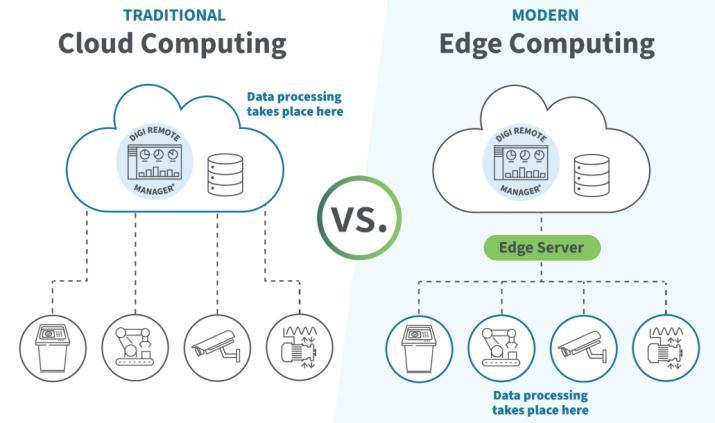
Figure 1: Cloud vs Edge computing architectural comparison showing local and remote processing points.
International Research Journal of Engineering and Technology (IRJET) e-ISSN: 2395-0056
Volume: 13 Issue: 01 | Jan 2026 www.irjet.net p-ISSN: 2395-0072
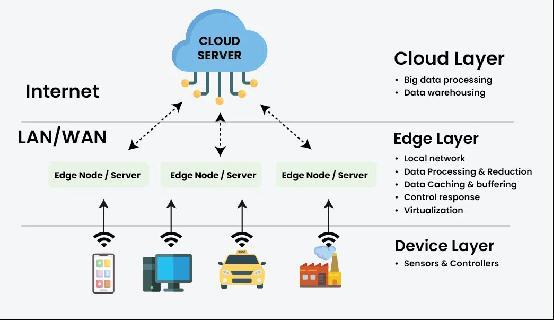
Thearchitecturaldistinctionbetweencloudcomputingand edge computing lies primarily in the location of computational resources and data processing. Cloud computingarchitecturesarecentralized,relyingonremote datacentersconnectedviawide-areanetworks(WANs).In contrast,edgecomputingarchitecturesaredistributed,with multipleedgenodespositionedclosertoenddevices.While cloudarchitecturesemphasizeresourcepoolingandelastic scalability, edge architectures prioritize proximity, low latency, and localized processing. In practice, modern systems often adopt a hybrid architecture, where edge computinghandlestime-criticaltasksandthecloudmanages large-scale analytics and long-term storage (Mach and Becvar,2017).
Evaluatingcloudandedgecomputingnetworksforlatencysensitive applications requires a set of well-defined performance metrics. These metrics enable objective comparisonandhelpdetermineapplicationsuitability.
2.3.1
Latencyreferstothetimedelaybetweendatagenerationat thesourceandthereceiptofprocessedresults.Itisoneof themostcriticalmetricsforreal-timeandlatency-sensitive applications. In cloud computing networks, latency is influencedbythephysicaldistancebetweenusersanddata centers, as well as network congestion. Edge computing significantly reduces latency by performing computation closertothedatasource,therebyimprovingresponsiveness andqualityofservice(QoS)(Satyanarayanan,2017).
Bandwidth utilization measures the amount of network capacityconsumedduringdatatransmission.Cloud-centric
architecturesoftenrequirecontinuoustransmissionoflarge volumes of raw data to centralized servers, leading to increased bandwidth consumption and potential network bottlenecks. Edge computing mitigates this issue by processing and filtering data locally, transmitting only relevant or aggregated information to the cloud. This approachreduces backbone network trafficandimproves overallnetworkefficiency(Shietal.,2016).
Energyefficiencyisacrucialmetric,particularlyformobile and IoT devices with limited power resources. Cloud computing may increase energy consumption due to frequentlong-distancedatatransmission.Edgecomputing canimproveenergyefficiencybyreducingcommunication overheadand enablinglocalizedprocessing.However,the deploymentofnumerousedgenodesintroducesnewenergy management challenges, making efficient resource orchestrationessential(Dengetal.,2016).
Scalabilityreferstoasystem’sabilitytohandleincreasing workloads without performance degradation. Cloud computing excels in scalability due to its centralized resource pooling and virtualization capabilities. Edge computing, while beneficial for latency reduction, faces scalability challenges arising from heterogeneous devices, limited resources at edge nodes, and dynamic network conditions.Effectivecoordinationbetweencloudandedge layersisnecessarytoachievescalableandreliablesystems (MachandBecvar,2017).
Securityandprivacyarecriticalconcernsinbothcloudand edgecomputingenvironments.Cloudcomputingfacesrisks related to data breaches, unauthorized access, and data sovereigntyduetocentralizeddatastorage.Edgecomputing improves privacy by processing sensitive data locally; however, it introduces new security challenges such as physicalnodevulnerability,distributedattacksurfaces,and trust management among heterogeneous edge devices. Addressing these concerns requires robust encryption, authentication,andaccesscontrolmechanismsacrossboth paradigms(Roman,LopezandMambo,2018).
Thissectionsystematicallyreviewsexistingresearchrelated to cloud computing and edge computing networks, with a particular emphasis on their applicability to latencysensitive applications. The review highlights key findings, comparativeinsights,andresearchgapsidentifiedinprior studies.
International Research Journal of Engineering and Technology (IRJET) e-ISSN: 2395-0056
Volume: 13 Issue: 01 | Jan 2026 www.irjet.net p-ISSN: 2395-0072
Acomprehensivereviewoftheliteraturewasconductedto understand the evolution, capabilities, and limitations of cloudandedgecomputingparadigms.Thereviewedworks primarily focus on architectural designs, performance evaluation,andapplication-specificimplementationsrelated to latency-sensitive systems. Both survey papers and experimental studies were considered to ensure balanced coverageoftheoreticalandpracticalperspectives.
3.1.1
To ensure relevance and quality, a structured selection methodologywasadoptedforidentifyingresearcharticles. The review emphasizes peer-reviewed journal papers, conferenceproceedings,andauthoritativetechnicalreports.
Cloudcomputinghasbeenextensivelystudiedasascalable and cost-effective solution for data-intensive applications. However,itssuitabilityforlatency-sensitiveapplicationshas beenasubjectofongoinginvestigation.
3.2.1
Several studies have analyzed latency behavior in cloud environments,identifyingnetworkdistance,congestion,and virtualization overhead as major contributing factors. Armbrustetal.(2010)demonstratedthatcentralizedcloud architecturesintroduceunpredictablelatencyduetoshared resourcesandwide-areanetworkdependencies.Subsequent studieshighlightedthatwhileclouddatacentersofferhigh computational power, the round-trip delay significantly impactsreal-timeapplicationperformance,particularlyfor mobileandIoT-basedsystems(Lietal.,2018).
Researchers have proposed various cloud-based optimizationtechniquestosupportreal-timeapplications, includingresourceprovisioning,workloadscheduling,and virtualizationenhancements.Techniquessuchaspriorityaware scheduling and latency-aware resource allocation have shown moderate improvements in response time (Zhangetal.,2015).However,theseapproachesoftenrely oncomplexorchestrationmechanismsandarelimitedbythe inherentdistancebetweencloudserversandenddevices.
3.2.3
Despite ongoing optimizations, existing literature consistentlyreportsthatcloudcomputingstrugglestomeet ultra-low latency requirements. Key limitations include dependencyonstablenetworkconnectivity,limitedcontext
awareness, and privacy concerns due to centralized data processing. These challenges make cloud-only solutions unsuitable for mission-critical applications such as autonomous driving and remote healthcare (Satyanarayanan,2017).
Edge computing research has rapidly expanded as a response to the limitations of cloud-centric architectures. Theliteratureemphasizesitspotentialtosupportreal-time andlatency-sensitiveapplications.
Multiple studies demonstrate that edge computing significantlyreduceslatencybyoffloadingcomputationfrom centralizedcloudstonearbyedgenodes.Techniquessuchas task offloading, computation caching, and data preprocessingattheedgehavebeenshowntoreduceend-toend delay by up to several milliseconds (Shi et al., 2016). Theselatencyreductionstrategiesareparticularlyeffective in dynamic environments such as vehicular networks and smartcities.
Researchhasexploredvariousedgenetworkarchitectures, includingfogcomputing,mobileedgecomputing(MEC),and multi-access edge computing. Mach and Becvar (2017) highlighted that hierarchical and distributed edge architectures improve scalability and fault tolerance. Protocols designed for edge environments emphasize lightweight communication, local orchestration, and seamlessintegrationwithcloudbackendstosupporthybrid deploymentmodels.
3.3.3
Edge computing plays a critical role in enabling nextgeneration IoT and5G/6G networks.Studies indicate that edge-assistedIoTframeworksenhancereal-timeanalytics, reducenetworkcongestion,andimproveenergyefficiency (Khan et al., 2020). In 5G and emerging 6G systems, edge computing supports ultra-reliable low-latency communication(URLLC),makingitessentialforapplications suchasaugmentedrealityandautonomoussystems(Taleb etal.,2017).
Comparativeanalysesbetweencloudandedgecomputing provide valuable insights into their relative strengths and limitations.
International Research Journal of Engineering and Technology (IRJET) e-ISSN: 2395-0056
Volume: 13 Issue: 01 | Jan 2026 www.irjet.net p-ISSN: 2395-0072
Several studies have explicitly compared cloud and edge computing architectures in terms of latency, bandwidth usage, and resource efficiency. Satyanarayanan (2017) reportedthatedge-basedsystemsconsistentlyoutperform cloud-basedsystemsforlatency-sensitiveworkloads.Hybrid models combining cloud scalability with edge responsivenesswerefoundtoofferbalancedperformancein diversescenarios.
Comparative evaluations indicate that edge computing significantlyimprovesQualityofService(QoS)byreducing responsetimeandjitter.Experimentalresultsinvehicular and industrial IoT environments show that edge-based processingmeetsstringentlatencyconstraintsthatcloudbasedapproachesfailtosatisfy(Dengetal.,2016).However, cloud computing remains advantageous for computeintensiveandnon-real-timeworkloads.
Despiteexistingcomparativestudies,theliteraturerevealsa lack of standardized evaluation metrics and benchmark scenarios. Many studies focus on specific applications or controlled environments, limiting generalizability. Additionally,fewworkscomprehensivelyanalyzesecurity, scalability, and energy efficiency alongside latency, highlightingtheneedforholisticcomparativeframeworks.
Thissectionpresentsadetailedcomparativeanalysisofedge computing networks and cloud computing networks with respect to key performance aspects relevant to latencysensitiveapplications.Thecomparisonhighlightstheoretical foundations,empiricalfindings,andpracticalimplications.
Latency is the most critical metric for evaluating the suitability of computing paradigms for real-time and mission-critical applications. Cloud and edge computing differ fundamentally in how latency is introduced and managedduetotheirarchitecturaldesigns.
Fromatheoreticalperspective,latencyincloudcomputing networks is primarily influenced by physical distance, routing complexity, and shared network infrastructure. Centralizedclouddatacentersareoftenlocatedfarfromend users,resultinginincreasedpropagationdelayandqueuing latency.Incontrast,edgecomputingminimizesthesedelays byplacingcomputationandstorageresourcesclosertodata sources.Queueingtheoryandnetworkmodelsconsistently
show that reducing hop count and transmission distance significantlylowersend-to-endlatency,whichexplainsthe inherentadvantageofedge-basedarchitecturesforlatencysensitiveworkloads(Satyanarayanan,2017;Shietal.,2016).
Experimental studies further validate the theoretical advantages of edge computing. Empirical evaluations in vehicularnetworks,smartcitydeployments,andindustrial IoT environments demonstrate that edge computing can reducelatencyby30–70%comparedtocloud-onlysolutions (Dengetal.,2016).Talebetal.(2017)reportedthatmultiaccess edge computing (MEC) significantly improves responsetimesin5Gnetworks,enablingultra-reliablelowlatencycommunication(URLLC).Theseresultsconfirmthat edgecomputingconsistentlyoutperformscloudcomputing inscenarioswithstringentlatencyconstraints.
Bandwidthconsumptionandnetworktrafficpatternsdiffer substantiallybetweencloudandedgecomputingnetworks. Cloud-centric models require continuous transmission of largevolumesofrawdatatocentralizeddatacenters,which increases backbone network traffic and may cause congestionduringpeakloads.Edgecomputingalleviatesthis issue by performing data filtering, aggregation, and preprocessing locally. As a result, only essential or summarized data is transmitted to the cloud, leading to reducedbandwidthusageandimprovednetworkefficiency (Shietal.,2016).Thischaracteristicisparticularlybeneficial for large-scale IoT deployments generating massive data streams.
Incloudcomputingnetworks,computationispredominantly centralized, with end devices acting mainly as data producers and consumers. This centralized processing model simplifies management but introduces latency and scalabilitychallenges.Edgecomputingadoptsadistributed computationmodel,whereprocessingtasksaredynamically offloaded between end devices, edge nodes, and cloud servers. Such hierarchical computation distribution improvesresponsivenessandfaulttolerancewhileenabling localizeddecision-making.Hybridedge–cloudframeworks are increasingly favored, as they combine the real-time benefitsofedgeprocessingwiththecomputationalpowerof centralizedclouds(MachandBecvar,2017).
Cost efficiency and resource utilization are important considerationswhencomparingcloudandedgecomputing. Cloudcomputingbenefitsfromeconomiesofscale,offering cost-effectiveresourceprovisioningthroughvirtualization and pay-as-you-go models. However, frequent data
International Research Journal of Engineering and Technology (IRJET) e-ISSN: 2395-0056
Volume: 13 Issue: 01 | Jan 2026 www.irjet.net p-ISSN: 2395-0072
transmissionandlatencypenaltiesmayincreaseoperational costs for real-time applications. Edge computing reduces communication overhead and latency-related costs but introduces additional expenses related to deploying, managing,andmaintainingdistributededgeinfrastructure. Studiessuggestthathybridarchitecturescanoptimizecost andperformancebyallocatingtime-criticaltaskstotheedge andcompute-intensivetaskstothecloud(Dengetal.,2016).
Security and privacy implications differ significantly betweencloudandedgecomputingnetworks.Centralized cloud environments are attractive targets for large-scale cyberattacksandraiseconcernsaboutdatasovereigntyand regulatorycompliance.Edgecomputingenhancesprivacyby enablinglocaldataprocessing,reducingtheneedtotransmit sensitive information over public networks. However, the distributednatureofedgenodesincreasestheattacksurface andintroduceschallengesrelatedtophysicalsecurity,trust management, and authentication. Consequently, both paradigms require robust, multi-layered security mechanisms tailored to their architectural characteristics (Roman,LopezandMambo,2018).
Scalability and flexibility are critical for supporting future networkscharacterizedbymassivedeviceconnectivityand dynamicworkloads.Cloudcomputingoffershighscalability through centralized resource pooling but may struggle to maintainperformanceunderstringentlatencyrequirements. Edge computing provides flexibility by enabling localized scalingandadaptiveresourceallocationbutfaceschallenges duetoheterogeneoushardwareandlimitededgeresources. Future network architectures are expected to rely on seamless integration of cloud and edge computing, supportedbyAI-drivenorchestrationandsoftware-defined networking, to achieve scalable, flexible, and low-latency services(Talebetal.,2017).
Latency-sensitive applications require immediate data processing and response to function correctly. In such applications,delaysofevenafewmillisecondscandegrade system performance, compromise safety, or negatively impact user experience. This section categorizes major latency-sensitiveapplications,discussestheirperformance requirements,andcomparesthesuitabilityofcloudandedge computingparadigmsforeachapplicationdomain.
Latency-sensitive applications span multiple domains, including transportation, multimedia, industrial systems, and healthcare. These applications typically involve realtime data acquisition, processing, and actuation,
necessitating ultra-low latency, high reliability, and continuousavailability.
Autonomousvehiclesrelyonreal-timeprocessingofsensor datacollectedfromcameras,LiDAR,radar,andvehicle-toeverything (V2X) communications. Decision-making tasks such as obstacle detection, path planning, and collision avoidance must be performed within strict latency constraintstoensurepassengersafety.Studiesindicatethat end-to-end latency requirements for autonomous driving applicationscanbeaslowas1–10milliseconds(Talebetal., 2017).Edgecomputingenablesrapidlocalprocessingand real-time coordination among nearby vehicles, whereas cloud-based solutions alone are insufficient due to communicationdelaysandreliabilityconcerns.
Augmented and virtual reality applications demand extremelylowlatencytoprovideimmersiveandseamless userexperiences.Motion-to-photonlatency,whichmeasures thedelaybetweenusermovementandvisualfeedback,must typically be below 20 milliseconds to prevent motion sickness and disorientation (Shi et al., 2016). Edge computingsupportsAR/VRbyoffloadingcomputationally intensive rendering and tracking tasks to nearby edge servers,significantlyreducingresponse timecompared to centralizedcloudprocessing(Satyanarayanan,2017).
Industrial automation systems and collaborative robots operate in time-critical environments where real-time control andmonitoringare essential.Applicationssuchas predictivemaintenance,processoptimization,androbotic control require deterministic latency and high reliability. Centralizedcloudarchitecturesmayintroduceunpredictable delays, making them unsuitable for closed-loop control systems. Edge computing facilitates local data processing and real-time feedback, enabling faster response and improved operational efficiency in smart manufacturing environments(MachandBecvar,2017).
Healthcare applications, particularly telemedicine and remote surgery, impose stringent latency and reliability requirements to ensure patient safety. Remote surgical procedures require end-to-end latency of less than 10 milliseconds and near-zero packet loss to enable precise control of surgical instruments (Khan et al., 2020). Edge computing enhances healthcare systems by enabling realtime patient monitoring, local data analysis, and reduced transmissiondelays,whilecloudcomputingsupportslongtermdatastorageandlarge-scalemedicalanalytics.
International Research Journal of Engineering and Technology (IRJET) e-ISSN: 2395-0056
Volume: 13 Issue: 01 | Jan 2026 www.irjet.net p-ISSN: 2395-0072
Latency-sensitiveapplicationssharecommonperformance requirements, including ultra-low latency, high reliability, minimaljitter,andconsistentqualityofservice.Additional metricssuchasbandwidthefficiency,energyconsumption, and fault tolerance are also critical, particularly in mobile and IoT-based environments. For applications operating over 5G and emerging 6G networks, support for ultrareliable low-latency communication (URLLC) is essential. These requirements necessitate computing architectures capable of adaptive resource management and real-time processing(Talebetal.,2017).
Comparativestudiesconsistentlyshowthatedgecomputing outperforms cloud computing for latency-sensitive applications by reducing response time and improving reliability. For autonomous vehicles and industrial automation, edge-based processing enables immediate decision-making and localized coordination. In AR/VR applications, edge computing significantly improves user experience by minimizing motion-to-photon latency. In healthcare,edgecomputingenhancesreal-timemonitoring and emergency response, while cloud computing remains valuablefor non-time-critical taskssuchasdata archiving andlarge-scaleanalytics.Consequently,hybridedge–cloud architectures are widely regarded as the most effective solution, combining the low-latency benefits of edge computingwiththescalabilityandcomputationalpowerof cloudplatforms(Satyanarayanan,2017;Dengetal.,2016).
Despite the significant advantages offered by edge computing over traditional cloud computing for latencysensitiveapplications,severalchallengesandopenresearch issuesremain.Thesechallengesspantechnical,architectural, andoperationaldomainsandmustbeaddressedtoenable large-scale,reliable,andsecuredeploymentofedge–cloud systems.
The technical challenges associated with edge and cloud computing primarily arises from the distributed and heterogeneous nature of modern networked systems. Efficientcoordinationbetweenenddevices,edgenodes,and centralized cloud servers remains a complex task, particularly for real-time applications with strict latency constraints.
Resource management is a critical challenge in edge computing environments due to limited computational capacity, storage, and energy availability at edge nodes.
Unlike cloud data centers, which offer virtually unlimited resources through virtualization, edge nodes must dynamically allocate resources among competing applications.Efficienttaskscheduling,workloadoffloading, and resource orchestration mechanisms are required to meet latency and quality-of-service requirements while minimizing overhead (Deng et al., 2016). Poor resource management can lead to performance degradation and serviceinstability.
Edge computing environments are inherently heterogeneous,consistingofdiversedevices,communication protocols,andnetworktechnologies.Supportingseamless operation across heterogeneous networks such as Wi-Fi, cellular, 5G, and future 6G systems poses significant challenges.Differencesinhardwarecapabilities,operating systems, and network conditions complicate application deploymentandmanagement.Researcheffortsemphasize theneedforadaptivemiddlewareandabstractionlayersto ensureinteroperabilityandconsistentperformanceacross heterogeneousenvironments(MachandBecvar,2017).
Thelackofunifiedstandardsremainsamajorbarriertothe widespread adoption of edge computing. Unlike cloud computing, which benefits from mature standardization frame works, edge computing involves multiple stakeholders, vendors, and deployment models. This fragmentation hinders interoperability between edge platforms and cloud services. Standardization efforts by organizationssuchasETSIandIEEEaimtodefinereference architectures and interfaces; however, achieving global consensus remains an open research issue (Taleb et al., 2017).
Security,privacy,andtrustmanagementareamongthemost criticalchallengesinedge–cloudenvironments.Whileedge computing improves privacy by enabling local data processing, it also introduces vulnerabilities due to the distributednatureofedgenodes.Physicalexposureofedge devicesincreasestheriskoftampering,whiledecentralized trust management complicates authentication and authorization.Ensuringsecuredataexchange,maintaining userprivacy,and establishingtrust among heterogeneous entitiesrequireadvancedcryptographictechniques,secure hardware,anddistributedtrustframeworks(Roman,Lopez andMambo,2018).
Energy efficiency is a key concern, particularly for edge nodes deployed in resource-constrained environments. Continuouscomputationandcommunicationattheedgecan
International Research Journal of Engineering and Technology (IRJET) e-ISSN: 2395-0056
Volume: 13 Issue: 01 | Jan 2026 www.irjet.net p-ISSN: 2395-0072
increaseenergyconsumption,affectingsystemsustainability andoperationalcosts.Researchhighlightstheimportanceof energy-awaretaskscheduling,adaptiveresourceallocation, and energy-efficient hardware design to reduce power consumption.Sustainableedge–cloudsystemsareessential forsupportinglong-termdeploymentofIoTandsmartcity applications(Shietal.,2016).
The rapid growth of IoT devices presents significant scalability challenges for both cloud and edge computing systems.MassiveIoTdeploymentsgeneratelargevolumesof dataandrequiresimultaneousconnectivityformillionsof devices.Whileedgecomputingreducesnetworkcongestion bylocalizingdataprocessing,managingandorchestratinga large number of edge nodes remains complex. Scalability issues related to device mobility, dynamic workload distribution, and fault tolerance remain open research problems,particularlyinultra-densenetworkenvironments (Khanetal.,2020).
This review presented a comprehensive comparative analysisofcloudcomputingnetworksandedgecomputing networks with a specific focus on latency-sensitive applications. The study highlighted that while cloud computing remains highly effective for scalable, computeintensive, and non-real-time workloads, its centralized architecture introduces inherent latency, bandwidth, and reliabilityconstraintsthatlimititssuitabilityfortime-critical applications. In contrast, edge computing addresses these limitations by decentralizing computation and bringing processingcapabilitiesclosertodatasourcesandendusers. Throughanalysisofexistingliterature,itisevidentthatedge computing significantly improves latency performance, bandwidthefficiency,andqualityofserviceforapplications suchasautonomousvehicles,AR/VR,industrialautomation, andhealthcaresystems.However,thereviewalsoindicates thatneitherparadigmissufficientinisolation.Hybridedge–cloudarchitecturesemergeasthemostpromisingsolution, combininglow-latencyresponsivenessattheedgewiththe scalability and computational power of the cloud. Overall, thisreviewprovidesvaluableinsightsforresearchersand practitionersdesigningnext-generationnetworkstosupport real-timeandmission-criticalapplications.
8.
Despite its comprehensive scope, this review has several limitations.First,theanalysisisprimarilybasedonexisting literature and does not include original experimental validation or real-world deployment results. Second, the reviewedstudiesoftenusedifferentevaluationmetricsand experimental setups, which may affect the direct comparabilityofresults.Third,emergingtechnologiessuch as 6G, AI-driven orchestration, and federated learning are
still in early research stages, limiting the availability of matureperformancedata.Finally,economicandregulatory considerationswerediscussedonlyatahighlevel,leaving roomfordeeperinvestigationinfuturework.
1. Armbrust,M.,Fox,A.,Griffith,R.,Joseph,A.D.,Katz,R., Konwinski,A.,Lee,G.,Patterson,D.,Rabkin,A.,Stoica,I. and Zaharia, M. (2010) ‘A view of cloud computing’, CommunicationsoftheACM,53(4),pp.50–58.
2. Cisco(2020)CiscoannualInternetreport(2018–2023). CiscoSystems.
3. Deng,R.,Lu,R.,Lai,C.,Luan,T.H.andLiang,H.(2016) ‘Optimalworkloadallocationinfog-cloudcomputing’, IEEETransactionsonVehicularTechnology,65(10),pp. 8783–8793.
4. Khan,L.U.,Yaqoob,I.,Tran, N.H.,Kazmi,S.M.A.,Dang, T.N. and Hong, C.S. (2020) ‘Edge computing enabled smartcities’,IEEEInternetofThingsJournal,7(10),pp. 10200–10232.
5. Li, W., Chou, W. and Zhou, Y. (2018) ‘Performance evaluation of cloud-based real-time applications’, FutureGenerationComputerSystems,80,pp.245–256.
6. Mach,P.andBecvar,Z.(2017)‘Mobileedgecomputing: Asurvey’,IEEECommunicationsSurveys&Tutorials, 19(3),pp.1628–1656.
7. Mell, P. and Grance, T. (2011) The NIST definition of cloud computing. NIST Special Publication 800-145. NationalInstituteofStandardsandTechnology.
8. Roman,R.,Lopez,J.andMambo,M.(2018)‘Mobileedge computing,fogetal.:Asurveyandanalysisofsecurity threatsandchallenges’, FutureGenerationComputer Systems,78,pp.680–698.
9. Satyanarayanan, M. (2017) ‘The emergence of edge computing’,Computer,50(1),pp.30–39.
10. Shi,W.,Cao,J.,Zhang,Q.,Li,Y.andXu,L.(2016)‘Edge computing: Vision and challenges’, IEEE Internet of ThingsJournal,3(5),pp.637–646.
11. Taleb,T.,Samdanis,K.,Mada,B.,Flinck,H.,Dutta,S.and Sabella,D.(2017)‘Onmulti-accessedgecomputing:A survey of the emerging 5G network edge cloud architectureandorchestration’,IEEECommunications Surveys&Tutorials,19(3),pp.1657–1681.
12. Zhang, Q., Chen, M., Li, L. and Li, S. (2015) ‘Dynamic resourceallocationforreal-timecloudservices’,Future GenerationComputerSystems,52,pp.83–94.
International Research Journal of Engineering and Technology (IRJET) e-ISSN: 2395-0056
Volume: 13 Issue: 01 | Jan 2026 www.irjet.net p-ISSN: 2395-0072
13. Bonomi, F., Milito, R., Zhu, J. and Addepalli, S. (2012) ‘FogcomputinganditsroleintheInternetofThings’, ProceedingsoftheFirstEditionoftheMCCWorkshop onMobileCloudComputing,pp.13–16.
14. Buyya, R., Yeo, C.S., Venugopal, S., Broberg, J. and Brandic,I.(2009)‘Cloudcomputingand emergingIT platforms’, Future Generation Computer Systems, 25(6),pp.599–616.
15. Chiang, M. and Zhang, T. (2016) ‘Fog and IoT: An overviewof researchopportunities’,IEEEInternet of ThingsJournal,3(6),pp.854–864.
16. Dinh, H.T., Lee, C., Niyato, D. and Wang, P. (2013) ‘A survey of mobile cloud computing’, Wireless Communications and Mobile Computing, 13(18), pp. 1587–1611.
17. ETS I (2019) Multi-access edge computing (MEC); Framework and reference architecture. ETSIGS MEC 003.
18. Gupta,H.,VahidDastjerdi,A.,Ghosh,S.K.andBuyya,R. (2017)‘iFogSim:Atoolkitformodelingandsimulation ofresourcemanagementtechniquesintheInternetof Things’,Software:PracticeandExperience,47(9),pp. 1275–1296.
19. Hashem, I.A.T., Chang, V., Anuar, N.B., Adewole, K., Yaqoob,I.,Gani,A.,Ahmed,E.andChiroma,H.(2016) ‘Theroleofbigdatainsmartcity’,InternationalJournal ofInformationManagement,36(5),pp.748–758.
20. Hou, X., Li, Y., Chen, M., Wu, D., Jin, D. and Chen, S. (2016) ‘Vehicular fog computing’, IEEE CommunicationsMagazine,54(11),pp.87–93.
21. Hu,Y.C.,Patel,M.,Sabella,D.,Sprecher,N.andYoung,V. (2015) ‘Mobile edge computing A key technology towards5G’,ETSIWhitePaper,11(11),pp.1–16.
22. ITU-R (2020) Minimum requirements related to technicalperformanceforIMT-2020radiointerface(s). InternationalTelecommunicationUnion.
23. Li,X.,Dang,Y.,Zhang,M.andChen,J.(2019)‘Latencyawareworkloadoffloadinginmobileedgecomputing’, IEEEAccess,7,pp.125398–125409.
24. Mao, Y., You, C., Zhang, J., Huang, K. and Letaief, K.B. (2017) ‘A survey on mobile edge computing’, IEEE CommunicationsSurveys&Tutorials,19(4),pp.2322–2358.
25. Ni, L., Zhang, J., Jiang, C., Yan, C. and Yu, K. (2019) ‘Resourceallocationinmobileedgecomputing’,IEEE CommunicationsSurveys&Tutorials,21(3),pp.2291–2316.
26. OpenFog Consortium (2017) OpenFog reference architectureforfogcomputing.OpenFogConsortium.
27. Park, S., Kim, Y., Kim, S. and Jung, J. (2018) ‘Latencyawareresourcemanagementforedgecomputing’,IEEE Transactions on Network and Service Management, 15(1),pp.295–308.
28. Perera, C., Liu, C.H., Jayawardena, S. and Chen, M. (2014)‘AsurveyonInternetofThingsfromindustrial marketperspective’,IEEEAccess,2,pp.1660–1679.
29. Rahmani,A.M.,Liljeberg,P.,Preden,J.S.andJantsch,A. (2018) ‘Fog computing in the Internet of Things’, SpringerInternationalPublishing.
30. Wang, S., Zhang, X., Zhang, Y., Wang, L., Yang, J. and Wang,W.(2017)‘Asurveyonmobileedgenetworks’, IEEEAccess,5,pp.25505–25530.
31. Xu,X.,Chen,S.,Li,J.,Xu,Y.andXu,Y.(2018)‘Latency and energy efficient computation offloading’, IEEE TransactionsonMobileComputing,17(10),pp.2463–2476.
32. Zhou,Z.,Chen, X.,Li,E.,Zeng,L.,Luo,K.andZhang, J. (2019) ‘Edge intelligence’, Proceedings of the IEEE, 107(8),pp.1655–1674.