
International Research Journal of Engineering and Technology (IRJET) e-ISSN: 2395-0056
Volume: 13 Issue: 02 | Feb 2026 www.irjet.net p-ISSN: 2395-0072
International Research Journal of Engineering and Technology (IRJET) e-ISSN: 2395-0056
Volume: 13 Issue: 02 | Feb 2026 www.irjet.net p-ISSN: 2395-0072
Sachin Kumar Gupta1 , Mrs. Arifa Khan2
1Master of Technology, Computer Science and Engineering, Lucknow Institute of Technology, Lucknow, India 2Assistant Professor, Department of Computer Science and Engineering, Lucknow Institute of Technology, Lucknow, India ***
Abstract - The rapid expansion of machine learning (ML) applications has significantly increased the computational demand of modern data centers, intensifying their energy consumption and associated carbon emissions. As geographicallydistributeddatacentersbecomethebackbone oflarge-scaleAIservices,carbon-awareintelligentscheduling has emerged as a promising strategy to mitigate environmental impact while maintaining performance guarantees. This review systematically examines existing approaches to carbon-aware scheduling of ML workloads acrossgeographicallydistributedinfrastructures.Weanalyze methods that leverage real-time and forecasted grid carbon intensity, renewable energy availability, geographic load balancing, and intelligent optimization techniques such as machine learning–driven prediction and reinforcement learning–baseddecisionmaking.Thereviewcategorizesprior studies based on scheduling objectives, optimization strategies, and evaluation metrics, highlighting trade-offs amongcarbonreduction,latency,cost,andqualityofservice. Furthermore, we compare architectural frameworks, workload characteristics, and deployment assumptions to identify common design patterns and limitations. Key challenges including data uncertainty, scalability constraints,multi-objectiveconflicts,andlackofstandardized benchmarks are critically discussed. Finally, emerging research directions are outlined, emphasizing integrated AIdriven orchestration, cross-layer optimization, and sustainability-aware system design. By synthesizing current knowledgeandidentifyingresearchgaps,thisreviewaimsto provide a comprehensive reference for researchers and practitioners seeking to design environmentally sustainable MLschedulingstrategiesindistributedcloudenvironments.
Key Words: Carbon-aware computing; Machine learning workloads; Geographically distributed data centers; Intelligent scheduling; Renewable energy integration; Sustainablecloudcomputing.
Therapiddigitaltransformationofmodernsocietyhasledto an unprecedented expansion of cloud services, artificial intelligence (AI), and large-scale data processing systems. Whiletheseadvancementsdriveinnovationandeconomic growth,theyalsocontributeto increasingenergydemand
and carbon emissions. Data centers, which serve as the backbone of digital infrastructure, are now recognized as significant energy consumers worldwide. Within this context, carbon-aware intelligent scheduling of machine learning (ML) workloads has emerged as a promising strategy to balance computational performance with environmental sustainability. This section introduces the background,motivation,andscopeofthisreview.
1.1.1 Climate Change and Carbon Emissions from Digital Infrastructure
Globalclimatechangeisstronglylinkedtogreenhousegas emissions,particularlycarbondioxide(CO₂),generatedfrom fossil fuel–based energy systems. The information and communicationtechnology(ICT)sectorcontributesanonnegligible share of global emissions, driven by increasing internetusage,cloudcomputing,andAIapplications.Recent assessments indicate that digital infrastructure, including networks and data centers, accounts for a growing percentage of global electricity consumption (IEA, 2023). Although improvements in hardware efficiency have partially mitigated growth in energy demand, the overall carbon footprint of computing continues to rise due to expandingservicerequirements.
Digital platforms increasingly rely on high-performance computingclusterstosupportdata-intensivetaskssuchas deep learning model training and large-scale analytics. Studieshaveshownthattraininglargeneuralnetworkscan produce substantial carbon emissions, especially when powered by carbon-intensive grids (Strubell, Ganesh and McCallum,2019).Consequently,sustainabilityhasbecomea critical design objective in next-generation computing systems.
1.1.2 Role of Data Canters in Global Energy Consumption
Datacentersformthecoreinfrastructuresupportingcloud services, enterprise applications, and AI systems. Their energy consumption arises from computing equipment, storage systems, networking devices, and cooling infrastructure.Accordingtoglobalenergyassessments,data
International Research Journal of Engineering and Technology (IRJET) e-ISSN: 2395-0056
Volume: 13 Issue: 02 | Feb 2026 www.irjet.net p-ISSN: 2395-0072
centers consume hundreds of terawatt-hours (TWh) of electricity annually, with demand projected to grow alongsidedigitalizationtrends(IEA,2023).
To evaluate efficiency, metrics such as Power Usage Effectiveness (PUE) have been widely adopted. However, while PUE captures facility-level efficiency, it does not directly reflect carbon intensity, which depends on the regional energy mix (Barroso, Clidaras and Hölzle, 2018). Therefore, two data centers with similar efficiency levels may exhibit significantly different carbon footprints depending on their geographic location and access to renewableenergysources.
The geographic distribution of hyperscale data centers introducesbothopportunitiesandcomplexities.Operators can potentially shift workloads across regions to exploit lower-carbonelectricity,yetsuchstrategiesmustcarefully consider latency constraints, network costs, and servicelevelagreements.
Machine learning workloads have grown rapidly in both scaleandcomplexity.Moderndeeplearningmodelsrequire extensive computational resources for training, often involving distributed GPU or TPU clusters. Research highlightsthatthecomputationalcostofstate-of-the-artAI models has increased exponentially over recent years, leadingtocorrespondingincreasesinenergyconsumption (Amodeietal.,2018).
Unlike traditional enterprise workloads, ML tasks particularly batch training jobs often exhibit temporal flexibility, making them suitable candidates for carbonaware scheduling. However, real-time inference services mayimposestrictlatencyrequirements,limitingrelocation ordelaystrategies.Furthermore,workloadheterogeneity, unpredictabledemand,anddynamicgridcarbonintensity introduceadditionalschedulingchallenges.
Thesesustainabilityconcernshavemotivatedresearchinto intelligentorchestrationmechanismscapableofaligningML workload execution with periods or locations of lower carbon intensity, thereby reducing environmental impact withoutsacrificingperformance.
This review concentrates specifically on carbon-aware scheduling mechanisms rather than hardware design or cooling innovations. Scheduling refers to the allocation of computational workloads across time and geographic locations to optimize defined objectives. In carbon-aware contexts, scheduling decisions integrate real-time or forecasted carbon intensity data, renewable energy availability,andworkloadcharacteristics.
Prior work has explored heuristic-based algorithms, optimization models, and machine learning–driven controllersforreducingemissionswhilepreservingquality of service (Qureshi et al., 2009; Radovanović, Koningstein andSchneider,2022).Bysynthesizingtheseapproaches,this review aims to classify methodologies, evaluate their strengthsandlimitations,andidentifyresearchgaps.
Geographically distributed data centers provide a unique opportunity for carbon-aware workload shifting. Since electricity grids differ in carbon intensity depending on generationmix suchascoal,naturalgas,hydro,wind,or solar relocating workloads can significantly reduce associated emissions. Geographic load balancing has been proposed as an effective mechanism to exploit spatial diversityinrenewableenergyavailability(Liuetal.,2011).
However,geographicschedulingmustaddressconstraints such as network latency, bandwidth limitations, data sovereignty regulations, and migration overhead. The interplay between carbon efficiency and service performancerepresentsacentralthemeintheliteratureand formsacorefocusofthisreview.
Sustainablecomputingextendsbeyondenergyefficiencyto encompass broader environmental and societal impacts. Carbon-aware intelligent scheduling aligns with global sustainability goals by enabling data center operators to actively reduce emissions through informed operational decisions. As regulatory frameworks and corporate sustainabilitycommitmentsincreasinglyemphasizecarbon accountingandreporting,integratingcarbonawarenessinto workloadmanagementbecomesstrategicallyimportant.
By systematically reviewing carbon-aware intelligent scheduling strategies for ML workloads in distributed
International Research Journal of Engineering and Technology (IRJET) e-ISSN: 2395-0056
Volume: 13 Issue: 02 | Feb 2026 www.irjet.net p-ISSN: 2395-0072
environments, this paper aims to provide a consolidated foundationforadvancingenvironmentallyresponsiblecloud andAIsystems.
Understandingcarbon-awareintelligentschedulingrequires a clear foundation in machine learning workload characteristics, carbon-aware computing principles, distributeddatacenterarchitectures,andthemetricsused to evaluate sustainability and performance. This section outlinestheessentialtechnicalandconceptualelementsthat underpintheresearchdomain.
Machine learning workloads have become a dominant componentofcloudcomputingenvironments,particularly with the widespread adoption of deep learning models acrossdomainssuchascomputervision,naturallanguage processing,andrecommendationsystems.Theseworkloads exhibit unique computational patterns and resource demandscomparedtotraditionalenterpriseapplications.
MLworkloadsindatacentersarebroadlycategorizedinto training and inference tasks. Training involves iterative optimization over large datasets to update model parametersandtypicallyrequiressubstantialcomputational power over extended durations. Distributed training frameworks often rely on clusters of GPUs or TPUs interconnectedwithhigh-speednetworkstoreducetraining time(Lietal.,2020).Asmodelsizesincrease,theenergyand carbon footprint of training large neural networks has becomeamajorsustainabilityconcern(Strubell,Ganeshand McCallum,2019).
Inferenceworkloads,incontrast,deploytrainedmodelsto generate predictions in real time or near real time. These tasks are generally latency-sensitive and must meet strict service-levelobjectives.Unliketraining,inferenceworkloads are more continuous and user-driven, often requiring geographicallycloserdeploymenttoenduserstominimize response times. The distinction between training and inference is critical for carbon-aware scheduling because trainingjobsaretypicallymoreflexibleintimeandlocation, whereasinferencetasksaremoreconstrained.
MLworkloadsdemandheterogeneousresources,including CPUs,GPUs,high-bandwidthmemory,storagesystems,and high-speed interconnects. Deep learning training is particularlyresource-intensiveduetolargemodelsizesand massive datasets. Resource consumption can vary significantly depending on model architecture, batch size, anddatasetcharacteristics(Amodeietal.,2018).
Moreover,workloaddemandindatacentersfluctuatesover time due to varying user activity patterns and business requirements. This variability complicates scheduling decisions,asoperatorsmustdynamicallyallocateresources while balancing performance, cost, and environmental impact.Effectivecarbon-awareschedulingmechanismsmust thereforeaccountforworkloadelasticity,heterogeneity,and temporalflexibility.
Carbon-aware computing integrates environmental considerationsintosystemdesignandoperationaldecisionmaking.Ratherthanfocusingsolelyonenergyefficiency,it emphasizes reducing carbon emissions associated with electricityconsumption.
Carbon-aware computing refers to strategies that adjust computationalactivitiesbasedonthecarbonintensityofthe electricity grid. Carbon intensity varies spatially and temporallydependingonthemixofgenerationsources,such as coal, natural gas, nuclear, hydro, wind, or solar. By aligning workload execution with periods or regions of lower carbon intensity, systems can reduce overall emissions without necessarily reducing total energy consumption (Radovanović, Koningstein and Schneider, 2022).
Thisparadigmoftenreliesonreal-timeorforecastedcarbon intensity data provided by grid operators or external monitoring services. Scheduling systems use this informationtodeterminewhenandwhereworkloadsshould runtominimizecarbonimpact.
Fordatacenteroperators,carbonawarenessisincreasingly tied to regulatory compliance, corporate sustainability commitments, and environmental reporting frameworks. While traditional efficiency metrics such as Power Usage Effectiveness(PUE)improveinfrastructureefficiency,they do not capture the carbon intensity of electricity sources (Barroso,ClidarasandHölzle,2018).Therefore,twoequally efficientfacilitiesmayhavevastlydifferentenvironmental impactsdependingontheirgeographiclocation.
Incorporatingcarbonawarenessintoschedulingdecisions enablesoperatorstoreduce Scope2 emissionsassociated withpurchasedelectricity.Thisshiftrepresentsamovefrom staticefficiencyoptimizationtodynamic,environmentally informedorchestration.
International Research Journal of Engineering and Technology (IRJET) e-ISSN: 2395-0056
Volume: 13 Issue: 02 | Feb 2026 www.irjet.net p-ISSN: 2395-0072
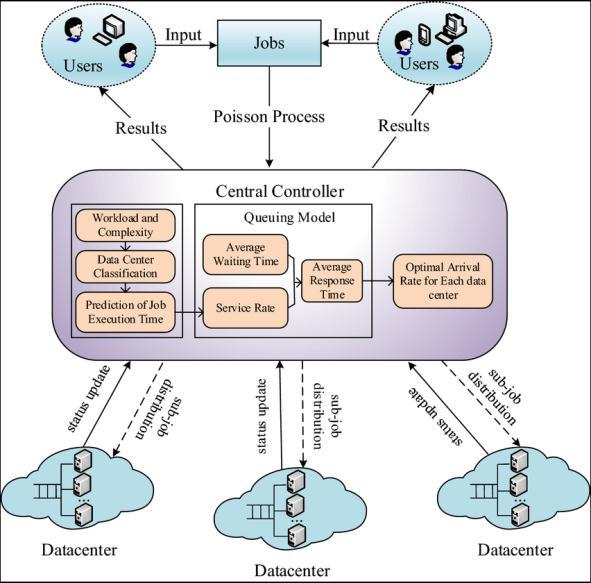
Geographicallydistributeddatacentersconsistofmultiple facilities located across different regions or countries, interconnected through high-speed networks. These architectures are common among hyperscale cloud providerstoensureredundancy,scalability,andlow-latency servicedelivery.
2.3.1 Definitions and Architectures
Distributed data center architectures typically follow a hierarchical or federated model, where workloads can be allocatedacrossregionsbasedonresourceavailabilityand demand. Such infrastructures leverage virtualization and containerization technologies to enable flexible workload migrationandreplication(BeloglazovandBuyya,2012).
The geographic dispersion of facilities exposes them to diverse electricity markets and energy mixes. As a result, carbonintensitycanvarysubstantiallybetweenlocationsat any given time, creating opportunities for spatial load shifting.
Theprimarybenefitofgeographicallydistributedsystemsis the ability to perform geographic load balancing redirecting computational tasks to locations with lower operational cost or carbon intensity. Research has demonstratedthatsuchstrategiescanreduceenergycosts and emissions while maintaining service quality under certainconstraints(Qureshietal.,2009).
However, workloadmigrationintroduceschallenges.Data transfer latency, bandwidth limitations, regulatory constraintsondatalocality,andpotentialservicedisruptions mustbecarefullymanaged.Forlatency-sensitiveinference
services,excessiverelocationmaydegradeuserexperience. Therefore,intelligentschedulingmechanismsmustevaluate trade-offsamongcarbonreduction,cost,andperformance.
Evaluating carbon-aware scheduling strategies requires multidimensional performance metrics that capture both environmentalandoperationalobjectives.
Carbon emissions are typically measured in kilograms or metrictonsofcarbondioxideequivalent(CO₂eq),accounting forvariousgreenhousegasesstandardizedtoCO₂impact.In datacenters,emissionsareoftencalculatedbymultiplying electricityconsumptionbythecarbonintensityfactorofthe regionalgrid(IEA,2023).Accuratemeasurementdepends onreliablecarbonintensitydataandtransparentaccounting methodologies.
PowerUsageEffectiveness(PUE)isdefinedastheratioof total facility energy consumption to IT equipment energy consumption. It provides an indicator of infrastructure efficiency, particularly cooling and power distribution systems.Whilewidelyadopted,PUEdoesnotdirectlyreflect environmental impact unless combined with carbon intensity metrics (Barroso, Clidaras and Hölzle, 2018). Consequently, carbon-aware scheduling research increasingly supplements PUE with emission-based indicators.
Operationalperformancemetricsremainessential.Latency measures response time for service requests, which is criticalforreal-timeMLinference.Throughputreflectsthe volume of tasks processed within a given period, while energyefficiencyassessescomputationaloutputperunitof energyconsumed.Carbon-awareschedulingsolutionsmust balance these performance indicators against emission reductionobjectivestoensurepracticaldeployability.
Carbon-awareschedulinghasevolvedfromsimpleenergycostminimizationstrategiestosophisticated,intelligencedrivenframeworksthatincorporatecarbonintensitysignals, renewableenergyavailability,andworkloadflexibility.This section criticallyreviewsthemajorthematiccategories of existing approaches, highlighting their methodological evolution,strengths,andlimitations.
International Research Journal of Engineering and Technology (IRJET) e-ISSN: 2395-0056
Volume: 13 Issue: 02 | Feb 2026 www.irjet.net p-ISSN: 2395-0072
Early carbon-aware scheduling research focused on leveraging spatial and temporal variations in grid carbon intensitytoreduceemissions.
3.1.1 Techniques Leveraging Grid Carbon Intensity Forecasts
Severalstudiesproposeadjustingworkloadexecutionbased on real-time or forecasted carbon intensity data from electricitygrids.Bydeferringorrelocatingflexibletasksto periodsoflowercarbonintensity,datacenterscanreduce indirect emissions without modifying hardware infrastructure. For example, carbon-intensity–aware workload shifting mechanisms have been implemented in large-scale production environments, demonstrating measurableemissionreductionswhilemaintainingservicelevel objectives(Radovanović,Koningsteinand Schneider, 2022).
Forecast-drivenapproachestypicallyintegratetime-series prediction models to anticipate short-term carbon fluctuations. While effective in reducing emissions, their performance depends heavily on forecast accuracy and workloadflexibility.Suddenchangesingridconditionsmay limitoptimizationpotential.
3.1.2 Carbon Pricing and Power Source Mix-Based Scheduling
Otherapproachesincorporatecarbonpricingorelectricity market signals into scheduling decisions. By internalizing carboncostintooperationalobjectives,thesemodelsalign environmentalgoalswitheconomicincentives.Researchon geographically distributed systems has shown that incorporating regional electricity prices and energy mix informationcansignificantlyreducebothoperational cost andemissions(Liuetal.,2011).
However, such strategies may prioritize cost savings over strict carbon minimization, especially when low-carbon electricity is expensive. Moreover, reliance on market mechanismsintroducesregulatoryandregionalvariability, limitinguniversalapplicability.
Advantages and Limitations:
Real-time carbon-aware scheduling is relatively straightforward to integrate into existing cloud orchestration systems and does not require complex predictive modeling. Nonetheless, its effectiveness is constrained by workload inflexibility, limited migration capacity,anduncertaintyincarbondatastreams.
As workloads and grid dynamics became more complex, researchshiftedtowardpredictiveandAI-drivenscheduling mechanisms.
Predictive models are increasingly used to estimate both future carbon intensity and workload demand. Machine learning techniques such as regression models and deep neuralnetworkscancapturenonlineartemporalpatternsin grid emissions and user activity. Surveys of distributed machine learning systems highlight the importance of predictive resource allocation to improve efficiency and scalability(Lietal.,2020).
By combining carbon forecasts with workload demand predictions, schedulers can proactively allocate tasks to optimal locations and times. However, model training overheadandforecastingerrorsremaincriticalconcerns.
Reinforcement learning (RL) has gained attention for adaptivedecision-makingindynamiccloudenvironments. RL-based schedulers learn optimal policies through interactionwithsystemstates,balancingcarbonreduction andperformanceobjectives.Comparedtostaticheuristics, RL approaches can adapt to changing grid conditions and workloadpatterns.
Heuristic algorithms, including greedy and metaheuristic methods, have also been widely adopted due to their computational efficiency. Energy-aware dynamic consolidation techniques in virtualized environments illustrate how heuristic approaches can achieve practical emissionsavingswithmanageablecomplexity(Beloglazov andBuyya,2012).
International Research Journal of Engineering and Technology (IRJET) e-ISSN: 2395-0056
Volume: 13 Issue: 02 | Feb 2026 www.irjet.net p-ISSN: 2395-0072
Uncertainty in carbon intensity forecasts, renewable generation, and workload arrivals necessitates robust scheduling frameworks. Adaptive methods incorporate stochastic optimization or online learning to respond to unexpectedfluctuations.Althoughadaptivesystemsimprove resilience,theyintroduceadditionalcomputationaloverhead anddesigncomplexity.
Geographic load balancing represents one of the most influentialparadigmsincarbon-awarecomputing.
3.3.1
Bydistributingworkloadsacrossgeographicallydispersed data centers, operators can exploit regional differences in carbonintensity.Foundationalresearchdemonstratedthat shiftingworkloadstolocationswithlowerelectricitycostsor cleanerenergymixescansubstantiallyreduceoverallenergy expenditureandemissions(Qureshietal.,2009).
Suchapproachesareparticularlyeffectivefordelay-tolerant batch workloads, including ML model training tasks. However, large-scale migration requires robust network connectivityanddatareplicationmechanisms.
Policy-based frameworks determine when and where workloads should be relocated. Policies may consider thresholdsincarbonintensity,forecastconfidenceintervals, or hybrid cost-carbon objectives. Empirical studies have shown that strategic geographic shifting can reduce emissions without significant performance degradation, providedthatlatency-sensitivetasksarecarefullymanaged (Liuetal.,2011).
Acentralchallengeingeographicschedulingliesinbalancing energyorcarbonreductionagainstlatencyconstraints.Realtimeinferenceservicesoftenrequireproximitytoendusers, limiting relocation options. Excessive migration may also increasenetwork energyconsumption, partiallyoffsetting carbonsavings.Therefore,effectivestrategiesmustcarefully evaluatesystem-wideimpactsratherthanfocusingsolelyon computationalemissions.
Integrationofrenewableenergysourceshasbecomeakey dimensionofcarbon-awareschedulingresearch.
Temporalalignmentstrategiesscheduleflexibleworkloads duringperiodsofhighrenewablegeneration,suchasmidday solar peaks or strong wind conditions. Research on sustainabledatacenterdesignemphasizestheimportanceof workload deferral and energy-aware orchestration to maximize renewable utilization (Barroso, Clidaras and Hölzle,2018).
ThisapproachisparticularlysuitableforMLtrainingtasks that can tolerate execution delays. However, renewable intermittency limits reliability without complementary mechanisms.
Energy storage systems, such as battery arrays, enhance renewable integration by smoothing variability. Hybrid schedulingmodelscoordinateworkloadallocationwithboth renewable generation forecasts and storage capacity constraints. While such systems can significantly reduce carbon intensity, they introduce additional capital and operational costs, complicating economic feasibility assessments.
Carbon-aware scheduling is inherently a multi-objective problem involving trade-offs among emissions, cost, and performance.
Mathematical optimization techniques including linear programming, mixed-integer programming, and convex optimization have been used to formalize carbonperformance trade-offs. These models often incorporate constraints such as service-level agreements, resource capacities,andmigrationoverhead.
Optimization-based frameworks provide theoretical guarantees but may face scalability challenges in large hyperscaleenvironments.
Pareto optimization approaches identify a set of nondominatedsolutionsbalancingcompetingobjectives.Such methodsallowoperatorstoselectpreferredtrade-offpoints depending on strategic priorities. Constraint-driven formulationsfurtherensurecompliancewithstrictlatency or reliability requirements while minimizing carbon emissions. Although computationally intensive, these frameworks offer comprehensive decision-support capabilities.
International Research Journal of Engineering and Technology (IRJET) e-ISSN: 2395-0056
Volume: 13 Issue: 02 | Feb 2026 www.irjet.net p-ISSN: 2395-0072
Recentresearchextendscarbon-awareschedulingbeyond centralizedcloudarchitectures.
3.6.1
The proliferation of edge computing introduces new opportunities and complexities. Deploying ML inference closertoendusersreduceslatencybutmayincreasetotal energy consumption due to smaller-scale infrastructure. Integrating carbon-aware mechanisms across cloud-edge hierarchies requires coordinated orchestration strategies anddistributeddecision-makingframeworks.
3.6.2
Federated and decentralized models distribute control across multiple administrative domains, enhancing scalabilityandresilience.Sucharchitecturesreducesinglepointdecisionbottlenecksandcanintegratelocalizedcarbon signals. However, coordination overhead and inconsistent policyenforcementremainopenchallenges.
A comparative analysis is essential in a review paper to move beyond descriptive summarization and provide structured evaluation of prior studies. This section synthesizes the reviewed literature by comparing methodologies, evaluation metrics, carbon reduction effectiveness, performance trade-offs, and real-world applicability.Ratherthantreatingeachstudyinisolation,the discussion identifies patterns, strengths, and limitations acrossthematiccategories.
A tabular synthesis of the literature enables systematic comparison across multiple dimensions, including schedulingmethodology,optimizationobjective,evaluation metrics,reportedcarbonsavings,performanceimpact,and scalability.Comparativeframeworksarecommonlyusedin cloudcomputingsurveystoidentifymethodologicaltrends andpracticallimitations(BeloglazovandBuyya,2012).
4.1.1
The reviewed studies employ diverse methodological approaches, including heuristic-based scheduling, mathematical optimization, geographic load balancing, predictivemodeling,andreinforcementlearning.Earlywork largelyreliedondeterministicorcost-drivenoptimization modelsfocusingonelectricitypriceandenergyconsumption (Qureshi et al., 2009). More recent research integrates carbonintensitysignalsandAI-baseddecisionmechanisms to dynamically adapt to grid and workload variability (Radovanović,KoningsteinandSchneider,2022).
Heuristic approaches are typically lightweight and computationally efficient but may lack global optimality guarantees.Optimization-basedmodelsprovidetheoretical rigorbutoftenstrugglewithscalabilityinhyperscalecloud environments. Learning-based methods demonstrate adaptability but require training data, computational overhead,andcarefultuning.
Acrossstudies,evaluationmetricsvarysignificantly.Carbon emissions are commonly measured in CO₂ equivalent (CO₂eq),calculatedusingregionalcarbonintensityfactors. Someresearchemphasizesenergyconsumptionalone,while othersintegratemulti-dimensionalmetricssuchaslatency, throughput,operationalcost,andPowerUsageEffectiveness (PUE)(Barroso,ClidarasandHölzle,2018).
Theabsenceofstandardizedbenchmarkscomplicatescrossstudycomparison.Forexample,someworksevaluatecarbon reduction percentage relative to baseline scheduling, whereas others report absolute emission values. Additionally, workload assumptions differ, ranging from synthetictracestoreal-worldproductionworkloads,limiting generalizability.
Reported carbon savings vary widely depending on workload flexibility and geographic diversity. Geographic load balancing studies demonstrate notable emission reductions when workloads can be shifted across regions with heterogeneous energy mixes (Liu et al., 2011). Similarly,carbon-intensity–awareschedulinginproductionscale systems has shown measurable reductions without majorperformancedegradation(Radovanović,Koningstein andSchneider,2022).
However, savings are often context-dependent. Delaytolerant ML training workloads yield higher reduction potentialcomparedtolatency-sensitiveinferenceservices. Furthermore, carbon reduction gains diminish in regions wherethegridisalreadydominatedbylow-carbonenergy sources.
Performance trade-offs remain central to comparative evaluation. While some approaches achieve carbon reductions with minimal latency impact, aggressive workloadmigrationcanincreaseresponsetimesornetwork overhead. Studies on distributed systems emphasize that costandcarbonoptimizationmustnotcompromiseservicelevelagreements(Qureshietal.,2009).
Learning-based scheduling can improve adaptability but mayintroducedecisionlatencyorcomputationaloverhead. Inlarge-scaleMLsystems,performancedegradationduring
International Research Journal of Engineering and Technology (IRJET) e-ISSN: 2395-0056
Volume: 13 Issue: 02 | Feb 2026 www.irjet.net p-ISSN: 2395-0072
migrationortaskdeferralmustbecarefullybalancedagainst environmentalbenefits.
4.1.5
Scalabilityisarecurringconcern.Heuristicandrule-based approachesgenerallyscalewellandareeasiertointegrate intoexistingcloudorchestrationframeworks.Optimizationbasedmodelsmaybecomecomputationallyexpensiveasthe number of data centers and workloads increases. Production-orientedcarbon-awareschedulingframeworks highlight the importance of incremental deployment strategiesandcompatibilitywithexistingcloudmanagement systems(Radovanović,KoningsteinandSchneider,2022).
Practical applicability also depends on data availability, including real-time carbon intensity signals and accurate workload forecasting. Many academic studies rely on simulatedenvironments,whichmaynotfullycapturerealworldoperationalcomplexity.
Beyond tabular comparison, synthesizing insights reveals broadertrendsandresearchgapswithinthefield.
The effectiveness of carbon-aware scheduling strategies depends largely on workload characteristics and infrastructure heterogeneity. Geographic load balancing performsbestwhensignificantspatialvariationincarbon intensityexistsandworkloadsaredelay-tolerant.Predictive andreinforcementlearningapproachesaremoresuitablein highlydynamicenvironmentswherebothworkloaddemand andgridcarbonintensityfluctuatefrequently.
Renewable-aligned scheduling is particularly effective in regions with high solar or wind penetration. However, in gridsdominatedbystablelow-carbonsourcessuchashydro or nuclear, marginal benefits may be limited. Therefore, context-aware hybrid strategies often outperform singleobjectivemethods.
Severalresearchgapsremainevident.First,thereislimited availabilityofstandardizedbenchmarkingframeworksfor carbon-awareMLscheduling.Thisrestrictsreproducibility andfaircomparisonacrossstudies.Second,mostresearch assumes homogeneous administrative control over geographicallydistributeddatacenters,whereasreal-world cloud ecosystems often involve multi-tenant and multiproviderconstraints.
Additionally,carbonaccountingmethodologiesvary,andfew studies incorporate full life-cycle assessment of infrastructure.Integrationofcarbon-awareschedulingwith
emergingparadigmssuchasedgecomputingandfederated learningalsoremainsunderexplored.
Some debates persist regarding the trade-off between carbon reduction and energy efficiency. While energyefficient systems often reduce emissions, this is not universally true in regions with low-carbon electricity. Moreover,shiftingworkloadsgeographicallymayincrease networkenergyconsumption,partiallyoffsettinggainsfrom cleanergrids.
Anotherareaofdebateconcernstherelativesuperiorityof optimization-based versus learning-based approaches. Optimization models offer interpretability and theoretical guarantees,whereasAI-drivenmethodsprovideadaptability but may lack transparency. The literature suggests that hybrid frameworks combining predictive modeling with constrainedoptimizationmayofferabalancedsolution.
Despite significant progress in carbon-aware intelligent scheduling for machine learning workloads, several technical, operational, and regulatory challenges remain unresolved.Thesechallengeslimitlarge-scaleadoptionand highlightimportantdirectionsforfutureinvestigation.
Carbon-aware scheduling fundamentally depends on accurate, high-resolution carbon intensity data. However, the availability and granularity of such data vary significantly across regions. In many electricity markets, real-timecarbonintensityinformationiseitherunavailable orpublishedwithlimitedtemporalresolution.Furthermore, discrepancies may arise between average grid intensity valuesandmarginalemissionfactors,whichmoreaccurately reflect the emissions impact of incremental electricity demand(Hawkes,2010).
Forecasting carbon intensity introduces additional uncertainty. Prediction errors caused by unexpected renewable variability, grid congestion, or sudden demand spikes canreducetheeffectivenessofschedulingdecisions. While machine learning models can improve forecasting accuracy, their performance depends on high-quality historical datasets and stable grid behavior. Inaccurate modeling may lead to suboptimal decisions, undermining carbonreductiongoals.
A persistent challenge in carbon-aware scheduling lies in balancingenvironmentalobjectiveswithqualityofservice requirements.Latency-sensitiveMLinferenceservicesoften
International Research Journal of Engineering and Technology (IRJET) e-ISSN: 2395-0056
Volume: 13 Issue: 02 | Feb 2026 www.irjet.net p-ISSN: 2395-0072
require geographic proximity to end users, limiting the feasibility of workload relocation. Excessive migration or deferral of workloads may increase response times and violateservice-levelagreements(Qureshietal.,2009).
Moreover,carbonminimizationstrategiescanconflictwith energyefficiencyoroperationalcostobjectives.Forexample, shifting workloads to low-carbon regions may increase network energy consumption or operational expenses. Studies on large-scale AI workloads also emphasize that aggressive optimization may introduce computational overhead or instability in distributed training systems (Strubell,GaneshandMcCallum,2019).Therefore,effective frameworks must carefully balance multiple objectives ratherthanoptimizingcarbonemissionsinisolation.
Many carbon-aware scheduling solutions are validated in simulated or small-scale environments, raising concerns aboutscalabilityinhyperscalecloudinfrastructures.Asthe number of data centers, workloads, and constraints increases,optimizationproblemsbecomecomputationally complex. Mixed-integer and multi-objective optimization models,whiletheoreticallyrobust,maynotscaleefficiently in real-time production settings (Beloglazov and Buyya, 2012).
Practicaldeploymentalsorequiresintegrationwithexisting orchestration platforms, container management systems, and workload schedulers. Production-oriented implementations demonstrate feasibility but highlight the importanceofincrementaladoptionandcompatibilitywith operational workflows (Radovanović, Koningstein and Schneider,2022).Additionally,inter-datacenterbandwidth limitationsanddatareplicationoverheadmayrestrictlargescaleworkloadmigration.
Economicincentivesstronglyinfluenceadoptionofcarbonaware scheduling. Electricity pricing structures, carbon taxation mechanisms, and renewable energy credits vary acrossjurisdictions.Insomemarkets,low-carbonelectricity maybemoreexpensive,discouragingpurelycarbon-driven workload migration. Incorporating carbon cost into operational decision-making requires transparent pricing mechanismsandstandardizedreportingframeworks.
Policy and regulatory constraints further complicate geographicscheduling.Datasovereigntylawsmayrestrict cross-borderdatamovement,limitingworkloadrelocation options. Moreover, corporate sustainability reporting standards are still evolving, leading to inconsistencies in carbon accounting methodologies (IEA, 2023). Aligning technicaloptimizationstrategieswithregulatorycompliance remainsasignificantopenissue.
Carbon-awareworkloadshiftingcanintroducenewsecurity andprivacychallenges.Transferringdataacrossgeographic regionsmayexposesystemstoadditionalattacksurfacesor compliance risks. Multi-tenant cloud environments must ensure that carbon optimization does not compromise isolationguaranteesordataconfidentiality.
Fairness considerations also emerge in shared infrastructure. If carbon-aware policies prioritize certain workloadsoverothers,resourceallocationinequalitiesmay arise.Furthermore,regionswithcleanerenergygridscould disproportionately benefit from increased computational activity, raising broader questions about equitable infrastructure utilization. Addressing these concerns requires transparent policy design, robust security frameworks,andfairness-awareschedulingmechanisms.
This review has systematically examined carbon-aware intelligent scheduling strategies for machine learning workloads in geographicallydistributed data centers. The analysis highlights a clear evolution from energy-centric optimization models to dynamic, carbon-intensity–aware and AI-driven scheduling frameworks. Real-time carbonawareworkloadshifting,predictivemodeling,reinforcement learning–basedorchestration,renewable-alignedscheduling, and multi-objective optimization approaches collectively demonstrate significant potential to reduce operational emissions while maintaining performance guarantees. Geographic load balancing emerges as a particularly impactful strategy when spatial variation in grid carbon intensityexistsandworkloadsexhibittemporalflexibility.
However, the effectiveness of these approaches depends heavily on accurate carbon intensity data, workload characteristics,infrastructureheterogeneity,andoperational constraints.Latency-sensitiveinferenceservices,regulatory limitations, and migration overhead often restrict carbon optimizationopportunities.Thereviewalsorevealsalackof standardized benchmarking frameworks, making crossstudycomparisonschallenging.
Carbon-awareintelligentschedulingrepresentsapromising pathway toward sustainable AI infrastructure. Future progresswillrequireintegratedframeworksthatcombine predictiveanalytics,adaptiveoptimization,andcross-layer coordination across cloud and edge environments. By synthesizing current research trends, identifying methodological strengths, and highlighting persistent challenges,thisreviewprovidesaconsolidatedfoundation for advancing environmentally responsible scheduling strategiesinlarge-scaledistributedcomputingsystems.
International Research Journal of Engineering and Technology (IRJET) e-ISSN: 2395-0056
Volume: 13 Issue: 02 | Feb 2026 www.irjet.net p-ISSN: 2395-0072
This review is subject to certain limitations. First, the analysis primarily focuses on carbon-aware scheduling at the operational level and does not extensively address hardware-level innovations, cooling technologies, or embodiedcarbonininfrastructuremanufacturing.Second, variationsinevaluationmethodologiesandmetricsacross studies limit direct quantitative comparison of reported carbon savings. Third, while efforts were made to include representativeandinfluentialresearch,therapidlyevolving natureofthisdomainmeansthatsomerecentdevelopments may not be fully captured. Finally, most reviewed studies relyonsimulatedenvironmentsorcontrolledexperiments, which may not fully reflect real-world production complexities.
1. Amodei,D.etal.(2018)‘AIandcompute’,OpenAIBlog.
2. Barroso, L.A., Clidaras, J. and Hölzle, U. (2018) The DatacenterasaComputer:DesigningWarehouse-Scale Machines.3rdedn.SanRafael:Morgan&Claypool.
3. Beloglazov, A. and Buyya, R. (2012) ‘Optimal online deterministic algorithms and adaptive heuristics for energy and performance efficient dynamic consolidationofvirtualmachinesinclouddatacenters’, Concurrency and Computation: Practice and Experience,24(13),pp.1397–1420.
4. Hawkes, A.D. (2010) ‘Estimating marginal CO₂ emissionsratesfornationalelectricitysystems’,Energy Policy,38(10),pp.5977–5987.
5. IEA (2023) Data Centres and Data Transmission Networks.Paris:InternationalEnergyAgency.
6. Li, M. et al. (2020) ‘A survey of distributed machine learning’,ACMComputingSurveys,53(2),pp.1–36.
7. Liu, Z. et al. (2011) ‘Greening geographical load balancing’, Proceedings of the ACM SIGCOMM Conference.
8. Qureshi, A. et al. (2009) ‘Cutting the electric bill for Internet-scalesystems’,ProceedingsofACMSIGCOMM.
9. Radovanović, A., Koningstein, R. and Schneider, I. (2022)‘Carbon-awarecomputingfordatacenters’,IEEE Micro,42(4),pp.50–57.
10. Strubell,E.,Ganesh,A.andMcCallum,A.(2019)‘Energy and policy considerations for deep learning in NLP’, ProceedingsofACL,pp.3645–3650.
11. Alex, M., Ojo, S.O. and Awuor, F.M. (2025) ‘Carbon aware, energy efficient, and SLA compliant
virtualmachineplacementinclouddatacentersusing Deep Q Networks and agglomerative clustering’ , Computers,14(7),280.
12. Bostandoost, R. et al. (2024) ‘LACS: learning augmented algorithms for carbon aware resourcescalingwithuncertaindemand’,arXiv.
13. Guillen Perez, A. et al. (2025) ‘DCcluster Opt: benchmarking dynamic multi objective optimization forgeo distributeddatacenterworkloads’,arXiv.
14. Saad,Z.etal.(2025)‘Towardscarbon awarecontainer orchestration: predicting workload energy consumptionwithfederatedlearning’,arXiv.
15. Breukelman,E.etal.(2024)‘Carbon awarecomputing in a network of data centers: a hierarchical game theoreticapproach’,arXiv.
16. Danach,K.etal.(2026)‘Carbon AwareSchedulingin Cloud Computing Operations: a multi objective optimisationapproach’,IETSmartGrid.
17. Lin,W.T.,Chen,X.andLi,Y.(2023)‘Carbon awareload balance control of data centers with renewable generations’,IEEE/ComputerSociety.
18. Zhou,Z.etal.(2013)‘Carbon AwareLoadBalancingfor Geo distributedCloudServices’,ACMMASCOTS.
19. Khodayarseresht,E.,Shameli Sendi,A.,Fournier,Q.and Dagenais,M.(2023)‘Energyandcarbon awareinitial VMplacementingeographicallydistributedclouddata centers’,SustainableComputing.
20. Zhao, D. et al. (2022) ‘An energy and carbon aware algorithm for renewable supported virtual machine placement’,ExpertSystemswithApplications.
21. Piontek,T.,Haghshenas,K.&Aiello,M.(2024)‘Carbon emission aware job scheduling for Kubernetes deployments’,JournalofSupercomputing.
22. Xu,K.etal.(2025)‘GREEN:carbon efficientresource schedulingformachinelearningclusters’,Proc.USENIX NSDI25.
23. Maji, D. et al. (2023) ‘Bringing carbon awareness to multi cloud application delivery’, Proc. HotCarbon 2023.
24. Sarkar, S. et al. (2025) ‘Hierarchical multi agent framework for carbon efficient liquid cooled data centerclusters’,arXiv.
International Research Journal of Engineering and Technology (IRJET) e-ISSN: 2395-0056
Volume: 13 Issue: 02 | Feb 2026 www.irjet.net p-ISSN: 2395-0072
25. Sarkar,S.etal.(2024)‘Carbon awarespatio temporal workload distribution in cloud data center clusters using reinforcement learning’, ClimateChange.ai / NeurIPS2024.
26. Panwar,S.S.,Rauthan,M.M.S.&Barthwal,V.(2022)‘A systematic review on effective energy utilization managementstrategiesinclouddatacenters’,Journal ofCloudComputing.
27. Lin, W. et al. (2024) ‘A systematic review of green awaremanagementtechniquesforsustainable datacenters’,SustainableComputing.
28. Janani,B.&Deepankumar,E.(2024)‘Improvingenergy cost efficiency for multiple cloud data centers using green computing’, International Journal of Intelligent SystemsandApplicationsinEngineering.
29. Gupta, N. & Tyagi, U. (2026) ‘Carbon aware machine learning: designing low energy AI algorithms for sustainablecomputing’,IERJ.
30. Miao, Z. et al. (2024) ‘Energy and carbon aware distributedmachinelearningtasksschedulingscheme for the multi renewable energy based edge cloud continuum’, Science and Technology for Energy Transition.
31. Anasuri, S. & Pappula, K.K. (2023) ‘Green HPC: carbon aware scheduling in cloud data centers’, Int. Journal of Emerging Research in Engineering and Technology.
32. Wiesner, P. et al. (2025) ‘Carbon aware quality adaptation for energy intensive services’, Proc. ACM E ENERGY25.