
International Research Journal of Engineering and Technology (IRJET) e-ISSN: 2395-0056
Volume: 13 Issue: 03 | Mar 2026 www.irjet.net p-ISSN: 2395-0072
International Research Journal of Engineering and Technology (IRJET) e-ISSN: 2395-0056
Volume: 13 Issue: 03 | Mar 2026 www.irjet.net p-ISSN: 2395-0072
Vivek Kumar Gautam1, Mr. Ushendra Kumar2
1Master of Technology, Civil Engineering, Lucknow Institute of Technology, Lucknow, India
2Head of Department, Department of Civil Engineering, Lucknow Institute of Technology, Lucknow, India
Abstract -The evaluation of bearing capacity of shallow foundationsonpartiallysaturatedsoilshasgainedincreasing attention due to the widespread occurrence of unsaturated ground conditions in natural and engineered deposits. Conventional bearing capacity theories, originally developed forfullysaturated or drysoils, neglect the influence of matric suction and hydraulic–mechanical coupling, leading to potential inaccuracies in design. This review synthesizes existing research on bearing capacity assessment of footings resting on partially saturated soils, with particular emphasis onmodifiedconstitutiveapproachesthatincorporatesuctiondependent behavior. The paper critically examines experimental investigations, including suction-controlled triaxialandplateloadtests,andevaluatestheircontributions to understanding strength enhancement under partial saturation. It further reviews effective stress-based models, elasto-plastic formulations, critical state frameworks, and advanced constitutive models such as the Barcelona Basic Model and hypoplastic approaches, highlighting their theoreticalfoundationsandpracticalapplicability.Numerical implementations using finite element methods are also analyzed to assess predictive capabilities and parameter sensitivity.Comparativeevaluationrevealsthatwhilesuctioninclusiveconstitutivemodelssignificantlyimproveprediction accuracy, challenges remain in parameter calibration, field validation, and coupled hydro-mechanical modeling. The reviewidentifieskeyknowledgegapsandproposesdirections for future research aimed at achieving reliable and unified design methodologies for foundations under partially saturatedconditions.Thesynthesisprovidedhereinservesasa comprehensive reference for researchers and practicing geotechnical engineers engaged in advanced foundation analysis.
Key Words: Partially saturated soils; Bearing capacity; Matric suction; Modified constitutive models; Effective stress framework; Hydro-mechanical coupling; Finite element analysis; Unsaturated soil mechanics.
The evaluation of bearing capacity is a fundamental componentofshallowfoundationdesignincivilengineering practice. Accurate prediction of ultimate load-carrying capacity ensures structural safety, serviceability, and economicefficiency.Classicalformulations,developedunder idealizedassumptions,havehistoricallyprovidedthebasis for design; however, increasing awareness of unsaturated
soil behavior has revealed important limitations in conventional approaches. In many field conditions, foundation soils exist in a partially saturated state, where matricsuctioncontributessignificantlytoshearstrengthand stiffness.Theinteractionbetweenhydraulicandmechanical processes under such conditions necessitates a more advancedmodelingframework.
Bearingcapacityrepresentsthemaximumpressurethatsoil can sustain without undergoing shear failure. Inadequate estimation may result in excessive settlement or catastrophic failure. The classical bearing capacity theory developedbyKarlTerzaghi(1943)laidthefoundationfor moderngeotechnicaldesignbyintroducinglimitequilibrium conceptsforshallowfoundations.Subsequentrefinements byGeoffreyMeyerhof(1963)incorporatedshape,depth,and inclinationfactorstoenhancepracticalapplicability.These formulations remain embedded in contemporary design codesandengineeringpractice.
Reliable bearing capacity assessment directly influences foundationdimensionsandconstructioncosts.Conservative estimatesincreasematerialusage,whereasunconservative predictions compromise safety. Modern infrastructure developmentinurbanandsemi-urbanregionsincreasingly encounters soils in unsaturated states, making accurate modelingofstrengthcharacteristicsundervaryingmoisture conditionsessentialforsustainableandresilientdesign(Das andSobhan,2018).
Partially saturated soils consist of a three-phase system involving solid particles, pore water, and pore air. The presence of matric suction, defined as the difference betweenporeairandporewaterpressures,contributesto apparent cohesion and enhanced shear strength. Foundational work by Fredlund and Morgenstern (1977) established the independent stress state variables
International Research Journal of Engineering and Technology (IRJET) e-ISSN: 2395-0056
Volume: 13 Issue: 03 | Mar 2026 www.irjet.net p-ISSN: 2395-0072
frameworkforunsaturatedsoils,demonstratingthatshear strength depends on both net normal stress and matric suction.
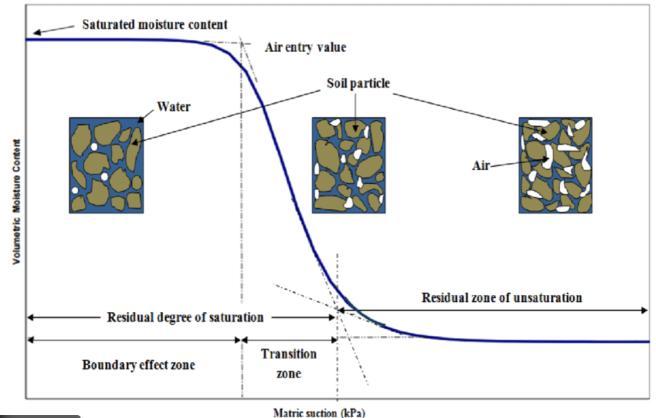
Unlikefullysaturatedsoils,partiallysaturatedsoilsexhibit strong coupling between hydraulic processes and mechanicalresponse.Variationsinmoisturecontentdueto rainfall,evaporation,or groundwater fluctuationcanalter matric suction and, consequently, shear strength and stiffness. The Soil–Water Characteristic Curve (SWCC) governs this relationship and plays a critical role in constitutive modeling (Van Genuchten, 1980). Seasonal changes may therefore significantly influence foundation performance, complicating design assumptions based on constantsoilproperties.
Theories in Partially Saturated States
1.3.1
Traditional bearing capacity theories implicitly assume eitherfullysaturatedordrysoilconditionsandtypicallyrely oneffectivestressconceptsapplicabletosaturatedsoils.The general bearing capacity equation derived by Terzaghi (1943) does not explicitly incorporate matric suction or degree of saturation effects. Consequently, the additional shear strength arising from suction is not directly represented.
1.3.2
Inpartiallysaturatedsoils,shearstrengthvariesnonlinearly withsuction.Experimentalevidencehasshownthatbearing capacity initially increases with suction and subsequently decreases as the soil approaches residual saturation. Classicalformulationscannotcapturethisbehaviorwithout empirical correction factors. Moreover, the failure mechanismspredictedbylimitequilibriummethodsmaynot reflect the complex stress–strain response observed in
unsaturated soils (Vanapalli and Fredlund, 2000). This theoreticalgapnecessitatesmodifiedanalyticalornumerical approaches.
Constitutive models describe the stress–strain–suction relationshipsgoverningsoilbehavior.Forpartiallysaturated soils, these models must incorporate additional state variablesandaccountforsuction-dependenthardeningor softeningmechanisms.Thedevelopmentofadvancedelastoplastic frameworks, such as the Barcelona Basic Model (Alonsoetal.,1990),markedasignificantadvancementin capturinghydro-mechanicalcouplingeffects.
Modified constitutive approaches enable simulation of progressive yielding, stiffness degradation, and collapse behavior associated with wetting. When implemented in numericalmethodssuchasthefiniteelementmethod,these modelsprovidemorerealisticpredictionsofload–settlement response and ultimate bearing capacity compared to simplified analytical solutions. However, their reliability depends on appropriate parameter calibration and validationagainstexperimentaldata.
This review aims to synthesize and critically evaluate existingresearchonbearingcapacityassessmentoffootings restingonpartiallysaturatedsoils,withparticularemphasis on modified constitutive approaches. The objectives are threefold:
➢ To examine experimental evidence highlighting the influenceofmatricsuctiononbearingcapacity;
➢ To analyze theoretical and constitutive modeling frameworks developed to address unsaturated soil behavior;and
➢ To identify knowledge gaps and propose future researchdirectionsforimprovingpredictivereliability in foundation design under partially saturated conditions.
By integrating theoretical developments, experimental findings,andnumericaladvancements,thisreviewseeksto provide a structured knowledge base for researchers and practicing geotechnical engineers working in advanced foundationanalysis.
International Research Journal of Engineering and Technology (IRJET) e-ISSN: 2395-0056
Volume: 13 Issue: 03 | Mar 2026 www.irjet.net p-ISSN: 2395-0072
Arigorousunderstandingofpartiallysaturatedsoilbehavior anditsimplicationsforfoundationengineeringisessential beforeevaluatingmodifiedbearingcapacityapproaches.The mechanicalresponseofsoilsunderunsaturatedconditions differsfundamentallyfromthatoffullysaturatedsystems duetothepresenceofmatricsuctionandcapillaryeffects. Thissectionoutlinesthetheoreticalfoundationsofpartially saturatedsoilmechanics,classicalbearingcapacitytheory, and the role of constitutive modeling in geotechnical analysis.
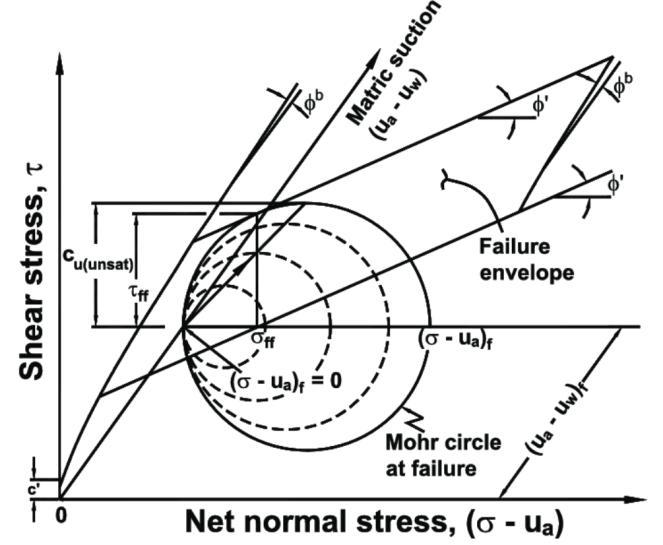
Partially saturated soils, often referred to as unsaturated soils,consistofthreeinteractingphases:solidparticles,pore water,andporeair.Thedegreeofsaturationvariesbetween zero and unity, influencing the mechanical and hydraulic properties of the soil mass. Unlike saturated soils, where effectivestressisgovernedsolelybyporewaterpressure, partially saturated soils exhibit additional stress contributions arising from matric suction. The conceptual frameworkforstressstatevariablesinunsaturatedsoilswas formalized by Fredlund and Morgenstern (1977), who demonstratedthatbothnetnormalstressandmatricsuction independentlyinfluenceshearstrength.Thisdistinctionis particularlysignificantinnear-surfacesoils,embankments, andshallowfoundationsystemswherefullsaturationrarely exists.
Water retention behavior describes the relationship betweensoilsuctionandvolumetricwatercontent,typically represented through the Soil–Water Characteristic Curve (SWCC).TheSWCCreflectsthesoil’spore-sizedistribution and governs hydraulic conductivity, compressibility, and strengthparameters.The widelyusedmodel proposed by VanGenuchten(1980)providesaclosed-formexpressionfor fitting experimental retention data. Suction is commonly dividedintomatricsuction(ua−uw)andosmoticsuction, though matric suction predominates in geotechnical problems involving shallow foundations. Variations in suction due to environmental changes can significantly modify stiffness and shear resistance, thereby affecting bearingperformance.
The incorporation of suctionintostressanalysishasbeen addressedthroughextendedeffectivestressformulations. Bishop(1959)introducedaneffectivestressparameter(χ) to account for partial saturation effects, linking matric suctiontoshearstrengthenhancement.Laterdevelopments refinedthisconceptbyrelatingχtodegreeofsaturationand
microstructuralinteractionswithinthesoilskeleton.These formulations demonstrate that suction induces apparent cohesion, increasing shear strength up to an optimal saturation range before diminishing near residual conditions. Understanding this nonlinear suction–stress relationshipisfundamental formodelingbearingcapacity underpartiallysaturatedstates.
Theclassicaltheoryofbearingcapacityisgroundedinlimit equilibriumandplasticityconcepts.Thepioneeringworkof Karl Terzaghi (1943) established the general bearing capacity equation incorporating cohesion, surcharge, and unit weight components. Subsequent refinements by Geoffrey Meyerhof (1963) and Vesic (1973) introduced correction factors to account for footing geometry, embedmentdepth,andloadinclination.Theseformulations assumehomogeneous,isotropic,andfullysaturatedordry soilconditions,withshearstrengthparametersderivedfrom conventional Mohr–Coulomb theory. While effective for saturated clays and sands, these models do not explicitly incorporatesuction-dependentstrengthcontributions.
2.2.2
Inpartiallysaturatedsoils,matricsuctionincreaseseffective stress and enhances shear strength, thereby elevating ultimatebearingcapacity.Experimentalinvestigationshave shown that bearing capacity may increase significantly at intermediatedegreesofsaturationduetocapillarybonding betweenparticles.However,thisenhancementisnotlinear and diminishes as suction approaches residual levels or during wetting-induced collapse. Analytical extensions incorporatingsuction-dependentshearstrengthparameters have been proposed to address this limitation, but their applicabilityremainsconstrainedbysimplifiedassumptions (Vanapalli and Fredlund, 2000). Consequently, classical bearing capacity equations require modification or replacementwhenappliedtounsaturatedconditions.
2.3.1
Constitutivemodelsdescribethestress–strainbehaviorof soils under mechanical and hydraulic loading. Traditional elastic–perfectlyplasticmodelsbasedontheMohr–Coulomb criterionprovideasimplifiedrepresentationoffailurebut cannot capture suction-induced hardening or softening effects.Advancedelasto-plasticframeworksextendcritical state soil mechanics to unsaturated conditions by introducingadditionalstatevariables.TheBarcelonaBasic Model (Alonso et al., 1990) represents a significant
International Research Journal of Engineering and Technology (IRJET) e-ISSN: 2395-0056
Volume: 13 Issue: 03 | Mar 2026 www.irjet.net p-ISSN: 2395-0072
milestone,incorporatingsuction-dependentyieldsurfaces andhardeninglawswithinathermodynamicallyconsistent formulation. Such models enable prediction of collapse behavior during wetting and strength evolution under varyingsuctionregimes.
2.3.2
Capillary forces generated at air–water interfaces create interparticle bonding, often termed structural attraction, which increases apparent cohesion in partially saturated soils.Thesemicrostructuralinteractionsinfluencestiffness, dilatancy,andfailuremechanisms.Constitutiveformulations that incorporate capillary stress tensors or suction stress concepts provide a more realistic representation of this behavior. Ignoring capillary effects may lead to underestimation of bearing capacity in arid or semi-arid regionswherepartialsaturationdominates.Therefore,the inclusion of hydro-mechanical coupling in constitutive modelingiscriticalforaccuratefoundationanalysis.
2.3.3
For shallow footings resting on partially saturated soils, load–settlementresponseandultimatefailurearegoverned by the combined effects of stress redistribution, suction variation, and plastic deformation. Constitutive models capable of representing these interactions offer improved predictive reliability compared to simplified analytical approaches. When integrated into numerical frameworks such as finite element analysis, these models allow simulationofprogressivefailuremechanismsandparameter sensitivity, thereby enhancing design confidence under complexfieldconditions.
The classical bearing capacity framework constitutes the theoretical foundation of shallow foundation design. Developed primarily within the limit equilibrium and plasticityparadigms,theseformulationsestimateultimate load-carrying capacity by assuming a predefined failure mechanism beneath the footing. While these approaches remain embedded in contemporary design practice, their theoretical assumptions limit their applicability under partiallysaturatedsoilconditions.Thissectionreviewsthe principal limit equilibrium solutions, examines their assumptions,andevaluatestheirrelevancetounsaturated soilsystems.
3.1.1
The seminal contribution to bearing capacity theory was made by Karl Terzaghi (1943), who derived the general bearingcapacityequationforstripfootingsbasedonlimit
equilibriumanalysisandassumedshearfailurealongwelldefined zones beneath the foundation. The formulation decomposes ultimate bearing capacity into three components associated with soil cohesion, surcharge, and unit weight, expressed through dimensionless bearing capacityfactors(Nc,Nq,Nγ).Terzaghi’stheoryassumesa rigid–plastic soil model governed by the Mohr–Coulomb failure criterion, with homogeneous and isotropic soil conditions. Although simplified, this model provided a rational analytical framework that significantly advanced foundationengineeringpractice.
Subsequentrefinementsenhancedthegeneralapplicability ofTerzaghi’ssolution.GeoffreyMeyerhof(1963)introduced correction factors to account for footing shape, depth of embedment, and load inclination, thereby improving predictive capability for practical configurations. Vesic (1973)furtherrefinedbearingcapacityfactorsandprovided improvedtheoreticalinterpretationsoffailuremechanisms basedonplasticitysolutions.Theseextensionsexpandedthe analytical versatility of limit equilibrium methods but retained the fundamental assumptions of classical soil mechanics,particularlyregardingstressstateandsaturation conditions.
Classical bearing capacity theories assume that the supporting soil mass is homogeneous and isotropic, with constantshearstrengthparametersthroughoutthefailure zone. In reality, natural soil deposits often exhibit stratification,anisotropy,andspatial variabilityindensity and fabric. Such simplifications may lead to discrepancies between predicted and observed bearing capacities, particularly in layered or structured soils. Furthermore, thesetheoriesidealizefailureasasuddenshearmechanism, whereas actual behavior may involve progressive plastic deformationandstrainlocalization.
Acriticallimitationofclassicalformulationsistheimplicit assumptionofeitherfullysaturatedorcompletelydrysoil conditions.Shearstrengthparameters(candφ)aretypically derived from saturated triaxial or direct shear tests and interpreted within the conventional effective stress framework proposed by Karl Terzaghi (1925). Under partially saturated conditions, however, matric suction contributes to apparent cohesion and modifies effective stress, effects that are not explicitly represented in traditional equations. Consequently, classical models may underestimate or misrepresent ultimate bearing capacity wheresuctionplaysasignificantrole.
International Research Journal of Engineering and Technology (IRJET) e-ISSN: 2395-0056
Volume: 13 Issue: 03 | Mar 2026 www.irjet.net p-ISSN: 2395-0072
3.3.1
The extension of classical bearing capacity equations to partially saturated soils introduces theoretical inconsistencies. Limit equilibrium solutions are derived under single-phase effective stress assumptions, whereas unsaturated soils require at least two independent stress state variables to describe mechanical behavior. The nonlinear relationship between matric suction and shear strength cannot be adequately captured through constant cohesion parameters. Moreover, failure mechanisms in partially saturated soils may be influenced by hydraulic boundary conditions and suction redistribution during loading, phenomena not addressed in conventional formulations.
Toaddresstheseshortcomings,researchershaveproposed empirical modifications incorporating suction-dependent shear strength parameters into classical bearing capacity equations. For instance, shear strength expressions developedforunsaturatedsoilshavebeensubstitutedinto Terzaghi-typeformulationstoaccountforapparentcohesion inducedbymatricsuction(VanapalliandFredlund,2000). Whilesuchapproachesimprovepredictiveaccuracyunder controlled conditions, they often rely on simplified assumptionsregardingsuctiondistributionanduniformity beneath the footing. As a result, empirical corrections provide interim solutions but lack the comprehensive theoretical rigor required for fully coupled hydromechanicalanalysis.
4. LITERATURE REVIEW:
Experimental research has played a decisive role in advancingtheunderstandingofbearingcapacitybehaviour of footings resting on partially saturated soils. Unlike saturated systems, where shear strength is governed primarily by effective stress, unsaturated soils exhibit suction-dependent strength enhancement and hydraulic–mechanical coupling. This section critically synthesizes laboratoryandfieldinvestigationsthathaveexaminedthese mechanisms,identifiesconsistent behavioural trends,and evaluatesmethodologicallimitations.
4.1.1 Triaxial and Direct Shear Testing under Controlled Suction
Controlled laboratory experiments have provided fundamentalinsightintosuction-dependentshearstrength. The introduction of axis-translation techniques enabled independentcontrolofmatricsuctionintriaxialanddirect
shear apparatus, significantly improving reliability of unsaturated soil testing. Early systematic studies demonstrated that shear strength increases with matric suctionduetocapillarybonding,withtherelationshipoften expressed through extended Mohr–Coulomb formulations (FredlundandRahardjo,1993).
Subsequent experimental programs refined this understandingbyquantifyingthecontributionofsuctionto apparentcohesionandidentifyingthresholdsuctionvalues beyond which incremental strength gain diminishes. Vanapalli et al. (1996) proposed predictive relationships linkingshearstrengthtotheSoil–WaterCharacteristicCurve (SWCC), thereby integrating hydraulic behaviour with mechanicalresponse.Theselaboratoryfindingsestablished thetheoreticalbasisforincorporatingsuctionintobearing capacityassessment.
Beyond element-level testing, small-scale plate load experiments have been conducted to simulate shallow foundationbehaviourunderpartiallysaturatedconditions. These studies typically involve compacted soil beds prepared at controlled moisture contents, with suction measured using tensiometers or filter paper techniques. Resultsconsistentlyindicatethatultimatebearingcapacity increases at intermediate suction levels and decreases duringwetting.OhandVanapalli(2011)demonstratedthat suction-induced strength enhancement can significantly elevate ultimate load compared to saturated conditions, particularly in compacted silty sands. Such tests provide direct evidence linking laboratory-derived shear strength parameterstofooting-scaleresponse.
International Research Journal of Engineering and Technology (IRJET) e-ISSN: 2395-0056
Volume: 13 Issue: 03 | Mar 2026 www.irjet.net p-ISSN: 2395-0072
4.2.1
Field-scale investigations offer essential validation of laboratoryfindingsbycapturingin-situstressredistribution and environmental variability. Instrumented footing tests conductedonunsaturatedcompactedfillshaveshownthat bearingcapacityissensitivetoinitialsuctionconditionsand subsequent moisture changes.Toll (2000)highlightedthe importanceofmonitoringsuctionprofilesbeneathshallow foundations to accurately interpret load–settlement behaviour. Field studies reveal that suction distribution beneath a footing is non-uniform and may evolve during loading,challengingsimplifiedanalyticalassumptions.
4.2.2
Long-termmonitoringprogramshavefurtherdemonstrated that seasonal climatic variations influence foundation performance in unsaturated soils. Changes in rainfall, evaporation,andgroundwaterlevelmodifymatricsuction, thereby altering stiffness and shear strength over time. Research on expansive and collapsible soils indicates that wetting events may trigger sudden reductions in bearing capacityduetosuctionlossandstructuralcollapse(Ngand Shi,1998).Thesefindingsunderscorethedynamicnatureof unsaturated soil systems and the need to consider environmentalloadingindesign.
4.3.1
A consistent outcome across laboratory and field investigations is the enhancement of shear strength with increasing matric suction within a specific range. This enhancement is primarily attributed to capillary stresses acting at particle contacts, which increase effective intergranularstress.However,therateofstrengthincrease diminishes at higher suction values as soils approach residual saturation. The relationship betweensuctionand strength is therefore nonlinear and soil-type dependent, governed by pore-size distribution and plasticity characteristics.
4.3.2
Experimentalplateloadtestsandnumericalback-analyses indicate that bearing capacity does not vary linearly with degreeofsaturation.Instead,maximumbearingresistanceis oftenobservedatintermediatesaturationlevels,reflecting optimal capillary bonding. During wetting, rapid suction reduction can induce collapse settlementsand substantial bearingcapacityreduction.Thisnon-monotonicbehaviour complicates direct application of constant-strength parameters in design equations and highlights the
importance of incorporating hydraulic state variables in predictivemodels.
4.4.1
Despite advancements in testing techniques, accurate control and measurement of suction remain technically demanding. Axis-translation methods are limited to moderatesuctionranges,whilehigh-capacitytensiometers and osmotic techniques require careful calibration and maintenance.Time-dependentequilibrationbetweenpore air and pore water pressures can introduce experimental uncertainty. Moreover, achieving uniform suction distribution in large specimens or soil beds is difficult, potentiallyaffectingreproducibilityofresults.
Laboratory plate load tests are inherently influenced by boundary confinement and scale effects. Small-scale experiments may not replicate stress paths, drainage conditions,orsuctionredistributionmechanismsobserved in field foundations. Boundary friction and limited failure zone development can lead to overestimation or underestimationofbearingcapacity.Fieldtests,whilemore representative, are costly and subject to environmental variability that complicates interpretation. Consequently, althoughexperimentalinvestigationsprovidecriticalinsight, theymustbeintegratedwithrobustconstitutivemodelingto achievereliablepredictivecapability.
The limitations of classical bearing capacity formulations underpartiallysaturatedconditionshavenecessitatedthe development of advanced constitute models capable of incorporating suction-dependent behaviour. Unlike saturated soil models, constitutive approaches for unsaturated soils must account for additional stress state variables,hydro-mechanicalcoupling,andsuction-induced hardeningorsofteningmechanisms.Thissectioncritically reviewstheprincipalmodelingframeworksusedtosimulate bearing capacity and stress–strain response of footings restingonpartiallysaturatedsoils.
5.1.1
One of the earliest attempts to extend effective stress principlestopartiallysaturatedsoilswasproposedbyAlan W. Bishop (1959). Bishop introduced a modified effective stress equation incorporating a parameter χ to scale the contributionofmatricsuctiontointergranularstress.The parameterχiscommonlyexpressedasafunctionofdegree
International Research Journal of Engineering and Technology (IRJET) e-ISSN: 2395-0056
Volume: 13 Issue: 03 | Mar 2026 www.irjet.net p-ISSN: 2395-0072
ofsaturation,therebylinkinghydraulicstatetomechanical response. This formulation preserves the conceptual simplicity of classical effective stress while enabling inclusion of suction effects in shear strength and deformationanalysis.However,theselectionandcalibration of χ remain subject to empirical interpretation, and its applicabilitymayvarywithsoiltypeandstresshistory.
Buildingonextendedstressconcepts,shearstrengthmodels have been developed that explicitly incorporate matric suctionintotheMohr–Coulombframework.Fredlundetal. (1978)proposedanequationexpressingshearstrengthasa function of both net normal stress and matric suction, introducing an additional strength parameter related to suction friction angle. Later refinements linked suction contributiontotheSoil–WaterCharacteristicCurve(SWCC), enablingpredictiveestimationbasedonhydraulicproperties (Vanapallietal.,1996).Thesemodelsareparticularlyuseful for modifying bearing capacity equations; however, they generallyassumeuniformsuctiondistributionbeneaththe footinganddonotcaptureprogressiveplasticdeformation.
5.2.1
Elasto-plasticconstitutivemodelsextendclassicalplasticity theorytounsaturatedconditionsbyincorporatingsuctionas anindependentstressvariable.Thesemodelsdescribenot only failure states but also pre-failure deformation behaviour,enablingpredictionofload–settlementresponse undershallowfoundations.Thecouplingbetweenhydraulic and mechanical behaviour is introduced through suctiondependent elastic moduli and plastic flow rules. Such frameworksallowsimulationofstiffnessdegradationduring wettingandstrengthenhancementduringdrying,thereby providing improved representation of foundation performancecomparedtorigid–plasticmodels.
5.2.2
Inunsaturatedelasto-plasticmodels,yieldsurfacesexpand orcontractinresponsetochangesinsuction,aphenomenon often termed suction hardening. As suction increases, the yield surface enlarges, reflecting increased apparent cohesion and stiffness; conversely, wetting induces contraction and potential collapse. The Barcelona Basic Model(BBM)proposedbyAlonsoetal.(1990)formalized this concept within a thermodynamically consistent framework. The BBM introduces a Loading–Collapse (LC) yieldcurvetorepresentvolumetriccollapseuponwetting, makingitparticularlyrelevantforfoundationsoncollapsible soils. Yield surface evolution thus becomes central to predicting bearing capacity under transient hydraulic conditions.
5.3.1
The BBM and its extensions represent a significant advancement in unsaturated soil constitutive modeling. Developed within critical state soil mechanics, the framework integrates suction-dependent hardening laws withelastoplasticstress–strainrelations.Byincorporating suction into both yield criteria and plastic potential functions, Barcelona-type models capture irreversible deformations induced by wetting or drying paths. These features make them suitable for finite element implementationinbearingcapacityproblems,wherestress redistribution and progressive failure occur beneath footings.
5.3.2
Advancedmodelsincorporatedualhardeningmechanisms: mechanicalhardeningduetoplasticstrainaccumulationand hydraulichardeningdrivenbysuctionvariation.Thisdual mechanismenablessimulationofcollapsesettlementsand strength recoveryunder cyclicwetting–dryingconditions. Criticalstate-basedextensionsfurtheraccountforchangesin specific volume and suction-dependentcritical state lines, enhancingpredictiverobustnessforcompactedandnatural unsaturatedsoils.
5.4.1
Hypoplastic models depart from classical yield surface conceptsandinsteaddefinestress–strainbehaviourthrough nonlinear rate equations. Extensions to unsaturated soils incorporate suction-dependent stiffness and strength parameters, enabling continuous representation of deformation without explicit yield surfaces. Such models effectively capture non-linear stiffness at small and intermediate strains, which is important for predicting settlementbehaviourunderworkingloads.
5.4.2
Boundingsurfaceplasticitymodelsprovideaframeworkfor simulatingcyclicloading andprogressive accumulation of plasticstrains.When adaptedfor partiallysaturatedsoils, these models account for suction-induced hardening and wetting-induced softening within a unified stress–strain formulation. They are particularly useful in analyzing repeatedloadingorseasonalmoisturefluctuationsbeneath shallowfoundations.Nevertheless,increasedmathematical complexity may limit their routine application in conventionaldesignpractice.
International Research Journal of Engineering and Technology (IRJET) e-ISSN: 2395-0056
Volume: 13 Issue: 03 | Mar 2026 www.irjet.net p-ISSN: 2395-0072
5.5.1 Determination of Suction-Related Parameters
A major challenge in implementing modified constitutive models lies in parameter identification. Suction-related parameters often require specialized laboratory tests, including controlled-suction triaxial or oedometer experiments. Determination of SWCC parameters, suction hardening coefficients, and collapse indices demands rigorous testing protocols and careful interpretation. Variability in measurement techniques can introduce uncertainty, affecting predictive reliability in bearing capacitysimulations.
5.5.2 Model Complexity versus Engineering Applicability
Although advanced constitutive models offer improved theoretical representation, their complexity may hinder widespread adoption in engineering practice. Increased computationaldemand,difficultyinparametercalibration, and sensitivity to initial conditions may discourage use in routinefoundationdesign.Consequently,abalancemustbe achieved between theoretical rigor and practical applicability. Simplified effective stress-based approaches may suffice for preliminary design, whereas advanced elastoplastic or hypoplastic models are better suited for research-levelanalysisorcriticalinfrastructureprojects.
Theadvancementofconstitutiveformulationsforpartially saturated soils has been closely accompanied by developments in numerical analysis techniques. Among these,thefiniteelementmethod(FEM)hasemergedasthe dominant framework for simulating bearing capacity and load–settlement behaviour of shallow foundations under hydro-mechanically coupled conditions. Numerical modelling enables incorporation of complex stress paths, non-uniformsuctiondistributions,andprogressivefailure mechanisms that cannot be adequately represented using analyticalsolutions.
6.1.1
Inunsaturatedsoilmodelling,hydro-mechanicalcouplingis essentialbecausevariationsinporewaterpressuredirectly influence effective stress and deformation. Coupled formulations simultaneously solve equilibrium equations and fluid flow equations, typically derived from Biot-type consolidationtheoryextendedtounsaturatedmedia.Alonso etal.(1990)demonstratedthefeasibilityofimplementing suction-dependent elasto-plastic models within FEM frameworks to simulate collapse upon wetting. Later
developments incorporated transient seepage analysis to accountforsuctionredistributionbeneathloadedfootings (Shengetal.,2008).Thesecoupledanalysesproviderealistic predictions of bearing capacity variation under environmental changes,particularlyrainfall infiltration or groundwaterfluctuations.
Accuraterepresentationofboundaryconditionsiscriticalin numerical bearing capacity simulations. Artificial confinement due to insufficient model dimensions may overestimate ultimate load. Mesh refinement near the footing–soil interface is required to capture stress concentration and shear band formation. Studies have shown that adaptive meshing or higher-order elements improve convergence and accuracy in modelling strain localization (Griffiths and Lane, 1999). Additionally, appropriatehydraulicboundaryconditionsmustbedefined to represent drainage or infiltration scenarios, as these significantly influence suction distribution and ultimate strength.
Comparative studies between FEM simulations and laboratory plate load tests indicate that suction-inclusive constitutive models significantly improve agreement with experimental observations compared to classical Mohr–Coulomb models. Numerical analyses incorporating extended effective stress or Barcelona-type models have successfullyreproducednon-linearload–settlementcurves and suction-induced strength enhancement. However, predictiveaccuracydependsheavilyonreliablecalibration ofhydraulicandmechanicalparameters.Discrepanciesoften arise from assumptions of uniform initial suction or simplifiedhydraulicconductivityfunctions.
Parametricanalysesrevealthatbearingcapacitypredictions arehighlysensitivetosuctionhardeningparameters,SWCC fitting constants, and elastic stiffness moduli. Small variations in suction-related parameters can lead to substantial changes in predicted ultimate load. Sensitivity studies underscore the need for rigorous laboratory characterization and highlight the risk of overparameterization in advanced models. The nonlinear relationship between suction and effective stress further amplifies this sensitivity, particularly under transient wettingconditions.
International Research Journal of Engineering and Technology (IRJET) e-ISSN: 2395-0056
Volume: 13 Issue: 03 | Mar 2026 www.irjet.net p-ISSN: 2395-0072
6.3.1
Implementation of advanced constitutive models often introduces numerical instability due to highly nonlinear yield surfaces and coupled hydraulic equations. Strainsofteningbehaviourandcollapsemechanismsmayleadto localizationandmeshdependency,affectingconvergenceof iterativesolvers.Regularizationtechniquesorviscoplastic formulationsaresometimesemployedtomitigatenumerical difficulties.Nonetheless,achievingstablesolutionsinfully coupled hydro-mechanical analyses remains computationallydemanding.
6.3.2
Coupled analyses with fine meshes and time-dependent seepage calculations significantly increase computational timeandmemoryrequirements.Forpracticalengineering design, this computational burden may limit routine application. Simplified approaches, such as uncoupled analysis or reduced integration schemes, are sometimes adoptedtoreducecost,thoughattheexpenseofpredictive rigor. Therefore, computational efficiency remains an importantconsiderationinselectingappropriatemodelling strategies.
A systematic comparison of analytical, experimental, and numerical approaches is essential for evaluating their relative reliability and applicability in foundation engineeringpractice.Differencesintheoreticalassumptions, parameter requirements, and computational complexity influencemodelselectionforpartiallysaturatedconditions.
7.1.1
Effective stress-based modifications provide moderate improvement over classical bearing capacity equations, particularlyforconditionsofuniformsuction.Elasto-plastic andBarcelona-typemodelsdemonstratehigherpredictive accuracy in simulating progressive failure and wettinginducedcollapse.Hypoplasticandboundingsurfacemodels offer superior representation of nonlinear stiffness and cyclic effects but require extensive calibration. Overall, advanced constitutive models outperform simplified analytical corrections when validated against controlled experimentaldata.
Incorporatingsuctioneffectsgenerallyincreasespredicted bearing capacity, potentially reducing required footing dimensions. However, reliance on transient suction enhancementwithoutaccountingforpossiblewettingmay compromisesafety.Designsafetyfactorsshouldtherefore considerworst-casehydraulicconditionsratherthanpeak suctionstates.Reliability-basedapproachesmayprovidea more rational framework for incorporating variability in suction.
7.2.2
For routine design, incorporation of suction-dependent shearstrengthparametersintoclassicalequationsmaybe acceptablewhereenvironmentalvariabilityislimited.For critical infrastructure or collapsible soils, coupled hydromechanicalnumericalanalysisusingvalidatedconstitutive modelsisrecommended.Long-termmonitoringofsuction profiles can further enhance reliability of design assumptions. Ultimately, integration of experimental characterization, advanced modelling, and environmental assessment is necessary to achieve robust foundation performanceinpartiallysaturatedsoils.
This review critically examined the bearing capacity evaluationofshallowfootingsrestingonpartiallysaturated soils, with particular emphasis on modified constitutive approaches and their numerical implementation. The synthesis of experimental investigations confirms that matric suction significantly enhances shear strength and ultimatebearingcapacitywithinaspecificsaturationrange, whilewetting-inducedsuctionlossmaytriggersubstantial reductions in strength and collapse settlements. Classical bearing capacity theories, although foundational to geotechnical design,are theoreticallyconstrainedbytheir assumption of fully saturated or dry soil conditions and thereforerequiremodificationforunsaturatedapplications.
Effective stress-based extensions provide a practical transitional framework by incorporating suction contributions into shear strength formulations. However, advancedelasto-plasticandcriticalstatemodels,particularly those incorporating suction-dependent hardening mechanisms, offer superior predictive capability by capturing hydro-mechanical coupling, yield surface evolution, and collapse behaviour. Finite element implementationsofthesemodelsenablerealisticsimulation ofprogressivefailureandtransienthydrauliceffects,albeit with increased parameter sensitivity and computational demand.
International Research Journal of Engineering and Technology (IRJET) e-ISSN: 2395-0056
Volume: 13 Issue: 03 | Mar 2026 www.irjet.net p-ISSN: 2395-0072
Overall,thereviewhighlightsthatreliablebearingcapacity predictionunderpartialsaturationrequiresintegrationof experimental characterization, suction-dependent constitutive modelling, and coupled numerical analysis. Continuedrefinementofmodelcalibrationproceduresand field validation is essential for translating advanced theoretical developments into robust foundation design practice.
This review is primarily conceptual and synthesis-based, relying on published experimental and modelling studies without conducting independent validation or metaanalytical quantification. Variability in testing methodologies, suction measurement techniques, and constitutiveparametercalibrationacrossdifferentstudies limitsdirectcomparabilityofreportedresults.Thereview also focuses predominantly on shallow strip and circular footings,withlimiteddiscussionofcomplexgeometriesor layeredsoilsystems.Furthermore,recentdata-drivenand probabilisticapproacheswereonlybrieflyaddressed,asthe primary emphasis was placed on constitutive modelling frameworks.Finally,regionalclimaticvariabilityandlongtermfieldmonitoringdataremainunderrepresentedinthe literature, constraining comprehensive evaluation of seasonalsuctioneffectsonfoundationperformance.
1. Alonso,E.E.,Gens,A.andJosa,A.(1990)‘Aconstitutive model for partially saturated soils’, Géotechnique, 40(3),pp.405–430.
2. Bishop,A.W.(1959)‘Theprincipleofeffectivestress’, TekniskUkeblad,106(39),pp.859–863.
3. Das, B.M. and Sobhan, K. (2018) Principles of Geotechnical Engineering. 9th edn. Boston: Cengage Learning.
4. Fredlund, D.G. and Morgenstern, N.R. (1977) ‘Stress state variables for unsaturated soils’, Journal of the GeotechnicalEngineeringDivision,ASCE,103(GT5),pp. 447–466.
5. Fredlund,D.G.andRahardjo,H.(1993)SoilMechanics forUnsaturatedSoils.NewYork:JohnWiley&Sons.
6. Fredlund, D.G., Morgenstern, N.R. and Widger, R.A. (1978) ‘The shear strength of unsaturated soils’, CanadianGeotechnicalJournal,15(3),pp.313–321.
7. Griffiths, D.V. and Lane, P.A. (1999) ‘Slope stability analysis by finite elements’, Géotechnique, 49(3), pp. 387–403.
8. Meyerhof, G.G. (1963) ‘Some recent research on the bearingcapacityoffoundations’,CanadianGeotechnical Journal,1(1),pp.16–26.
9. Ng, C.W.W. and Shi, Q. (1998) ‘A numerical investigationofthestabilityofunsaturatedsoilslopes subjected to transient seepage’, Computers and Geotechnics,22(1),pp.1–28.
10. Oh,W.T.andVanapalli,S.K.(2011)‘Bearingcapacityof unsaturated soils under strip footings’, Journal of Geotechnical and Geoenvironmental Engineering, 137(12),pp.1140–1151.
11. Sheng, D., Sloan, S.W. and Yu, H.S. (2008) ‘Aspects of finiteelementimplementationofcriticalstatemodels’, ComputersandGeotechnics,35(2),pp.185–196.
12. Terzaghi, K. (1925) Erdbaumechanik auf Bodenphysikalischer Grundlage. Leipzig: Franz Deuticke.
13. Terzaghi, K. (1943) Theoretical Soil Mechanics. New York:JohnWiley&Sons.
14. Toll, D.G. (2000) ‘A framework for unsaturated soil behaviour’,Géotechnique,50(5),pp.507–522.
15. VanGenuchten,M.T.(1980)‘Aclosed-formequationfor predicting the hydraulic conductivity of unsaturated soils’,SoilScienceSocietyofAmericaJournal,44(5),pp. 892–898.
16. Vanapalli,S.K.andFredlund,D.G.(2000)‘Comparison of different procedures to predict unsaturated soil shearstrength’,AdvancesinUnsaturatedGeotechnics, ASCEGeotechnicalSpecialPublicationNo.99,pp.195–209.
17. Vanapalli,S.K.,Fredlund,D.G.,Pufahl,D.E.andClifton, A.W.(1996)‘Modelforthepredictionofshearstrength with respect to soil suction’, Canadian Geotechnical Journal,33(3),pp.379–392.
18. Vesic,A.S.(1973)‘Analysisofultimateloadsofshallow foundations’, Journal of the Soil Mechanics and FoundationsDivision,ASCE,99(SM1),pp.45–73.
19. Bagherieh, A.R. and Çinicioğlu, Ö. (2024) ‘Bearing capacity equation for shallow foundations on unsaturatedsoils’,TurkishJournalofCivilEngineering, 35(3),pp.1–20.
20. Du,D.,Zhuang,Y.,Sun,Q.,Yang,X.andDias,D.(2021) ‘Bearingcapacityevaluationforshallowfoundationson unsaturated soils using discretization technique’, ComputersandGeotechnics,137,104309.
International Research Journal of Engineering and Technology (IRJET) e-ISSN: 2395-0056
Volume: 13 Issue: 03 | Mar 2026 www.irjet.net p-ISSN: 2395-0072
21. Kim, Y., Park, H. and Jeong, S. (2017) ‘Settlement behavior of shallow foundations in unsaturated soils underrainfall’,Sustainability,9(8),1417.
22. Yan, Q. (2020) ‘Ultimate bearing capacity of strip foundations in unsaturated soils considering the intermediateprincipalstresseffect’,AdvancesinCivil Engineering,2020,8854552.
23. Vanapalli, S.K. and Mohamed, F.M. (2007) ‘Bearing capacity of model footings in unsaturated soils’, J. Geotechnical Studies, available at: ResearchGate (accessed2025).
24. Showkat, R. (2023) ‘Deterministic and probabilistic analysis of the response of shallow footings on unsaturated soils due to rainfall’, Transportation Geotechnics,43,101150.
25. Sheng,D.(2011)‘Reviewoffundamentalprinciplesin modellingunsaturatedsoilbehaviour’,Computersand Geotechnics,38,pp.757–776.
26. Liu,Y.,Cai,G.,Li,J.andZhao,C.(2021)‘Afullycoupled thermo-hydro-mechanical constitutive model for unsaturated soils’, Chinese Journal of Geotechnical Engineering,43(3),pp.547–555.
27. Han, B.-W., Cai, G.-Q., Li, J. and Zhao, C.-G. (2020) ‘Hydro-mechanical coupling bounding surface model for unsaturated soils considering bonding effect of particles’,ChineseJournalofGeotechnicalEngineering, 42(11),pp.2059–2068.
28. Riad,B.etal.(2022)Characterizingandmodelingthe coupled hydro-mechanical cyclic behavior of unsaturated soils’, Transportation Research Record, 21088775.
29. Oh,W.T.,Jeong,S.andVanapalli,S.K.(2011)‘Modelling the applied vertical stress and settlement of shallow foundationsinunsaturatedsands’,CanadianJournalof CivilEngineering,38,pp.757–776.
30. Kavvadas, M. (2023) ‘Bearing capacity of shallow footing on an unsaturated embankment upon infiltration’,E3SWebofConferences,Unsat2023.
31. Rojas,J.C.,Salinas,L.M.andSejas,C.(2007)‘Plate-load tests on an unsaturated clay’, in Experimental Unsaturated Soil Mechanics, Springer, Berlin/Heidelberg,pp.445–452.
32. Phan, D.G., Nguyen, G.D., Bui, H.B. and Bennett, T. (2020) ‘Constitutive modelling of partially saturated soils:Hydro-mechanicalcoupling’,InternationalJournal ofPlasticity,133,102821.
33. Khalil,S.,Abboud,N.andAlmoukdad,F.(2022)‘Effect of saturation degree on bearing capacity and failure mechanism of sandy soils’, Scientific Steps in Civil Engineering.
34. Scientific.Net(2011)‘Bearingcapacitycharacteristicof unsaturated granular soils’, Advanced Materials Research,261–263,pp.989–993.
35. Scientific.Net(2011)‘Simulationsofbearingcapacityof foundation on unsaturated granular soils’, Applied MechanicsandMaterials,52–54,pp.1400–1405.
36. Ravichandran,N.,Mahmoudabadi,V. and Shrestha, S. (2017) ‘Analysis of the bearing capacity of shallow foundation in unsaturated soil using Monte Carlo simulation’,InternationalJournalofGeosciences,8,pp. 1231–1250.
37. Chai, H. et al. (2024) ‘Deformation and strength of unsaturatedloess–hydrauliccouplingeffects’,Water, 16(7),997.
38. Xu, S. and Zhou, D. (2023) ‘Seismic bearing capacity solution for strip footings in unsaturated soils’, Mathematics,11(12),2692.
39. Toll, D.G., Lourenço, S.D.N. and Mendes, J. (2013) ‘Advancesinsuctionmeasurementsusinghighsuction tensiometers’,EngineeringGeology.
40. Li,Y.,Cai,G.,Zhou,A.,Han,B.andLi,J.(2021)‘Afully coupled constitutive model for thermo-hydromechanical unsaturated soils’, Computers and Geotechnics,2021,104032.
41. Showkat,R.,Duan,Q.andZhuang,Y.(2021)‘Numerical evaluationofbearingcapacitywithsuctionvariation’, TransportationGeotechnics.
42. Reddy, A.S., Singh, A.K. and Michalowski, R.L. (2018) ‘Upper bound analyses for unsaturated soil bearing capacity’,EngineeringStructures,[online].
43. Cavallaro, A. et al. (2022) ‘Footing bearing capacity enhancement due to matric suction effects’, GeotechnicalResearchJournal,[journaldetails].