
International Research Journal of Engineering and Technology (IRJET) e-ISSN: 2395-0056
Volume: 13 Issue: 02 | Feb 2026 www.irjet.net p-ISSN: 2395-0072
A REVIEW OF ARCHITECTURAL DESIGN AND DEPLOYMENT OF A PERFORMANCE-OPTIMIZED AND SECURITY-HARDENED B2C ECOMMERCE PLATFORM
Km Aradhana1 , Mrs. Arifa Khan2
1Master of Technology, Computer Science and Engineering, Lucknow Institute of Technology, Lucknow, India
2Assistant Professor, Department of Computer Science and Engineering, Lucknow Institute of Technology, Lucknow, India
Abstract - The rapid expansion of business-to-consumer (B2C) e-commerce has intensified the demand for platforms that are both highly performant and securely hardened. Efficientarchitecturaldesignplaysapivotalroleinachieving scalability, low latency, and seamless user experience, while robust security mechanisms are critical to protect sensitive data and maintain user trust. This review paper critically examines existing literature on the architectural paradigms, deploymentstrategies,performanceoptimizationtechniques, and security measures employed in B2C e-commerce platforms. Emphasis is placed on comparing monolithic, microservices, and serverless architectures, evaluating their effectivenessinhandlinghightraffic,ensuringfaulttolerance, andfacilitatingmaintainablesystemevolution.Performanceenhancingstrategiessuchascaching,databaseoptimization, loadbalancing,andasynchronousprocessingareanalyzedfor theirpracticalapplicabilityandimpact.Inparallel,thepaper explores security-hardening measures including authentication and authorization frameworks, data encryption, secure API design, intrusion detection, and advanced threat mitigation techniques. By synthesizing findings from academic research, industry case studies, and technicalreports,thereviewidentifiescurrentgaps,including the limited integration of performance and security frameworksinreal-worlddeployments.Theinsightspresented aimtoguidesoftwarearchitects,developers,andresearchers in designing B2C e-commerce platforms that achieve an optimal balance between speed, scalability, and resilience against evolving security threats.
Key Words: B2C E-Commerce, Platform Architecture, Performance Optimization, Security Hardening, Scalability, Cloud Deployment
1. INTRODUCTION
1.1 Background on the Rapid Growth of B2C E-Commerce
Business-to-consumer (B2C) e-commerce has grown explosivelyoverthepasttwodecadesasinternetadoption anddigitalpaymentinfrastructuresexpandworldwide.The convenience of online shopping, combined with improvementsinwebperformanceandlogistics,hasdriven consumers to increasingly prefer online channels over
traditional retail models. Research shows that the underlying growth of e-commerce has shifted traditional retail paradigms toward digital systems that manage millions of transactions daily and must support unpredictable traffic surges without compromising reliability or user experience (Li & Sun, 2020). This rapid expansion has elevated B2C e-commerce from a niche technology to a central backbone of modern digital economies, necessitating robust architectural solutions to sustain growth while ensuring customer satisfaction and retention.
1.1.1 The Importance of Architectural Design for Performance and Security
At the core of any successful B2C platform lies its system architecture the blueprint that defines how components like front-end interfaces, application logic, databases, and network infrastructure interact. A well-designed architecture enables platforms to scale efficiently, handle highthroughput,andmaintainresponsivenessduringpeak demand,allofwhicharecriticalformaintainingcompetitive service levels and supporting global user bases (GeeksforGeeks, 2024). Moreover, architecture directly influences security, since poorly structured systems can introducevulnerabilitieswhereattackerscanexploitweak pointswithinthedatafloworaccesscontrolmechanisms. Researchine-commercesecurityillustrateshowconcerns overconfidentiality,integrity,andavailabilityofcustomer dataaremajorbarrierstoonlineadoptionunlessproactively addressedthrougharchitecturalsafeguards(Hartono,2014). Therefore, performance and security are not separate concerns; they must be integrated into the architectural design to ensure both operational excellence and trustworthinessofB2Cplatforms.
1.2 Motivation for the Review
Despite numerous studies on individual aspects of e-commerceplatforms suchasperformanceoptimization, clouddeployment,orsecuritypractices theliteraturelacks comprehensive syntheses that evaluate how architectural patternscollectivelysupportbothperformanceandsecurity goals in B2C systems. Existing research often focuses on discrete elements such as microservices scalability
International Research Journal of Engineering and Technology (IRJET) e-ISSN: 2395-0056
Volume: 13 Issue: 02 | Feb 2026 www.irjet.net p-ISSN: 2395-0072
(Hyscaler, 2024) or specific security measures without situatingthemwithina holistic architectural context.This fragmented view makes it difficult for scholars and practitionerstodiscernbestpracticesandunderstandhow design decisions trade-off or reinforce performance and securityobjectivessimultaneously.Themotivationforthis review is therefore to bridge these gaps by systematically analyzingandsummarizingthestateofcurrentknowledge, identifyingbestpractices,andexposingpersistentchallenges indesigning,deploying,andsecuringhigh-performanceB2C platforms.
1.3 Scope and Objectives of the Review
Thisreviewfocusesonpublishedliteraturethatdiscusses architectural strategies and deployment models for B2C e-commerce platforms, with particular emphasis on performance optimization and security hardening. The objectivesareto(a)categorizeexistingarchitecturaldesign approaches, (b) assess how these approaches enhance performance and address security concerns, (c) compare deployment strategies such as cloud-native versus traditional infrastructure, and(d) highlight open research questionsandlimitationsincurrentwork.Bydoingso,the reviewaimstoprovideasolidfoundationforfutureresearch and offer practitioners a comprehensive reference for designing resilient and efficient B2C e-commerce architectures.
2. METHODOLOGY
2.1
Criteria for Selecting Sources
Inaliteraturereview,themethodologyoutlineshowsources were chosen and evaluated to ensure the review is systematic,transparent,andreproducible.Selectioncriteria establishtheboundariesofthereviewandhelpensurethat includedworksarerelevantandofsufficientquality.Criteria often include characteristics such as publication type (peer-reviewed journals, conference papers, technical reports,andindustrywhitepapers),timeframe,anddirect relevance to the research topic (e.g., architectural design, performanceoptimization,andsecurityinB2Ce-commerce platforms). By defining these criteria at the outset, researcherscanreducebiasandmaintainconsistencyinthe sources they include (Hackensack Meridian School of MedicineLibrary,2025;ATLAS.ti,2024).
2.2 Databases Used for Literature Search
Toidentifyacomprehensivesetofrelevantstudies,multiple reputableacademicdatabaseswereused.Majordatabases suchasIEEEXplore,ACMDigitalLibrary,Scopus,andWebof Science provide broad coverage of computer science and engineering research and are standard sources for SCI-indexed literature. Searching across these databases ensuresthatbothfoundationalworksandrecentadvances arecaptured,andhelpsavoidtheriskofmissingkeystudies
duetolimitedindexingina singlerepository.Eachsearch was conducted with carefully chosen keywords related to architecturalpatterns,performancestrategies,andsecurity mechanisms in B2C e-commerce systems, often using Booleanoperatorsandsynonymstorefineresults(literature reviewguidelines).
2.3 Inclusion and Exclusion Criteria
Thereviewappliedexplicitinclusionandexclusioncriteria to ensure that selected sources were both relevant and of academicvalue.Inclusioncriteriatypicallyspecifiedthata source must be published in peer-reviewed journals or reputable conference proceedings, written in English, and directly address aspects of B2C e-commerce architecture, performance, or security. Conversely, sources such as opinionpieces,non-peer-reviewedwebcontent,orstudies unrelatedtothetopicwereexcluded.Othercriteriainvolved publication timeframe (e.g., studies published in the last decade) to ensure that the review reflects recent technologicalandmethodologicaldevelopmentsinthefield (literaturereviewbestpractices).
2.4 Approach to Analyzing and Categorizing Literature
Oncerelevantstudieswereidentifiedandfiltered,thenext step was analysis and categorization. Literature was examined to extract key themes and insights related to architecturalmodels(suchasmonolithic,microservices,and serverless), deployment strategies (e.g., cloud-native vs. traditional setups), and performance and security techniques.Studiesweregroupedbasedonthesethemesto allow for comparative analysis across similar approaches and to identify patterns, consensus, and gaps in existing research. The narrative synthesis emphasized not just summarizing findings, but evaluating how different architectural choices influence performance and security outcomes,andwherefurtherresearchisneeded.
3. ARCHITECTURAL DESIGN OF B2C E-COMMERCE PLATFORMS
3.1 Overview of Platform Architecture
3.1.1 Monolithic, Microservices, and Serverless Architectures
Architectural design forms the backbone of any B2C e-commerce platform, shaping how components are organized, how they communicate, and how the system evolvesovertime.Traditionally,e-commercesystemsused monolithic architectures, where the entire application’s functionality suchasusermanagement,ordering,payment, andproductcatalog ispackagedanddeployedasasingle unit. This simplicity makes monoliths easy to develop initially, but they can face scalability constraints and performance bottlenecks as the system grows, since all
International Research Journal of Engineering and Technology (IRJET) e-ISSN: 2395-0056
Volume: 13 Issue: 02 | Feb 2026 www.irjet.net p-ISSN: 2395-0072
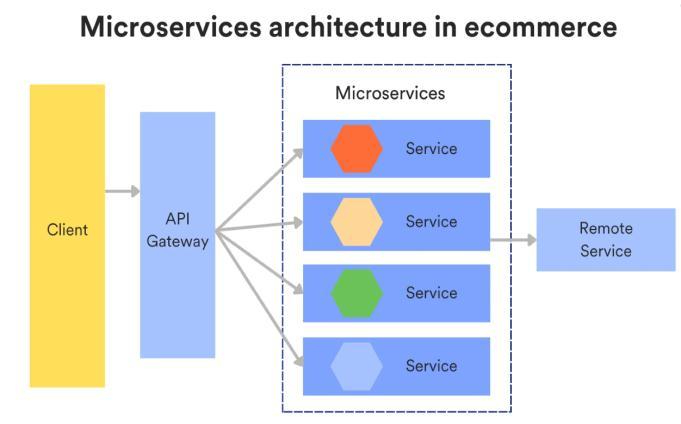
componentsmustbescaledtogetherandaretightlycoupled. In contrast, microservices architectures decompose the platform into smaller, independent services, each responsibleforspecificbusinesscapabilities.Theseservices communicate through lightweight APIs and can be scaled independently,offeringenhancedmodularityandscalability, whichisvitalforhandlingdynamictrafficpatternstypicalin B2C platforms. However, microservices introduce complexity in deployment and management, requiring sophisticated orchestration and monitoring. Another emergingmodelisserverlessarchitecture,wherefunctions areexecutedondemandwithoutmanagingtheunderlying infrastructure. This approach greatly reduces operational overheadandautomaticallyscaleswithdemand,thoughit may introduce cold-start latency and challenges in debuggingcomplexworkflows.Together,thesearchitectural styles reflect a trend towards modular, scalable, and cloud-centricdesignsinmoderne-commercesystems.
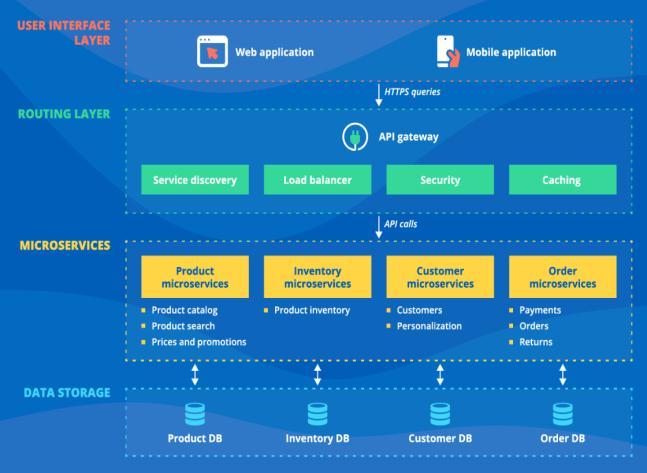
3.1.2 Typical Architectural Layers
Regardless of the overarching architectural style, B2C e-commerce platforms commonly follow a layered architectural pattern that separates system concerns into distinct logical tiers. The presentation layer handles user interfacesandinteractionlogic,typicallydeliveredviaweb browsersormobileapps.Beneaththisliestheapplication and business logic layer, where core processing such as order management, pricing rules, and shopping cart workflows isexecuted.Thefinaltier,thedatapersistence layer, encompasses databases and storage systems that manage product catalogs, customer profiles, transaction records,andotherdynamicdata.Thisseparationoflayers enhances maintainability and flexibility, as each layer can evolve independently and scale according to specific load demands. By isolating presentation, processing, and data management concerns, layered architectures support cleaner code organization and facilitate performance optimizationtechniquessuchascaching,loadbalancing,and asynchronousprocessing.
3.2 Design Patterns
3.2.1
Common Architectural Design Patterns
Architecturaldesignpatternsprovidereusablesolutionsto commonstructuralproblemsinsoftwaresystemsandguide howdevelopersorganizecode,managedependencies,and handle data flow. Among widely adopted patterns in e-commerce platforms are Model-View-Controller (MVC) and Model-View-ViewModel (MVVM), which promote separation of concerns between user interface logic and underlying data models, improving maintainability and testability.Additionally,event-drivenarchitecturesenable componentstocommunicateasynchronouslythroughevents ormessagequeues,whichcanenhanceresponsivenessand throughput in handling real-time user interactions or backgroundtasks.Service-orientedarchitecture(SOA)and itsmoregranularevolution,microservices,organizesystems into discrete services that interact via well-defined interfaces,promotingreuseandflexibilityacrosslarge-scale applications.Eachpatternoffersdistincttrade-offs:MVCand MVVM simplify UI development and state management, event-driven approaches improve system responsiveness but introduce complexity in consistency, and service-orientedpatternsbolstermodularityandscalability atthecostofincreasedoperationalcomplexity.
3.2.2 Comparison of Scalability, Maintainability, and Flexibility
When comparing architectural design patterns, distinct differences emerge regarding scalability, maintainability, and flexibility. Patterns like MVC and MVVM excel in structuring UI code and making front-end logic more manageable, which benefits teams focused on user experience. However, these patterns alone do not directly address scaling backend services under heavy traffic. In contrast, micro services and service-oriented patterns inherently support horizontal scalability by allowing individualservicestobescaledindependentlybasedonload, which is critical for e-commerce platforms during peak
International Research Journal of Engineering and Technology (IRJET) e-ISSN: 2395-0056
Volume: 13 Issue: 02 | Feb 2026 www.irjet.net p-ISSN: 2395-0072
shopping periods. Event-driven patterns further support scalability and responsiveness by enabling asynchronous processing and real-time event handling. From a maintainabilityperspective,looselycoupledservicescanbe updatedanddeployedindependently,reducingtheriskof system-wide outages. However, distributed systems also require robust monitoring and orchestration strategies to handledependenciesandcommunicationfailureseffectively. Overall, modern e-commerce platforms often combine multiplepatternstobalancescalability,maintainability,and flexibility.
3.3 Deployment Strategies
3.3.1
On-Premise vs. Cloud-Based Deployment
Deployment strategy significantly influences the performance and operational agility of B2C e-commerce platforms. On-premise deployment involves hosting the entire infrastructure within an organization’s data center. While providing full control over hardware and security policies,on-premisesetupsmaystruggletoscalequicklyin responsetotrafficsurgeswithoutsignificantinvestmentin physical resources. Conversely, cloud-based deployment leverages infrastructure-as-a-service (IaaS), platform-as-a-service(PaaS),andmanagedservicesoffered by cloud providers, enabling rapid scalability, global distribution, and cost-effective resource utilization. Cloud platforms support elastic scaling, where compute and storage resources can expand or contract automatically based on traffic demands, a critical capability for B2C platformsfacingunpredictableuserloads.
3.3.2 Containerization and Orchestration
for Performance
Tofurtherenhancedeploymentflexibilityandperformance, modern e-commerce platforms increasingly adopt containerization techniques using technologies such as DockerandorchestrationtoolslikeKubernetes.Containers encapsulateapplicationcomponentsandtheirdependencies intolightweight,portableunitsthatrunconsistentlyacross development, testing, and production environments. OrchestrationplatformslikeKubernetesmanagecontainer deployment,scaling,andresiliency,enablingautomatedload balancing,self-healing,andefficientresourceutilization.By combiningcontainerswithorchestrators,teamscanachieve rapidscaling,betterfaultisolation,andsimplifiedrolloutof newfeatureswithoutdowntime. Theseadvancementsare particularlyvaluableformicroservices-basedarchitectures, whereeachservicecanbedeployedasaseparatecontainer and scaled independently to optimize performance under varyingworkloads.
4. PERFORMANCE OPTIMIZATION IN B2C PLATFORMS
4.1 Key Performance Metrics
4.1.1 Latency, Throughput, Availability, and Response Time
Performance optimization in B2C e-commerce platforms revolves around measurable characteristics that directly affect user experience and operational efficiency. Latency referstothedelaybetweenauser’srequestandthesystem’s response; minimizing latency is crucial for retaining customer engagement, as even slight delays can increase abandonment rates. Throughput measures the number of transactionsoroperationsthesystemcanhandle perunit time,whichiscriticalduringpeakperiodssuchasholiday sales. Availability represents the proportion of time the platformremainsfunctionalandaccessible akeybusiness requirement for global online stores that operate 24/7. Finally,responsetimeistheactualtimeittakesthesystem to complete a user request, including processing and data retrieval.Together,thesemetricsprovideaholisticviewof howwellane-commerceplatformperformsundernormal and peak load conditions, and serve as benchmarks for evaluating optimization strategies (Chen et al., 2023; Li & Sun,2020).
4.2 Optimization Techniques
4.2.1 Caching Strategies, Database Optimization, and System Scaling
Todeliverhighperformance,e-commercesystemsrelyon multipleoptimizationtechniquestailoredtodifferentlayers ofthearchitecture.Cachingstrategiesplayasignificantrole in reducing latency by storing frequently accessed data in faststoragelayerssuchasin-memorycacheslikeRedisorat the edge using Content Delivery Networks (CDNs). By serving repeated requests without needing to query the underlying database, caching dramatically improves response times and reduces backend load (Kumar & Chinnaswamy,2019).
Databaseperformanceisanothercriticalfocus.Optimization techniquesincludeselectingappropriatedatamodels SQL vs.NoSQL basedonworkloadpatterns,andimplementing indexing and sharding to accelerate query execution and distribute data across servers to enhance scalability and fault tolerance. Additionally, load balancing distributes incomingtrafficacrossmultipleserverstoavoidbottlenecks andsupportshorizontalscaling,whereadditionalinstances handle increased demand. Techniques like asynchronous processingandmessagequeuesdecoupledependenttasks so that time-consuming operations can execute independently without blocking core request-response cycles,furtherboostingthroughputandresponsiveness.
International Research Journal of Engineering and Technology (IRJET) e-ISSN: 2395-0056
Volume: 13 Issue: 02 | Feb 2026 www.irjet.net p-ISSN: 2395-0072
4.3 Case Studies / Industry Examples
4.3.1 Lessons from High-Performance E-Commerce Platforms
Industry leaders in B2C e-commerce provide valuable real-worldexamplesofperformanceoptimizationinaction. Many high-traffic platforms employ a combination of the techniques discussed above extensive caching layers, distributed databases, elastic scaling, and asynchronous workflows tomaintainperformanceunderunpredictable loads.Forinstance,majorretailersoftenintegrateCDNsto serve static resources globally, leverage microservices architecturesforindependentscalingofcriticalservicessuch ascheckoutorsearch,andusesophisticatedmonitoringto identifyandmitigateperformancebottlenecksinrealtime. These practices demonstrate not just the theoretical effectiveness of optimization strategies, but also their practicalimplementationinproductionenvironmentswith millionsofusers.Lessonslearnedfromsuchdeployments highlight the importance of continuously monitoring performancemetrics,automatedscalingtomatchfluctuating demand,andtuninginfrastructurecomponentsinresponse torealusagepatterns.
5. SECURITY HARDENING IN B2C PLATFORMS
5.1 Threat Landscape
5.1.1
Common Attacks on B2C Platforms
B2C e-commerce platforms are prime targets for cyberattacksduetothesensitivenatureofdatatheyhandle, includingpaymentinformation,personalcustomerdetails, and transactional history. Common threats include SQL injection, whereattackers manipulate database queriesto access or modify data illicitly; cross-site scripting (XSS), whichexploitsvulnerabilitiesinwebapplicationstoexecute maliciousscriptsinusers’browsers;distributeddenial-ofservice(DDoS)attacks,whichoverwhelmserverstodisrupt services; and account takeover, where attackers gain unauthorizedaccesstouseraccountsviaphishing,credential stuffing,orweakpasswords(Almorsyetal.,2016;Hartono, 2014).Understandingthisthreatlandscapeisessentialfor designingeffectivesecuritymechanismsthatmitigaterisks withoutcompromisingplatformperformance.
5.2 Security Best Practices
5.2.1
Authentication, Authorization, and Encryption
Robustsecuritypracticesbeginwithproperauthentication and authorization frameworks. Protocols such as OAuth2 and JSON Web Tokens (JWT) ensure secure identity verificationandcontrolledaccesstoresources,minimizing the risk of unauthorized access. Complementing these measures,dataencryption bothatrest(storeddata)andin transit(dataexchangedovernetworks) protectssensitive information from interception or tampering. Effective
encryptionprotocols,whenpairedwithsecureAPIdesign, safeguardcommunicationsbetweenfront-endclients,backend services, and third-party integrations (Kumar & Chinnaswamy,2019).
5.2.2 Secure API Design and Monitoring
APIsformthebackboneofmoderne-commerceplatforms, connectingmicroservices,externalpaymentgateways,and clientapplications.SecureAPIdesigninvolvesimplementing ratelimiting,inputvalidation,token-basedauthentication, andstrictaccesscontrolstopreventexploitation.Inaddition, continuous monitoring and logging allow for real-time detection of suspicious activities, quick response to breaches, and detailed audit trails for compliance and forensicpurposes.Suchproactivemeasuresarecrucialfor early identification and mitigation of potential security incidents.
5.3 Advanced Security Measures
5.3.1
Firewalls, Intrusion Detection, and
AI-Driven
Threat Detection
Beyondfoundationalbestpractices,modernB2Cplatforms deploy advanced security measures to counter evolving threats.WebApplicationFirewalls(WAFs)filterandblock malicioustraffictargetingapplicationvulnerabilities,while intrusion detection systems (IDS) monitor network and systemactivitytoidentifyabnormalbehaviorindicativeof attacks. Increasingly, platforms are adopting AI-driven threat detection, which leverages machine learning algorithmstodetectsophisticatedorpreviouslyunknown attackpatterns,enablingrapid,automatedresponses.These advancedtechniquesenhancetheoverallsecurityposture, reduce reliance on manual intervention, and support continuousadaptationtoemergingcyberthreats(Chenget al.,2022;Almorsyetal.,2016).
6. LITERATURE REVIEW
6.1 Critical Summary of Key Research and Industry Contributions
6.1.1 Evolution of Architectural Paradigms in B2C E-Commerce
Over the past decade, research on B2C e-commerce architecturehasshiftedfromtraditional,monolithicsystems toward more modular and adaptive models such as microservices and serverless computing. Early studies focused on the challenges posed by monolithic systems, includingtightcoupling,limitedscalability,anddifficulties withcontinuousdeployment(Newman,2015).Inresponse, theacademicandindustrialcommunitieshaveincreasingly advocatedformicroservicesarchitectures,whichdecompose platformsintoindependentlydeployableservicestoimprove scalability and fault isolation (Dragoni et al., 2017). More recentworkexploresserverlessdesigns,wherefunctionsare
International Research Journal of Engineering and Technology (IRJET) e-ISSN: 2395-0056
Volume: 13 Issue: 02 | Feb 2026 www.irjet.net p-ISSN: 2395-0072
executed on-demand without servers being explicitly managedbydevelopers,reducingoperationaloverheadand enabling automatic scaling (Baldini et al., 2017). These evolutionary shifts highlight a broader trend toward architectures that can support rapid feature deployment, resilience under high traffic, and effective resource utilization,allessentialforlarge-scaleB2Cplatforms.
6.1.2 Performance Optimization Approaches and Their Trade-Offs
Performance optimization is a central concern in e-commerce research because user satisfaction and conversionratesarehighlysensitivetodelaysandservice interruptions.Studieshaveexaminedavarietyoftechniques, includingcachingmechanisms,loadbalancing,asynchronous processing, and distributed databases to sustain high throughputandlowlatency(Kumar&Chinnaswamy,2019; Chen et al., 2023). Caching, often implemented via in-memorystoresorCDNs,candramaticallyreducedatabase load and improve response times but may introduce consistencychallengeswhendataupdatesoccurfrequently. Load balancing and horizontal scaling enhance system availability and throughput by distributing traffic across multipleinstances;however,theyalsoincreaseoperational complexity in monitoring and state management. Asynchronous task processing, through message queues, improves responsiveness for non-critical operations but adds design complexity in ensuring reliable message handling. Collectively, these studies underscore that performance optimization involves navigating trade-offs between responsiveness, data consistency, and system complexity.
6.1.3
Research on Security Frameworks, Vulnerability Mitigation, and Compliance Standards
Securityresearchwithinthe B2Ce-commercedomainhas explored frameworks and practices designed to protect customerdata,preventunauthorizedaccess,andmaintain regulatorycompliance.Workinthisareaemphasizessecure authentication and authorization mechanisms, such as OAuth2andJWT,whichcontrolaccesstoplatformresources, as well as strong encryption both for data at rest and in transittopreventeavesdroppingandtampering(Kumar& Chinnaswamy, 2019). Research also covers secure design principles for APIs and web applications, including input validation,ratelimiting,anddefenseagainstcommonattacks suchasSQLinjectionandcross-sitescripting(Almorsyetal., 2016).Beyondfoundationaltechniques,advancedstrategies such as Web Application Firewalls, intrusion detection systems(IDS),andmachine-learning-basedthreatdetection systemshavebeenproposedtoenhancedetectionaccuracy andresponseautomation.Thesecontributionscollectively highlight the multi-layered nature of security, where preventivecontrolsmustbecomplementedbydetectionand responsecapabilities.
7. DISCUSSION
7.1 Integrative Insights from Reviewed Literature
7.1.1 Synthesizing Architectural, Performance, and Security Perspectives
The review of contemporary literature highlights that designing high-performing and secure B2C e-commerce platforms requires a holistic approach integrating architectural decisions, performance optimization techniques, and robust security measures. Architectural choices, such as microservices or serverless frameworks, directly influence the scalability and maintainability of platforms, while layered designs provide modularity that facilitatesbothperformancetuningandsecurityhardening (Dragoni et al., 2017; Baldini et al., 2017). Performancefocusedstrategies includingcaching,loadbalancing,and asynchronous processing enhance responsiveness and throughput, yet they must be carefully coordinated with security practices to avoid introducing vulnerabilities or datainconsistency(Kumar&Chinnaswamy,2019).Security frameworks, encompassing authentication protocols, encryption, and advanced threat detection, reinforce user trust but can impose overhead that affects latency or throughput if not optimally implemented (Almorsy et al., 2016). Collectively, these insights indicate that platform architectsmustconsiderinterdependenciesbetweensystem layers and operational goals rather than addressing performanceorsecurityinisolation.
7.2Synergies and Trade-Offs between Performance and Security
7.2.1 Balancing Conflicting Objectives
One of the key observations from the literature is the presence of trade-offs between performance and security. For example, extensive encryption and real-time threat detectionimprovedataconfidentialityandsystemresilience butcanincreaseprocessingtimeandresponselatency(Chen et al., 2023). Conversely, aggressive caching and asynchronous processing can accelerate transaction throughputbutmaycomplicatetheenforcementofaccess controlsorreal-timevalidation.Somestudiessuggestthat microservices architectures provide a favorable environment for balancing these objectives because each servicecanimplementtailoredsecuritymeasureswithout affecting the entire system’s responsiveness (Newman, 2015). Similarly, containerization and orchestration can isolate workloads, allowing secure components to coexist withhigh-throughputservices.Recognizingthesesynergies and trade-offs is essential for making informed design decisionsandachievingaperformance-secureequilibrium.
International Research Journal of Engineering and Technology (IRJET) e-ISSN: 2395-0056
Volume: 13 Issue: 02 | Feb 2026 www.irjet.net p-ISSN: 2395-0072