
International Research Journal of Engineering and Technology (IRJET) e-ISSN:2395-0056
Volume: 12 Issue: 03 | Mar 2025 www.irjet.net p-ISSN:2395-0072
International Research Journal of Engineering and Technology (IRJET) e-ISSN:2395-0056
Volume: 12 Issue: 03 | Mar 2025 www.irjet.net p-ISSN:2395-0072
1P.H.J. Venkatesh, 2Padmakar Maddala, 3Saikumar Amda
1Assistant Professor, Dept.of Mechanical Engineering, Vignan’s Institute of Information Technology, beside VSEZ, Duvvada, Visakhapatnam, A.P, India
2Assistant Professor, Dept.of Civil Engineering, Vignan’s Institute of Information Technology, beside VSEZ, Duvvada, Visakhapatnam, A.P, India
3Assistant Professor Department of Mechanical Engineering, JB Institute of Engineering and Technology (A), Hyderabad, Telangana, India JB Institute of Engineering and Technology (A) Hyderabad, Telangana state. India ***
Abstract: The Artificial Intelligence is revolutionizing the materials science arena, enabling the discovery, design, and optimization of innovative mechanical and bioinspired materials. This review consolidates insights from recent developments in AI-enabled methods to improve properties such as stiffness, strength, thermal performance, and durability of materials. This work focuses on diverse applications, including nanogenerator, Graphene-based electrodes, composites, metamaterials, and polymers, with an emphasis on how generative AI, deeplearning,andmachinelearningapproachesoptimize material configurations to enhance prediction accuracy and streamline manufacturing processes. It further demonstrates the ability of AI in reducing redundancies, minimizing defects, and improving material quality by integrating into additive manufacturing, metamaterials design, and electrochemical energy storage. The results underline the importance of AI in pushing innovations within these fields: sustainable polymers, advanced ceramics, and precision manufacturing rendering transformative solutions for challenges in materials engineering.
Keywords: Artificial Intelligence, Mechanical Materials Performance, Generative AI, Nano generators, Graphenebased, Electrodes, Additive Manufacturing, Metamaterials Design, Machine Learning; Electrochemical Energy Storage, Sustainable Polymers, Advanced Ceramics, Precision Manufacturing, Fault Prediction, Thermal PerformanceOptimization.
In recent years, materials science has experienced certain remarkable developments based on increasing integration with artificial intelligence techniques. In materialscience,AIhasshowntobeanessentialtoolfor the enhancement of mechanical and bioinspired materials; this is clearly evidenced through the recent studies of generation of new materials and optimization ofthepropertiesofmaterialsthroughAIapproaches[1]. In the domain of nanogenerator, AI has also played a
very important role in improving performance and applications, holding potential to revolutionize the technologies of energy harvesting [2]. Another AI application is in revolutionizing the design of supra molecular materials; this shows how it can spur innovationinafieldrangingfrommaterialschemistryto engineering [3]. The influence of AI goes further in the prediction and optimization of mechanical properties in composite materials. For instance, interpretable deep learningmodelshavebeenappliedtoexploretheeffects ofparticulatereinforcementsinmetalmatrixcomposites [4], while AI-enhanced models for fault prediction have been used in improving industrial processes, mainly when dealing with incomplete data [5]. Lastly, the contribution of AI in heat transfer enhancement and optimization techniques is an area that keeps on progressing and has really contributed much toward efficiency and effectiveness in thermal management systems [6]. With the development of automation and robotics, the AI-assisted method is increasingly applied in the improvement of machining process, especially in lightweightmaterialfabrication[7].Inthisregard,oneof the most promising areas is the design of architectured materials, where hybrid approaches using AI are adoptedto create materials withimprovedstiffnessand strength, therefore showing the potential of AI in datadrivendesign[8][16].Furthermore,theapplicationofAI in optimizing performance of polymeric meta-hybrid structures is a typical example of its usefulness in optimizing auxetic behavior for advanced engineering applications [9] [26]. Application of AI is also gaining huge momentum in additive manufacturing, where hybrid statistical approaches are used to optimize the processes to enhance product quality and raise the efficiency of production [10]. The ability of Quantam AI applications is further extending this capability of materials design, ushering in new waves of innovations by integrating quantum computing and artificial intelligence [11]. The AI-based sensitivity analysis methods in material selection will provide improved decisionprocessesforthecompositematerialsdesignin which AI has started playing a central role in multi-
International Research Journal of Engineering and Technology (IRJET) e-ISSN:2395-0056
criteria decision scenarios [12] [14].In the fastdevelopingfield,theroleofAIinhuman-AIcollaboration for problem-solving is becoming increasingly important, as illustrated by the research into how AI attributes affect trust, workload, and performance in classification tasks [13] [18]. Another very good example is using Graphene-based electrodes in triboelectric nanogenerator to improve the material properties for energy-harvesting applications [14]. These developmentshavebroughtaprofoundimpactthatAIis having on the design and optimization of materials and further accelerates the shift toward more efficient, sustainable, and high-performing materials across a varietyofindustries[2][5][8][12][19][26][35]
Badini,S.,Regondi,S.,&Pugliese,R.(2025):Theworkby Badinietal.providesadetailedintegrationofgenerative AI in the development of advanced materials. Their research is oriented toward developing materials with enhanced mechanical properties by using techniques inspired by nature and bioinspired features through AI. The leading paper sheds light on the transformative potential of AI in material property optimization and opensnewroutestosustainableandfunctional material design.TheypresentAI-drivenmethodstoovercomethe barriers in the conventional material design process. Application of generative AI is also viewed to accelerate the discovery and application of new materials. Their work may have huge implications in the field of aerospace,automotive,andbiomedicalengineering.
Xu,S.,Manshaii,F.,Xiao,X.,&Chen,J.(2025):Xuetal.has presented an overview of artificial intelligence applications in nanogenerator technology and the cooperation between AI and energy-harvesting materials. They speak of how AI will optimize the performance of nano generators in developing better design, material selection, and system integration. Their research demonstrates that AI techniques, including machine learning, can predict the behavior of nano generators in a way that increases their efficiency in convertingenergy.Theyfurtherpointouttheprospectof AI-assisted development of multifunctional nano generators in wide applications, from wearable electronics to environmental monitoring. Such a methodology can realize tremendous new gains in designingnext-generationenergy-harvestingdevices.
Zhu, H., Wang, Z., Li, L., Dong, L., Li, Y., Xue, B., & Cao, Y. (2025): Zhu et al. have now used this concept for supramolecular materials design in one of the most advanced fields of materials science. Their research focuses on how AI can revolutionize the design of materials by predicting the interactions at a molecular level to enhance the creation of complex functional
Volume: 12 Issue: 03 | Mar 2025 www.irjet.net p-ISSN:2395-0072 © 2025, IRJET | Impact Factor
materials.TheauthorsgoontonotethatAIwilloptimize self-assembly processes, hence creating novel materials with unique properties. The work shows tremendous potential in applications in drug delivery and sensors, amongotheradvancedtechnologies.TheirresultsputAI as transformative in materials discovery and able to accelerate the development of high-performance, adaptivematerials.
Chai,X.,Su,Y.,Lin,Z.,Qiu,C.,Liu,X.,Zhang,X.,&Zhang,D. (2025): Chai et al. proposed an interpretable deep learning approach for the prediction of mechanical properties and exploration of configuration effects of particulate-reinforced metal matrix composites. Combining AI approaches to the understanding and optimization of the interaction among different compositecomponentscanimprovematerialproperties. Thisstudyappliesmachinelearningforthepredictionof complex material behavior underdifferentconditionsof stress. Their method is more precise and computationally efficient compared to traditional modeling techniques. The deep learning model is of course proposed to aid in designing high-performance composites used in the aeronautic and automotive industriesandmanufacturing.
Shao, X., Cai, B., Zou, Z., Shao, H., Yang, C., & Liu, Y. (2025): Shao et al. discuss AI-enhanced fault prediction inindustrialsystemswithincompleteinformation. Their work demonstrates how, especially machine learningbased AI models, fault detection and prediction can be carried out on machines and systems even in cases where data is incomplete or missing. This paper brings out the role of AI in improving the reliability of predictive maintenance. Their approach ensures the reduction in possible fault detection inaccuracies due to information gaps and decreases downtime and overall costs of maintenance. The work will find a place in especially complex and critical systems of industry, includingmanufacturing,transportation,andenergy.
Kumar,A., Awasthi,M. K.,Dutt,N.,& Singh,V. P.(2025): The review work by Kumar et al. looks at recent achievements in heat transfer enhancement techniques and gives special consideration to the optimization of thermal performancebyusingAI.Theydiscussdifferent AI-based approaches for the improvement of heat transfer efficiency in industrial applications, including heat exchangers and thermal management systems. Their review underlines how AI models can be used to predict heat transfer behaviors and suggest design modifications for better performance. The paper also investigatestheapplicationofAIinreal-timemonitoring and optimization of thermal processes. Such research is of the essence in various industries including power generation, automotive, and electronics, which depend onheatmanagement.
International Research Journal of Engineering and Technology (IRJET) e-ISSN:2395-0056
Volume: 12 Issue: 03 | Mar 2025 www.irjet.net p-ISSN:2395-0072
Pedrosa, A. F., Sebbe, N. P., Silva, F. J., Campilho, R. D., Sales-Contini, R. C., Costa, R. D., & Sánchez, I. I. (2025): Pedroso et al. review recent developments related to robot-assisted compensation methods applied to machining of lightweight materials, highlighting how robotic systems, when integrated with AI technologies, are able to improve the precision and efficiency of the machining process. They discuss the application of AI in compensating for the intrinsic difficulties in machining materials like composites and lightweight metals. The research will contribute to a reduction in defects and improvement in product quality for industries such as aerospace and automotive. The paper also gives future trends in robotics and AI for advanced manufacturing systems.
Yeo, J., Cheung, S., Gu, X. W., & Ryu, S. (2025): Yeo et al. discuss hybrid TPMS-based architectured materials for enhanced specific stiffness by using data-driven design approaches.TheyshowhowAIalgorithmscanbeusedin optimizing the geometrical configuration of materials to obtain superior mechanical properties such as stiffness and strength. The authors present a data-driven design framework that integrates artificial intelligence with topology optimization methods for material development.Thishascritical implicationsinthedesign of lightweight, high-performance materials used in structural applications in aerospace and automotive industries. More efficient and better-tailored material solutions will be possible when AI is fully integrated in thedesignprocess.
Zhou,X.,Leng,Y.,Dutta,A.K.,Juraev,N.,Alkhayyat,A.,& Elmasry, Y. (2025): Zhou et al. discuss machinelearning techniques that can be applied for the analysis and optimization of the auxetic performance of a polymeric meta-hybrid structure combining re-entrant with metatrichiral configurations. Their work will present how AI can model and predict complex structures showing auxeticproperties,wherethesematerialsarethatwhich expand when stretched. In this line, the work is presenting a new method for improving properties in materials about energy absorption and resistance to impact. Their findings are applicable within protective materials, medical devices, and aerospace engineering applications. The paper exemplifies the role of AI in material performance optimization by way of structural design.
Dev, S., & Srivastava, R. (2025): Dev and Srivastava presented some work in this area of additive manufacturing process optimization using AI-based hybrid statistical approaches. Their work shows how AI techniques may bring about more efficiency and precisioninadditivemanufacturing,suchas3Dprinting, by analysis and optimization of process parameters. Combining machine learning with statistical methods will enable the researchers to possibly alleviate issues
around material waste, production time, and part quality.Indeed,theirworkdoesprovidesomuchinsight into how to improve the sustainability and performance of additive manufacturing in aero, auto, healthcare, and otherindustries.Thekeytoachievinghighqualityatlow costs in production lies in integrating AI within its processes.
D.Chauhan,P.Ranka,P.Bahad,andR.Pathak,2025:This systematicreview addressestheintegration of quantum artificial intelligence (QAI) with its applications in solving complex problems across various domains, including semiconductor technology. Quantum computing can enhance AI models, especially for tasks that demand heavy computation. This might give a general view of how QAI has branched out into areas such as material science, cryptography, and machine learning. Quantum algorithms can be used to enhance the ability of AI systems to accomplish tasks in a more efficient way than classical computing. Challenges in implementation also arise due to hardware constraints and the development of specific algorithms in QAI. The authors conclude with a discussion on the future directions for the development and integration of QAI systems.
J. Więckowski and W. Sałabun, 2025: The following paper applies sensitivity analysis techniques, particularly the One-at-a-Time (OAT) and COMSAM methods, in a multi-criteria decision-making process for composite material selection. The methods are compared with each other, considering their capability of evaluating material properties and performance under different conditions. The study compares the accuracyandcredibilityoftheresultsfromeachmethod, henceservingvaluableinsightintomaterialselectionfor engineering applications. The paper provides practical recommendations for researchers and engineers using the methods in the processes of material selection. Sensitivityanalysisisoneof themost importantaspects in the optimization of composite material selection based on requirements of strength, durability, and environmental impact. The findings contribute to the understanding of decision-making techniques in the contextofengineeringmaterials.
The study's research methodology will focus on using artificial intelligence techniques to elevate the performance of mechanical materials by centering on design optimization, fault prediction, and efficiency improvement. In the present work, the AI approach will be utilized, including machine learning algorithms and data-driven design methods for optimizing material properties and improving the process of designing materials. This integration includes the recent
International Research Journal of Engineering and Technology (IRJET) e-ISSN:2395-0056
Volume: 12 Issue: 03 | Mar 2025 www.irjet.net
applications of AI-assisted nanogenerator [2] AI-based fault prediction models [5] and AI-enhanced manufacturing process [18], enabling the prediction of material behavior to increase material performance and reducedefectsduringmanufacturing.Thestudywillalso address how quantum artificial intelligence can be applied in advanced material discovery [11] and machine intelligence in metamaterials design [21] in ordertoraisematerialstrengthandfunctionality.Also,it will consider AI-driven optimization methods for nano materials and composites [3] [8] with a focus on how they enable the improvement of mechanical properties in materials. It will also discuss the integration of deep learning models for material configuration and
p-ISSN:2395-0072
prediction of properties [4]. The approach then aims to bring together breakthroughs in AI for the different fields to drive leading edges in material performance, with a focus on mechanical materials applied in engineeringandmanufacturingindustries.
International Research Journal of Engineering and Technology (IRJET) e-ISSN:2395-0056
Volume: 12 Issue: 03 | Mar 2025 www.irjet.net
The following table summarizes the different ways of enhancing mechanical materials performance with artificial intelligence, as shown in recent research. For instance, using generative AI in materials design in this case, bioinspired material design improves the mechanical properties by many times through simulations and optimization of material structures [1]. Improvement in the energy conversion capability of AIassistednanogeneratorsisbyusingAIinenhancingthe design and optimization of nano materials [2]. In the fieldofsupramolecularmaterials,AIassistsindesigning new compounds by predicting and enhancing molecular interactions, which improves the properties of the material [3]. Furthermore, deep learning methods are applied in composite materials, such as particulatereinforced metal matrix composites, to predict and improve their mechanical properties, providing knowledgeonconfiguration effects[4].Itisalsoofwide application in fault prediction for industrial systems, realizing predictive maintenance and ensuring the reliability of mechanical systems through handling incomplete data [5]. In heat transfer enhancement, AIbased techniques optimize the thermal performance of systems like heat exchangers and fluid systems for efficient energy transfer [6]. In lightweight material robot-assisted machining, AI is applied to improve the quality of material processing and the accuracy and efficiency of the machining operation [7]. In a similar way, data-driven design approaches, such as hybrid
p-ISSN:2395-0072
TPMS-basedmaterialsdesign,makeuseofAItoenhance the stiffness and structural performance of architected materials[8].Machinelearning,whenappliedtoauxetic structures, was found to optimize the performance of polymeric materials in meta-hybrid configurations and resulted in improved mechanical characteristics [9]. Optimization of 3D printing processes has been carried out using AI techniques, resulting in fabricated parts with better material properties [10]. Most recently, quantum AI became the powerful tool in material discovery and particularly for semiconductor materials to identify new materials with excellent properties [11].AI also contributes to composite material selection using various techniques, such as sensitivity analysis, to increase the efficiency of decision-making within multicriteria material selection [12]. In human-AI collaboration,theattributes ofAIbecomeprominentfor solving classification problems for better accuracy and performance in decision-making [13]. Optimization of Graphene-based electrodes in triboelectric nano generators is performed via AI for improved energy harvesting[14],whereasAI-drivenmetamaterialsdesign makesarevolutionincreatinginnovativematerialswith uniquepropertiesforavarietyofapplications[15].More generally,AIisrevolutionizingdesign, optimization,and performance of diverse materials, which may impact advances in energy conversion, manufacturing, and structuralintegrityinagreatmanyapplications.
2: Real-timeexamplesfocusonAIapproachestoenhancingmechanicalmaterialsperformance
The table gives a general idea of how artificial intelligence is being used to improve the mechanical performance of materials in different industries. For instance, AI-assisted design methods, including machine learning-based optimization, have been applied in designing nano generators for energy harvesting, as indicated in reference [2]. Moreover, AI-driven composite material selection using multi-criteria decision methods, such as OAT and COMSAM, is becoming very significant in industries like aerospace and automotive, as brought out in reference [12], in the selection of appropriate materials for lightweight structures. Predictive analytics and deep learning are beingusedtoimprovefaultpredictioninmanufacturing processes. Reference [5] shows the application of AI in predicting equipment failure, optimization of maintenancescheduling,anddowntimereductionwithin such industries as automotive manufacturing. Similarly, Reference [14] shows AI-optimized Graphene-based electrodes revolutionizing the efficiency of triboelectric nano generators and improving performances in energy conversion systems. Machine learning is now being applied to the design of materials, in electrochemical energystorage,tooptimizethesematerialsforimproved efficiency in a battery, as, for example, in reference [16] of this article.AI greatly assists in material discovery. It designs high-performance alloys and polymers using data-driven models for improved mechanical properties for instance, by using data-driven design models to enhancemechanicalproperties;seereference[8].AIalso contributes to the very important field of quantum computing by predicting material properties for nextgeneration electronics, discussed in reference [11] [19] Deep learning models in manufacturing are used to improve process efficiency and reduce defect rates, as
discussed in reference [18]. Hybrid AI-statistical models in additive manufacturing, 3D printing, optimize material deposition and increase the strength of a component,notedin[10].Moreover,theroleofAIinthe design of hybrid materials for construction, such as reinforced concrete, is finding inroads; for instance, reference [22] shows its application in enhancing the strength and durability of concrete. In aerospace and defense, AI can lift the design of metamaterials to new heights by predicting material properties, as noted in reference[21].Finally,roboticmachining,aidedbyAI,is optimizing the manufacturing of lightweight materials, helping to achieve higher precision and efficiency in processes, as detailed in reference [7]. Generally, the above examples show that AI is going to revolutionize material science due to better mechanical performance, an enhanced design process, and optimization of productionmethodsinvariousindustries.
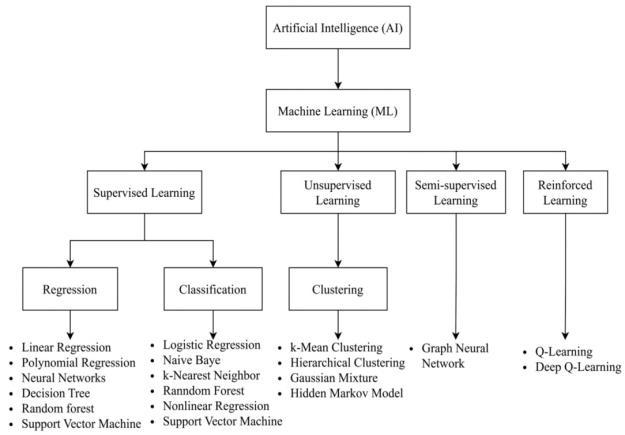
International Research Journal of Engineering and Technology (IRJET) e-ISSN:2395-0056
Volume: 12 Issue: 03 | Mar 2025 www.irjet.net p-ISSN:2395-0072
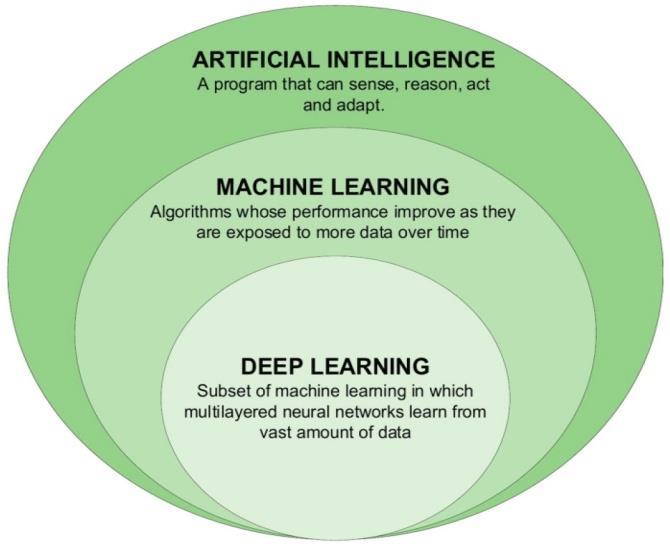
Fig 2: Therelationshipbetweenartificialintelligence, machinelearning,anddeeplearning[23]
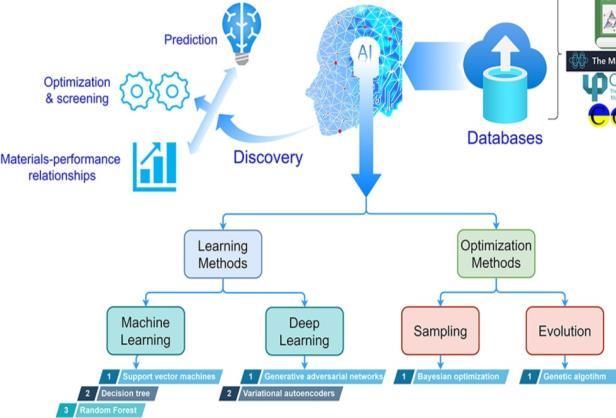
Fig 3: PredictionMethodsofartificial-intelligence[24]
New AI Approaches in for Enhancing Mechanical MaterialsPerformance[8][9][12][23][24][18]
1.AI-DrivenMaterialsDiscovery
2.PredictiveModelingforMaterialBehavior
3.OptimizationofMaterialMicrostructures
4.AI-EnhancedAdditiveManufacturing(3DPrinting)
5.Self-HealingandAdaptiveMaterials
6.AIinFatigueandFailureAnalysis
PredictiveMaintenance:AImodelspredict
7.Data-DrivenAlloyDesign
8.SustainableMaterialsthroughAI
9.DigitalTwinMaterialPerformance
10.CollaborativeAI-ExperimentalPlatforms
The integration of artificial intelligence into the domain of material science has, so far, shown unprecedented promise in the enhancement of mechanical material performance within different fields. AI-driven methodologies,suchasgenerativeAI,deeplearning,and machine learning, significantly improved the prediction
accuracy of various material properties including stiffness, strength, thermal performance, and durability. Suchapproacheshaveledtotheoptimizationofmaterial configurations that have led to advanced materials such as Graphene-based electrodes, high-performance composites, and bioinspired metamaterials. AI has also smoothed out manufacturing by reducing redundancies, minimizing defects, and generally improving the quality ofmaterialsinprocessessuchasadditivemanufacturing and electrochemical energy storage systems. Further, AI has enabled the design of sustainable polymers and advanced ceramics transformative solutions to some of the long-standing challenges in materials engineering. The ability of AI to accelerate the process of discovery and optimization in materials not only improves their performance but also reduces their development time and costs opening a path to novel applications in precisionmanufacturingandfarbeyond.
ThefutureofAIinmaterialssciencehasyettobehugely effective for Materials Science. The development in at least a couple of directions the evolution of more powerful, interpretable models for difficult multi scale materialssystemsandintegrationintoexperimentaland computational data, where AI is promising to reside at the core of material property knowledge. Advanced characterization techniques are still in their infancy and present many challenges. One more under-explored frontieristheapplicationofAIindesigningmaterialsfor extreme environments, like high-temperature or highpressure conditions. The combination of AI with quantum computing mayfurtherincreasethepredictive capabilitytodiscovernewmaterialswithunprecedented properties. Another promising direction is the use of AI for optimizing circular economy practices such as recycling and up cycling of materials toward a sustainable environment. Collaboration among AI researchers, materials scientists, and industry stakeholders will be a critical ingredient to overcoming such challenges and to driving innovations that may redefine the boundaries of performance and functionalityofmaterials.
Artificial intelligence has brought great improvement to the fields of materials science and engineering in the design, optimization, and application of new materials. From AI-driven methods in nanogenerators and metamaterials to machine-learning-based predictive modeling in composite materials, these innovational concepts are revolutionizing the traditional methodologiesinhowtheyenhanceefficiency,accuracy, and performance. AI has enabled the discovery of new materials, optimization of mechanical properties, and
International Research Journal of Engineering and Technology (IRJET) e-ISSN:2395-0056
Volume: 12 Issue: 03 | Mar 2025 www.irjet.net p-ISSN:2395-0072
automation of manufacturing toward sustainable highperformance solutions for industries. That cooperation between AI and materials science just keeps growing, with fast-evolving applications in, among others, energy storage, additive manufacturing, and structural optimization. With AI tools becoming much more sophisticated, application in materials development will continue to spur innovation, improved mechanical properties, energy efficiency, and sustainable alternatives. Tackling challenges around AI interpretability, data availability, and computational complexity, this potential in full needs to be unleashed by the emerging techniques for applications in material scienceandengineering.
1. Badini, S., Regondi, S., & Pugliese, R. (2025). Enhancing mechanical and bioinspired materials throughgenerativeAIapproaches.NextMaterials,6, 100275.
2. Nagarjuna Reddy Aturi, "Cognitive Behavioral Therapy(CBT)DeliveredviaAIandRobotics,"Int.J. Sci. Res. (IJSR), vol. 12, no. 2, pp. 1773–1777, Feb. 2023,doi:10.21275/SR230313144412.
3. Xu, S., Manshaii, F., Xiao, X., & Chen, J. (2025). Artificial intelligence assisted nanogenerator applications.JournalofMaterialsChemistryA,13(2), 832-854.
4. Zhu,H.,Wang,Z.,Li,L.,Dong,L.,Li,Y.,Xue,B.,&Cao, Y.(2025).Revolutionizingsupramolecularmaterials design with artificial intelligence. Supra molecular Materials,4,100090.
5. Nagarjuna Reddy Aturi, "Navigating Legal and Regulatory Challenges for Global Non-Profit Ethical LeadershipandGovernance -LeveragingGenerative AI for Strategic Planning," Int. J. Sci. Res. (IJSR), vol. 13, no. 8, pp. 1863–1867, Aug. 2024, doi: 10.21275/SR240806112349.
6. Chai, X., Su, Y., Lin, Z., Qiu, C., Liu, X., Zhang, X., & Zhang, D. (2025). Mechanical property prediction and configuration effect exploration of particulate reinforced metal matrix composites via an interpretable deep learning approach.Materials ScienceandEngineering:A,147880.
7. Shao, X., Cai, B., Zou, Z., Shao, H., Yang, C., & Liu, Y. (2025). Artificial intelligence enhanced fault prediction with industrial incomplete information.Mechanical Systems and Signal Processing,224,112063.
8. Nagarjuna Reddy Aturi, "Psychophysiology of Human-Computer Interaction (HCI) and the Role of HapticFeedbackinEmotionalRegulation,"Int.J.Sci. Res.(IJSR),vol.12,no.8,pp.2566–2570,Aug.2023, doi:10.21275/SR230811144545.
9. Kumar, A., Awasthi, M. K., Dutt, N., & Singh, V. P. (2025). Recent Innovation in Heat Transfer Enhancement Techniques. Heat Transfer Enhancement Techniques: Thermal Performance, OptimizationandApplications,1-38.
10. Pedroso,A.F.,Sebbe,N.P.,Silva,F.J.,Campilho,R.D., Sales-Contini, R. C., Costa, R. D., & Sánchez, I. I. (2025). An overview on the recent advances in robot-assisted compensation methods used in machining lightweight materials.Robotics and Computer-IntegratedManufacturing,91,102844.
11. Yeo,J.,Cheung,S.,Gu,X.W.,&Ryu,S.(2025).Hybrid TPMS-based architectured materials (HTAM) for enhanced specific stiffness using data-driven design.Materials&design,249,113523.
12. Nagarjuna Reddy Aturi, "Leadership and Governance: Overcoming Legal and Policy Challenges-TheRoleofDataandAnalyticsinGlobal Non-ProfitCampaigns,"Int.J.Sci.Res.(IJSR),vol.13, no. 9, pp. 1719–1723, Sep. 2024, doi: 10.21275/SR240902113351.
13. Zhou, X., Leng, Y., Dutta, A. K., Juraev, N., Alkhayyat, A., & Elmasry, Y. (2025). Machine learning analysis/optimization of auxetic performance of a polymeric meta-hybrid structure of re-entrant and meta-trichiral.European Journal of MechanicsA/Solids,109,105463.
14. Nagarjuna Reddy Aturi, "A Triadic Approach: The Role of Gut Health and Micro biome in Suicidal Tendencies - Combining Yoga, Nutritional Therapy, and Cognitive Behavioral Therapy," Int. J. Sci. Res. (IJSR),vol.13, no.8, pp. 1858–1862,Aug.2024,doi: 10.21275/SR240801114551.
15. Dev, S., & Srivastava, R. (2025). Experimental investigation and optimization of the additive manufacturing process through AI-based hybrid statistical approaches.Progress in Additive Manufacturing,10(1),107-126.
16. Nagarjuna Reddy Aturi, "Integrative Yoga and PsychoneuroimmunologyforPost-SurgeryRecovery - A Complementary Therapy in Post-Surgical PTSD," Appl. Med. Res., vol. 10, no. 2, pp. 1–6, 2023, doi: 10.47363/AMR/2023(10)25.
International Research Journal of Engineering and Technology (IRJET) e-ISSN:2395-0056
17. Chauhan, D., Ranka, P., Bahad, P., & Pathak, R. (2025). Applications of Quantum Artificial Intelligence: A Systematic Review.Integration of AI, Quantum Computing, and Semiconductor Technology,159-182.
18. Nagarjuna Reddy Aturi, "Cross-Disciplinary Models for Genomic Analysis of Yoga and Ayurvedic Interventions," Int. J. Sci. Res. (IJSR), vol. 13, no. 7, pp. 1620–1624, Jul. 2024, doi: 10.21275/SR24071144722.
19. Nagarjuna Reddy Aturi, "Longitudinal Study of Holistic Health Interventions in Schools: Integrating Yogic Practices, Diet, and Micro biome Testing," Int. J. Sci. Res. (IJSR), vol. 13, no. 9, pp. 1724–1728, Sep. 2024,doi:10.21275/SR241016121029.
20. Więckowski, J., & Sałabun, W. (2025). Comparative sensitivity analysis in composite material selection: evaluating OAT and COMSAM methods in multicriteria decision-making.Spectrum of Mechanical EngineeringandOperationalResearch,2(1),1-12.
21. Lotfalian Saremi, M., Ziv, I., Asan, O., & Bayrak, A. E. (2025). Trust, Workload, and Performance in Human–Artificial Intelligence Partnering: The Role of Artificial Intelligence Attributes in Solving Classification Problems.Journal of Mechanical Design,147(1).
22. Xie,B.,Guo,Y.,Chen,Y.,Zhang,H.,Xiao,J.,Hou,M.,... & Wong, C. (2025). Advances in graphene-based electrode for triboelectric nanogenerator.NanoMicroLetters,17(1),17.
23. Song, J., Lee, J., Kim, N., & Min, K. (2024). Artificial intelligence in the design of innovative metamaterials: A comprehensive review.International Journal of Precision EngineeringandManufacturing,25(1),225-244.
24. Liu, X., Fan, K., Huang, X., Ge, J., Liu, Y., & Kang, H. (2024). Recent advances in artificial intelligence boosting materials design for electrochemical energy storage.Chemical Engineering Journal, 151625.
25. Bello, I. T., Taiwo, R., Esan, O. C., Adegoke, A. H., Ijaola, A. O., Li, Z., ... & Ni, M. (2024). AI-enabled materials discovery for advanced ceramic electrochemicalcells.EnergyandAI,15,100317.
26. Nagarjuna Reddy Aturi, "Ayurvedic Culinary Practices and Microbiome Health: Aligning Ayurvedic Eating Practices with Chrononutrition," Int. J. Sci. Res. (IJSR), vol. 11, no. 6, pp. 2049–2053, Jun.2022,doi:10.21275/SR22066144213.
Volume: 12 Issue: 03 | Mar 2025 www.irjet.net p-ISSN:2395-0072 © 2025, IRJET | Impact Factor value: 8.315 | ISO 9001:2008
27. Chukwunweike, J., Anang, A. N., Adeniran, A. A., & Dike, J. (2024). Enhancing manufacturing efficiency and quality through automation and deep learning: addressing redundancy, defects, vibration analysis, and material strength optimization Vol. 23.World Journal of Advanced Research and Reviews. GSC OnlinePress
28. Tran,H.,Gurnani,R.,Kim,C.,Pilania,G.,Kwon,H.K., Lively, R. P., & Ramprasad, R. (2024). Design of functional and sustainable polymers assisted by artificial intelligence.Nature Reviews Materials, 121.
29. Olu-lawal,K.A.,Olajiga,O.K.,Adeleke,A.K.,Ani,E.C., & Montero, D. J. P. (2024). Innovative material processingtechniquesin precisionmanufacturing:a review.International Journal of Applied Research in SocialSciences,6(3),279-291.
30. Cerniauskas,G.,Sadia,H.,&Alam,P.(2024).Machine intelligence in metamaterials design: a review.Oxford Open Materials Science,4(1), itae001.
31. Zhu, F., Wu, X., Lu, Y., & Huang, J. (2024). Strength estimation and feature interaction of carbon nanotubes-modified concrete using artificial intelligence-based boosting ensembles.Buildings,14(1),134.
32. Kibrete, F., Trzepieciński, T., Gebremedhen, H. S., & Woldemichael, D. E. (2023). Artificial Intelligence in Predicting Mechanical Properties of Composite Materials.JournalofCompositesScience,7(9),364.
33. Idris Temitope Bello, Ridwan Taiwo, Oladapo Christopher Esan, Adesola Habeeb Adegoke, Ahmed Olanrewaju Ijaola, Zheng Li, Siyuan Zhao, Chen Wang,ZongpingShao,MengNi,
34. AI-enabled materials discovery for advanced ceramic electrochemical cells, Energy and AI, Volume15,2024,100317,ISSN2666-5468
35. Nagarjuna Reddy Aturi, "AI-Driven Analysis of Integrative Approaches to Genetic Predispositions and Ayurvedic Treatments Related to Mental Health," Int.J.Fundam.Med. Res.(IJFMR),vol.6,no. 1, pp. 1–5, Jan.–Feb. 2024, doi: 10.36948/ijfmr. 2024.v06i01.8541.