
International Research Journal of Engineering and Technology (IRJET) e-ISSN: 2395-0056
Volume: 13 Issue: 02 | Feb 2026 www.irjet.net p-ISSN: 2395-0072
International Research Journal of Engineering and Technology (IRJET) e-ISSN: 2395-0056
Volume: 13 Issue: 02 | Feb 2026 www.irjet.net p-ISSN: 2395-0072
Abhay
Singh1 , Mrs.
Arifa Khan
2
1Master of Technology, Computer Science and Engineering, Lucknow Institute of Technology, Lucknow, India 2Assistant Professor, Department of Computer Science and Engineering, Lucknow Institute of Technology, Lucknow, India ***
Abstract - The rapid proliferation of streaming data in cloud-centricenvironmentshasintensifiedtheneedforrobust machine learning (ML) models capable of adapting to nonstationary data distributions. In dynamic data streams, conceptdrift definedaschangesinthestatisticalproperties of the target variable or feature space over time can significantly degrade model performance. Traditional static retraining schedules are often inefficient, leading either to unnecessary computational overhead or delayed adaptation. Consequently,adaptivemodelretrainingtriggermechanisms driven by concept drift quantification have emerged as a critical research area.
This review systematically examines existing approaches for detecting and quantifying concept drift within streaming cloud data pipelines and analyzes how these quantification strategies inform adaptive retraining decisions. The study categorizesdriftdetectiontechniquesintostatistical,windowbased,distribution-based,andensemble-drivenmethods,and evaluates their applicability in cloud-native streaming architectures. Furthermore, it synthesizes retraining trigger mechanisms,includingthreshold-based,performance-driven, and hybrid frameworks, highlighting their computational trade-offs and scalability considerations. By identifying methodological trends, practical deployment challenges, and research gaps, this review provides a structured understanding of adaptive retraining strategies and outlines future research directions for resilient, cost-aware, and scalable ML systems in real-time cloud environments.
Key Words: Concept Drift; Adaptive Retraining; Streaming Data Pipelines; Drift Quantification; Cloud Computing; Online Machine Learning
Theproliferationoflarge-scale,high-velocitydatastreams hasfundamentallytransformedhowmachinelearning(ML) modelsaredeployedandmaintained.Moderncloud-native infrastructuresenablereal-timeingestion,processing,and analysisofstreamingdataacrossdistributedenvironments. However, the non-stationary nature of streaming data introducessignificantchallengestomaintainingpredictive reliability. This section contextualizes the emergence of adaptiveretrainingtriggermechanismsdrivenbyconcept
driftquantificationandoutlinestheobjectivesandscopeof thisreview.
1.1.1
Streamingdatasystemsaredesignedtoprocesscontinuous, unboundeddataflowswithlowlatencyandhighthroughput. Distributed frameworks such as Apache Kafka, Apache Spark, and Apache Flink enable scalable event-driven architectures within cloud environments. These systems leverageelasticresourceprovisioning,containerization,and micro services to handle fluctuating workloads efficiently (Krepsetal.,2011;Zahariaetal.,2016).
Cloud integration enhances fault tolerance, horizontal scalability,andcostoptimizationbydecouplingstorageand computation layers. Server less and managed streaming services further reduce operational overhead while supporting continuous ML inference pipelines. As organizations increasingly rely on real-time analytics for fraud detection, recommendation engines, and IoT monitoring,streamingMLmodelshavebecomeintegralto cloud-nativearchitectures(Carboneetal.,2015).
Real-timedecisionsystemsdependonMLmodelscapableof producing rapid and accurate predictions from streaming inputs. Applications such as credit risk scoring, predictive maintenance,cybersecuritythreatdetection,anddynamic pricing require low-latency inference pipelines. Unlike batch-learning environments, streaming contexts demand continuousadaptationtoevolvingdatadistributions.
Onlineandincrementallearningalgorithmsenablemodels to update parameters progressively as new data arrives (Gamaetal.,2014).However,whendeployedinproduction, many ML systems rely on static models retrained periodically, which may lead to performance degradation under distributional shifts. Maintaining model validity in dynamic environments therefore requires systematic monitoringandadaptiveretrainingstrategies.
International Research Journal of Engineering and Technology (IRJET) e-ISSN: 2395-0056
Volume: 13 Issue: 02 | Feb 2026 www.irjet.net p-ISSN: 2395-0072
1.2.1
Concept drift refers to changes in the joint probability distribution P(X,Y)P(X, Y)P(X,Y) over time, where XXX representsinputfeaturesandYYYthetargetvariable.Such drift may manifest as sudden, gradual, incremental, or recurring shifts, each affecting model generalization differently(WidmerandKubat,1996).
Driftdetectionmechanismshavebeenextensivelystudied, including error-rate monitoring approaches such as Drift DetectionMethod(DDM)andEarlyDriftDetectionMethod (EDDM), as well as adaptive windowing techniques like ADWIN (Bifet and Gavaldà, 2007). Statistical divergence measures and sequential hypothesis testing methods are also employed to quantify distributional change (Lu etal., 2018).
In cloud-based streaming pipelines, concept drift poses additional operational challenges due to scale, latency constraints, and cost considerations. Undetected drift can resultindeterioratingpredictiveaccuracy,biasedoutputs, andcompromisedsystemreliability.
Traditional retraining strategies such as fixed-interval retraining fail to account for dynamic environmental changes. Excessive retraining increases computational expenditureandcloudresourceutilization,whereasdelayed retraining reduces model fidelity. Consequently, adaptive retrainingtriggersbasedondriftquantificationhavegained prominence.
Adaptive frameworks integrate drift detection outputs, performancemonitoringmetrics,andstatisticaldivergence thresholdstodetermineoptimalretrainingpoints(Žliobaitė et al., 2016). In cloud environments, retraining decisions must balance accuracy restoration with operational efficiency,incorporatingcost-awareschedulingandresource elasticity.
Thecentralchallengeliesindesigningmechanismsthatare sensitive to meaningful distributional change while minimizingfalsealarmsandredundantmodelupdates.
1.3.1
Although extensiveliteratureexists ondriftdetectionand onlinelearning,comparativelyfewerstudiessystematically synthesize retraining trigger mechanisms grounded in quantitativedriftmeasurement,particularlywithincloudbasedstreamingarchitectures.Existingreviewsoftenfocus solely on detection algorithms without addressing how
quantifieddriftinformsautomatedretrainingpolicies(Luet al.,2018).
Thisreviewthereforeaims tobridgethatgapbycritically examining how drift magnitude, severity, and persistence metricsare operationalized totriggerretraining events in scalablestreamingpipelines.
This section establishes the theoretical and architectural foundations necessary to understand adaptive model retrainingmechanismsinstreamingcloudenvironments.It covers streaming infrastructures, ML paradigms for nonstationary data, formal definitions of concept drift, and retrainingtriggerstrategies.
2.1.1
Streaming data refers to continuously generated, timeordereddatathatmustbeprocessedincrementallyrather than stored for batch analysis. Unlike static datasets, streamingdataisunboundedandtypicallycharacterizedby highvelocity,highthroughput,andlow-latencyprocessing requirements.Distributedstream-processingsystemsenable nearreal-timeanalyticsbypartitioningdataacrossclusters andexecutingparallelcomputations(Krepsetal.,2011).
Cloud-native pipelines integrate ingestion, processing, storage,andinferencelayersusingscalableinfrastructure. These pipelines prioritize elasticity, fault tolerance, and horizontal scaling to handle fluctuating workloads. Lowlatency processing is achieved through event-driven architecturesandin-memorycomputationmodels(Carbone etal.,2015).
Modern streaming ecosystems rely on distributed frameworkssuchasApacheKafka,ApacheSparkStreaming, andApacheFlink.
Kafkaprovidesafault-tolerantpublish–subscribemessaging systemoptimizedforhigh-throughputdataingestion(Kreps etal.,2011).SparkStreamingextendstheSpark engineto supportmicro-batchstreamprocessingwithunifiedbatch and streaming semantics (Zaharia et al., 2016). Flink, in contrast,supportsnativeevent-timeprocessingandstateful computations,makingitsuitableforcomplexevent-driven MLpipelines(Carboneetal.,2015).
These platforms serve as the operational backbone for deploying adaptive machine learning systems in cloud environments.
International Research Journal of Engineering and Technology (IRJET) e-ISSN: 2395-0056
Volume: 13 Issue: 02 | Feb 2026 www.irjet.net p-ISSN: 2395-0072
2.2.1
Machine learning models in streaming contexts must address non-stationary and continuously evolving data. Batch learning assumes a fixed dataset and trains models offline,whicharelaterdeployedforinference.Thisparadigm is computationally intensive and unsuitable for rapidly evolvingenvironments.
Online learning, by contrast, updates model parameters incrementallyasnewdatainstancesarrive.Algorithmssuch as incremental gradient descent and Hoeffding trees are designedforsingle-passlearningundermemoryconstraints (Gama et al., 2014). Online approaches reduce retraining latency and support real-time adaptation but require mechanismstodetectwhendistributionalshiftsinvalidate existingmodelassumptions.
Hybridstrategiesalsoexist,wheremodelsareperiodically retrained in batches but monitored continuously through onlineperformancemetrics.
2.2.2
Incloudenvironments,MLmodelsarecommonlydeployed usingmicroservicearchitectures,whereinferenceengines operateasindependentlyscalableservices.Containerization technologiesandorchestrationframeworksenableisolation, reproducibility,andautomatedscaling.
Serverless computing further abstracts infrastructure management by triggering execution in response to streaming events. These deployment models facilitate elasticity but introduce challenges related to state managementandretrainingorchestration.Integratingdriftaware retraining mechanisms into such architectures requirescoordinationbetweenmonitoringsystems,model registries, and continuous integration/continuous deployment(CI/CD)pipelines.
2.3.1
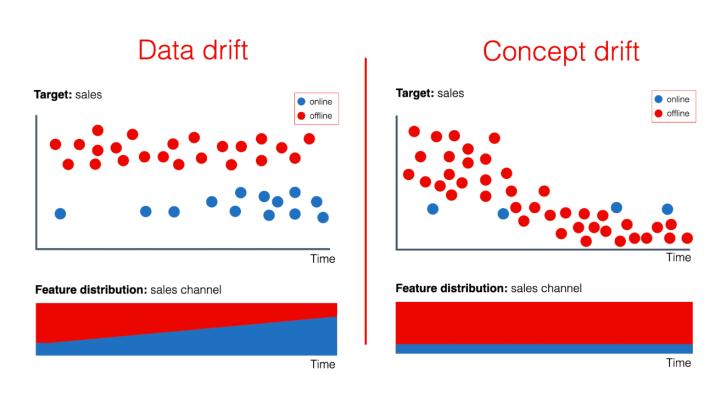
Conceptdrift occurs whenthestatistical properties of the datadistributionchangeovertime,formallyrepresentedasa shiftinthejointprobabilitydistributionP(X,Y)P(X,Y)P(X,Y). Early foundational work identified multiple types of drift, including sudden (abrupt), gradual, incremental, and recurringpatterns(WidmerandKubat,1996).
Suddendriftreflectsabruptenvironmentalchanges,suchas fraud pattern shifts. Gradual drift represents transitional changes over time. Incremental drift involves slow continuous evolution, while recurring drift reflects previously observed concepts reappearing. Detection and
adaptation strategies must be tailored to the specific drift type.
2.3.2
Unaddressed drift leads to degradation in predictive accuracy,increasederrorvariance,andbiasedpredictions. Performancemetricssuchasaccuracy,precision–recall,or areaunderthecurve(AUC)maydeteriorateprogressivelyas themodel’slearnedrepresentationbecomesmisalignedwith newdatadistributions(Luetal.,2018).
In high-stakes domains such as cybersecurity or financial analytics, delayed detection of drift can produce systemic risks. Therefore, robust monitoring and timely adaptation are essential for maintaining model validity in streaming pipelines.
2.3.3 Sources of
Concept drift may arise from multiple factors, including evolving user behavior, seasonal trends, adversarial adaptation, sensor degradation, and policy or regulatory changes.Non-stationaryexternalenvironmentsfrequently alter feature distributions (covariate shift) or the relationship between features and target variables (real conceptdrift).
In cloud-based IoT systems, for instance, device heterogeneity and environmental variability introduce distributional instability. Similarly, changes in market dynamicscanaltertransactionpatternsinfinancialdatasets. These evolving conditions necessitate quantitative mechanisms for detecting and measuring distributional shifts(Žliobaitėetal.,2016).
2.4.1
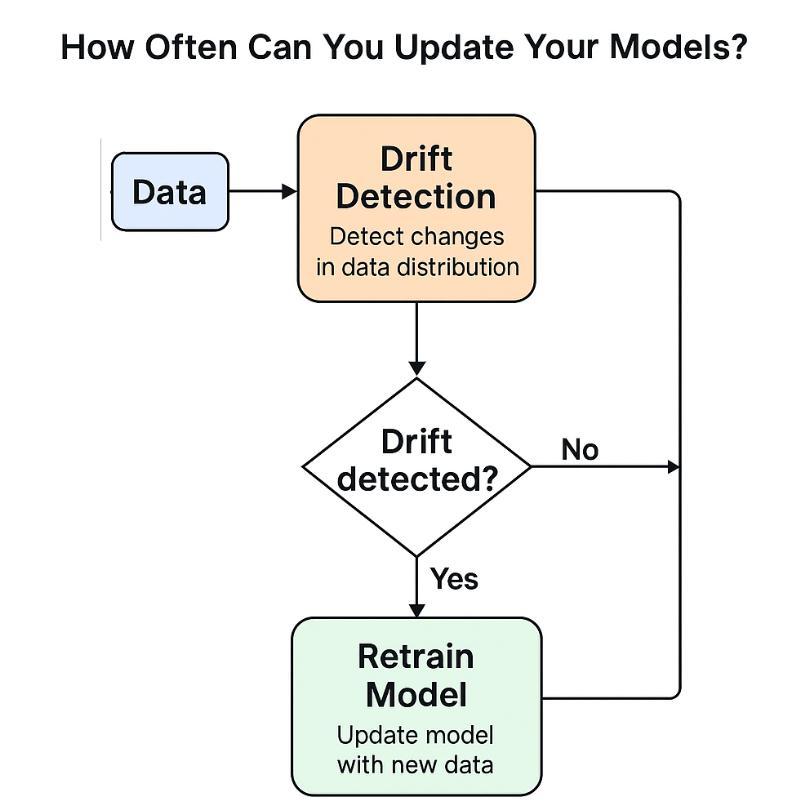
Retraining triggers determine when a deployed model should be updated. Static triggers rely on predefined schedules(e.g.,weeklyormonthlyretraining)orfixeddata volume thresholds. Although simple to implement, static
International Research Journal of Engineering and Technology (IRJET) e-ISSN: 2395-0056
Volume: 13 Issue: 02 | Feb 2026 www.irjet.net p-ISSN: 2395-0072
policies often lead to either unnecessary retraining or delayedresponsetodrift.
Adaptive triggers dynamically initiate retraining based on monitored indicators such as performance degradation, statistical divergence, or drift detection alarms. These approachesalignretrainingeventswithactualdistributional changes,improvingefficiencyandreducingoperationalcost.
2.4.2 Drift Quantification Metrics
Drift quantification extends beyond binary detection by measuring the magnitude and severity of distributional change. Metrics such as Kullback–Leibler divergence, Jensen–Shannondistance,PopulationStabilityIndex(PSI), and adaptive window-based statistics are commonly employed to estimate drift intensity (Bifet and Gavaldà, 2007).
Quantitative drift measures enable threshold-based retraining decisions and facilitate cost-aware trade-offs between computational overhead and predictive accuracy restoration. In cloud-native environments, these metrics must be computationally efficient and scalable to handle high-throughputdatastreams.
A systematic and transparent literature collection methodology is essential for ensuring reproducibility and scholarlyrigorinanSCI-indexedreviewarticle.Thissection outlines the databases searched, keyword strategies, inclusionandexclusioncriteria,andscreeningprocedures adoptedtosynthesizeresearchonadaptivemodelretraining triggermechanismsusingconceptdriftquantification.
3.1.1
To ensure comprehensive coverage of peer-reviewed and high-impact research, literature was retrieved from established digital libraries and indexing platforms, includingIEEEXplore,Scopus,WebofScience,ACMDigital Library,andSpringerLink.
Thesedatabaseswereselectedduetotheirstrongcoverage ofcomputerscience,machinelearning,distributedsystems, andcloudcomputingliterature.Indexingplatformssuchas ScopusandWebofSciencewereadditionallyusedtoidentify citationnetworksandemergingtrendsinconceptdriftand streamingMLresearch.
3.1.2
A structured keyword strategy was employed to capture studies at the intersection of streaming analytics, concept drift detection, and adaptive retraining. Primary search termsincluded:
“conceptdriftdetection”
“conceptdriftquantification”
“adaptivemodelretraining”
“streamingmachinelearning”
“onlinelearningincloud”
“clouddatapipelines”
“drift-awareMLOps”
Booleanoperators(AND,OR)andwildcardvariationswere used to refine results and reduce irrelevant matches. The keywordselectionwasinformedbyfoundationalsurveyson conceptdriftandevolvingdatastreams(Gamaetal.,2014; Lu et al., 2018), ensuring alignment with established terminologyinthefield.
3.2
To maintain methodological rigor and relevance, explicit inclusion and exclusion criteria were defined prior to screening.
3.2.1
Theprimaryfocuswasonstudiespublishedwithinthelast ten years to capture recent advancements in cloud-native streaming architectures and adaptive retraining frameworks.However,seminalworkspredatingthisperiod were included where necessary to provide theoretical grounding,particularlyinthedomainofconceptdriftand onlinelearning(WidmerandKubat,1996).
3.2.2
International Research Journal of Engineering and Technology (IRJET) e-ISSN: 2395-0056
Volume: 13 Issue: 02 | Feb 2026 www.irjet.net p-ISSN: 2395-0072
Includedstudieswererequiredtoaddressatleastoneofthe followingdimensions:
Conceptdriftdetectionorquantificationinstreaming data
Adaptiveorautomatedretrainingmechanisms
Machinelearning deployment in cloud or distributed streamingenvironments
Studies focusing exclusively on offline batch learning withoutconsiderationofstreamingornon-stationarydata were excluded. Similarly, purely application-specific case studieslackingmethodologicalcontributiontoretrainingor driftquantificationwereomitted.
3.2.3
Priority was given to peer-reviewed journal articles and conference proceedings indexed in recognized citation databases. Studies were evaluated based on clarity of experimentaldesign,statisticalvalidation,reproducibilityof results,andscalabilityconsiderations.Empiricalevaluations using real-world streaming datasets or benchmark frameworks were favored over purely theoretical discussions.
Greyliterature,non-peer-reviewedreports,andduplicated publicationswereexcludedtopreserveacademicintegrity andreliability.
The screening process followed a structured multi-stage approachinvolvingtitlescreening,abstractreview,andfulltext eligibility assessment. Duplicate records across databaseswereremovedpriortoevaluation.Studiesfailing tomeetpredefinedcriteriawereexcludedsystematicallyto minimizeselectionbias.
3.3.1
Although optional, the Preferred Reporting Items for Systematic Reviews and Meta-Analyses (PRISMA) framework was adopted to enhance transparency in the selection process. The PRISMA guidelines provide standardized procedures for documenting identification, screening, eligibility, and inclusion phases (Moher et al., 2009).
APRISMAflowdiagram(recommendedforinclusioninthe final manuscript) visually summarizes the number of records identified, screened, excluded, and ultimately included in the qualitative synthesis. This structured approachstrengthensthecredibilityandreproducibilityof thereview.
This section synthesizes prior research on concept drift detection, drift quantification, and adaptive retraining triggermechanismswithinstreamingclouddatapipelines. Ratherthanpresentingindividualstudiessequentially,the discussion is organized by methodological categories to provideconceptualclarityandcomparativeinsight.
Conceptdriftdetectionmethodsaimtoidentifystatistically significant changes in data distributions or predictive performance over time. Existing approaches can be categorized into error-rate based, distribution-based, window-based,statisticaltest-based,andensemble-driven techniques.
Error-rate based approaches monitor predictive performancemetricssuchasclassificationerrororlossover time.TechniquessuchasDriftDetectionMethod(DDM)and EarlyDriftDetectionMethod(EDDM)detectdriftbytracking deviations in error distributions under the assumption of binomialerrorrates(Gamaetal.,2004).
Thesemethodsarecomputationallyefficientandsuitablefor real-timestreaming;however,theydependonlabeleddata availability and may detect drift only after significant performancedegradationhasoccurred.
Distribution-basedapproachesidentifydriftbymeasuring divergencebetweenhistoricalandrecentdatadistributions. CommonmetricsincludeKullback–Leibler(KLD)divergence, Hellinger distance, and Population Stability Index (PSI). Thesetechniquesquantifychangesinfeatureorprediction distributionswithoutnecessarilyrequiringlabeledoutputs (Luetal.,2018).
Distribution-basedmethodscandetectcovariateshiftearlier than error-based techniques, but high-dimensional data increases computational complexity and memory requirements.
Window-based algorithms compare statistics between adaptive sliding windows. Adaptive Windowing (ADWIN) dynamically adjusts window size based on statistically significantchangesinmeanvalues(BifetandGavaldà,2007). DDM and EDDM also operate using window-based error tracking.
These methods balance sensitivity and stability by automatically adapting to evolving stream characteristics.
International Research Journal of Engineering and Technology (IRJET) e-ISSN: 2395-0056
Volume: 13 Issue: 02 | Feb 2026 www.irjet.net p-ISSN: 2395-0072
However,maintainingwindowstatisticsinhigh-throughput pipelinescanimposememoryoverhead.
Sequentialstatisticalhypothesistestingmethodssuchasthe Kolmogorov–Smirnov (KS) test and Cumulative Sum (CUSUM) control charts are widely used to detect distributional change. The KS test measures differences betweenempiricalcumulativedistributions,whileCUSUM monitors cumulative deviations from expected behavior (Page,1954).
Statisticaltestsprovideformalsignificanceguaranteesbut mayrequireparametertuningandaresensitivetonoisein streamingcontexts.
4.1.5
Ensemble-based drift detection combines multiple base learners or detectors to improve robustness. Techniques such as accuracy-weighted ensembles dynamically adjust model weights based on performance in recent windows (KolterandMaloof,2007).
Ensembleapproachesenhanceadaptabilityandresilienceto diverse drift patterns, but they incur increased computational cost due to maintaining multiple models concurrently.
Fromacomparativestandpoint:
Sensitivity:Window-basedandensemblemethodstend to detect gradual drift more effectively, whereas statisticaltestsaremoresensitivetoabruptchanges.
Computational Cost: Error-rate methods are lightweight; distribution-based and ensemble approachesaremoreresource-intensive.
SuitabilityforStreaming:Algorithmswithincremental updatecapabilityandboundedmemoryusagearemore appropriateforreal-timecloudenvironments(Žliobaitė etal.,2016).
Beyondbinarydetection,driftquantificationmeasuresthe magnitude, severity, and persistence of distributional changes,providingactionablesignalsforretraining.
4.2.1
Magnitude estimation quantifies how far current data deviates from historical distributions using divergence metricsornorm-baseddistancemeasures.Jensen–Shannon divergence and Wasserstein distance have been used to
measure shift intensity in probabilistic outputs (Lu et al., 2018).
Quantifyingmagnitudeenablesprioritizationofretraining eventsbasedonseverityratherthanmereoccurrence.
Driftseverityassessestheimpactofdistributionalchangeon predictiveperformance.Severityindicatorsmayincorporate errorvariance,misclassificationrateincrease,orconfidence reduction metrics. Severity-aware frameworks attempt to differentiatebetweenminorfluctuationsandcriticalshifts thatrequireimmediateintervention.
Time-decayed or exponentially weighted statistics assign higherimportancetorecentobservations.Suchapproaches enhanceresponsivenesstoemergingtrendswhilereducing sensitivity to outdated data. Time-weighted averaging is particularlyeffectiveinstreamingpipelineswhereconcept evolutionisgradual.
4.2.4
Distance-basedmetricsmeasuredistributionaldifferencesin feature space or embedding representations. Hellinger distance and maximum mean discrepancy (MMD) are commonly applied in high-dimensional contexts. Efficient approximationtechniquesareoftennecessarytomaintain scalabilityincloud-basedsystems.
Drift quantification transforms detection signals into decision variables for retraining policies. Instead of triggering retraining upon binary alarms, systems may define severity thresholds proportional to magnitude estimates.Thisapproachreducesfalsepositivesandavoids unnecessaryretrainingcycles.
4.2.6
Incloud-nativepipelines,driftquantificationmustconsider latency constraints, distributed processing, and cost optimization. Approximate sketching algorithms and incremental statistics are frequently adopted to maintain computational efficiency in high-throughput streaming systems.
Adaptive retraining mechanisms translate drift indicators intooperationaldecisions.Ratherthananalyzingindividual papers,mechanismsarecategorizedbytriggerlogic.
International Research Journal of Engineering and Technology (IRJET) e-ISSN: 2395-0056
Volume: 13 Issue: 02 | Feb 2026 www.irjet.net p-ISSN: 2395-0072
Threshold-based triggers initiate retraining when a monitoredmetricexceedspredefinedlimits.
Fixed thresholds use static divergence or error-rate boundaries.Whilesimpletoimplement,theylackflexibility acrossvaryingdriftpatterns.
Dynamic thresholds adapt based on historical trends or moving averages. These mechanisms reduce sensitivity to noiseandaccommodateevolvingdatascales.
Feedback-loop mechanisms continuously monitor model performance and initiate retraining upon sustained degradation. Sliding window performance monitoring comparesrecentaccuracywithbaselineperformance(Gama etal.,2014).
Such approaches integrate evaluation directly into deploymentpipelines,enablingautomatedself-correction.
4.3.3
Confidence-basedtriggersrelyonposteriorprobabilitiesor predictiveuncertaintymeasures.Whenaverageconfidence drops below a predefined level, retraining is initiated. Bayesian models and Monte Carlo dropout techniques estimatepredictiveuncertainty,offeringearlyindicatorsof conceptshift.
These methods are particularly useful in classification systems where labeled data may not be immediately available.
4.3.4
Hybrid approaches combine drift detection signals with performancemonitoringorensembledecision-making.For example, retraining may be triggered only when both distributional divergence and performance degradation exceedthresholds.
Meta-learning frameworks dynamically select retraining strategies based on drift characteristics. Although more robust,hybridmechanismsincreasesystemcomplexityand computationaldemands.
Adaptiveretrainingincloudenvironmentsmustaccountfor infrastructureconstraintsandoperationalcost.
4.4.1 Resource Constraints in Cloud
Retraininglarge-scalemodelsconsumesCPU/GPUresources and storage bandwidth. Frequent retraining may conflict
withservice-levelagreements(SLAs)andinferencelatency requirements.
Cost-aware frameworks incorporate cloud pricing models and computational budgets into retraining decisions. Retrainingmaybedeferredduringpeakusageorscheduled during low-cost intervals to optimize operational expenditure.
Drift-triggered retraining can interact with autoscaling policies.Suddenretrainingworkloadsmaytriggerresource scaling events, affecting cost and system stability. Coordinatingdriftmonitoringwithautoscalingcontrollers enhancesefficiency.
Inserverlessarchitectures,retrainingtasksareevent-driven and stateless by design. Efficient state check pointing and distributed parameter storage are necessary to maintain continuity across invocations. Lightweight drift quantificationtechniquesarepreferredtoreduceexecution latency.
Thissectioncriticallysynthesizesthereviewedliteratureby identifyingmethodologicaltrends,researchgaps,scalability concerns,andpracticaldeploymentlimitationsinadaptive retrainingmechanismsforstreamingcloudenvironments.
Recent years have witnessed a shift from traditional statistical drift detection methods toward deep learningbasedrepresentationlearningtechniques.Insteadofrelying solely on feature-level distribution comparisons, modern approaches analyze latent embedding shifts using neural architectures. Deep auto encoders and recurrent neural networks have been employed to detect subtle non-linear distributionalchangesinhigh-dimensionalstreamingdata (Luetal.,2018).
Additionally,transformer-basedmonitoringandembedding similarity tracking have emerged in large-scale industrial systems, particularly in recommendation and anomaly detection pipelines. These approaches leverage representation learning to capture complex drift patterns thatclassicaldivergencemeasuresmayoverlook.
International Research Journal of Engineering and Technology (IRJET) e-ISSN: 2395-0056
Volume: 13 Issue: 02 | Feb 2026 www.irjet.net p-ISSN: 2395-0072
5.1.2 Integration with MLOps and Automation Frameworks
Anothersignificanttrendinvolvesintegratingdriftdetection andretrainingtriggerswithinMLOpspipelines.Automated monitoring, model registries, CI/CD integration, and deployment orchestration are increasingly embedded in cloud-basedMLsystems.Continuousevaluationframeworks align drift detection with lifecycle management, reducing manualinterventionandenablingautonomousadaptation (Žliobaitėetal.,2016).
5.2 Research Gaps
Despitemethodologicaladvances,severallimitationsremain evidentintheliterature.
5.2.1
A substantial portion of existing research evaluates drift detection and retraining mechanisms using controlled or synthetic datasets. While benchmark datasets enable comparative analysis, they often fail to reflect real-world operational complexity, such as asynchronous data ingestion, distributed latency, and heterogeneous infrastructureconstraints.
Empirical validation in production-grade cloud environments remains limited. Studies rarely quantify infrastructure overhead, energy consumption, or cost implicationsassociatedwithfrequentretrainingcycles.
5.2.2
Althoughevolvingdatastreambenchmarksexist,thereisno widely accepted standardized benchmark specifically designed for evaluating adaptive retraining trigger mechanisms in cloud-native streaming pipelines. Many studiesusedomain-specificdatasets,limitingreproducibility andcross-comparison(Gamaetal.,2014).
The absence of standardized evaluation metrics for retraining efficiency, false-trigger rates, and costperformance trade-offs hinders objective comparison of proposedframeworks.
5.2.3
Scalabilityremainsa corechallenge. While window-based and ensemble approaches improve detection robustness, they often increase computational complexity. Highdimensionaldatastreams,particularlyinIoTandfinancial analytics, amplify memory consumption and processing latency.
Distribution-baseddivergencecalculationssuchasKullback–Leiblerdivergencebecomecomputationallyexpensivewhen appliedacrossnumerousfeaturesorembeddingdimensions (Lu et al., 2018). Furthermore, ensemble-based retraining
triggersmayrequiremaintainingmultiplemodelinstances simultaneously,raisingstorageandorchestrationoverhead.
This review systematically examined adaptive model retraining trigger mechanisms driven by concept drift quantification within streaming cloud data pipelines. The analysishighlightedthatmaintainingpredictivereliabilityin non-stationary environments requires more than conventionalperiodicretrainingstrategies.Driftdetection techniques includingerror-ratemonitoring,window-based approaches such as ADWIN, statistical hypothesis testing, and divergence-based distribution comparison provide foundational mechanisms for identifying evolving data distributions.However,effectiveoperationalizationdepends on translating detection outputs into robust retraining decisions.
Driftquantificationmetrics,includingdivergencemeasures, severity estimation, and time-weighted statistics, enable moreinformedandcost-awareretrainingpoliciescompared tobinary alarmsystems.Threshold-based,feedback-loopdriven, confidence-based, and hybrid retraining triggers demonstratevaryingtrade-offsinsensitivity,computational efficiency, and scalability. The review further emphasizes that cloud-native architectures introduce additional considerations, including resource elasticity, latency constraints,andcostoptimization.
Overall,adaptiveretrainingmechanismsrepresentacritical componentofresilientmachinelearningsystemsdeployed in real-time environments. Future research mustfocus on standardized benchmarks, scalable quantification techniques,andtighterintegrationwithMLOpsframeworks to ensure efficient, interpretable, and economically sustainabledeploymentinlarge-scalestreamingecosystems.
Thisreviewissubjecttocertainlimitations.First,although major indexed databases were systematically consulted, somerelevantstudiesmayhavebeenomittedduetosearchtermvariabilityorindexingconstraints.Second,thereview emphasizes methodological synthesis rather than quantitative meta-analysis; therefore, comparative performanceclaimsarebasedonreportedfindingsrather than unified experimental evaluation. Third, the rapidly evolving nature of streaming machine learning and cloud architectures means that emerging industrial implementationsmaynotyetbereflectedinpeer-reviewed literature. Finally, while efforts were made to analyze scalability and cost considerations, limited availability of real-world deployment data restricts comprehensive evaluation of operational trade-offs in production cloud environments.
International Research Journal of Engineering and Technology (IRJET) e-ISSN: 2395-0056
Volume: 13 Issue: 02 | Feb 2026 www.irjet.net p-ISSN: 2395-0072
1. Bifet, A. and Gavaldà, R., 2007. Learning from timechangingdatawithadaptivewindowing.Proceedingsof the 2007 SIAM International Conference on Data Mining,pp.443–448.
2. Carbone,P.,Katsifodimos,A.,Ewen,S.,Markl,V.,Haridi, S.andTzoumas,K.,2015.ApacheFlink™:Streamand batch processing in a single engine. IEEE Data EngineeringBulletin,38(4),pp.28–38.
3. Gama,J.,Medas,P.,Castillo,G.andRodrigues,P.,2004. Learning with drift detection. Advances in Artificial Intelligence – SBIA 2004, Lecture Notes in Computer Science,3171,pp.286–295.
4. Gama, J., Žliobaitė, I., Bifet, A., Pechenizkiy, M. and Bouchachia, A., 2014. A survey on concept drift adaptation.ACMComputingSurveys,46(4),pp.1–37.
5. Kolter,J.Z.andMaloof,M.A.,2007.Dynamicweighted majority: An ensemble method for drifting concepts. Journal of Machine Learning Research, 8(Dec), pp.2755–2790.
6. Kreps, J., Narkhede, N. and Rao, J., 2011. Kafka: A distributed messaging system for log processing. ProceedingsoftheNetDBWorkshop,pp.1–7.
7. Lu, J., Liu, A., Dong, F., Gu, F., Gama, J. and Zhang, G., 2018. Learning under concept drift: A review. IEEE Transactions on Knowledge and Data Engineering, 31(12),pp.2346–2363.
8. Moher,D.,Liberati,A.,Tetzlaff,J.andAltman,D.G.,2009. Preferredreportingitemsforsystematicreviewsand meta-analyses:ThePRISMAstatement.PLoSMedicine, 6(7),e1000097.
9. Page, E.S., 1954. Continuous inspection schemes. Biometrika,41(1/2),pp.100–115.
10. Widmer, G. and Kubat, M., 1996. Learning in the presenceofconceptdriftandhiddencontexts.Machine Learning,23(1),pp.69–101.
11. Žliobaitė, I., Pechenizkiy, M. and Gama, J., 2016. An overview of concept drift applications. In: Big Data Analysis:NewAlgorithmsforaNewSociety.Springer, pp.91–114.
12. Zaharia, M., Das, T., Li, H., Shenker, S. and Stoica, I., 2013. Discretized streams: Fault-tolerant streaming computation at scale. Proceedings of the TwentyFourth ACM Symposium on Operating Systems Principles,pp.423–438.
13. Zaharia,M.,Chen,A.,Davidson,A.,Ghodsi,A.,Hong,S.A., Konwinski, A., Murching, S., Nykodym, T., Ogilvie, P., Parkhe, M. and Xie, F., 2016. Apache Spark: A unified engineforbigdataprocessing.Communicationsofthe ACM,59(11),pp.56–65.
14. Halstead, B., Koh, Y.S., Riddle, P., Pechenizkiy, M. and Bifet,A.,2024.Aprobabilisticframeworkforadapting to changing and recurring concepts in data streams. arXivpreprint.
15. MohammadAbuShaira,M.,Feng,Y.,Fan,H.andShi,W., 2025. OLC-WA: Drift Aware Tuning-Free Online ClassificationwithWeightedAverage.arXivpreprint.
16. Dar,U.andCavus,M.,2024.datadriftR:AnRPackage forConceptDriftDetectioninPredictiveModels.arXiv preprint.
17. Chaudhari, A.V. and Charate, P.A., 2025. Adaptive AutoML pipelines for large-scale data streams under concept drift. International Journal of Development Research,15.
18. Peng,J.andTan,S.,2025.Conceptdriftdetectionand adaptivelearninginmultimodaldatastreams.Applied andComputationalEngineering.
19. Recurrentconceptdriftsondatastreams.Gunasekara, N.,Pfahringer,B., Gomes,H.M.,Bifet,A.andKoh, Y.S., 2024.IJCAIProceedings.
20. Online detection and adaptation of concept drift in streaming data classification. Procedia Computer Science,2024.
21. Scalable concept drift adaptation for stream data mining. Hu, L., Li, W., Lu, Y. et al., 2024. Complex & IntelligentSystems.
22. A survey on machine learning for recurring concept drifting data streams. Expert Systems with Applications,2023.
23. Concept drift detection in data stream mining: A literaturereview.ScienceDirect,2021.
24. Severity-Aware Drift Adaptation for Cost-Efficient ModelMaintenance.MDPI,2025.
25. Impactanalysisofrealandvirtualconceptdriftsonthe predictive performance of classifiers. Procedia ComputerScience,2024.
26. Peng, J., Tan, S., Concept drift detection and adaptive learning in multimodal data streams, Applied and ComputationalEngineering,2025.
27. Time to Retrain? Detecting Concept Drifts in ML Systems,researchgate/ArXiv,2025.
International Research Journal of Engineering and Technology (IRJET) e-ISSN: 2395-0056
Volume: 13 Issue: 02 | Feb 2026 www.irjet.net p-ISSN: 2395-0072
28. Yu, E., Lu, J., Zhang, B. and Zhang, G., 2023. Online boosting adaptive learning under concept drift for multistreamclassification.arXiv.
29. Adaptive Random Forest with dynamic detectors for evolvingdatastreamclassification,IEEEIntl.Conf.on Computing&AI,2023.
30. Adaptive Decision Forest: An incremental machine learningframework,PatternRecognition,2022.
31. Adaptivedeepforestforonlinelearningfromdrifting datastreams,arXiv,2020context(referenced).
32. Enhancing Concept Drift Detection in Drifting & ImbalancedStreamsviaMeta-Learning,IEEEBigData 2023.
33. Lightweight concept drift detection and adaptation framework for IoT data streams, IEEE IoT Magazine, 2021.
34. Adaptive XGBoost for concept drift handling in sentimentstreaming,ETASR,recent.
35. Adaptive learning on fog-cloud collaborative architectureforstreamdataprocessing,INSymposium onNetworks&Communications,2021.
36. Conceptdriftdatastreamregressionmodel basedon adaptivedriftdetection,SPIEProceedings,2024.
37. Virtual concept drift detection and adaptation in federateddatastreamlearning,IJDSA,2026.
38. Holisticcontinuallearningunderconceptdrift,arXiv, 2025.
39. Adaptive model updates under constrained resource budgets(RCCDA),arXiv,2025.
40. AutomatedMLOpspipelineforcost-effectiveretraining inresponsetoshifts,arXiv,2025.
41. Model retraining upon concept drift detection in networktrafficanalyses,MDPI,2025.