
International Research Journal of Engineering and Technology (IRJET) e-ISSN: 2395-0056
Volume: 13 Issue: 03 | Mar 2026 www.irjet.net p-ISSN: 2395-0072
International Research Journal of Engineering and Technology (IRJET) e-ISSN: 2395-0056
Volume: 13 Issue: 03 | Mar 2026 www.irjet.net p-ISSN: 2395-0072
Vijay Chakole1 ,Ayush Sarode2,Raju Malekar3,Muskan Kulkarni 4,Ravisha Kolhe5 , Khushi Chakole6
1Head of Dept , Dept of Electronics and Telecommunication, KDK College of Engineering, Maharashtra, India 2345 Dept of Electronics and Telecommunication, KDK College of Engineering, Maharashtra, India ***
Abstract - Rapid advancements in artificial intelligence and embedded computing have enabled the development of intelligent systems capable of performing complex tasks directly on edge devices. In the context of smart homes, cooking assistance remains an area where intelligent automation can significantly enhance efficiency and reduce food wastage. This research presents the design and implementation of a Smart Kitchen Assistant that detects food ingredients using computer vision and provides recipe guidance through an edge artificial intelligence framework. The proposed system employs a Raspberry Pi-based embedded platform integrated with a camera module anda lightweight convolutional neural network model optimized using TensorFlow Lite. Unlike conventional cloud-based solutions, the system performs inference locally on the device, ensuring reduced latency, improved privacy, and independence from internet connectivity. A structured offline recipe database is integrated with a similarity-based matching algorithm to recommend recipes based on detectedingredients.Experimentalevaluationdemonstrates reliable ingredient recognition accuracy while maintaining low computational overhead. The proposed framework demonstrates the feasibility of deploying intelligent cooking assistance systems in domestic environments using affordablehardwareandedgeAItechniques.
Key Words: Edge Artificial Intelligence, Smart Kitchen, Ingredient Detection, Embedded Vision, Raspberry Pi, Recipe Recommendation System
Artificial Intelligence (AI) has become an essential component in modern technological systems, particularly in the domain of smart homes and intelligent automation. The integration of AI with embedded computing has enabled devices to perform complex decision-making processes locally without relying heavily on remote cloud servers. Edge AI represents a paradigm shift where machinelearningmodelsoperatedirectlyonlocaldevices such as microcontrollers, embedded systems, and edge computingplatforms.
Cooking is one of the most common daily activities in households. However, many individuals face challenges when deciding what meals to prepare using the available
ingredients. Traditional recipe applications require manualsearchingandrelyoninternetconnectivity,which limits accessibility and convenience. Moreover, these applicationsdonotactivelydetectingredientsavailablein thekitchen.
Recentadvancesincomputervisionhavemadeitpossible to recognize objects from images using convolutional neural networks (CNNs). By integrating these capabilities into a kitchen environment, it becomes possible to create intelligent systems capable of identifying ingredients and recommendingappropriaterecipes.
This research proposes a Smart Kitchen Assistant that utilizes edge artificial intelligence to detect ingredients placed in front of a camera and automatically suggest recipes that can be prepared using those ingredients. The system is designed to operate fully offline, ensuring privacyandreliabilitywhilereducinglatency.
Themainobjectivesofthisresearchinclude:
Designing an embedded AI system for ingredient recognition
Implementingreal-timeimageclassificationusing lightweightCNNmodels
Developing an offline recipe recommendation system
Evaluating the performance of the proposed architectureonedgehardware
The proposed Smart Kitchen Assistant is designed using an edge computing architecture that enables real-time ingredient detection and recipe recommendation without relying on cloud-based processing. The system integrates both hardware and software components to perform image acquisition, data processing, ingredient classification, and recipe retrieval within a single embeddedplatform.Thecorehardwarecomponentofthe system is the Raspberry Pi 4 Model B, which acts as the central processing unit responsible for executing image processing and machine learning inference tasks. A highresolution camera module is connected to the Raspberry Pi to capture images of ingredients placed in front of the device. These captured images are transferred to the
Volume: 13 Issue: 03 | Mar 2026 www.irjet.net p-ISSN: 2395-0072
processing pipeline where they undergo preprocessing operations such as resizing, normalization, and noise reduction in order to improve the performance of the machinelearningmodel.
After preprocessing, the processed image is passed to a convolutional neural network model optimized for edge deployment. In this research, a lightweight deep learning architecture based on MobileNetV2 is utilized because it offers a balance between computational efficiency and classification accuracy. The trained model is converted into TensorFlow Lite format, allowing it to run efficiently on the Raspberry Pi with reduced memory usage and faster inference speed. The model analyzes the visual features of the input image and predicts the ingredient class by generating a probability distribution across all possible ingredient categories. The ingredient label with thehighestprobabilityisselectedasthefinalclassification output.
Once the ingredient has been detected, the system interacts with a local recipe database stored within the Raspberry Pi. The database contains multiple recipes along with their required ingredients and preparation steps. A similarity-based matching algorithm is used to compare the detected ingredient with the ingredients listedintherecipes.Basedonthiscomparison,thesystem identifies recipes that can be prepared using the detected ingredient and ranks them according to their similarity score.Therecommendedrecipesarethendisplayedtothe user through a graphical interface on the connected displayscreen.
The entire system operates locally on the embedded device,whicheliminatestheneedforinternetconnectivity and enhances data privacy. By performing all computational tasks at the edge, the architecture reduces latency and ensures real-time performance suitable for interactive kitchen environments. This modular architecture also allows future expansion such as multiingredient detection, voice interaction, and integration withsmartkitchenappliances.
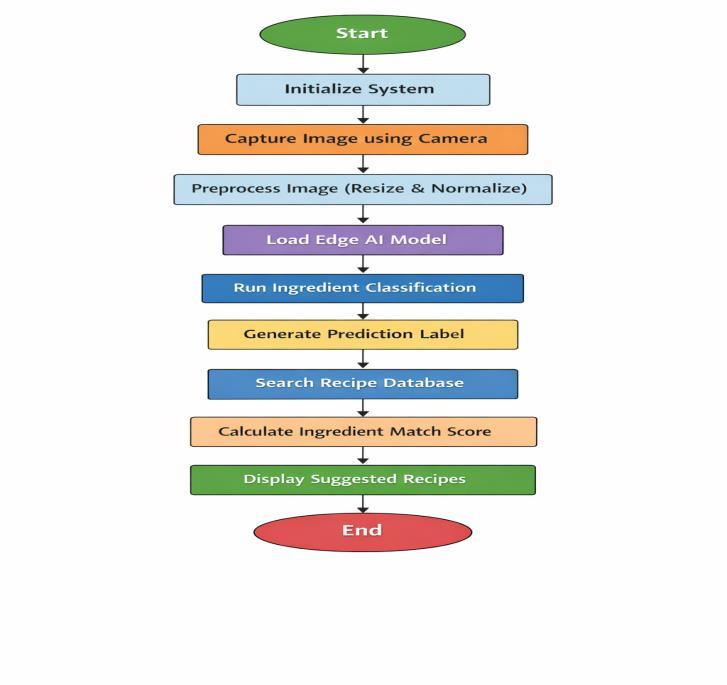
The workflow of the proposed Smart Kitchen Assistant begins with the initialization of the system and activation of the camera module installed in the kitchen environment. When the user places food ingredients in front of the camera, the system captures an image of the ingredients in real time. This captured image acts as the primary input for the intelligent processing pipeline. The system ensures that the captured image is clear and suitable for further processing before it proceeds to the nextstage.
After the image is captured, it undergoes an image preprocessing stage where operations such as resizing,
normalization, and noise reduction are applied. These preprocessing steps ensure that the image is compatible with the input requirements of the deep learning model. Once the preprocessing is completed, the edge artificial intelligence model is loaded on the embedded device. A trainedconvolutionalneuralnetwork(CNN)modelisthen used to analyze the image and perform ingredient classification.Themodeldetectsdifferentfoodingredients present in the image and generates prediction labels correspondingtoeachidentifiedingredient.
Following ingredient detection, the system sends the identified ingredient list to the recipe recommendation module. In this stage, the system searches a structured recipe database containing multiple recipes and their required ingredients. A matching algorithm evaluates the similarity between the detected ingredients and the ingredients required for different recipes. Based on this comparison, a match score is calculated to determine which recipes can be prepared using the available ingredients.
Finally, the system displays the most suitable recipes to theuserthroughagraphicalinterfaceorconnectedmobile application. The suggested recipes include step-by-step cooking instructions and may also provide additional information such as preparation time and nutritional value. This workflow enables the Smart Kitchen Assistant to automatically recognize ingredients and guide users toward suitable meal options while operating efficiently on edge computing devices without heavy reliance on cloudprocessing.
Volume: 13 Issue: 03 | Mar 2026 www.irjet.net p-ISSN: 2395-0072
The proposed Smart KitchenAssistant system isdesigned to automatically detect food ingredients and generate suitable recipes using edge artificial intelligence. The system begins with an image acquisition stage where a camera module captures real-time images of ingredients placedonthekitchencounter.Theseimagesareprocessed usinganedgecomputingdevicesuchasaRaspberryPior embedded AI processor. A pre-trained deep learning model based on convolutional neural networks (CNN) is usedtoidentifyandclassifytheingredientspresentinthe image. The detected ingredients are then converted into structured data that represents the available food items forfurtherprocessing.
Once the ingredients are identified, the system utilizes a reciperecommendationmodulethatmatchesthedetected ingredients with a recipe database. Natural Language Processing (NLP) techniques and rule-based filtering are appliedtodeterminethemostsuitablerecipesthatcanbe preparedwiththeavailableingredients.Thefinaloutputis presented to the user through a display interface or mobile application, which provides recipe instructions, preparationsteps,andoptionalnutritionalinformation.By performing inference on the edge device rather than relying entirely on cloud computing, the system ensures faster response time, reduced internet dependency, and improved user privacy while assisting users in making efficientcookingdecisions.
The proposed Smart Kitchen Assistant for Ingredient Detection and Recipe Guidance Using Edge Artificial Intelligence demonstrates how computer vision and edge computing can be applied to simplify everyday cooking activities. By deploying a convolutional neural network model on an edge device, the system is capable of detectingfoodingredientsinrealtimeandrecommending appropriate recipes without relying on continuous internet connectivity. This approach reduces processing latency and improves user privacy because the captured images are processed locally on the device rather than beingsenttoexternalcloudservers.
Anotherimportantbenefitofthesystemisitspotential to improvekitchenefficiencyandreducefoodwastage.Many usersareoftenunsureaboutwhatmealscanbeprepared with the ingredients available in their kitchen. The proposed system addresses this challenge by automatically identifying ingredients and matching them with a structured recipe database. This allows the system to recommend suitable recipes that can be prepared with the detected ingredients, thereby helping users utilize available food items effectively and simplifying the decision-makingprocessduringcooking.
However, certain challenges remain in the practical implementation of the system. Ingredient recognition accuracy may vary depending on lighting conditions, background clutter, and variations in ingredient appearance.Additionally,real kitchenenvironments often involve multiple ingredients at once, which may require more advanced multi-object detection techniques. Future improvements could focus on enhancing model accuracy, supporting multiple ingredient detection, and incorporating personalized recipe recommendations based on user preferences and dietary requirements, which would further improve the usability and effectivenessoftheSmartKitchenAssistantsystem.
This research presents the development of a Smart Kitchen Assistant for Ingredient Detection and Recipe Guidance Using Edge Artificial Intelligence, designed to assistusersinidentifyingfoodingredientsandgenerating suitable recipes automatically. The proposed system integrates computer vision and deep learning techniques to detect ingredients using images captured through a camera module. By deploying the trained model on an edge computing device, the system performs ingredient recognition locally, enabling real-time processing while reducing dependency on cloud-based services. This edgebased approach improves response time, enhances data privacy, and makes the system suitable for practical kitchenenvironments.
The system further utilizes a recipe recommendation module that matches the detected ingredients with a structured recipe database to suggest appropriate dishes along with preparation instructions. This feature helps users make better use of available ingredients, reduces food wastage, and simplifies the cooking process, especially for beginners. Although the system demonstrates promising results, future enhancements such as multi-ingredient detection, improved model accuracy, and personalized recipe recommendations can further improve its effectiveness. With continued advancements, the proposed Smart Kitchen Assistant can contribute significantly to the development of intelligent andautomatedsmartkitchensystems.
[1] A. G. Howard et al., “MobileNets: Efficient Convolutional Neural Networks for Mobile Vision Applications,”arXivpreprintarXiv:1704.04861,2017.
[2]M.Sandleretal.,“MobileNetV2:InvertedResidualsand Linear Bottlenecks,” Proceedings of the IEEE Conference on Computer Vision and Pattern Recognition (CVPR), 2018,pp.4510–4520.
International Research Journal of Engineering and Technology (IRJET) e-ISSN: 2395-0056
Volume: 13 Issue: 03 | Mar 2026 www.irjet.net p-ISSN: 2395-0072
[3] F. Chollet, “Xception: Deep Learning with Depthwise Separable Convolutions,” Proceedings of the IEEE CVPR, 2017,pp.1251–1258.
[4] K. Simonyan and A. Zisserman, “Very Deep Convolutional Networks for Large-Scale Image Recognition,” International Conference on Learning Representations(ICLR),2015.
[5] C. Szegedy et al., “Going Deeper with Convolutions,” ProceedingsoftheIEEECVPR,2015,pp.1–9.
[6] M. Abadi et al., “TensorFlow: Large-Scale Machine Learning on Heterogeneous Systems,” Google Research, 2016.
[7]B.Zophetal.,“LearningTransferableArchitectures for Scalable Image Recognition,” Proceedings of the IEEE CVPR,2018.
[8] J. Redmon et al., “You Only Look Once: Unified, RealTime Object Detection,” Proceedings of the IEEE CVPR, 2016,pp.779–788.
[9] A. Krizhevsky, I. Sutskever, and G. Hinton, “ImageNet Classification with Deep Convolutional Neural Networks,” AdvancesinNeuralInformationProcessingSystems,2012.
[10] Y. LeCun, Y. Bengio, and G. Hinton, “Deep Learning,” Nature,vol.521,no.7553,pp.436–444,2015.
[11] W. Shi et al., “Edge Computing: Vision and Challenges,” IEEE Internet of Things Journal, vol. 3, no. 5, pp.637–646,2016.
[12] M. Satyanarayanan, “The Emergence of Edge Computing,”Computer,vol.50,no.1,pp.30–39,2017.
[13]H.Chenetal.,“DeepLearningonEmbeddedSystems: A Survey,” IEEE Transactions on Emerging Topics in Computing,2020.
[14] S. Han et al., “Deep Compression: Compressing Deep Neural Networks with Pruning, Trained Quantization and Huffman Coding,” International Conference on Learning Representations,2016.
[15] J. Dean et al., “Large Scale Distributed Deep Networks,” Advances in Neural Information Processing Systems,2012.
[16] R. Want, “An Introduction to RFID Technology,” IEEE PervasiveComputing,vol.5,no.1,pp.25–33,2006.
[17]S.K.Dattaetal.,“SmartHomeAutomationUsingIoT,” IEEEConsumerElectronicsMagazine,vol.5,no.1,pp.48–55,2016.
[18]P.ViolaandM.Jones,“RapidObjectDetectionUsinga Boosted Cascade of Simple Features,” Proceedings of the IEEECVPR,2001.
[19] D. G. Lowe, “Distinctive Image Features from ScaleInvariant Keypoints,” International Journal of Computer Vision,vol.60,no.2,pp.91–110,2004.
[20] N. Lane et al., “Deep Learning for Mobile and EmbeddedDevices:ASurvey,”IEEEPervasiveComputing, vol.17,no.3,pp.35–44,2018.