
International Research Journal of Engineering and Technology (IRJET) e-ISSN:2395-0056
Volume: 12 Issue: 06 | Jun 2025 www.irjet.net p-ISSN:2395-0072
International Research Journal of Engineering and Technology (IRJET) e-ISSN:2395-0056
Volume: 12 Issue: 06 | Jun 2025 www.irjet.net p-ISSN:2395-0072
Prof. Jaitee Bankar1 , Jay Patil2 , Atharv Chormale3 , Chaitanya Pathak4 .
1Assistant Professor, 2,3,4Student IT Department, Savitribai Phule Pune University, Sinhgad College of Engineering, Warje
Domestic physical therapy exercises often lack professional supervision, which can slow recovery or lead to further injuries. This project uses computer vision and machine learning to provide real-time pose recognition and feedback systems. This is specialized for general rehabilitation exercises. The system uses directional points like media pipe taylors in webcam inputs and uses logistics regression models to classify physical therapy poses such as wrist stretching, grip movement, shoulder roll, fingertip touch, cat child, vertebral container, and arm rotation. A graphical user interface (GUI) created with TKINTER displays recognized poses along with trust values and provides realtime correction feedback via visual information and audio requests. The system provides accurate and immediate attitude assessments and improves the security and effectiveness of unattended rehabilitation. This work shows what is scalable and accessible.
KEY WORDS:
Physiotherapy, pose detection, holistic media pipes, logistics regression, real-time feedback, human pose estimation, home rehabilitation, computer vision, TKINTER-GUI, posture correction, machine learning, rehabilitation exercises, landmark tracking.
Physiotherapy is a key component of the recreational and rehabilitation process after musculoskeletal injury, surgery,orchronicphysicalillness.Asignificantportionof today's physical therapy is performed at home, and patients are expected to perform regular and accurately prescribed exercise. Without professional monitoring, maintaining proper form can be difficult to increase the risk of ineffective treatments and other injuries. The system supports commonly defined physical therapy exercises,includingwristtracks,gripmovements,shoulder rolls, fingertip touches, cat cows, spine intelligence, and arm rotation. These exercises aim for joint flexibility and joint flexibility and strength nuclear areas in orthopedic andneurologicalcaserehabilitationprotocols.Thesesights areusedbylightbuteffectivelogisticregressionmodelsto classifyposesinrealtime.Thissystemprovidesimmediate
visual and audit feedback via a custom TKINTER-based GUI.Thisallows users tomodify their attitudes whilethey are running. It enables patients with implementable feedback, promotes consistency in rehabilitation and reducesrelianceoncontinuoustherapistmonitoring.
The proposed system can be extended to a mobile application to enable users to perform physical therapy exercises that conveniently perform smartphones using theirsmartphones.Futureversionscanintegratelanguagebased feedback and enable hands-free interaction. Additionally, the integration of portable devices improves pause recognition accuracy and allows for continuous monitoring. The system can also be developed to include report counts, personalized athletic planning, and performance tracking. These improvements allow therapists to monitor patient progression from afar and moreeffectivelyadaptrehabilitationprotocols.
Physical therapy pose detection recorded different advances in different modalities. Agrawal et al. (2020, Arxiv) Tensorflow-based skeletal pose estimates for custom data records (5,500 images) reach 99.04% accuracy in random forests, although limited by various data. Verma et al. (2020, arxiv) Proposal *Physiotherapy82 *, 82 Poznan large hierarchical data set using Denenenet-based CNNs, improving classification robustness under occlusion and dispersion. Anantamek (2019, IEEE) used EMG signals to detect posture adjustment with lower extremities. This provided an accuracy of87.43%reporting andhighlightingaccuracy at the muscle level despite sensor complexity. Balakrishnan and Zhao (2020, DSPACE-MIT) introduced modularly generated neuronal networks for new pose integration on activities and focused on realism through controversial training. Gochoo and Tan (2018, IEEE) developed an IoT system using eight raw thermostunts and deep CNNs, and designed privacy with a F1 score of 0.9989 in LaTENCY (107 ms), ideal for domestic-based applications. Gregory (2020, IEEE) has developed a real-time system for detecting child posture accommodations that support coaches with standardized feedback, although limited by
International Research Journal of Engineering and Technology (IRJET) e-ISSN:2395-0056
Volume: 12 Issue: 06 | Jun 2025 www.irjet.net p-ISSN:2395-0072
complex pose variations. Overall, studies have shown that pose-based physical therapy is likely to involve compromises in generalization, real-time adaptability, privacyandhardwaredependency.
The proposed system allows for real-time classification of physicaltherapyposesusingcomputervisionandmachine learning. The architecture consists of four main components: data collection, characteristic extraction, modeltraining,andreal-timeinference.
4.1 Data Collection:
Self-curated data records were created by capturing pose samples of seven physical therapy exercises: wrist, wrist movement, grip movement, shoulder roll, fingertip touch, cat cow, spine impressions, and arm rotation. Webcam input was used in conjunction with the MediapipeGanzitige model to extract 3D body, hand and face marks. Each recorded sample contains over 500 landmark coordinatesmarkedwiththecorrespondingposeclass.
4.2 Characteristic Extraction:
Foreach frame,thesystem value(x,y,z,visibility) extract is the extract of each recognized landmark. These are flattened into a single functional vector and stored along withthepauselabelsintheCSVfilefortraining.
4.3 Model Training:
Data records are processed using logistic regression modelsinthepipeline.Thedataissplitusingatestratioof 80:20 Thailand. The trained model is serialized using picklestointegrateintoreal-worldapplications.
4.4 Real-time inference and feedback:
Live webcam feeds are processed during execution. MediaPipe extracted landmarks that were handed over to models trained for classification. The predicted pose and your trust values will be displayed in the TKINTER GUI alongwithlanguage-basedfeedbackgeneratedbyGTTS.
5.FIGURES AND TABLE
5.1 Dataset:
Self-collected data records were used, including real-time webcamrecordingsofphysicaltherapyposes.Datarecords includelabeledlandmarkcoordinatesforposessuchaslist tracks,gripmovements,shoulderrollers,fingertiptouches, cat cows, spinal intakes, arm rotation, and more. Each sample contains 500 (x, y, z, bivivileable) generated via Mediapipe. A total of 3,650 samples were collected and a traintestat80:20wassplittoevaluatethemodelpanel.
Table 1. Dataset summary including class-wise distributionandtrain-testsplit.
5.2 Model Architecture:
Figure 1 shows the complete pipeline of the system. It recognizes the overall directional point using the media pipe and is displayed in webcam-based pose input using conversion to CSV format, classification using logistic regressionviaTKINTER-basedgraphicsinterface,andrealtimefeedback.
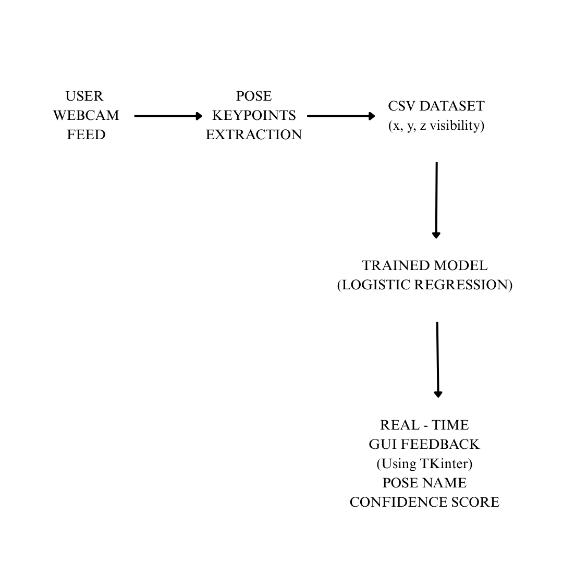
Figure 1. Systemarchitectureoutliningthephysiotherapy posedetectionpipelineusingMediaPipeandmachine learning.
5.3 Evaluation and Classification:
This model was evaluated on a test dataset using two classifiers: logistics regression and ridge classifier. Logistics regression was chosen to achieve the highest accuracyandprovidearealsystem. Pose
International Research Journal of Engineering and Technology (IRJET) e-ISSN:2395-0056
Volume: 12 Issue: 06 | Jun 2025 www.irjet.net p-ISSN:2395-0072
Table 2. Comparativemodelperformancebasedon accuracyandF1-score.
6.1 Performance Diagram: Pose Accuracy Comparison
5.4 GUI Results:
Figure 2 shows the live GUI interface. The interface recognizes Poses, shows reliable predictive names, and uses voice feedback to lead users. Supports personalized registrationandsessioninitializationforusersperforming rehabilitationexercises.

Figure 2. Real-timeGUIdetectionandfeedbackoutput duringuserexecution.
6.RESULTS
The system showed strong performance in accurate classification of physical therapy from live webcam input. The logistics regression model achieved 91% training accuracyand82%testingaccuracy.Thisdemonstrates the ability to properly generalize to invisible data. An average F1scoreof0.81continuestoconfirmtherobustnessofthe modelacrossallsevenposeclasses.
In the live version, poses such as wrist tracks, grip movements, and arm rotation were classified with high reliability under stable lighting conditions. The system showed minor power fluctuations when multiple users were encountered in a frame or when parts of the body were closed. The tracking of the landmark was also affected by sudden hand movements and background impairments.Thisunderscoredtheimportanceofaproper setup for optimal results. As a result, users were able to dynamically adjust their attitudes throughout the session andmaintainthecorrectform.Overall,theresultsexamine the system's ability to act as an effective device for homebasedunattendedphysiotherapy.
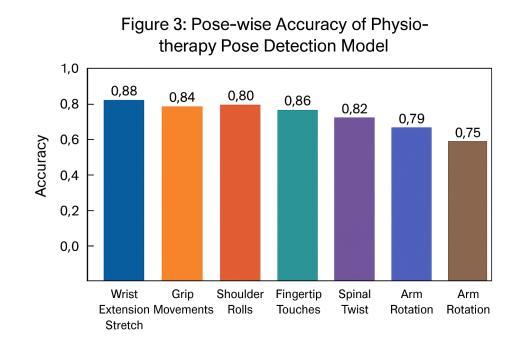
Figure 3. Accuracyofposeclassificationforeach physiotherapyexercise,showingconsistentperformance above75%forallposestested.
The future development of the proposed physiotherapy recognitionsystemwillfocusonimprovingmodelaccuracy and increasing access through devices. Data magnification technologies such as rotation, scaling and lighting variations can improve generalization under a variety of real conditions. Additionally, the system is integrated into mobile applications, allowing users to conveniently perform exercises on their smartphones. Including language-based interactions and gesture-controlled navigation also improves prospects, especially in patients with limited mobility. In a clinical setting, the Remote Monitoring-Dashboard allows therapists to assess performanceandadapttheirtreatmentplansaccordingly.
Thisstudyshowsafeedbacksystemthatuses mediacapix fermentationforreal-timedetectionofphysiotherapy, and a logistic regression classification for detection of Poznan. The system supports seven important exercises of upper bodyandspinalphysiotherapyanddeliversviaaneasy-touse GUI. Despite the challenges such as occlusion and background interference, modular design allows for continuous improvement and future scalability. The system contributes to the digital transformation of healthcare by providing cost-effective, AI-controlled solutionsforremoteFijitherapymonitoring.
[1] V. Akuhota and S. F. Nedler,” Core Strengthening,” American Academy of Physical Medicine and Rehabilitation,2004. Model
International Research Journal of Engineering and Technology (IRJET) e-ISSN:2395-0056
Volume: 12 Issue: 06 | Jun 2025 www.irjet.net p-ISSN:2395-0072
[2] R. Szeliski,” Computer Vision: Algorithms and Applications,”Springer,2010.
[3] G. Bradski and A. Kaehler,” Learning OpenCV,” O’Reilly,2008.
[4] Z.Cao,T.Simon,S.-E.WeiandY.Sheikh,”Realtime Multi-Person 2D Pose Estimation using Part Affinity Fields,” The Robotics Institute, Carnegie MellonUni-versity,2017.
[5] P. Ganesh,” Human Pose Estimation: Simplified,” Towards Data Science, 26 March 2019. [Online]. Available: https://towardsdatascience.com/human-poseestimation- simplified6cfd88542ab3. [Accessed 3 April2020].
[6] S.-E. Wei, V. Ramakhrisna, T. Kanade and Y. Sheikh,” Convolutional Pose Ma- chines,” The Robotics Institute Carnegie Mellon University, 2016.
[7] P. K. Borkar, M. M. Pulinthitha and A. Pansare,” Match Pose - A System for Comparing Poses,” International Journal of Engineering Research Technology(IJERT),vol.8,no.10,2019.
[8] M. C. Thar, K. Z. N. Winn and N. Funabiki,” A Proposal of physiotherapy Pose Assessment Method Using Pose Detection for Self- Learning,” University of Infor- mation Technology Okayama University.
[9] S. K. Yadav, A. Singh, A. Gupta and J. L. Raheja,” Real-time physiotherapy recognition using deep learning,”Springer-VerlagLondonLtd.,2019.
[10] H. Hanaizumi and H. Misono,” An OpenPose BasedMethodtoDetectTexting whileWalking,” 7th IIAE International Conference on Intelligent SystemsandIm-ageProcessing2019,2019.
[11] K. Chen,” Sitting Posture Recognition Based onOpenPose,”IOPPublishingLtd,2019.
[12] S. Jin, X. Ma, Z. Han, Y. Wu, W. Yang, W. Liu, C. Qian and W. Ouyang,” Towards Multi-Person Pose Tracking: Bottom-up and Topdown Methods,”ICCV2017,2017.