
International Research Journal of Engineering and Technology (IRJET) e-ISSN: 2395-0056
Volume: 13 Issue: 04 | Apr 2026 www.irjet.net p-ISSN: 2395-0072

International Research Journal of Engineering and Technology (IRJET) e-ISSN: 2395-0056
Volume: 13 Issue: 04 | Apr 2026 www.irjet.net p-ISSN: 2395-0072
CHEMBROLU SATISH1* , Dr.ALUGOLU AVINASH2
1M.Tech Student,Rno:24A31D5809, Dept. of Computer Science Engineering
2Associate Professor, Dept. of Computer Science Engineering Pragati Engineering College1,2, A.P, India
Abstract - Early detection of pediatric cancer remains a significanthealthcarechallengeduetonon-specificsymptoms, limited availability of annotated datasets, and delays in clinical decision-making. This studypresentsacomprehensive Agentic Artificial Intelligence framework designed for early cancer detection in children below ten years of age. The proposed system integrates multimodal medical data, including clinical records, laboratory reports, and patient history, to enhance diagnostic accuracy. Multiple intelligent agents collaboratively perform key tasks such as data preprocessing, feature extraction, classification, and result interpretation. Several machines learning models, including Support VectorMachine, LogisticRegression, RandomForest, andXGBoost, areimplementedandevaluatedforperformance comparison. Experimental results indicate that the XGBoost model achieves the highest accuracy of 93.68 percent along withan improvedF1-score, demonstratingitseffectivenessfor earlydiagnosis. Theframeworkalsoincorporatesexplainable AI techniques to improve transparency and support clinical trust inautomatedpredictions. Byreducing diagnostic delays and enabling timely intervention, the proposed system contributes to improved early-stage cancer detection in paediatric patients. This work highlights the potential of Agentic AI in advancing paediatric oncology diagnostics and supporting precision healthcare solutions.
Key Words: Agentic AI, Paediatric Cancer Detection, Machine Learning, XGBoost, Explainable AI, Multimodal Data Analysis, Early Diagnosis, Healthcare AI
Paediatric cancer detection presents unique challenges compared to adult oncology. Children often exhibit vague and non-specific symptoms such as fatigue, fever, or mild pain, which are frequently misinterpreted as common illnesses.Thisoftenresultsindelayeddiagnosisandreduced survival rates[9]. With the advancement of healthcare technologies, large volumes of medical data are now available through electronic health records, laboratory reports,andimagingsystems.ArtificialIntelligence(AI)has emergedasapromisingsolutionforanalysingsuchcomplex andheterogeneousdatatosupportearlydiagnosis[5,7] However,existingAI-basedsystemsfaceseverallimitations, includingtheinabilitytoeffectivelyintegratemultipledata sources,lack ofadaptability,andabsenceof explainability
[1,3].Mostconventionalmodelsfunctionasisolatedsystems andgeneratepredictionswithoutprovidingclearreasoning, thereby reducing trust [10,14] among clinicians. To address thesechallenges,thisresearchproposesanAgenticAI-based frameworkinwhichmultipleintelligentagentscollaborate toprocessmultimodaldataandgenerateaccurateaswellas interpretablepredictions.
The proposed system aims to enhance early detection accuracy,minimizefalsepositives,andassistclinicianswith transparentandreliabledecision-makingtools.
The dataset [16] used in this study consists of structured paediatricmedicaldata,includingdemographicattributes, clinical symptoms, and laboratory measurements. Key features include age, gender, weight, height, hemoglobin levels, white blood cell count, platelet count, and environmentalexposurefactors.Properorganizationofdata before analysis is essential; therefore, the content should initiallybepreparedseparatelybeforeapplyingformatting. Text and graphical elements should be handled independently until the final formatting stage. Authors shouldavoidunnecessaryuseofhardtabsandexcessiveline breaks,andnomanualpaginationshouldbeadded,asthe templatemanagesformattingautomatically.
Data preprocessing plays a critical role in improving the performance and reliability of machine learning models. Several preprocessing steps were implemented to ensure dataqualityandconsistency.Missingvalueswerehandled usingmeanandmedianimputationtechniques.Numerical featureswerenormalizedtomaintainuniformscaleacross variables. Categorical attributes were encoded into numerical formatstoenable model compatibility.Outliers weredetectedandremovedtopreventskewedpredictions. Additionally, feature selection techniques were applied to retainonlythemostrelevantattributes,therebyenhancing modelefficiency
Theproposedsystemadoptsasystematicmachinelearning pipelineconsistingofmultiplestagestoensureaccurateand reliablepredictions.Initially,patientdataiscollectedfrom clinicalrecordsanduserinputinterfaces.Thecollecteddata undergoes preprocessing, which includes data cleaning,
International Research Journal of Engineering and Technology (IRJET) e-ISSN: 2395-0056
Volume: 13 Issue: 04 | Apr 2026 www.irjet.net p-ISSN: 2395-0072
normalization,andfeatureselectiontoimprovedataquality. In the feature engineering stage, significant attributes are extractedtoenhancemodellearningcapability. Subsequently, multiple machine learning models such as SupportVectorMachine,LogisticRegression,RandomForest, andXGBoostaretrainedusingtheprocessed[8.9]dataset.The trained models are then evaluated based on standard performancemetricstodeterminetheireffectiveness.Among the evaluated models, XGBoost demonstrates superior performance and is selected as the final model for deployment.Thesystemthengeneratesreal-timepredictions basedonnewinputdata.Additionally,explainableartificial intelligence techniques are integrated to provide interpretabilityandreasoningbehindthemodelpredictions, therebyimprovingtrustandusability[1,3,13]inclinicalsettings.
Evaluation Metrics:
Accuracy is used to measure the proportion of correctly classifiedinstancesamongthetotalobservations.
Accuracy = (TP + TN) / (TP + TN + FP + FN)
F1Scoreisusedtobalanceprecisionandrecall,especiallyin casesofimbalanceddatasets.
F1 Score = 2 × (Precision × Recall) / (Precision + Recall)
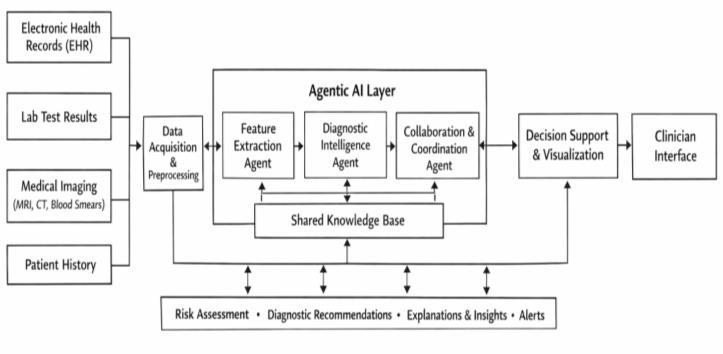
Thesystemarchitectureconsistsoffourmainlayers:
1.DataLayer–Collectspatientdatafrommultiplesources.
2.PreprocessingLayer–Cleansandpreparesdata.
3.AgentLayer–IncludesDataAgent,FeatureAgent, DiagnosticAgent,andExplainabilityAgent.
4.DecisionLayer–Generatespredictionsand recommendations.
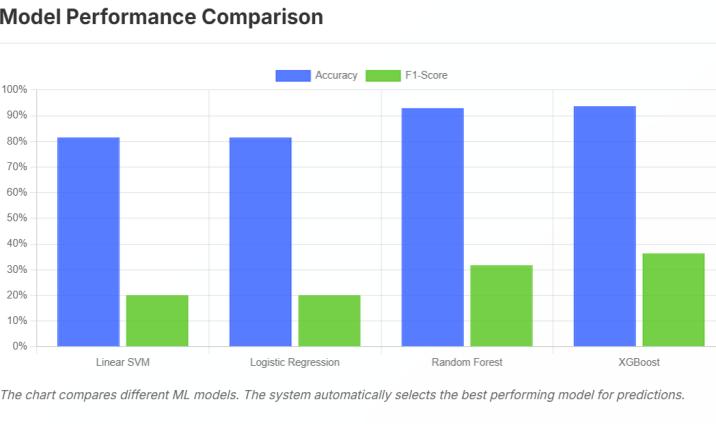
This section presents the performance evaluation of the proposed machine learning models along with system predictions based on real-time patient data inputs. The comparisonofmodelsindicatesthatXGBoostoutperforms otheralgorithmsintermsofbothaccuracyandF1-score.
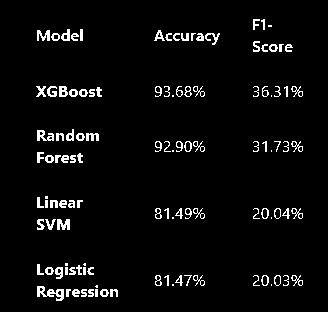
Fromtheexperimentalresults,XGBoostachievesthehighest accuracyof 93.68% andanF1-scoreof 36.31%,followedby Random Forest with 92.90% accuracy and 31.73% F1score. Linear SVM and Logistic Regression show comparatively lower performance, both achieving approximately 81.4% accuracy and 20% F1-score. This demonstrates that ensemble-based models provide better predictive capability for paediatric cancer detection compared [7,8]totraditionalmodels.
Thesystemalsosupportsreal-timepredictionusingpatient medicalinputssuchasage,gender,laboratoryvalues,and clinicalsymptoms.Basedontheprovidedsampleinput,the model predicts “No Cancer” with a confidence score of 89.92%,indicatingalowprobabilityofcancerpresence. Additionally,ExplainableAI(XAI)techniquesareintegrated into the system to provide interpretability [1,2,4]. The explanationoutputindicatesthatthepredictionisbasedon theabsenceofstrongcancer-relatedindicatorsintheinput data. It also emphasizes that the result is not a definitive diagnosis and recommends further clinical evaluation, thereby supporting responsible and informed medical decision-making.
Overall,theresultsdemonstratethattheproposedAgentic AI framework effectively improves prediction accuracy, supportsreal-timeclinicalusage,andenhancestransparency throughexplainableinsights[3,10,11]
International Research Journal of Engineering and Technology (IRJET) e-ISSN: 2395-0056
Fig -3: ComparisonofdifferentMLmodelsintabularform
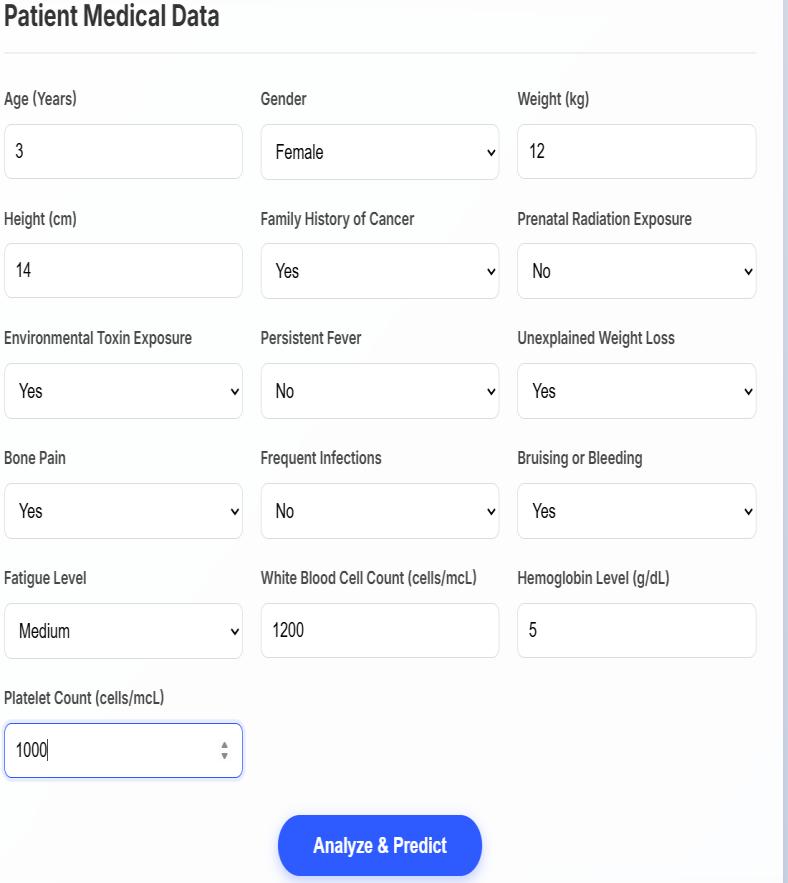
Fig -4: Predictionforcancerdetection(Runtimevalues)
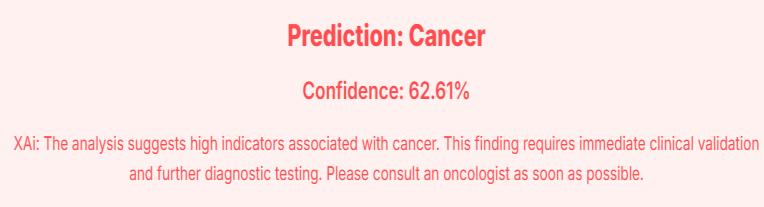
Fig -5: PredictionOutput
REFERENCES
1) D.Jin,E.Sergeeva,W.-H.Weng,G.ChauhanandP. Szolovits,ExplainableDeepLearninginHealthcare: AMethodologicalSurveyfromanAttributionView, arXiv preprint,Dec.2021.arXiv
2) B.DhanalaxmiandP.V.V.S.Srinivas,“Explainable MultimodalDeepLearninginHealthcare:ASurvey of Current Approaches,” International Research Journal on Advanced Engineering Hub (IRJAEH), vol.3,no.03,pp.1055–1059,Mar.2025.Irjaeh
3) A.Chaddad,J.Peng,J.XuandA.Bouridane,“Survey of Explainable AI Techniques in Healthcare,” Sensors,vol.23,no.2,pp.634,Jan.2023.MDPI
4) D.Bhati,F.NehaandM.Amiruzzaman,“ASurveyon ExplainableArtificialIntelligence(XAI)Techniques for Visualizing Deep Learning Models in Medical Imaging,” J.Imaging,vol.10,no.10,pp.239,Sept. 2024.MDPI
5) “Artificial Intelligence in Paediatric Clinical Medicine: Applications, Innovations and Practical Implications,” Eur. J. Clin. Med., 2025. European JournalofClinicalMedicine
6) “Artificial intelligence for neuroimaging in paediatric cancer: current state and challenges,” PubMed,2025.PubMed
7) Y. Yang, Y. Zhang and Y. Li, “Artificial intelligence applications in paediatric oncology diagnosis,” Explor. Target Antitumor Ther., vol. 4, no. 1, pp. 157–169,Feb.2023.PMC
8) M. Hassan, S. Shahzadi and A. Kloczkowski, “Harnessing Artificial Intelligence in Paediatric Oncology Diagnosis and Treatment: A Review,” Cancers,vol.17,no.11,1828,May2025.PMC
9) N.N.Elsayidetal.,“TheRoleofMachineLearning Approaches in Paediatric Oncology: A Systematic Review,”Cureus,vol.17,no.1,e77524,Jan.2025. PMC
10) “A survey of explainable artificial intelligence in healthcare:Concepts,applications,andchallenges,” InformaticsMed.Unlocked,vol.51,101587,2024. ScienceDirect
11) S. Nerella, S. Bandyopadhyay, J. Zhang et al., “Transformers in Healthcare: A Survey,” arXiv preprint,Jul.2023.arXiv
12) H.Daldrup-Link,“Artificialintelligenceapplications for paediatric oncology imaging,” Pediatr. Radiol., vol.49,no.11,pp.1384–1390,Oct.2019.PMC
13) “Explainable artificial intelligence (XAI) in deep learning-based medical image analysis,” arXiv preprint,Jul.2021.arXiv
Volume: 13 Issue: 04 | Apr 2026 www.irjet.net p-ISSN: 2395-0072 © 2026, IRJET | Impact Factor value: 8.315 | ISO 9001:2008 Certified Journal | Page89
International Research Journal of Engineering and Technology (IRJET) e-ISSN: 2395-0056
Volume: 13 Issue: 04 | Apr 2026 www.irjet.net p-ISSN: 2395-0072
14) “Explainable deep learning models and interpretability in medical AI,” PubMed, various authors,ongoingsurveysin2023-24.PubMed
15) “Artificial intelligence applications in paediatric oncology,” World Neurosurg., highlighted by systematicreviews.
16) https://drive.google.com/file/d/1JZmbSr6IZEF4cZ A3k50fJeOObLDPJ_EB/view?usp=drive_link
BIOGRAPHIES


Mr Ch Satish working as Assistant professor in Electronics and communication department, Pragati Engineering college, Surampalem with 16yearsofexperience,with3yearsof softwareindustryexperienceatSynergy MultiTech,Hyderabad.Hehaspublished 3 international journals and 1 book chapter and 1 UGC journal paper. Attendedseveralworkshopsandguest lectures,doneNPTELcoursesinMPMC, Communicationskills,PYTHONcourses.
Dr.A.Avinash,AssociateProfessor,CSE departmentwith15yearsofexperience inteachingwithmachinelearning-NLP specialization , published over 35 Plus research articles in reputed journals, published3 patents,5 book chapters,3 textbooks,He'samemberofIAENGand ISRD . Reviewer for Springer Nature journal neural computing and applications(NCAA).