
International Research Journal of Engineering and Technology (IRJET) e-ISSN: 2395-0056
Volume: 12 Issue: 04 | Apr 2025 www.irjet.net p-ISSN: 2395-0072
International Research Journal of Engineering and Technology (IRJET) e-ISSN: 2395-0056
Volume: 12 Issue: 04 | Apr 2025 www.irjet.net p-ISSN: 2395-0072
Prakash Singh-Madhur Srivastava
1M.Tech (CAD CAM) Scholar, Department of Mechanical Engineering, Ambalika Institute of Management & Technology, Lucknow, Uttar Pradesh, India
2 Assistant Professor, Department of Mechanical Engineering, Ambalika Institute of Management & Technology, Lucknow, Uttar Pradesh, India
Abstract- FrictionStirWelding(FSW)offersapromising solid-state joining method, particularly for high-strength aluminum alloys like AA7075-T6, which are prone to welding defects under conventional fusion methods. This research evaluates how variations in welding speed (50–100 mm/min) and axial force (4–10 kN) influence mechanical performance and microstructural features of FSW joints. Using a systematic design of experiments, joints were evaluated via tensile testing, Vickers microhardness, and optical microscopy. Optimal results were found at 60 mm/min and 6 kN, yielding a tensile strengthof420MPaandrefined,defect-freegrains.These findings provide actionable insight into parameter selection for advanced aerospace and automotive applications.
Key Words: Friction Stir Welding (FSW), Welding Speed andAxialForce,tensilestrength,etc.
Tungsten Friction Stir Welding (FSW) is a solid-state joining process that has revolutionized the way engineers and manufacturers approach the welding of non-ferrous metals, especially aluminum alloys. Developed by The Welding Institute (TWI) in 1991, the technique involves theuseofaspeciallydesignedrotatingtoolwithapinand shoulder that is plunged into the abutting edges of the workpieces to be joined. As the tool traverses along the jointline,frictionalheatandplasticdeformationsoftenthe material without reaching its melting point. The softened material is stirred and forged under axial pressure, resulting in a high-integrity, fully consolidated weld. This methodeliminatescommonfusionweldingdefectssuchas solidification cracking, porosity, and metallurgical discontinuities.
High-strengthaluminumalloyssuchasAA7075-T6,which are precipitation-hardened and belong to the 7xxx series, areessentialinhigh-performanceapplicationsduetotheir excellent strength-to-weight ratio, fatigue resistance, and corrosion behavior. These alloys are widely used in aerospace structures, automotive crash components, defense systems, and marine applications. However, their inherent weldability issues pose significant challenges.
Traditional arc welding techniques often degrade the mechanical properties of these alloys by dissolving strengthening precipitates and inducing defects such as hot cracking and voids due to their high thermal conductivityandlowsolidustemperature.
FSWprovidesaneffectivesolutionbyjoiningthematerial inthesolidstate,preservingitsmetallurgicalintegrityand reducing heat-affected damage. Nevertheless, the mechanicalandmicrostructuralqualityoftheFSWjointis highlysensitivetoprocess parameters.Amongthecritical variablesinFSW,weldingspeed(traversespeed)andaxial force (downward pressure) play vital roles. These parameters control heat input, material flow, toolworkpiece interaction, and recrystallization behavior, all ofwhichinfluencethefinaljointstrengthandquality.
i. Welding speed affects the time available for frictional heat generation and plastic flow. Higher speeds reduce heat input, potentially leading to defects such as tunnel voids due to inadequate stirring. Conversely, slower speeds increase heat, whichcancausegraincoarseningorexcessiveflash.
ii. Axial force governs the depth of tool penetration and material consolidation. Insufficient axial force may lead to incomplete bonding or void formation, while excessive force can cause flash defects and increasetoolwear.
While previous studies have addressed these variables independently, limited research has examined their combined effects on the FSW of AA7075-T6, especially under industrially relevant conditions. Moreover, the interaction between these parameters remains underexploredintermsofhowtheyaffectjointefficiency, hardness gradients, and microstructural transformation zones,suchasthenuggetzone(NZ),thermo-mechanically affectedzone(TMAZ),andheat-affectedzone(HAZ).
Thepresentstudyaimstobridgethisgapbyconductinga comprehensiveparametricinvestigationintohowvarying welding speeds and axial forces influence the mechanical properties and internal structure of AA7075-T6 FSW joints. Through systematic experimentation and
International Research Journal of Engineering and Technology (IRJET) e-ISSN: 2395-0056
Volume: 12 Issue: 04 | Apr 2025 www.irjet.net p-ISSN: 2395-0072
analysis includingtensiletesting,Vickersmicrohardness profiling, optical microscopy, and defect inspection this work provides insight into the optimal parameter combinations that maximize joint strength and quality. The outcomes are expected to contribute significantly to the development of optimized process protocols for the FSWofhigh-strengthaluminumalloys,therebyenhancing their reliability and efficiency in critical structural applications
Friction Stir Welding (FSW) has been the subject of extensive research since its introduction by The Welding Institute(TWI)in1991.Itsabilitytoproduce high-quality joints in difficult-to-weld materials, especially aluminum alloys, has driven considerable interest in both academic and industrial settings. Numerous studies have explored the influence of key process parameters including welding speed, tool rotation speed, axial force, and tool design onjointperformance,mechanicalproperties,and microstructural features. However, thecombined effect of welding speed and axial force, particularly in highstrength aluminum alloys like AA7075-T6, remains insufficientlyaddressedinthecurrentbodyofliterature.
Mishra and Ma (2005) provided one of the earliest comprehensivereviewsofFSW,highlightingtheinfluence of tool rotation speed and welding speed on the heat generation and dynamic recrystallization in the nugget zone. Their findings established that increasing tool rotation enhances heat input, while increasing traverse speed reduces it both of which significantly affect weld morphologyandmechanicalstrength.
Rajakumaretal.(2011)conductedadetailedstudyonthe FSW of AA7075-T6, optimizing process parameters using a statistical design of experiments approach. They found that tool rotation speed and welding speed jointly influence tensile strength, but noted that excessively high or low values could lead to reduced weld quality due to overheating or lack of material mixing. They achieved a maximum joint efficiency of 77% under optimized parameters.
Liu et al. (2013) examined the microstructure and mechanical properties of FSW joints in 7075 aluminum alloy, showing that slower welding speeds lead to larger grain sizes due to increased heat input and prolonged exposure. They also observed that faster traverse speeds improved mechanical strength but increased the risk of tunneldefectsifaxialforcewasnotadequatelycontrolled.
Esparzaetal.(2018)emphasizedtheneedtobalanceaxial force with other parameters. Their work demonstrated
that excessive axial force not only leads to flash and tool degradation but can also reduce joint performance due to increased residual stresses. On the other hand, low axial forces cause poor material consolidation and internal voids,negativelyaffectingtensileandfatigueproperties.
Zhao et al. (2012) modeled the thermal profiles in FSW and demonstrated that welding speed directly influences the peak temperature in the nugget zone. Higher welding speeds reduce the time for heat accumulation, which can refine grain size but may limit complete material mixing. They recommended a moderate welding speed to balance thermalsofteningandplasticflow.
Sato et al. (1999) provided detailed observations on microstructural evolution during FSW, revealing that optimal welding speed ensures a well-defined, equiaxed grain structure in the stir zone, which is critical for achieving high strength and toughness. Their work confirmedtheimportanceofmaintainingaproperthermal cyclethroughspeedcontrol.
Elangovan and Balasubramanian (2008) investigated the effect of axial force on weld defects and found a direct correlation between downward force and material consolidation.Insufficientforceledtolackofbondingand wormhole defects, while too much force increased flash formationandwearonthetoolshoulder.
Buffaetal.(2009)usednumericalsimulationstostudythe influence of process parameters on FSW thermal and material flow fields. They highlighted that axial force is crucial in governing the size of the nugget zone and directly impacts the vertical pressure and frictional heat generation,ultimatelyaffectingthemechanicalstrengthof theweld.
Despitethesevaluablecontributions,mostexistingstudies evaluate welding speed and axial force in isolation, with limited attention to their interdependent effects on joint performance in high-strength precipitation-hardened alloys like AA7075-T6. There is also a lack of comprehensive data linking parameter variations with defect types, grain boundary behavior, and hardness distribution across the weld region. Moreover, optimization studies often rely on empirical trial-anderror approaches rather than systematically designed experimentsconsideringcombinedparametervariations.
International Research Journal of Engineering and Technology (IRJET) e-ISSN: 2395-0056
Volume: 12 Issue: 04 | Apr 2025 www.irjet.net p-ISSN: 2395-0072
Given the critical importance of AA7075-T6 in aerospace and automotive sectors, where joint integrity and consistency are paramount, there is a compelling need to explore the interactive influence of welding speed and axial force. This study addresses this gap by conducting a parametric analysis, integrating mechanical testing with microstructural examination to derive meaningful conclusionsforindustrialapplication
3.1 Material Selection
a) Base Material: AA7075-T6,5mmthick
Composition (wt.%): Al (Base), Zn (5.6%), Mg (2.5%), Cu (1.6%),Fe(0.5%)
b) Tool Material: H13 tool steel, heat-treated for wear resistance
Design: Threaded cylindrical pin (5 mm dia., 4 mm length),concaveshoulder(15mm)
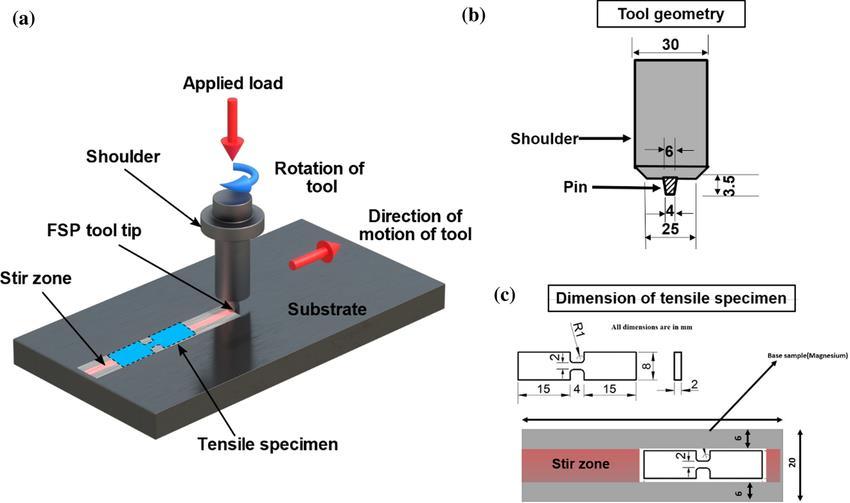
Figure1:FrictionstirweldingProcess
3.2 Welding Parameters
Table1:Weldingparameters
Parameter Levels
WeldingSpeed 50,60,75,100mm/min
AxialForce 4,6,8,10kN
ToolRotation Constantat1000rpm
TiltAngle 2°
3.3 Experimental Setup
CNC-controlled FSW machine ensured consistent forceandtravelrate.
Thermocouples monitored in-situ temperatures inthenuggetzone.
12sampleswereproducedtocoverallparameter combinations.
3.4 Testing Procedures
i. Tensile Testing: ASTM E8 sub-sized specimens, testedat2mm/min
ii. Hardness: Vickers hardness across the crosssection(HV0.1)
iii. Microstructure: Etched samples (Keller's reagent)observedunderOM&SEM
iv. Radiography: X-ray analysis for tunnel/void defects
4.1 Welding Speed
Table2:EffectofWeldingSpeedonUTSatConstantAxial Force(6kN)
(mm/min)
(MPa) Hardness(HV) Defects
Force (kN) UTS (MPa) Defects
Figure2:Speed,UTSandHardnessofwelding
International Research Journal of Engineering and Technology (IRJET) e-ISSN: 2395-0056
Volume: 12 Issue: 04 | Apr 2025 www.irjet.net p-ISSN: 2395-0072
i. Low speeds (50 mm/min): Excessive heat input ledtograincoarsening.
ii. Optimal speed (60 mm/min): Balanced heat inputpromoteddynamicrecrystallization.
iii. High speeds (100mm/min):Inadequatematerial flowresultedinvoidsandtunneldefects.
4.2 Axial Force
Table3:AxialForcevs.TensileStrengthatConstantSpeed (60mm/min)
UTS(MPa) Defects FlashFormation
4 360 Voids None
6 420 None Minimal
8 405 None Moderate
10 390 None Excessive
i. Lower force (4 kN): Insufficient consolidation → voids.
ii. Higher force (10 kN): Induced flash and thermal softening,loweringstrength.
iii. Best balance at 6 kN: Full consolidation, low flash.
4.3 Microstructural Analysis
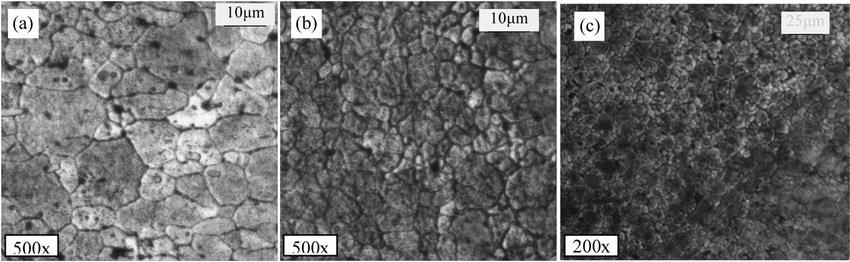
Figure3:Microstructureofweldedjoints
Figure3describedthefollowingpoints-
a) Stir Zone (SZ): Fine, equiaxed grains (~10 µm) duetodynamicrecrystallization.
b) Thermo-Mechanically Affected Zone (TMAZ): Elongatedgrains,minorcoarsening.
c) Heat Affected Zone (HAZ): Grain growth with softenedmicrostructure(lossofprecipitates).
d) SEM revealed no porosity or voids in optimal samples; tunnel defects were visible at high weldingspeeds.
This study confirmed that welding speed and axial force significantly influence the quality of FSW joints in AA7075-T6. The best combination 60 mm/min welding speedand6kNaxialforce yielded:
Hightensilestrength(420MPa)
Uniformhardness(150HV0.1)
Defect-free,recrystallizedmicrostructure
These findings support precise tuning of process parameters for demanding applications like aerospace fuselagejoiningandautomotivecrashcomponents.
Toadvancethisresearch:
a) Incorporate finite element modeling (FEM) to simulatetemperatureandstraindistribution.
b) Extend studies to dissimilar materials and multipasswelding.
c) Investigate tool wear and lifetime at different forcesforindustrialscaling.
[1] Buffa, G., Hua, J., Shivpuri, R., & Fratini, L. (2009). A continuum based FEM model for friction stir welding Model development. Materials Science and Engineering: A, 419(1-2), 389–396. https://doi.org/10.1016/j.msea.2005.12.007
[2] Elangovan, K., & Balasubramanian, V. (2008). Influences of tool pin profile and tool shoulder diameter on the formation of friction stir processing zone in AA6061 aluminium alloy. Materials and Design, 29(2), 362–373. https://doi.org/10.1016/j.matdes.2006.11.002
[3] Esparza, D., Cabrera, J. M., & Prado, J. M. (2018). Effects of axial force and heat generation in friction stir welding of AA7075 aluminum alloy. Procedia Manufacturing, 13, 262–269. https://doi.org/10.1016/j.promfg.2017.09.058
[4] Liu,H.J.,Zhang,H.J.,Yu,L.,&Yu,S.(2013).Effect of welding parameters on microstructure and mechanical properties of friction stir welded jointsof7075aluminumalloy. Materials&Design, 45, 576–582. https://doi.org/10.1016/j.matdes.2012.09.032
[5] Mishra, R. S., & Ma, Z. Y. (2005). Friction stir welding and processing. Materials Science and Engineering: R: Reports, 50(1–2), 1–78. https://doi.org/10.1016/j.mser.2005.07.001
International Research Journal of Engineering and Technology (IRJET) e-ISSN: 2395-0056
Volume: 12 Issue: 04 | Apr 2025 www.irjet.net p-ISSN: 2395-0072
[6] Rajakumar, S., Muralidharan, C., & Balasubramanian, V. (2011). Influence of friction stir welding process and tool parameters on strength properties of AA7075-T6 aluminium alloy joints. Materials & Design, 32(2), 535–549. https://doi.org/10.1016/j.matdes.2010.08.025
[7] Sato, Y. S., Urata, M., & Kokawa, H. (1999). Parameters controlling microstructure and hardness during friction-stir welding of precipitation-hardenable aluminum alloy 6063. Metallurgical and Materials Transactions A, 30(12), 3125–3130. https://doi.org/10.1007/s11661-999-0072-7
[8] Zhao, Y., Zhang, D., & Wang, X. (2012). Numerical simulation of temperature field in friction stir welding of 7050 aluminum alloy. Materials and Manufacturing Processes, 27(6), 641–646. https://doi.org/10.1080/10426914.2011.606520
[9] Cavaliere, P., & Squillace, A. (2008). Mechanical properties of 2024 aluminium alloy joints produced by friction stir welding. Materials & Design, 29(1), 138–143. https://doi.org/10.1016/j.matdes.2006.11.001
[10] Colegrove, P. A., & Shercliff, H. R. (2005). 3Dimensional CFD modelling of flow round a threadedfrictionstirweldingtoolprofile. Journal ofMaterialsProcessingTechnology, 169(2), 320–327.https://doi.org/10.1016/j.jmatprotec.2005.0 4.120
[11] Hattingh, D. G., Blignault, C., van Niekerk, T. I., & James, M. N. (2008). Characterization of the influences of FSW tool geometry on welding forces and weld tensile strength using an instrumentedtool. JournalofMaterialsProcessing Technology, 203(1–3), 46–57. https://doi.org/10.1016/j.jmatprotec.2007.09.04 0
[12] Kumar, K., & Kailas, S. V. (2008). The role of friction stir welding tool on material flow and weld formation. Materials Science and Engineering: A, 485(1–2), 367–374. https://doi.org/10.1016/j.msea.2007.08.018
[13] Lee,W.B.,&Yeon,Y.M.(2003).Characteristicsof friction stir welded pure aluminum joints by rolled tool. MaterialsScienceandEngineering:A, 355(1–2), 154–159. https://doi.org/10.1016/S0921-5093(03)000202
[14] Peel, M. J., Steuwer, A., Preuss, M., & Withers, P. J. (2003). Microstructure, mechanical properties and residual stresses as a function of welding speed in aluminium AA5083 friction stir welds. Acta Materialia, 51(16), 4791–4801. https://doi.org/10.1016/S1359-6454(03)003197
[15] Schneider, J. A., & Nunes, A. C. (2004). Characterization of plastic flow and resulting
microtexturesinafrictionstirweld. Metallurgical andMaterialsTransactionsA, 35(8), 2927–2937. https://doi.org/10.1007/s11661-004-0275-y
[16] Threadgill, P. L., Leonard, A. J., Shercliff, H. R., & Withers, P. J. (2009). Friction stir welding of aluminiumalloys. InternationalMaterialsReviews, 54(2), 49–93. https://doi.org/10.1179/174328009X411136