
International Research Journal of Engineering and Technology (IRJET) e-ISSN: 2395-0056
Volume: 13 Issue: 04 | Apr 2026 www.irjet.net p-ISSN: 2395-0072

International Research Journal of Engineering and Technology (IRJET) e-ISSN: 2395-0056
Volume: 13 Issue: 04 | Apr 2026 www.irjet.net p-ISSN: 2395-0072
Devi Anitha, Dr.P.S.V.Vachaspati, Ande Venkata Harshitha, Chintapalli Mohammad Jani, Galimutti Aneeth Babu
Department of Computer Science and Engineering, Bapatla Engineering College, Andhra Pradesh,India
Abstract: Inthemoderndigitalera,unhealthydietaryhabitsandlackofnutritionalawarenesshavesignificantlycontributed tolifestyle-relateddiseases.Althoughseveralnutrition-trackingapplicationsexist,mostofthemfailtoprovidepersonalized health guidance based on individual user profiles and consumed foods. This research paper presents NutriLens, a webbasedfoodnutritionandhealthanalysissystemthatcollectsuser-specificdetailssuchasage,weight,andhealthconditions, and evaluates the nutritional suitability of consumable foods. The system analyzes user food items using standardized nutritiondatabases,havingunitconversionsformeasuringthefoodquantity, visualizesnutrientcompositionthroughpie charts,andrecommendshealthierfoodchoicestailoredtotheuser’sbodyrequirements.NutriLensaimstobridgethegap betweenfoodconsumptionandpersonalizedhealthawarenessthroughanintelligent,user-centricapproach.
Keywords: PersonalizedNutrition,FoodIntakeAnalysis,DietaryRecommendationSystems,NutritionalInformatics,HealthAware Food Analysis, Unit Conversion Modeling, Interactive Data Visualization, Web-Based Healthcare Systems, Decision SupportSystems
Nutritionisafoundationaldeterminantofhumanhealth, directly influencing disease prevention, physiological recovery, and long-term well-being. Adequate intake of macro- and micronutrients is especially critical during physiologically demanding conditions such as injury recovery, postpartum care, anemia, aging, and chronic disease management, where improper nutrition can significantlydelayrecoveryandworsenhealthoutcomes [6], [7], [9], [16]. Despite increased public awareness regarding healthy dietary practices, a persistent gap remains between theoretical nutritional knowledge and its consistent application in everyday life, particularly amongnon-expertindividuals[11],[12].
Therapidgrowthofdigitalhealthtechnologieshasledto widespread adoption of nutrition-tracking applications designed to assist users in monitoring dietary intake. However, most existing systems are primarily limited to calorie estimation and basic macronutrient tracking, offeringminimalsupportforpersonalizedandconditionspecific dietary guidance [2], [8], [11]. These platforms typically overlook critical user-specific factors such as age, gender, physiological condition, recovery stage, and mealtiming.Consequently,usersmustmanuallyinterpret numerical nutrient summaries, which often results in poor usability, reduced engagement, and ineffective decision-making[8],[12].
This limitation becomes more pronounced in healthsensitive scenarios, including diabetes management, anemia treatment, bone fracture recovery, postpartum nutrition,andinjuryrehabilitation,wheregenericdietary recommendations may be insufficient or even clinically inappropriate [6], [7], [10]. Furthermore, conventional nutrition systems rely heavily on rigid structured inputs such as barcode scanning and predefined food database searches, increasing user effort and reducing long-term adherence [2], [3]. Another critical weakness lies in the presentation of nutritional feedback. Static tables and text-based summaries fail to effectively communicate actionable insights, whereas interactive and visual representationshavebeenshowntosignificantlyimprove comprehension and user engagement in digital health environments[3],[4],[11].
To address these limitations, this paper proposes NutriLens: A Personalized Food Nutrition and Health Analyzer, an AI-driven web-based framework that bridgesthegapbetweendietaryintakeandindividualized health awareness. NutriLens integrates adaptive user profiling,natural-language-basedmeallogging,real-time nutritional computation, and health-condition-aware reasoning to generate personalized dietary insights [1], [2], [5]. The system converts unstructured food descriptions into standardized nutritional values using validated nutrition databases and performs automated
International Research Journal of Engineering and Technology (IRJET) e-ISSN: 2395-0056
Volume: 13 Issue: 04 | Apr 2026 www.irjet.net p-ISSN: 2395-0072
unitnormalizationtoensureaccuratequantityestimation [13],[14].
Unlike traditional nutrition platforms, NutriLens incorporatescontext-awareintelligencethatdynamically adjusts analysis based on user attributes such as age, health condition, and meal timing. Nutritional composition is presented through interactive visual analyticstoenhanceinterpretability, whilea multimodal AIavatardeliverssynchronizedvisual,textual,andaudio feedbacktoimproveengagementandaccessibility[3],[4], [15],[17],[18].
Themajorcontributionsofthisworkaresummarizedas follows:
1. Development of an AI-driven personalized nutrition analysis framework incorporating health-condition-awaredietaryreasoning.
2. Natural language-based meal input with automated quantity normalization and nutritionalcomputation.
3. Interactive visual analytics for intuitive interpretation of nutrient composition and dietarybalance.
4. MultimodalfeedbackdeliveryusinganAIavatar to improve user comprehension and engagement.
5. Scenario-specific dietary guidance supporting recovery, disease prevention, and long-term healthmanagement.
Recentadvancesinartificialintelligencehaveenabledthe developmentofintelligent nutritionanalysisanddietary recommendation systems. Existing research in this domain primarily focuses on food recognition, nutrient estimation, and personalized dietary guidance using machinelearningandrule-basedapproaches.
Several studies employ computer vision techniques for food identification and portion estimation, leveraging convolutional neural networks and object detection models such as YOLO and Faster R-CNN. These approaches demonstrate promising accuracy under controlled imaging conditions; however, their performancedegradesinreal-worldenvironmentsdueto
lightingvariations,occlusions,mixeddishes,andregional food diversity. Additionally, image-based systems typically require extensive labeled datasets, which often lack adequate representation of traditional Indian cuisinesandhome-cookedmeals.
Recent survey studies categorize AI-driven nutrition systems into vision-based food recognition, nutrient assessment models, and personalized dietary recommendation engines. While these systems advance automatedfoodanalysis,limitedattentionhasbeengiven to free-text or speech-based meal logging, despite its suitability for everyday use and accessibility across diverseusergroups.
Natural language processing–based food intake analysis remains comparatively underexplored. Existing textbasedsystemsoftenrelyonrigidtemplatesorpredefined food lists, restricting usability in casual, real-world scenarios involving ambiguous or mixed food descriptions.
2.PersonalizedDietaryRecommendationSystems
Personalized nutrition platforms have been proposed using machine learning, case-based reasoning, and knowledge-driven frameworks. Applications such as virtualnutritionadvisorsgeneratedietaryplansbasedon user attributes including age, weight, preferences, and health objectives. Specialized systems have been developed for clinical populations, such as cancer patients, where dietary recommendations are generated for predefined meal categories (breakfast, lunch, and dinner).
Knowledgegraph–basedapproacheshavebeenappliedto address multimorbidity in elderly populations, demonstrating improvements in dietary diversity and nutritional balance compared to self-selected diets. However, many existing systems assume manual meal categorization and do not dynamically adapt recommendations based on actual time of consumption orshort-termrecoveryphases.
Furthermore, most personalized nutrition systems deliver feedback primarily through static textual interfaces, which may limit user engagement and comprehension,particularlyfornon-technicalusers.
3.HealthCondition–AwareNutritionSystems
Numerousclinicalstudiesestablishstronglinksbetween dietary patterns and health outcomes. For example,
International Research Journal of Engineering and Technology (IRJET) e-ISSN: 2395-0056
Volume: 13 Issue: 04 | Apr 2026 www.irjet.net p-ISSN: 2395-0072
calcium- and vitamin D–rich diets are associated with improvedbonerecoveryandreducedfracturerisk,while iron intake plays a critical role in postpartum recovery andanemiamanagement.Despitetheavailabilityofsuch evidence-basedguidelines,fewnutritionanalysissystems integrate condition-specific dietary constraints dynamically or recommend duration-based nutritional protocols.
Existing platforms largely focus on chronic disease managementandoverlookacutehealthscenariossuchas injury recovery, active bleeding, or short-term rehabilitation, where nutritional requirements differ significantlyfromlong-termdietaryplanning.
D.ResearchGaps
Basedonthereviewedliterature,thefollowinglimitations areidentifiedincurrentnutritionanalysissystems:
• Limited support for free-text or conversational mealinput.
• Dependence on image-based food recognition underunconstrainedconditions.
• Absenceofinteractivevisualizationsfornutrient comprehension.
• Lackofautomaticmeal-timedetection.
• Insufficient handling of acute and recoveryoriented health conditions with time-bound dietaryguidance.
System / Study Core Approach Strengths Critical Limitations
NutrifyAI[1]
ChatDiet[2]
AI-based food detection and nutritionestimation
Real-time food recognition; automated nutrient calculation
LLM-powered conversational diet assistant
NUTRIVISION [3]
DietGlance[4]
Automated diet monitoring in smart healthcare
Knowledge-based dietary monitoring andanalysis
Natural language interaction; personalized dietary suggestions
Continuous monitoring; healthcare-oriented design
AI-assisted monitoring and recommendations
Mainly focuses on food detection; limited healthconditionreasoning;weak personalization beyond calories and macronutrients
Limited structured nutrient accuracy; weak nutrient visualization; minimalclinical-condition awareness
Depends on structured input; limited usability; weak engagement and interpretability
Static data presentation; limited real-time personalization; low engagement
Research Gap Addressed by NutriLens
Adds health-conditionaware dietary reasoningandadaptive personalization based on physiological condition
Provides accurate nutrient computation with visualization and condition-specific reasoning
Enables free-text meal loggingwithinteractive visualization and multimodalfeedback
Introduces interactive visualanalyticsandAIavatar-basedfeedback
International Research Journal of Engineering and Technology (IRJET) e-ISSN: 2395-0056
Volume: 13 Issue: 04 | Apr 2026 www.irjet.net p-ISSN: 2395-0072
System / Study Core Approach
Strengths
Critical Limitations
Integrated AI Nutrition Framework[5]
Generic Nutrition Apps (e.g., MyFitnessPal)
Machine Learning and NLP-based dietary recommendation
Strong personalization; intelligent recommendations
Caloriecountingand macronutrient tracking
Large food database; simpletracking
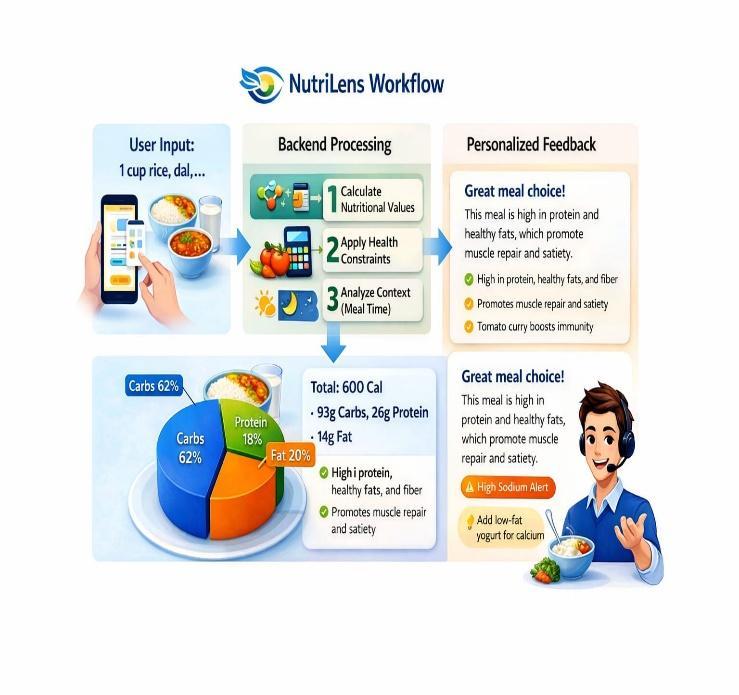
ThesegapsmotivatethedevelopmentofNutriLens,which integrates natural language meal logging, unit-based quantity normalization, condition-aware reasoning, and multimodal feedback within a unified personalized nutritionanalysisframework
Ⅲ System Design Framework
A. System Design
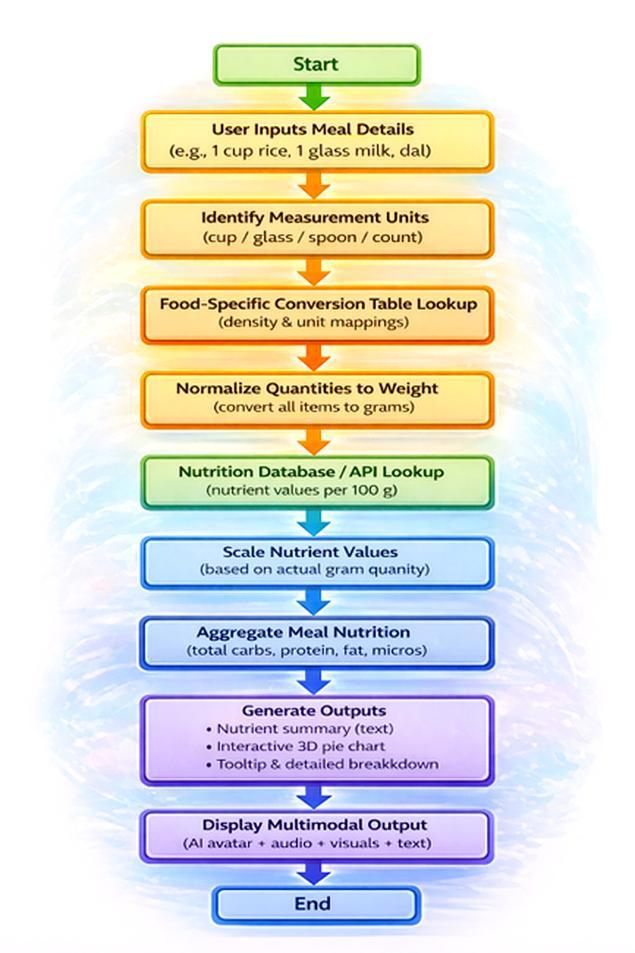
NutriLens is designed as a modular, service-oriented system to support real-time nutritional analysis, personalized health reasoning, and multimodal user interaction. To ensure scalability, maintainability, and extensibility, the system architecture is organized into threeprimarylayers:theFrontendLayer,BackendLayer, andDataandExternalServicesLayer,asillustratedinFig. 1.
The Frontend Layer serves as the primary interface between the user and the system. It is responsible for capturinguserinput,presentingnutritionalinsights,and delivering interactive feedback in an intuitive and engagingmanner.Thislayersupportsbothstructuredand unstructured meal logging, allowing users to input food consumption details in natural language or via voicebasedinteraction.
Userprofilesetupishandledduringtheinitialonboarding process, where demographic attributes and health
Focuses mainly on recommendation generation; lacks realtime adaptive feedback andvisualization
No health-condition awareness; manual interpretation required; weakpersonalization;low engagement
Research Gap Addressed by NutriLens
Combines real-time analysis, visualization, and adaptive feedback loop
Enablescontext-aware, health-conditionspecific, automated dietary insight generation
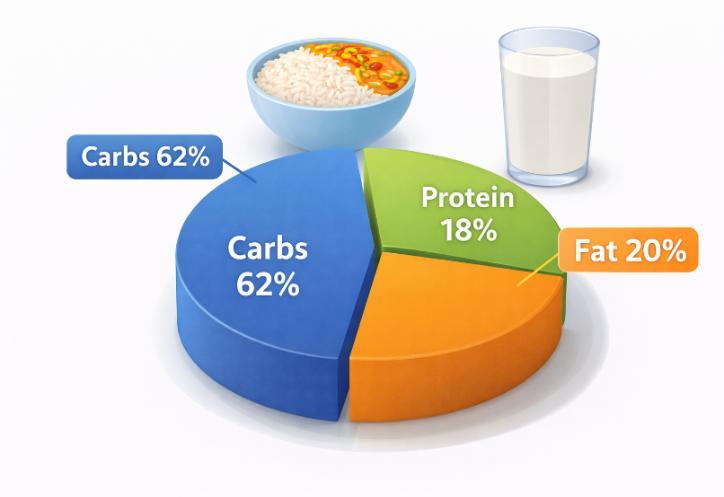
conditions are securely collected. Based on this information, a personalized avatar is generated and rendered dynamically. Nutritional analysis results are visualizedusinginteractivethree-dimensionalpiecharts, enabling users to explore macronutrient and micronutrient composition through rotation, zoom, and tooltip-basedexploration.Thefrontendalsosynchronizes visual output with audio feedback from the AI avatar, enhancingusercomprehensionandengagement.
Communication with backend services is achieved through secure RESTful and WebSocket-based APIs to enable both request-response interactions and real-time updates.
The Backend Layer constitutes the core computational anddecision-makingengineofNutriLens.Itorchestrates data processing pipelines, performs nutritional computation, and generates personalized health recommendations.
Upon receiving meal input from the frontend, the Nutrition Parsing Service applies natural language processingtechniquestoidentifyfoodentities,quantities, and measurement units. Named Entity Recognition is employed to extract food items, followed by quantity normalization using standardized unit conversion tables to transform household measurements into gram-based values.
International Research Journal of Engineering and Technology (IRJET) e-ISSN: 2395-0056
Volume: 13 Issue: 04 | Apr 2026 www.irjet.net p-ISSN: 2395-0072
NormalizedfooddataisthenprocessedbytheNutrition ComputationModule,whichretrievesnutrientvaluesper standardizedquantityfromexternalnutritiondatabases. The computed nutrient profile is evaluated by the AI Personalization Engine, which integrates user-specific healthconditions,agegroup,andcontextualinformation such as time of meal consumption. This engine applies condition-aware reasoning rules and large language model–based inference to generate tailored dietary feedback,warnings,andrecommendations.
ThebackendlayerisexposedthroughanAPIGatewaythat managesauthentication,authorization,ratelimiting,and secureroutingofrequestsbetweenservices.
TheDataandExternalServicesLayerprovidespersistent storage,cachingmechanisms,andaccesstoauthoritative nutritionalknowledgesources.User
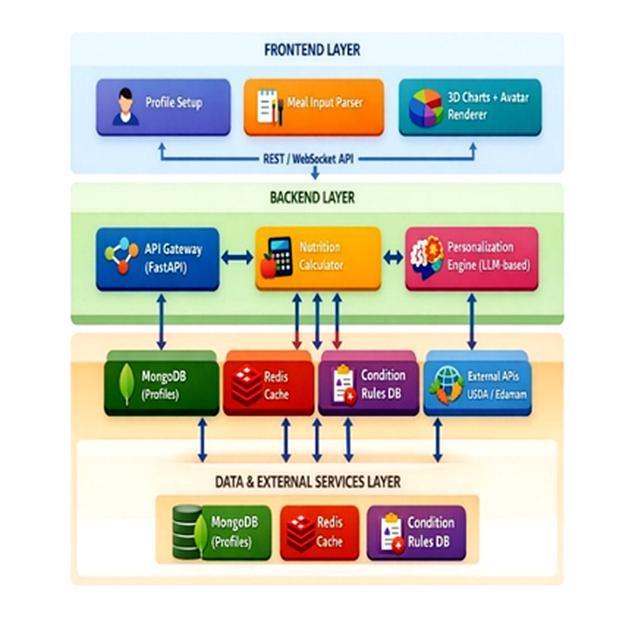
Fig1: System architecture block diagram profiles, health conditions, and historical nutritional summaries are stored in a secure database with encryption to protect sensitive health information. Inmemory caching is utilized to reduce latency for frequently accessed nutritional data and recommendationrules.
External nutrition databases are accessed through standardized APIs to obtain accurate macro- and micronutrientinformation.Inaddition,acuratedhealthcondition rules repository encodes evidence-based dietary guidelines for both chronic and acute health scenarios, such as fracture recovery, postpartum
nutrition, and injury rehabilitation. These rules are dynamicallyappliedduringrecommendationgeneration, enabling duration-specific and condition-safe dietary guidance.
The layered architecture ensures clear separation of concerns, allowing independent evolution of user interfaces, computational logic, and data services. This design supports horizontal scalability, facilitates future integrationofvision-basedfoodrecognitionor wearable health devices, and enhances system reliability by isolatingfailureswithinindividuallayers.
International Research Journal of Engineering and Technology (IRJET) e-ISSN: 2395-0056
Volume: 13 Issue: 04 | Apr 2026 www.irjet.net p-ISSN: 2395-0072
B. Component Details
Layer Technology
Frontend ReactNative,Three.js, Lottie
API Gateway FastAPIw/JWT
Nutrition Service Python,spaCy
Responsibility Key Features
User interaction Avatargeneration,3Dcharts,lip-sync avatar
Requestrouting Ratelimiting,authentication
Mealparsing NERextraction,quantitynormalization
AI Service Llama-3.18B,Groq Personalization Condition-awarerecommendations
Data Layer MongoDB,Redis Persistence AES-256encryptionforhealthdata
Ⅳ. METHODOLOGY
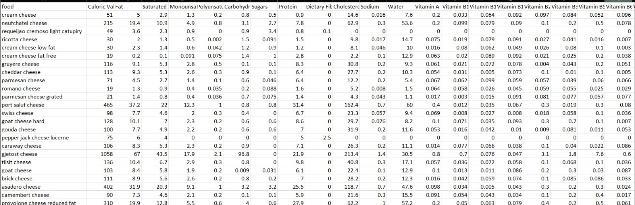
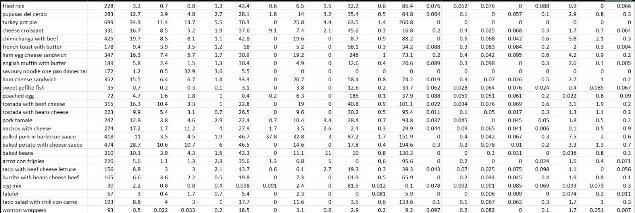
A. Dataset
© 2026, IRJET | Impact Factor value: 8.315 | ISO 9001:2008
International Research Journal of Engineering and Technology (IRJET) e-ISSN: 2395-0056
Volume: 13 Issue: 04 | Apr 2026 www.irjet.net p-ISSN: 2395-0072
Mathematical Formulation
NutriLens processes food inputs and generates personalized health advice using mathematical aggregation,rule-basedlogic,andAImodels.
1. Ingredient-Based Nutrient Calculation
Input
Letamealconsistof��ingredients.Eachingredient��has:
• Quantity����
• Unit����
• Nutrientvector:���� =(����,����,��
,����)
Where:��
=Calories,
Carbohydrates.
Unit Conversion
Total Nutrient Calculation
TotalCalories=∑
Thisformsthenutrientvector:
2. Meal Time Detection Algorithm
Mealtypedeterminedusingsystemtime:Letcurrent hour=ℎ
• Breakfast:5≤ℎ <11
• Lunch:11≤ℎ <16
• Dinner:16≤ℎ <22
• Snack:else
3. Health Rule Engine (Rule-Based Algorithm)
Eachhealthcondition��hasruleset��
Rule Matching: violation
Example (Diabetes):
• Carbs<45gpermeal
• Glycemicindex<55foringredients
4. Personalization Algorithm
Personalizationinputsaredefinedasatuple (������������,�������� ��������,��,��������,������),andthe recommendationfunctionisexpressedasrec = f(PersonalizationInputs)
5. AI-Based Recommendation Algorithm (LLM)
WhenLLMAPIavailable: ���� ���������������� =������(������������)
AI Fallback Logic:
FinalResponse ={ ���� ���������������� ifAPIavailable Rule-basedresponse otherwise
Algorithms Used in NutriLens
Algorithm 1: Nutrient Aggregation
Type:Deterministic Steps:Ingredients→Grams→Multiply→Sum→������������
Algorithm 2: Meal Classification
Type:Time-based Steps:Readtime→Compareranges→Assigncategory
Algorithm 3: Rule-Based Health Analysis
Type:Expertsystem Steps:LoadJSON→Matchissues→Checkconflicts→ Generateadvice
Algorithm 4: Hybrid AI Recommendation
Type:Hybrid Steps:CheckAPI→LLMorrules→Returnmessage
Algorithm 5: Data Visualization
Type:Datamapping Steps:Nutrients→Chartlabels→Chart.jsrender
Ⅴ. Multimodal Output System
AI Avatar Implementation
Avatar Pipeline:
NutriLens employs a multimodal output system to enhance user comprehension and engagement by delivering nutritional feedback through synchronized visual, auditory, and textual channels. This approach addresses the limitations of traditional text-based
International Research Journal of Engineering and Technology (IRJET) e-ISSN: 2395-0056
Volume: 13 Issue: 04 | Apr 2026 www.irjet.net p-ISSN: 2395-0072
nutrition applications, which often fail to effectively communicate complex dietary information to nontechnicalusers.
A. AI Avatar-Based Feedback
AnanimatedAIavatarservesastheprimarymediumfor deliveringpersonalizednutritionalinsights.Theavatar presentsmealanalysisresults,healthbenefits,warnings, andrecommendationsinaconversationalmanner, improvingaccessibilityandretentionofinformation acrossdiverseagegroups.
B. Avatar Implementation
The avatar feedback generation pipeline consists of the followingstages:
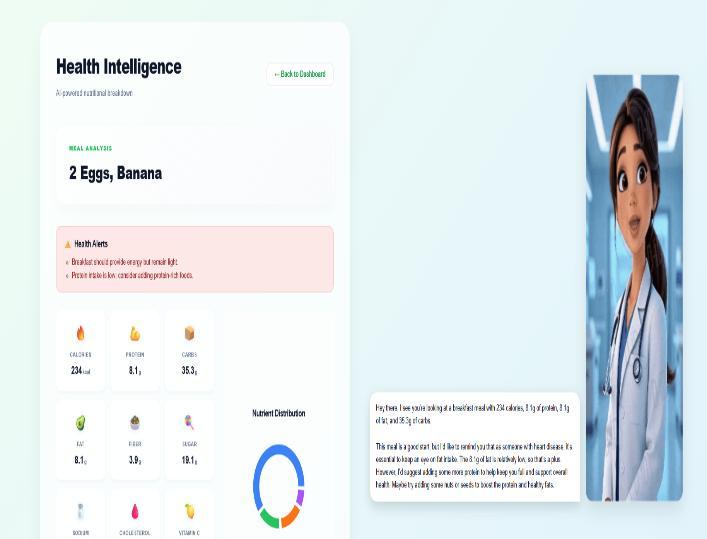
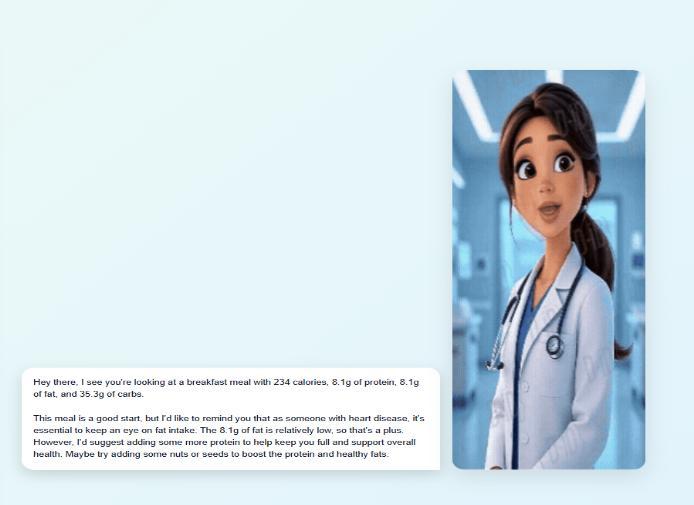
The avatar feedback generation pipeline consists of the followingstages:
1. Text-to-Speech Generation:
Personalized nutritional feedback generated by theAIreasoningengineisconvertedintonaturalsounding speech using a neural text-to-speech system.
2. Phoneme Timeline Extraction:
The generated audio is processed to extract phoneme-level timing information, enabling precise synchronization between speech and facialmovements.
3. Lip-Synchronization and Animation Mapping: Phoneme timelines are mapped to predefined viseme animations using a vector-based animationframework,ensuringaccuratelip-sync behavior.
4. Real-Time Rendering:
The animated avatar is rendered using a 3D graphics engine, allowing real-time facial expressionsandsmoothtransitionsalignedwith spokenfeedback.
5. Audio Playback and Spatialization:
The Web Audio API is utilized to manage audio playback and spatial positioning, providing a moreimmersiveuserexperience.
Thispipelineensureslow-latency,synchronized audiovisualfeedbacksuitableforreal-timenutritional analysisandrecommendationdelivery.
1.TTSGeneration→elevenlabs.io(voice:"Sarah")
2.PhonemeTimelineExtraction
3.LottieAnimation→Lip-syncmapping
4.Three.jsRendering→Real-timefacialexpressions
5.WebAudioAPI→Spatialaudiopositioning
International Research Journal of Engineering and Technology (IRJET) e-ISSN: 2395-0056
Volume: 13 Issue: 04 | Apr 2026 www.irjet.net p-ISSN: 2395-0072
Interactive 3D Pie Chart
Features:
•Hover→Nutrienttooltip(RDI%)
•Click→Detailedbreakdown
•Rotate→360°view
•Legend→Color-to-nutrientmapping
•Animation→Smoothsectortransitions
Ⅵ. Implementation & Development
A. Technology Stack
Frontend: React Native + Expo + Three.js + Lottie React Native
Backend:FastAPI+Uvicorn+Celery(asynctasks)
AI: Llama-3.1 8B (Groq API) + spaCy + Sentence Transformers
Database: MongoDBAtlas+RedisCloud
APIs:EdamamNutrition,USDAFoodDataCentral
Deployment:Vercel(frontend)+Render (backend) + CloudflareCDN
B. Privacy & Security
1.UserDataCollection
NutriLens collects minimal and necessary user information only for providing personalized nutritionanalysis.
Datacollected:
Name
Age
Gender
Healthissues(selectedbyuser)
Primaryhealthgoal
International Research Journal of Engineering and Technology (IRJET) e-ISSN: 2395-0056
Volume: 13 Issue: 04 | Apr 2026 www.irjet.net p-ISSN: 2395-0072
Mealingredientsenteredbytheuser
➢ Nosensitivepersonalidentifierssuchas phonenumber,email,address,or Aadhaararecollected.
2.PurposeofDataUsage
The collected data is used only for functional purposes,suchas:
Personalizednutritionanalysis
Health-basedfoodrecommendations
Time-basedmealsuggestions
AI-poweredadvicegeneration
➢ User data is not used for advertising or profiling.
3.DataStorage
User profile data is stored in a local SQLite database
Meal history is stored temporarily (in-memory) fordemonstration
Noclouddatabaseisusedinthecurrentversion
➢ Thisapproachensures:
Simplicityforacollegeproject
Reducedriskofexternaldataexposure
4.AI&Third-PartyServices
NutriLensoptionallyintegratesOpenAIAPIfor AI-generatednutritionadvice.
Importantpoints:
Onlynutritionaldataandhealthcontextaresent totheAI
Nopersonallyidentifiableinformation(PII)like contactdetailsisshared
AI usage is protected with API keys stored in environmentvariables
APIkeysareneverhardcodedinthesourcecode.
5.APIKeySecurity
OpenAIAPIkeyisstoredina.envfile
Environment files are excluded from version control
This prevents accidental exposure on GitHub or sharedsystems
BestpracticesforAPIsecurityarefollowed.
6.AccessControl
BackendAPIsareaccessedonlythroughdefined endpoints
No unauthorized direct database access is allowed
Data is processed only when the user explicitly submitsinputs
7.Network&CommunicationSecurity
BackendusesFastAPI,whichprovides:
InputvalidationusingPydanticmodels
Protectionagainstmalformedrequests
CORS is configured safely for frontend-backend communication
8.DataRetentionPolicy
Userdataisstoredonlyforthedurationrequired foranalysis
Meal history resets when the backend restarts (demomode)
Nolong-termtrackingisperformed
9.UserControl&Transparency
Usersexplicitlyprovidealldata
Nobackgrounddatacollectionoccurs
Userscanupdatetheirprofileatanytime
10.Ethical&ResponsibleAIUsage
AIsuggestionsareassistive,notmedicaladvice
Rule-based fallback ensures safe recommendationsifAIisunavailable
Clear messaging is shown when AI services are limited.
International Research Journal of Engineering and Technology (IRJET) e-ISSN: 2395-0056
Volume: 13 Issue: 04 | Apr 2026 www.irjet.net p-ISSN: 2395-0072
A. Key Contributions
1. Firstsystemcombiningconversationalinput,3D visualization,andanimatedAIavatar
2. Comprehensive condition coverageincluding acutescenarios(bleeding,accidents)
3. Time-contextual recommendationsimproving mealappropriateness
4. Production-ready architecturewith privacy-first design
B. Limitations
1. Absence of Vision-Based Food Recognition
ThecurrentversionofNutriLens reliesontextbasedmeallogginganddoesnotsupportcamerabasedfoodrecognition.Asaresult,accuratefood identification depends on user-provided descriptions and may be affected by input ambiguity.
2. Lack of Wearable Device Integration
NutriLensdoesnotcurrentlyintegratedatafrom wearable health devices such as continuous glucose monitors or fitness trackers. Consequently, nutritional recommendations are not dynamically adjusted based on real-time physiologicalsignals.
3. Language Constraints in Meal Parsing
The natural language parsing module primarily supports English food descriptions. Regional Indian languages and dialect-specific cuisine terms are not fully supported, limiting accessibilityfornon-English-speakingusers.
4. Individual-Centric Usage Model
The system is designed for single-user interactionanddoesnotprovidecollaborativeor socialfeaturessuchasfamilymealcoordination orshareddietarytracking
C. Future Enhancements
1. Camera-Based Food Recognition Integration
Future versions of NutriLens will incorporate computer vision techniques for automatic food identification and portion estimation using
smartphone cameras, reducing reliance on manualinput.
2. Wearable and Biosensor Synchronization
Integration with wearable devices, including continuous glucose monitoring systems, is planned to enable real-time, physiologically adaptivedietaryrecommendations.
3. Multilingual and Regional Cuisine Expansion
The NLP pipeline will be extended to support multiple Indian languages and region-specific cuisine vocabularies, improving inclusivity and parsingaccuracy.
4. Social and Collaborative Nutrition Features
Plannedenhancementsincludefamily-levelmeal planning,shareddietarygoals,andgroup-based nutritional monitoring to support collective healthmanagement.
NutriLens demonstrates the feasibility of integrating artificialintelligence–drivennutritionalanalysiswithan interactive,user-centricmobileinterfacetoimprovethe accessibilityofdietaryguidance.Thesystemeffectively combinescomputervision,naturallanguageprocessing, and verified nutritional databases to deliver personalized,condition-awarefeedbackinaformatthat isunderstandabletonon-technicalusers.
Unlike conventional nutrition applications that rely primarily on static text and manual data entry, NutriLens introduces a multimodal feedback approach usingvisual,textual,andconversationalelements.This design reduces cognitive load and enhances user engagement, particularly for individuals with limited nutritional literacy. The modular system architecture ensures scalability and allows seamless integration of additional health conditions, food databases, or AI modelsinthefuture.
From an engineering perspective, the use of asynchronous backend services and cloud-based deploymentenableslow-latencyresponsesandreliable performanceundervariableworkloads.Theinclusionof privacy-preservingmechanisms,suchasencrypteddata storage, secure communication protocols, and anonymized analytics, ensures that sensitive health information is handled responsibly and in compliance withdataprotectionprinciples.
International Research Journal of Engineering and Technology (IRJET) e-ISSN: 2395-0056
Volume: 13 Issue: 04 | Apr 2026 www.irjet.net p-ISSN: 2395-0072
While the current implementation focuses on dietary analysis and recommendations, the framework can be extended to support real-time health monitoring, wearable device integration, and longitudinal dietary trendanalysis.Futureworkwillinvolvelarge-scaleuser evaluations, quantitative accuracy assessment against clinicalbenchmarks,andoptimizationoftheAImodels to further reduce inference latency and computational cost.
In conclusion, NutriLens provides a practical and extensible foundation for next-generation AI-powered nutrition assistance systems, demonstrating how advanced machine learning techniques can be translated into meaningful, user-friendly health applications
Ⅹ.Reference
1. M.Han,J.Chen,andZ.Zhou,“NutrifyAI:AnAI-Powered System for Real-Time Food Detection, Nutritional Analysis, and Personalized Meal Recommendations,” arXiv:2408.10532,2024.
2. Z. Yang, E. Khatibi, N. Nagesh, M. Abbasian, I. Azimi, R. Jain, and A. M. Rahmani, “ChatDiet: Empowering Personalized Nutrition-Oriented Food Recommender Chatbots through an LLM-Augmented Framework,” arXiv:2403.00781,2024.
3. M. Veeramreddy et al., “NUTRIVISION: A System for Automatic Diet Management in Smart Healthcare,” arXiv:2409.20508,2024.
4. Z. Jiang et al., “DietGlance: Dietary Monitoring and Personalized Analysis at a Glance with KnowledgeEmpoweredAIAssistant,”arXiv:2502.01317,2025.
5. A.KaramanlıAydın,R.H.Ali,S.Faiz,andT.A.Khan,“An Integrated AI Framework for Personalized Nutrition Using Machine Learning and Natural Language ProcessingforDietaryRecommendations,”Appl.Sci.,vol. 15,no.17,p.9283,2025.
6. Artificialintelligenceinpersonalizednutritionandfood manufacturing: a comprehensive review of methods, applications,andfuturedirections,Front.Nutr.,2025.
7. AI-Driven Personalized Nutrition: Integrating Omics, Ethics,andDigitalHealth,PubMed,2026.
8. Artificial Intelligence Applications to Personalized Dietary Recommendations: A Systematic Review, mdpi.com,2025.
9. Artificial intelligence in food science and nutrition: a narrativereview,PubMed,2022.
10.An AI-based nutrition recommendation system: technical validation with insights from Mediterranean cuisine,PubMed,2025.
11.Artificial Intelligence in Nutrition and Dietetics: A Comprehensive Review of Current Research, MDPI, 2025.
12.A Systematic Review of Nutrition Recommendation Systems: With Focus on Technical Aspects, PubMed, 2020.
13.USDA FoodData Central API Documentation, U.S. Department of Agriculture, 2025. (Dataset/API reference)
14.EdamamNutritionAnalysisAPIv2,EdamamInc.,2025. (Dataset/APIreference)
15.AINutrition AssistantArchitecture,IJERT,vol.13,no.4, 2024.(JournalArticle)
16.T.ColinCampbellandT.M.CampbellII,TheChinaStudy: The Most Comprehensive Study of Nutrition, BenBella Books,2005.(Foundationalnutritionreference)
17.Lottie Animation Framework, Airbnb, 2023. (Software/libraryreference)
18.Three.js 3D Graphics Library, 2025. (Software/library reference)
19.Generative AI-based Meal Recommender System, J. InformaticsWebEng.,2025.
20.Intelligent diet recommendation system powered by AI forpersonalizednutritionalsolutions,Clin.Nutr.ESPEN, 2025.