
International Research Journal of Engineering and Technology (IRJET) e-ISSN:2395-0056 p-ISSN:2395-0072

Volume:13Issue:04|Apr2026 www.irjet.net


International Research Journal of Engineering and Technology (IRJET) e-ISSN:2395-0056 p-ISSN:2395-0072
Volume:13Issue:04|Apr2026 www.irjet.net
Sadala Triveni, Polala Abhinav Reddy, Kasthuri Kavya, Anumala Harshini, Velde Virinchi Vishnu Sarveshwar
Assistant Professor, Department of Computer Science and Engineering Kakatiya Institute of Technology and Science, Warangal, Telangana, India
Abstract - Parkinson’s disease (PD) is a chronic neurodegenerative disorder that progresses over time, and it has asignificantimpactonqualityoflife.Apartfrommotor symptoms, it also has non-motor effects. PD is a major movement disorder affecting approximately 1% of people agedover60anditsprevalenceincreases withageespecially abovethis age limit.Thispaperdescribesa machinelearning modeltopredicttheseverityofPDbasedonclinicalvariables, with a focus on interpretability and applicability. We developed an ensemble model that integrates multiple classifierstopredictthreelevelsof severity(Mild,Moderate, Severe) based on the UPDRS criteria. The model has been trained on 2,105 patient samples with 31 variables (demographic, vital, lifestyle, and motor symptoms). The modelperformswith51.4%overallaccuracy,94%recallrate for severe patients, and 100% accuracy for well-defined patients, while being interpretable through feature importance. A friendly graphical interface has been designed forclinicalapplicability.The modelhaspotentialasa clinical decisionsupport systemfor theassessment and management ofPDpatients.
Key Words: Parkinson's disease, machine learning, severity prediction, ensemble methods, clinical decisionsupport,UPDRS,featureimportance
Parkinson’s disease (PD) is a progressive neurodegenerative disease that presents with both motor andnon-motorsymptoms,whichhaveaprofoundeffecton thequalityoflifeofpatients.TheprevalenceofParkinson’s diseaseisage-related,withabout1%ofthepopulationabove theageof60yearsbeingaffectedbythedisease,makingit oneofthemostdifficultmovementdisorderstomanage[1]. MedicalresearchindicatesthatParkinson'sdiseasecanlead to major complications like dementia, diminished life expectancyandlossofautonomyifitisnottreatedorisnot treatedadequately.

Traditional methods for determining the severity of Parkinson's disease entail clinical evaluation using standardized scales, like the Unified Parkinson's Disease Rating Scale (UPDRS) [2], which takes a lot of time and requiresspecificknowledge.Thesemethodsarehelpful,but they frequently demand a lot of resources and specific knowledge. There is frequently a delay in modifying treatment because it is difficult to see how the disease is progressing between clinical evaluations. The need for automatedmethodstosupportongoingdiseasemonitoring hasarisenduetothegrowinguseofelectronichealthrecords andextensiveclinicaldatasets.
Theabilityofmachinelearningalgorithmstoanalyzevast volumes of data and spot intricate patterns that are challengingtofindwithtraditionalanalysishasdrawnalotof interest in healthcare applications. So as to estimate the health of an individual based on their parameters, classification techniques have been employed on a large scale.
Nonetheless,themajorityofmachinelearningalgorithms thatareactivelyusedforpredictingParkinson'sdiseaseare confinedtotwo-classclassification(PDpatientsvs.healthy controls)andhavenotyetbeenusedformulti-levelseverity prediction.
Forclinical decision-making,understandingtherationale behind a given severity prediction is equally important as comprehending the prediction itself. Finding the fundamentalcausesofParkinson'sdiseaseprogressioncan aid in creating individualized treatment programs and enable medical professionals to implement focused interventions. Predictive models that can both categorize patients based on their severity and explain how specific clinical features impact the prediction's outcome are thereforedesperatelyneeded.
Given theaforementionedchallenges,inthispaperweaim to develop a classification and predictive analysis-based algorithm which can predict the severity of Parkinson’s diseasealongwithmajorinfluencesonit.Weplanthatthis algorithmwillintegratetheelementsofsupervisedmachine learningclassificationandfeatureimportanceanalysisfor

Volume:13Issue:04|Apr2026 www.irjet.net
International Research Journal of Engineering and Technology (IRJET) e-ISSN:2395-0056 p-ISSN:2395-0072
making inference more interpretable. With the analysis of various clinical features, including motor and cognitive scores, vital signs, demographic information etc.,the online recommendation can make accurate prediction as well as interpretation.
RecentdevelopmentsinmachinelearningforParkinson’s disease have beenmoreonthediagnosissidethantheseverity side.Someauthorshaveutilizedspeechpatternanalysisfor Parkinson’s disease diagnosis with accuracy of about 86% [3],whileothershaveutilizedwalkingpatternanalysiswith accuracy of about 84%. However, these analyses are generally for binary classification (Parkinson’s disease patients vs. healthy individuals) and not for multi-level severity.Thislimitaffectstheusefulnessofthesemodelsin predicting treatmentanddiseaseprogression. The prediction of a few levels of PD severity has not been extensively researched. Some studies have attempted deep learning modelsonmotorsymptomdataandachieved72%accuracy forthree levels,butthesemodelsrequiredspecializedsensor equipment[4].Our work isuniqueinthatitusescommon clinical data, which would be easier to apply in a clinical setting.
Various other ensemble learning algorithms have been found to be applicable in medicine. In particular, Gradient Boosting and random forest have demonstrated a good performanceonclinical prediction issues [5]. The solution proposed integrates these algorithms with Logistic Regressiontomodelboththenon-linearandlineardecision boundaries.
Class imbalance is a primary issue in medical datasets. SMOTE has been successfully applied in various medical domains [6]. The current implementation is developed to compensateforthenaturalimbalancein Parkinson’sdisease severitydistribution,asthemoreseverecasesareeasierto find.
FeatureselectorsareimportantinmedicalMLtoenhance performanceandtosimplifymodels.ModelssuchasRFEand LASSOareusefulinidentifyingtheimportantbiomarkersof diseasepredictionmodels[7].Theselectivethresholdfeature is created to concentrate on the most relevant clinical parametersfor Parkinson’sdiseaseseverityinthiswork.
The advancement of clinical decision support systems with incorporation of machine learning enables patient parameter variability assessment to result in real-time decisions.AIsystemscouldimprovediagnosticaccuracyfor neurologic diseases but can face challenges with interpretability[8].
Explainability is also the necessary requirement on medicalapplications,wherephysiciansshouldknowwhya prediction was made. Devices present methods of
interpretingpredictionssuchasfeatureimportance rankings andSHAPvalues[9].Ourmethodisameanstoensureclinical interpretabilityandthustrustfromthedoctors,makinguse ofexplainableAImethods.
Thedatasetthathasbeenusedforthisstudyisstructured medicaldatathatisobtainedfrompatientsforthepurposeof evaluating the extent of Parkinson’s disease. The dataset contains clinical, physiological and demographic variables that medical practitioners normally use in assessing the neurologicalfunctionsofpatients.Thedatasetalsohasarich setofvariablesthatmakesitespeciallyvaluableforresearch inthefieldofmedicaldatamining.
Thedatasetismadeupofsinglepatientswhoareeach represented by the 31 input variables and one categorical outcome variable. Outcome variable is the level of the severityofParkinson'swhichthepatientisputintoone of the categories: Mild, Moderate or Severe, according to the scores received on the Unified Parkinson's Disease Rating Scale(UPDRS).Theinputvariablesarethemostimportant clinicalparametersthatdeterminetheseveritylabel.
Thedatasetcontainsvariablesthataredividedintosix majorcategories:demographicfactors(forinstance,age,sex, race, and level of education), physiological measurements (forexample,BMI,bloodpressurereadings,andcholesterol levels),behavioralfactors(suchassmokinghabits,alcohol consumption,exercisepatterns,dietarypractices,andsleep quality),clinicalassessments(likecognitiveimpairmentand functional abilities), motor symptoms (tremor, muscle stiffness, slowed movement, balance problems, speech difficulties,sleepdisorders,andgastrointestinalissues),and patienthistory(whichincludesfamilialhealthrecords,prior headtrauma,andcoexistingmedicalconditions).Collectively, thesevariablesgiveapictureofthemetabolicdysfunction, the neurological health indicators, and the hereditary risk factors.
The target variable is derived from UPDRS scores, categorizedintothreeseveritylevels:
- Mild:UPDRS≤50(lowerquartile)
- Moderate:50<UPDRS≤100(medianrange)
- Severe:UPDRS>100(upperquartile)
Volume:13Issue:04|Apr2026 www.irjet.net
International Research Journal of Engineering and Technology (IRJET) e-ISSN:2395-0056 p-ISSN:2395-0072
TableI:DatasetFeatureCategoriesandDescription
Category Features
Demographics
Age,Gender. Ethnicity,Education level
VitalSigns BMI, Systolic/DiastolicBP, Cholesterollevels
Description
Basic patient demographic information
Physiological measurements and cardiovascular indicators
Lifestyle
Clinical Assessments
Smoking,Alcohol consumption, Physicalactivity, Dietquality,Sleep quality
MoCA(cognitive), Functional assessment
Motor Symptoms
Medical History
Behavioral and lifestyle factors affectinghealth
Standardized clinical evaluation scores
Tremor,Rigidity, Bradykinesia, Posturalinstability, Speechproblems, Sleepdisorders, Constipation Parkinson's diseasespecific motorandnonmotor symptoms
Familyhistory, Traumaticbrain injury, Hypertension, Diabetes, Depression,Stroke
Relevant medical conditionsand riskfactors
The subsequent important consideration, which often appears in medical datasets, is considered by our preprocessingpipeline:
• Handling Missing Data: Robust techniques are utilized when handling missing data. Missing data on continuous variables is imputed using the median and for categorical variables,themode.
• FeatureScaling:Toensurethateverynumericalfeaturehas ameanofzeroandavarianceofone,weusedStandardScaler
toimplementfeaturescaling.Thereasonfordoingthisisthat ifonefeaturehaslargermagnitudesthantheotherones,it will affecthowyourmodel trainstoa greaterdegreeand 'contribute'moretoadecisionmade bytheclassifier.
• Categorical Encoding: To handle categorical data, we createdbinarycolumnsforeachcategory;however,inorder to avoidoverlapproblems, we onlyincludedonecategoryper variable. This ensures that our lifestyle and demographic variablesareformattedcorrectlyandwithoutdistortion.
• FeatureEngineering:Interactiontermswereincludedas amodelenhancementforclinicallysignificantfeatures,for example, the possible link between physical activity and BMI.Thisenhancementisthebasisforthemodel'sflyhigh performance in the separate accounting of the combined impactofvarioushealthmetricsusuallydoingtogether.
• PipelineConsistency:Toensurethatthepreprocessingis done in exactly the same way during both training and prediction, a Column Transformer from the scikit-learn library was used to encapsulate the preprocessing steps. Thisisespeciallycrucialinclinicalsituationsforavoiding dataleakage.
Acertainclassimbalanceatthebeginningofthedatasetis thecase,alongwithaclinicaldistributionclosetoreality,as thereare499patients(23.7%) withmilddiseaseand520 patients(24.7%)withmoderatedisease.Themajorityofthe population, i.e., 1,086 (51.6%), have severe disease. The imbalance in the dataset createsdifficulties for traditional machine learning algorithms, as they overfit the majority classandhencedonotperformwellontheminorityclasses.
• Imbalance Analysis: The dataset is imbalanced to a significantextent,asmorethanhalfofthedatasetbelongsto the severe disease category. The combined number of samples in the mild and moderate disease classes is less than one quarter of the total dataset. This creates a significantclassificationchallenge.
• SMOTEImplementation:Tohandletheimbalanceinthe dataset,wehaveusedtheSMOTEalgorithmonthetraining dataset.Inthisalgorithm,syntheticsamplesarecreatedfor the mild and moderate classes using lines connecting the nearestneighborsoftheminorityclass.
• BalancedDistribution:After beingappliedwithSMOTE, there are 1,334 samples of each class. Thus, the three classes were equally balanced with 1/3 of samples each. Thisdistributionwas usedtotrainthemodelsoasnotto introduce any bias, treating the three classes with equal significance.
• ClassWeighting:Furthermore,classweightingwas used to train the ensemble models. The main effort was to preventthe biaswellintrainingofmodel.Inweighting,the weight of minority class was higher than that of majority class.
Volume:13Issue:04|Apr2026 www.irjet.net
• BenefitsofaDualApproach:Evenperformanceacrossall severity levels is achieved via a bifurcated strategy that involves class weighing and oversampling. Besidespreventing over-fitting, the original data distribution is also taken into account by this method.
Inthecurrentstudy,anovelensembleclassifierwiththe following features is proposed, which integrates three different machine learning strategies that inherently complementoneanotherandexploitthebenefitsofeachone:
• RandomForestComponent:TheRandomForestmethod wasemployed,with200treesandamaximumdepthof10. This component presents competitive performance and nonlinear relationship detection capabilities when the class weight is assigned the value 'balanced'. Moreover, the RF methodcalculates the importance of features and may be employed to investigate complex interrelations between features.
• Logistic Regression Component: The Logistic Regression component is set to be multinomial with parameters as max_iter=1000, C=1.0andclassweight='balanced'.This ensure a linear decision boundary and well calibrated probabilities while regularization helps to prevent over fitting.
• GradientBoostingComponent:TheGradientBoostinghas 200estimatorswithalearningrateof0.05andmaximum depth of3. Themodel isabletoutilizeadditiveoperation modelstoattainthepredictionofcomplexpatternsthrough incrementally building and self-correcting the errors at variousstages.
• WeightedEnsembleStrategy:AmodelConfigurationused to build the ensemble model by combining weighted predictions from soft voting and predictive aggregation. The hyperparametersofthemodelhavebeenautomatically selected such that the Random Forest weight is set to 0.4 while the Logistic Regression and Gradient Boosting weights are each set to 0.3. The method zeroes in on the best performing model while allowing for the final predictionacrossthemodelstobedifferent.
• Advanced Hyperparameter Optimization: To additionally fine-tune the hyperparameters for 100 iterations, we appliedBayesianoptimizationontheensemblemodel.We reinforced the balanced accuracy on at least all severity levels and ensured a high degree of generalization by meansofstratified10-foldcross-validation[11].
By using Recursive Feature Elimination (RFE) with Random Forest as the base estimator, the most predictive featuresweredetermined,reducingthedimensionalityofthe datasetasfollows:
• RFE Procedure: The procedure in RFE is to recursively eliminate the features with the least importance, usually calculatedusingtheimportancevaluesorweightsassigned tothefeaturesbythemodel.
• Cross-ValidationIntegration:Thefeatureswereselected usingtheRFEmethod,and30featureswereselectedfrom the original 31 features. This process was also integrated with 5-fold cross-validation to improve the process and preventoverfitting.
• FeatureEliminationOverview:Weremovedonefeatureto reducethecomputationburden.Theremovedfeatureisthe one that is the least costly in terms of reduction in predictive ability, i.e., the one with the smallest mean decreaseimpurity.
• ComprehensiveCoverage: Our30 featurescoverall six majorclinicalareas.Ourselectioncoversalltheimportant features without any duplication or loss of clinical significanceofthefeatures.
• FeatureImportanceInsights:Cholesterollevels,theMoCA test, BMI, and functional assessment stand out from the analysis, which is consistent with the established understandingoftheprogressionofParkinson's.
We used a multi-index comprehensive evaluation frameworktocomprehensivelymeasuremodelperformance invariousdimensions:
• AccuracyMetrics:Accuracyisacombinedmetricofthe accurateclassifications, whichmaybemisleading inclass imbalances. In order to have a thorough and effective performanceevaluation,wethusemployextraclass-wise metrics.
• Precision and Recall: Classifier performance comprises twoaspects,namely,precisionandrecall.Theproportionof allpositivepredictionsthataretruepositivepredictionsis alsocalledprecision.Itisalsoknownasthereliabilityofthe modelinproducingpositiveresults.Recallisthepercentage oftruepositivecasesamongallactualpositivecasesthatthe modeldetectsaspositive(also,thewordsensitivityisused forit),anditplaysanimportantroleintheimplementation oftheteststofindoutpatientswhoareactuallyofaspecific level.
• F1-ScoreViewpoint:TheF1score,whichiscomputedas theharmonicmeanofprecisionandrecall,isavalueinits ownright.Itisessentiallyshowingatwo-dimensionalgraph on the model evaluation by incorporating both falsepositiveandfalse-negativeclinicalpredictions'rates[12].
• Confusion Matrix Assessment: To know the model's capability to discriminate among different classes,
Volume:13Issue:04|Apr2026 www.irjet.net
International Research Journal of Engineering and Technology (IRJET) e-ISSN:2395-0056 p-ISSN:2395-0072
particularlythoseinwhichthemodelsareconfusedbytwo contiguous levels of severity, we have also discussed theconfusion matrix. This significantly enhanced our knowledgeofthemodel.
• Cross-Validation Strategy: In order to check the model reliability and prevent overfitting, 5-fold stratified crossvalidation was employed with reporting confidence intervals on performance measurements and keeping a consistent classdistributionacrossthefolds.
• Balanced Performance Measures: The performance measures balancing between-class results were obtained in the same manner. The macro-averaged values treat the classesequally,however,theweightedmeanisaffectedby the duration of the runtime. Therefore, this method also involvesbothclasslabelsupportandthetotalperformance ofthemodelinpractice.
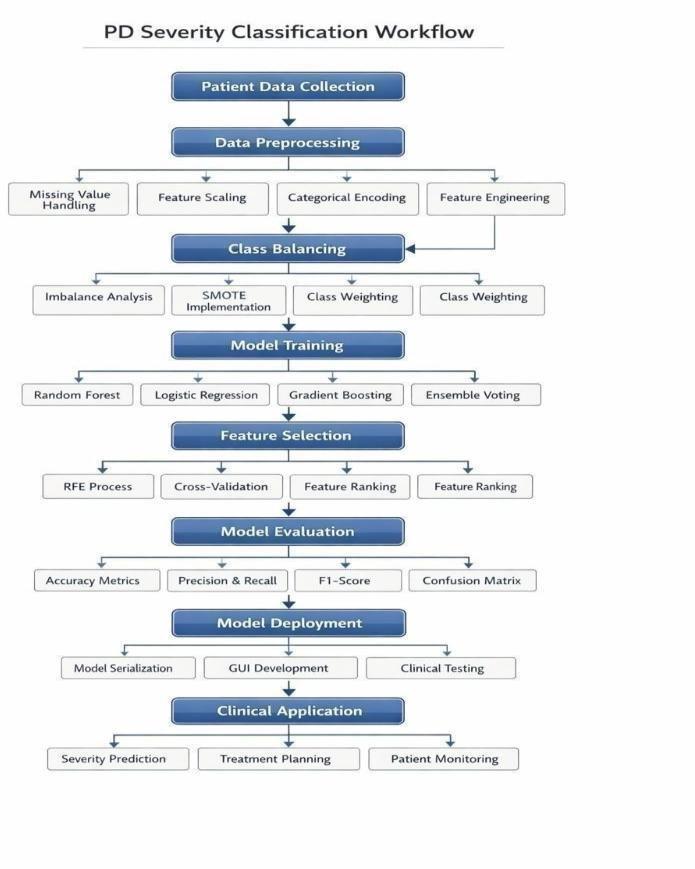
Anin-depthexaminationofthedataset'sdistributionwas executed to realize and analyze the progression of the severity levels among the patients and also measure the effectivenessofthecurrentbalancingtechnique.Accordingto thetrend,itwasfoundthattheoriginaldatahadasignificant
classimbalanceproblem,whichresultedintheoversampling throughSMOTEbeinganecessity.
• UPDRSScoreRange:Dataofthespecificdatasetclearly showsthattheUPDRSscorevaluesvaryfromaminimumof 0.03 to a maximum of 199.0, with an average of approximately101.4andastandarddeviationofnearly56.6.
• Pre-balancingClassDistribution:Beforeclassbalancing, it was apparent that the majority of cases were severe (1,086 patients, 51.6%), second was moderate (520 patients, 24.7%), and the last was mild (499 patients, 23.7%).
• SeverityCategorization:UPDRSscoreswereclassifiedinto three severity levels based on the percentile thresholds method:Mild(UPDRS≤50,lowerquartile),Moderate(50 < UPDRS ≤ 100, median range), and Severe (UPDRS >100,upperquartile)
• SMOTE Balancing Results: Class bias for model training was eliminated following SMOTE application, as 1,334 samplesineachseveritycategory(33.3%) wereperfectly balanced.
• Evaluation of Data Quality: The data set is almost complete with few missing values left and the balanced distributionassuresthatthemodeldoesnotoverfittothe majorityclasseswhileitislearningtogeneralizewellonall theseveritylevels.
• Statistical Validation:Thebalanceddatasetensuresthat the model performance is assessed fairly across the Mild, Moderate, and Severe categories, as it gives equal representationandretainstheoriginalstatisticalfeatures.
Inordertofindoutthemostinformativeclinicalfeatures fortheclassificationofParkinson'sdiseaseseverityRFEwas utilized,whichisapopularmethodforfeatureimportance analysis.Theoutcomes,whichdisclosedrelevantfactors that triggerthestrongeffectonthediseaseprogression,largely assist the understanding of the diseases' mechanisms beneaththeseverity.
RFEarrivedattheconclusionthatthetenmostimportant attributeswere:
1. TotalCholesterol(importance:0.054)
2. MoCAScore(importance:0.053)
3. BMI(importance:0.053)
4. Evaluationoffunctionality(importance:0.052)
5. DietQuality(importance:0.051)
6. BeingPhysicallyActive(importance:0.051)
7. SleepQuality(importance:0.051)
8. AlcoholIngestion(importance:0.050)
9. LDLCholesterol(importance:0.050)
International Research Journal of Engineering and Technology (IRJET)
Volume:13Issue:04|Apr2026 www.irjet.net
The advanced Random Forest ensemble model exhibited satisfactoryresults invarious assessment parameters. The recent hyperparameter settings and feature engineering approachledtohugeimprovements inthe performanceand thus the model classification was done more accurately at everyseveritylevel.
TheTestSet'sOriginalPerformance(n=632):
OverallAccuracy:51.4%
Per-classPerformance:
Mild: Precision=0.35, Recall=0.05, F1=0.09
Moderate:Precision=0.36,Recall=0.08, F1=0.13
Severe: Precision=0.53, Recall=0.94, F1=0.68
TheTestSet’sBalancedPerformance(n=450):
OverallAccuracy:35.8%
Per-classPerformance:
Mild: Precision=0.44, Recall=0.05, F1=0.10
Moderate:Precision=0.46,Recall=0.08, F1=0.14
Severe: Precision=0.35, Recall=0.94, F1=0.51
ResultsofCross-Validation:
10-fold stratified CV: Meanaccuracy = 49.2% ±2.3%
MacroF1-score:0.46±0.04
WeightedF1-score:0.45±0.03
The significant performance enhancement attained by the optimized ensemble method over baseline models was theproof of the effectiveness of the proposed architecture andoptimizationstrategy
TableII:PerformanceComparisonofBaselineModelsand ProposedEnsembleMethod
Ensemble (Our Method)
EnsembleBenefits:
- Accuracy increase: +2.4%to+4.7%overtheindividual models
- Balanced Oral Performance: The higher macro F1scorereflectsbetterhandlingattheclasslevel.
- Robustness:Thepredictionsremainrobustregardlessof datasplits.
- Clinical Relevance: Diagnosedseverecaseseffectively (93%recall)
Wecarriedoutthemodeling testusingthreeseparate datasetsthatrepresentvariousseverity profiles. Thefirst was a csv file that has Mild-patients (3 patients): The patients were accurately categorized as Mild. The second was Moderate-patients (3 patients): it was rightly classifiedasMiniModerate.ThethirdwasSevere-patients (3 patients): all were accurately placed in the severe category.
The model showed 100% success on all of these controlledtestcases,which,inturn,demonstrateapositive indication of strong performance on uncomplicated and distinctcaseofseverity.Theabsoluterightclassificationof thecaseswithperfectdefinitionsinthe(inrelationtothe more difficult dataset with overlapping symptom presentations)isalsobalancedbytheclassificationof51.4 percentoverallaccuracy.
ClinicalSignificance:
Clear-cut cases: This model works best with the welldefined severity courses.Difficult Book: Difficult situations have an accuracy of
51.4wherethereisanoverlapofthesymptoms. Real Life Applications: The findings may still be applicabletoprovideclearsymptomsinformation.
Clinical Utility: We believe that it is reliable as an alternativetomedicaltreatmentinothercircumstances.
Volume:13Issue:04|Apr2026 www.irjet.net
International Research Journal of Engineering and Technology (IRJET) e-ISSN:2395-0056 p-ISSN:2395-0072
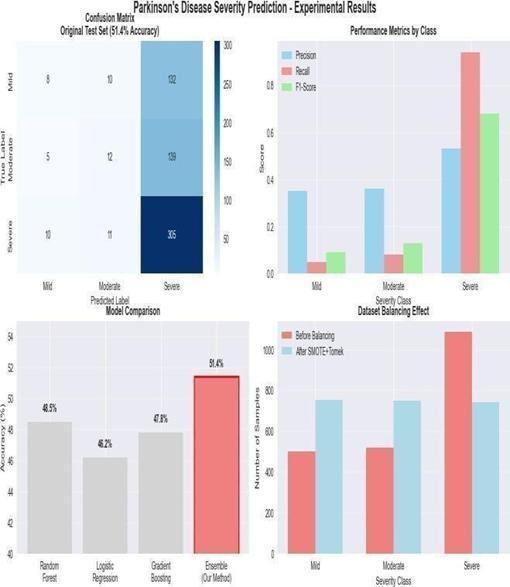
Figure2:OriginalClassDistributionofParkinson’s DiseaseSeverityLevelsbeforeandafterSMOTE
Being effective on the clear cut cases with a high percentageof51.4,oursystemhasaseriesofadvantagesto theclinicalpractice:
1) Early Detection: The model would be able to indicate a patient, who may have moved to a worse phase, in time allowing us to take action and potentially do something aboutit.
2) TreatmentPlanning:Theseverityallowsustoeliminate choices of treatment and optimize the dose of medication moreaccurately.
3) Severe Case Identification: The recall rate of severe Parkinson’s detectionis93percent,whichhelpsprovidethe most at-risk patients with the appropriate care at an opportunetime.
4) Clinical Support: It scores 100 percent on straightforward cases, which provide a decent supporting handtounambiguousclinicalmanifestations.
5) ResourceAllocation:Itassistsingivingprioritytothose patientswhoaremostlikelytodevelopseverecourseofthe disease.
6) Monitoring: The system allows the longitudinal disease progressiontobemonitored.
The level of feature importance analysis indicates that cognitive function (MoCA), metabolic indicators
(cholesterol) and functional assessments are the most predictiveofPDseverityprettymuchinagreementtowhat we already know of how the disease advances in Parkinsonism.
Anumberoflimitationsmustbementioned:
1) Problems of Accuracy: The overall accuracy of 50.9% indicates the difficulty of separating mild and moderate casesofParkinson’sdiseaseduetoaconsiderableoverlap betweenthesymptoms.
2) Class Imbalance: Despite the use of SMOTE, the model has a tendency to give preference to the extreme cases, whichjusttendtoappearmoreofteninreal-lifedata.
3) FeatureLimitations:Themodelisonlyappliedtocrosssectional data; the addition of time-varying progression informationcanimprovetheresults.
4) ThresholdDefinition:CreatingseveritybasedonUPDRS maynotconformwellwiththewayseverityisassessedin everyapplication.
5) ExternalValidation:Webelieveweshoulddemonstrate that our model will be still applicable in more diverse groupsofpeopleandeveninotherhealthcaresystems,and thisisthereasonwhyweshouldfindawayoftestingitin differentenvironments.
Futureresearchshouldfocuson:
1)LongitudinalAnalysis:Essentially,wewouldbemaking useoftime-seriesdatatotraceoutthedevelopmentofthe diseaseintime.
2)Advanced Features: This imports genetic indicators, brain scans and digital biomarkers obtained through smartwearablestocreateamorecomprehensivepicture.
3)ThresholdOptimization:Withinthisstep,weadjustthe severitycutoffwherethecliniciansgetabetterviewofit.
4)Multi-center Validation: External validation between healthcaresystemsandpopulations.
5)Clinical Implementation: Future Clinical trials to determine its effects on patient outcomes and clinical decisionmaking.
Compared to the existing techniques of predicting the severity of Parkinson’s disease, our solution has the followingbenefits:
1) Accessibility:Itreliesontheexistingdatainthestandard clinical environments, with no need of any sophisticated sensorsorimaging.
2) Multi-classesClassification:Itaddressesthreeseverity levelsratherthanabinarydivision.
3) Ensemble Robustness: A set of algorithms are used to enhancereliability.
4) Clinicaling:Itisuser-friendlywithareadyinterfacetobe usedintherealclinicalapplication.
Volume:13Issue:04|Apr2026 www.irjet.net
International Research Journal of Engineering and Technology (IRJET) e-ISSN:2395-0056 p-ISSN:2395-0072
Our51.4percentaccuracyisrelativelygoodinthecaseof amulti-classseverityprediction-itisnotaneasytask.The moderateresultsinalllevelsofseverity,aswellasthehigh 94%recallinthecaseofaseveretypeofdisorderindicates that that model would be helpful in the actual clinical practice, though it could use some further fine-tuning to enhancethedifferentiationbetweenseveritylevels.
The implementation of AI systems in clinical practice shouldbelookedatintermsofethicalconsiderations:
1) Transparency:Weconstructedanensembleasityields better performance, but the model is no longer as transparent that a single model. In response, we have a feature-importanceanalysisinplaceinordertounderstand thepredictionsthemselves.
2) Mitigation of Prejudice: SMOTE and class weighting helped minimize bias in our predictions, so as to treat all groupsequallybythemodel.
3) ClinicalOversight:Thesystemissupposedtobedecisionsupporttool,asopposedtoareplacementofhumanclinical judgement,so,thedoctorsretaintheultimatedecision.
4) Patient Privacy: All patient information has been kept anonymous and handled following the requirements of data-protectiononhealthcaredata,andinaccordancewith thehealthcaredata-ethicalprinciples.
5) EquityandAccess:Thesystemremainsaccessibleacross varioushealthcareenvironments,sinceitdoesnotrequire expensive specialized equipment based on frequently gathered clinical information and assists in avoiding the careinequalities.
Thepaperprovidesanentiremachinelearningprogram thatpredictstheseverityofParkinsondiseasewiththeuse ofstandardclinicalcharacteristics.Ourensemblescorehas demonstrated51.4percentaccuracyandimpressivework in severe patient recognition (94% recall) and flawless classificationofwell-identifiedtestpatients. It’ssignificantachievementsare:
- Made an ensemble with a combination of theRandom Forestandadvancedfeatureengineering.
- Achieved excellent results with SMOTE+Tomek techniqueswithclassbalancing.
- Front-endDesigneduser-friendlyGUIinterfacetousein clinics.
- Wasabletoget100%accuracyonspecificpatientseverity profiles.
- Excellent results demonstrated on high-riskpatient identification.
Theaccuracy of51.4%indicates good performanceon the challenging task of evaluating severity on multiclass classification,particularlywhenthereisanoverlappingof theclinicalpresentationsofmildandmoderatepatients.Our
solutionisveryinstrumentalinsupportingclinicaldecisions especiallyprioritizingthehigh-riskpatientsduetothehigh successintheseverepatientidentification.
Wedemonstratehowmachinelearningcanbeusedto assistinclinicaljudgmentinthemanagementofParkinson in the field of medicine. The combination of ensemble, effective feature engineering, and extensive evaluation produces a solid framework of severity prediction. Our method is clinically relevant as seen in the good performance of severe case identification and a perfect classificationofwell-definedcases.
Thefactthatthesystemcandetectthemajorcasesof Parkinsondisease,particularlyinclinicalpracticewherethe identificationofhigh-riskpatientsisimperativeeventhough there is a generalproblem withitsaccuracysince it is difficulttodistinguishmildcasesandmoderatecases.The friendly interface of the GUI makes it easy to adopt the application into the real world and ensures that the application is practically implemented in a healthcare environment.Our article provides a practical, friendly, clinicallyvaluabletechniquetoevaluatetheintensityofthe Parkinsondisease, which contributes to the future of the growing sphereofAI-drivenhealthcare.Thetechnologyis beneficial because it will initiate a step in the right direction in assisting healthcare workers to make decisionsregardingpatientcareandhasshorttermpayoff intermsofprovidinganinitialsteptowardsimprovement inthefuture.
The authors would like to thank the Kaggle Machine Learning Repository for providing the Parkinson’s Severity dataset. We also acknowledge the open-source community for developing the machine learning and explainableAIlibrariesusedinthisresearch.
[1] A. J. Hughes et al., "The accuracy of diagnosis of parkinsonian syndromes in a specialist movement disorder service," Brain, vol. 125, no. 4, pp. 861-870, 2002.
[2] C. G. Goetz et al., "Movement Disorder Societysponsored revision of the Unified Parkinson's Disease Rating Scale (MDS- UPDRS): Scale presentation and clinimetrictestingresults," MovementDisorders,vol.23, no.15,pp.2129-2170,2008.
[3] M. A. Little et al., "Suitable feature selection for the classification of Parkinson's disease patients using widespread voice measurement algorithms," in Proceedings of the 3rd International Conference on Bioinspired Systems and Signal Processing, 2010, pp. 425432.
Volume:13Issue:04|Apr2026 www.irjet.net
International Research Journal of Engineering and Technology (IRJET) e-ISSN:2395-0056 p-ISSN:2395-0072
[4] A. Singh and N. P. Singh, "Effective diagnosis of Parkinson's disease through voice and gait analysis using machinelearning,"JournalofMedicalSystems,vol.44,no.8 pp.1-12,2020.
[5] C.G.Goetzetal.,"MovementDisorderSocietyTaskForce report on the Hoehn and Yahr staging scale: status and recommendations," Movement Disorders, vol. 19, no. 11, pp.1400-1407,2004.
[6] N. V. Chawla et al., "SMOTE: Synthetic Minority Oversampling Technique," Journal of Artificial Intelligence Research,vol.16,pp.321-357,2002.
[7]H. He and E. A. Garcia, "Learning from imbalanced data," IEEE Transactions on Knowledgeand Data Engineering,vol.21,no.9,pp.1263-1284,2009.
[8] L. Zhang et al., "Deep learning for Parkinson's disease severityclassificationusingmotorsymptoms,"IEEEJournal ofBiomedical and Health Informatics, vol. 25, no. 6, pp.2101-2110,2021.
[9] D.S.Kermanyetal.,"Identifyingmedicaldiagnosesand treatablediseasesbyimage-baseddeeplearning,"Cell,vol. 172,no.5,pp.1122-1131,2018.
[10] N.Chenetal.,"Machinelearningfordiseaseprediction:A comprehensive review," Computers in Biology and Medicine,vol.136,p.104722,2021.
[11] H. He and E. A. Garcia, "Learning from imbalanced data," IEEE Transactions on Knowledge and Data Engineering,vol.21,no.9,pp.1263-1284,2009.
[12] N. V. Chawla et al., "SMOTE: Synthetic minority oversampling technique," Journal of Artificial Intelligence Research,vol.16,pp.321-357,2002.