
International Research Journal of Engineering and Technology (IRJET) e-ISSN: 2395-0056
Volume: 13 Issue: 01 | Jan 2026 www.irjet.net p-ISSN: 2395-0072
International Research Journal of Engineering and Technology (IRJET) e-ISSN: 2395-0056
Volume: 13 Issue: 01 | Jan 2026 www.irjet.net p-ISSN: 2395-0072
Rutuja Saharkar
Student, Electronics & Telecommunication Engineering, Yeshwantrao Chavan
College of Engineering, Nagpur, Maharashtra, India
Abstract - Monitoring blood hemo globin (Hgb) levels is crucial for a variety of illnesses' diagnosis, evaluation, and treatment. An economical and effective hemo globin measurement method is becoming more and more in demand worldwide, especially in developing countries. This article provides a thoroughreviewof severalcontinuous,non-invasive hemo globin monitoring strategies, emphasizing those that employ embedded platforms for picture analysis. It also talks about the best non-intrusive method that may be used everywhere. There are still not many commercially feasible non-intrusive hemo globin monitors on the market, despite continuous attempts by research organizations. Compared to typical invasive procedures, non-invasive hemo globin monitoring techniques offer a number of benefits, such as a high accuracy rate of 90.9% and the removal of infection concerns related to blood samples and needles. Usually, these non-invasive methods make use of wearable sensors that can be affixed to the skin for ongoing monitoring, like a finger probe. This method is especially beneficial for broad use since it eliminates the need for intrusive procedures, which lessens patient discomfort and improves safety. An ArduinoUno(with an embedded system), a MAX30105 light-sensing diodephotodiode, several UV LEDs, a liquid crystal display (LCD), and an I2C are the hardware components that make up the system suggested in this study. This arrangement helps to overcome problems brought on by variations in blood volume brought on by cardiac cycles by enabling the computation of an average hemo globin concentration fromsamplescollected over a one-minute period. Such devices may eventually give doctors access to real-time data, facilitatingquickerdiagnosis and treatment. This will be particularly helpful in urgent circumstances where prompt action can significantly impact patient outcomes.
Key Words: Non-Invasive, Hemoglobin, Embedded Platform, Arduino Uno, MAX30105, Liquid Crystal Display, I2C Module, PPG (Photoplethysmography), Multiple LED’s, Optical Sensor
Blood is a crucial part of the human body that performs severalvitaltasksthatkeepusalive.Itcirculatesthroughout the body to maintain body temperature, send signals to different organs, and provide nutrition, hormones, and oxygen.Akeycomponentofthisprocessishemo globin,a proteinpresentinredbloodcellsthatcarriesoxygenfrom
thelungstoallofthebody'stissues.Millionsofindividuals worldwide suffer from anemia, a disorder caused by the body'sinabilitytoproperlydistributeoxygentoitsorgans dueto a lack ofhemo globin. Anemiaaffectspeopleof all agesandbackgrounds,andtheWorldHealthOrganization (WHO) estimates that 1.6 billion people worldwide, or roughly30%ofthepopulation,sufferfromit.
Measuring hemoglobin levels precisely is crucial for diagnosis and treatment since anemia has a substantial negativeinfluenceonhealth.Invasivetechniqueslikeblood draws,whichcallformedicalpersonneltogathersamples, havehistoricallybeenusedtoevaluatehemoglobincontent. Despitetheireffectiveness,thesetechniqueshaveanumber of disadvantages, such as the possibility of infection, discomfortforthepatient,delaysinreceivingfindings,and lesscompliancefromthosewhorequirerecurrenttesting. Withtheadvancementofmedicaltechnologyinrecentyears, non-invasive hemo globin measurement techniques have beendeveloped.Comparedtoconventionalmethods,these non-invasive methods such as spectroscopy, pulse oximetry, and near-infrared light offer a number of benefits.Thesetechniquesofferaquicker,safer,andmore pleasant alternative to check patients' hemo globin levels withoutrequiringbloodsamples.
Systemsfornon-invasivehemoglobinmonitoringarevery usefulinavarietyofclinicalcontexts,suchascriticalcare, surgery,andthetreatmentofchronicillnesses.Healthcare providers may monitor a patient's condition continuously andinrealtimewiththesedevices,eliminatingthehazards and pain of repeated blood draws. Additionally, they are particularly helpful in places with low resources, where access to trained healthcare professionals or laboratory facilitiesmayberestricted.Apartfromitsclinicaluses,noninvasivedevicesalsolowerthedangerofinfectionandcrosscontamination,whichmakesthemperfectforuseinroutine checkupsoremergencyscenarios.
International Research Journal of Engineering and Technology (IRJET) e-ISSN: 2395-0056
Volume: 13 Issue: 01 | Jan 2026 www.irjet.net p-ISSN: 2395-0072
This section outlines system design for Non-Invasive HemoglobinDeviceshowninfigure1&figure2
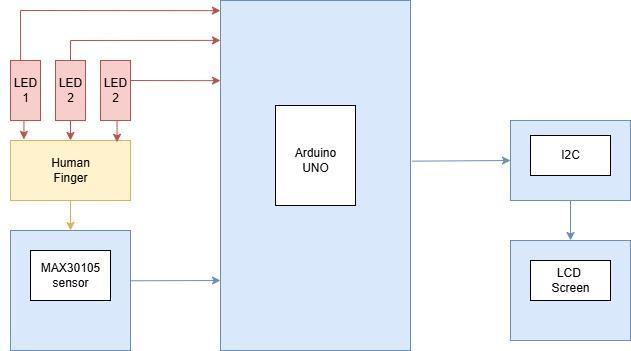
-1:BlockDiagramofNon-InvasiveHemoglobinDevice
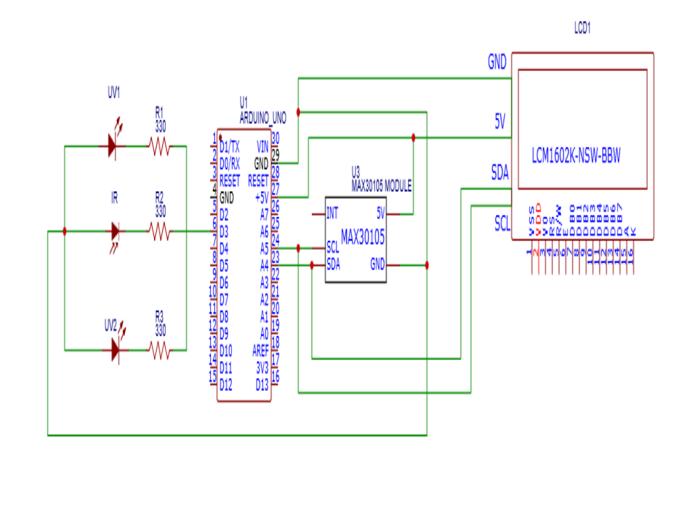
Fig -2:SchematicDiagramofNon-InvasiveHemoglobinKit
The system's design is broken down as follows:
[1] Acquisition of Signals: Through the skin and blood vessels, the MAX30105 optical sensor will emit light at variouswavelengths(fromtheUVLEDs).Specificamounts of light at various wavelengths are absorbed by the hemoglobinfoundinblood.Thesensorrecordsinformation that indicates the amount of hemoglobin in the blood by measuring the amount of light that is transmitted and reflected.
[2] Signal Processing: The Arduino Uno processes the signals that the MAX30105 sensor receives. The Arduino determines the absorption at various wavelengths by reading the light intensity data. Hemoglobin levels are estimatedusingthelinkbetweenhemoglobinconcentration and light absorption. To guarantee precise hemoglobin estimation, the Arduino will carry out the required calculationsusingpresetalgorithms.
[3] DataDisplay: Next,theLCDpanelshowsthedetermined hemoglobinconcentration.Inadditiontoprovidingreal-time hemoglobinleveldata,theLCDmighthaveagraphicaluser interface for additional visual feedback. The system can signal the abnormal condition by displaying warnings or alertmessagesonthescreenifthelevelsaretoohighortoo low.
[4] LED Wavelengths: Becauseoftheircapacitytointeract with hemoglobin, the various UV LEDs will emit light at a specificwavelength.Toincreasemeasurementaccuracy,the LEDs will either be employed in tandem or alternately to emit light onto the patient's finger. The hemoglobin absorption spectra will be used to determine the wavelength. In order to detect human finger intervention andprovideanadditional command forUVLEDsto begin emittinglight,anadditionalinfraredLEDisfittedtothekit.
[5] Housingand SensorMounting: TheArduino,LEDs,and MAX30105sensorwillallbeenclosedinaclearglassshell. The sensor can effectively detect reflected light, and the transparent housing makes sure that the light that is releasedmaypenetrateandreachtheskin.Ideally,theglass housingcanbeplacedonthebodytomeasurebloodflowor wornontheskinlikeabracelet.Itismadetobecomfortable fortheuser.
[6] Power Source: The gadget will be powered by a USB power source or a battery. The device can operate for extended periods of time without requiring frequent recharging thanks to the low power consumption of the ArduinoUnoandMAX30105sensor.
[7] Userinteractionandcalibration: Inordertoobtain reliable readings, the device must be calibrated. To guarantee accurate hemoglobin readings, the user can completeaquickcalibrationprocedurebeforetousingthe instrument.UsinginstructionsshownontheLCDpanel,the ArduinoUnowillwalktheuserthroughthisprocedure.
International Research Journal of Engineering and Technology (IRJET) e-ISSN: 2395-0056
Volume: 13 Issue: 01 | Jan 2026 www.irjet.net p-ISSN: 2395-0072
InitializeComponents
BeginMainLoop IsIRValue >7000?
DisplayError"Please PlaceYourFinger"
CheckforHeartbeat (checkForBeat(irValue))
CalculateBPM(Heart Rate) Checkif beatsPerMinute< 255&& beatsPerMinute > 20
Algorithm of Code:
InitializeSerialcommunicationfordebugging. Set up the MAX30105 sensor for heart rate and pulse oximetrymeasurements.
InitializetheLCDdisplaytoshowmessages. SetuptheUVandIRLEDsforsensing. Setupvariablesforheartratecalculationandstorage. Display the message "Hemoglobin detection" on the LCD screen.
Continuouslyrunthefollowingstepsintheloop()function. Read the infrared (IR) and red light values from the MAX30105sensor.
IfIR>7000(indicatingfingerplacement):
CallcheckForBeat(irValue)todetectpulse. Ifpulsedetected:
TurnonUVandIRLEDs.
PrintaverageBPM(beatAvg)toSerialmonitor.
Calculatedelta(timedifference)usingmillis().
CalculateBPM:BPM=60/(delta/1000.0).
IfBPMisinrange(20-255),storeinrates[].
CalculateaverageBPMfromlast4readings.
AdjustIRLEDbrightnessusingPWMcontrol.
ReadUVandIRintensities(UVandIRnotdefinedin code).
Estimate hemoglobin: Hemoglobin Level = (UV Intensity-IRIntensity)*100.
DisplayhemoglobinlevelonLCD.
If no pulse is detected (i.e., IR value is less than 7000), display a message asking the user to "Please Place Your Finger".
Repeatloopforcontinuousupdatesandreadings.
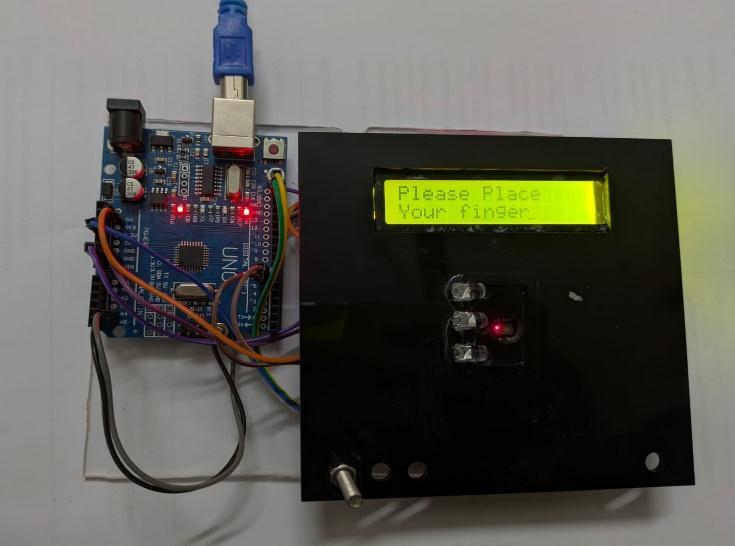
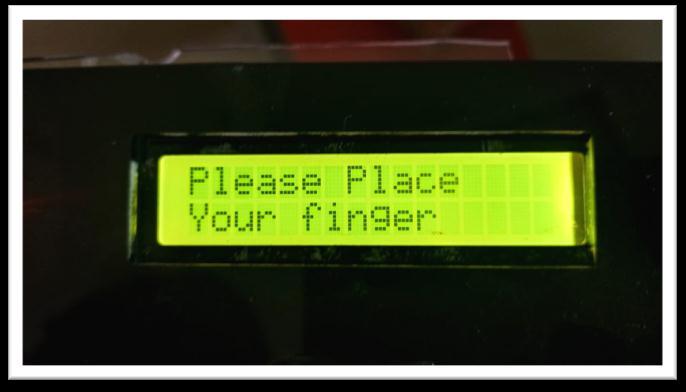
Fig –3(a): HardwarePrototype 3(b): Initializationofthekit
International Research Journal of Engineering and Technology (IRJET) e-ISSN: 2395-0056
Volume: 13 Issue: 01 | Jan 2026 www.irjet.net p-ISSN: 2395-0072
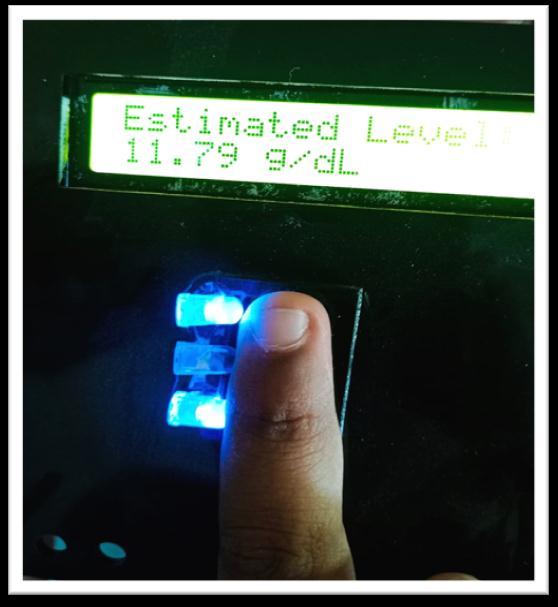
TheNon-InvasiveHemoglobinMonitoringKitisinitializedin Figure-3(b). Wherethedeviceturnsonandbecomesready formeasurement.Theestimatedhemoglobinlevelof11.79 g/dLisshowninFigure-4. indicatingasomewhatreduced hemoglobinconcentration.
The first stage in the hemoglobin estimate procedure, initializingtheNon-InvasiveHemoglobinMonitoringKit,is shown in Figure-3(b). The system starts this phase by turning on the parts that are necessary for detecting and processing the needed data, such as the Arduino UNO embeddedsystemandtheMAX30105opticalsensor.After thesystemhasbeensetup,theuserinsertstheirfingeron thesensor,whichinitiatesthelightabsorptionandreflection analysis procedure that is necessary to determine the blood'shemoglobinconcentration.
Theestimatedhemoglobinlevelofthesubject,inthiscase 11.79g/dL,isshowninFigure-4.Usingtheoptical sensor and the Arduino-based system's real-time processing capabilities,thisoutcomewasobtained.Withahemoglobin level of 11.79 g/dL, the individual may have mild anemia because it is slightly below the normal range, which is normallybetween12and17g/dLforadults.Thisismerely anestimate,though,andadditional clinical testing likea bloodtest isrequiredforafinaldiagnosis.
Inconclusion,theNon-InvasiveHemoglobinMonitoringKit represents a potential development in the field of medical diagnostics.Real-timehemoglobinlevelmonitoringremoves theneedforintrusive,conventionalbloodtests,whichmakes theprocedurelesstime-consumingandmorecomfortablefor patients.Inemergencyscenarios,wherepromptandprecise
evaluation of a patient's status is crucial, the device's userfriendlinessandspeedyresultsareespeciallyadvantageous. Additionally, this gadget is affordable and compact, which makesitsuitableforavarietyofhealthcaresettings,including homecaresettings,smallclinics,andmajorhospitals.
The device's overall functioning and dependability are improvedbytheseamlessandnon-intrusivemonitoringmade possiblebytheArduinoUNOembeddedsystem.TheArduinobased system is perfect for long-term monitoring and interactionwithothermedicaltechnologiessinceitoffersan effective platform for ongoing health assessments. A significantadvancementinnon-invasivediagnosticshasbeen madepossiblebythisdevice'scapacitytodeliverprecise,realtime hemoglobin level data without causing discomfort or interferingwiththepatient'sregularactivities.
[1] Md Kamrul Hasan, Md Hasanul Aziz, Md Ishrak Islam Zarif, Mahmudul Hasan, MMA Hashem, Shion Guha, Richard R Love, Sheikh Ahamed,” Noninvasive Hemoglobin Level Prediction in a Mobile Phone Environment: State of the Art Review and Recommendations”,UnitedStates,2021Apr8
[2] B. Joseph, A. Haider, and P. Rhee, "Non-invasive haemoglobin monitoring," Department of Surgery, DivisionofTrauma,andAcuteCareSurgery,University ofArizonaMedicalCentre,UnitedStates
[3] J.H. Lee, Y.H. Park, and J.T. Kim, "Current use of noninvasive haemoglobin monitoring in anaesthesia," SpringerScience+BusinessMediaNewYork,2014
[4] R.S.Al-Baradie,"ANon-InvasivePortableMeasurement System for Quantification of Hemoglobin," College of AppliedMedicalSciences,MajmaahUniversity,Kingdom ofSaudiArabia
[5] JianmingZhu,RuiyangSun,HuilingLiu,TianjiaoWang, LijuanCai,ZhenchengChen,BaoliHeng,”ANon-Invasive Hemoglobin Detection Device Based on Multispectral Photoplethysmography”,China,30December2023
[6] Suresh Mestry, Kasturi Shinde, Dhanita Redij, Rajeshwari Tajnekar,” Real-time and Non-Invasive DetectionofHaemoglobinlevelusingCNN”,MCT’SRajiv Gandhi Institute of Technology, Maharashtra, India, Jan2023
[7] CajePinto, JivanParab,GourishMNaik,”Non-invasive hemoglobinmeasurement using embedded platform”, July2020SensingandBio-SensingResearch29:100370
[8] ZhenchengChen,HuishanQin,WenjunGe,ShiyongLi, YongboLiang,”ResearchonaNon-InvasiveHemoglobin
International Research Journal of Engineering and Technology (IRJET) e-ISSN: 2395-0056
Volume: 13 Issue: 01 | Jan 2026 www.irjet.net p-ISSN: 2395-0072
Measurement System Based on Four-Wavelength Photoplethysmography”,12March2023
[9] Rosanna Carmela De Rose, Antonio Romanelli,” Accuracy and precision of non-invasive continuous haemoglobin concentration monitoring in diabetic patients”,2022,Ain-ShamsJournalofAnesthesiology
[10] Melissa F. Young, Kelley Raines, Farhad Jameel, Manal Sidi, Shaiana Oliveira-Streiff, Paula Nwajei, Katherine McGlamry, Jiangda Ou, Alawode Oladele, Parminder S. Suchdev,” Non-invasive hemoglobin measurement devices require refinement to match diagnosticperformancewiththeirhighlevelofusability andacceptability”,16July2021
[11] Caje Pinto, Jivan Parab, Gourish M Naik, Marlon Darius Parab,”Improving hemoglobin estimation accuracythroughstandardizingoflight-emittingdiode power”, February 2022 International Journal of ElectricalandComputerEngineering(IJECE)12(1):219228
[12] Chuchart Pintavirooj,Baorong Ni,Chaiwat Chatkobkool,andKittitorn Pinijkij,” Noninvasive PortableHemoglobinConcentrationMonitoringSystem Using Optical Sensor for Anemia Disease”,National LibraryofMedicine,2021May29
[13] Md Kamrul Hasan, Md Hasanul Aziz, Md Ishrak Islam Zarif, Mahmudul Hasan, MMA Hashem, Shion Guha, Richard R Love, Sheikh Ahamed,” SmartHeLP: Smartphone-basedHemoglobinLevelPredictionUsing anArtificialNeuralNetwork”,2018Dec5
[14] M D AnggraeniandA Fatoni,” Non-invasive SelfCare Anemia Detection during Pregnancy Using a SmartphoneCamera”,IOPConferenceSeries:Materials Science and Engineering,Volume 172,11th Joint Conference on Chemistry in Conjunction with the 4th Regional Biomaterials Scientific Meeting 15–16 September2016,Purwokerto,Indonesia
[15] KanzoOkazakia,KaoruOkazaki,MasayoshiUesugi, TakahiroMatsusima,HiroshiHataya,”Evaluationofthe accuracy of a non-invasive hemoglobin-monitoring device in schoolchildren”, Department of Human Science, Faculty of Liberal Arts, Tohoku-Gakuin University,Japan,July2021