
International Research Journal of Engineering and Technology (IRJET) e-ISSN: 2395-0056
Volume: 13 Issue: 04 | Apr 2026 www.irjet.net p-ISSN: 2395-0072

International Research Journal of Engineering and Technology (IRJET) e-ISSN: 2395-0056
Volume: 13 Issue: 04 | Apr 2026 www.irjet.net p-ISSN: 2395-0072
Abhishek Kumar Singh1 , Ashok Kumar Singh2 ,
1Btech Student, Department of Civil Engineering, Bharti Vishwavidyalaya Durg CG
2Assistant Professor, Department of Civil Engineering, Bharti Vishwavidyalaya Durg CG
Abstract - The integration of recycled waste glass into Portlandcementandconcretehasgarneredsignificantglobal interestduetorisingdisposalcostsandenvironmentalissues. Glass, being amorphous and rich in silicon and calcium, exhibitspozzolanicorevencementitiouscharacteristicswhen finely ground, making it a potential substitute for cement in concrete applications. However, utilizing crushed glass as aggregates introduces challenges, such as expansion and crackinginconcrete;nonetheless,concretewith100%crushed glass can still be viable. The cement industry is a major contributortoglobalCO2 emissions,withapproximately5%of such emissions attributed to its production processes. The burgeoningpopulationincreasesthedemandforconstruction, resultinginmillionsoftonsofglasswastegeneratedannually, much of which ends up in landfills, exacerbating environmental concerns. This review highlights the advancement in using waste glass as an alternative in concrete, noting its pozzolanic properties and potential for reducing cement consumption. It has been found that the mechanicalpropertiesofWasteGlassPowder(WGP)concrete are dependent on factors such as particle size and the replacement ratio of cement. The article compiles previous experimental results on the role of waste glass powder as a partial cement replacement, underscoring the importance of its size and chemical properties on mortar performance. Additionally, it discusses the development of a predictive model for the compressive strength of mortar using multi logisticlinearregression(MLR)andartificialneuralnetworks (ANN), with ANN demonstrating superior predictive capabilities.
Key Words: Concrete; Cement replacement; Mechanical properties;Wastemanagement;WasteGlassPowder(WGP)
1.1 Concrete: - a widely used construction material, is composedofcement,sand,gravel,andwater,sometimes withadmixtures.Cement,whichactsasabindingagent, constitutes 7–15% of concrete's volume, while aggregates account for 70–75%. In 2015, global aggregateusagereached48.3billiontons.Urbanization trendssuggestthatby2050,over60%ofthepopulation inmanycountrieswillliveinurbanareas,primarilyin AfricaandAsia,whichwillhost90%oftheexpected2.5 billionnewresidents.Theconstructionindustryplaysa vital role in sustainable infrastructure. However, concrete production, estimated at one ton per person annually, contributes significantly to CO2 emissions,
causing environmental concerns related to climate change. To mitigate the cement industry's environmental impact, supplementary cementitious materials like Waste Glass Powder (WGP) are being explored.WGPexhibitspozzolanicpropertiesandcan be effectively used to replace cement, with optimal replacementlevelsat10–40%.Concretewith10–20% WGP shows enhanced resistance to chloride ion penetration, making it suitable for coastal structures. The problem of waste glass (WG), which is nonbiodegradableandcontributestolandfillissues,canbe transformedintoaresourcethroughrecycling.Although WG poses challenges in conversion to usable cullet suchasequipmentwearandsafetyissuesduetosharp edges newmethodslikeimplosiontechnologyprovide safer alternatives. This review discusses the potential applicationsandeffectsofWGPasacementsubstitute
1.2 Glass: - is a versatile material valued for its optical transparency, chemical inertness, and low permeability. Despite being theoretically recyclable, over200 milliontons of glass are landfilled annually duetolimitationsinqualityforre-manufacturing,with soda-lime glass, primarily from beverage bottles, makingupthebulkofwaste.InHongKong,lessthan 10% of waste glass bottles are recycled. The construction industry presents opportunities for recycling waste glass, reducing landfill strain, preservingresources,andlesseningcarbonfootprints. Early studies, beginning in 1963, demonstrated that waste glass could be transformed into useful aggregates.However,challengesarosewiththeuseof glassculletleadingtodecreasedconcreteworkability and strength, along with alkali-silica reaction (ASR) expansion. Ground glass powder (GP), a solution to thesechallenges,offersimprovedworkabilitywithits finer particle size and angular shape, consisting of primarilySiO2,Na2O,andCaO,andcanactasareactive pozzolanincementmixturesorevenasaprecursorfor geopolymer production. GP's applications extend to creating lightweight aggregates and phase change materials, aligning with the construction industry's increasingfocusonsustainability.Thispaperreviews the potential uses of GP in cement concrete, blocks, bricks, polymer composites, and other eco-friendly constructionmaterials,emphasizingitsversatilityasa sustainableoption.
International Research Journal of Engineering and Technology (IRJET) e-ISSN: 2395-0056
Volume: 13 Issue: 04 | Apr 2026 www.irjet.net p-ISSN: 2395-0072
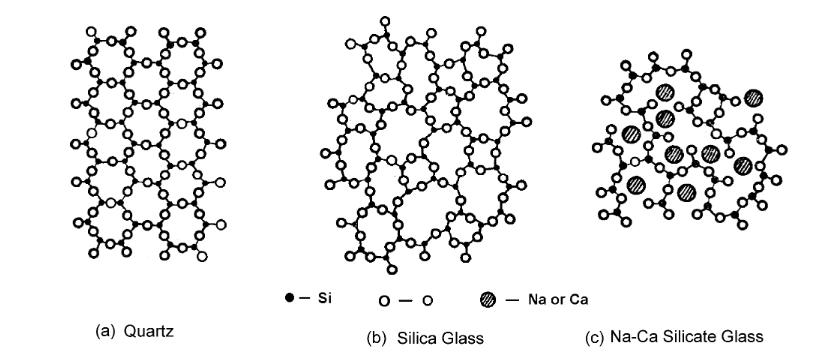
Fig. 1. Structure of quartz, silica glass and Na–Ca silicate glass.
Table-1 Physical properties of waste glass
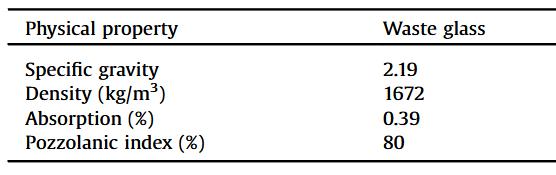
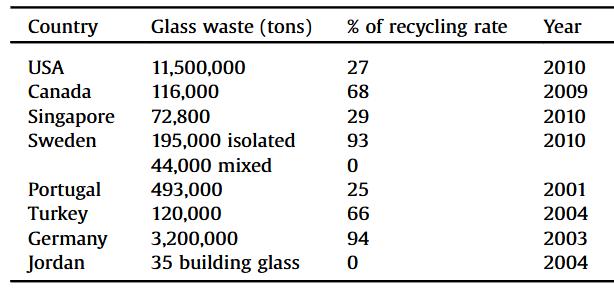
Table -2 Amount of waste glass and the percentage of recycling in different countries
1.3 Cement: - isacrucialbindingmaterialinconstruction, withaglobalproductionrateof2.8billiontonsannually, anticipated to exceed 4 billion tons due to rapid urbanization in various regions. Historically, ancient civilizationslikeEgyptandGreeceusedlimesediment before Joseph Aspdin developed Portland Cement in 1824. The production of cement involves primary materials such as silica, limestone, magnesium oxide, ferrous oxide,andalumina,leadingtovarious cement typesfromOrdinaryPortlandCement(Type1)tohighly
sulfate-resistant cement (Type 5). Cement can be produced through wet or dry processes, with each methodinvolvingtheprecisepreparationandburning ofrawmaterialsathightemperatures.
1.4 Challenges to Glass and cement industries:- High energy consumption, resource depletion, low glass wasterecyclingrates,andimpactstoclimatechangeare just a few of the major issues facing the glass and cementsectors.Theseproblemshavebeenmadeworse by the rising usage of glass.The cement industry also confronts comparable challenges, such as fuel prices, greenhouse gas emissions, and the depletion of raw materials;foreverytonofcementproduced,1.5to1.7 tonsofresourcesareused.Bothbusinessesarealways under pressure to address their environmental consequencesduetotheseinterrelatedissues.
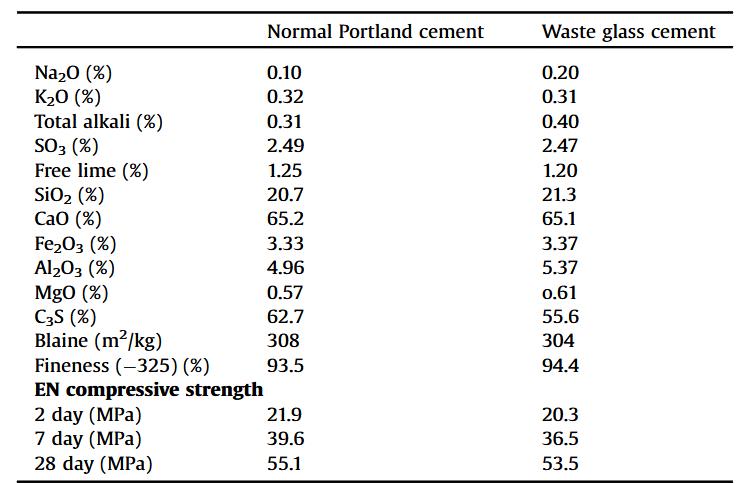
Table-3 Properties of waste glass cement and portland cement
1.5 Waste glass as cementitious material:- nonbiodegradable and non-recyclable waste glass (WG) poses a significant landfill burden, particularly in metropolitan areas where landfill space is limited. Utilizing WG in concrete production presents a viable solution due to its comparable physical and chemical propertiestosandandcement.Thisapproachnotonly protects the environment but also conserves natural resources and benefits the economy. WG, exhibiting pozzolanic characteristics, can replace cement in concrete;particlesizesinfluenceitseffectiveness,with 38 μm particles capable of substituting up to 30% of cement.Moreover,thepozzolanicbehaviordiminishes withlargerglassparticles,andusing20%finelyground WGcansignificantlymitigatealkali-silicareaction(ASR) expansioninconcrete.
International Research Journal of Engineering and Technology (IRJET) e-ISSN: 2395-0056
Volume: 13 Issue: 04 | Apr 2026 www.irjet.net p-ISSN: 2395-0072
Table-4 Chemical Composition of cement and different colored glass.
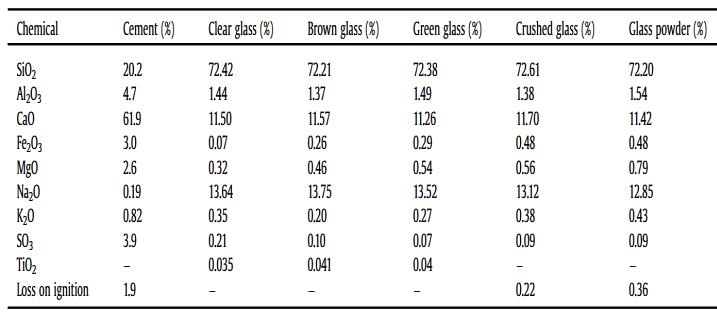
Hassani et al. (2023) Hassani et al. reviewed many previousstudiesandconcludedthatwasteglasspowder canimprovebothcompressivestrengthanddurability of concrete. They emphasized that fine glass powder performs better because it has higher reactivity and formsmorebindingcompoundsinsideconcrete.
Matos et al. (2023) Matos et al. reported that waste glass powder works as a filler material in concrete. It fillsthetinyvoidsbetweencementparticles,makingthe concrete structure denser, stronger, and less porous. Thisalsohelpsinimprovingoveralldurability.
Zhang et al. (2023) Zhang et al. highlighted the environmentalbenefitsofusingWGP.Theystatedthat replacing cement with glass powder reduces cement consumption,whichinturnlowerscarbondioxide(CO₂) emissions.Thismakesconcreteproductionmoreecofriendly and supports sustainable construction practices.
Eixeira et al. (2023) Teixeira et al. found that the optimumreplacementlevelofcementwithwasteglass powder is around 10% to 30%. Within this range,
concrete shows a good balance between strength, workability, and durability. Beyond this limit, performancemaystartdecreasing.
Sivasuriyan et al. (2025) Sivasuriyanetal.explained that waste glass powder reacts with cement to form additionalcalciumsilicatehydrate(C-S-H)gel.Thisgel is responsible for increasing strength and reducing permeabilityinconcrete.
3.1 Aim & Objectives:
acomprehensivereviewonhowdifferentdosages ofwasteglassaffectfresh,physical,mechanical,and durabilityproperties.
AReviewofpriorresearchontheimpactofwaste glass ratios on mortar properties. Examination of glasscomposition'sroleinmortarproperties.
Thepaperaimstoprovideinsightsintothefactors influencingcompressivestrengthwhenusingwaste glassinmortar.
4.1 Effect of using glass powder in concrete:
a. Slump test: Vasudevan Gunalaan and Kanapathy pillaySeriGanis[2013]studiedslumppropertyin hisresearchandresultedthatcomparedtocontrol mix,byusingwasteglasspowderwillgiveanother benefitwhichistheworkabilityofconcretewhichis muchhigher.R.Vandhiyanetal[2013]investigated that the workability was reduced due to the replacement and it reduced with increase in replacement, this is due to the increase in the surface area of the glass powder and also the angularshapeoftheglassparticles.KumarappanN. [2013] presented that there is a systematicincreases in the slump as the glass powder in the mix increases. The slump ranged from around 40mmforthereferencemix(i.e.0%glasspowder) to 160mm at 40% glass powder. Khatib J.M. et al [2012] in his study showed that there was a systematic increase in the slump as the glass powdercontentinthemixincreases.JangidJitendra B. and Saoji A.C. [2012] resulted that the workability decreases as the percentage glass powderinthemixincreases..ChikhalikarS.M.and TandeS.N.[2012]studiedthepropertiesofSFRC( SteelFibreReinforcedConcrete)containingwaste glass as pozzolona and concluded that the 20% replacementofcementbywasteglasspowdergives betterworkabilitytoSFRC.NassarRoz-Ud-Dinand Soroushian Parviz [2012] utilized milled waste
International Research Journal of Engineering and Technology (IRJET) e-ISSN: 2395-0056
Volume: 13 Issue: 04 | Apr 2026 www.irjet.net p-ISSN: 2395-0072
glass in his experimentation and resulted that slump is observed to slightly increase with the introduction of milled waste glass. This could be attributedtothelowwaterabsorptionofglass.The slumpofrecycledaggregateconcretemixes(atboth levels of w/cm ratio) is higher than that of correspondingcontrolmixes.
b.
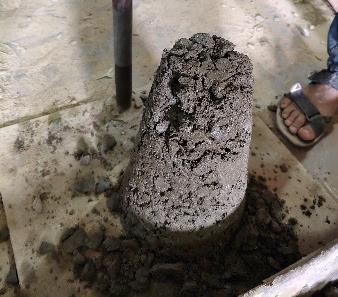
c. Compressive strength: Many studies have explored the impact of waste glass powder as a partialreplacementforcementinconcrete.Notably, GunalaanandSeriGanis(2013)foundthata20% replacementofglasspowdersignificantlyimproved compressive strength at 28 days of curing compared to lower ratios of 10% and 15%. Meanwhile,Vandhiyanetal.(2013)reportedthata 15% replacement resulted in a 29% increase in strengthat7days,thoughthisdecreasedto23%by 28days,withoptimalstrengthat10%replacement. Kumarappan (2013) also found that up to 10% replacement yielded higher compressive strength than control mixes. Further, Vijayakumar et al. (2013) suggested up to 40% replacement could enhancestrengthover28and60days.Incontrast, Nwaubani and Poutos (2013) observed that increased glass content generally reduced compressivestrength,thoughthiseffectdiminished with prolonged curing time, emphasizing particle size distribution as a critical factor. Khatib et al. (2012) noted similar findings, where maximum strengthoccurredataround10%glasspowderand declinedwithgreateramounts.Research byPatel Dhirendra (2012) indicated moderate declines in compressivestrengthat28days,whileJangidand Saoji (2012) confirmed strength increases up to 40%replacement,peakingat20%.Chikhalikarand Tande(2012)demonstrateduptoa30%strength increasewithfiber-reinforcedconcretecontaining waste glass, with the peak at a 20% replacement. DaliandTande(2012)reportedupto25%strength increments at 20% replacement. In experimental work, Khmiri et al. (2012) found that sieve sizes lower than 40 μm could lead to a compressive strengthindexofover82%.PatilandSangle(2012) concluded that 20% glass powder addition
significantlyenhancedstrength.Bajadetal.(2011) demonstrated that 20% replaced glass powder maintainedpeakstrengthevenundersulfateattack. Lastly, studies by Wang and Hou (2011) and Oliveira et al. (2010) suggested effective cement replacement rates of 10% and 30% respectively, focusing on the pozzolanic activity and favorable strength properties. Overall, optimal results generally indicate that partial replacement of cementwithwasteglasspowderleadstoimproved concrete characteristics, particularly around the 10%to20%range.
d. Split tensile strength: Inthestudyofsplittensile strength, Vijayakumar G. et al. (2013) found that glass powder concrete enhances tensile strength compared to conventional concrete, while VandhiyanR.etal.(2013)reportedonlyamarginal improvement. Chikhalikar S.M. and Tande S.N. (2012) identified that Steel Fibre Reinforced Concrete(SFRC)reachesitspeaktensilestrengthat a 20% cement replacement with waste glass powder. Furthermore, Dali J.S. and Tande S.N. (2012) concluded from their experiments on concrete with mineral admixtures that a 20% replacementisoptimal,irrespectiveofwhetherthe concreteexperiencesalternatewettinganddrying conditions. Regardingwaterabsorption,MalikM. Iqbaletal.(2013)demonstratedintheirresearch on using Waste Glass as a partial fine aggregate replacement that the percentage of water absorption decreases with higher waste glass content,withthelowestabsorptionobservedata 40%wasteglassmix.Conversely,NwaubaniSunny O.andPoutosKonstantinosI.(2013)indicatedthat waterabsorptionriseswithincreasedglasspowder content,yetmoderatesubstitutions(5%and20% glass powder) yielded values comparable to the control mix. Finally, Nassar Roz-Ud-Din and Soroushian Parviz (2012) found that the introduction of milled waste glass as a partial cement replacement significantly reduces water absorptioninbothlowandhighwater/cementratio mixes.
e. Water absorption test MalikM.Iqbaletal.(2013) investigated the use of waste glass as a partial replacementforfineaggregatesinconcrete,finding that water absorption decreased with increased wasteglasscontent,withthelowestabsorptionat 40% waste glass. Nwaubani Sunny O. and Poutos KonstantinosI.(2013)exploredtheeffectofwaste glass powder fineness on cement mortars, noting that water absorption rose with higher glass powder content, though moderate substitutions (5%and20%glasspowder)showedvaluessimilar to the control mix. Lastly, Nassar Roz-Ud-Din and Soroushian Parviz (2012) examined the strength anddurabilityofrecycledaggregateconcretewith
International Research Journal of Engineering and Technology (IRJET) e-ISSN: 2395-0056
Volume: 13 Issue: 04 | Apr 2026 www.irjet.net p-ISSN: 2395-0072
milled glass as a partial cement replacement, concludingthatwaterabsorptionwassignificantly reduced with milled waste glass in both low and highwater/cementratiomixes.
a. The following conclusions can be drawn:
A large quantity of waste glass (WG) is produced annually,significantlyimpactinglandfills,especially inurbanareas.
WGisprimarilysenttolandfillswithoutrecycling, contributing to energy consumption and CO2 emissions from glass and cement industries, exacerbatingglobalwarming.
Theconcreteindustryoffersasustainablesolution by using waste glass as a substitute for cement, resulting in improved concrete characteristics comparedtotraditionalmixes.
Key properties enhanced through waste glass in concrete include compressive strength, flexural strength,workability,andsplittensilestrength.
The level of cement replacement by waste glass powder (WGP) presents challenges, with varying optimallevelsidentifiedinresearch.
ThereisalackofliteratureonusingWGPasboth cementandfineaggregatereplacementinconcrete, suggestinganeedforfurtherresearchonitseffects onconcreteproperties.
Glass can partially replace cement in concrete, enhancingworkability.Improvementsobservedin strength parameters: compressive, flexural, and splittensilestrength.Increaseddurabilityindicated by results from water absorption and sorptivity tests.
Utilization of waste glass addresses disposal challenges related to limited landfill space and rising disposal costs. This approach provides economicbenefitswhilemitigatingwastedisposal issues.
Alkali-silicareaction(ASR)posesrisksduetoglass particles reacting with cement alkalis, leading to expansion,cracking,anddurabilityissues.
Theeffectivenessofwasteglasspowder(WGP)is dependent on particle fineness; coarser particles maybehaveasinertmaterials,negativelyimpacting concretestrength.
High replacement levels of WGP can reduce the workabilityoffreshconcrete,complicatinghandling andcompaction.
Studiesindicatethatonly10-30%ofcementcanbe effectivelyreplacedwithWGP;exceedingthisrange candiminishmechanicalproperties.
TheabsenceofuniversalstandardsforWGPusein construction hinders its widespread adoption. Waste glass quality varies based on its source (bottles,windows,mixedwaste),whichcanaffect concreteperformance.
The energy-intensive process of grinding waste glassintofinepowdercanelevatecosts,potentially offsettingeconomicbenefits.
Future studies should investigate chemical additivesorsupplementarymaterialstocontrolor eliminatealkali-silicareactioninWGPconcrete.
Expandedresearchonnano-sizedorultra-fineglass powderisneeded,asitmayenhancereactivityand concretestrength.
Further studies on combining WGP with other wastematerialslikeflyash,silicafume,andGGBS couldimproveperformanceanddurability.
ResearchshouldexploretheapplicationofWGPin structuralcomponentssuchasbeams,columns,and high-risestructuresforreliability.
Future studies should investigate chemical additivesorsupplementarymaterialstocontrolor eliminatealkali-silicareactioninWGPconcrete.
Expandedresearchonnano-sizedorultra-fineglass powderisneeded,asitmayenhancereactivityand concretestrength.
Further studies on combining WGP with other wastematerialslikeflyash,silicafume,andGGBS couldimproveperformanceanddurability.
Long-termfieldstudies(10–20years)arenecessary to assess real-life performance under varying environmentalconditions.
ResearchshouldexploretheapplicationofWGPin structuralcomponentssuchasbeams,columns,and high-risestructuresforreliability.
[1] ConcreteTechnology:TheoryandPracticebyM.L Gambhir.
[2] ConcreteTechnology:byS.S.Bhavikatti.
[3] F.A.OlutogeandC.Strength,“EffectofWasteGlass Powder (WGP) on the Mechanical Properties of Concrete,” Am. J. Eng. Res., vol. 38, no. 511, pp. 2320–847,2016,[Online].Available:www.ajer.org.
[4] R. Gowtham, S. Manikanda Prabhu, M. Gowtham, andR.Ramasubramani,“AReviewOnUtilizationOf WasteGlassIn ConstructionField,”IOPConf.Ser. Mater.Sci.Eng.,vol.1130,no.1,p.012010,2021, doi:10.1088/1757-899x/1130/1/012010.
[5] UnitedNations,“WorldUrbanizationProspects:The 2014 Revision, United Nations Department of
International Research Journal of Engineering and Technology (IRJET) e-ISSN: 2395-0056
Volume: 13 Issue: 04 | Apr 2026 www.irjet.net p-ISSN: 2395-0072
EconomicandSocialAffairs/PopulationDivision.,” NewYork,NY,USA,2014.
[6] H. Du, K.H. Tan, Use of waste glass as sand in mortar.PartII.Alkali–silicareactionandmitigation methods, Cement and Concrete Composites 35 (2013)118126,http://dx.doi.org/10.1016/j.cemcon comp.2012.08.029.
[7] W. Hogland, Remediation of an old landfill site, ESPR-Environmental Science and Pollution Research1(2002)49–54.
[8] IB. Topçu, M. Canbaz, Properties of concrete containing waste glass, Cement and Concrete Research34(2004)267274http://dx.doi.org/10.101 6/j cemconres.2003.07.003.
[9] M.Saito,M.Shukuya,Energyandmaterialuseinthe production of insulating glass widows, Solar Energy58(1996)247252,http://dx.doi.org/10.1016 /S0038-092X(96)00056-4.
[10] M.Ruth,P.Dell’Anno,Anindustrialecologyofthe USglassindustry,ResourcesPolicy23(1997)109–124,http://dx.doi.org/10.1016/S03014207(97)000 20-2.
[11] H. Isa, The need for waste management in the glassindustries:a review, ScientificResearchand Essay3(2008)276–279.
[12] L.M. Federico, S.E. Chidiac, Waste glass as a supplementarycementitiousmaterialinconcrete–criticalreviewoftreatment methods,Cementand Concrete Composites 31 (2009) 606–610, http://dx.doi.org/10.1016/j.cemconcomp.2009.02.001
[13] StateU.,EnvironmentalProtectionAgencyreport, 2012,http://www.epa.gov/epawaste/conserve/mat erials/glass.htm
[14] C.Ambell,A.Bjorklund,M.Soderman,Potentialför öÖkad Materialåtervinning av Hushållsavfall och Industrialavfall(Swedish),KTHreport,Stockholm, ISSN1652-5442,2010.
[15] L.A.Pereira-de-Oliveira,J.P.Castro-Gomes,P.M.S. Santos, The potential pozzolanic activity of glass and red-clay ceramic waste as cement mortars components, Construction and Building Materials 31(2012)197203,http://dx.doi.org/10.1016/j.conb uildmat.2011.12.110
[16] T.Zhang,P.Gao,P.Gao,J.Wei,Q.Yu,Effectiveness of novel and traditional methods to incorporate industrial wastes in cementitious materials – an overview, Resources, Conservation and Recycling 74(2013)134143,http://dx.doi.org/10.1016/j.resco nrec.2013.03.003
[17] A.M.Matos,J.Sousa-Coutinho,Durabilityofmortar usingwasteglasspowderascementreplacement, ConstructionandBuildingMaterials36(2012)205–215,http://dx.doi.org/10.1016/j.conbuildmat.2012. 04.027
[18] M. Schneider, M. Romer, M. Tschudin, H. Bolio, Sustainable cement production present and
future, Cement and Concrete Research 41 (2011) 642–650, http://dx.doi.org/10.1016/j.cemconres.2011.03.01 9
[19] N.Pardo,J.A.Moya,A.Mercier,Prospectiveonthe energy efficiency and CO2 emissions in the EU cement industry, Energy 36 (2011) 3244–3254, http://dx.doi.org/10.1016/j.energy.2011.03.016.
[20] N.A.Madlool,R.Saidur,M.S.Hossain,N.A.Rahim,A critical review on energy use and savings in the cement industries, Renewable and Sustainable Energy Reviews 15 (2011) 2042–2060, http://dx.doi.org/10.1016/j.rser.2011.01.005.
[21] L. Szabó, I. Hidalgo, J.C. Ciscar, A. Soria, CO2 emission trading within the European Union and Annex B countries: the cement industry case, Energy Policy 34 (2006) 72–87, http://dx.doi.org/10.1016/j.enpol.2004.06.003.
[22] M.B. Ali, R. Saidur, M.S. Hossain, A review on emissionanalysisincementindustries,Renewable andSustainableEnergyReviews15(2011)2252–2256,http://dx.doi.org/10.1016/j.rser.2011.02.014
[23] R.Rehan,M.Nehdi,Carbondioxideemissionsand climatechange:policyimplicationsforthecement industry,EnvironmentalScience&Policy8(2005) 105–114, http://dx.doi.org/10.1016/j.envsci.2004.12.006
[24] A. Bosoaga, O. Masek, J.E. Oakey, CO2 capture technologiesforcementindustry,EnergyProcedia1 (2009)133–140,http://dx.doi.org/10.1016/j.egypro.2009.01.020
[25] K.M.Lee,H.K.Lee,S.H.Lee,G.Y.Kim,Autogeneous shrinkage of concrete containing granulated blast furnace slag, Cement and Concrete Research 7 (2006)1279–1285.
[26] N. Farzadnia, Ali A.A. Abang, R. Demirboga, M.P. Anwar,Effectofhalloysitenanoclayonmechanical properties,thermalbehaviorandmicrostructureof cementmortars,CementandConcreteResearch48 (2013)97104,http://dx.doi.org/10.1016/j.cemconr es.2013.03.005.
[27] N. Lairaksa, A.R. Moon, N. Makul, Utilization of cathode ray tube waste: encapsulation of PbOcontainingfunnelglassinPortlandcementclinker, JournalofEnvironmentalManagement117(2013) 180186,http://dx.doi.org/10.1016/j.jenvman.2012. 12.014.23376301.
[28] S. Kou, C. Poon, A novel polymer concrete made with recycled glass aggregates, fly ash and metakaolin,ConstructionandBuildingMaterials41 (2013)146151,http://dx.doi.org/10.1016/j.conbuil dmat.2012.11.083
[29] S.deCastro,J.deBrito,Evaluationofthedurability of concrete made with crushed glass aggregates, Journal of Cleaner Production 41 (2013) 7–14, http://dx.doi.org/10.1016/j.jclepro.2012.09.021.
International Research Journal of Engineering and Technology (IRJET) e-ISSN: 2395-0056
Volume: 13 Issue: 04 | Apr 2026 www.irjet.net p-ISSN: 2395-0072
[30] R.G.Pike,D.Hubbard,Physicochemicalstudiesof the destructive alkali- aggregate reaction in concrete,JournalofResearchoftheNationalBureau of Standards 59 (2) (1957) 127–132, http://dx.doi.org/10.6028/jres.059.013
[31] V.Ducman,A.Mladenovi9c,J.S.Šuput,Lightweight aggregatebasedonwasteglassanditsalkali–silica reactivity,CementandConcreteResearch32(2002) 223–226,http://dx.doi.org/10.1016/S00088846(01)00663-9
[32] K.H. Tan, H. Du, Use of waste glass as sand in mortar. Part I. Fresh, mechanical and durability properties, Cement and Concrete Composites 35 (2013)109117,http://dx.doi.org/10.1016/j.cemcon comp.2012.08.028
[33] Y.Shao,T.Lefort,S.Moras,D.Rodriguez,Studies onconcretecontaininggroundwasteglass,Cement and Concrete Research 30 (2000) 91–100, http://dx.doi.org/10.1016/S0008-8846(99)002136.
[34] A. Khmiri, B. Samet, M. Chaabouni, A cross mixture design to optimise the formulation of a groundwasteglassblendedcement,Construction and Building Materials 28 (2012) 680–686, http://dx.doi.org/10.1016/j.conbuildmat.2011.10.032
[35] R. Idir, M. Cyr, A. Tagnit-Hamou, Pozzolanic properties of fine and coarse color- mixed glass cullet,CementandConcreteComposites33(2011) 1929,http://dx.doi.org/10.1016/j.cemconcomp.201
0.09.013 A. Shayan, Value-added utilization of waste glass in concrete, IABSE Symposium, Melbourne,2002,pp.1–11.