
International Research Journal of Engineering and Technology (IRJET) e-ISSN: 2395-0056
Volume: 13 Issue: 05 | May 2026 www.irjet.net p-ISSN: 2395-0072

International Research Journal of Engineering and Technology (IRJET) e-ISSN: 2395-0056
Volume: 13 Issue: 05 | May 2026 www.irjet.net p-ISSN: 2395-0072
Chetanshi Somanlal Sahu1, Ashok Kumar Singh2, Bhoj Ram Sahu3
1Mtech Student, Department of Civil Engineering, Bharti Vishwavidyalaya Durg CG
2,Assistant Professor, Department of Civil Engineering, Bharti Vishwavidyalaya Durg CG
3Assistant Professor, Department of Civil Engineering, Bharti Vishwavidyalaya Durg CG
Abstract - The most popular building material in the world is concrete, which causes serious environmental problems due to the exploitation of raw materials and CO2 emissions during the cement-making process. Approximately one ton of CO2 emissions and significant energy usage are produced for every ton of cement. A solution is provided by supplementary cementing materials (SCMs), which improve concrete performance while using less cement. One prominent SCM that functions as a pozzolanic substance is metakaolin (MK), which is obtained from calcined kaolinitic clay. This study presents a thorough overview of the literature on the use of MK as a partial cement substitute in mortar and concrete.
Key Words: Concrete, Metakaolin, Fresh concrete properties, Workability, Mechanical properties, Permeability & pore size distribution
1.1 Concrete: - Concrete, which is mostly made of water, aggregates, and Portland cement, is manufactured in two billion tons a year and is used in construction because of its strength, durability, and affordability. Measuring, mixing, and a 28-day curing period are all part of the concreting process. Despite its benefits, concreteisweakundertensionandPortlandcementisa major source of CO2 emissions worldwide. Additives improve performance, and research is continuing to provide more robust and environmentally friendly substitutes.Althoughconcreteisstillnecessaryforcivil engineering,improvementsinadmixturesarerequired tomakeitmoreworkableanddurable.
1.2 Metakaolin:- Byloweringcementusageandincreasing strength and durability, the use of pozzolanas, especially high-reactive metakaolin (MK), improves mortar and concrete efficiency. With a mean size of around3μm,99.9%ofMK'sparticlesarelessthan16 μm. With trace proportions of other oxides, it is composed of 50–55% SiO2 and 40–45% Al2O3. Becausesupplementalcementitiousmaterials(SCMs) likeMKrequirealargequantityofcalciumhydroxide (CH),whichdoesnotaddtoconcretestrengthandmay adversely impact durability, a higher alumina concentrationboostspozzolaniccapability.Bycreating calcium silicate hydrate gel, which greatly increases overallstrength,metakaolinstrengthensandprolongs the life of concrete. By sealing in the gaps between
cement and aggregates, it lowers permeability and stops moisture and chemicals from penetrating and causing degradation. Additionally, because of its spherical form and tiny particle size, which improve dispersion, lower water requirements, and increase viscosityforeasyplacement,metakaolinincreasesthe workabilityandcohesivenessofconcretemixtures.
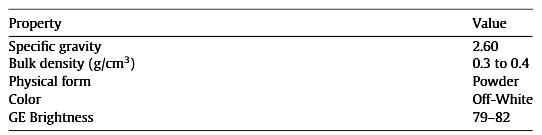
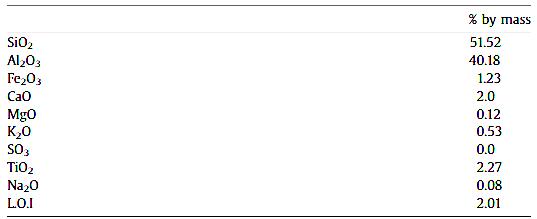
1.3 Metakaolin reactivity: - Thecalcinationconditionsof kaoliniteandthecharacterizationofmetakaolin(MK) are critical in understanding its thermal activation throughdehydration,resultinginareactivetransitional phase.Theinteractionbetweenamorphoussilica(AS2) and calcium hydroxide (CH) during cement hydration yields additional cementitious C-S-H gel and various crystallineproducts,influencedbytheAS2/CHratioand temperature. The incorporation of MK as a partial replacementforPortlandcementsignificantlylowersCH concentration,withstudiesshowingareductionofupto 20% replacement, and complete removal at higher levels (30-40%) under specific conditions. Research indicates peak pozzolanic activity in MK-PC pastes occursaround14days,leadingtoareductioninCHand higher compressive strength due to the reaction betweenMKandCH.Thedegreeofpozzolanicreaction is enhanced at lower replacement levels (5%), attributedtoahigherconcentrationofCHcomparedtohigherreplacements.
International Research Journal of Engineering and Technology (IRJET) e-ISSN: 2395-0056
Volume: 13 Issue: 05 | May 2026 www.irjet.net p-ISSN: 2395-0072
1.4 Steel slag: - Steel slag is a byproduct of steelmaking, formed from reactions in the furnace that remove impurities from iron ore and flux materials. Its composition varies depending on raw materials and processes, generally containing residual metals and metalliciron.Therearethreemaintypes:BasicOxygen Furnace(BOF)slag,richinCaO,SiO₂,andFeO;Electric Arc Furnace (EAF) slag, which has higher magnesium oxide and phosphorus; and Ladle Furnace (LF) slag, enrichedincalciumandmagnesiumoxides.Steelslagis dense, hard, and durable, making it suitable for construction. It is used as an aggregate in road construction, in cement production, as a soil amendment,forenvironmentalremediation,andinsteel recycling. However, potential metal leaching is a concern,necessitatingsafetytestingforenvironmental applications. Overall, steel slag serves as a valuable resource for various economic and environmental benefits.
Table
1.5 Development of concrete with metakaolin & steel slag techniques:-Theprocessofdevelopingconcrete usingsteelslagandmetakaolincomprisesutilizingthese resourcestoproduceconcretewithimprovedqualities. Steelslag,abyproductofthesteelindustry,canpartially substitutenaturalaggregatestosavecostsandenhance densityandmechanicalqualities.Metakaolinisahighreactivity pozzolan that increases strength and durabilitybyimprovingmicrostructureanddecreasing porosity. Increased strength, better resistance to chemical assaults, increased sustainability through fewer carbon emissions and dependence on natural aggregates, and decreased porosity, which improves resiliencetoenvironmentalproblems,arealladvantages oftheircombination.
1.6 Techniquesforintegrating metakaolinand steel slag in concrete:-Methodsforincorporatingsteelslagand metakaolin into concrete need precise mixing, curing, andproportioning.Whilesteelslagmayreplace10–50% of coarse aggregates, necessitating processing for compatibility, metakaolin usually replaces 5–15% of cement, improving workability and compressive strength. Due to their effect on water demand, mix designmodificationsarerequired,frequentlyinvolving theuseofsuperplasticizers.Thepozzolanicreactionof
metakaolinrequirespropercuringandextensionwhen needed.Freshsteelslagshouldalsobeagedortreated tostopexpansionfromfreelimeandpericlase,andfine grindingisadvisedwhenusingitinplaceofcementto increasereactivity.
A comprehensive study by Silva et al. (2024) examined the long-term performance of mortars incorporating ladle furnace slag and metakaolin. TheresultsindicatedthatthecombineduseofMK and slag significantly improves compressive strengthanddurabilityovertimeduetocontinued pozzolanic and hydraulic reactions, leading to a densercementmatrix.
Wei et al. (2024) reportedthatpartialreplacement of cement with metakaolin and slag improves reactivity and strength development, confirming theirfeasibilityasalternativebinders.
In 2024, research on the synergistic hydration mechanism of steel slag and metakaolin demonstrated that their combined incorporation enhances cement hydration through ionic dissolution and complementary chemical interactions. The study showed that metakaolin compensates for the low reactivity of steel slag, resultinginimprovedformationofcalciumsilicate hydrate (C–S–H) gel and refined pore structure . This synergy leads to improved microstructural densificationandreducedporosity.
Ibrahim et al. (2025) investigatedthereplacement of natural aggregates with steel slag and found significantimprovementsincompressivestrength and sustainability, highlighting its potential as a viableconstructionmaterial.Anotherstudy(2025) reportedthatelectricarcfurnaceslagcanreplace cement and fine aggregates in high proportions while maintaining mechanical and durability performance, emphasizing its role in reducing naturalresourcedepletion.Additionally,Akhtaret al. (2025) demonstrated that steel slag improves porestructurecharacteristics,contributingtohighperformanceandsustainableconcrete.
Ahmad et al.(2025) demonstratedthatmetakaolin improves the mechanical and durability performance of composite cementitious systems whencombinedwithslag-basedmaterials.
Gao et al. (2026) optimized metakaolin–slag mixtures and reported improved mechanical properties and sustainability performance due to the formation of geopolymer aluminosilicate networkks.
International Research Journal of Engineering and Technology (IRJET) e-ISSN: 2395-0056
Volume: 13 Issue: 05 | May 2026 www.irjet.net p-ISSN: 2395-0072
3.1 Aim & Objectives:
Review the role of metakaolin and steel slag as supplementarycementitiousmaterials(SCMs).
Examinetheirphysical,chemical,andmineralogical propertiesandtheirinfluenceonconcretebehavior.
Analyzethe effectof metakaolinandsteel slagon the mechanical properties of concrete, including compressivestrengthbasedonrecentstudies.
Investigate the durability characteristics of metakaolin–steel slag concrete, focusing on resistancetowaterabsorption,permeability
Understand the hydration mechanisms and microstructural development, reviewing how the pozzolanic activity of metakaolin and latent hydraulicpropertiesofsteelslagcontributetoC–S–H formation, pore refinement, and ITZ improvement.
Identifyoptimumreplacementlevelsofmetakaolin andsteelslag,determiningthemosteffectivemix proportions reported in literature for enhanced performance.
Evaluatethesynergisticeffectsofcombineduseof metakaolinandsteelslagbycomparingbinaryand ternary blends with conventional concrete to highlightperformanceimprovements.
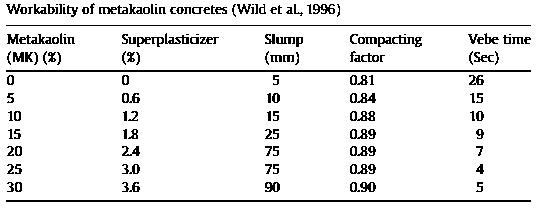
4.1 Workability & Setting Time: MK(Metakaolin)isfound to produce smaller slump in concrete mixtures compared to control mixtures, leading to extensive research on its water demand and flow properties. Kinuthia et al. (2000) noted a significant reduction in the workability of concrete as MK content increased, necessitatingmoresuperplasticizerstocompensatefor this loss. Other studies corroborate these findings, indicatingthatMK'shighchemicalactivityandspecific surface area contribute to increased water requirements. MK has shown better workability characteristics compared to other supplementary cementitiousmaterials(SCMs)likesilicafume(SF),as highlighted by various researchers. For instance, Calderoneetal.(1994)notedthatMKconcreterequired 25%-35% less high-range water reducers than SF mixtures, resulting in a less sticky consistency. Additionally,allSCMs,includingMK,tendtodelaythe settingtimeofconcrete.Brooksetal.(2000)foundthat the extent of retardation increased with greater contentsofSF,flyash(FA),andslag,whileMKshoweda progressiveretardingeffectatlowerreplacementlevels, which decreased at higher levels. Contrasting results were reported by various researchers regarding the impact of MK on setting times, showcasing that its blending can either prolong or reduce setting times
depending on specific conditions and replacement levels. Overall, MK blending leads to higher water demand and thixotropic behavior, accentuated by its roleinacceleratingPortlandcementhydration.
4.2 Heat of Hydration: - In various studies, the incorporation of metakaolin (MK) has been shown to enhanceheatevolutionduringthehydrationofPortland cement(PC).ThisincreaseisduetoMK'saccelerating effect on PC hydration and its high reactivity with calcium hydroxide (CH). While this elevated temperaturecancausethermalstresscrackinginlarge concretemembers,itisadvantageousincoldweather conditions where rapid setting is preferred. For instance, research by Zhang and Malhotra (1995) indicatedthata10%MKreplacementledtoa7°Crise intemperaturecomparedtoPCconcrete.Ambroiseetal. (1994)foundthattemperatureincreasesfor10%,20%, and 30% MK replacements were 8 °C, 6 °C, and 1 °C, respectively,demonstratingadecreaseintemperature risewithhigherMKlevels.Thisreductionseemstostem from the dilution effect resulting from the significant removal of cement. Conversely, a mere 10% replacement with silica fume resultedin onlya 0.5 °C increaseintemperature.Fríasetal.(2000)comparedfly ash(FA),silicafume,andMKintermsofheatevolution, finding that MK mortars exhibited a slight increase in heatcomparedto100%PCmortars,attributedtoMK's high pozzolanic activity. Both MK and silica fume showed pozzolanic behavior, particularly after two hours,whereasFAdemonstratedmuchlowerreactivity. BaiandWild(2002)observedthattemperaturerisein FAsystemsdeclinedwithincreasedreplacement,while MK systems showed a significant increase in temperature.Theyreportedpeaktemperaturesof29°C, 27 °C, and 31 °C for control, 10% FA, and 10% MK mixtures,respectively.Baietal.(2003)furtherexplored the combined effects of FA and MK in ternary blends, finding a compensatory relationship where the temperature rise for a blend of 10% FA and 10% MK matchedthatofthecontrolmixture.
4.3 Permeability & pore sizedistribution: - influencedby factors such as particle size, chemical composition, mineralogy,andlossonignitionofpozzolans.Friasand Cabrera(2000)examinedtheevolutionofcapillaryand
International Research Journal of Engineering and Technology (IRJET) e-ISSN: 2395-0056
Volume: 13 Issue: 05 | May 2026 www.irjet.net p-ISSN: 2395-0072
gelporosityduringhydrationusingMercuryIntrusion Porosimetry(MIP),categorizingcapillaryporesbetween 0.01-5.00 μm and gel pores as smaller than 0.01 μm. Theirfindingsindicatedareductionintotalporosityup to28days,afterwhichitstabilized.Notably,mixtures withmetakaolin(MK)exhibitedhighertotalporosities than control samples due to increased water content, although they had a reduced number of pores in the 0.01-5.00μmrangeandmoreinthesub-0.01μmrange, suggesting pore refinement. Khatib and Wild (1996) corroborated these findings, noting that MK incorporation improved pore structure refinement significantly, with pastes of 15% MK reaching nearly 60%oftotalporevolumeinsub-20nmporesat14days, comparedtoabout30%inthecontrol paste.Thisage alsomarksthemaximumstrength enhancementfrom MK,attributedtoa reaction productlayeraroundMK particlesthatconstrainsfurtherreactionwithcalcium hydroxide(CH). Incontrast,Poonetal.(2001)reported lowerporosityandsmalleraverageporediametersin MKpastescomparedtocontrolandsilicafumepastesat variousages,indicatingMK’ssuperioreffectivenessin pore structure refinement. Disparities in findings between studies might stem from differing water-tocementratios;wherepastesinearlierstudieshadaratio of 0.55, Poon et al. used a lower ratio of 0.30. Ambroiseetal.(1994)foundthata20%MKpastewith aw/cmof0.34hadsimilarporositytoacontrolpaste with a w/cm of 0.25, reinforcing the notion that MK significantly enhances pore structure refinement. Kostuchetal.furtherconfirmedsignificantreductionsin average pore size at a 20% MK replacement and improved resistance to chloride and sodium ion penetration.Additionally,KhatibandClay(2003)noted thatwaterabsorptionduringimmersioncorrelateswith total pore volume, which increases with MK, while capillary water penetration decreases, indicating a disruptioninporecontinuity.
4.4 Mechanical properties:- Researchpresentsthatpartial replacementofPortlandcementwithmetakaolin(MK) enhances the compressive strength of concrete by reducing calcium hydroxide (CH) content, thus decreasing the interfacial transition zone (ITZ) and overallporosity.Caldaroneetal.(1994)demonstrated that concretes with 5% and 10% MK at a water-tocement ratio (w/c) of 0.40 exhibited average strength improvementsof10%overthosecontainingsilicafume (SF)atupto365days.Wildetal.(1996)identified20% MKreplacementasoptimalforlong-termstrengthwitha w/c of 0.45. Badogiannis et al. (2005) confirmed considerable strength enhancement with 5% MK in cementover180days,favoring10%MKover20%MK forgeneralapplications.Curcioetal.(1998)foundthat 15%MKimprovedstrengthevolutioninmortarsatearly ages, while Ding and Li (2002) observed comparable benefitswithboth5%to15%MKandsilicafume,noting alinearstrengthincreaseforMKwithinthefirst28days,
deceleratingthereafter.LiandDing(2003)validatedthat a10%MKreplacementconsistentlyresultedingreater strength, particularly when combined with ultra-fine slag. Vu et al. (2001) established that the optimal MK replacement level varies with mortar maturity, recommending10%forearlyagesand15-20%for7to 28days.Inanexaminationoftheimpactofmetakaolin (MK) on the strength characteristics of mortars and concretes, several studies noted that the optimal percentage for enhancing strength at 28 days and beyondvarieddependingonthewater-to-cementratio (w/cm).Forinstance,thehigheststrengthwasachieved with10-25%MKreplacement;ataw/cmof0.32,10% MKwasoptimal,while20%wasbestat0.44.Research byKhatibandWild(1996)highlightedtheimportance ofMK'sparticlesize,observingthatgreaterfinenessled to quicker strength gains and allowed higher cement replacement without detrimental dilution effects, althoughitdidnotaffectlong-termstrength.Qianetal. (2001) reported substantial increases in compressive strength, with a 51% rise observed at 15% MK replacementafterthreedays,indicatingMK'ssignificant early strength contribution. Other studies confirmed similartrendsincompressivestrengthimprovements. OquianandZongjinli(2001)furtherestablishedthatMK incorporationupto15%enhancedtensile/compressive strengthsandpeakstrain.Aconsensusidentifiedthree principalfactorsinfluencingconcretestrengthwithMK: the filler effect, acceleration of Portland cement (PC) hydration, and pozzolanic reactions with calcium hydroxide (CH). Wild et al. (1996) suggested that the benefits from MK decrease after 14 days. Flexural strengthanalysesindicatedthatbothMKandsilicafume improvedstrength,withMKalsoenhancingtoughness. MK's effect on the modulus of elasticity (MOE) was generally positive, with a reported increase in MOE correspondingtoMKcontentbutataslowerratethan compressivestrengthincrements.FindingsbyQianetal. (2001)andCaldaroneetal.(1994)corroboratedthese observations with quantifications of MOE gains at differentcuringintervals.Overall,theinclusion ofMK proved beneficial in enhancing the mechanical propertiesofconcreteandmortar,particularlyinearly strengthdevelopment.
Theliteratureevaluationsupportsusingpozzolanic materials,suchMK,inplaceofsomeofthecement inmortarandconcrete.
It highlights MK's function as a performance enhancer, enhancing mechanical qualities in the shortandlongterm.
MK greatly lowers permeability and increases resistancetothemovementofhazardousionsand water.
International Research Journal of Engineering and Technology (IRJET) e-ISSN: 2395-0056
Volume: 13 Issue: 05 | May 2026 www.irjet.net p-ISSN: 2395-0072
A replacement level of 10–15% MK offers some protectionagainstchemicalingressionandstrong definesagainstsulfateassault.
When applied within ideal limits, MK aids in preventing harmful expansion brought on by the alkali-silicareaction(ASR).
Ontheotherhand,MKmayenhanceshrinkageand theheatgeneratedduringhydration,whichcallsfor moreinvestigation.
Concrete'ssustainabilityisimprovedbycustomized compositions and particle sizes made possible by advancementsinnanotechnology.
• Duetovariationsinsource,manufacture,and treatment, the material qualities of steel slag andmetakaolinvary,makingresultsdifficultto generalize.
• Variationsintheidealreplacementlevelsresult fromthelackofdefinedmixdesignprocesses forproportioningmetakaolinandsteelslag.
• There is little information on long-term durability;instead,short-termperformanceis prioritized above factors like creep and shrinkage.
• Steel slag can affect density and finishing, creatingpracticaldifficulties;highmetakaolin concentrationmaydecreaseworkability.
• Ratherthanevaluatingparametersincombined hostilesituations,durabilitystudiesfrequently evaluateparametersindependently.
• Afocusoncasestudiesandfieldapplicationto validatelabresultsinreal-worldcontexts.
[1] ConcreteTechnology:TheoryandPracticebyM.L Gambhir.
[2] ConcreteTechnology:byS.S.Bhavikatti.
[3] Al-Akhras,N.M.Durabilityofmetakaolintosulfate attack.CementandConcreteResearch36(9),2006, pp.1727–1734.
[4] Ambroise,J.,Maximilien,S.andPera,J.PropertiesOf metakaolin blended cements, Advanced Cement BasedMaterials,1(4),1994,pp.161-168.
[5] Ambroise,J.,Murat,M.,Pera,J.Hydrationreaction and hardening of calcined clays and related minerals:V.Extensionoftheresearchandgeneral conclusions, Cement and oncrete Research, 15, 1985,pp.261-268.
[7] Asbridge, A.H., Chadbourn, G.A. and Page, C.L. Effectsofmetakaolinandtheinterfacialtransition zone on the diffusion of chloride ions through cement mortars, Cement and Concrete Research, 31(11),2001,pp.1567-1572.
[8] Badogiannis, E., Kakali, G., Dimopoulou, G., Chaniotakis, E., Tsivilis, S. Metakaolin as a main cement constituent: exploitation of poor Greek kaolins.CementandConcreteComposites27,2005, pp.197–203.
[9] Bai,J.andWild,S.Investigationofthetemperature changeandheatevolutionofmortarincorporating PFA and metakaolin, Cement and Concrete Composites,24(2),2002,pp.201-209.
[10]Batis, G., Pantazopoulou, P., Tsivilis, S. and Badogiannis,E.Theeffectofmetakaolinonthe corrosionbehaviorofcementmortars,Cementand ConcreteComposites,2004,pp.432-441.
[11]Boddy,A.,Hooton,R.D.andGruber,K.A.Long-term testing of the chloride penetration resistance of concrete containing high-reactivity metakaolin, Cement and Concrete Research, 31(5), 2001, pp.759-765.
[12]Brooks,J.J.andJohari,M.A.M.Effectofmetakaolin on creep and shrinkage of concrete, Cement and ConcreteComposites,23(6),2001,pp.495-502.
[13]Brooks,J.J.,Johari,M.A.M.andMazloom,M.Effectof admixtures on the setting times of high-strength concrete,CementandConcreteComposites,22(1), 2000,pp.293-301.
[14]Caldarone, M.A., Gruber, K.A. and Burg, R.G. High reactivity metakaolin (HRM): a new generation mineraladmixtureforhighperformanceconcrete, ConcreteInternational,16(11),1994,pp.37-40.
[15]Courard, L., Darimont, A., Schouterden, M., Ferauche, F., Willem, X. and Degeimbre, R. Durability of mortars modified with metakaolin, Cement and Concrete Research, 33(9), 2003, pp. 473-1479.
[16]Curcio, F., DeAngelis, B.A. and Pagliolico, S. Metakaolin as a pozzolanic micro filler for highperformance mortars, Cement and Concrete Research,28(6),1998,pp.803-809.
[17]Diamond,S.Mercuryporosimetry:aninappropriate method for the measurement of pore size
[6] Aquino,W.,Lange,D.A.andOlek,J.Theinfluenceof metakaolin and silica fume on the chemistry of alkali-silicareactionproducts,CementandConcrete Composites,23(6),2001,pp.485-493.
International Research Journal of Engineering and Technology (IRJET) e-ISSN: 2395-0056
Volume: 13 Issue: 05 | May 2026 www.irjet.net p-ISSN: 2395-0072
distributions in cement-based materials, Cement andConcreteResearch,30,2000,pp.1517-1525.
[18]Ding,J.T.andLi,Z.J.Effectsofmetakaolinandsilica fume on properties of concrete, ACI Materials Journal,99(4),2002,pp.393-398.
[19]Dubey,A.andBanthia,N.(1998),Influenceofhighreactivitymetakaolinandsilicafumeontheflexural toughness of high-performance steel fiberreinforced concrete, ACI Materials Journal, 95(3): 284-292.
[20]Frías,M.andCabrera,J.Poresizedistributionand degreeofhydrationofmetakaolin-cementpastes, Cement and Concrete Research, 30(4), 2000, pp.561-569.
[21]Frías,M.,deRojas,M.I.S.andCabrera,J.Theeffect that the pozzolanic reaction of metakaolin has on theheat evolutioninmetakaolin-cementmortars, Cement and Concrete Research, 30(2), 2000, pp. 209-216.
[22]Gruber,K.A.,Ramlochan,T.,Boddy,A.,Hooton,R.D. andThomas,M.D.A.Increasingconcretedurability with high-reactivity metakaolin, Cement and ConcreteComposites,23(6),2001,pp.479-484.
[23]Gleize P.J.P., Cyr M., Escadeillas G. Effects of metakaolin on autogenous shrinkage of cement pastes,CementandConcreteComposites,29,2007, pp.80-87.
[24]Jin, X., Li, Z., Effects of mineral admixture on propertiesofyoungconcrete.JournalofMaterialsin CivilEngineering15(5),2003,pp.435–442.
[25]Kinuthia, J.M., Wild, S., Sabir, B.B. and Bai, J. Selfcompensating autogenous shrinkage in Portland cement-metakaolin-fly ash pastes, Advances in CementResearch,12(1),2000,pp.35-43.
[26]Kostuch, J.A., Walters, G.V., Jones, T.R. High PerformanceConcreteIncorpor-atingMetakaolin-a review.Concrete2000.UniversityofDundee,1993, pp.1799–1811.
[27]Kurtis, K.E., Monteiro, P.J.M, and Madanat, S.M. Empirical models to predict concrete expansion caused by sulfate attack, ACI Materials Journal, 97(2),2000,pp.156-162.
[28]Lee,S.T.,Moon,H.Y.,Hooton,R.D.,Kim,J.P.Effectof solutionconcentrationsand replacementlevelsof metakaolinontheresistanceofmortarsexposedto magnesiumsulfatesolutions.CementandConcrete Research35,2005,pp.1314–1323.
[29]Li, Z.J. and Ding, Z. Property improvement of Portlandcementbyincorporatingwithmetakaolin and slag, Cement and Concrete Research, 33(4), 2003,pp.579-584.
[30]Luc Courard, Anne Dari mount Marleen Schouterden,FabriceFerauche,XavierWilliumand RobertDegeimber.Durabilityofmortarsmodified withmetakaolin,CementandConcreteResearch,33 (9),2003,pp.1473-1479.
[31]Malhotra V.M., Role of Supplementary Cementing Materialsin Reducing Greenhouse GasEmissions, ConcreteTechnologyforaSustainableDevelopment in the 21st Century, O.E. Gjorv and K. Sakai, eds., E&FNSpon,London,2000.
[32]Mindess,S.,Young,F.J.andDarwin,D.Concrete,2nd ed.,UpperSaddleRiver:PrenticeHall,2003.
[33]Moulin,E.,Blanc,P.andSorrentino,D.Influenceof keycementchemicalparametersontheproperties of metakaolin blended cements, Cement and ConcreteComposites,23(6),2001,pp.463-469.
[34]Roy, D.M., Arjunan, P. and Silsbee, M.R. Effect of silicafume,metakaolin,andlow-calciumflyashon chemical resistance of concrete, Cement and ConcreteResearch,31(12),2001,pp.1809-1813.
[35]Sabir, B.B., Wild, S. and Bai, J. Metakaolin and calcined clays as pozzolansfor concrete:a review, CementandConcreteComposites,23(6),2001,pp. 441-454.
2026, IRJET | Impact Factor value: 8.315 | ISO 9001:2008