
International Research Journal of Engineering and Technology (IRJET) e-ISSN:2395-0056
Volume: 12 Issue: 05 | May 2025 www.irjet.net p-ISSN:2395-0072
International Research Journal of Engineering and Technology (IRJET) e-ISSN:2395-0056
Volume: 12 Issue: 05 | May 2025 www.irjet.net p-ISSN:2395-0072
Dr. D. Koteswara Rao1, Sajida Sulthana Mohammed2 , Sangepu Sairam3
1Professor, Head of The Civil Engineering Department, OSD to Hon’ble Vice Chancellor, University College of Engineering Kakinada(A), JNTUK, Kakinada, Andhra Pradesh, India
2Assistant Professor(C), Department of Civil Engineering, University College of Engineering Kakinada(A), JNTUK, Kakinada, Andhra Pradesh, India
3Post graduation Student, Department of Civil Engineering, University College of Engineering Kakinada(A), JNTUK, Kakinada, Andhra Pradesh, India
Abstract - Expansive soils, covering nearly one-sixth of India’s land area, are locally known as Black Cotton Soils or Regur. These shrink-swell soils undergo significant volume changes up to 30% due to variations in moisture content, leading to heaving or settlement that can severely damage structures and pavements. In particular, expansive subgrades contribute substantially to road failures. Traditional remedies such as soil replacement and moisture control often face limitations duetohighcostsorimpracticalimplementation.
This study investigation the stabilization of expansive soils using Rice Husk Ash (RHA), an industrial waste, combined with Magnesium Chloride (MgCl₂), a chemical stabilizer. RHA,a by-productof rice milling, is produced in vast quantities in India approximately 20 million tonnes annually. Due to its siliceous nature and impurities, RHA is seldom used in industry and is typically dumped, causing environmental pollution. Utilizing RHA in soil stabilization not only addresses waste disposal challenges but also offers economic and environmentalbenefits.
Chemical stabilization using electrolytes like MgCl₂ provides a promising alternative to conventional lime treatment. These chemicals readily dissolve in water, offering a convenient method for soil treatment via ponding or borehole injection, facilitating cation exchange without the need for extensive mixing. This investigationaimstoassesstheimpactofRHAandMgCl₂ on the strength and performance of expansive soils, contributing to more sustainable and cost-effective geotechnicalpractices.
Keywords: Expansive Soil (ES), Rice Husk Ash (RHA), Magnesium Chloride (MgCl₂), Stabilization, CBR, Plasticityindex
1.Introduction
Expansive soils are a category of problematic soils characterizedbytheirtendencytoundergoconsiderable volumetricchangesin responseto moisturefluctuations expanding when saturated and shrinking upon drying These soil movements can induce substantial structural distress in civil engineering infrastructure, including pavements, foundations, embankments, and utility lines. Found predominantly in arid and semi-arid climatic zones, expansive soils pose significant engineering challengesacrosstheglobe.
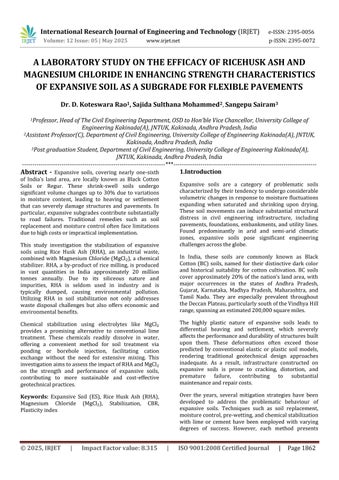
In India, these soils are commonly known as Black Cotton (BC) soils, named for their distinctive dark color and historical suitability for cotton cultivation. BC soils coverapproximately20%ofthenation’slandarea,with major occurrences in the states of Andhra Pradesh, Gujarat, Karnataka, Madhya Pradesh, Maharashtra, and Tamil Nadu. They are especially prevalent throughout theDeccanPlateau,particularlysouthoftheVindhyaHill range,spanninganestimated200,000squaremiles.
The highly plastic nature of expansive soils leads to differential heaving and settlement, which severely affectstheperformanceanddurabilityofstructuresbuilt upon them. These deformations often exceed those predicted by conventional elastic or plastic soil models, rendering traditional geotechnical design approaches inadequate. As a result, infrastructure constructed on expansive soils is prone to cracking, distortion, and premature failure, contributing to substantial maintenanceandrepaircosts.
Over the years, several mitigation strategies have been developed to address the problematic behaviour of expansive soils. Techniques such as soil replacement, moisturecontrol,pre-wetting,andchemicalstabilization with lime or cement have been employed with varying degrees of success. However, each method presents
International Research Journal of Engineering and Technology (IRJET) e-ISSN:2395-0056
Volume: 12 Issue: 05 | May 2025 www.irjet.net p-ISSN:2395-0072
certain limitations, including high cost, implementation complexity,andlimitedlong-termeffectiveness.
In recent times, the use of industrial and agricultural wastematerials suchasflyash,ricehusk ash,andother pozzolanicby-products indyhasemergedasa promising and sustainable alternative for soil stabilization. These materialsnotonlyimprovetheengineeringpropertiesof expansive soils but also offer an environmentally friendly solution to industrial waste management. This study focuses on the geotechnical behaviour of black cottonsoilsinIndiaandevaluatesexistingandemerging stabilizationtechniques,withparticularemphasisonthe useofindustrialwasteforenhancingsoilperformance.
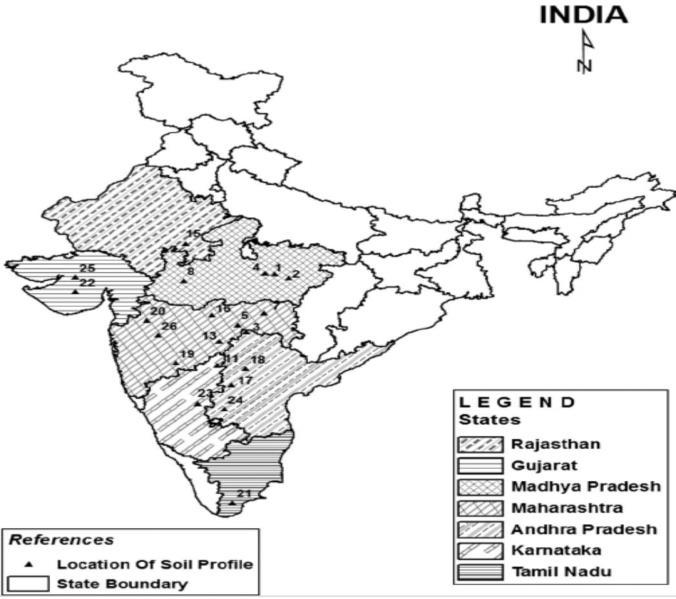
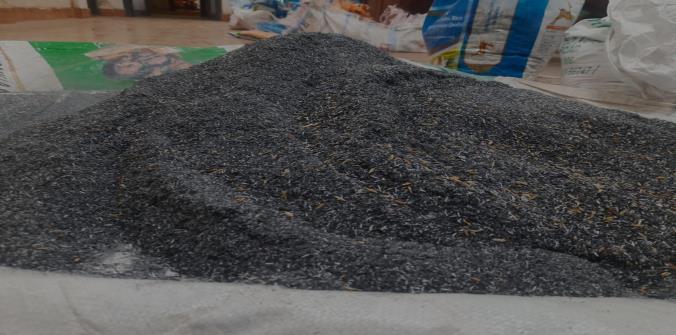
Rice husk is an abundantly available waste material in all rice producing countries, and it contains about30%–50%oforganiccarbon.Ricehuskash(RHA) isanabundantlyavailableandrenewableagriculturebyproduct from rice milling in the rice-producing countries. It has the highest proportion of silica content among all plant residues. In the course of a typical milling process, the husks are removed from the raw grain to reveal whole brown rice which upon further milling to remove the bran layer will yield white rice. RHA is the product of incineration of rice husk. RHA is grayish-black in color due to unburned carbon. At burningtemperaturesof550–800°C,amorphoussilicais formed, while crystalline silica is produced at higher temperatures. The specific gravity of RHA varies from 2.01 to 2.27; it is highly porous and light weight, with a veryhighspecificsurfacearea.
Forpresentstudy,theRHAwasSourcedfromthecaptive power plant of Lalitha Rice mill, Peddapuram, East Godavaridistrict,AndhraPradesh,India.
The high percentage of siliceous materials in rice husk ashindicatesithaspotentialpozzolanicproperties.RHA hasbeenclassifiedintohighcarbonchar,lowcarbonash and carbon free ash. It is chemically stable and its physical properties are similar to that of natural sand. The high angularity and friction angle of rice husk contribute to excellent stability and load bearing capacity.
Rice husk ash contain a large amount of iron oxide and silicate. It has higher density, stay in the top layer and then transported to a water basin with a low temperature for solidification. Rice husk aggregate tend to free drying and are not frost susceptible. It is highly resistant to moisture penetration and fungal decomposition. Husk therefore makes a good insulation material. Rice husk ash has a high silica contents which means that it decomposes slowly when brought back to thefield.
The soil used was a typical black cotton soil collected from Toorpulanka near Amalapuram, in East Godavari District,AndhraPradeshState,India. Thisexpansivesoil was collected at a depth of 1.0m from the ground level. Thetests werecarriedout onthesoilasperIS Codes of practice.
Theobjectivesofthepresentexperimentalstudyare
To determine the Engineering properties of the ExpansiveSoil.
To assess the performance of Expansive Soil when treated with Rice Husk Ash and MagnesiumChloride.
To evaluate the optimal proportion of RHA and Magnesium Chloride at which soil provides the maximumstrength.
International Research Journal of Engineering and Technology (IRJET) e-ISSN:2395-0056
Volume: 12 Issue: 05 | May 2025 www.irjet.net p-ISSN:2395-0072
To perform the California bearing ratio (CBR) and cyclic plate load test on both treated and untreatedexpansivesoilcombination.
1.
2.
3. Compaction properties
4. SpecificGravity(G)
5. ISClassification CH
6. C.B.R(%)
7. Differentialfreeswell(%)
8. Cohesion(C)(Kg/cm²) 0.36
9. Angleofinternalfriction(ø)
2.1 Dr. D. Koteswara Rao et al. (2011) Kakinada, statedthattheRHAismanufacturedintheamountof20 million tons per year, poses a significant environmental risk, inflicting damage to the land and the ecosystem in which it is disposed. There are numerous options for disposingitthroughthecommercialuseofRHA.TheUCS increased by 548 percent after 28 days curing for an optimumpercentofRHAwithlimeandgypsum,andthe CBR increased by 1350 percent after 14 days curing for anoptimumpercentofRHAwithlimeandgypsum.
2.2 Katti et al. (1966) attemptedtostabilizethein-situ soil using KOH solution, and they discovered that treating black cotton soils in place with an aqueous solutionofKOHcanchangetheirproperties.
2.3 Sivanna et al. (1976) investigated the effects of CaCl2 and KOH on the strength and consolidation
properties of black cotton soil and found that these chemicals boosted strength while decreasing settling andswelling.Fieldstudieswerethoughttobenecessary todeterminetheirapplicabilityunderin-situsettings.
2.4 Muntohar et al. (2000) tostabilizeexpansivesoil,a mixtureofricehuskashand limewasutilized.RHAwas used as a replacement for expansive soil at 7.5 percent, 10%,and12.5%,andlimeat2%,4%,6%,8%,10%,and 12%.TheirIp(plasticityindex)plummetedfrom41.25% to 0.96 % with a 12-12.5%RHA-lime combination, and their swell potential declined from 19.23% to minimal. CBR value increased from 3% to 16%, internal friction angle increased from 50 to 240, and cohesion increased from 54.32kN/m² to 157.19kN/m², raising bearing capacityfrom391.12kN/m²to4131kN/m².
2.5 Radhey S. Sharma et al (2008) the engineering featuresofareconfiguredsoftsoilscombinedwithlime, calcium(CaCl2)andRHAwereexamined.Bydryweight of soil, the quantities of RHA, lime, and calcium chloride were increased from 0% to 16%, 0% to 5%, and 0% to 2%,respectively.TheeffectofadditivesonUCSandCBR has been discovered. The stress-strain behavior of expansive clay was improved by adding up to 5% calcium or 1% CaCl2. The greatest improvement in breakdownloadwas225and328%at4%limeand1% calcium chloride, respectively. A RHA level of 12% was discovered to be ideal in terms of both UCS and CBR in thepresenceofeitherlimeorcalciumchloride.
2.6 Vishnu T.C et al. (2016) work on "Stabilization Using Rice Husk Ash, Lime, and Jute," that at 6% RHA, 6% Lime, and 2% Jute gradually increased OMC, decreasedMDD,increasedUCS,andincreasedCBR.
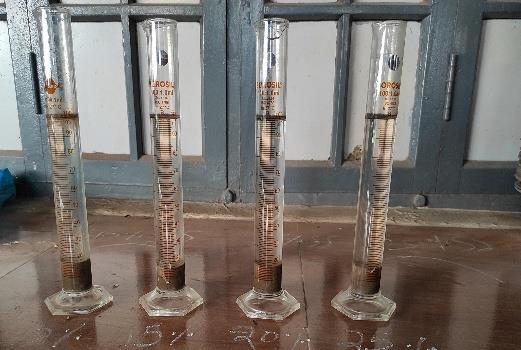
TodeterminetheFreeSwellIndexofsoilasper IS: 2720 (Part XL) – 1977.Freeswellordifferentialfree swell, also termed as Free Swell Index, and is the increase in volume of soil without any external constraintwhensubjectedtosubmergenceinwater.
Free Swell Index = ([Vd - Vk] / Vk ) x 100%
Where,
Vk = Volume of soil specimen read from the graduated cylindercontainingkerosene.
Vd = Volume of soil specimen read from the graduated cylindercontainingdistilledwater.
International Research Journal of Engineering and Technology (IRJET) e-ISSN:2395-0056
Volume: 12 Issue: 05 | May 2025 www.irjet.net p-ISSN:2395-0072
3.2.1
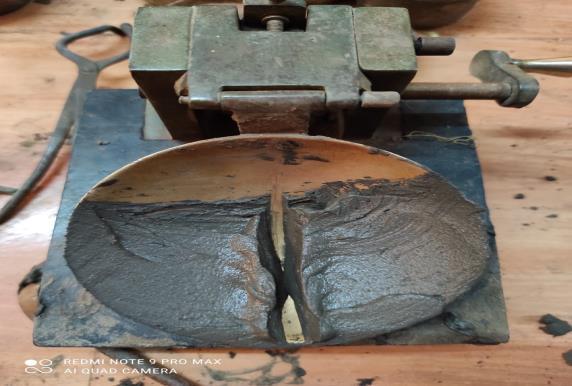
Virginsoiland optimum percentageof RHA(i.e. 9%bydryweight)aremixedwiththesoilandtheliquid limitwasdeterminedasper IS: 2720 (part-5)-1985
Liquidlimitisthemoisture contentatwhich25 blowsinstandardliquidlimitapparatus willjust closea groove of standard dimensions cut in the sample by the grooving tool by specified amount. The flow curve is plotted in the log-scale on the x-axis, and the water contentinthearithmeticscaleony-axis.The flowcurve is straight line drawn on the semi-logarithmic plot, a nearlyaspossiblethroughthreeor moreplotted points. Themoisturecontentcorrespondingto25blowsisread fromthiscurveroundedofftothenearestwholenumber andisreportedastheliquidlimitofthesoil
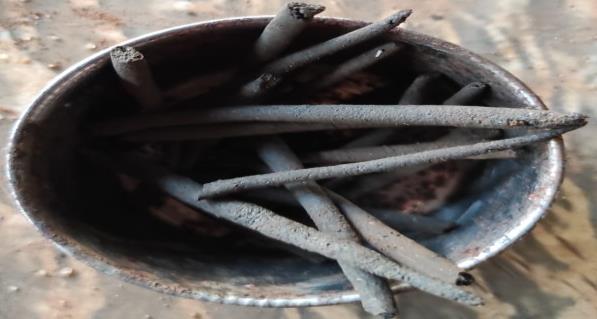
Virgin soil and optimum percentage of RHA (i.e., 9% by dry weight) is mixed with the soil and the plastic limit wasdeterminedasper IS: 2720 (part-6)-1972
3.2.2 Plastic Limit
Plasticlimitisthemoisturecontentatwhichasoilwhen rolled into thread of smallest diameter possible, starts crumblingandhasadiameterof3mm.
The Plastic limit (Wp) is reported as the average moisture content at which the soil begins to crumble whenrolledinto3mmthreads.
3.3 Modified Proctor Compaction Test
The maximum dry density (MDD) and Optimum Moisture Content (OMC) of the soil are determined through compaction tests, following the procedure outlined in the Indian standard codes of practice IS: 2720(PartVIII)-1983.
3.4 California Bearing Ratio (CBR)
Test The California Bearing Ratio (CBR) serves as a measure of the shearing resistance of a material under controlled density and moisture conditions. A load penetration curve is plotted for each specimen on a natural scale. From these curves, the CBR values are calculatedfor2.5mmand5.0mmdepthsofpenetration.
Table-2: Mix Proportions for testing Soil
S NO Stabilizing Agent % content
4.1 Differential Free Swell Test
5 89%ES+9%RHA+2%MgCl2
Volume: 12 Issue: 05 | May 2025 www.irjet.net
LL, PL, IP values of Expansive Soil with varying percentages of RHA
International Research Journal of Engineering and Technology (IRJET) e-ISSN:2395-0056
Volume: 12 Issue: 05 | May 2025 www.irjet.net
CBR Values of ES treated with 9% RHA and various percentages of MgCl2
91%ES+9%RHA+0%MgCl2
90.5%ES+9%RHA+0.5%MgCl2
90%ES+9%RHA+1%MgCl2
89.5%ES+9%RHA+1.5%MgCl2
Optimum percentages of Rice Husk Ash and Magnesium Chloride were observed during laboratory investigations are summarized in following table.
S.NO Additives Optimum Percentage
1 Rice Husk Ash 9%
2 Magnesium Chloride 1.5%
Conclusions of the various laboratory test results were presented.
i) It is observed from the laboratory test results that the Liquid Limit of the Expansive Soil has decreased from 78.92% to 56.34% by 28.61% on treating Expansive Soil with 9% RHA and 1.5% MgCl2.
ii) It is noticed that the Plastic Limit of the Expansive soil has increased from 37.25% to 42.79% by 14.89% on treating Expansive Soil with 9% RHA and 1.5% MgCl2
iii) The Plasticity Index of the Expansive Soil has decreased from 41.66% to
p-ISSN:2395-0072
13.55% by 67.47% on treating Expansive soil with 9% RHA and 1.5%MgCl2
iv) By the addition of 9% RHA and 1.5% Magnesium Chloride, the DFS value has decreased from 120% to 65% by 45.83%.
v) It is observed from the results that the C.B.R value of the Expansive Soil has increased from 1.321% to 8.784% by 564.95% on treating Expansive soil with 9% RHA and 1.5% MgCl2
vi) It is noticed that the O.M.C of the Expansive Soil has decreased from 27.08% to 24.12% by 10.93% on the addition of 9% RHA and 1.5% MgCl2.
vii) It is observed from the results that the MDD of the Expansive Soil has been increased by 11.13% on the addition of 9% RHA and 1.5% MgCl2
viii) The CBR value of the Expansive Soil on treating with 9% RHA and 1.5% MgCl2 is found to be 8.19% and it is satisfying standard specifications.
ix) It is observed from the laboratory investigations of the cyclic plate load test results, the ultimate cyclic pressure of treated Expansive Soil sub grade flexible pavement with 9% RHA has been improved from 630kPa to 1000kPa by 58.7% and further improved to 1400kPa by 122.2% on treating Expansive Soil Sub-grade with 9% RHA and 1.5% MgCl2.
x) It is observed from the laboratory test results of cyclic plate load test that the total deformations of treated Expansive Soil sub-grade flexible pavement with an optimum of 9% RHA and 1.5% MgCl2 has been reduced from 2.73mm to 2.33mm by 14.65% at OMC.
xi) So finally, it is concluded from the above test results that the expansive soil treated with 9% RHA and 1.5% MgCl2 is suitable to use as sub grade material for the pavement construction.
Hence, from the present laboratory investigations, it was included that the Expansive Soil treated with 9% of Rice husk ash and 1.5% Magnesium Chloride as an optimum
International Research Journal of Engineering and Technology (IRJET) e-ISSN:2395-0056
Volume: 12 Issue: 05 | May 2025 www.irjet.net p-ISSN:2395-0072
exhibits satisfactory result as per IRC 37-2001 and 2012 code of practice.
The following areas are identified as the scope of further research in this direction, based on the experience of the present work.
Further laboratory investigations can be carried out with the addition of various chemicals with the expansive soil along with RHA to improve strength characteristics.
Field tests are to be conducted to confirm the laboratory test results in the field.
Further laboratory Cyclic Plate Load tests can be conducted by using Geotextile as Reinforcement and Separator.
1. A.K. Sabat, and R. P. Nanda, "Effect of marble dust on strength and durability of rice husk ash stabilized expansive soil," International journal of Civil and Structural Engineering, vol.1 (4), pp.939-948,2011.
2. A.N. Ramakrishna, and A.V. Pradeep Kumar, "Stabilizationofblackcottonsoilusingricehusk ash and cement," in Proceedings of National conference Civil Engineering meeting the challengesoftomorrow,2006,pp.215-220.
3. Agus Setyo Muntohar and Gendut Hantoro, "Influence of the Rice Husk Ash and Lime on Engineering Properties of Clayey Sub-grade", Soil Mechanics Laboratory Department of Civil Engineering, Muhammadiyah University of Yogyakart Indonesia, EJGE Vol. 5 (2000), Vol. 8 [2003],BundleA
4. Alhassan,M.(2008)PotentialsofRiceHusk Ash forsoilstabilization.AUJ.T.11(4):246-250.
5. Ali M, Sreenivasulu V (2004). "An Experimental Study on the Influence of Rice Husk Ash and LimeonPropertiesofBentonite",Proceedingsof IndianGeotechnicalConference,Warangal.
6. Al-Rawas A.A., et.al(2002) "A comparative evaluation of various additives used in the stabilization of expansive soils", Geotechnical TestingJournal,Vol.25,No.2,pp.199-209.
7. Amu, O.O., Owokade, O. S., Shitan, O.I. (2011)” PotentialsofCoconutShellandHuskAshonthe GeotechnicalPropertiesofLateriticSoilforRoad Works”InternationalJournalofEngineeringand Technology,Vol.3(2),pp87-94.
8. Argaw Asha Ashangol and Nihar Ranjan Patra (2016), "Behavior of Expansive Soil Treated with Steel Slag, Rice Husk Ash, and Lime", DOI
10.1061/(ASCE) MT.1943- 5533.0001547. AmericanSocietyofCivilEngineers.
9. Bhasin et al. (1988) "A laboratory study on the stabilization of black cotton soil as a pavement material using RHA, Bagasse ash, fly ash, lime sludgeandblacksulphiteliquor”.
10. Biswas, S., Biswas, A., and Biswas, A "Utilization of Rice Husk with Lime in Subgrade Soil for a RuralRoad",EFITRA,2012.
11. Casangrane A. “The Structure of Clay and Its Importance in Foundation Engineering”, Journal BostanSocietyofCivilEngineers,Vol.19,1932.
12. Chandrasekhar, B.P., Prasad Raju, G.V.R., Ramana Murthy, V. and Hari Krishna, P. (1999). "Relative performance of Lime and Calcium Chloride on properties of expansive soil for pavementSubGrades",proc.OfIGC-99,Calcutta, pp279-282.
13. Chang. M. F (1991), Stress History of Singapore Marine Clay, Journal of Geotechnical EngineeringDivision,ASCE,Vol.22,pp5-21.
14. Chen, F. H. (1988), “Foundations on expansive soils”, Chen & Associates, Elsevier Publications, U.S.A.
15. Dallas N. Little, “Stabilization of Pavement Subgrades and Base Courses with Lime”, Dubuque, Iowa;Kendall/HuntPublishingCompany,1995.