
International Research Journal of Engineering and Technology (IRJET) e-ISSN: 2395-0056
Volume: 13 Issue: 02 | Feb 2026 www.irjet.net p-ISSN: 2395-0072
International Research Journal of Engineering and Technology (IRJET) e-ISSN: 2395-0056
Volume: 13 Issue: 02 | Feb 2026 www.irjet.net p-ISSN: 2395-0072
Hemangi H Joshi
1
, Nehal N Kalani
2
1Assistant Professor, Information Technology Department, VVP Engineering College, Gujarat, India
2Assistant Professor, Information Technology Department, VVP Engineering College, Gujarat, India ***
Abstract - Spam messages continue to threaten digital communication platforms by affecting user productivity and system security. Traditional single-classifier approaches often struggle to maintain high generalization performance across diverse spam patterns. This study proposes a hybrid ensemble framework for robust spam email classification by integrating TF-IDF feature extraction with hyperparameteroptimized machine learning models [1]. The SMS Spam Collection dataset containing 5,572 labelled messages was used for experimental evaluation. Logistic Regression, Support Vector Machine (SVM), and an optimized Random Forest classifier were combined using a soft voting ensemble strategy [2][3]. Hyperparameter tuning was performed using GridSearchCV with 5-fold cross-validation to enhance model reliability. Performance evaluation was conducted using Accuracy, Precision, Recall, F1-score, ROC-AUC, and cross-validation metrics. Experimental results show that the proposed Hybrid Voting Ensemble achieved the highest accuracy of 98.57% and a cross-validation score of 98.13%, outperforming individual models. The findings confirm that ensemble learning improves predictive consistency and classification robustness for spam detection tasks while maintaining computational efficiency suitable for real-time deployment.
Key Words: Spam Detection, Ensemble Learning, TFIDF, Random Forest, SVM, Cross-Validation, Machine Learning.
Electroniccommunicationplatformshavebecomeintegral to modern society, enabling instant information exchange across the globe. However, the rapid growth of digital communication has led to a significant increase in unsolicitedandmaliciousmessagescommonlyreferredto as spam. Spam messages reduce user productivity and pose security risks through phishing attacks, malware distribution,andfraudulentschemes.
Traditional spam detection systems relied on rule-based filtering mechanisms. Although effective in early stages, these approaches lack adaptability to evolving spam patterns. Machine learning-based techniques have gained prominence due to their ability to automatically learn discriminativefeaturesfromtextualdata.Algorithmssuch as Logistic Regression, Support Vector Machines (SVM),
and Decision Trees have been widely applied in spam classificationtasks.
Despitetheireffectiveness,individualclassifiersoftenface limitations in balancing precision and recall. Ensemble learning techniques address this limitation by combining multipleclassifierstoimprovepredictiveperformanceand robustness[4]
This research proposes a hybrid ensemble framework integrating Logistic Regression, Support Vector Machine, and an optimized Random Forest classifier using a soft voting mechanism [8]. The study incorporates TF-IDF feature extraction, hyperparameter optimization using GridSearchCV,and5-foldcross-validationtoensuremodel reliabilityandgeneralizationcapability.
The objectives of this research are:
To evaluate the performance of individual classifiersforspamdetection.
To optimize Random Forest parameters using hyperparametertuning.
To design a hybrid ensemble framework for improvedclassificationperformance.
To analyze model robustness using crossvalidationandROC-AUCmetrics.
Spam detection has been extensively studied in machine learning and text classification research. Early studies focused on Naïve Bayes classifiers due to their simplicity andefficiencyinprobabilistictextmodelling.
Support Vector Machines demonstrated strong performance in high-dimensional text classification tasks due to their margin maximization capability [2]. Random Forest classifiers improved robustness by aggregating multiple decision trees, thereby reducing overfitting and enhancingpredictivestability[3]
Recent research emphasizes ensemble learning techniques such as boosting and voting mechanisms to improve generalization performance [4]. Boosting algorithmsiterativelyimproveweaklearners,whilevotingbasedensemblescombinepredictionsfromheterogeneous classifiers.
International Research Journal of Engineering and Technology (IRJET) e-ISSN: 2395-0056
Volume: 13 Issue: 02 | Feb 2026 www.irjet.net p-ISSN: 2395-0072
Feature extraction techniques such as TF-IDF have become standard in text classification tasks by assigning importance weights to words based on frequency distribution [6]. Although deep learning approaches such as LSTM and transformer-based models show promising results, traditional machine learning combined with ensemble methods remains computationally efficient and suitableforreal-timedeployment[9]
This study builds upon prior research by integrating TF-IDF feature engineering, hyperparameter optimization, and hybrid voting-based ensemble learning to enhance spamclassificationrobustness.
3.1 Dataset Description
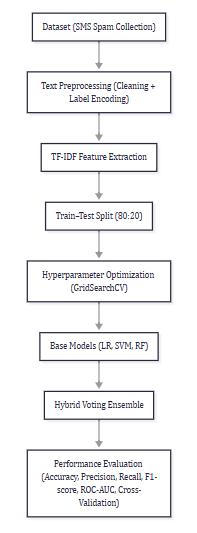
The SMS Spam Collection dataset was used for experimental analysis. The dataset consists of 5,572 labelled messages categorized as spam or ham (nonspam).
3.2 Data Preprocessing
Label encoding was applied to convert textual labelsintobinaryformat.
TF-IDF vectorization transformed text messages intonumericalfeaturevectorswithamaximumof 3000features.
The dataset was split into 80% training and 20% testingsets.
3.3 Hyperparameter Optimization
The Random Forest classifier parameters were optimized using GridSearchCV with 5-fold cross-validation. The optimalparametersidentifiedwere:
n_estimators=200
max_depth=None
3.4 Hybrid Ensemble Framework
Asoftvotingensembleclassifierwasconstructedusing:
LogisticRegression
SupportVectorMachine
OptimizedRandomForest
The final prediction was determined based on weighted probabilityaveraging.
3.5 Evaluation Metrics
Themodelswereevaluatedusing:
Accuracy
Precision
Recall
F1-Score
ROC-AUC
5-FoldCross-ValidationScore
4. EXPERIMENTAL RESULTS AND ANALYSIS
Table -1: Performance Comparison of Models
International Research Journal of Engineering and Technology (IRJET) e-ISSN: 2395-0056
Volume: 13 Issue: 02 | Feb 2026 www.irjet.net p-ISSN: 2395-0072
[7]F. Sebastiani, “Machine Learning in Automated Text Categorization,”ACMComputingSurveys,2002.
[8]H. Drucker, D. Wu, and V. Vapnik, “Support Vector Machines for Spam Categorization,” IEEE Transactions on NeuralNetworks,1999.
The Hybrid Voting Ensemble achieved the highest classificationaccuracyof98.57%.TheoptimizedRandom Forest demonstrated strong ROC-AUC performance (0.9913),indicatinghighdiscriminationcapability.
Logistic Regression achieved perfect precision but lower recall, indicating conservative spam classification behaviour. The ensemble model provided improved balance between precision and recall, resulting in the highest F1-score. Cross-validation results confirmed the robustness of the hybrid model with a 98.13% average score,demonstratingstronggeneralizationperformance.
This research introduced a hybrid ensemble-based spam detectionframeworkintegratingTF-IDFfeatureextraction with optimized machine learning classifiers. The soft voting ensemble achieved superior classification accuracy and improved balance between precision and recall compared to individual models. Cross-validation confirmed strong generalization capability and robustness.
Future work may explore deep learning-based text classification approaches, real-time spam filtering deployment, multilingual spam detection, and transformer-basedarchitecturestofurtherenhancemodel performance.
[1]C.D.Manning,P.Raghavan,andH.Schütze,Introduction to Information Retrieval. Cambridge University Press, 2008.
[2] T. Joachims, “Text Categorization with Support Vector Machines,”inProc.ECML,1998.
[3]L. Breiman, “Random Forests,” Machine Learning, vol. 45,no.1,pp.5–32,2001.
[4]Y. Freund and R. Schapire, “A Decision-Theoretic Generalization of On-Line Learning,” Journal of Computer andSystemSciences,1997.
[5]A. McCallum and K. Nigam, “A Comparison of Event Models for Naive Bayes Text Classification,” AAAI Workshop,1998.
[6]G. Forman, “An Extensive Empirical Study of Feature Selection Metrics,” Journal of Machine Learning Research, 2003.
[9]J. Friedman, “Greedy Function Approximation: A GradientBoostingMachine,”AnnalsofStatistics,2001.