
International Research Journal of Engineering and Technology (IRJET) e-ISSN: 2395-0056
Volume: 13 Issue: 05 | May 2026 www.irjet.net p-ISSN: 2395-0072
International Research Journal of Engineering and Technology (IRJET) e-ISSN: 2395-0056
Volume: 13 Issue: 05 | May 2026 www.irjet.net p-ISSN: 2395-0072
SHIVAM
BE CSE AIML CHANDIGARH UNIVERSITY GHARUAN, PUNJAB
Abstract - Hybrid E-attendance system is a Framework designed to monitor students’ attendance in institutions using proximityandAADHAARenabledbiometricattendancesystem (AEBAS) Along with temporal facial Authentication, Till date The institutions use traditional method for attendance monitoringandmanagement,whichoftenfailtoensureactual presence of student and are vulnerable to proxy attendance. The proposedsystem leverages AEBAS foruserAuthentication usingfingerprint or iris recognition, that generatesadynamic QR code or Network credentials outside the class, with this user connects to a certain WIFI or Bluetooth network, the connectivity time is measured anduser is markedpresentonly if satisfies The 80 percent rule, to further mitigate vulnerabilities, periodical facial verifications are conducted, this approach ensures secure entry, identity validation throughout the class and ensures continuous presence tracking. The system demonstrates improved reliability and robustness compared to single-factor traditional attendance systems and conventional biometric systems.
Key Words: E-attendance, AEBAS, Proximity Sensing, Face Recognition, Temporal Verification, Biometric Authentication, Proxy Detection
1. INTRODUCTION
Attendancesystemsplayacrucialroleininstitutionsasthey reflect student’s presence and participation in academic sessions, and their discipline and consistency towards studies. Accurate attendance records are essential for institutionalcomplianceandacademicevaluation.Traditional methods used in marking attendance such as manual registration by verification , are time-consuming and are pronetohumanerror.Althoughautomatedsystemssuchas AEBASandRFID-basedattendancesystemsarebeingused, they still fail to ensure continuous presence of student throughouttheclassduration.
Themajorlimitationoftheseexistingattendancesystems lies in their single-point verification mechanism. Most systemsvalidateattendanceonceonlyatthebeginningofthe session,introducingseveralloopholesinthesesystems:
Proxy attendance, where one student marks attendanceforanother.
Early exit, where students leave after initial verification.
Lackofcontinuousmonitoringthroughouttheclass.
Biometric systems, including fingerprint and iris recognitionlikeAEBASensuresecureauthentication,andare suitable for initial identity verification but are limited to entry-level authentication. As they do not incorporate temporal validation or continuous presence tracking (proximity), which are essential for correct evaluation of attendance.
This hybrid E-attendance system inculcates idea of proximity-based attendance using WIFI and Bluetooth technologies.Thesesystemsdeterminewhetherastudentis physically present in a session by monitoring his device connectivityandevaluatehisattendancestatusbycalculating attendancepercentage.Let:
T =Totaldurationofclass
C =Connectivitytimeofthestudentdevice
Theattendancepercentagecanbecalculatedas:

Attendance is evaluated based on a predefined threshold condition:
If A ≥80%→Studentismarked Present
If A <80%→Studentismarked Absent
While proximity sensing allows us to continuously monitor students, it alone is not sufficient due to possible misuse,suchassharingdeviceorleavingthedevicewithin theproximityrange.Therefore,a multi-factor approach is requiredtoenhancesystemreliabilityandsecurity.
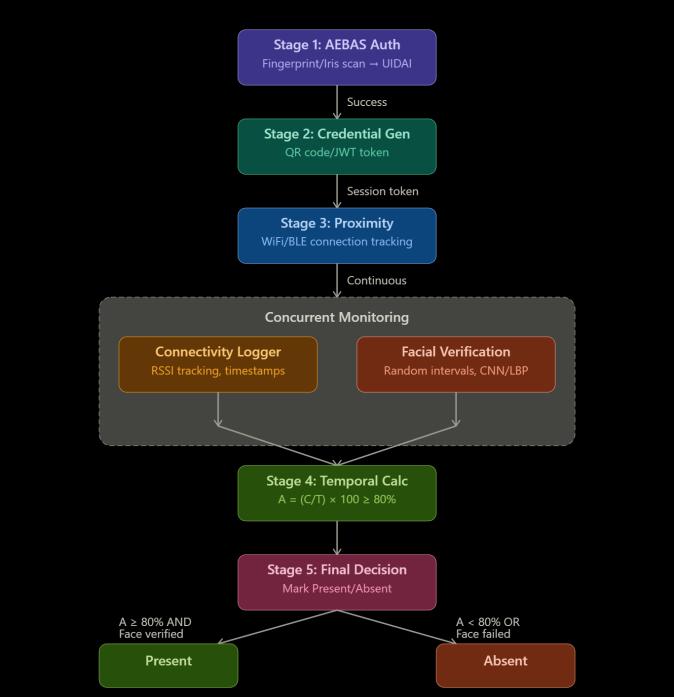
To overcome these limitations, this paper proposes a frameworkintegratingbiometricauthentication,proximity sensing, temporal validation, and facial verification. The systemoperatesinmultiplestages:
Stage1:AuthenticationStudentsauthenticateusing AEBAS(fingerprint/iris)outsidetheclassroom
Stage2: Access Generation AdynamicQRcodeor securenetworkcredentialisgenerated
Stage3: Proximity Monitoring Studentsconnectto a designated WIFI/Bluetooth network and connectivityistracked
Stage4: Temporal Validation Attendance is calculatedbasedonconnectivityduration(C/T)
International Research Journal of Engineering and Technology (IRJET) e-ISSN: 2395-0056
Volume: 13 Issue: 05 | May 2026 www.irjet.net p-ISSN: 2395-0072
Stage5: Identity Reinforcement Periodic facial verification ensures the same individual remains present
Thislayeredapproachensures: SecureidentityverificationatentrylikeAEBASsystemsand then Continuous presence tracking by proximity with designatednetworkallowingDetectionofproxyattendance and early exits from the sessions giving us Improved accuracy in comparison to traditional attendance systems and methods, allowing secure automated monitoring
reducingmanualwork.
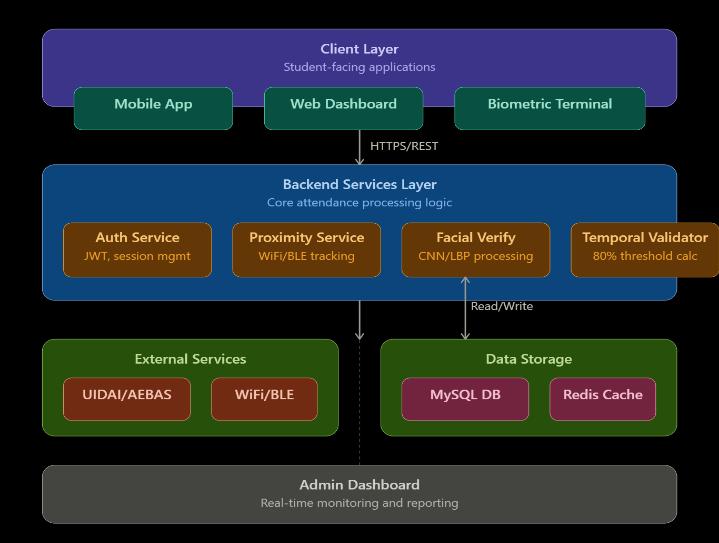
FIGURE -1: SystemArchitectureDiagram
The combination of these components results in a robust, scalable, and efficient attendance management system suitableformoderneducationalenvironments.Comparedto single-factor traditional systems, the proposed framework provides enhanced accuracy and reliability by combining identity authentication with real-time presence validation withproximityandfacialauthentication.
This paper discusses the system design, implementation details,andperformanceevaluationoftheproposedhybridattendancesystem.
Multipleresearchershaveproposedvariousmethodsforthe automation of attendance systems including advanced technologiessuchasbiometricbasedsystems,RFID,IoT,and many web based systems. The evolution of traditional attendance management systems reflects a digital transformation of educational institutions, shifting from manualorlabour-intensiveprocessestoautomated,cyberphysicalframeworks.
Traditional attendance management systems primarily includedmanualpaper-basedregisters,whichhaslongbeen the standard in educational environments. However, as notedinearlystudiesby Hussainetal.[1],thesemethods arehighlyunreliableduetohighlatencyinentryofdataand is exposed to human error or proxy attendance where a
student marks attendance for an another absent student. Thisisaloopholethatmanualverificationcannotdealwith, so they developed an RFID-based attendance system that automaticallyrecordsstudententrybyscanningRFIDcards. Although effective in reducing manual effort, it requires specific hardware and infrastructure setup, increasing implementation costs. Also a research by Farag [2] highlightedacriticalflaw:RFIDtagsverifyonlythepresence of the token, not the individual. This allows for proxy attendance where a single student carries multiple RFID tags, marking large scale false attendance, making it unreliableincaseoflargeacademicinstitutions.
In context of Indian institutions, the Aadhaar Enabled Biometric Attendance System (AEBAS) is one of the most efficient way for secure identity verification, Eze et al. [3] proposedabiometricfingerprintbasedattendancesystem that ensures identity verification and eliminates proxy attendance.Thisapproachenhancesaccuracybutmayface challengesinscalabilityandhygienewhendealingwithlarge student populations. This biometric based framework significantlymitigatesidentityfraudbyusingthecentralized unique identification authority of India UIDAI database directlyforreal-timeauthentication.Despiteitsrobustness inreal-timeidentityverification,AEBASprimarilyfunctions asaentry-only"checkpoint"technology.Asarguedinrecent literaturebyOluwoleetal.[4],biometriccheck-insbyAEBAS are typically performed only at the point of entry. This creates a "temporal void" a window of time where a studentwhohavesuccessfullyauthenticatedtheiridentityat entrymayexitthesessionbeforehand.Withoutasecondary layer of of verification or continuous monitoring, AEBAS cannotdistinguishbetweenastudentwhoattendedthefull durationandonewholeftimmediatelyorprematurelyafter theinitialscan.
Similarly,Ranietal.[5]and Nairetal.[6],implemented a facerecognition-basedattendancesystemusingcomputer visionandmachinelearningalgorithmstoidentifystudents through camera or live real time images. The primary algorithm that can be used in face recognition are Convolutional Neural Networks (CNN) and Local Binary Patterns(LBP)astheyleveragecomputervisiontodealwith early-exitproblemsbyreal-timemonitoringofstudents.The systemtheyproducedshowedhighaccuracyundercertain conditionsbutwasverysensitivetofactorslikevariationsin illuminationlevels,facialorientation,anddifferentcamera quality and angles, leading to false rejection rates FRR degrading user’s experience. Despite these minor flaws, it represents a promising step toward AI-driven automated
International Research Journal of Engineering and Technology (IRJET) e-ISSN: 2395-0056
Volume: 13 Issue: 05 | May 2026 www.irjet.net p-ISSN: 2395-0072
attendance systems. With a major challenge of large scale implementation due to continuous processing of high resolutionvideoinmultipleclassroomsacrosstheinstitute.
Recentresearcheshasexploredvariousdigitalmethodsand proposedhybridattendancesystemsthatcombinemultiple verificationtechniquestoimprovereliabilityandefficiency. These systems integrate biometric authentication with additional mechanisms such as QR codes, mobile-based access,andtemporalvalidationandfacialauthenticationsto addressthelimitationsofindividualapproaches,Nairetal. [7].LikeSinghetal.[8]proposedanIoT-enabledattendance monitoringsystemusingESP32microcontrollersandradio frequencyidentificationRFIDmodules,connectedtoacloud database.Theirsystemofferedreal-timeupdates,allowing administrators to monitor students attendance easily via webapplicationsanddashboards.Thisapproachimproved scalability and accessibility but required stable internet connectivity.
Whilesuchsystemsdemonstrateimprovedrobustnessand reliabilitycomparedtosingle-factorortraditionalmethods, many still lack a unified framework that ensures secure entry, continuous monitoring, and multi-stage identity verification simultaneously. Most existing frameworks prioritizeeithersecurity(Biometrics),duration(Proximity), orreal-timerecognitionorvalidations,butrarelyincludeall thefactorsatonce.Thereisaclearresearchgapfora hybrid E attendance system that utilizes AEBAS for identity verification, triggers a proximity-based temporal monitor usinga80%connectivitythresholdrule,andreinforcesthe entiresessionwithintermediatefacialauthentications.This paper addresses this gap by proposing a layered hybrid frameworkthatensuresthatauthenticatedstudentremains connectedtothesessionfortheentireduration.
The proposed hybrid attendance system is designed as a multi-layered cyber-physical framework that integrates biometric identity authentication AEBAS, network-based proximity sensing, temporal validation for connectivity analysis, and periodic facial verification in between the sessions into a cohesive pipeline. The architecture of this system is depicted in Table. 1. Each stage in this pipeline addresses a specific vulnerability present in existing conventionalattendancesystems,andtogethertheyforma robust and reliable mechanism capable of resisting proxy attendance,earlyorintermediatoryexitfraud,anddevicesharingexploitations.
TABLE -1: Systemcomponentsandtechnologymapping
Module Function Technology / Standard
Biometric Terminal Fingerprintandiris captureforidentity verification AEBAS/ UIDAIAPI
Credential Generator Issuessession-specific dynamicQRortoken JWT,QRCode Gen
Proximity Module Tracksdevice connectivityin classroomzone
Temporal Validator
Facial Verifier
ComputesA=(C/T)×100 andappliesthreshold
Wi-FiRSSI/ BLEBeacon
Backend timerlogic
Periodicidentityreconfirmationviacamera CNN/LBP (OpenCV)
Attendance DB Storescompletesession logsandrecords CloudRDBMS (MySQL)
Admin Dashboard Real-timemonitoring andexportinterface WebApp (RESTAPI)
The framework consists of five sequential stages that are logically ordered to ensure that each verification layer reinforces the previous one. The five stages are: (1) biometric authentication via the AEBAS, (2) dynamic credential generation for session access, (3) continuous proximity sensing through wireless network connectivity likeWIFI/BT,(4)temporalvalidationusingtheconnectivityduration ratio, and (5) periodical facial verification for continuousidentityverificationthroughouttheclasssession.
This system architecture follows a client-server model in which a central main attendance server manages authenticationtokens,sessioncredentials,connectivitylogs, and attendance records of the student. Student-side interactionsaredonethroughadedicatedmobileapplication installedonthestudent'sdevice.Theservercommunicates
International Research Journal of Engineering and Technology (IRJET) e-ISSN: 2395-0056
Volume: 13 Issue: 05 | May 2026 www.irjet.net p-ISSN: 2395-0072
with the UIDAI (Unique Identification Authority of India) databaseforreal-timebiometricvalidationofidentityand maintainsanindependentcloud-hostedattendancedatabase accessibletoeducationalinstitutionsadministratorsthrough aweb-baseddashboard.
B. Stage 1-Biometric Authentication Using AEBAS
Uponarrivingoutsidetheclassroom,theattendanceprocess initiatesatadesignatedbiometricterminalpositionedonthe entranceoftheclassroom.Theterminalisintegratedwith theAEBASsystem,whichsupportstwotypesofbiometric inputs:fingerprintscanningandirisrecognition.Thesetwo modes are selected for their universality, reliability, and resistance to malfunctions under standard operational conditions.
Thebiometricsamplecapturedattheterminaloutsidethe classroomistransmittedinaencryptedformtotheUIDAI for one-to-one verification against the student's Aadhaarlinkedprofile.Thisverificationstepisessentialtoconfirm the student's identity with a high level of certainty, as Aadhaar-basedbiometricrecordsaremanagedcentrallyand are secure from local tampering. Upon successful verification, the AEBAS terminal generates a confirmation signaltothecentralattendanceserver,triggeringthenext phasethatisgeneratingcredentials.Ifverificationfailsdue tounregisteredormismatchinbiometricdata,orasensor error, access is denied and the student is directed to a human supervisor for manual resolution in case of any discrepancy.
TheuseofAEBASatinitialstageensuresthattheidentityof the individual who is initiating the attendance process is establishedproperly,beforeanyproximitysensingorfacial checksareperformed.Thiseliminatesthemostfundamental loopholesofproxyattendance,whereonestudentattempts tomarkattendanceonbehalfofanotherabsentstudent.
Following by successful biometric authentication, the attendance server generates a specific credential for the authenticatedstudent.Thiscredentialcanbeissuedinone outoftwoformsdependingontheavailableinfrastructurein theeducationalinstitutions:adynamicQRcoderenderedon the student's mobile application or a one-time network accesstokendeliveredthroughasecurenotificationonthe device.TheQRcodeortokenisspecificallyvalidonlyforthe durationofthecurrentsessionandisboundtothestudent's uniqueidentifierandthesessiontimestampmakingitnontransferableandnon-reusable.
Thedynamicnatureofthecredentialisaimportantdesign choiceasitaddressesacriticalweaknessinstaticcredential methods, where a student could share login details or the fixed QR code to another student for proxy marking false presence. Since the credential expires at the end of the designatedsessionandisregeneratedfreshatstartofeach class,itcannotbepre-capturedanddistributedinadvance.
The credential generation module is implemented on the mainserverusingtoken-basedauthenticationprotocolsand are generated through Technologies like JWT, QR code generator. The mobile application on the student's device communicates with the server over a secured HTTPS connection, and the credential is displayed exclusively within the authenticated application for the session, preventingscreen-captureexploitation.
Withthesessioncredentialsinhand,thestudentconnect to thenetworkthroughtheirregistereddevicespecificnetwork either can be a Wi-Fi access point or a Bluetooth beacon designated for that session only. The connection event is logged in by the proximity sensing module on the server, whichrecordstheconnectiontimestampsforthestudent's sessionentrytime.
Theproximitymoduleontheservercontinuouslychecksthe network for device connectivity at regular intervals throughouttheclassduration.BothWi-FiandBluetoothare complementarychannelsforproximity.Wi-Ficonnectivityis assessedusingtheReceivedSignalStrengthIndicator(RSSI), whichprovidesusamethodtoquantitativelymeasurethe
International Research Journal of Engineering and Technology (IRJET) e-ISSN: 2395-0056
Volume: 13 Issue: 05 | May 2026 www.irjet.net p-ISSN: 2395-0072
signalstrengthandallowsthesystemtodistinguishbetween a device that is genuinely present within the classroom range (typically 10–15 meters for an indoor Wi-Fi access point) and one that is barely connected with the network fromancloserlocation.Bluetoothproximitysensingserves asasecondarylayerforconfirmation,particularlyusefulin environmentswithoverlappingWi-Ficoveragezones.
Thenetworkinfrastructurerequiredforthisstageconsists ofeitheradedicatedwirelessrouterorBluetoothgatewayor both per classroom, configured in such a way so that the networkisisolatedfromadjacentclassrooms,Amiddleware servicerunningontheattendanceserverreceivesperiodic connectivitydatafromeachstudentsregistereddeviceand maintainsareal-timepresencelogrecordingofconnection anddisconnectioneventswithmillisecond-leveltimestamps.
Attheendofthesession,theattendanceserverprocesses the connectivity logs for each student to calculate an attendancepercentageusingthefollowingformula:
T =Totaldurationofclass
C =Connectivitytimeofthestudentdevice
Theattendancepercentagecanbecalculatedas:
Here, Both C and T are measured in seconds to ensure precision.
The computed attendance percentage A is then evaluated againstapredefinedthresholdconditionalignedaccordingly with standard requirements in education institutions, keeping in mind a 20% buffer for washroom breaks and connectivityissuesduringthesession:
If A ≥80%→Studentismarked Present
If A <80%→Studentismarked Absent
This threshold-based rule ensures that students who are present in the class for the majority of the duration are markedaspresent,whileaccommodatingbrief,unavoidable disconnections in connectivity such as those caused by momentary interference in network. Simultaneously, it penalizesstudentsbymarkingthemabsent,forleavingthe sessionearlyorbeforeitsconclusion,thusaddressingthe early-exitproblemthatiscommonintraditionalorsinglepointcheck-insystems.
Thetemporalvalidationmodulealsomaintainseventiniest logs of all connectivity gaps exceeding a configurable tolerance threshold (defaulting to 5 minutes). These gap
recordsarestoredintheattendanceDBandareaccessibleto instructorswhomaywishtoreviewcaseswithborderline attendance or investigate patterns of intentional and accidentaldisconnectionsandreconnections.
Whileproximitysensingensuresthatastudent'sregistered deviceonethatisconnectedtothenetworkremainswithin the classroom, it does not prevent a student from leaving their device behind or passing it to another student. To addressthisloophole,theframeworkincludesperiodicfacial verification mechanism that operates at random intervals duringthesession.
The facial verification subsystem is embedded within the student's mobile application and is triggered by push notifications sent from the attendance server at random intervals. Upon receiving the notification, the student's deviceactivatesthefront-facingcameraandcapturesarealtimefacialimage.Thisimageisprocessedusingoneoftwo most reliable machine learning algorithms selected at the timeofsystemconfiguration:
This deep learning approach extracts high-dimensional feature representations from facial images using multiple convolutional and pooling layers. CNN-based verification offers high accuracy even in multiple variations such as illumination, partial clarity, and facial expression but requires comparatively more computational resources on theserver.
A computationally lightweight descriptor of texture that encodes the local structure of facial regions into binary patterns.LBPworkswellforareal-timefacialverificationin restrictedresourcesandincorporatesacceptableaccuracy undercontrolledconditions.
This captured image is transmitted directly to the server, where it is compared with the student's enrolled facial profile image stored in database at the time of initial registration.Thecomparisongivesasimilarityscore,which isevaluatedwithapredefinedacceptancethreshold.Ifthe similarity score meets the expectation of threshold, the verification is considered to be successful and the session proceeds normally. If the score falls below the threshold thenitcanbeapotentialidentitysubstitution thesystem flags the event, logs the discrepancy, and may optionally send an alert to the course instructor of the concerned student.
International Research Journal of Engineering and Technology (IRJET) e-ISSN: 2395-0056
Volume: 13 Issue: 05 | May 2026 www.irjet.net p-ISSN: 2395-0072
The randomization of verification interval is a planned securitydesigndecision,asafixed-intervalschedulecanbe easily detected and exploited by students by briefly returningtotheirdeviceatthesescheduledintervalstopass facialverification.Byrandomizingtheverificationintervals withinaconfigurablerange(onceevery15–30minutes),the systemensuresthatthestudentispresentthroughoutthe session.
The final attendance for each student is computed by the logical attendance decision module at the end of each session. This module aggregates the outputs of all stages collectively and applies a conjunctive rule: a student is markedPresentonlyifthetemporalvalidationthreshold(A ≥80%)issatisfiedANDnounresolvedfacialverificationor biometricfailurewasrecordedduringthesession.Afacial verificationfailureisconsideredunresolvedifthestudent didnotsuccessfullyre-verifywithinagraceperiodfollowing thefailedcheck.
Thedecisionlogicalsoincludesanoverridemechanismonly accessible to authorized instructors to configure final marking,Incaseswherethesystemmarksastudentabsent by mistake due to technical faults such as unstable networkconnectivity,devicemalfunctions,poorlightingor camera conditions the instructor can manually override attendancewithadocumentedreason.Allmanualoverrides are stored separately and included in the institutional records.
Once the decision is finalized, the attendance record is storedintheclouddatabasewithacompletestandardized format including the AEBAS authentication timestamp, sessionconnectivitylogsummary,facialverificationresults, the computed attendance percentage, and the final attendance status. This record is visible on the administrative dashboard and can be exported for integration with the educational institution's existing LearningManagementSystem(LMS)makingitmorefeasible andefficientinreal-time.
AcriticaladvantageoftheproposedHybridsystemliesinits multi-staged layered security model. Table II presents a structuredanalysismappingeachidentifiedattackvectorto thecorrespondingmitigationstagesimplementedwithinthe system.
TABLE -2: MitigationstagetoAttackvectorMapping
Attack / Vulnerability Mitigation Stage Mechanism
Proxyatentry
Shareddevice /credential
Earlyexitafter entry
Deviceleft behind
Identity substitution mid-session
Network spoofing
Stage1-AEBAS Authentication Biometric uniqueness
Stage2-Credential Generator Sessionboundtoken
Stage4-Temporal Validation C/Tthreshold ≥80%
Stage5-Facial Verification. Random periodic checks
Stage5-Facial Verification. CNN/LBP matching
Stage3-Proximity RSSI+BLE dualcheck
AsobservedinaboveTable,nosingleattackvectorisableto destabilize the system because each stage independently verifies a different part of student presence monitoring. Astudentseekingtofraudulentlymarkproxywouldneedto simultaneously defeat biometric identity system, forge session-specific credentials, maintain a device within the classroom proximity zone for at least 80% of the class duration, and pass random facial verification checks a combination that presents a high safety barrier under realisticoperationalconditions.
Theproposedhybridframeworkisdesignedwhilekeeping educationalinstitution’sscalabilityinmind.Theserver-side componentsarestoredinaDatabaseandcanbedeployedon cloudinfrastructure,enablingsystemtoaccommodatelarge studentpopulationsacrossmultiplesimultaneousongoing sessions.TheAEBASterminalsrepresentafixedhardware investmentperbuildingentrypointinsteadofperclassroom which reduces the implementation cost. Wireless access points are a common component of modern institutional networks these days, and the proximity sensing software
International
Volume: 13 Issue: 05 | May 2026 www.irjet.net p-ISSN: 2395-0072
layer can be deployed as a lightweight service on existing hardwareusedfornetworkmanagement.
For educational institutions where all students use registered devices, the mobile app serves as the primary interface.Forstudentswithdeviceconnectivityissuesand other technical problems, secondary mechanisms such as instructor-verifiedmanualoverrideandsecondarybiometric terminalsatclassroomentrypointsarebeingimplemented withinthesystemtoensurethatunintentionalproblemsdo notunfairlypenalizestudents.
Thissystemhasamodulardesignthatallowspartial deployment,whereaninstitutionmayimplementonly selectedstagesoftheirchoice forexample,Stages1to4 leavingfacialverification asastartingchoice,withthe optiontoimplementadditionalstageslateras infrastructureincreases.Thismodularsystemreducesthe restrictiontoentryforinstitutionswithcomparatively lesserinitialbudgetswhilefollowingaclearupgradeplan towardthefullmulti-factorframework
To evaluate the performance of the proposed hybrid framework, a prototype system was tested underartificial classroom conditions. The system was implemented consisting proposed layer using a combination of AEBAS, WIFI-basedproximitysensing,temporalvalidationlogic,and periodic facial verifications. A group of students was observedovermultiplesessionsoffixeddurationtocheck systemaccuracy,reliability,andresistancetoloopholes.
For evaluation, class duration (T) of 50 minutes was considered.Theconnectivitytime(C)foreachstudentdevice was recorded using WIFI monitoring, and attendance percentage(A)wascalculatedusingtheproposedformula.
Attendancewasmarkedbasedonthepredefinedthreshold conditionof80%.
Theresultsdemonstratethatthesystemeffectivelyenforces both temporal and identity-based validation.Inasample of5students,S1,S2,andS5werecorrectlymarkedpresentas theysatisfiedboththeconnectivitythreshold(A ≥ 80%)and facialverificationrequirements.StudentS3,despitepassing facial verification, was marked absent due to insufficient connectivity time, demonstrating the effectiveness of the temporal threshold in detecting early exits and S4 was physically present or connected to network but marked absentduetofailedfacialvalidation,showingimportanceof identity check and indicating that the system successfully prevents proxy attendance even when the device remains withintheproximityrange.
TABLE -3: Proposedvsexistingsystemscomparison
Attack Vector Manual System
Only Biometric Only Proposed System Identity fraud at entry
Early exit after checkin
Device sharing N/A
Device left behind N/A N/A N/A VeryLow
Mid-session substitution High N/A High VeryLow
Credential replay N/A Medium N/A Negligible
This comparison clearly shows that the proposed system efficientlyoutperformstraditionalandsingle-factorsystems thatwerebeingusedbyintegratingidentity,proximity,and temporal validation intoaunifiedhybridsystem.
Theproposedsystemwasevaluatedbasedonthefollowing parameters:
Accuracy: Highaccuracyinattendancemarkingdue tocombinedmultipleverificationmethods
Security: Strong resistance to proxy attendance throughbiometricandfacialvalidationmethods.
Reliability: Continuous monitoring ensures detectionofearlyexitsofstudent.
Scalability: Can be deployed using existing WIFI infrastructure with minimal additional cost for hardware.
Discussion
Theexperimentalresultsconfirmthatthehybridapproach significantly improves reliability for attendance on E attendancesystemsbyaddressingkeylimitationsofexisting systems. The integration of AEBAS ensures secure initial authentication of student outside classroom, while WIFIbased proximity sensing enables continuous presence tracking inside classroom. Temporal validation enforces
International Research Journal of Engineering and Technology (IRJET) e-ISSN: 2395-0056
Volume: 13 Issue: 05 | May 2026 www.irjet.net p-ISSN: 2395-0072
minimum attendance duration, and periodic facial verificationpreventsdevice-basedswitching.
However, certain limitations were observed, such as dependencyonstablenetworkconnectivityandsensitivityof facialrecognitiontovariousenvironmentalconditions.These challengescanbeaddressedinfutureworkbyimplementing offlinesynchronizationmechanismsandmoreadvancedAIbasedfacialrecognitionmodels.
Thispaperpresentedahybride-attendanceframeworkthat integrates biometric authentication, proximity sensing, temporal validation, and periodic facial verification to address the limitations of traditional and single-factor attendance systems. The proposed system ensures secure identity verification using AEBAS, followed by continuous presencemonitoringofstudentthroughWIFIandBluetoothbased proximity sensing. The implementation of temporal analysisusingthe80%thresholdensuresmajoritypresence of student in class, while periodic facial verification strengthensidentityvalidationprocess.
The results demonstrate that the multi-layered hybrid approach significantly improves accuracy and reliability making it efficient in attendance marking by effectively tacklingcommonissuessuchasproxyattendance,earlyexits, anddevice-basedmisuse.Unliketraditionalsystemsthatrely on single-point verification, the proposed framework providescontinuousmonitoringandmulti-stagevalidation, making it more secure and robust for real-world implementationineducationalinstitutions.
However, the system has certain limitations that can vary withtheconsiderablefactorsincludingdependencyonstable networkconnectivityandsensitivityoffacialrecognitionto externalenvironmentalconditions.Thesechallengescanbe overcomeinfutureworkbyincorporatingmoreadvancedAIbased recognition models, edge processing for faster verification,andothersynchronisingmechanismstoimprove systemresilience.
Overall, the proposed hybrid attendance system offers a scalable, efficient, and secure solution to traditional and modern attendance management methods and has strong potential for implementation in all kind of learning environments.
1. -S. T. Hussain, T. A. Taha, S. R. Ahmed, , "AutomatedRFID-BasedAttendanceandAccess Control System"2023 7th International SymposiumonInnovativeApproachesinSmart Technologies (ISAS), Istanbul, Turkiye,2023,pp.1-6,doi: 10.1109/ISAS60782.2023.10391615
2. W. A. Farag, "An RFID-based smart school attendance and monitoring system," BOHR J. Comput.Intell.Commun.Netw.,vol.1,no.1,pp. 26–34,2023,doi:10.54646/bjcicn.2023.05.
3. P. U. Eze, C. K. Joe-Uzuegbu, U. Laz, and F. K. Opara,"Biometric-basedattendancesystemwith remote real-time monitoring for tertiary institutions in developing countries," in Proc. IEEENIGERCON,2013,pp.1–8.
4. A.S.Oluwole,O.P.Odekunle,andE.Olubakinde, "Smart fingerprint biometric and RFID timebased attendance management system," Eur. J. Electr.Eng.Comput.Sci.,vol.5,no.4,pp.34–39, Jul.2021,doi:10.24018/ejece.2021.5.4.339.
5. R.S.Rani,V.Manya,S.Parimi,andS.M.Nelavelli, "Optimizing attendance: Real-time mobile notifications through facial recognition with LBPH," in Proc. 2024 10th Int. Conf. Advanced ComputingCommun.Syst.(ICACCS),Coimbatore, India,2024,pp.1–5.
6. APotdar, P. Barbhaya and S. Nagpure, "Face Recognition for Attendance System using CNN basedLivelinessDetection,"2022International Conference on Advances in Computing, Communication and Materials (ICACCM), Dehradun, India, 2022, pp. 1-6, doi: 10.1109/ICACCM56405.2022.10009024.
7. Varadannanavar,A.Nair,A.Kumar,P.KandA.R. Choudhury,"AutomaticAttendanceSystemUsing Biometric Authentication and Varying QR Code,"2022 4th International Conference on AdvancesinComputing,CommunicationControl andNetworking(ICAC3N),GreaterNoida,India, 2022,pp.24252429,doi:10.1109/ICAC3N56670.2 022.10074099.
8. T.Singh,A.Chauhan,M.Dewan,andA.Agarwal, "IoTbaseddigitalattendancesystemusingRFID andESP32,"Int.J.Mod.TrendsSci.Technol.,vol. 8,no.2,pp.122–126,Feb.2022.