
International Research Journal of Engineering and Technology (IRJET) e-ISSN: 2395-0056
Volume: 12 Issue: 11 | Nov 2025 www.irjet.net p-ISSN: 2395-0072
International Research Journal of Engineering and Technology (IRJET) e-ISSN: 2395-0056
Volume: 12 Issue: 11 | Nov 2025 www.irjet.net p-ISSN: 2395-0072
Kedar Gurav1
1Department of Engineering Science and Humanities, Vishwakarma Institute of Technology, Pune, India
Harsh Gupta2
2Department of Engineering Science and Humanities, Vishwakarma Institute of Technology, Pune, India
Abstract – Air pollution is a prolonged environmental and public-health concern that requires affordable monitoring tools. This work presents a dual-microcontroller Internet-ofThings (IoT) air-quality monitoring system that separates time-critical alert logic from network communication. An Arduino Uno performs continuous data acquisition and threshold evaluation of an MQ135 gas sensor, while a NodeMCU ESP8266 handles Wi-Fi connectivity and cloud transmission to the Blynk platform. Local LED and buzzer alertsarecontrolledthroughanon-blocking200mssampling loop, achievingsub-millisecond computationalreactionafter threshold breach. Experimental tests with incense smoke diffusion showed that the sensor crossed the 70 ADC alert threshold after ≈ 80 s and reached a peak of 145 ADC after ≈ 130 s. The alert deactivated after ≈ 170 s and the sensor returned to baseline in ≈ 14.5 min. Local alert functions remainedoperationalduringintentionalWi-Fiinterruptions, demonstrating architecture-level stability.. Although the uncalibrated MQ135 limits measurement fidelity, the system provides an economically viable and reliable framework for educational and awareness-based air-quality monitoring applications.
Key Words: Air Quality Monitoring, Internet of Things, MQ135 Sensor, Arduino, NodeMCU, Real-Time Alert System, Environmental Sensing, IoT Architecture.
Airpollutionisoneofthebiggestenvironmentalthreatsto humanhealth.TheWorldHealthOrganization(WHO)states thatitcausesabout7millionprematuredeathseveryyear. Weseethispollutioninourcitiesfromcars,factories,and burningfossilfuels.Theseactivitieshaveraisedthelevelsof harmfulpollutantslikePM2.5,NO₂,SO₂,andothers[1].
Although many low-cost prototypes exist, they still have several key problems. Many existing systems use a single microcontroller to both acquire sensor data and communicate with the network, leading to latency and
Abhimanyu Gitte3
3Department of Engineering Science and Humanities, Vishwakarma Institute of Technology, Pune, India
potential failure points in critical alert functions. Systems dependingsolelyoncloud-basedalertsstopworkingduring networkoutages,whichcreatesasafetyvulnerability.[2].
This project is designed to address these gaps with the followingobjectives:(1)Designandimplementareal-time airpollutionmonitoringsystemusingreadilyavailable,lowcost components within an IoT framework; (2) Develop a dual-microcontroller architecture that decouples timecritical sensor acquisition and alerting from network communicationtasks;(3)IntegrateanMQ135gassensorfor detection of common airborne pollutants; (4) Implement immediatelocalfeedbackmechanismsthroughanI2CLCD display and audiovisual alerts; (5) Enable wireless data transmission to the Blynk IoT platform for remote monitoring; (6) Validate system functionality through controlledexperimentaltesting.
The main contributions are: (1) A dual-microcontroller architecture,whichwasvalidatedexperimentlytoenhance systemrobustnessbyisolatingsafety-criticalfunctionsfrom networkdependencies;(2) End-to-endsystemintegration from sensor hardware to cloud visualization; (3) A performancevalidationthatshowssystemresponsiveness andoperationalstability.
Traditional air monitoring networks use expensive, hightech tools like chemiluminescence analyzers for nitrogen oxidesandultravioletfluorescenceforsulfurdioxide.While theyprovidehighlyaccuratemeasurements,thesetoolscost $30,000ormore,citiescan'tinstallmanyofthem[1].This creates large gaps in data. Clements et al. [2] studied the switchtocheaper,"low-cost"monitors.Theypointedoutthe
International Research Journal of Engineering and Technology (IRJET) e-ISSN: 2395-0056
Volume: 12 Issue: 11 | Nov 2025 www.irjet.net p-ISSN: 2395-0072
mainchallenges:weneedtocalibratethesesensors,make surethedataisgood,andtesthowlongtheylast.
Metal Oxide Semiconductor (MOS) sensors, like the MQ series, areseeninmanyprojects.Thisisbecausetheyare verycheapandrespondfast.But,theyhavebigproblems. They often react to gases they aren't supposed to (crosssensitivity),andtheirreadingschangewithtemperatureand drift over time. This limits their accuracy, so we can't get exact numbers from them without good calibration [3]. Recent studies have explored calibration approaches, including co-location with reference instruments and machinelearningalgorithms[4].
Byintegratingthelow-costsensorswithIoTplatforms,we cannowbuildhugemonitoringnetworks.Someresearchers focusonmakingthedatasecure[5],whileothershaveused NodeMCU and Blynk, like we did [6]. But, we found that many of these projects use only one microcontroller. This singlechiphastodobothsensingandcommunication,which canmakethealertsfailifthenetworkdrops[6].
Inourliteraturereviewwefoundthereisalimitedfocuson system-levelrobustness,specificallyinensuringlocalalert functionalityautonomousofcloudconnectivity.Thereisalso limited documentation of methodologies for setting meaningful alert thresholds on uncalibrated sensors. Our projectaddressesthesegapsthroughadual-microcontroller architecturewiththoroughperformancevalidation.
The system uses a multi-level architecture: a sensing and alertinglayer,acommunicationgatewaylayer,andacloud visualization layer. Our main principle was "functional isolation",wheretime-criticaloperationsincludingsensor obtainment, threshold evaluation, and alerting are decoupled from non-deterministic network condition operations such as Wi-Fi management and cloud communication. This makes sure the local alert works consistently whether there is network availability or not. Suchalayeredisolationstrategyalignswithrecentresilience approaches in edge computing, which emphasize architectural fault containment and predictable local
execution under unreliable network conditions [17].
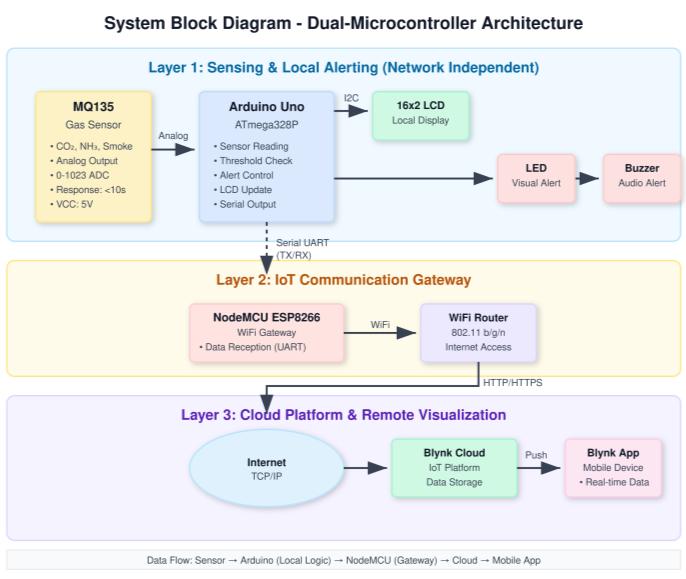
Fig -1: Thesystem's3-layerblockdiagram,showinghow wedecoupledthesensor(Layer1)fromtheIoTgateway
(Layer2).
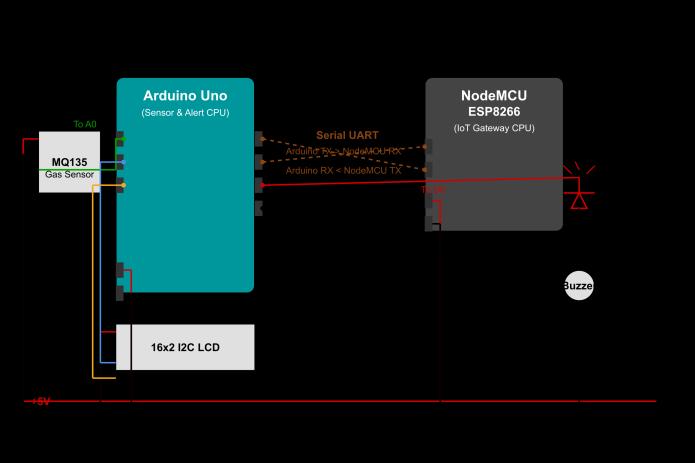
Fig -2: Thecompletecircuitschematicdesigned,showing theUARTconnectionbetweentheArduinoandNodeMCU.
Oursystem'sworkflowisa6-stepprocess(seeFig-1):(1) First, the MQ135 sensor continuously samples the air. (2) The Arduino Uno reads this as an analog voltage. (3) The Arduinochecksthevalue,updatestheLCD,andcontrolsthe localalerts.(4)ItthensendsthefinalvalueviaserialUART toNodeMCU;(5)TheNodeMCUgetsthisdata,connectsto WiFi,andtransmitsdatatotheBlynkcloud;(6)Finally,we (theuser)canseethedataviatheBlynkmobileapplication.
Wechoseourcomponentsbasedoncost,availability,and function.Thecompletesystemspecificationsare presentedinTable1.
International Research Journal of Engineering and Technology (IRJET) e-ISSN: 2395-0056
Volume: 12 Issue: 11 | Nov 2025 www.irjet.net p-ISSN: 2395-0072
Table -1: Thelistofcomponentsused,theirmainfunction, andtheircost.
Component
Primary Microcontro ller Arduino UnoR3
pollutant detection MOStype, 10-200ppm CO₂,Analog output, Response: <10s
acquisition &local alerting
IoTGateway NodeMCU ESP8266 WiFi connectivity &cloud communicat ion
Display 16x2
withI2C
ATmega32 8P,16MHz, 6analog inputs,14 digitalI/O
ESP-12E, 802.11 b/g/n, 80MHz, Integrated TCP/IP
data visualization Alphanume ric,I2C interface (SDA/SCL), Backlit
TheMQ135sensorusesatindioxide(SnO₂)semiconducting ceramicItworksbasedonchemoresistivebehavior,where thesensor'sresistancechangesinthepresenceofvarious gases. The sensor exhibits non-linearity, cross-sensitivity, and dependence on temperature and humidity [7]. It providesananalogvoltageoutputrangingfrom0to5volts corresponding to gas concentration, with a fast response time . During testing with incense smoke, the MQ135 exhibitedanaverageresponsetimeof≈80s,consistentwith reportedbehaviorforslow-diffusingsmokeenvironments.
TheArduinoUnoisusedasthededicatedprocessorforall time-criticaljobs:continuousanalog-to-digitalconversion, real-time threshold evaluation, LCD management via I2C protocol,anddigitalcontroloftheLEDandbuzzer.Itstimed execution guarantees uniform sampling rates and alert latency.
The NodeMCU ESP8266 [4] handles internet connectivity, managing serial communication with the Arduino, WiFi authentication,andperiodicdatatransmissiontotheBlynk server. By isolating network operations, the NodeMCU's processingloaddoesnotimpacttheArduino'ssamplingand alert functionality, ensuring local alerts function independentlyofnetworkstatus[3].
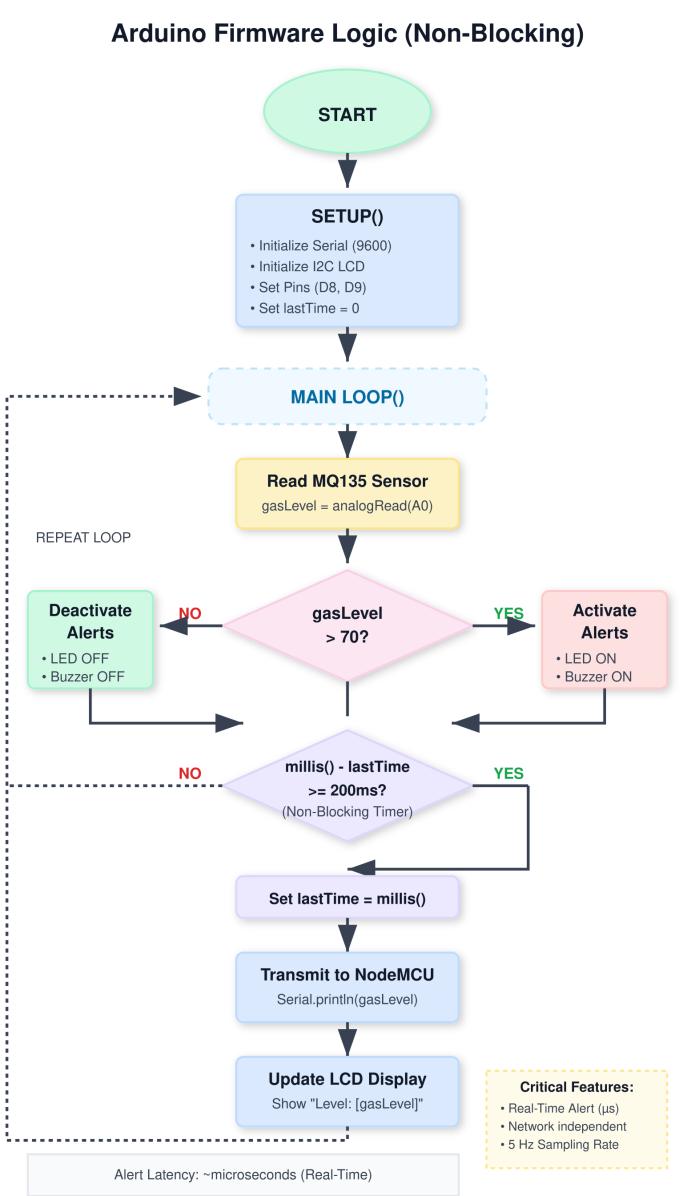
TheArduinocoderunsacontinuousmonitoringloop.Inthe setup()function,weconfigureserialcommunicationat9600 baud, initializes the I2C LCD, and configure digital output pins for the LED at D8 and buzzer at D9. The main loop() functiondoesthefollowing:(1)Readtheanalogvaluefrom theMQ135connectedtopinA0;(2)Transmitthereadingto theNodeMCUviaSerial.println;(3)UpdatetheLCDdisplay; (4)EvaluatethethresholdconditionwheregasLevelexceeds 70; (5) If exceeded, activate the LED to HIGH state and buzzer with pulsating pattern; (6) If below threshold, deactivateallalerts toLOWstate;(7) Wecontroltheloop usinganon-blockingtimerbypollingthemillis()function. Thisensuresthemainloopneverstops.
International Research Journal of Engineering and Technology (IRJET) e-ISSN: 2395-0056
Volume: 12 Issue: 11 | Nov 2025 www.irjet.net p-ISSN: 2395-0072
TheMQ135givesananalogvoltage,andtheArduino'sADC turnsthisintoanumberfrom0to1023.Thisisjustaraw ADCnumber;itisnotastandardairqualitymetric.Wemade akeydecisionhere:wedidnottrytoconvertthisrawvalue toPPMoranofficialAirQualityIndex(AQI)[13].Todothat, we would need to calibrate our sensor against lab-grade equipment.Withoutthatcalibration,tryingtoguessthePPM isnotscientificallyvalid.Becauseofthis,oursystemworks asa"relative"airqualityindicator.Basedonourowntests, wecreatedasimplescalerelativeairqualityindicator.Based on empirical testing, ADC readings were qualitatively interpreted:0to30indicatescleanairconditions,30to50 indicates normal indoor air quality, 50 to 70 indicates elevated levels, and values exceeding 70 indicate poor air
qualityrequiringattention.Thisscalegivespeopleauseful warning,butwedonotclaimithasquantitativeprecision.
Thealertthresholdof70ADCunitsissetbasedonourown tests.Thesystem'sbaselineinacleanoutdoorenvironment averaged 18 ADC units. Typical indoor environments averaged 35 ADC units. We chose the 70 ADC threshold because it provides a substantial margin above normal conditions, approximately twice the indoor average, and reliablydetectsmoderatepollutioneventswithoutexcessive false alarms. While this may correspond to manufacturer estimatesformoderatecarbondioxideorsmokelevels[8], we must emphasize that this is an empirical, not a quantitative,threshold.
TheNodeMCU'scodeissimplerbecauseitonlyfocuseson networktasks.WewroteittoconnecttoourlocalWiFiand makeasecureconnectiontotheBlynkserver.Itspendsall its time listening for data from the Arduino. When a new readingcomesin,thatdataispushedtotwovirtualpinson ourBlynkdashboard:V0forthenumber,andV1forthealert light,tomirrorthelocalalertstatusonthemobileinterface.
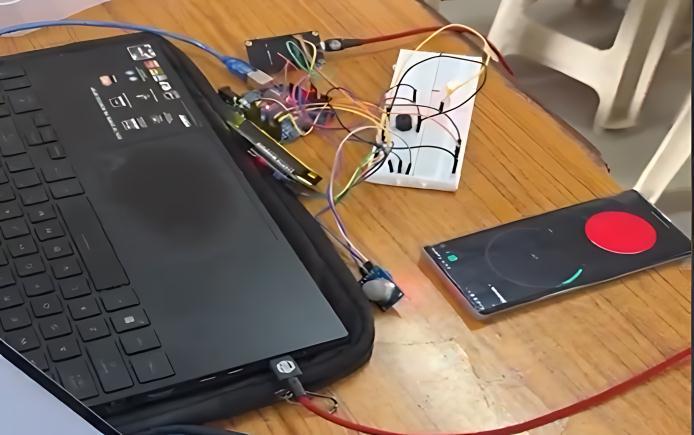
Tovalidateperformance,weranastructuredtest.thetest weresetupinacontrolledindoorroom.Ourprotocolhad5 steps: (1) A 15-minute baseline recording phase; (2) A pollutionintroductionphaseattimeequals15minutesusing anincensestick;(3)Aresponsephasetoobservedetection andalertactivation;(4)Arecoveryphaseattimeequals20 minutes after removing the source; (5) Repeatability assessmentacrossthreetrials.
International Research
Volume: 12 Issue: 11 | Nov 2025 www.irjet.net p-ISSN: 2395-0072
Whilethesystemwasinanactivealertstate(ADC>70),the Wi-FiaccesspointconnectedtotheNodeMCUmodulewas intentionallypowereddowntosimulateanetworkoutage. Thetestwasconducted4times,eachlastingfiveminutes. During thisperiod,theArduinoUnocontinueditssensing andalert-controlloop,whiletheNodeMCUexperiencedloss of connection to the Blynk cloud server. System behavior, including LED and buzzer operation, serial-monitor readings, and post-reconnection status, was recorded to verifythatlocalalertfunctionalityremainedunaffectedby thelossofnetworkconnectivity.
Our system showed consistent and reliable performance. TheaveragedquantitativeresultsarepresentedinTable2.
Table -1: Measuredperformancemetricsoftheprototype (meanofn=3trials).Computationallatencyreferstolocal codeexecutiontimeafterthresholddetection,measuredin milliseconds,whileend-to-endlatencyreferstothephysical timefrompollutantintroductiontoalertactivation. Performance
Data
Alertactivation (computational)
Sampling
Interval(loop)
<1ms(code / digitalWrite() aftersample) n/a (negligible) nota sensor metric
FalseAlarm Rate Nofalse alarms
observed(n= 3)
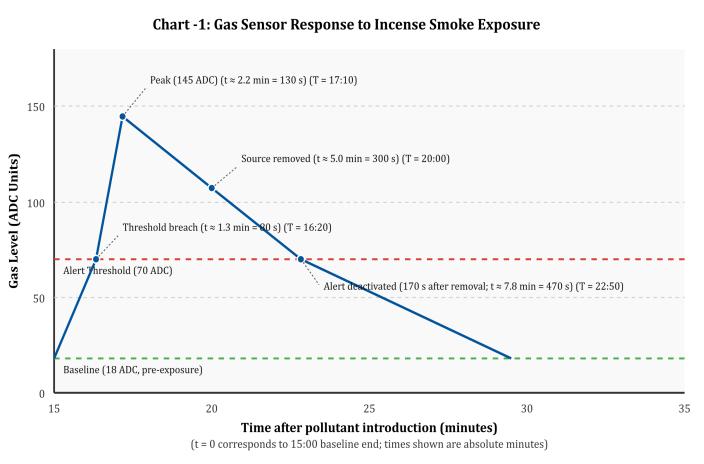
Chart -1: Timeshownrelativetothestartofpollutant introduction(t=0at15:00).Valuesinchartareabsolute minutes;keyeventtimesarealsogiveninsecondsin annotations Baseline=18ADC,Threshold=70ADC,Peak =145ADC,andRecovery≈870s(14.5min).
Theprototypemaintainedaclean-airbaselineofabout18 ADCunitswithasmalldeviationof±2units.Afterincense smoke exposure, the sensor output crossed the alert thresholdat≈80seconds(±18s),peakednear145ADCat≈ 130 seconds, and returned to baseline about 870 seconds (14.5min)afterthesourcewasremoved.Alertdeactivation occurredroughly170seconds(±22s)aftersourceremoval, consistentwiththeexpecteddiffusion-recoveryprofileofthe MQ135sensor.
The microcontroller reacted almost instantly once the threshold was reached, requiring less than 1 ms for code execution.Withasamplingloopof200ms,theend-to-end alert latency effectively matched the sensor’s physical responsetime.Acrossthreediffusiontrials,nofalsealarms wereobserved,allWi-Fipacketsweredeliveredsuccessfully, and the cloud dashboard updated within about 1.2 ± 0.3 secondsoflocalalertactivation.
Overall,thedataconfirmthatsystemdelayisdominatedby the sensor’s adsorption–desorption dynamics rather than processing time. The close agreement between repeated measurements and the plotted curve in Chart 1 indicates consistent time behavior and stable operation of both sensing and communication layers under the tested
Volume: 12 Issue: 11 | Nov 2025 www.irjet.net p-ISSN: 2395-0072
conditions. The MQ135 outputwas observedimmediately afterpower-upwithoutlong-termstabilization;hence,the timingdatareflectrelativesignalbehaviorduringdiffusion tests,notcalibratedgasresponseconstants.
When the Wi-Fi access point was switched off during an activealert,theNodeMCUimmediatelylostconnectiontothe Blynk server and paused data transmission. However, the Arduino-controlledLEDandbuzzerremainedactiveforthe entirefive-minutedisconnectioninterval,followingthesame on/offpatterndeterminedbythelocalthresholdlogic.The ADC readings continued to update on the serial monitor without interruption, confirming that sensing and alert control were fully autonomous of the network link. Upon restoringWi-Fi,theNodeMCUautomaticallyre-established connectionandresumeddatauploadswithoutrequiringa systemreset.Theseresultsverifythatthealertsubsystem operates independently of cloud connectivity and that networkinterruptionsdonotaffectlocalresponsetimingor reliability.
Results confirm the prototype achieves all research objectives, showing a functional end-to-end data pipeline. Themainstrengthofourdesignisitsvalidatedarchitectural design. he decision to implement a decoupled, dualmicrocontrollerarchitecturewasexperimentallyevaluated; results show the local alert logic executes with negligible computationallatency(microseconds–milliseconds),while the end-to-end detection time is dominated by sensor response, far exceeding the 200ms latency of a simpler delay()-based system. This addresses a critical safety concern prevalent in single-microcontroller implementations, where network operations can compromisealertintegrity[9].
Acomparativesummarywithrelatedprojectsispresented in Table 3. Where the cited works do not report numeric sensor threshold times, the table notes ‘Not reported’; for professional systems using laser PM sensors we cite the sensordatasheetfortypicalresponsetimes. Thedual-microcontrollerdesignprovidesclearadvantages oversingle-microcontrollerimplementations[6],primarily ensuring dependable local alert operation independent of network status [3].This functional isolation also ensures consistent sampling intervals and provides fault containment.
Table -2: Ourcomparisonofthissystemwithother projects.
Feature Propose d System
Architecture
Primary Sensors
Muhd Zain [6]
Dual MCU (Arduino + ESP8266 )
MQ135 (MOS Multigas)
SingleMCU (ESP8266)
MQ135(MOS Multi-gas)
Bobulski [5]
Arduino Mega+ Raspberry Pi4
Calibrated PM,CO₂, VOC
Local Display 16×2 LCDI2C None 7-inch Touchscree n
Alert
Independenc e Yes, local alerts operate network -free No,clouddependent Yes
Data Representati on Raw ADC01023 PPMbasic conversion Calibrated μg/m³
Measured Response
Target Application
≈80s (meanof 3 incense trials)
Educatio n, Citizen Science
Not reported(protot ypeuses NodeMCU+ Blynk;latency notquantified)
Not reported (usesPM sensorand securedata transmissio n;no numeric threshold timegiven)
Home monitoring Professiona lResearch
Oursystemisabout80%cheaperthanprofessional-grade systems [5]; however, the end-to-end detection time is dominatedbysensorphysics(≈80sinourincensediffusion trials),whereasprofessionalsystemsusecalibratedlaserPM sensors whose datasheets indicate response times on the orderofseconds(e.g.,PlantowerPMSseries,single/instant update~1s;totalresponse<10s).ThecomparisoninTable
International Research Journal of Engineering and Technology (IRJET) e-ISSN: 2395-0056
Volume: 12 Issue: 11 | Nov 2025 www.irjet.net p-ISSN: 2395-0072
3thereforereportsthesensorthreshold-breachresponsefor eachsystemornotes‘Notreported’wheretheoriginalpaper givesnonumericvalue.
The main limitation of the prototype is the uncalibrated MQ135sensor:thedeviceshouldbeconsidereda relative indicator. Section 4.2 discusses cross-sensitivity and environmental drift impacting absolute accuracy, and its ADCreadingsaresubjecttocross-sensitivityfromvarious gases,aswellasenvironmentaldriftfromtemperatureand humidity [7]. Inter-unit variability and sensor aging also meanthe70ADCthresholdisempiricalandwouldrequire re-characterizationforeachdeviceorlong-termdeployment. Therefore,oursystemisbestusedforawarenessandalert applications,notforscientificormedical-gradequantitative measurement, which remains a key area for future work throughco-locationcalibration[13].
The MQ135 sensor provides qualitative readings that indicaterelativegaspresencebutcannotyieldstandardized concentrations without calibration using reference instruments. The 70 ADC alert threshold in this work is empirical and used only to evaluate system response. Accordingly,theexperimentsvalidatesystemarchitecture, timing, and alert reliability rather than absolute pollutant accuracy
The MQ135 sensor was operated without an extended preheating or calibration phase; therefore, the absolute readingsandtimingcurvesmayincludeinitialdrifteffects. These data are interpreted qualitatively to assess system responsivenessratherthantocharacterizesensorkinetics.
Evenwiththeselimitations,oursystemisstillveryuseful. The tests confirm it is a good fit for places where cost mattersmorethanperfectaccuracy.Forexample,itisgreat for education and STEM projects, showing real-time environmental feedback and illustrating IoT design principlesthroughhands-onprototyping.Thesystemcanbe deployedinhousehold environmentstodetectventilation deficiencies and cooking-related pollutant buildup. Communitygroupscoulduseourdesigntodeploymultiple low-cost nodes for comparative neighborhood mapping, identifyingpollutionhotspotsthroughrelativedifferences rather than absolute measurements. Small workplace environments including workshops, storage areas, and parking garages can use the system as preliminary screening,triggeringventilationwhensignificantdeviations frombaselineoccur.
Themostimportantnextstepistocalibratethesensor.We would like to do this by co-locating it with certified regulatory monitors, this would let us the use of machine learning models to convert raw data into calibrated measurements[4].Wecouldalsoaddmoresensors(likea PM2.5sensor)[12]andmigrating intelligence to the edge usingTinyMLframeworksforon-devicecalibration[13].
A low-cost dual-microcontroller IoT prototype was developedandtested;thefunctionalisolationofsensingand networking preserves local alerts during network interruptions. The prototype demonstrates architecturelevelrobustnessforawarenessapplications,thoughabsolute pollutantquantificationrequirescalibration.TheArduinobasedcontrollerdemonstratedreal-timereaction(<1ms) oncethesensorthresholdwassampled,whileoverallalert latency was dominated by the MQ135 sensor’s ≈ 80 s responsetodiffusiveincenseexposure.Peakreadingsof145 ADC and a 14.5-minute recovery were consistent across three trials. The system showed no false alarms and maintainedfunctionduringWi-Fidisconnections.Although not calibrated for absolute pollutant concentrations, the prototype validates the benefit of functional isolation between sensing and network tasks and serves as an accessibleeducationalandcitizen-sciencetoolforlocalairquality awareness. Future work will focus on sensor calibrationandintegrationofmulti-gasmodulestoimprove quantitativefidelity.
Thepresentedsystemdemonstratesthefeasibilityofadualmicrocontroller IoT architecture that maintains alert autonomy under network outages. Although the MQ135 sensorlimitstheprecision ofmeasuredvalues,thedesign successfully validates the real-time responsiveness, reliability,andcost-effectivenessoftheproposedapproach for educational and awareness-oriented air-quality monitoring.
We acknowledge Vishwakarma Institute of Technology, Pune, for providing laboratory facilities and technical resources.OurspecialgratitudetoProf.SayaliShinde,Dept. of Computer Science and Engineering (Data Science), VIT Pune and Prof. Pradnya Kolekar, VIT Pune for valuable guidanceandcontinuoussupportthroughoutthisproject.
[1] A.L.Clements, W.G.Griswold,A.Rs,J. Johnson, M. M. Herting, J. Thorson, A. Collider-Oxandale, and M. Hannigan,"Low-costairqualitymonitoringtools:From
International Research Journal of Engineering and Technology (IRJET) e-ISSN: 2395-0056
researchto practice(A workshopsummary)," Sensors, vol.17,no.12,p.2685,2017.
[2] L. Morawska, P. K. Thai, X. Liu, A. Asumadu-Sakyi, G. Ayoko,A.Bartonova,A.Bedini,F.Chai,B.Christensen,M. Dunbabin,andJ.Gao,"Applicationsoflow-costsensing technologies for air quality monitoring and exposure assessment: How far have they gone?," Environment International,vol.116,pp.286-299,2018.
[3]L.Spinelle,M.Gerboles,M.G.Villani,M.Aleixandre,and F.Bonavitacola,"Fieldcalibrationofaclusteroflow-cost available sensors for air quality monitoring. Part A: Ozoneandnitrogendioxide," SensorsandActuatorsB: Chemical,vol.215,pp.249-257,2015.
[4]P.Zimmerman,N.Peredkov,J.Abdelnour-Nocera,andS. ClelandWoods,"Advancinglow-costairqualitymonitor calibration with machine learning methods," EnvironmentalScience&Technology,vol.58,no.10,pp. 4567-4578,2024.
[5] J. Bobulski, S. Szymoniak, and K. Pasternak, "An IoT system for air pollution monitoring with safe data transmission,"Sensors,vol.24,no.2,p.445,2024.
[6] N. Muhd Zain, M. Othman, M. A. R. Mohd Rozi, and Z. Paidi, "The development of an IoT-based air quality monitoringsystemusingtheBlynkapplication,"Journal ofComputingResearchandInnovation,vol.9,no.1,pp. 157-166,2024.
[7] C. Aleixandre and M. Gerboles, "Review of small commercialsensorsforindicativemonitoringofambient gas,"ChemicalEngineeringTransactions,vol.30,pp.169174,2012.
[8] D. H. Tsujita, T. Ishida, and T. Moriizumi, "Metal oxide semiconductorgassensorsforairqualitymonitoring,"in Proc.IEEESensors,2004,pp.1383-1386.
[9]R.Williams,V.Kilaru,E.Snyder,A.Kaufman,T.Dye,A. Rutter,A.Russell,andH.Hafner,"Airsensorguidebook," US Environmental Protection Agency, Washington, DC, EPA/600/R-14/159,2014.
[10] X. Xie, I. Semanjski, S. Gautama, E. Tsiligianni, N. Deligiannis, and W. Philips, "A review of urban air pollutionmonitoringandexposureassessmentmethods," ISPRSInternationalJournalofGeo-Information,vol.6,no. 12,p.389,2017.
[11] Badura, M., et al. (2020), “Evaluation of low-cost sensorsforambientairmonitoring,”Atmosphere,11(2).
[12]M.Mead,O.A.Popoola,G.B.Stewart,P.Landshoff,M. Calleja, M. Hayes, J. J. Baldovi, M. W. McLeod, T. F. Hodgson, J. Dicks, and A. Lewis, "The use of electrochemicalsensorsformonitoringurbanairquality in low-cost, high-density networks," Atmospheric Environment,vol.70,pp.186-203,2013.
[13] K. Ashton (2022), “The Internet of Things: Principles andapplications,”IEEEPotentials,41(3).
[14]Y.Wang,J.Li,H.Jing,Q.Zhang,J.Jiang,andP.Biswas, "Laboratoryevaluationandcalibrationofthreelow-cost particle sensors for particulate matter measurement," AerosolScienceandTechnology,vol.49,no.11,pp.10631077,2015.
[15] T. Athira, T. Jilesh, and A. S. Kumar, "A review of machine learning models for predicting air quality in urban areas," Atmospheric Pollution Research, vol. 13, no.4,p.101342,2022.
[16]D.ZhangandS.S.Woo,"Real-timelocalizedairquality monitoringandpredictionthroughmobileandfixedIoT sensingnetwork,"IEEEAccess,vol.8,pp.89584-89594, 2020.
[17] Liu et al. (2023), “Edge computing resilience for IoT systems,”IEEEInternetofThingsJournal,vol.10,no.2.
Volume: 12 Issue: 11 | Nov 2025 www.irjet.net p-ISSN: 2395-0072 © 2025, IRJET | Impact Factor value: 8.315 | ISO 9001:2008