
International Research Journal of Engineering and Technology (IRJET) e-ISSN: 2395-0056
Volume: 12 Issue: 10 | Oct 2025 www.irjet.net p-ISSN: 2395-0072
International Research Journal of Engineering and Technology (IRJET) e-ISSN: 2395-0056
Volume: 12 Issue: 10 | Oct 2025 www.irjet.net p-ISSN: 2395-0072
Diaeldin Izeldin Mohamed1 , Dr. Sally D. Abualgasim2 , Dr. Yasir Abdelgadir Mohamed3
1 University of Gezira, Faculty of Engineering and Technology, Wad-Medani, Sudan
2 University of Gezira, Faculty of Engineering and Technology, Wad-Medani, Sudan
3 A’Sharqiyah University, College of Business Administration/MIS, Ibra, Oman
Abstract –
As Internet of Things (IoT) ecosystems expand across distributed and heterogeneous environments, ensuring finegrained, adaptive, and context-aware access control has become essential for maintaining trust, confidentiality, and resilience.Thispaperpresentsacomprehensiveaccess-control framework that integrates environment analysis, dynamic policy enforcement, and defense-in-depth strategies to safeguardIoTresourcesfrombothconventionalandemerging threats. The proposed model is bult upon classical accesscontrol principles so as to extend functionality through realtime contextual evaluation, multi-layer firewall integration, and adaptive authorization mechanisms. Virtualization and policy-driven automationenable multi-domain deployments, decision accuracy, and administrative efficiency. ExperimentalvalidationinasimulatedIoTenvironmentshows that the proposed solution managed to reduce unauthorized activities, similarly, offers low access latency, and improves dependability over current IoT access-control techniques. Furthermore, the results confirm the framework’s scalability and its ability to dynamically adjust to evolving network conditionsandthreatlandscapes.Thisstudycontributeswith a practical and extensible solution so as to secure IoT infrastructures while providing a foundation for future research in intelligent and self-adapting access-control architectures.
Keywords: Internet of Things, Access Control, Dynamic Authorization,Context-AwareSecurity,DistributedResources.
The Internet is rapidly evolving from a communication medium connecting human users into a globally interconnectedecosystemofintelligentdevices[1].Rather than functioning as a static network of terminals, future architectures will comprise pervasive systems of sensors, actuators, and embedded electronic components that collectively form the Internet of Things (IoT) [1]. These devices, seamlessly integrated into everyday objects and environments,enablingcontinuousinteractionbetweenthe physicalanddigitalrealms,andsupportingawiderangeof applicationsinmanyareas,suchashealthcare,industry,and smart cities. However, this transformation introduces
substantial security and privacy challenges. A lot of IoT nodesarethoughttoberesource-constrained,whichmeans theymaynothavethecomputingpowerorstoragespaceso as to employ standard encryption and authentication methods [2]. Furthermore, the extreme heterogeneity of devices,theirdynamicoperatingconditions,andthemassive scale of deployment render traditional access control approaches inadequate for protecting modern IoT infrastructures[3].Theselimitationsdrawtheattentionto thenecessityforacontext-aware,adaptive,andlightweight access-control framework capable of maintaining trust, integrity, and availability in dynamic, distributed environments[4]
SomeofthekeychallengesinsecuringIoTsystemsinclude:
Aconstraineddevicesauthentication[5]
Trust establishment among untrusted components [6],
Detectionofroguenodes[7][8],
Privacyprotectionforuserdata[9],
Intrusiondetection[10],
Dataintegrityandprotection[5],
Accesscontrolindynamic,distributedcontexts[11],
Other issues, such as key management and data aggregation[12]
Access control serves as an essential block of information security,thatisbydefiningandregulatingwhichentitiesare authorizedtoperformspecificactionsonsystemresources, such as devices, data, or services. In the context of the Internet of Things (IoT), access control ensures that only trustedandauthenticatedentitiescaninteractwithdevices or access sensitive information, thereby fostering trust amonginterconnectedparticipantsHowever,toimplement aneffectiveaccesscontrolinIoTenvironmentsiscommonly consideredachallenge,thatisbecauseofthescale,resource limitations, and distributed nature of these systems [13] [14]. IoT networks often encompass thousands of heterogeneous devices with varying computational capabilities, communication protocols, and security
International Research Journal of Engineering and Technology (IRJET) e-ISSN: 2395-0056
Volume: 12 Issue: 10 | Oct 2025 www.irjet.net p-ISSN: 2395-0072
requirements. These constraints limit the feasibility of traditional access control models such as Role-Based Access Control (RBAC) or Attribute-Based Access Control (ABAC) which typically rely on centralized policy managementandintensivecomputationalprocessing[13]
Furthermore, delegation of access rights is frequently required in large-scale IoT deployments to maintain operational flexibility and support dynamic interactions amongdevices,users,andservices.Tomanagesuchtypeof delegationsinasecuremanneracrossmultipledomainswill addcomplexity,especiallywhendevicesareintermittently connected or operate autonomously [15] [16]. These challenges highlight the need for frameworks that have lightweight, context-aware, and adaptive access-control featuresandcapableofevaluatingcontextualparametersin adynamicmannersuchasdevicetrustlevels,environmental conditions, and behavioral patterns to ensure secure and resilientIoToperations.
Access control has changed over the recent years, from DiscretionaryAccessControl(DAC)andMandatoryAccess Control (MAC) to Role-Based Access Control (RBAC) and Attribute-Based Access Control (ABAC). Researchers have also explored beyond, to History-Based Access Control (HBAC), Relationship-Based Access Control (ReBAC), and UsageControl(UCON).Butmostofthesemodelsfallshortin dynamic,openIoTenvironments.Forexample,ABAClacks support forprovenancemetadata;RBACsuffersfrom role explosion; UCON introduces ongoing obligations that IoT devicesmaynotsupport.
In large dynamic systems, manual policy management becomesinfeasible.Closedenvironmentsmightmanagethat, but IoT’s open and dynamic setting demands automated, scalableaccesscontrolsolutions[17][18]
The rapid proliferation of Internet of Things (IoT) applicationshasbeenhinderedbypersistentconcernsover trust, privacy, and security. The lack of reliable accesscontrol mechanisms in distributed IoT environments has significantlylimitedusers’confidenceinadoptingIoT-based services. Surveys consistentlyindicatethat a considerable portion of users distrust organizations handling their personalandsensordata,whichinturnslowsthegrowthof IoT ecosystems. This study aims to (1) develop a formal frameworkformodellingaccess-controlentitiesinopenIoT environmentssoastoreducemanualadministrativeefforts, (2)designagenericandadaptivemodeltomitigatesecurity threatsandpresentpolicydefinitioninasimplerway,and (3) implement automated delegation, revocation, and verificationofaccessrightsacrossdistributedcontexts. Rest ofpaperisorganizedasfollows: Section2reviewsrelevant work, Section 3 explains the access-control architecture,
Section 4 implements it, Section 5 analyses experimental findings,andSection6closeswithfutureresearch.
AccesscontrolwithinInternetofThings(IoT)environments hasdrawnanattentionofresearchersasofthegrowingneed for secure and context-aware management of connected devices. The current frameworks generally fall into three main categories: role-based, attribute-based, and contextawaremodels.Role-BasedAccessControl(RBAC)simplifies permissionassignmentbygroupingusersunderpredefined roles [19]; however, it lacks flexibility in dynamic IoT settings where device interactions frequently change. Attribute-Based Access Control (ABAC) extends this flexibility as it incorporates user and environmental attributes into policy decisions [20]. To this point, ABAC systems are computationally intensive and struggle to operateefficientlyonresource-constrainedIoTnodes.
Context-aware access-control frameworks have been introduced so as to overcome the limitations of static models,byintegratingcontextualinformationsuchasdevice location,networkconditions,andbehavioralpatternsinto authorization decisions [21]. While these models improve adaptability, their reliance on predefined contextual parameterslimitstheirresponsivenesstorapidlyevolving securitythreats.
Recent research has also explored hybrid access-control architectureswhichmergecentralizeddecision-makingwith decentralized enforcement [22] [23], with the aim of balancing scalability and performance. Blockchain-based approaches[24][25]havefurtherenhancedtransparency and trust in distributed IoT environments, however, they stillintroducesignificantlatencyandstorageoverheadsthat hinder real-time enforcement. In a similar way, AI-driven access-controlmechanismshaveemergedtosupportthreat detection and anomaly prediction [26]; however, most of theseeffortsfocusontheoreticalframeworksorsmall-scale simulations rather than integrated, enterprise-level implementations.
Despite these advances, a significant gap remains in the integrationofreal-timethreatintelligenceintotheaccesscontroldecisionloop.Mostframeworksoperatereactively evaluating access requests based solely on static policy conditions without leveraging continuous malware analytics or adaptive rule refinement. This limitation restrictstheirabilityto reflectdynamic responsiveness to zero-dayattacksandemergingthreatvectors.
In order to address these deficiencies, this study aims to introduce a framework that integrates aspects such as policy-driven, hybrid access-control framework that combines Cisco Advanced Malware Protection (AMP) for threat analysis, Qualys for vulnerability assessment, Cisco Identity Services Engine (ISE) for dynamic policy
International Research Journal of Engineering and Technology (IRJET) e-ISSN: 2395-0056
Volume: 12 Issue: 10 | Oct 2025 www.irjet.net p-ISSN: 2395-0072
enforcement, and Active Directory (AD) for identity verification.Thisintegrateddesignwillhavethecapabilityto enable real-time synchronization between device posture assessmentandauthorizationdecisions,thus,itbridgesthe gap between static policy enforcement and adaptive, intelligence-drivenaccesscontrol.
3.1 Overview
Thissectionoutlinesthesystematicmethodologywehave adopted so as to design and implement a secure and adaptiveAccessControlFramework(ACF)foropenInternet ofThings(IoT)environment.Theframeworkisbuiltupon the classical access-control architecture, integrating contextualintelligence,defense-in-depthmechanisms,and dynamic policy enforcement. The methodology includes environment analysis, framework feature identification, access control information (ACI) modelling, policy establishment,andmulti-layereddefenseintegration.
3.2 Framework Design Process
1) The research methodology adopts the following structuredmulti-phaseapproach:
a. TheIoTecosystemwasstudiedsoastoidentify distributedresources,communicationchannels,and theheterogeneityofconnecteddevices(e.g.,sensors, gateways,servers).
b. The core features of the proposed framework were derived, emphasizing scalability, adaptability, delegation,andfine-grainedaccesscontrol.
c. Access control entities (for example: initiators, targets, access requests, and contextual attributes) were defined and structured based on the ISO/IEC X.800model.
d. Rule-based and identity-based access control policies were developed for different IoT architectures(service-based,client-based,end-to-end, andcentralized).
2) Layerednetworksecuritycomponents corenetwork security, perimeter security, communication security, andendpointprotection wereincorporatedtomitigate internalandexternalthreats.
TooperationalizetheAccessDecisionFunction(ADF),the framework incorporates a hierarchical decision workflow thatevaluateseachaccessrequestagainstmultiplelayersof policies. As illustrated in Fig -1, the process starts with a preliminarycheckagainstthedefaultaccesscontrolpolicy so as to detect known threats. If no immediate threat is identified, the request is assessed through identity-based
policies and, subsequently, mapped to the appropriate categoryofinitiator(service-based,centralized,client-based, orend-to-end).Eachbranchenforcestailoredaccesscontrol rules,atthetime,thenon-matchingoruntrustedrequests will be by default denied. This flowchart highlights the adaptive nature of the framework, this will ensure both proactive threat mitigation and fine-grained access managementindistributedIoTenvironments.
Theframeworkincorporatestwodefaultpoliciesandfour specialized rule-based policies designed for diverse IoT architectures.
Automatically enforced so that it prevents common attackssuchasIPspoofing,DoS,ICMPflooding,and unauthorizedaccesstounusedports.
Custom-definedforservice-based,client-based,endto-end, and centralized configurations to ensure adaptivesecurityindynamicenvironments.
Updated periodically so as to reflect user-specific privileges and evolving organizational security requirements.
International Research Journal of Engineering and Technology (IRJET) e-ISSN: 2395-0056
Volume: 12 Issue: 10 | Oct 2025 www.irjet.net p-ISSN: 2395-0072
TheACImodelcapturestheessentialattributesfordecisionmaking,classifiedinto:
InitiatorACI:Entityidentifiers,groupaffiliations,and sensitivitymarkings.
TargetACI:Resourceidentifiers,containercontexts, andsecurityclassifications.
Access Request ACI: Operation type, integrity level, anddatasensitivity.
ContextualACI:Real-timeenvironmentaldatasuchas time,location,anddetectedthreats.
Each ACI is bound to its respective entity using cryptographic techniques so as to ensure the authenticity and integrity of exchanged control information, e. The NetworkAccessDevice(NAD)interactswiththeRADIUSand DomainController(DC)toauthenticateandenforceaccess decisions. All ACI exchanges are digitally signed or encapsulatedwithinsecuritytokenstopreventtamperingor replayattacksduringtransmission.
The proposed framework applies a multi-layered defense architecture (Fig -2) that reinforces security across four levels:
Managed by a Domain Controller integrating DNS, authentication,VPN,andcertificateauthorityservices.
Dual-firewall topology employing a Perimeter FirewallHostandZone-BasedFirewallHost,soasto mitigating external attacks and isolating internal networkzones.
All transmissions are protected using AES-128 encryption for service-based communications, VPN tunnellingforclient-basedusers,andIPSec VPN for end-to-endsecurelinks.
Automated endpoint configuration ensures uniform protection,complementedbyoptionaluser-controlled measures such as screen locking and one-time passwords(OTPs).
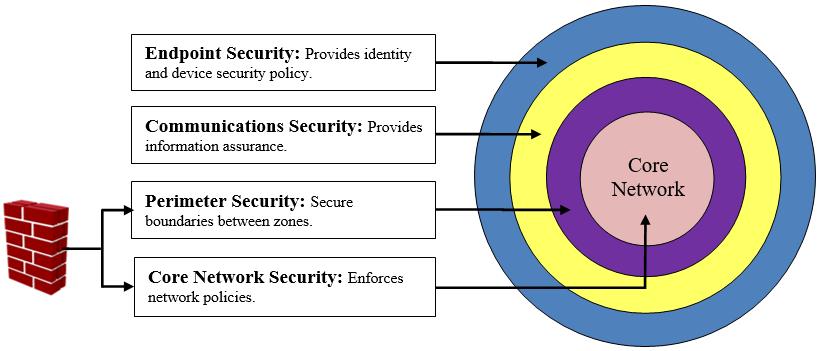
Fig –3 shows the designed Context Authentication and Authorization(CAA)Framework Itwasimplementedusing CiscoIdentityServicesEngine(ISE)integratedwithActive Directory(AD),CiscoAdvancedMalwareProtection(AMP) andQualys-CommonVulnerabilityScoringSystem(QualysCVSS)
TheISEdynamicallyadjustsaccessprivilegesbased oncontextualinputs(deviceposture,location,time, andthreatintelligence).
Real-timedatafromPostureValidationServers(PVS) informsadaptivepolicyenforcement.
Access privileges automatically degrade or elevate dependingonvulnerabilityscore(e.g.,mediumscore vulnerabledeviceresultsinreducedauthority).
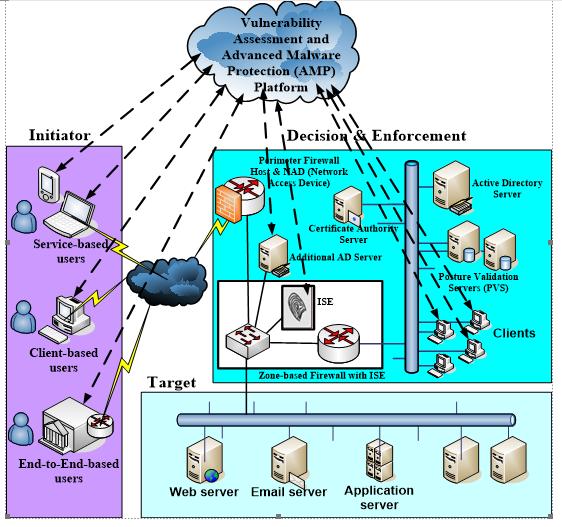
Fig -3: Context-awareaccesscontrolarchitecture integratingISE,AD,andAMP.
International Research Journal of Engineering and Technology (IRJET) e-ISSN: 2395-0056
Volume: 12 Issue: 10 | Oct 2025 www.irjet.net p-ISSN: 2395-0072
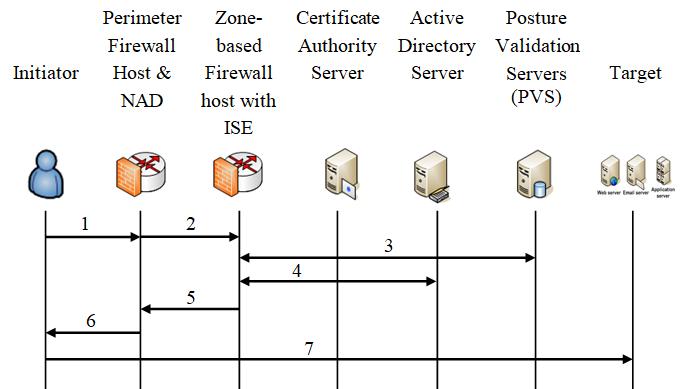
AsillustratedinFig-4,theaccesscontrolsequenceproceeds asfollows:
1) The Initiator submits an access request through the perimeterfirewallhostandNAD.
2) Theperimeterfirewallhostenforcesthedefaultaccess control policies to mitigate most the known security threatsthen,forwardtherequesttotheISE.
3) TheISEretrievescontextualandposturedatafromthe PVS
4) TheISEcommunicateswiththeactivedirectoryserver to validate the initiator’s identity. If it is valid, ISE requeststheinitiator’saccesscontrolinformation(ACI).
5) According to the ACI, policy sets, and the initiator’s healthstate,theISEmakestheaccesscontroldecision andsendittotheNAD.
6) TheNADenforcestheaccesscontroldecisionwiththe initiator.
7) Theinitiatorisallowed/deniedtoaccessthedesignated targetresources.
ISE’s policy evaluation engine processes access requests throughpredefinedpolicysets:
Eachrequestisevaluatedagainstcontextual,identity, andthreat-basedconditions.
If authentication and authorization conditions are satisfied,thentheaccesswillbegranted;otherwise, deniedautomatically.
Policies are modular and reusable, enabling automatedhandlingofnewIoTuserswithoutmanual configuration
Asasummarytothis;theproposedmethodologyprovidesa structuredandscalableapproachtoIoTaccessmanagement bycombiningformalpolicydefinition,contextualadaptation, anddefense-in-depthprotection. Theframework achieves real-timethreat-awaredecision-making,lowadministrative overhead,andstrongresilienceagainstevolvingIoTthreats, thisbyutilizingCiscoISE,AMP,Qualys,andADintegration.
Theproposedaccess-controlframework(Fig-3)was implementedusingahybridsetupcombiningphysical and virtualized components so as to ensure robust, scalable, and secure access management across a distributedIoTenvironment.
A dedicated server acted as the centralized authenticationandpolicyauthority,enforcinguniform security rules and user authentications. This will ensurethatallaccessrequestswereverifiedagainsta unified directory service, thereby minimizing unauthorizedaccess.
Layer-3 Switch as Network Access Device (NAD) is configuredastheAccessEnforcementFunction(AEF), the Layer-3 switch handled routing, switching, and enforcementofaccessdecisionsmadebytheAccess DecisionFunction(ADF).
TheperimeterrouterwasconfiguredasaVPNserver to establish secure tunnels for remote users. It also enforced the first default access-control policy to mitigatethreatsatthenetworkentrypoint.
CiscoISEwasusedastheAccessDecisionFunctionto evaluatereal-timecontextualdataandapplydynamic policies.Itprovidedthreat-centricaccesscontroland centralizedpolicymanagement.
Tensimulatedclientnodeswereusedsoastoemulate userrequestsandtestperformanceunderrealisticIoT networkloads.
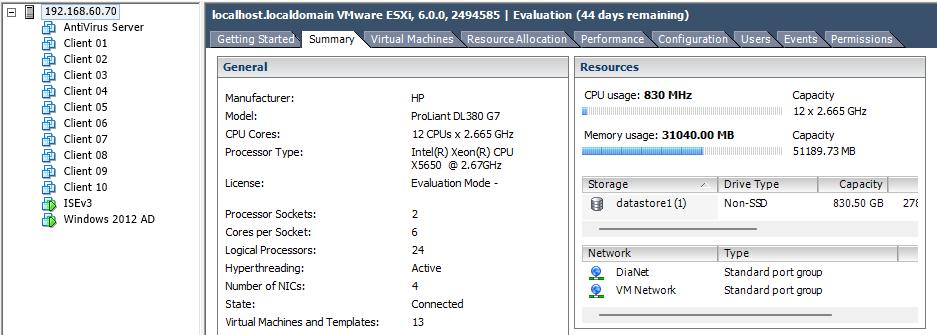
AsshowninFig-5,theimplementationwasperformedina virtualized environment using VMware ESXi 6.0 on an HP ProLiantDL380G7server(12-coreIntel®Xeon®CPU,51 GB RAM). The ESXi hypervisor hosted multiple virtual machines, including Windows Server 2012 (Active Directory)andCiscoISErouters.Thisconfigurationenabled efficientresourcemanagement,rapidreconfiguration,and replicationofcomplexIoTarchitectures.
International Research Journal of Engineering and Technology (IRJET) e-ISSN: 2395-0056
Volume: 12 Issue: 10 | Oct 2025 www.irjet.net p-ISSN: 2395-0072
4.2 Active Directory and Organizational Structure
The domain controller (dia.com) was structured into four Organizational Units (OUs) representing distinct IoT architecturaldomainsasshowninFig-6:
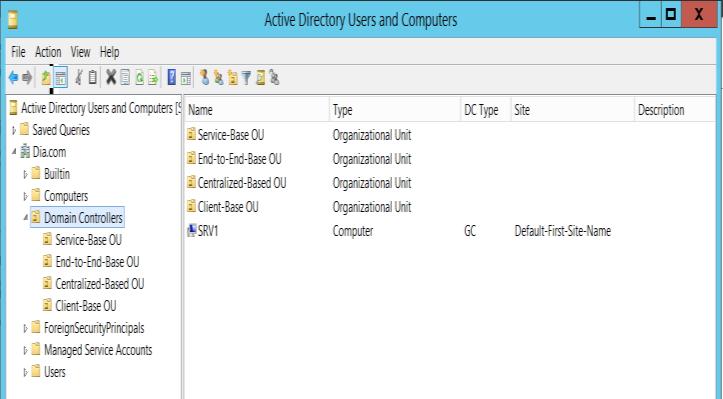
Fig -6: FourOrganizationUnitsthatRepresenttheIoT Architectures
The Service-based OU managing service-oriented devicesandapplications.
End-to-End OU securing full-path device-to-device communications.
CentralizedOUenforcingtop-levelcontrolandunified policymanagement.
Client-based OU isolating end-user devices with tailoredpermissions.
This logical segmentation supported fine-grained policy enforcementandscalabilitysoastoachievedistributedIoT deployments.
4.3 Security Component Configuration
TheCertificateAuthority(CA)ServerConfiguredfor automatic certificate issuance to internal users and manualwebenrollmentforremoteusers.
Authentication Server: Implemented Multi-Factor Authentication (MFA) combining password, token, and biometric validation so as to strengthen user identityassurance.
Cisco Advanced Malware Protection (AMP) and Qualys continuously assessed device integrity and synchronized threat intelligence with ISE for proactivevulnerabilitymanagement.
The ISE server (ISE3.dia.com – 192.168.60.65) was configuredwith:
- Threat-Centric NAC (TC-NAC): real-time access adaptationbasedonthreatseverity.
- Integration of Cisco AMP in conjunction with vulnerabilityassessmenttools(Qualys):third-party validationofendpointhealth.
- ConnectiontoADSource(dia.com):identity-based policyenforcement.
- NetworkAccessDevice(NAD)Configuration:using CiscoSwitch3750forpolicyenforcementasshown inFig-7.
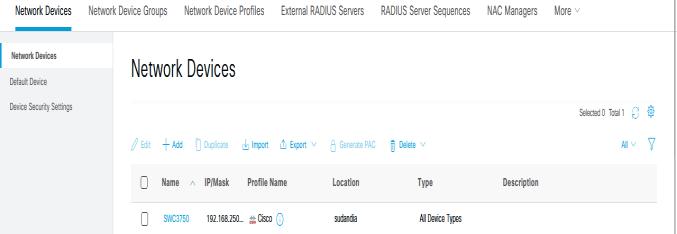
Fig -7: NetworkAccessDevice(NAD)
ISE policy sets were created to define conditions, authentication, and authorization policies for different accesscategories
International Research Journal of Engineering and Technology (IRJET) e-ISSN: 2395-0056
Volume: 12 Issue: 10 | Oct 2025 www.irjet.net p-ISSN: 2395-0072
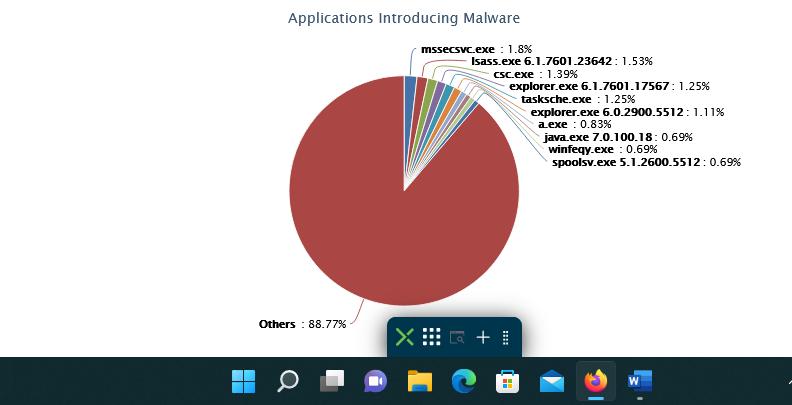
Cisco AMP identified device vulnerabilities, health status, androot-causeanalysesfordetectedthreats.Thesemetrics enhancedvisibilityofendpointcompliance,ensuringup-todatepatchingandanti-malwareintegrity.
AsillustratedinFig-8,thesummaryprovidesanoverviewof the status of client devices within the network. This summaryincludescriticalmetricssuchasthetotalnumber ofclients,thenumberofdevicesthatrequireantivirus(AV) updates, those that need an update for the Cisco AMP connector,andotherrelevantstatuses.
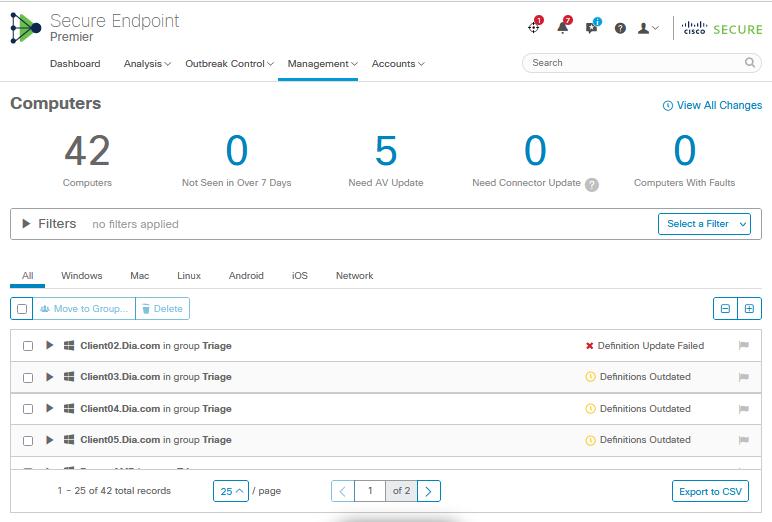
Fig-9showsthethreatsrootcauseanalysis.Thesemetrics offervaluableinsightsintothesecuritycomplianceofclient devices, helping administrators identify and address potentialvulnerabilitiesproactively.
ISE live logs (as shown in Fig -10) recorded detailed the AccessDecisionprocessundervaryingpolicyconditions:
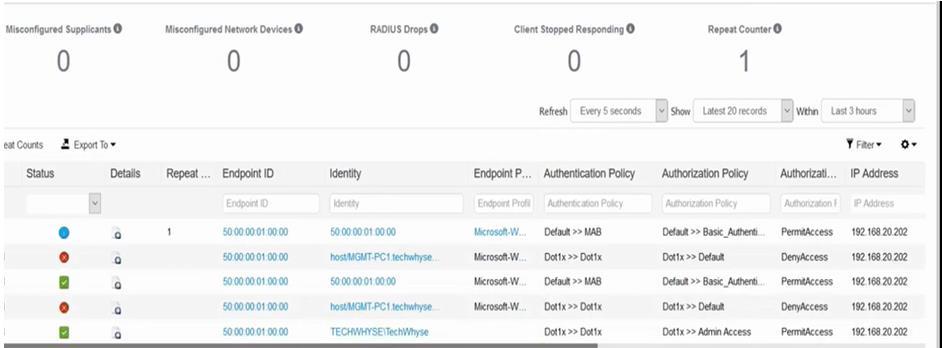
Fig -10: ISElivelogs
AccessGrantedunderDefaultPolicySetusingMAB+ Basic_Authentication.
Access Denied under Dot1x Policy Set requiring stricterIEEE802.1Xauthentication.
Thesefindingsvalidatedthesystem’sabilitysoasto enforcedifferentialpolicydecisionsdynamically.
Theresultsconfirmfullattainmentofthestudy’sobjectives:
a) The proposed model reduced administrative overhead by automating policy definition and accessverification.
b) Integration of ISE and Cisco AMP in conjunction with Qualys achieved real-time contextual enforcement, improving threat response and scalability.
c) Theframeworksuccessfullyautomateddelegation, revocation, and validation of access rights using Qualys-CVSS.
This study presented the design, implementation, and evaluation of a context-aware access control framework tailoredsoastoachievethesegoalsindistributedInternetof Things (IoT) environments. The proposed framework successfullyintegratedcoresecuritycomponents Domain Controller, Cisco Advanced Malware Protection (AMP), Qualys,andCiscoIdentityServicesEngine(ISE) todeliver fine-grained,scalable,andadaptiveaccessmanagement.
Experimental results demonstrated that the framework effectivelymitigatesunauthorizedaccess,streamlinespolicy definition, and automates delegation and revocation in distributed contexts. These outcomes confirm the framework’s ability to balance security robustness with
International Research Journal of Engineering and Technology (IRJET) e-ISSN: 2395-0056
Volume: 12 Issue: 10 | Oct 2025 www.irjet.net p-ISSN: 2395-0072
administrativeefficiency,achievingallresearchobjectives while addressing the dynamic security demands of IoT ecosystems.
Although the framework achieved strong performance within the simulated testbed, scalability and performance underverylargeorheterogeneousIoTenvironmentswere notfullyexplored, butshouldbeconsidered inthefuture. Additionally,real-worlddeploymentareexpectedtoreveal operational and interoperability challenges that extend beyondthecontrolledexperimentalsetup.
Futureresearchshouldfocusonandincorporateevaluating performanceinlarge-scaleandheterogeneousIoTsystems, integrating artificial intelligence and machine learning for predictivethreatdetectionandadaptivepolicygeneration, and testing the framework’s applicability across different industry sectors so as to refine its generalizability and efficiency.
Allinall,theproposedaccess-controlframeworkprovidesa practicalandextensiblefoundationsoastosecuringnextgeneration IoT systems. It highlights the importance of combiningcontextualintelligence,multi-layerdefense,and policy automation to safeguard interconnected environmentswhileminimizingadministrativecomplexity.
[1] J. Gubbi, R. Buyya, S. Marusic, and M. Palaniswami, “Internet of Things (IoT): A Vision, Architectural Elements, and Future Directions,” Future Generation Computer Systems, vol. 29, no. 7, pp. 1645–1660, Sept. 2013,doi:10.1016/j.future.2013.01.010.
[2] O.Garcia-Morchon,S.Kumar,andM.Sethi,“Internetof Things(IoT)Security:StateoftheArtandChallenges,” RFC 8576,Apr.2019,doi:10.17487/RFC8576.
[3] R. Xu, Y. Chen, E. Blasch, and G. Chen, “A Federated Capability-basedAccessControlMechanismforInternet of Things (IoTs),” in Sensors and Systems for Space Applications XI, Proc. SPIE, vol. 10641, 2018, doi: 10.1117/12.2305619.
[4] F. Pereira, R. Correia, P. Pinho, S. I. Lopes, and N. B. Carvalho, “Challenges in Resource-Constrained IoT Devices:EnergyandCommunicationasCriticalSuccess FactorsforFutureIoTDeployment,” Sensors,vol.20,no. 22,art.6420,Nov.2020,doi:10.3390/s20226420.
[5] S.Sicari,A.Rizzardi,L.A.Grieco,andA.Coen-Porisini, “Security, privacy and trust in Internet of Things: The roadahead,” Computer Networks,vol.76,pp.146–164, Jan.2015,doi:10.1016/j.comnet.2014.11.008
[6] S.R.Islam,D.Kwak,M.H.Kabir,M.Hossain,andK.-S. Kwak, “The Internet of Things for Health Care: A
Comprehensive Survey,” IEEE Access, vol. 3, pp. 678–708,2015,doi:10.1109/ACCESS.2015.2437951
[7] M. Ammar, G. Russello, and B. Crispo, “Internet of Things: A survey on the security of IoT frameworks,” JournalofInformationSecurityandApplications,vol.38, pp.8–27,Feb.2018,doi:10.1016/j.jisa.2017.11.002.
[8] R. H. Weber, “Internet of Things – New security and privacy challenges,” Computer Law & Security Review, vol. 26, no. 1, pp. 23–30, Jan. 2010, doi: 10.1016/j.clsr.2009.11.008.
[9] M. Conti, A. Dehghantanha, K. Franke, and S. Watson, “Internet of Things security and forensics: Challenges andopportunities,” FutureGenerationComputerSystems, vol. 78, pp. 544–546, Jan. 2018, doi: 10.1016/j.future.2017.07.060.
[10] Y.Xiao,V.Rayi,B.Sun,X.Du,F.Hu,andM.Galloway,“A survey of security services in IEEE 802.11 wireless networks,” Wireless Communications and Mobile Computing, vol. 12, no. 1, pp. 4–30, Jan. 2012, doi: 10.1002/wcm.975
[11] X. Ma, F. Fang, and X. Wang, “Dynamic Authentication and Granularized Authorization with a Cross-Domain Zero Trust Architecture for Federated Learning in Large-Scale IoT Networks,” arXiv, Jan. 2025. [Online]. Available:https://arxiv.org/abs/2501.03601
[12] K. Srinivas and S. Kadapa, “Secure key management techniques in IoT-enabled wireless sensor networks,” AIP Conference Proceedings, vol. 2971, no. 1, 2024. doi: 10.1063/5.0195860
[13] S. A. Alhoori, “Access Control for IoT: A Survey of Existing Research, Dynamic Policies and Future Directions,” Sensors, vol. 23, no. 4, art. no.1805, Feb. 2023,doi:10.3390/s23041805.
[14] H.Filho,“AComprehensiveSurveyontheRequirements, Applications,andFutureChallengesforAccessControl ModelsinIoT:The StateoftheArt,” MDPI Electronics, vol. 6, no. 1, art. 9, Jan. 2023, doi: 10.3390/electronics6010009.
[15] R. Xu, Y. Chen, E. Blasch, and G. Chen, “A Federated Capability-basedAccessControlMechanismforInternet ofThings(IoTs),” arXivpreprint arXiv:1805.00825,May 2018.(Preprint)
[16] R. Xu, Y. Chen, E. Blasch, and G. Chen, “BlendCAC: A Blockchain-Enabled Decentralized Capability-Based Access Control for IoTs,” Future Generation Computer Systems, vol. 124, pp. 350–364, 2021, doi: 10.1016/j.future.2021.05.011.
International Research Journal of Engineering and Technology (IRJET) e-ISSN: 2395-0056
Volume: 12 Issue: 10 | Oct 2025 www.irjet.net p-ISSN: 2395-0072
[17] S.Alharbi,S.Basudan,andH.Wang,“ASurveyonAccess ControlfortheInternetofThings,” Future Internet,vol. 14,no.6,art.165,Jun.2022,doi:10.3390/fi14060165.
[18] T. Rehman, K. Grønbæk, and M. Abdullah, “Adaptive Context-Aware Access Control for IoT Environments Leveraging Fog Computing,” International Journal of Information Security,2024,doi:10.1007/s10207-02400866-4
[19] A. Ouaddah, A. Abou Elkalam, and A. Ait Ouahman, “AccessControlintheInternetofThings:BigChallenges andNewOpportunities,” Computer Networks,vol.112, pp. 237–262, Jan. 2017, doi: 10.1016/j.comnet.2016.11.003
[20] H. Hu, G.-J. Ahn, and K. Kulkarni, “Anomaly discovery andresolutioninattribute-basedaccesscontrol,” ACM Transactions on Information and System Security (TISSEC), vol. 17, no. 4, pp. 1–41, Apr. 2015, doi: 10.1145/2675131
[21] D. Ouaddah, A. Ait Ouahman, and A. Abou Elkalam, “Towards a Context-Aware Access Control Model for Smart Environments,” Journal of Information Security and Applications, vol. 38, pp. 53–65, Feb. 2018, doi: 10.1016/j.jisa.2017.11.008
[22] O. A. Khashan and N. M. Khafajah, “Efficient hybrid centralized and blockchain-based authentication architectureforheterogeneousIoTsystems,” Journalof King Saud University - Computer and Information Sciences, vol. 35, no. 2, pp. 726–739, Feb. 2023, doi: 10.1016/j.jksuci.2023.01.011.
[23] S.PalandZ.Jadidi,“Protocol-BasedandHybridAccess Control for the IoT: Approaches and Research Opportunities,” Sensors,vol.21,no.20,art.no.6832,Oct. 2021,doi:10.3390/s21206832
[24] M. A. Ferrag, M. Derdour, M. Mukherjee, A. Derhab, L. Maglaras, and H. Janicke, “Blockchain Technologies for the Internet of Things: Research Issues and Challenges,” IEEE Internet of Things Journal,vol.6,no.2,pp.2188–2204, Apr. 2019, doi:10.1109/JIOT.2018.2882794.
[25] S.Cha,J.Kim,andJ.H.Park,“Blockchain-basedAccess Control for IoT: Challenges and Future Directions,”Wireless Communications and Mobile Computing, vol. 2021, Article ID 5521876, doi:10.1155/2021/5521876
[26] R.S.T.Lee,S.M.Zaki,andS.Y.Lee,“AI-DrivenAccess Control and Anomaly Detection in Internet of Things Networks:ASurvey,” IEEETransactionsonNetworkand
ServiceManagement,vol.19,no.3,pp.1736–1751,Sep. 2022,doi:10.1109/TNSM.2022.3189956
2025, IRJET | Impact Factor value: 8.315 | ISO 9001:2008